 |
| Here, I fixed your banner. |
Showing posts with label fssp. Show all posts
Showing posts with label fssp. Show all posts
Monday, July 11, 2016
The Remnant Responds!
I am happy to see that the good folks over at The Remnant have taken my call for intra-traditionalist tolerance seriously and announced the 2016 Catholic Identity Conference. The panel of experts includes priests from both the FSSPX and the FSSP. Don't worry, though: Chris Ferrara will be there to drown out all other conversation that might get nasty.

Sunday, October 12, 2014
Rite of Lyon in Pictures
From 1993, a celebration by the FSSP in Lyon in the presence of the Primate Archbishop, Albert Cardinal Decourtray.
 |
| Reverencing the Primate after the prayers before the altar |
 |
| The subdeacon brings the pax brede to the Primate during the preparation for Communion. Most non-Roman rites used the pax brede to spread the pax during Mass. A rubric does exist for a bishop celebrating a non-Pontifical High Mass to use the brede. |
 |
| The gifts are covered by the corporal, not a pall or chalice veil. This was common during the Middle Ages in northern Europe. |
 |
| Incensing the clergy, Byzantine style with full use of the chain. The Rad Trad knew a Roman M.C. who did this, too. |
 |
| The subdeacon carries the paten with his maniple during the Patern noster, an interesting variation |
 |
| The ablutions |
source: www.fsspwigratzbad.blogspot.com
Wednesday, September 11, 2013
FSSP Priest Caught Celebrating Versus Populum!
 |
| source: fssp.org/photos |
Never mind that it was at St. Clement's in Rome!
Sunday, July 21, 2013
Two Latin Masses in Anglican Churches
 |
| Mass at the tomb of St. Edward the Confessor, King of England |
There have been two, presumably MR1962, Masses of note celebrated at churches owned and operated by the Church of England. The one was at Westminster Abbey (where the Rad Trad once visited, but then left at the outrageous idea of paying £15 to see a church) and the other at Canterbury Cathedral. The former was celebrated by a Benedictine monk and the matter by a FSSP pilgrimage run by the Remnant newspaper.
The Westminster celebration, although a low Mass, was at the tomb of St. Edward the Confessor and intended for his wife, Queen Edith. You can read the particulars here. Aesthetically the Mass is very successful: neo-gothic vestments, no weird emblems on the back, very English altar, and the large candles at the foot of the altar are lit.
The Canterbury Mass was done by an FSSP priest, so as one might expect it was a low Mass, with some chant though, and a fiddleback chasuble. While not exactly "period" the server is wearing a more medieval/English surplice at least. Perhaps I am too distracted by aesthetics. This is not a historical reconstruction, it is an actual Mass. There is a video below.
Sunday, May 12, 2013
Reaction to Fr. Sven Conrad's "Renewal of the Liturgy in the Spirit of Tradition"
I recently had time to read Fr. Sven Conrad, FSSP's article Renewal of the Liturgy in the Spirit of Tradition: Perspectives Towards the Liturgical Development of the West and will give a quick review of it here. Before making any comments, I would like to thank our resuscitated cardinal, Désiré, for linking me to this article some time ago. You may find the article here.
 |
| Fr. Sven Conrad, FSSP source: newliturgicalmovement.org |
Renewal of the Liturgy is essentially comprised of three sections: the first considering the development of the Roman rite over the last millennium, the second tracing the outlook of the reformers of the 1950s and 1960s, and the last segment provides some outlook in thinking about future reforms. Although quoted sparingly, Joseph Ratzinger's liturgy perspective provides the framework for Fr. Conrad to construct a conservative take on Ratzinger's concept of "organic" liturgy development. Implicit in Conrad's article is the thesis that the reforms of the 1950s and 1960s were less than organic in their nature.
Conrad creates a thesis of liturgical development in the first section, broken into three subsections—covering some basic history, hypothesized rules of development, and the Tridentine Council. Conrad establishes the variability of certain prayers of the Mass during the Middle Ages and traces the development of the Curial Missal to St. Gregory VII and Innocent III. The Curial Missal would eventually become the basis of the "Tridentine" Mass of 1570, used in various incarnations until 1969.
More importantly, Conrad sets down two rules of liturgical progression. The first is a historical remark: that local variations in the Latin rite are not matters of chance or corruption, but legitimate variations of the Roman rite, which is of Apostolic origin. The second rule, more Ratzingerian than the first, is that liturgical change and progression is small and most visible in secondary customs (the prayers at the foot of the altar would likely be an example of this). The Carolingian reforms, claims the author, solidified the basic form and orations of the Roman rite, leaving the details to local custom. Liturgical practices in cathedrals and monasteries enriched the spiritual life of Europe. The proper place for development of legislation was in tempering excesses and possible abuses, such as the restrictions the Council of Trent imposed on votive Masses of the Dead.
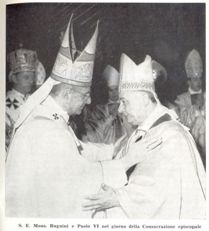 |
| Archbishop Annibale Bugnini with Pope Paul VI source: doctrinaliturgica.com |
With these assumptions in mind, Conrad takes us to Pius XII and Vatican II. Conrad spends a lot of ink of the Memoria of Pius XII's commission for liturgical reform, which the author interprets as a very conservative document, mainly concerned with sorting out the bloated sanctoral cycle in the extant calendar. Although the portion on Vatican II is called the Vatican II Connection, it ought to be titled the Bugnini Connection. An entire subsection is, deservedly, devoted to Archbishop Annibale Bugnini's thought and opinions, as illustrated in his own memoirs. Here Conrad educates the reader with Bugnini's theology of liturgical reform, which assumes the liturgy to be an extension of the ministry of Christ, but then proceeds to devalue the external and the private in favor of the Archbishop's communitarian approach. I spent a good deal of time trying to convince people that the liturgical reform did not appear out of thin air, yet did not approach the theology of the reformers. Conrad gives us some insight I intentionally omitted. Our author then dedicates considerable time to the short-comings of the new rite's premises, like taking parish Mass rather than Pontifical Mass as the presumed liturgical norm, and the blurring of the lines between the lay and ordained that resulted from this idea. The result is a debased, de-ritualized, and un-concentrated liturgy. In many ways, says Conrad, this was the result of the subordination of liturgy to theological pre-conceptions:
"With all respect to the experts and, above all, to the authority of the Church, one cannot avoid the impression that this reform followed fundamentally different guidelines than every preceding liturgical development.... At the same time, we must emphasize a decisive aspect: The Second Vatican Council for the first time in history subordinated the assessment of established rites to a theological premise."
In his last segment, Conrad turns our attention to the ever-enduring question of liturgical reform. He sides with Msgr. Klaus Gamber in wishing that the new and old rites might co-exist for some period of time for the benefit of the new rite:
"The new form should be linked up with it own tradition. In which the old form is a living point of reference and both should reciprocally enrich each other."
Perhaps Fr. Conrad is actually a certain priest whose last name starts with the last letter of the English alphabet....
Moreover, Conrad is optimistic that a more positive view of the Middle Ages will ensure more qualitative reform. In the Middle Ages liturgy was not just a part of life, but it was life.
In the last section, Is Reform Necessary?, Fr. Conrad touches on many points of contention among traditionalists and the reform-of-the-reform movement. Are there too few readings in the 1962 Missal? Should certain things, like the door ceremony on Palm Sunday, be restored? Should the liturgy be a matter of canon law at all? How can the ceremonies of the old rite inspire the Pauline liturgy?
Conrad, understandably, avoids concrete suggestions, but illuminates the wisdom of the eastern rites, which retain the form of their liturgical usages while adapting to the needs of the age, avoiding revolution at the same time.
On to my reaction:
Pros:
- Establishes a thorough framework and retains his principles while considering both the Pian and Pauline attempts at reform.
- Invaluable insight into the mind and fundamental assumptions of Archbishop Annibale Bugnini. At least read the article for this insight.
- Makes a convincing case that the liturgy is neither a matter for theological subjugation nor of positive legislation.
- Admits there are some serious problems in the 1962 liturgy, but did the Pauline reform solve these defects or not?
Cons:
- Is the author genuinely Ratzingerian, or was Benedict XVI just popular when this was written? The theme of organic development, although trendy, may not stand up to historical scrutiny.
- Quiet on the many drastic reforms in the Roman rite that pre-dated the Pauline revision, and which set the stage for it. Perhaps the author wishes to concentrate on the Pauline rite only?
- The last section of the article fell flat when it failed to find anything the Pauline rite could learn from 1962 other than some ceremonial.
Conclusion: this exposition ought to convince any reader of serious flaws in the assumptions of those who instituted the new rites, assumptions which differ in principle from those of previous liturgical reformers and practitioners. The author shies from more exacting analyses or concrete suggestions, either intentionally or because he has constrained himself to Joseph Ratzinger's liturgical ideas. On the whole, a very informative article worth reading, and one that suggests liturgical theology is slowly returning to its proper place after a long exile.
Subscribe to:
Posts (Atom)