Showing posts with label Epiphany. Show all posts

Wednesday, January 4, 2017

Epiphany and Esotericism

“Clouds and darkness are round about him.” (Ps. 96)
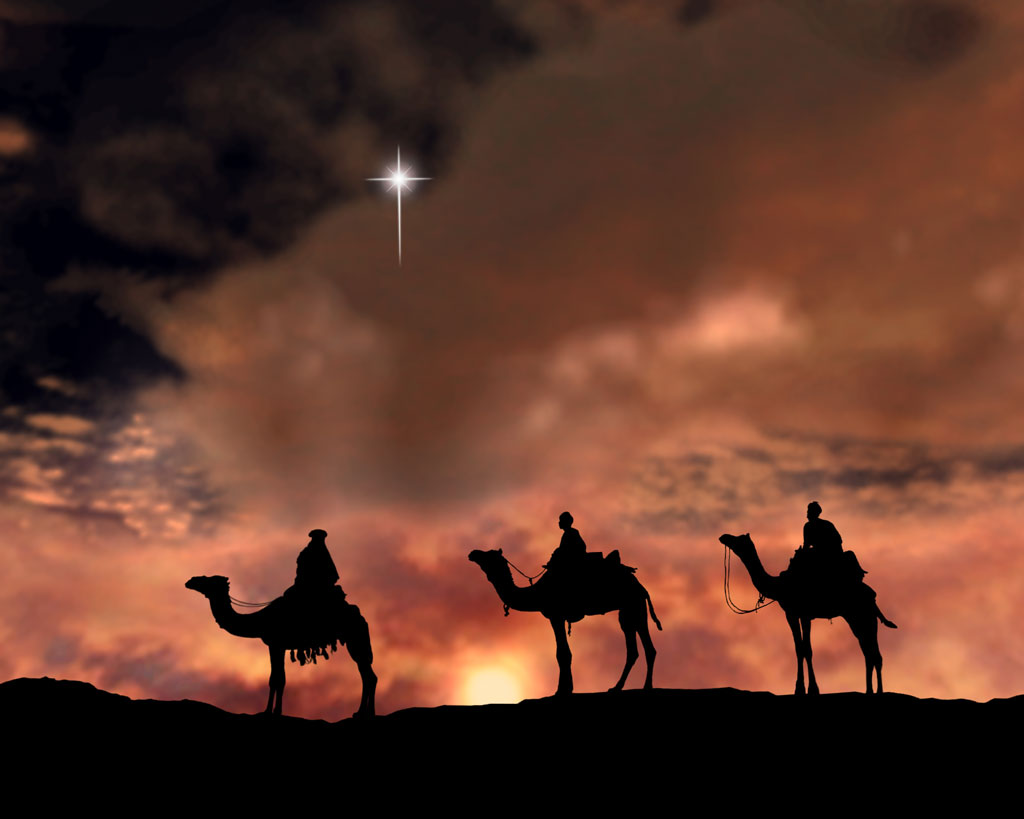
Little is known about the three Magi who visited the Christ Child in Bethlehem. The Western tradition names them Melchior, Caspar, and Balthazar. Some traditions hold that St. Thomas the Apostle baptized the Magi in his oriental journeys, and that they were made bishops of the Catholic Faith. Western iconography eventually began to depict the Magi as being of three different races (European, Asian, and African) to symbolize the three continents, and of three ages (young, middle aged, and elderly) to symbolize the fullness of man’s life; in this respect, the Magi are a synecdoche of man in his natural, pre-Christian state.

The Magi were likely priests of, or otherwise heavily involved in, the religion of Zarathustra, although in spite of their name they may not have been practitioners of magic or sorcery. Certainly they were astrologers in the sense of astronomical philosophers and speculators. The use of the lights of heavens as signs goes all the way back to the Hebrew creation account (Gen. 1.14), pagans though they were. The details of the ancient Chaldean religions are vague and perhaps tainted by the research of much later speculative philosophers, but it bears superficial similarities to many later heresies like Manichæism.

John Senior describes the aspects of Chaldean astrology in The Way Down and Out: “The cosmology of the sacerdotal schools fits the theological order exactly [That is, of the universe as an emanation of the Divine rather than a creation. –J.], the world in fact being a replica of heaven so that everything which happens in the one is reflected in the other. This accounts for the efficacy of astrology and allied forms of divination and of magic” (11). This doctrine of correspondence between Heaven and Earth, and of Man as an image of the universe, is the popular basis of belief in Man as Divine.

“The heavens declared his justice: and all people saw his glory.” (Ps. 96)
The religions of Babylon and Egypt would eventually be sprinkled with Hindoo doctrines and find a nesting place in Greece (through the Orphic mysteries) and later in Rome (in the rites of Mithras), but would also influence various Neoplatonist movements. In a sense, the world has never been rid of Chaldean errors. The theological dualism of Zarathustra provides a theodicy for the emotional insecure and simple-minded. The implied divinity of Man excuses all manner of vices, especially vainglory and lust, for it makes sexual union into a quasi-divine and magical act.

Still, the stink of Babylon lingers, and likely will until the end of time. Its practitioners call theirs the “esoteric” religion, mocking the public, Catholic religion as “exoteric.” The hidden (“occult”) religion is meant for the enlightened few, the public religion for the simple masses. This pride has diminished over time. Senior notes that the esoteric religion exists in the modern day, but not as the fruits of an unbroken tradition:
Because in the West there has been no “tradition” since the Renaissance, the symbolist doctrine has been in the hands of individuals rather than schools, amateurs rather than professionals; and this has led to a kind of esoteric protestantism, to the formation of individual sects, some wise, many foolish. (xiv)
The conversion of the Magi was not a deathblow to what Dr. Senior would later call the “Perennial Heresy,” but it did open an alternative to the temptation of vain curiosity. What the Magi sought were wisdom and enlightenment, and they were true lovers of wisdom (philo-sophia) in ways that those with itching ears are not. The doctrine of correspondence between Heaven and Earth, of Man holding within himself the Divine, came true in the humble city of Bethlehem of Judea. It came true in a way that the Magi could never have predicted, in a way that they would certainly spend their entire lives attempting to understand.

The esoteric had become exoteric—“the light shineth in darkness.” Lovers of obscurity hate the light and “do not comprehend it,” preferring the darkness of the occult. At best they are alchemists intent on improving their own souls; at worst they are sorcerers and worshippers of angels. The esoteric religion remains to be discovered by men restless and intelligent, like a chunk of arctic ice housing a deadly bacteria long thought to be extinct.

Jesus spoke in parables to darken the eyes and block the ears of grievously sinful men, not to prevent the humble and unlearned from entering in to the Kingdom. Some remain blind and deaf, in spite of the epiphaneia of the Gospel. Some wish to remain unenlightened.

“Light is risen to the just, and joy to the right of heart.” (Ps. 96)

Wednesday, January 13, 2016

Epiphany is the Eschaton

(Marten de Vos)
Today's Lauds includes the following antiphon surrounding the Canticle of Zachary:
This day is the Church joined unto the Heavenly Bridegroom, since Christ hath washed away her sins in Jordan; the wise men hasten with gifts to the marriage supper of the King; and they that sit at meat together make merry with water turned into wine. Alleluia.
The eschatological language is clear, especially as the "marriage supper" references the book of the Apocalypse. During Advent, prophetic allusions to the Second Coming are numerous in the Breviary and in Mass readings. Now is the the climax of Christmastide, when the Second Coming mystically occurs, as symbolized in the Gifts of the Magi (the Gentiles entering into the Church; cf. Apoc. xxi.14), the Baptism in the Jordan (cf. the river of the waters of life in Apoc. xxii.1), and the Miracle at Cana (cf. the marriage supper of the Lamb in Apoc. xix.7).

St. Paul uses the Greek word epiphaneia repeatedly to refer to the future Coming of Christ. Epiphany means appearance or manifestation, and every year we celebrate anagogically the Second Coming with the Octave of Epiphany.

Wednesday, January 6, 2016

Reges munera offerent

"Dearly beloved brethren, hear ye from the Gospel lesson how, when the King of heaven was born, the king of earth was troubled? The heights of heaven are opened and the depths of earth are stirred. Let us now consider the question, why, when the Redeemer was born, an angel brought the news to the shepherds of Judea, but a star led the wise men of the East to worship Him. It seemeth as if the Jews as reasonable creatures received a revelation from a reasonable being, that is, an angel, but the Gentiles without, being as brutes, are roused not by a voice, but by a sign, that is, a star. Hence Paul hath it: a sign, not to them that believe, but to them that believe not but prophesying serveth not for them that believe not, but for them which believe. So the prophesying, that is, of the angel was given to them that believed, and the sign to them that believed not.
"Thus also we remark that afterwards the Redeemer was preached among the Gentiles not by Himself, but by His Apostles, even as, when a little Child, He is shown to them, not by the voice of angels, but merely by the vision of a star. When He Himself had begun to speak He was made known to us by speakers, but when He lay silent in the manger, by that silent testimony in heaven. But whether we consider the signs which accompanied His birth or His death, this thing is wonderful, namely, the hardness of heart of the Jews, who would not believe in Him either for prophesying or for miracles.
"All things which He had made, bore witness that their Maker was come. Let me reckon them after the manner of men. The heavens knew that He was God, and sent a star to shine over where He lay. The sea knew it, and bore Him up when He walked upon it. The earth knew it, and quaked when He died. The sun knew it, and was darkened. The rocks and walls knew it, and rent at the hour of His death. Hell knew it, and gave up the dead that were in it. And yet up to this very hour the hearts of the unbelieving Jews will not acknowledge that He to Whom all nature testified is their God, and, being more hardened than the rocks, refuse to be rent by repentance." Pope St. Gregory the Great

To the reader disgruntled at not getting Mattins last time: are you happy?

A blessed Epiphany/Theophany to all! 

Saturday, November 16, 2013

Liturgy and the Eighth Day

Discussion about the Roman liturgy varies in Catholic circles. For most liturgically interested Catholics the debate is between the "EF" and the "OF," or how the "reverence" of the "EF" might improve the "OF," or even how an amalgamated rite could be fostered. Others, the SSPX/FSSP type traditionalists who attend churches not staffed by diocesan priests, contrast the "theology" of the "Traditional Latin Mass" with that of the Mass of Paul VI, praising the emphasis on sacrifice in the former and criticizing the excessive focus on the meal elements of the Eucharist in the latter. Even more radical traditionalists focus on the "pre-1955" Missal, which is most typical editions published, versus the 1962 rite; people in this crowd inevitably dwell on Annibale Bugnini's role in crafting Pius XII's dodgy new Holy Week rites, in some sense inferior to those in the Pauline Missal (regardless of what one may think of the Ordo Missae in the Pauline books). Something neglected in all these discussions is the liturgical year itself and its contributions.

It is safe to say that the older rites, 1962 or 1474, have a more involved liturgical year, with more vigils, the ember days, and richer texts in the Office and at Mass for Advent and Lent than the modern books. But what of another long neglected aspect of the kalendar: octaves.

Octaves merit little attention these day, aside from discussion of the Octave of Pentecost in the 1962 rite, because both the Pauline kalendar and the Johannine kalendar have so few, two and three respectively. Prior to 1955 octaves occupied a very prominent place in the liturgical year of the Roman Church. For well over a thousand years the Church set aside eight day periods for the observation and re-visitation of the mysteries and salvific action of God in His works and in His saints. Most recently we would have finished the octave of All Saints, one of the most recent octaves, on November 8th. So what is an octave and what does it matter?

"In the beginning God created heaven and earth," thus begins the Holy Scripture in the Book of Genesis. On the first day gave began creation, a gradual effort in which He fashioned everything for six days and then, on the seventh day, left it as it was. In light of the Resurrection, which occurred the day after the day of the rest, the Christian sees the eighth day as the beginning of a new creation, which is, in effect, a renewal and a re-vivification of the old creation. As Christ rose from the dead with the same body, but glorified and transformed (Philippians 3:21), so the Christian will at the end of time at the Last Judgment. But this process is not so removed from our current time and current needs.

In Greek, so the Byzantines tell me, the phrase the "Kingdom of God is at hand" (Mark 1:14, Matthew 3:2, Matthew 10:7) does not mean that the end of the world is immanent, but that the Kingdom of God, which was formerly inaccessible, is now immediately accessible, although in a less tangible form than what will be found at the end of time. Christianity, which is a fundamentally liturgical religion, is a fundamentally eschatological religion. What will happen in the end happens to the Christian now. He is joined to events that have happened, such as the Resurrection or the descent of the Holy Spirit at Pentecost, and to things yet to come. In short, the Christian's baptism binds him to mysteries of God that exist outside of time and which will transform the world at the end, at the eschaton. Our participation in the eschaton through baptism on earth necessitates our observation of God's creation and recreation, of the Son's Life and Resurrection in this time. This is what was foreshadowed in the Old Testament for us and what was done in the Roman liturgy in a very complete way until 1955, and in a very reduced way after 1955.

In chapter 23 of Leviticus the Lord establishes the Day of Atonement, the beginning of a seven day cycle of sacrifices for the sins of the people called the "Feast of Tabernacles" or the "Feast of Booths"—called such because the Jews would build booths out of palm branches in which they would live during those seven days. On the eighth day the offering of sacrifices was renewed with greater solemnity (Leviticus 23:36), forming the first octave, a foreshadowing of what was to come on the eighth day many years later. Not only did the Feast of Tabernacles begin on the Sabbath, a day of rest, and end on the Sabbath, a day of rest, but God prohibited servile work on the days between (Leviticus 23:35), extending the penance—or celebration for the Christian—for eighth days.
source: modeoflife.wordpress.com
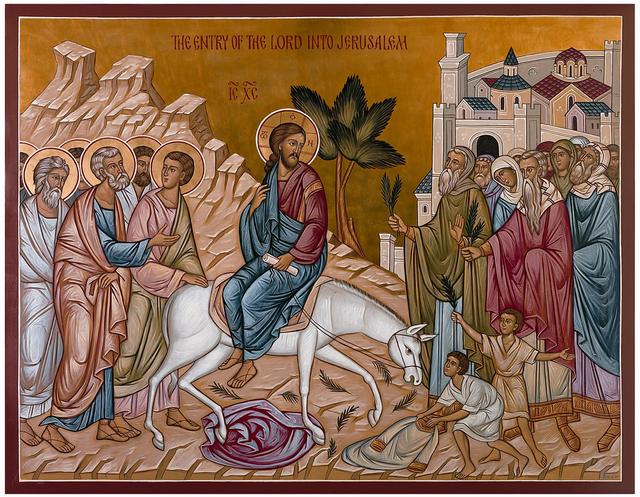
On Palm Sunday, to my view, Christ began the first Christian octave. The Jews often enthroned their king during the Feast of Tabernacles (Danielou Bible and the Liturgy 335). On this day the Jews sang psalm 117, a psalm the Byzantine rite still sings during Communion and which the Roman Mass utilizes on Pascha, which includes that renown word "Hosanna." What did the Jews sing on Palm Sunday? "Hosanna to the Son of David" (Matthew 21:9). What were they doing? Holding branches of palms, as they would during the Feast of Tabernacles (Ibid 21:8). The narrative draws a clear parallel between the coronation of the king and the entrance of Jesus into Jerusalem. The inhabitants were enthroning Him as their new king, Why was the Feast of Tabernacles observed? To remind the Jews of their deliverance. Why did Christ enter Jerusalem? To observe the Passover and to fulfill the true deliverance, deliverance from sin and death. He would "rest" on the seventh day and rise again, in a renewed body, on the eighth day.

In some sense, although not strictly part of the liturgy, the period from Palm Sunday to Low Sunday forms consecutive octaves, the first ending with the new Creation and the second concluding with a greater clarity and invigorated spirit which only adds to that new Creation (Christ giving the Holy Spirit and power to forgive sins to His Apostles in the Upper Room).

As God made the Jewish people do penance and offer sacrifice for their sins for seven days,  creation lasted seven days, and as they redoubled their efforts on the eighth, He renewed creation on the eighth in His Son's Resurrection from the dead. This process of creation, exploration, growth, and renewal is at the heart of Christ's work and, as it exists in time, makes His work accessible to us on earth, for us living in the eschaton terrestrially. The Church observes octaves—and observed even more—precisely for this point.

Many readers will know that Pascha, Christmas, and, in the older rites, Pentecost mandate octave length celebrations. Formerly well over a dozen occasions did so. Among them we see great evidence for the above analysis. St. John the Baptist's Nativity took an octave, the only Saint other than Our Lady whose birthday rather than death day is observed as a feast, suggesting that St. John was born without sin. If so, his own conception, birth, and life are a great act of God's restoration of human nature into its holier form. The same can be said of the Octave of All Saints.

source: glory2godforallthings.com
A more startling example might be Epiphany, a feast of greater importance than Christmas if we are to be theologically honest with ourselves. Why was Epiphany observed as an octave until the last years of Pius XII? What renewal or improvement did it offer on the eighth day? "Epiphany" literally means a "showing" of something, in this case the showing of God in the flesh to Gentiles, a revelation that this Child's work would benefit all men, not exclusively Jewish people. On the eighth day, the octave day of Epiphany, an even greater revelation is shown to us, that of the Holy Trinity. The octave day of Epiphany is the Baptism of the Lord in the Jordan by St. John, wherein the Holy Spirit descended upon the Son and the Father said He was "well pleased" with the Son (John 1:29-34). This was the first direct revelation of the Holy Trinity to mankind, an even greater, but not segregated, revelation than that of Epiphany.

Octaves did not regularly appear during Paschaltide (except for the 19th century feast of St. Joseph), owing to the already Paschal nature of the season, and of course not during Lent. Instead the Church of Rome gave her faithful octaves to observe throughout the rest of the year, particularly during the time after Pentecost, during which the faithful might always recall how the Saints were in themselves new creations (Ss. Peter & Paul, John the Baptist, Lawrence of Rome, the Assumption of Our Lady, the Nativity of Our Lady, and All Saints all occur during the "green" Sunday season).

Yet does not the evidence oppose my eschatological hypothesis? Were these octaves so important and were the eighth day so relevant in liturgical theology surely the Church of Rome would have devised unique Masses for the days within the octaves, as she did for Pascha and Pentecost, rather than repeat the festive Mass again and again. Not so! In older times, outside of monasteries and collegiate churches, Mass would only be observed on Holy Days and Sundays. The repetition of Masses is the consequence of filling in the days between the feast and the nearest Sunday or Sunday and the octave day. Where octaves are truly to be observed is in the Divine Office. The lessons at Mattins would progress through didactic material germane to the mystery at hand for eight days and the antiphons repeated at the major hours would do much the same.  Gregory DiPippo has been doing a fascinating series on the Mattins lessons for the Octave of All Saints in the Roman Curial Breviary which can be read here. The use of the festive office, with shorter psalms and no penitential prayers as would be found on ferial or simple days, contrasted starkly with the almost brutal daily cycle of prayers found in the ferial psalter. Octaves were clearly a time of joy, a period of living out some holy mystery in the present (although some of this was lost in the 1911 re-distribution of the psalter).

Liturgical octaves observe the eighth day of creation, the renewal of creation in the Resurrection of Christ. They make what is distant to us immanent and accessible as Christ's own salvific work made it immanent and accessible to those who had longed for it and observed it in its type for so long. We, on the other end of salvation history, observe its anti-type, its eschaton. For this reason, and for reasons better stated by those more liturgically learned than myself, we should push to re-introduce octaves into the Roman rite for feasts of saints and for feasts of Our Lord's work.

God bless!

Saturday, January 5, 2013

Vigil of the Epiphany of Our Lord


From the Second Sermon on the Epiphany by St. Leo the Great:
Dearly beloved brethren, rejoice in the Lord; again I say, rejoice. But a few days are past since the solemnity of Christ's Birth, and now the glorious light of His Manifestation is breaking upon us. On that day the Virgin brought Him forth, and on this the world knew Him. The Word made Flesh was pleased to reveal Himself by degrees to those for whom He had come. When Jesus was born He was manifested indeed to the believing, but hidden from His enemies. Already indeed the heavens declared the glory of God, and their sound went out into all lands, when the Herald Angels appeared to tell to the shepherds the glad tidings of a Saviour's Birth; and now the guiding star leadeth the wise men to worship Him, that from the rising of the sun to the going down thereof, the Birth of the true King may be known abroad; that through those wise men the kingdoms of the east might learn the great truth, and the Roman empire remain no more in darkness.
The very cruelty of Herod, when he strove to crush at His birth this King Whom he alone feared, was made a blind means to carry out this dispensation of mercy. While the tyrant with horrid guilt sought to slay the little Child he did not know, amid an indiscriminate slaughter of innocents, his infamous act served to spread wider abroad the heaven-told news of the Birth of the Lord. Thus were these glad tidings loudly proclaimed, both by the novelty of their story, and the iniquity of their enemies. Then was the Saviour borne into Egypt, that nation, of a long time hardened in idolatry, might by the mysterious virtue which went out of Him, even when His presence was unknown, be prepared for the saving light so soon to dawn on them, and might receive the Truth as a wanderer even before they had banished falsehood.
Dearly beloved brethren, we recognise in the wise men who came to worship Christ, the first-fruits of that dispensation to the Gentiles wherein we also are called and enlightened. Let us then keep this Feast with grateful hearts, in thanksgiving for our blessed hope, whereof it doth commemorate the dawn. From that worship paid to the new-born Christ is to be dated the entry of us Gentiles upon our heirship of God and co-heirship with Christ. Since that joyful day the Scriptures which testify of Christ have lain open for us as well as for the Jews. Yea, their blindness rejected that Truth, Which, since that day, hath shed Its bright beams upon all nations. Let all observance, then, be paid to this most sacred day, whereon the Author of our salvation was made manifest, and as the wise men fell down and worshipped Him in the manger, so let us fall down and worship Him enthroned Almighty in heaven. As they also opened their treasures and presented unto Him mystic and symbolic gifts, so let us strive to open our hearts to Him, and offer Him from thence some worthy offering.