The few sources I have found on the matter date the octave of Pentecost to around the 800s. Before that, the Sunday of Pentecost coincided with the seasonal ember days, so, given the Baptismal and creation-based character of the feast, it seemed reasonable to extend it over the ember days to each the whole week.
Some of the language in today's collect hints that the ember Mass pre-dates a certain dispute of language....
Mentes nostras, quǽsumus, Dómine, Paráclitus, qui a te procédit, illúminet: et indúcat in omnem, sicut tuus promísit Fílius, veritátem.... Per Dominum nostrum....
Showing posts with label octaves. Show all posts
Showing posts with label octaves. Show all posts
Wednesday, June 7, 2017

Wednesday, April 19, 2017
Paschal Octave Musings: Feast and Fast
 |
| "That bread may be brought forth from the earth and wine that gladdens the heart of man." source: AZcentral |
During the Paschal octave we should rejoice and feast after the fast, the nearest beverage to which is water: satisfying, cleansing, and yet some an occasion for joy unto its own; yet, water followed by wine is a pleasing contrast between nourishment and enrichment. No other substances, however delectable, offer what these two offer the believer.
To development my point and to amuse your minds I have reproduced Gilbert Keith Chesteron's The Song of Right and Wrong below. A blessed Pascha to all!
Feast on wine or fast on water
And your honour shall stand sure,
God Almighty’s son and daughter
He the valiant, she the pure;
If an angel out of heaven
Brings you other things to drink,
Thank him for his kind attentions,
Go and pour them down the sink.Tea is like the East he grows in,
A great yellow Mandarin
With urbanity of manner
And unconsciousness of sin;
All the women, like a harem,
At his pig-tail troop along;
And, like all the East he grows in,
He is Poison when he’s strong.Tea, although an Oriental,
Is a gentleman at least;
Cocoa is a cad and coward,
Cocoa is a vulgar beast,
Cocoa is a dull, disloyal,
Lying, crawling cad and clown,
And may very well be grateful
To the fool that takes him down.As for all the windy waters,
They were rained like tempests down
When good drink had been dishonoured
By the tipplers of the town;
When red wine had brought red ruin
And the death-dance of our times,
Heaven sent us Soda Water
As a torment for our crimes.
Wednesday, January 13, 2016
Epiphany is the Eschaton
 |
| (Marten de Vos) |
This day is the Church joined unto the Heavenly Bridegroom, since Christ hath washed away her sins in Jordan; the wise men hasten with gifts to the marriage supper of the King; and they that sit at meat together make merry with water turned into wine. Alleluia.The eschatological language is clear, especially as the "marriage supper" references the book of the Apocalypse. During Advent, prophetic allusions to the Second Coming are numerous in the Breviary and in Mass readings. Now is the the climax of Christmastide, when the Second Coming mystically occurs, as symbolized in the Gifts of the Magi (the Gentiles entering into the Church; cf. Apoc. xxi.14), the Baptism in the Jordan (cf. the river of the waters of life in Apoc. xxii.1), and the Miracle at Cana (cf. the marriage supper of the Lamb in Apoc. xix.7).
St. Paul uses the Greek word epiphaneia repeatedly to refer to the future Coming of Christ. Epiphany means appearance or manifestation, and every year we celebrate anagogically the Second Coming with the Octave of Epiphany.
Sunday, November 8, 2015
7s and 8s for the Octave of All Saints
 |
| Seven candle laid before the altar in the Leonian Triclinium during the Fourth Lateran Council, Innocent III presiding. |
Seven and Eight occupy a prominence in the Church, both in Holy Writ and in the liturgical life of Christians. While Three arrantly refers to the Holy Trinity and the days before the Resurrrection, and while Twelve recalls the tribes of Israel and the Apostles, Seven and Eight are less immediately obvious and the most inseparable of these numbers, not least because they are sequential in every way.
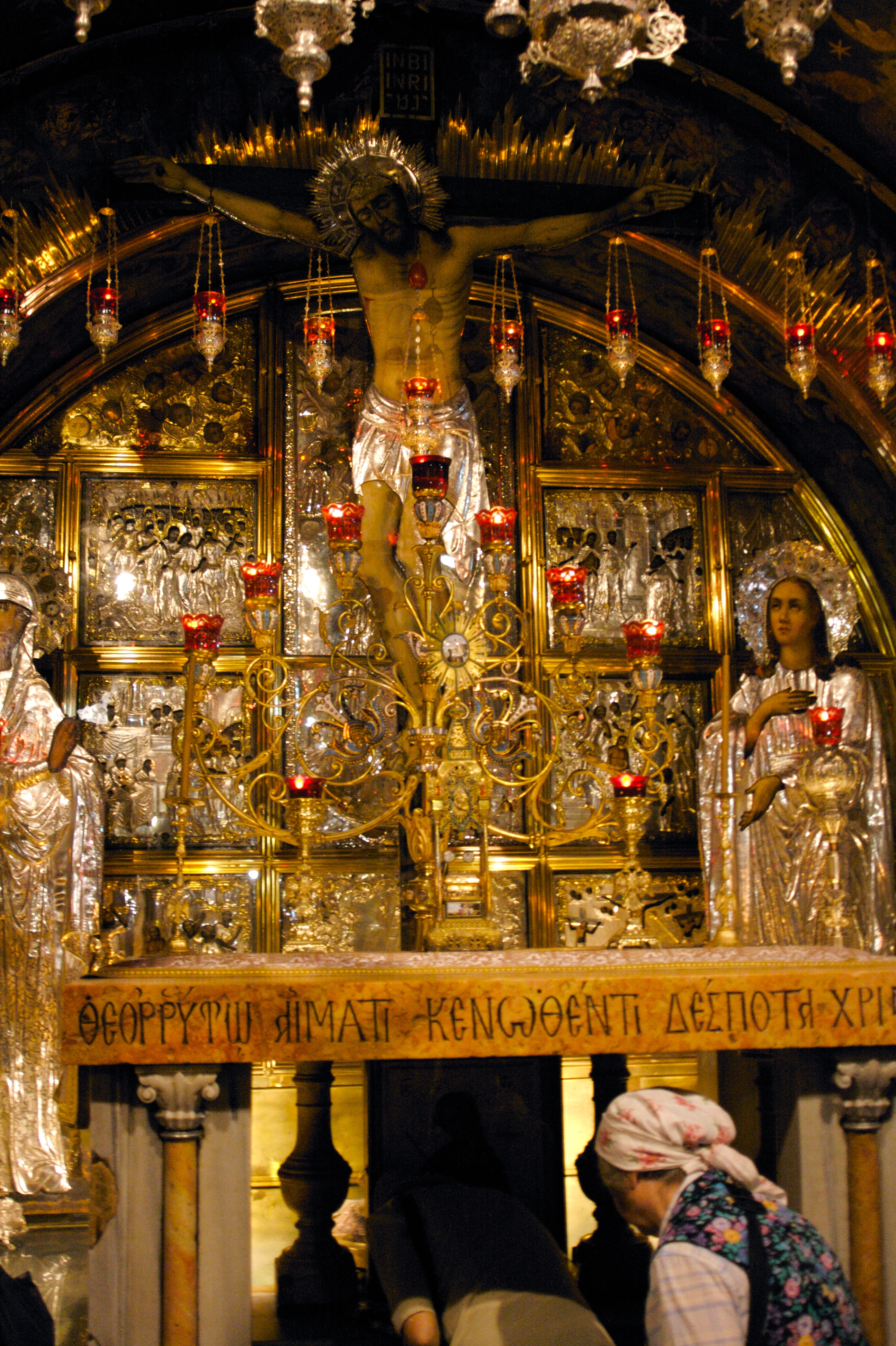 |
| Count 'em: seven on the top. |
Seven is conspicuous throughout the tradition of the Church, being found in Scripture and in the celebration of sacred rites. According to Genesis, God created the world in seven "days," the last of which He did not create anything, but instead rested and sanctified that day by His rest. He dedicated the day to Himself. Seven is also reiterated throughout the Apocalypse of St. John: seven candles, seven spirits, seven seals. In the old rite of Papal Mass, acolytes set seven candles in front of the altar, imitated in the Lyonese rite. The "Tridentine" Roman liturgy, a pontifical Mass celebrated by a bishop in his own diocese mandates seven candles on the altar rather than the conventional six, or whatever the rank of the day dictates. Many Byzantine Holy Tables will support a tabernacle ornamented with seven candles, too.
Seven is perfection. It is fulfillment. It is rest for God, but not for man. By sanctifying the seventh day unto Himself, God made Himself man's duty on that day rather than the work he earned by the merit of his sin. The seventh day is meant for the worship and adoration of God, to plead for the forgiveness of sins and for clemency in all man's needs.
Man's Fall impairs his worship of the Creator. Abraham's summoning to the mountain initiated the Jewish tradition of sacrificing small animals, vital sources of sustenance—milk, meat, textile materials, for God's ignorance of sin. The Law came through Moses. Grace and Truth—and the realized remission of sin—came through Jesus Christ. Christ's death on the Cross remitted the sins of those who follow Him, just as His Resurrection from the dead empowered His Apostles to heed the command to repeat the offering of bread and wine "for the anamnesis of me," revisiting, not repeating, His sacrifice.
The significance of Seven did not end with the Cross, rather it realized it final potential and deeper meaning. St. Paul's much abused adage "the letter kills, but the Spirit gives life" (2 Corinthians 3:6) excuses most Christians from meeting their duties by dismissing their potential detractors as legalists. The real meaning of this phrase could not be further from its modern reception. The letter, meaning the Law of Moses, was a meeting point between the Divine plan and man's fallen nature. Since the Passion of Christ and the coming of the Holy Spirit, the Law has become antiquated in light the coming of the Spirit. Adherence to the Law yields death, adherence to the Spirit yields life. The significance of the signs of the Law did not vanish with Christ; they became more powerful.
God's reservation of the seventh day makes Seven a Temple number, both in the Old Testament and in the New. A young animal was fit for sacrifice when it was seven days old (Exodus 22:30). Visibly there were seven lamp stands in the Temple, an image continued in the Apocalypse of St. John. In a passage of Scripture read at Mattins for the feast of All Saints, the writer described the court of the Almighty:
"And from the throne proceeded lightnings, and voices, and thunders; and there were seven lamps burning before the throne, which are the seven spirits of God" (Apocalypse 4:5)God no created nothing new on the seventh day, yet Genesis delineates the end of Creation on the seventh day. The seventh day is perfect, it is completion. The use of seven in the Apocalypse may relate a vision to the reader, but it may also communicate to the reader that the eternal liturgy in the heavenly court is the Christian's final destination, his perfection, his fulfillment. If true, this imbues the liturgy with an apocalyptic nature, a preview of what eternity is supposed to be. The tradition of the seven lamps remained a feature of Papal Mass until Paul VI discontinued the rite in 1964. The use of Lyon retained the tradition until adopting Pope Paul's reforms. Greek churches still often display seven candles above the altar. The recent loss of this tradition does not neglect what appears to have been the conventional interpretation of this number by the Church according to her sacred rites, that adoration of God in sempiternal beatitude in the un-ending end of the faithful.

Alas, Seven is succeeded by Eight, and it is time to move on.
If Seven is clear and explicit, Eight is hinted and implicit. Christ entered Jerusalem on Palm Sunday the day after the Sabbath and was put to death the day before the Sabbath. A good Jew, he rested on the Sabbath and rose the next day, a unique and extraordinary event in human history never to be repeated. Our Lord did not rise in a new body, nor the old as it was, but in the old body glorified, so resplendent and transformed that His own Apostles did not recognize Him. Understanding this, St. Paul writes to the Philippians, "Who will reform the body of our lowness, made like to the body of his glory, according to the operation whereby also he is able to subdue all things unto himself" (3:21). Christ rose on the first day of the new week, a new first day of Creation, in the "body of his glory."
"Our Redeemer's visible presence," wrote St. Leo the Great, "has passed into Sacraments." The Sacrament most readily associated with the Resurrection and with the renewal of mankind is Baptism, which St. Augustine often calls the Sacrament in his Confessions (my emphasis). Baptism is the Sacrament of regeneration, where what Christ did physically comes to the catechumen spiritually now and physically in eternity.
The great ancient feasts, Greek and Latin, have two commonalities: an extended liturgical celebration and the celebration of Baptism. Pascha, Pentecost, and Epiphany/Theophany are the greatest of all feasts in the Church, feasts liturgically observed for an octave of days and which relics of the older practice of Baptism on the feast vaguely remains. Pascha and Pentecost were preceded by a vigil in older times that became its own liturgical day in the middle ages. On those vigils, Baptism is still celebrated with the reading of prophecies, the blessing of water, and the Sacrament itself. Epiphany/Theophany no longer sees Baptism on the day of its celebration, but water is blessed and distributed by vials or by sprinkling among the faithful there gathered.
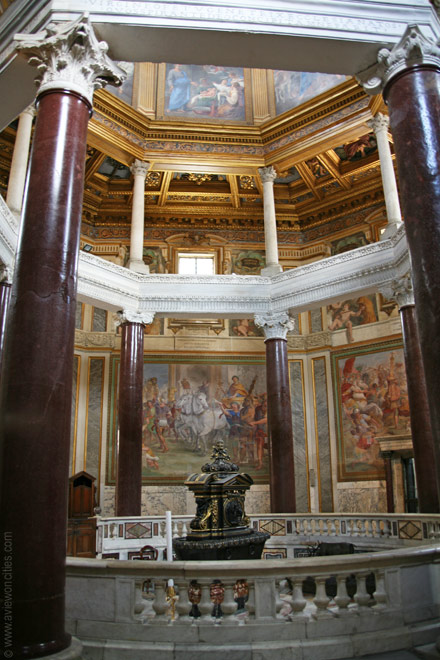 |
| Lateran Baptistery |
Eight not only appears in liturgical times of Baptism, but also in space. Baptisteries traditionally have eight sides, again signifying the Resurrection on the eighth day of the week, the first day of the new Creation. Even smaller churches without dedicated Baptisteries often possess an octagonal font. The local FSSP parish—despite the prevalence of plaster statues, blue wall paper, and young St. Joseph—has a proper Baptistery, octagonal in shape.
For the Jew, the only eighth day was the eighth day of the Feast of Tabernacles. Those under the Mosaic Law would build tents of palms and offer sacrifices for seven days, recalling the cycle of Creation. The entirety of the seven days was an extension of the Sabbath, the seventh and perfect day, wherein no servile work was performed. On the eighth day, a solemn celebration would resume and sacrifices would be offered communally. "On the first and eighth day shall be a sabbath, that is a day of rest" (Leviticus 23:39). This was a penitential cycle, attached to the Day of Atonement, the day the people would project their sins onto a "scapegoat" and offer sacrifices according to their means. For the Christian, the Sacrifice has been made by Christ, the Lamb Who took on the sins of the world. The celebration is a celebration not only in the sense of observance, but also in joy.
Unfortunately, the significance of Eight, octaves, and Baptism became obfuscated by the decline in liturgical observance in the Latin Church and the suppression of almost all octaves, save three, by Pius XII in 1955. Paul VI would unwittingly suppress Pentecost in 1970, after his mentor, Pius XII, removed its vigil and Baptism rites 15 years earlier.
Seven and Eight are sequential, as the fullness of Creation in one gives way to the new Creation in another. God created us to His end, from which we fell away on the seventh day and to which He restored us on the eighth. We are meant for Him, both now and forever. There is no new revelation, no new progression along the Biblical number line. We live in the final age, the last aeon (one could write a post on the meaning of "unto the ages of ages" in prayers). There will be no more progression in our knowledge of God until the end, when we will no longer see Him gradually lifting the veil, but instead see Him and He is. To end this numeric article, Msgr. Alfred provides the faithful with another mathematical insight on the Almighty in the first chapter of We Believe:
"The analogy or comparison which I personally find useful is to think of eternity as the point at the center of a circle. You know from your geometry that a point has no extension in space: it simply exists. In the same way, eternity has no extension in time: it simply exists. When we say of Almighty God in our limited language that He was, is and always will be, it would be far more correct to say—since in eternity there is no succession of events—that He always is. Now, if you think of time as the circumference of that circle, with every single point on the circumference equally and simultaneously present to the center, you may see what we mean when we say that the whole of time is likewise equally and simultaneously present to Almighty God. But to us the succession of events in real indeed: we are successively encountering what is simultaneous to Almighty God."Seven and Eight can make you a saint! A happy octave day to all.
Monday, June 1, 2015
Lost Octaves: The Ascension
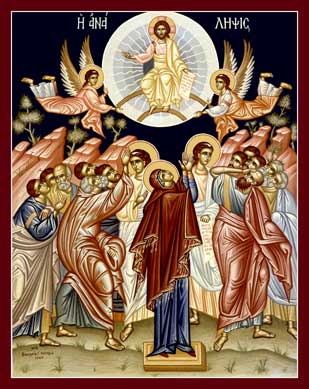
Octaves give the faithful seven days to digest a great feast. Rogation days, three days of penitential services and processions, precede the feast of the Ascension. St. Mamerus of Vienne instituted what eventually became the Rogation days while he was bishop of that see. The saint wanted his people to do penance so that they might repair for the wars of that region. The Council of Tours championed the practiced in 567 and in the ninth century it found a champion in St. Leo III, the pope of the age.

The Gospel of the Ascension and what occurs immediately after its reading are among the most subtle acts in the subdued Roman liturgy. In the 16th chapter of St. Mark's Gospel, Christ commands the Apostles to preach to the good news to the ends of the earth, telling them that they shall cast out devils, speak in new tongues, and survive poison, for no harm shall impede them from their charge. While this sounds hyperbolic, it means that the sign of the Church is miracles—God acting apart from conventional expectation to draw people's attention to the truth of Christ. If the sign of the Church is miracles, then the sign of the Church is holiness above all. Miracles are not part of the message of Christ or of the Church, rather they point to it and enable it.

Saturday morning's Mattins delve more explicitly into the extinction of the Paschal candle. The Lord "has given us great and precious promises, that by [faith and knowledge (cf. 1-2)] you may be made partakers of the divine nature" (2 Peter 1:4). Grace is given freely, not seen instantly. It must be perceived by faith, just as the presence of Christ is no longer seen physically in human form, only by faith. St. Leo the Great explicitly states in the second nocturne of Saturday "the seen presence of Our Redeemer in the body has been changed for the unseen presence of sacraments, and hearing was given to the Church instead of seeing." As she can no longer "see" her Spouse, the Church turns to externals like the Holy Fire to as reminders of Christ's humanity and His perpetual presence. Some Greek churches expand beyond the medieval Roman practice by reserving the Holy Fire for the entire year and lighting all candles until the next Holy Saturday from it.
The Apostles are left at the peak of Mt. Olivet with the Virgin, confused and disconsolate, none the wiser than they were when Jesus said "The Son of Man must suffer" or "I go to My Father." For understanding they had to await the descent of the Holy Spirit. The Ascension of the second person of the Holy Trinity necessarily implicates the descent of the third. The first nocturne at Mattins on the octave day contains the greeting "peace from God the Father, and from Christ Jesus, the Son of the Father", stopping short of St. Paul's Trinitarian greeting in 2 Corinthians 13:14. As the Holy Spirit has not yet descended in liturgical time, the Church does not draw further attention to the Paraclete, only anticipation. Instead, she continues to focus on Christ's assumption of our humanity both at the Incarnation and the Ascension. St. Augustine of Hippo emphasizes in the second nocturne of Mattins that Christ had to be man for the Cross to matter and that he similarly had to God for the Resurrection to transpire. Local uses further expurgate on the communion between God and Man in the Ascension. The rite of Lyon, in the French tradition, offers additional readings at Mass within the octave. On Wednesday before the octave day the French church reads Christ's prayer: "I pray for them; I pray not for the world, but for them that you have given me, because they are yours. All things are yours and they are mine, and I am glorified in them" (John 17:9-10). The soul naturally drifts to the words recorded in Exodus 33:20, that "no man has seen my face and lived." Now that Christ has taken our humanity into heaven and left the promise of His divinity with us on earth, what was hopeless in the old covenant is now hoped for in the new. Adam fell and could not see God. Christ rose so that we may.
From that same state bear back
From whence by sin he fell,
To the joys of Paradise,
When Thou as Judge dost come
To doom the universe,
Grant, we beseech thee, Lord,
Eternal joys to us
In the Saints' blessed land,
In which we all to Thee
Shall Alleluias sing.
From the Sarum sequence for the feast
Saturday, April 25, 2015
New Series: Missing Octaves

Since J.'s recent liturgical addendum to the Josephology series sparked discussion and corrections concerning the feast and octave of "St. Joseph, Patron of the Universal Church," I thought it appropriate to begin a little series of my own on the missing octaves of the modern Roman kalendars, both 1962 and 1970. I would cover the subject in part on:
- The octaves of the Comites Christi: Ss. Steven, John, and the Holy Innocents
- Epiphany and its octave day, the Baptism in the Jordan
- Octaves of the Virgin (Assumption and Nativity, later Immaculate Conception, too)
- Holy men of the Lord, the lost octaves of St. John the Baptist and Ss. Peter & Paul
- Octaves of the Lord, Corpus Christi and Ascension
- The greatest Roman octave: Pentecost
- Local octaves: patronal feast of the parish etc.
Look for words on the Comites Christi in the near future!
Saturday, November 16, 2013
Liturgy and the Eighth Day
 Discussion about the Roman liturgy varies in Catholic circles. For most liturgically interested Catholics the debate is between the "EF" and the "OF," or how the "reverence" of the "EF" might improve the "OF," or even how an amalgamated rite could be fostered. Others, the SSPX/FSSP type traditionalists who attend churches not staffed by diocesan priests, contrast the "theology" of the "Traditional Latin Mass" with that of the Mass of Paul VI, praising the emphasis on sacrifice in the former and criticizing the excessive focus on the meal elements of the Eucharist in the latter. Even more radical traditionalists focus on the "pre-1955" Missal, which is most typical editions published, versus the 1962 rite; people in this crowd inevitably dwell on Annibale Bugnini's role in crafting Pius XII's dodgy new Holy Week rites, in some sense inferior to those in the Pauline Missal (regardless of what one may think of the Ordo Missae in the Pauline books). Something neglected in all these discussions is the liturgical year itself and its contributions.
It is safe to say that the older rites, 1962 or 1474, have a more involved liturgical year, with more vigils, the ember days, and richer texts in the Office and at Mass for Advent and Lent than the modern books. But what of another long neglected aspect of the kalendar: octaves.
Octaves merit little attention these day, aside from discussion of the Octave of Pentecost in the 1962 rite, because both the Pauline kalendar and the Johannine kalendar have so few, two and three respectively. Prior to 1955 octaves occupied a very prominent place in the liturgical year of the Roman Church. For well over a thousand years the Church set aside eight day periods for the observation and re-visitation of the mysteries and salvific action of God in His works and in His saints. Most recently we would have finished the octave of All Saints, one of the most recent octaves, on November 8th. So what is an octave and what does it matter?
 "In the beginning God created heaven and earth," thus begins the Holy Scripture in the Book of Genesis. On the first day gave began creation, a gradual effort in which He fashioned everything for six days and then, on the seventh day, left it as it was. In light of the Resurrection, which occurred the day after the day of the rest, the Christian sees the eighth day as the beginning of a new creation, which is, in effect, a renewal and a re-vivification of the old creation. As Christ rose from the dead with the same body, but glorified and transformed (Philippians 3:21), so the Christian will at the end of time at the Last Judgment. But this process is not so removed from our current time and current needs.
In Greek, so the Byzantines tell me, the phrase the "Kingdom of God is at hand" (Mark 1:14, Matthew 3:2, Matthew 10:7) does not mean that the end of the world is immanent, but that the Kingdom of God, which was formerly inaccessible, is now immediately accessible, although in a less tangible form than what will be found at the end of time. Christianity, which is a fundamentally liturgical religion, is a fundamentally eschatological religion. What will happen in the end happens to the Christian now. He is joined to events that have happened, such as the Resurrection or the descent of the Holy Spirit at Pentecost, and to things yet to come. In short, the Christian's baptism binds him to mysteries of God that exist outside of time and which will transform the world at the end, at the eschaton. Our participation in the eschaton through baptism on earth necessitates our observation of God's creation and recreation, of the Son's Life and Resurrection in this time. This is what was foreshadowed in the Old Testament for us and what was done in the Roman liturgy in a very complete way until 1955, and in a very reduced way after 1955.
In chapter 23 of Leviticus the Lord establishes the Day of Atonement, the beginning of a seven day cycle of sacrifices for the sins of the people called the "Feast of Tabernacles" or the "Feast of Booths"—called such because the Jews would build booths out of palm branches in which they would live during those seven days. On the eighth day the offering of sacrifices was renewed with greater solemnity (Leviticus 23:36), forming the first octave, a foreshadowing of what was to come on the eighth day many years later. Not only did the Feast of Tabernacles begin on the Sabbath, a day of rest, and end on the Sabbath, a day of rest, but God prohibited servile work on the days between (Leviticus 23:35), extending the penance—or celebration for the Christian—for eighth days.
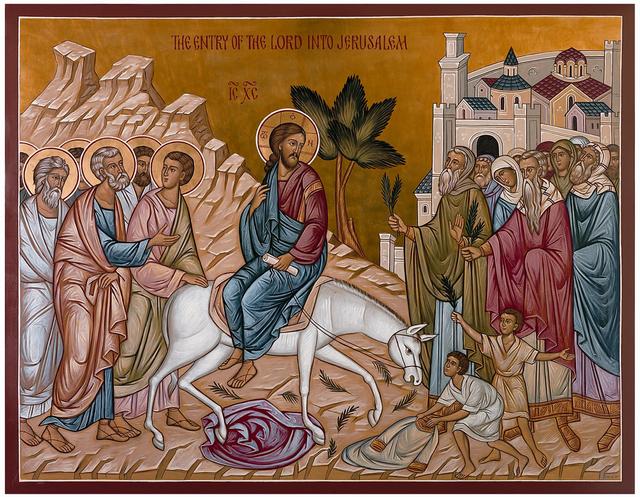 |
| source: modeoflife.wordpress.com |
On Palm Sunday, to my view, Christ began the first Christian octave. The Jews often enthroned their king during the Feast of Tabernacles (Danielou Bible and the Liturgy 335). On this day the Jews sang psalm 117, a psalm the Byzantine rite still sings during Communion and which the Roman Mass utilizes on Pascha, which includes that renown word "Hosanna." What did the Jews sing on Palm Sunday? "Hosanna to the Son of David" (Matthew 21:9). What were they doing? Holding branches of palms, as they would during the Feast of Tabernacles (Ibid 21:8). The narrative draws a clear parallel between the coronation of the king and the entrance of Jesus into Jerusalem. The inhabitants were enthroning Him as their new king, Why was the Feast of Tabernacles observed? To remind the Jews of their deliverance. Why did Christ enter Jerusalem? To observe the Passover and to fulfill the true deliverance, deliverance from sin and death. He would "rest" on the seventh day and rise again, in a renewed body, on the eighth day.
In some sense, although not strictly part of the liturgy, the period from Palm Sunday to Low Sunday forms consecutive octaves, the first ending with the new Creation and the second concluding with a greater clarity and invigorated spirit which only adds to that new Creation (Christ giving the Holy Spirit and power to forgive sins to His Apostles in the Upper Room).
As God made the Jewish people do penance and offer sacrifice for their sins for seven days, creation lasted seven days, and as they redoubled their efforts on the eighth, He renewed creation on the eighth in His Son's Resurrection from the dead. This process of creation, exploration, growth, and renewal is at the heart of Christ's work and, as it exists in time, makes His work accessible to us on earth, for us living in the eschaton terrestrially. The Church observes octaves—and observed even more—precisely for this point.
Many readers will know that Pascha, Christmas, and, in the older rites, Pentecost mandate octave length celebrations. Formerly well over a dozen occasions did so. Among them we see great evidence for the above analysis. St. John the Baptist's Nativity took an octave, the only Saint other than Our Lady whose birthday rather than death day is observed as a feast, suggesting that St. John was born without sin. If so, his own conception, birth, and life are a great act of God's restoration of human nature into its holier form. The same can be said of the Octave of All Saints.
 |
| source: glory2godforallthings.com |
A more startling example might be Epiphany, a feast of greater importance than Christmas if we are to be theologically honest with ourselves. Why was Epiphany observed as an octave until the last years of Pius XII? What renewal or improvement did it offer on the eighth day? "Epiphany" literally means a "showing" of something, in this case the showing of God in the flesh to Gentiles, a revelation that this Child's work would benefit all men, not exclusively Jewish people. On the eighth day, the octave day of Epiphany, an even greater revelation is shown to us, that of the Holy Trinity. The octave day of Epiphany is the Baptism of the Lord in the Jordan by St. John, wherein the Holy Spirit descended upon the Son and the Father said He was "well pleased" with the Son (John 1:29-34). This was the first direct revelation of the Holy Trinity to mankind, an even greater, but not segregated, revelation than that of Epiphany.
Octaves did not regularly appear during Paschaltide (except for the 19th century feast of St. Joseph), owing to the already Paschal nature of the season, and of course not during Lent. Instead the Church of Rome gave her faithful octaves to observe throughout the rest of the year, particularly during the time after Pentecost, during which the faithful might always recall how the Saints were in themselves new creations (Ss. Peter & Paul, John the Baptist, Lawrence of Rome, the Assumption of Our Lady, the Nativity of Our Lady, and All Saints all occur during the "green" Sunday season).
Yet does not the evidence oppose my eschatological hypothesis? Were these octaves so important and were the eighth day so relevant in liturgical theology surely the Church of Rome would have devised unique Masses for the days within the octaves, as she did for Pascha and Pentecost, rather than repeat the festive Mass again and again. Not so! In older times, outside of monasteries and collegiate churches, Mass would only be observed on Holy Days and Sundays. The repetition of Masses is the consequence of filling in the days between the feast and the nearest Sunday or Sunday and the octave day. Where octaves are truly to be observed is in the Divine Office. The lessons at Mattins would progress through didactic material germane to the mystery at hand for eight days and the antiphons repeated at the major hours would do much the same. Gregory DiPippo has been doing a fascinating series on the Mattins lessons for the Octave of All Saints in the Roman Curial Breviary which can be read here. The use of the festive office, with shorter psalms and no penitential prayers as would be found on ferial or simple days, contrasted starkly with the almost brutal daily cycle of prayers found in the ferial psalter. Octaves were clearly a time of joy, a period of living out some holy mystery in the present (although some of this was lost in the 1911 re-distribution of the psalter).
Liturgical octaves observe the eighth day of creation, the renewal of creation in the Resurrection of Christ. They make what is distant to us immanent and accessible as Christ's own salvific work made it immanent and accessible to those who had longed for it and observed it in its type for so long. We, on the other end of salvation history, observe its anti-type, its eschaton. For this reason, and for reasons better stated by those more liturgically learned than myself, we should push to re-introduce octaves into the Roman rite for feasts of saints and for feasts of Our Lord's work.
God bless!
Subscribe to:
Posts (Atom)