|
Seven candle laid before the altar in the Leonian Triclinium during
the Fourth Lateran Council, Innocent III presiding. |
"And on the seventh day God ended his work which he had made: and he rested on the seventh day from all his work which he had done. And he blessed the seventh day, and sanctified it: because in it he had rested," begins the second chapter of Genesis. Biblical numbers used to occupy a more prominent place in the world of conspiracy theories and listeners of the Art Bell Show, but to a believer Three, Seven, Eight, Twelve, and multiplication by thousands still carries importance. Seven remains a popular number in common life because a week is seven days long, the resting day preceding a return to work. A former coworker of mine named her son Seven—poor lad.
Seven and Eight occupy a prominence in the Church, both in Holy Writ and in the liturgical life of Christians. While Three arrantly refers to the Holy Trinity and the days before the Resurrrection, and while Twelve recalls the tribes of Israel and the Apostles, Seven and Eight are less immediately obvious and the most inseparable of these numbers, not least because they are sequential in every way.
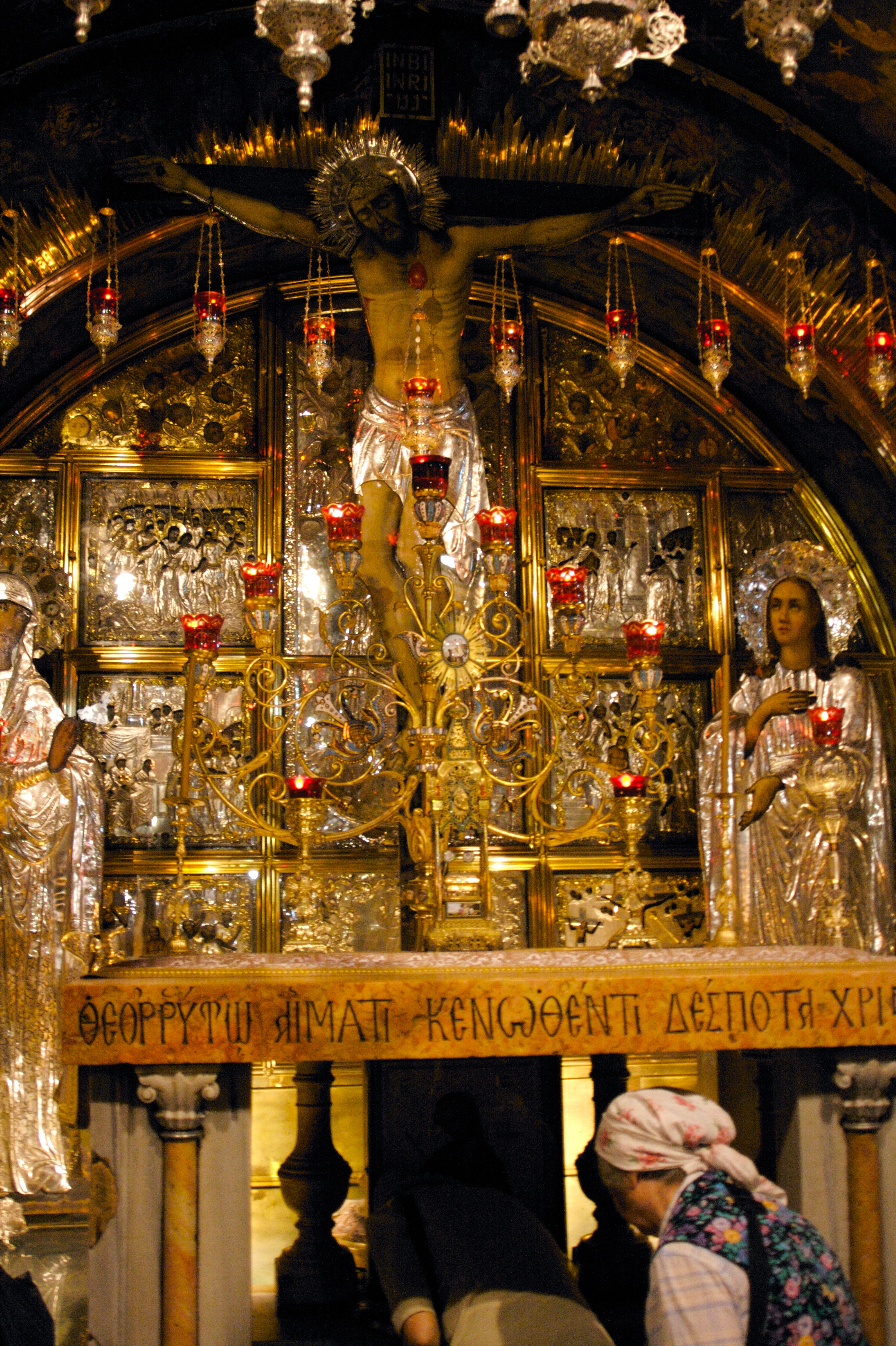 |
| Count 'em: seven on the top. |
Seven is conspicuous throughout the tradition of the Church, being found in Scripture and in the celebration of sacred rites. According to Genesis, God created the world in seven "days," the last of which He did not create anything, but instead rested and sanctified that day by His rest. He dedicated the day to Himself. Seven is also reiterated throughout the Apocalypse of St. John: seven candles, seven spirits, seven seals. In the old rite of Papal Mass, acolytes set seven candles in front of the altar, imitated in the Lyonese rite. The "Tridentine" Roman liturgy, a pontifical Mass celebrated by a bishop in his own diocese mandates seven candles on the altar rather than the conventional six, or whatever the rank of the day dictates. Many Byzantine Holy Tables will support a tabernacle ornamented with seven candles, too.
Seven is perfection. It is fulfillment. It is rest for God, but not for man. By sanctifying the seventh day unto Himself, God made Himself man's duty on that day rather than the work he earned by the merit of his sin. The seventh day is meant for the worship and adoration of God, to plead for the forgiveness of sins and for clemency in all man's needs.
Man's Fall impairs his worship of the Creator. Abraham's summoning to the mountain initiated the Jewish tradition of sacrificing small animals, vital sources of sustenance—milk, meat, textile materials, for God's ignorance of sin. The Law came through Moses. Grace and Truth—and the realized remission of sin—came through Jesus Christ. Christ's death on the Cross remitted the sins of those who follow Him, just as His Resurrection from the dead empowered His Apostles to heed the command to repeat the offering of bread and wine "for the anamnesis of me," revisiting, not repeating, His sacrifice.
The significance of Seven did not end with the Cross, rather it realized it final potential and deeper meaning. St. Paul's much abused adage "the letter kills, but the Spirit gives life" (2 Corinthians 3:6) excuses most Christians from meeting their duties by dismissing their potential detractors as legalists. The real meaning of this phrase could not be further from its modern reception. The letter, meaning the Law of Moses, was a meeting point between the Divine plan and man's fallen nature. Since the Passion of Christ and the coming of the Holy Spirit, the Law has become antiquated in light the coming of the Spirit. Adherence to the Law yields death, adherence to the Spirit yields life. The significance of the signs of the Law did not vanish with Christ; they became more powerful.
God's reservation of the seventh day makes Seven a Temple number, both in the Old Testament and in the New. A young animal was fit for sacrifice when it was seven days old (Exodus 22:30). Visibly there were seven lamp stands in the Temple, an image continued in the Apocalypse of St. John. In a passage of Scripture read at Mattins for the feast of All Saints, the writer described the court of the Almighty:
"And from the throne proceeded lightnings, and voices, and thunders; and there were seven lamps burning before the throne, which are the seven spirits of God" (Apocalypse 4:5)
God no created nothing new on the seventh day, yet Genesis delineates the end of Creation on the seventh day. The seventh day is perfect, it is completion. The use of seven in the Apocalypse may relate a vision to the reader, but it may also communicate to the reader that the eternal liturgy in the heavenly court is the Christian's final destination, his perfection, his fulfillment. If true, this imbues the liturgy with an apocalyptic nature, a preview of what eternity is supposed to be. The tradition of the seven lamps remained a feature of Papal Mass until Paul VI
discontinued the rite in 1964. The use of Lyon retained the tradition until adopting Pope Paul's reforms. Greek churches still often display seven candles above the altar. The recent loss of this tradition does not neglect what appears to have been the conventional interpretation of this number by the Church according to her sacred rites, that adoration of God in sempiternal beatitude in the un-ending end of the faithful.
Alas, Seven is succeeded by Eight, and it is time to move on.
If Seven is clear and explicit, Eight is hinted and implicit. Christ entered Jerusalem on Palm Sunday the day after the Sabbath and was put to death the day before the Sabbath. A good Jew, he rested on the Sabbath and rose the next day, a unique and extraordinary event in human history never to be repeated. Our Lord did not rise in a new body, nor the old as it was, but in the old body glorified, so resplendent and transformed that His own Apostles did not recognize Him. Understanding this, St. Paul writes to the Philippians, "Who will reform the body of our lowness, made like to the body of his glory, according to the operation whereby also he is able to subdue all things unto himself" (3:21). Christ rose on the first day of the new week, a new first day of Creation, in the "body of his glory."
"Our Redeemer's visible presence," wrote St. Leo the Great, "has passed into Sacraments." The Sacrament most readily associated with the Resurrection and with the renewal of mankind is Baptism, which St. Augustine often calls
the Sacrament in his
Confessions (my emphasis). Baptism is the Sacrament of regeneration, where what Christ did physically comes to the catechumen spiritually now and physically in eternity.
The great ancient feasts, Greek and Latin, have two commonalities: an extended liturgical celebration and the celebration of Baptism. Pascha, Pentecost, and Epiphany/Theophany are the greatest of all feasts in the Church, feasts liturgically observed for an octave of days and which relics of the older practice of Baptism on the feast vaguely remains. Pascha and Pentecost were preceded by a vigil in older times that became its own liturgical day in the middle ages. On those vigils, Baptism is still celebrated with the reading of prophecies, the blessing of water, and the Sacrament itself. Epiphany/Theophany no longer sees Baptism on the day of its celebration, but water is blessed and distributed by vials or by sprinkling among the faithful there gathered.
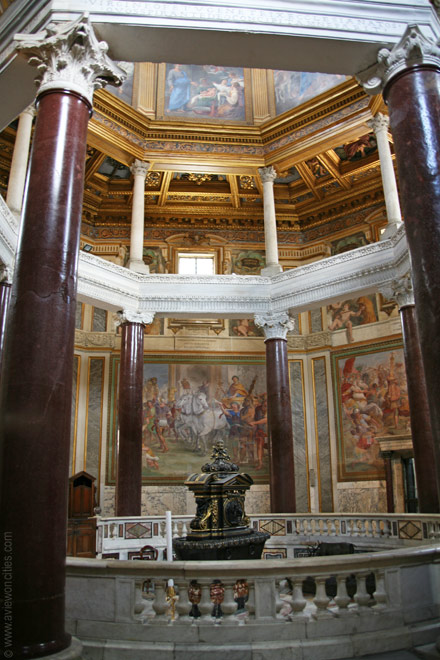 |
| Lateran Baptistery |
The extended liturgical celebration of Christ's regenerative mysteries is the octave, the eight day long week. In lesser feasts, the octave day repeats the feast day. In these three feasts, however, the octave day is unique from the feast itself. Pascha has Low Sunday (Thomas Sunday for the Greeks). Epiphany/Theophany is capped with the Baptism of the Lord (or a leave-taking in Byzantium). Pentecost does not have a strict octave day, but its semi-festive vigil can reasonably make Ember Saturday an octave day; Trinity Sunday could also be read as an accidental octave day, celebrating the complete revelation of the Trinity, the Third Person of Whose revelation was observed the prior week (Greeks do not have a formal octave, but they do call the week after Pentecost Sunday "Trinity Week," during which there is no fasting).
Eight not only appears in liturgical times of Baptism, but also in space. Baptisteries traditionally have eight sides, again signifying the Resurrection on the eighth day of the week, the first day of the new Creation. Even smaller churches without dedicated Baptisteries often possess an octagonal font. The local FSSP parish—despite the prevalence of plaster statues, blue wall paper, and young St. Joseph—has a proper Baptistery, octagonal in shape.
For the Jew, the only eighth day was the eighth day of the Feast of Tabernacles. Those under the Mosaic Law would build tents of palms and offer sacrifices for seven days, recalling the cycle of Creation. The entirety of the seven days was an extension of the Sabbath, the seventh and perfect day, wherein no servile work was performed. On the eighth day, a solemn celebration would resume and sacrifices would be offered communally. "On the first and eighth day shall be a sabbath, that is a day of rest" (Leviticus 23:39). This was a penitential cycle, attached to the Day of Atonement, the day the people would project their sins onto a "scapegoat" and offer sacrifices according to their means. For the Christian, the Sacrifice has been made by Christ, the Lamb Who took on the sins of the world. The celebration is a celebration not only in the sense of observance, but also in joy.
Unfortunately, the significance of Eight, octaves, and Baptism became obfuscated by the decline in liturgical observance in the Latin Church and the suppression of almost all octaves, save three, by Pius XII in 1955. Paul VI would unwittingly suppress Pentecost in 1970, after his mentor, Pius XII, removed its vigil and Baptism rites 15 years earlier.
Seven and Eight are sequential, as the fullness of Creation in one gives way to the new Creation in another. God created us to His end, from which we fell away on the seventh day and to which He restored us on the eighth. We are meant for Him, both now and forever. There is no new revelation, no new progression along the Biblical number line. We live in the final age, the last
aeon (one could write a post on the meaning of "unto the ages of ages" in prayers). There will be no more progression in our knowledge of God until the end, when we will no longer see Him gradually lifting the veil, but instead see Him and He is. To end this numeric article, Msgr. Alfred provides the faithful with another mathematical insight on the Almighty in the first chapter of
We Believe:
"The analogy or comparison which I personally find useful is to think of eternity as the point at the center of a circle. You know from your geometry that a point has no extension in space: it simply exists. In the same way, eternity has no extension in time: it simply exists. When we say of Almighty God in our limited language that He was, is and always will be, it would be far more correct to say—since in eternity there is no succession of events—that He always is. Now, if you think of time as the circumference of that circle, with every single point on the circumference equally and simultaneously present to the center, you may see what we mean when we say that the whole of time is likewise equally and simultaneously present to Almighty God. But to us the succession of events in real indeed: we are successively encountering what is simultaneous to Almighty God."
Seven and Eight can make you a saint! A happy octave day to all.