Showing posts with label Lost Octaves series. Show all posts

Sunday, May 29, 2016

Lost Octaves Series: Corpus Christi & Musings


A correspondent wrote to me confessing a slight faintness with the gravity of Catholic teaching on the Eucharist, that Christ is not merely present in a spiritual sense after Anglo-Catholic fashion, but is really present in His Flesh on the altar:
Verbum caro, panem verumverbo carnem efficit:fitque sanguis Christi merum,et si sensus deficit,ad firmandum cor sincerumsola fides sufficit. 
The choice of the word "flesh" comes to us from Holy Writ, not handmedown concepts of oblation inherited from Roman paganism or Judaic sacrifice. "Unless you eat the flesh of the Son of Man and drink His blood," Our Lord teaches, "you shall not have life within you" (John 6:54). A spiritual presence straddles a fine boundary between mystical and symbolic. A fleshly presence accepts a spiritual presence while adding a more immediate one to it. The Eucharist must be a physical and spiritual reality precisely because the Church is both a physical and spiritual reality, as a remarkably long and un-monitored comment box on EENS demonstrates. The Church is not bound by the sharing of the Eucharist among its numbered members, but in Christ absorbing the faithful into Himself by giving His flesh over to them ut unum sint. St. John Chrysostom says as much during Mattins for Saturday within the octave:
"Dearly beloved brethren, it behoveth us to learn the miracle of the Mysteries what the Gift is, and why It was given, and what is the use thereof. "We, being many, are one body," saith [the Apostle Paul, 1 Cor. x. 17, and again] "We are members of His Body, of His Flesh, and of His Bones." Eph. v. 30.Only the initiated will now understand what I say. That this union may take place, not by love only, but verily and indeed, we ought to mingle our own with His Flesh. And this is done by eating that Food Which He hath given unto us, being fain to manifest that exceeding great love which He beareth to us-ward. To this end He hath mingled Himself with us, and infused His Body into our bodies, that we may be one together, like as the limbs of a man and his head are all of one body. Such union do they long for that love much."
The Archbishop of Constantinople continues in Monday's Mattins:
"In this mysterious Sacrament Christ doth mingle Himself with all and each of His faithful ones. They are His children, and He nurseth them Himself, and giveth them not over unto another, herein again assuring us that the Flesh He hath taken unto Himself is ours. We then, who have been deemed meet to be treated with such love and such honour, let us be wakeful See ye not how eagerly the sucklings seize on the breasts, how readily they fix their mouths on the paps Let us, with like eagerness, draw nigh to that Table, and suck at that spiritual Cup. Yea, let us prize that gracious Food as the suckling doth its mother's breast, and hold it the great woe of life to be cut off from that Banquet. Here there are set before us no works of man's power He That worked at that Last Supper, the Same worketh the same here still. As for us Priests, we hold the place of His ministers, but He Which halloweth and changeth is He. Hither let there draw nigh no Judas, nor covetous one this is no Table for him. But he which is Christ's disciple, let him come for the Lord saith "I will keep the Passover with My disciples," Matth. xxvi. 18. This is that Passover Table, and it is all Christ's what is wrought there is not some of it Christ's work, and some of it man's work, but it is all His work and not another's." 
The eagerness of the faithful to "suck at that spiritual Cup" is obscured on our reformed 20th century rites. With very few exceptions anyone who attended a Latin rite parish today experienced an "external solemnity" of Corpus Christi Thursday Sunday. This is unfortunate and a consequence of the reduction of octaves under Pius XII and the availability of celebrating major feasts in place of the Sunday Mass. In the traditional Roman rite today would have been the Second Sunday after Pentecost, Sunday within the octave, complete with white vestments, commemorations at Mass and the office, and the preface of the Incarnation during the Mass. The gospel passage comes from Luke chapter 14, in which Our Lord makes a parable of a rich man who holds a banquet only to find that all the invited guests have made their polite excuses. The rich man then tells his servants to go into the streets and invite everyone they can find to the banquet. The Sacrament of the Lord, the glue of the Church, is open to all who do not reject it. The Jewish people were granted the revelation of God to man ("Salvation is from the Jews" John 4:22) and the unique place of being His "people" in the world; in declining Christ, to Whom the fullness of revelation was offered in Christ, the faith was then opened to the entirety of the world. The Temple sacrifices besought the forgiveness of the sins of the Jewish people and bound them under God's command. The Memoriale mortis Domini actually accomplishes the forgiveness of sins within the Church and binds the Church visibly under the Son of Man's own flesh.

Sunday Gospel as an antiphon

The feast of Corpus Christi is quintessentially Roman in its texts, direct yet with heuristic, subtle wordplay from St. Thomas Aquinas. The fleshly presence of Christ in the Eucharist finds itself expressed in many texts and actions throughout Eastern and Western liturgical history; long before monstrances the Sacrament was carried in a pyx by the celebrant and heralded by boys dressed in sack cloth as "prophets" in the Sarum form of Palm Sunday. The Sacrament extends Christ's presence on earth without dividing Him. 

And yet there is an odd extension of Eucharistic piety that personifies the Sacrament to a level that the Church has never traditionally understood. There have been some pious additions in Eucharistic devotion in the Latin Church that frankly give not a few of us the "heebie jeebies." I recall one fine Sunday morning breaking the fast at Brown's on Woodstock after the 8AM Mass at the Oxford Oratory. A gathering of us discussed the long road ahead to getting the old liturgy a permanent foothold in the mainstream Church. One of our number commented that one difficulty was the odd focus on the Blessed Sacrament itself outside of the liturgy, which distracts from the fact that the liturgy exists to confect the Sacrament. "What, pray tell, do you mean?" I asked. "Well, Rad Trad," he dilated, "I recently ran into a friend on his way to the Oxford chaplaincy to pay a 'visit' to the Sacrament. All well and fine to me, but when I asked why he did not just pop into the Oratory or Blackfriars, nearer his college, he gave me a queer reply. Do you know what he said? 'He's lonely.' Well, of course He's 'lonely'! He's God! He's the Only One!" 

A blessed continued octave of the Body of the Lord to all!


Monday, June 1, 2015

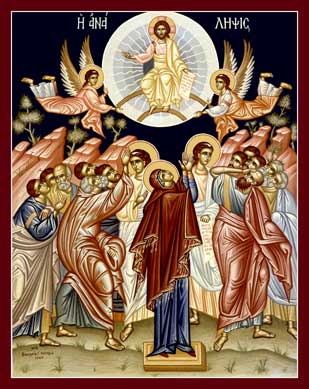
Lost Octaves: The Ascension


Christ rose from the dead on the eighth day of the week, capping a week that began with His triumphant entry into Jerusalem on Palm Sunday with His entry into Hades, its harrowing, and His return to this earth glorified. Since then, the Church has traditionally marked the great feasts with eight day long celebrations, commemorating the marked significance of what Our Lord did either Himself or through His saints with protractions of the Office, Mass, and associated festivals. We recently concluded the octave of Pentecost, or Trinity Week in the Byzantine rite, one of the few octaves remaining in the 1962 Roman liturgy. The liturgy of Paul VI lacks this octave. Traditionally the Church celebrated numerous octaves until the pontificate of Pius XII, among them the octave of the Ascension of Our Lord into heaven. 

Octaves give the faithful seven days to digest a great feast. Rogation days, three days of penitential services and processions, precede the feast of the Ascension. St. Mamerus of Vienne instituted what eventually became the Rogation days while he was bishop of that see. The saint wanted his people to do penance so that they might repair for the wars of that region. The Council of Tours championed the practiced in 567 and in the ninth century it found a champion in St. Leo III, the pope of the age. 


Originally the Rogation days resembled the Roman observance of Ash Wednesday: the clergy and faithful wore poor clothing, marked themselves with ashes, and processed from church to church singing psalms and litanies. Over time the Rogation days, owing to their proximity to the Ascension, became spiritualized lamentations at the end of Paschaltide for the impending departure of Christ. Dom Gueranger wrote that observance of the Rogation days to their full extent with abstinence "would express how [the Church] feels at the loss of her Spouse, who is soon to be taken from her."

The Gospel of the Ascension and what occurs immediately after its reading are among the most subtle acts in the subdued Roman liturgy. In the 16th chapter of St. Mark's Gospel, Christ commands the Apostles to preach to the good news to the ends of the earth, telling them that they shall cast out devils, speak in new tongues, and survive poison, for no harm shall impede them from their charge. While this sounds hyperbolic, it means that the sign of the Church is miracles—God acting apart from conventional expectation to draw people's attention to the truth of Christ. If the sign of the Church is miracles, then the sign of the Church is holiness above all. Miracles are not part of the message of Christ or of the Church, rather they point to it and enable it.

After the deacon has read the Gospel, an acolyte snuffs the Paschal candle, which will not burn again save for at the blessing of the font on the vigil of Pentecost. In the middle ages this act would have made more sense to us than it does in the 1962 form or the Pauline form (if it is still done). The other candles in a church would have been light from the Paschal fire, which burned without pause from Holy Saturday through the Ascension. Devotional candles, candles on side altars, and other candles in the sanctuary would have been lit from the Paschal candle before the acolyte extinguished it. Christ has taken the Apostles to the top of Mt. Olivet. Peaks of mountains and hills, as the "closest" point to heaven for those on earth and places of isolation, have special significance in the Scriptures. Moses ascended Mt. Sinai and received the Ten Commandments. Reflectively, Christ brought the Apostles up Mt. Tabor to show the congruity between the Jewish covenant and the one to come when He transfigured before them. At this moment atop Mt. Olivet, the Apostles again assume, again wrongly, that Christ will now restore the kingdom of Israel to its Davidic glory, forgetting the Lord's condemnation of Israel on Palm Sunday. A new covenant will be accompanied by a new Jerusalem, one based in heaven and present on earth, descending from one to another. God outwardly signified His presense in a cloud over the Mercy Seat on the Ark of the Covenant. Now, His presence would descend from heaven to earth and diffuse through the working of the Holy Spirit and the work of the Church, its opus Dei.

Saturday morning's Mattins delve more explicitly into the extinction of the Paschal candle. The Lord "has given us great and precious promises, that by [faith and knowledge (cf. 1-2)] you may be made partakers of the divine nature" (2 Peter 1:4). Grace is given freely, not seen instantly. It must be perceived by faith, just as the presence of Christ is no longer seen physically in human form, only by faith. St. Leo the Great explicitly states in the second nocturne of Saturday "the seen presence of Our Redeemer in the body has been changed for the unseen presence of sacraments, and hearing was given to the Church instead of seeing." As she can no longer "see" her Spouse, the Church turns to externals like the Holy Fire to as reminders of Christ's humanity and His perpetual presence. Some Greek churches expand beyond the medieval Roman practice by reserving the Holy Fire for the entire year and lighting all candles until the next Holy Saturday from it.

The Apostles are left at the peak of Mt. Olivet with the Virgin, confused and disconsolate, none the wiser than they were when Jesus said "The Son of Man must suffer" or "I go to My Father." For understanding they had to await the descent of the Holy Spirit. The Ascension of the second person of the Holy Trinity necessarily implicates the descent of the third. The first nocturne at Mattins on the octave day contains the greeting "peace from God the Father, and from Christ Jesus, the Son of the Father", stopping short of St. Paul's Trinitarian greeting in 2 Corinthians 13:14. As the Holy Spirit has not yet descended in liturgical time, the Church does not draw further attention to the Paraclete, only anticipation. Instead, she continues to focus on Christ's assumption of our humanity both at the Incarnation and the Ascension. St. Augustine of Hippo emphasizes in the second nocturne of Mattins that Christ had to be man for the Cross to matter and that he similarly had to God for the Resurrection to transpire. Local uses further expurgate on the communion between God and Man in the Ascension. The rite of Lyon, in the French tradition, offers additional readings at Mass within the octave. On Wednesday before the octave day the French church reads Christ's prayer: "I pray for them; I pray not for the world, but for them that you have given me, because they are yours. All things are yours and they are mine, and I am glorified in them" (John 17:9-10). The soul naturally drifts to the words recorded in Exodus 33:20, that "no man has seen my face and lived." Now that Christ has taken our humanity into heaven and left the promise of His divinity with us on earth, what was hopeless in the old covenant is now hoped for in the new. Adam fell and could not see God. Christ rose so that we may.

From that same state bear back
From whence by sin he fell,
To the joys of Paradise,
When Thou as Judge dost come
To doom the universe,
Grant, we beseech thee, Lord,
Eternal joys to us
In the Saints' blessed land,
In which we all to Thee
Shall Alleluias sing.

From the Sarum sequence for the feast