Showing posts with label St. Gregory the Great. Show all posts

Thursday, March 23, 2017

The Origins of "Church Militant"

Recently while reading the discourses of P. Gregory the Great with Peter the Deacon concerning the immortality of the soul, I came across this interesting passage recounting how the death of multiple monks in Gregory's old monastery was foretold by an angelic visitor:
That those also, which lie a dying, do oftentimes by divine revelation foretell what shall happen afterward, we may learn by such things as have fallen out amongst us in divers Abbeys. For ten years since, there was a monk in my Monastery, called Gerontius, who, lying sore sick, saw by vision in the night time, certain white men beautifully apparelled to descend from above into the Monastery, and standing by his bed-side, one of them said: "The cause of our coming hither is to choose out certain of Gregory's monks, to send them abroad unto the wars": and forthwith he commanded another to write in a bill the names of Marcellus, Valentinian, Agnellus, and divers others, whose names I have now forgotten: that being done, he said further: "Put down also the name of him that now beholdeth us." By which vision he being assured of that which would come to pass, the next morning he told the monks, who they were that should shortly die out of the Monastery, adding also that himself was to follow them. The next day the foresaid monks fell more dangerously sick, and so died all in that very order which they were named in the bill. Last of all, himself also departed this life, who had foretold the departure of the other monks before him. (IV.xxvi)
What interested me especially was the phrase used by the angel of death, that these monks were being recruited to be "sent abroad unto the wars." This imagery of the saints in Heaven engaged in warfare is not, to my knowledge, found elsewhere. It makes sense that the souls of holy men war against the Devil just as the holy angels do, but still the appellation Ecclesia Militans is applied to us here on earth, and Ecclesia Triumphans describes those safe in the harbor of Heaven.

The imagery in the Militant-Triumphant metaphor is clear: the soul of a man on Earth is in constant warfare against sin, the world, the flesh, and the Devil; while the soul of a man in Heaven has triumphed over all these enemies and is established forever in grace. St. Thomas Aquinas used the Militant-Triumphant dichotomy in his Summa (II-I.102.4), but I cannot otherwise trace the origins of this terminology.

I have to wonder why the Gregorian imagery of the holy dead being sent off to war did not gain purchase in popular piety. Was it because of a increasing consciousness of the middle state, the Ecclesia Dolens? Did Purgatory conquer so much of the imagination that theologians desired to emphasize the rest and triumph of the state of blessedness? The ecclesial phrases suggest a transition from activity to passivity, but if the holy angels truly rest in the Beatific Vision and yet are perpetually active on our behalf, why should not the great "cloud of witnesses" do the same? We might we not go from one sort of militancy to another?

Mind you, I am not being critical or especially skeptical of the popular terminology of Militant-Suffering-Triumphant. I am merely curious about its origins. If any of our good readers have knowledge of this aspect of Catholic piety, I would love to hear it.


Sunday, March 12, 2017

Gregory the Great


Today marks the traditional feast of P. Gregory I, surnamed Magnus, one of the brightest lights of the Catholic priesthood. A tireless reformer, writer, and lover of monasticism, Gregory is known for his revisions of the Roman Rite of the liturgy, for his Scripture commentaries, and perhaps most popularly for his Dialogues, which serve as an early collection of hagiography and monastic history. The voluminous Moralia in Job was not only a Scripture commentary of the highest order, but a source of allegorical imagery that would influence Western iconography for many centuries. He is said to have been so impressed by the natural virtues of the pagan Emperor Trajan that he beseeched God to raise the man from the dead so that he could receive baptism; the Almighty promptly granted the pope's request, and the pagan emperor soon found himself plucked from the fires of Hell and admitted into the joys of Heaven.

So exalted were his writings that Gregory is often depicted, as above, with the Divine Dove speaking in his ear, as though his writings were inspired like the Holy Writ itself. During his own life he was occasionally painted in art with a square nimbus, an iconographical oddity permitted for the depiction of living, holy men. His feast is celebrated on this day (of his death) even among the heretics and schismatics, with the 1969 neo-kalendar being the sole exception.

From Lauds:
Deus, qui animae famuli tui Gregorii aeternae beatitudinis praemia contulisti: concede propitius; ut qui peccatorum nostrorum pondere premimur, ejus apud te precibus sublevemur.

O God, who hast blessed the soul of thy servant Gregory with an everlasting blessing, mercifully grant that we, who groan under the burden of our sins, may by his prayers be relieved.

Thursday, May 5, 2016

Why Look Down, Men of Galilee?


"I may be allowed to say that the disciples' slowness to believe that the Lord had indeed risen from the dead, was not so much their weakness as our strength. In consequence of their doubts, the fact of the Resurrection was demonstrated by many infallible proofs. These proofs we read and acknowledge. What then assureth our faith, if not their doubt? For my part, I put my trust in Thomas, who doubted long, much more than in Mary Magdalene, who believed at once. Through his doubting, he came actually to handle the holes of the Wounds, and thereby closed up any wound of doubt in our hearts." —St. Gregory the Great, 29th sermon on the Gospels

Sunday, April 17, 2016

Gregory the Great: Hour of the Sacrifice


"For this sacrifice doth especially save our souls from everlasting damnation, which in mystery doth renew unto us the death of the Son of God: who although being risen from death, doth not now die any more, nor death shall not any further prevail against him: yet living in himself immortally, and without all corruption, he is again sacrificed for us in this mystery of the holy oblation: for there his body is received, there his flesh is distributed for the salvation of the people: there his blood is not now shed betwixt the hands of infidels, but poured into the mouths of the faithful. Wherefore let us hereby meditate what manner of sacrifice this is, ordained for us, which for our absolution doth always represent the passion of the only Son of God: for what right believing Christian can doubt, that in the very hour of the sacrifice, at the words of the Priest, the heavens be opened, and the quires of Angels are present in that mystery of Jesus Christ; that high things are accompanied with low, and earthly joined to heavenly, and that one thing is made of visible and invisible?" (Dialogues IV:58, St. Gregory the Great)

Wednesday, January 6, 2016

Reges munera offerent

"Dearly beloved brethren, hear ye from the Gospel lesson how, when the King of heaven was born, the king of earth was troubled? The heights of heaven are opened and the depths of earth are stirred. Let us now consider the question, why, when the Redeemer was born, an angel brought the news to the shepherds of Judea, but a star led the wise men of the East to worship Him. It seemeth as if the Jews as reasonable creatures received a revelation from a reasonable being, that is, an angel, but the Gentiles without, being as brutes, are roused not by a voice, but by a sign, that is, a star. Hence Paul hath it: a sign, not to them that believe, but to them that believe not but prophesying serveth not for them that believe not, but for them which believe. So the prophesying, that is, of the angel was given to them that believed, and the sign to them that believed not.
"Thus also we remark that afterwards the Redeemer was preached among the Gentiles not by Himself, but by His Apostles, even as, when a little Child, He is shown to them, not by the voice of angels, but merely by the vision of a star. When He Himself had begun to speak He was made known to us by speakers, but when He lay silent in the manger, by that silent testimony in heaven. But whether we consider the signs which accompanied His birth or His death, this thing is wonderful, namely, the hardness of heart of the Jews, who would not believe in Him either for prophesying or for miracles.
"All things which He had made, bore witness that their Maker was come. Let me reckon them after the manner of men. The heavens knew that He was God, and sent a star to shine over where He lay. The sea knew it, and bore Him up when He walked upon it. The earth knew it, and quaked when He died. The sun knew it, and was darkened. The rocks and walls knew it, and rent at the hour of His death. Hell knew it, and gave up the dead that were in it. And yet up to this very hour the hearts of the unbelieving Jews will not acknowledge that He to Whom all nature testified is their God, and, being more hardened than the rocks, refuse to be rent by repentance." Pope St. Gregory the Great

To the reader disgruntled at not getting Mattins last time: are you happy?

A blessed Epiphany/Theophany to all! 

Tuesday, September 29, 2015

Michaelmas


In commemoration of the dedication of a Roman basilica to St. Michael, September 29 is kept in honor of the Archangel who the Prophet Daniel describes as “the great prince, who standeth for the children of thy people.”

The Mattins of the day include a sermon from St. Gregory the Great:
They who go on the lesser messages are called Angels they who go on the greater Archangels. Hence it is that unto the Virgin Mary was sent no common Angel, but the Archangel Gabriel. For the delivery of this, the highest message, it was meet that there should be sent the highest Angel. Their individual names also are so given as to signify the kind of ministry wherein each is powerful. Michael signifieth: Who-is-like-unto-God? Gabriel, the Strength-of-God, and Raphael, the Medicine-of-God. 
As often as anything very mighty is to be done, we see that Michael is sent, that by that very thing, and by his name, we may remember that none is able to do as God doeth. Hence that old enemy whose pride hath puffed him up to be fain to be like unto God, even he who said, I will ascend unto heaven, I will exalt my throne above the stars of God. I will be like the Most High, this old enemy, when at the end of the world he is about to perish in the last death, having no strength but his own, is shown unto us a-fighting with Michael the Archangel, even as saith John: There was war in heaven Michael and his Angels fought against the dragon; and the dragon fought and his angels.
In Lauds the pious belief that Michael will lead the souls of men to judgment after death is repeated in antiphon: “Michael Mine Archangel, I have appointed thee for a prince over the ingathering of souls.”


Customarily, Michaelmas is celebrated with a feast of goose and apples. Blackberry cobbler is also popular in some parts of Christendom, because of the belief that St. Michael cast Satan out of Heaven into a blackberry bush. Some bloggers try to convince the world that carrots are proper for this feast, but they are clearly operating out of a corrupted tradition.


The Michaelmas Daisy is a late-blooming flower best used for systematically discerning romantic interest via plucking the petals.

(source)


Saturday, June 1, 2013

Sunday with the Octave of Corpus Christi


from: vultus.stblogs.org
I wanted to write something about the Octave of Corpus Christi, but I fear I would not have anything better to say than David Forster of Liturgia Latina. I would encourage you all to read his post on Sunday with the Octave of Corpus Christi here. He reads the Old Testament typology of the prophet Samuel through the eyes of St. Gregory the Great in order to consider the idea of God feeding man. Fittingly, the Gospel reading on this Sunday is from chapter 14 of St. Luke, wherein Jesus speaks a parable of a man who has prepared a great feast, but all the invited excuse their absence. The actual Thursday feast of Corpus Christi is laden with Incarnational undertones (the doxologies, the preface of the Mass, the hymn Pange Lingua to some extent). Earlier I even posted an excerpt from St. Gregory of Nyssa's catechism concerning the Eucharist, which takes an "organic" approach. Point being, there is a great wealth of typology, ecclesiology, theology, and liturgy to consider when trying to understand the Eucharis. This is why the Church gave the feast an octave in the 15th century. It is for our benefit.

Sunday, May 19, 2013

Happy Pentecost!


"Dearly beloved brethren, our best way will be to run briefly through the words which have been read from the Holy Gospel, and thereafter rest for a while quietly gazing upon the solemn subject of this great Festival. This is the day whereon "suddenly there came a sound from heaven," and the Holy Ghost descended upon the Apostles, and, for fleshly minds, gave them minds wherein the love of God was shed abroad and, while without "there appeared unto them cloven tongues, like as of fire, and it sat upon each of them," within, their hearts were enkindled. While they received the visible presence of God in the form of fire, the flames of His love enwrapped them. The Holy Ghost Himself is love whence it is that John saith "God is love." Whosoever therefore loveth God with all his soul, already hath obtained Him Whom he loveth for no man is able to love God, if He have not gained Him Whom he loveth.
"But, behold, now, if I shall ask any one of you whether he loveth God, he will answer with all boldness and quietness of spirit "I do love him." But at the very beginning of this day's Lesson from the Gospel, ye have heard what the Truth saith " If a man love Me, he will keep My word." The test, then, of love, is whether it is showed by works. Hence the same John hath said in his Epistle. "If a man say, I love God, and keepeth not His commandments, He is a liar." Then do we indeed love God, and keep His commandments, if we deny ourselves the gratification of our appetites. Whosoever still wandereth after unlawful desires, such an one plainly loveth not God, for he saith, Nay, to that which God willeth.
And My Father will love him, and We will come unto him, and make Our abode with him." O my dearly beloved brethren, think what a dignity is that, to have God abiding as a guest in our heart Surely if some rich man or some powerful friend were to come into our house, we would hasten to have our whole house cleaned, lest, perchance, when he came in, he should see aught to displease his eye. So let him that would make his mind an abode for God, cleanse it from all the filth of works of iniquity. Lo, again, what saith the Truth " We will come unto him, and make Our abode with him." There are some hearts whereunto God cometh, but maketh not His abode therein with a certain pricking they feel His Presence, but in time of temptation they forget that which hath pricked them and so they turn again to work unrighteousness, even as though they had never repented."—Pentecost Sermon of Pope St. Gregory the Great, 30th Sermon on the Gospels

Saturday, March 30, 2013

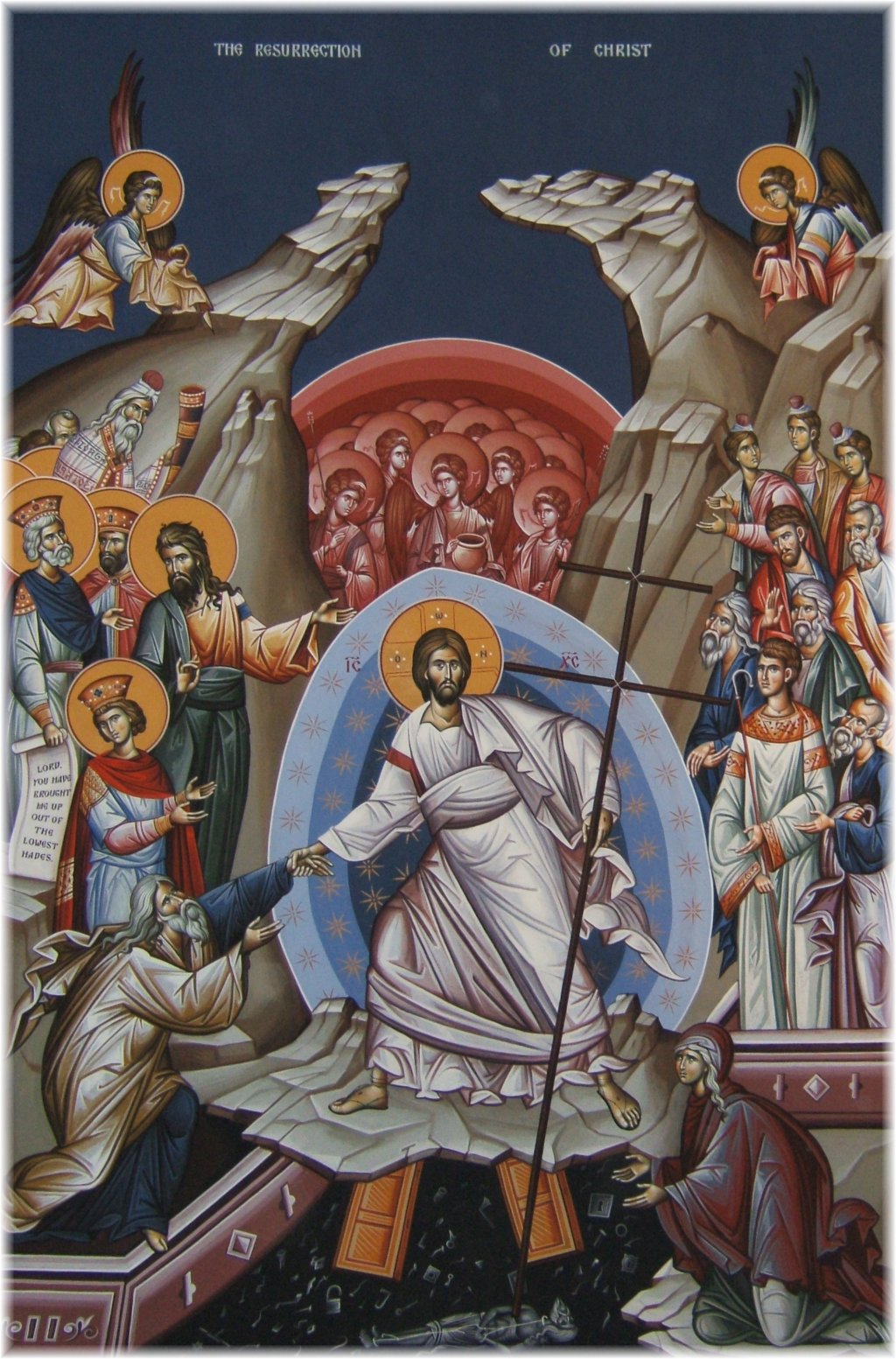
Surrexit Christus Hodie!


Dearly beloved brethren, ye have heard the deed of the holy women which had followed the Lord; how that they brought sweet spices to His sepulchre, and, now that He was dead, having loved Him while He was yet alive, they followed Him with careful tenderness still. But the deed of these holy women doth point to somewhat which must needs be done in the holy Church. And it behoveth us well to give ear to what they did, that we may afterward consider with ourselves what we must do likewise after their ensample. We also, who believe in Him That was dead, do come to His sepulchre bearing sweet spices, when we seek the Lord with the savour of good living, and the fragrant report of good works. Those women, when they brought their spices, saw a vision of Angels, and, in sooth, those souls whose godly desires do move them to seek the Lord with the savour of good lives, do see the countrymen of our Fatherland which is above.
It behoveth us to mark what this meaneth, that they saw the Angel sitting on the right side. For what signifieth the left, but this life which now is? or the right, but life everlasting? Whence also it is written in the Song of Songs : His left hand is under my head, and His right hand doth embrace me. Since, therefore, our Redeemer had passed from the corruption of this life which now is, the Angel which told that His undying life was come, sat, as became him, on the right side. They saw him clothed in a white garment, for he was herald of the joy of this our great solemnity, and the glistering whiteness of his raiment told of the brightness of this holy Festival of ours. Of ours, said I? or of his? But if we will speak the truth, we must acknowledge that it is both his and ours. The Again-rising of our Redeemer is a Festival of gladness for us, for us it biddeth know that we shall not die for ever; and for Angels also it is a festival of gladness, for it biddeth them know that we are called to fulfill their number in heaven.
See this glad Festival then, which is both his and ours, the Angel appeared in white raiment. For as the Lord, rising again from the dead, leadeth us unto the mansions above, He. repaireth the breaches of the heavenly Fatherland. But what meaneth this, that the Angel said unto the women which came to the sepulchre : Fear not? Is it not as though he had said openly : Let them fear which love not the coming of the heavenly countrymen; let them be afraid who are so laden by fleshly lusts, that they have lost all hope ever to be joined to their company. But as for you, why fear ye, who, when ye see us, see but your fellow - countrymen? Hence also Matthew, writing of the guise of the Angel, saith : His countenance was like lightning, and His raiment white as snow. The lightning speaketh of fear and great dread, the snow of the soft brilliancy of rejoicing.
From Sermon 21 of Pope St. Gregory the Great

Happy Pascha!