|
Dom Prosper Guéranger, founder of Solesmes and of
the Liturgical Movement |
Today's topic is the most loaded and hence the most difficult for us to explore with confidence, but I feel up to giving a concise account of the Liturgical Movement's origin, its phases, and its eventual diffusion in the 1950s and 1960s.
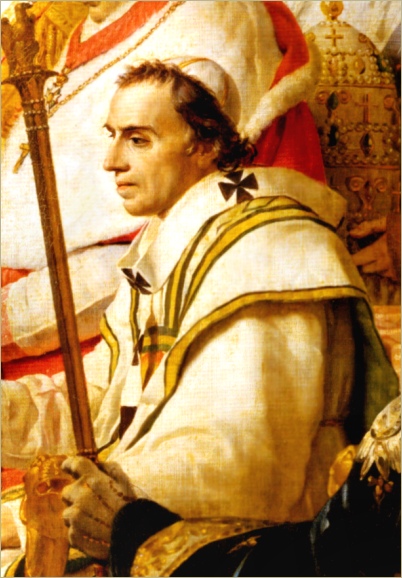 |
Pius VII, bored by Napoleon's self-coronation.
The artist forgot the fanon. |
The origins of the Liturgical Movement are usually traced to the diocesan priest-turned-monk Dom Prosper Guéranger, who founded the monastery of Solesmes. The four major contributions of Solesmes to what would be called the future of the Roman rite and the Liturgical Movement are:
- A new interest in liturgical scholarship
- An interest in the complete liturgy, as opposed to the simple Mass, including the Office and various ceremonies as it existed in the Middle Ages
- A restoration of the more ancient, pre-high Middle Ages, notation for plainsong
- And the suppression of the local rites of France.
The Movement in its nascence sounds very "right wing," especially in regard to the last point. Dom Guéranger's ultramontanism involved a compulsion to imitate all things Roman, not merely to accept doctrinal decisions from the Papal Chair. His Roman zeal led to the suppression of many local, "neo-Gallican" rites which Pius VII recognized as legitimate after his treaty with Napoleon, although these local rites were more often just usages, the Roman Mass and Office with variations in the psalm arrangements, propers of the Mass, and orations. Indeed just a few centuries earlier Bishop Pierre de Gondy of Paris was confronted by his cathedral canons' refusal to adopt the Roman Office, preferring their own liturgy. Solesmes' early efforts resulted in centralization and ultramontanism throughout the newly formed branch monasteries, but these features would not endure. Indeed, one under-appreciate result of Solesmes' effort to restore monasticism is that it created a network through which many would be able to undermine liturgical orthopraxis and spread their ideas.
The first phase of the Liturgical Movement had two distinct trends: (1) an effort to renew liturgical practice in the Latin Church through the use of the Roman rite and by the exercise of the Papal Office and (2) a trend among monastic and diocesan clergy to ignore all things Roman and to implement a curious mix of an imagined liturgical past with perceived pastoral needs of modern man. The latter led to many members of the early Liturgical Movement to be considered doctrinally suspect, even if this was not always the case.
 |
St. Pius X celebrated the 50th anniversary of his ordination
at a Papal Mass in the Sistine Chapel. |
I have mentioned Fr. Antonio Rosmini before and will mention him again, as his life and works, condemned by the Holy Office after his death until his beatification by John Paul II last decade, reflect the fundamental issues which the Liturgical Movement confronted. Renewed interest in patristic and liturgical scholarship, often perceived by Rome as an effrontery to scholastic theology, coincided with a growing frustration with the "low Mass culture" mentioned in Part II of our series. The first chapter of Rosmini's
Five Wounds laments the insufficiency of formulae and rites, good things in themselves, in teaching the laity, suggesting that instruction might be preferable—and even notes the suitability of the Latin language to this purpose. Still, Rosmini notes a separation between people and clergy in liturgical rites (Ch1. XX) which undermines the celebration of the Divine Mysteries. At the end of the first chapter, the priest concludes that solutions can only be achieved by the clergy, thus the Liturgical Movement, popular among the priests and a mystery to the laity, came to one form of expression.
The more centralized approach contrasted sharply with the previous approach, which often demanded more simplified rites and popularly accessible ceremonies. The centralized outlook, which only lasted until World War I, was most potent during the papacy of St. Pius X. Papa Sarto favored a return to ritual, particularly in musical form, but also seemed to believe that such a return was most possible through simplification. In his first motu proprio, Tra le sollecitudini, Pius affirmed the primacy of Gregorian chant, condemned the use of female voices and vulgar instruments in liturgical music, and emphasized the importance of frequent Confession and Communion. The last of these resulted in the curious practice of un-Confirmed persons communicating at Mass, something Eastern Catholic and Orthodox Churches find most puzzling.
The centralized approach found its strongest expression in the re-organization of the Divine Office, promulgated by the bull
Divino Afflatu in 1911. Not only did the changes to the psalms, antiphons, and hymns radically
alter the Office, but the reforms set a precedent, that the right authority had the right to sweep away tradition with the swipe of a pen. I wish the Pope took St. Pius V and Benedict XIV's approach by reducing the number of Double feasts, but instead the Pontiff removed and explicitly banned the use of the old psalter. The Liturgical Movement's left side eventually came to agree with the right side on one critical point: the highest authority can do whatever he wishes with the liturgy.
Benedict XV, a curial diplomat before his elevation to the Archbishopric of Bologna, was not a very liturgically-minded man and issued a missal in 1920 which followed his predecessor's changes, but did not go much further.
 |
| Fr. Karl Rahner, S.J. |
Around this time the first phase of the Liturgical Movement, comprised by parish priests and monks, died and gave way to a new phase of the Movement, which engulfed the major religious orders and occasionally merged with the variety of questionable opinions called "Modernism."
The Jesuits were among the chief players in the new phase of the Movement. Fr. Pierre Teilhard de Chardin, something of a pantheist, used the internal connectivity of the Society of Jesus to circulate his heresies after Rome prohibited him from publishing work for popular consumption. Fr. Karl Rahner, S.J. followed the same vein, albeit in a less radical stance. The Order of Preachers experienced similar problems. At the heart of the heterodoxies circulating in the religious orders in the post-World War I phase of the Movement were an openness to non-Catholic and non-Christian ideas and a desire to adjust liturgy and theology to meet the needs of a Europe quickly losing its observance of faith.
Conterminous with the theological trends of the orders was a new interest in liturgical scholarship and history. The Jesuit Fr. Josef Jungmann's history of the Roman liturgy ranks among the most influential works of the Liturgical Movement. More important than Jungmann's scholarship was his place among other would-be reformers of the Roman rite. In his Work of Human Hands Fr. Anthony Cekada spends some time highlighting a convention Jungmann held at Banz Abbey in 1948. At the conference Jungmann advocated for the use of vernacular, use of a presider's chair for the first half of Mass, the abolition of the old offertory prayers, a reform of the Canon, an increase of readings, and a reduction of ceremonial. While these suggestions demonstrate some concurrence with the earlier phase of the Liturgical Movement and the influence of the theology of Rahner and his ilk, one must ask: do these changes really address the causes of the poor state of the liturgy that followed the Council of Trent? After having the new rites, the outcome of these propositions, in place for several decades I am persuaded to answer in the negative.
Fr. Jungmann served as a consultant to a newly formed commission to study the question of reform of the Roman rite. The original intentions of that committee are unknown, but the man who created it, Pope Pius XII, must have had some intentions beyond changing the time of the Holy Saturday liturgy. Here Jungmann came to know Msgr. Anniable Bugnini, the object of much controversy, and Fr. Ferdinando Antonelli O.F.M. These men would influence, and indeed write, a new series of rites for Holy Week, begun in 1951 and accomplished in 1956. The controversy around the new rites of Holy Week have become well known in recent years, so I will not consider them here. Additional changes involved a simplification of the calendar, the compression of semi-double feasts into simples, a reduction of patristic texts in the Office, a reduction of the priest's role in the first half of Mass, the suppression of the Vigil of Pentecost, and other changes less obvious to the average person in the pew. These alterations to the Roman liturgy in the 1950s became the basis for the greater changes of the 1960s. Some deny this, but some honest commentators who favor the changed, like
Fr. Robert Taft, S.J., openly correlate the two series of reforms.
Here we see the most important difference between the first and second phases of the Liturgical Movement. The "right wing" of the first stage was ultramontane and the "left wing" was a disorganized band of of priests, monks, and scholars who paid little attention to Rome. The new phase of the Liturgical Movement learned something from the "right wing" of the first phase: he who holds power can institute whatever changes he wishes. The 1951-1960 changes to the Mass and Office were followed by Msgr. Bugnini's authorship of Sacrosanctum Concilium, the Second Vatican Council's document on the liturgy.
The liturgical constitution is remarkable for its vagueness, demanding introduction of the vernacular and the retention of Latin, an increase in scriptural readings, and other obscure statements such as the affirmation of Gregorian chant's place of "honor." Bishops by this time must have become aware of the poor state of the liturgy, but were perhaps suspicious of people like Jungmann and his cohorts. The vagueness of this document placated their concerns: whereas the affirmation of Gregorian chant meant to most gathered a return to a form of Church music mostly suppressed by the low Mass culture, to the reformers it meant that chant was one of many kinds of music acceptable in the liturgy.
 |
Msgr. Annibale Bugnini years after Vatican II
as an archbishop. |
Thinkers from other religious organizations, such as the Oratorian Fr. Louis Boyer and the Benedictine monk Fr. Vagaggini—who did great violence to the Roman Canon, joined the institutional presence of the Liturgical Movement at the Council. Pope Paul VI, himself something of an enthusiast for reform, appointed Msgr. Bugnini and many others to a commission called the Consilium, which would be responsible for eventuating the instructions of Sacrosanctum Concilium. This commission, which acted with greater authority than even the Sacred Congregation for Rites, issued changes to the existing form of Mass in 1964 with Inter oecumenici and in 1967 with Tres abhinc annos. Both sets of changes claimed to be restorations of the ancient practice, even though the changes were actually very dubious in their historical foundations.
Without drawing too much on a matter that could fill several books, the changes purported to be a return to a better liturgical past. The most famous instance of this antiquarianism is Eucharistic Prayer II in the Pauline Mass, fashioned after the Canon described by St. Hippolytus—who may have only been recounting the structure and intention of the Canon of ancient days and not its literal content. Another trait was the removal of anything medieval and the selective partial restoration of anything that was presumably ancient.
The document Sacrosanctum Concilium may have less reflected the active will of the Second Vatican Council than it reflected the will of the reformers from the Liturgical Movement who learned that they needed legal and institutional precedent to justify their changes.
Our purpose in this post is not to consider the antiquarianism, theological views, and personalities of the Liturgical Movement. Our purpose is to consider the Movement's roots, its development and institutional expression, its transition into a mainly "left" wing trend in the Church, and how it came to be the agent of the reform of the Roman Rite. I hope we have accomplished as much. I welcome critiques and further information below!
Next: centralization!
"Centralization grows and goes madder every century."—Fr. Adrian Fortescue writing to Fr. H. Thurston SJ, November 5th, 1910
Post script: I am aware Fr. Anthony Cekada is a sedevacantist and while I do not share his view on the occupancy of the Petrine Chair or of Eastern theology, I see no reason to dismiss the honest history described in his Work of Human Hands, which has been warmly received by canonically regular clergy like Dom Alcuin Reid and Msgr. Andrew Wadsworth of ICEL.