Showing posts with label versus populum. Show all posts

Friday, October 30, 2015

Popularizing the Faith, One List at a Time

I recently happened upon a strange online article entitled, "5 Saints Who Had Terrifying Visions of Hell." From the title, I thought it might be a sober reflection on the final end of the damned, perhaps in the form of a sermon. Instead, I discovered it to be a Buzzfeed-style list with excerpts from holy mystics focusing almost entirely on grotesque imagery.

Being already in a morbid state of mind, thanks to the impending holiday, I decided to investigate this website further. Called "ChurchPOP," it is run by a fellow named Brantly Millegan, who (as his personal website informs us) has an MA in Theology and is working on a PhD in Theology from CUA.

I am pleased to see that Mgr. Millegan defends the Catholic's right to criticize the reigning pope, but I suppose that means Michael Voris will not be inviting him onto his Daily Whirligig show. I find myself feeling slightly envious about the extent of his writing portfolio, everything from the seemingly-Feeneyite ("3 Need-to-Know Dogmas You Never Hear About") to the near-occasion-of-Weigel ("Serious Catholics Are Evangelical").


Now, Mr. Grump will never be invited to write for Aleteia or Catholic Sistas, but maybe Mgr. Millegan would see fit to publish a ChurchPOP version of my Josephology series: "7 Reasons Why St. Joseph Was an Old Fuddy-Duddy" (Reason 1: Ecumenism with the East is still a thing!).

One quote from the "5 Saints" article stood out to me, though. This was from Teresa of Avila, describing the hellish pains of certain heretics, and it seems particularly relevant in light of tomorrow's celebration of Reformation Day:
It was that vision that filled me with the very great distress which I feel at the sight of so many lost souls, especially of the Lutherans – for they were once members of the Church by baptism – and also gave me the most vehement desires for the salvation of souls; for certainly I believe that, to save even one from those overwhelming torments, I would most willingly endure many deaths.
St. Teresa of Avila, pray for us!

"By God's grace, I know Satan very well."

Wednesday, September 16, 2015

The Scourge of Celebrity

In his recent appearance on a late-night talk show, comedian James Gaffigan joked about his ever-growing family and his "Shiite Catholic" wife (she's really not), while announcing that he would be performing a show for Pope Francis during His Holiness's upcoming visit to Philadelphia.


His host Conan O'Brien is a Catholic, as well. I am unaware of just how much of a practicing Catholic he is, but his Irish-Catholic legacy is a frequent topic of humor on his show(s).


Meanwhile, Stephen Colbert has been exploiting the Faith for years. He has cozied up to William Donahue of the Catholic League to straighten up his image, and more recently he has been preparing for his new talk show by presenting the Faith to the world with a much more liberal bent.


None of which compares to his softball interview with the pseudo-Catholic Vice President in a recent show.

In some respects it's hard to dislike these celebrities. They appear to be genuinely nice men who did their best job staying Catholic in a time of liturgical and doctrinal tumult. (Compare them to talk show host James Fallon, who apostatized after losing the old Latin Mass.) One could share the proverbial beer with them, and even have a good time swapping stories about silly priests and serving at Mass.

Still, their undermining of Catholic morals and doctrine is only going to increase as time goes on. Much like JFK, with his assurances to the American public that he would never allow the Vatican to dictate the formation of his conscience, so do these Catholic celebrities surround themselves with quasi-celebrity priests and bishops who soothe them with soft words of encouragement and never deign to offer a word of chastisement or correction.

Celebrity itself is a scourge. What kind of man can push against the temptation to celebrity with real humility? After all, why not make the compromises that they know the networks will demand in order to remain on the air? Why not be welcoming to all orientations? Why not publicly excuse abortionists from their moral horrors? Why not present yourself as the most reasonable golden mean between two unreasonable pseudo-Catholic extremes? Those who have the potential talent to make it big in the entertainment factories will find it difficult to save their souls.

It is also a scourge to the faithful. We are lulled into moral complacency through laughter and through the surface appearance of orthodoxy and piety. We are assured they are "one of us," and even our non-Catholic friends seem to find their version of Catholicism attractive. Shouldn't we exploit that attraction for the good of our friends? Isn't an imperfectly motivated attraction better than no attraction at all?

As long as a celebrity Catholic feels the need to placate the world in the public sphere, as long as he holds a position of fame or influence that could be lost if the advertisers are twitchy about bigotry, he will be sorely tempted to do whatever it takes to remain in that position. If he can calm his conscience with flattering clerics, so much the better.

Don't we all gravitate towards the confessors we know will be soft on our sins?

The Flatterers, by Gustave DorĂ©


Tuesday, April 16, 2013

The Roman Rite in Transition

Consistory of 1965
credit: orbiscatholicussecundus.blogspot.com
Many have come to believe either than Vatican II changed the Roman Mass in a particular instant, in say 1965, or that Pope Paul VI's rite was imposed upon a liturgically pristine Church in 1969. This was not quite the case, although the changes most visible and dramatic to the laity did occur between 1964 and 1969.


Here are some photographs of the Roman rite in Transition.

The one immediately to the right shows the consistory of 1965, at which Paul VI created new cardinals for the Roman Church. The legendary Enrico Dante, the long time Master of Ceremonies for the Papal Court, was among those elevated. Readers will notice the odd practice of wearing a biretta with Mass vestments, something prelates typically only did at low Masses. The design of the vestments is stunningly bad, as though someone ripped the fabric from a 1950s American living room sofa, cut it in a conical shape, and draped it over the nearest priest. Still, the maniple survived through 1965 as an optional vestment. These designs had become popular in the United States and central Europe after World War I, but not throughout the entire Roman rite until Paul VI began using them after his election to the Petrine Chair. Why are they wearing Mass vestments? Surely there was no concelebration, outside of ordination ceremonies, before 1969! Oh yes there was!

This photograph is from a Mass at St. Peter's Basilica in May of 1969. The instructions given at the time demanded concelebration only involve a reasonable number of clergy, those who could fit around the altar. Paul VI expanded the altar and added a platform over St. Peter's tomb (still there) and conjoined a symmetrical table to the original. This is Mass according to a somewhat revised version of the Tridentine ordinary of the Mass. The new rite did not "kick in" until Advent that year. For a while each concelebrant got his own bread and chalice of wine to consecrate. By 1969 the rules reduced the number down to only what was in front of the main celebrant.

credit: St Bede Studio

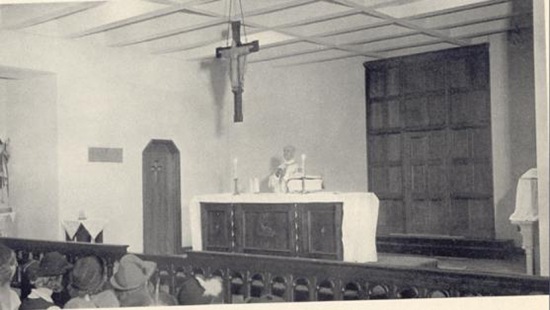
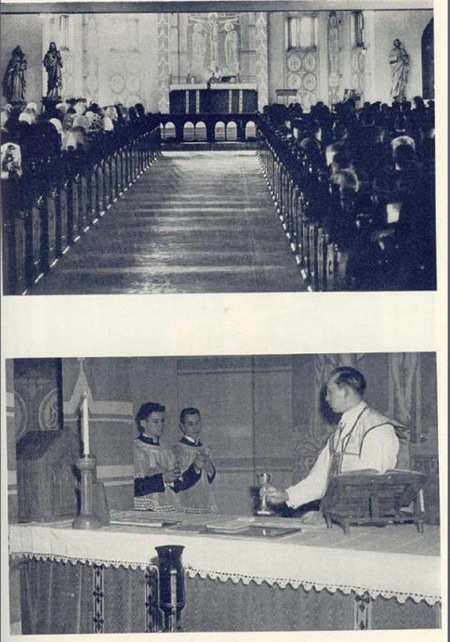
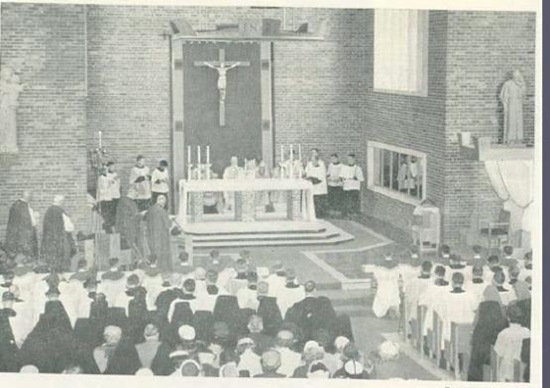
Some [very] daring priests even began to celebrate Mass facing the people, which required a relocation of the tabernacle. This was popular in some circles in post-World War I Europe and in post-World War II America, particularly on the east coast. Service time as chaplains during the war and the influence of Collegeville, Minnesota doubtlessly formed the tendencies of American clergy. Perhaps most startling is this: priests need permission and funding approval from their bishops to remodel their parishes. "Wreckovations" were more popular before 1969 than most think, and they were executed with episcopal approval.

Latin School in Indianapolis, 1965. Versus populum was common but not explicitly legal
at this point.
From Gerald Ellard's Mass of the Future, published in 1948

This one is particularly odd:

From St. Helen's in Minneapolis, Minnesota. See the "bread box" styled
tabernacle on the side? I think article 315 of the GIRM is an improvement over this...

More interesting:
A Mass celebrated by Archbishop Howard of Portland, Oregon in 1947.
Another in the same vein:

Archbishop O'Hara of Kansas City celebrated the Feast of Christ the King in 1954.

An "offertory procession" of the President and First Lady of the Philippines in 1965.
One can easily find similar images from New York City in the 1940s.
credit: catholicphilippines.blogspot.com

These practices did not appear out of thin air in 1969, or even in 1965. They had been on-going in many communities for decades by the time the Second Vatican Council and Paul VI popularized them.