Thanks to the Unionized Society of Postal Sloths, the USPS, the Ordo recitandi Officii Divini Sacrique peragendi published by the St. Lawrence Press has finally arrived at my doorstep. Perhaps the Orthodox Christmas cards cleared the mail and they decided to get to the international bag?
The SLP Ordo is a must for any Traditional Catholic with a remotely liturgical interest, be (s)he clerical or lay. Even those who, like myself, observe the Roman Office predating S Pius X's alterations will find this booklet helpful for things like tracing the occurring Scripture, following when commemorations falls, finding the Saturday Vespers antiphon, and which third verse to say on Iste confessor.
Initially compiled by John Tyson, attributed on the second page of the Ordo, the SLP book is preferable to any other Ordo recitandi precisely because it is the only traditional one. It follows the Roman rite as it existed before Pius XII began the un-ending tinkeritis on the Mass and the associated deforms to the Divine Office. Originally, the Ordo was published in association with the FSSPX before Archbishop Lefebvre's liturgical about face. Since then it has been compiled under the aegis of the St. Lawrence Press in England.
As such, it is also the only truly traditional Ordo in how it is published. As it began only a few years after the conclusions of Vatican II and the abolition of Latin and the old liturgy, it retains the structure, style, and useful items that the older, traditional Ordines had in better times. I have seen the FSSP, FSSPX, and LMS publications, all of which follow the 1962 Missal and are available in English. The SLP Ordo instead follows the older style of abbreviations and page layout and in the Latin language, making it a universally useful product. For those who would excuse the vernacular in the '62 products, if a priest cannot follow a simple fragment sentences in Latin he has no business reading Mattins or the Roman Canon in that tongue either.
This Ordo contains much more than just the color of the day or what to do at Vespers. It denotes on which day votive and Requiem Masses may be said or sung as well as the commemorations and, if occurring, proper Last Gospel, both useful steps in an incrementalist approach to wean off the '62 rite.
The front of the Ordo is uniquely valuable. It contains the Noveritis both for liturgical use and for reference of the user. Following that are the regulations around votive Masses, the manner of observing a patronal feast when it is impeded, the rules around external solmenities of the Sacred Heart, how to conduct a Forty Hours devotion, when a Nuptial Mass is permitted, votive Masses—sung or said—of devotions or Requiem, the general rules around commemorations, and what qualifies as a proper Last Gospel. Other Ordines may tell you when these things happen or are permitted in '62ville, but they will not educate one who actually wishes to know what the traditional liturgical praxis of the Roman rite is.
This Ordo has its virtues, virtues which may at first look challenging. The traditional abbreviation system, for example, may look daunting in contrast to this bit of spoon feeding, but page 16 explains the whole thing and provides an easy reference if a reader gets stuck on a day. It is not hard, but just like learning the old Mass and Office, it requires a little patience and curiosity before providing immense return. So go over the to St. Lawrence Press, get your copy, support tradition, and practice it.
Showing posts with label St. Lawrence Press. Show all posts
Showing posts with label St. Lawrence Press. Show all posts
Sunday, January 19, 2020

Sunday, November 25, 2018
Ordo MMXIX
Yesterday I did something rare in this day and age: I received something meaningful from a friend in the mail. It was my annual copy of the St. Lawrence Press Ordo Recitandi Officii Divini Sacrique Peragendi. What would I, someone who reads a 19th century breviary, do with an Ordo that follows the 1939 Roman rite? Quite a bit, actually.
First and foremost, this book is indispensable, even if one follows the Tridentine or any pre-Divino Afflatu kalendar, whenever the ferial Office occurs. I am easily confused reading the epistle in my Greek rite parish on Sundays (where the number of weeks after Pentecost begins on Monday after Pentecost) and then glancing at my Pius IX Office, which numbers the weeks after Pentecost from the Sunday after Pentecost Saturday. If not for this book I would probably never have my head on straight enough to find the proper Magnificat antiphon for Saturday evenings, taken from a text corresponding to the Office rather than to the day of the week.
Secondly, and similarly, this Ordo notes changes in the occurring Scripture for ferial Mattins, which is the same system in my breviary. This becomes more valuable, and tricky without a guide, in September and October, when the method of counting weeks differs between the traditional variations of the Roman rite and the 1962 rite, which counts September and October more in accord with modern secular time. In a like manner, this Ordo helps one track things like September Ember days and the treatment of vigils of Apostles, which are either on different days or non-existent in later editions of the Roman liturgy.
Lastly, the SLP Ordo is invaluable for timing liturgical devotions and observances that often go unnoticed. During Lent and Advent the Office, and Mass, of the Dead are conventionally said on the first day of the week without a feast of nine lessons; the Ordo notes such days with an X in the margin. For those in Holy Orders, there are additional instructions for the Forty Hours, privileged votive Masses on certain days of the month, and even external solemnities.
So if you've been reciting the Tridentine Office and don't quite trust that DivinumOfficium.com website, or if you wish to follow something more recent and need an aid, buy a St. Lawrence Press Ordo!
Wednesday, December 27, 2017
Ordo for the Ordinary Old Rite, Not the Extraordinary New Rite

How is the 1962 liturgy different than what preceded it? For
one, Pius XII “renewed” Holy Week by tossing it asunder and concocting
something else. There are also fewer commemorations than the one to six one
could feasibly observe on most days in the old rite. Is that it? A few less
prayers and one week of the year a bit wonky? What if I were to tell you every day of the year is different in
1962 from what came before it. While some days, like the Sunday of Our Lord’s
Resurrection, only vary minutely, large swatches of the year are quite
different from the traditional Roman liturgy.

Enter exhibit A, the days preceding Palm Sunday during
Passiontide. The most obvious difference is that the 1962 liturgy admits no
such thing as Palm Sunday other than as an alternative name, curiously calling
the day the “Second Sunday in Passion Time.” What about the days before the
Second Sunday in Passion Time? Wednesday calls for Saint Benedict’s three
nocturne Office and a Mass with a commemoration and proper Last Gospel of the
feria. Friday anticipates the suffering of Christ in one week by contemplating
the suffering of His Immaculate Mother now, again commemorating the feria. And
Saturday is the feast of Saint Gabriel the Archangel. Both of these feasts
would treat the season just like Saint Benedict’s feast, a full liturgy with
proper and thorough commemoration of the season, so as not to omit it.

Why, surely the 1962 liturgy, which—unlike the big, bad “Novus
Ordo”—has feasts of saints plentifully and commemorations, does this right? No.
In fact it disregards most of it out of hand. You see, Carissime, the old rite does not permit saints to replace Sundays
of penitential seasons, but it will permit them to replace weekdays under
certain conditions. Perhaps saints ought not make such a splash during a time
of fasting and prayers. Or perhaps Saint Benedict is not a minor saint, but the
father of Western monasticism and the man whose legacy saved Europe for Christ’s
sake. Perhaps the feast of the Seven Dolors of the Blessed Virgin is not a lollipop
Marian devotion, but a preparation for the Passion of Christ and the antecedent
to the surviving September feast, which is centuries newer. And perhaps Saint
Gabriel is celebrated on the 24th of March because the following day
is ordinarily the Annunciation, when God firmly entered into the fullness of
time for our salvation by the fiat of
the Virgin and the words of the same archangel.

These differences, sometimes subtle and sometimes broad, are
exactly why every traditionalist, cleric or lay liturgy-ophile, should be armed
with the 2018 edition of the St. Lawrence Press Ordo Recitandi Officii Divini Sacrique Peragendi. This Ordo, unlike those of Ecclesia Dei, the British Latin Mass
Society, the FSSPX, or FSSP, follows the liturgy as it existed before the gears
of change that brought about the liturgical revolution began to churn. It is
the last Office, Missal, Gradual, and Ritual that Montini, Pacelli, Braga, and
Bugnini did not touch, and is consequently the last calendar that a saint from
1900 and 900 would recognize, especially during major liturgical seasons. Ought
it be used to its full extent?—i.e. the use of the Roman liturgy prior to the “extraordinary
form”? It is really not much of a moral dilemma. One should follow the
tradition of the Church and her mens
of worship, which, come to think of it, precluded committee fabrications until
quite recently. There really is not much dilemma as to what one should do on
May 1st, when one can either follow the 7th/8th
century feast of Ss. Philip & James or celebrate the [rather dated]
political outreach to communists called Joe the Worker, which includes texts
about construction workers joyously listening to Pius XII talk in St. Peter’s
square.

Not only is the St. Lawrence Press Ordo valuable to a full-on traditionalist parish, but also to those
who are searching for enough bottle to take the final plunge; it is good for
those getting a feel for tradition and looking to filter good practices, like
commemorations or Monday Requiem Masses during Lent, into the current extraordinary
form of the Pauline Mass, the 1962 Missal. One could, for instance, celebrate a
votive Mass of the Holy Name of Mary on the Sunday after her September Nativity
or that of St. Joachim on the Sunday after her Assumption. One can introduce
the proper Last Gospel, as we recently had at the third Mass of Christmas day.
Lastly, the St. Lawrence Press Ordo is worth buying because of the increasing popularity of the
old rites of Holy Week and the traditional rubrics (both ritual and textual)
for Sunday Masses. Not only does the Ordo
help with such work, but it made these modern efforts possible in the first
place by preserving and promoting liturgical orthopraxis after Archbishop
Marcel Lefebvre acquiesced to the Vatican’s 1983 request that he switch to 1962
precisely because it was published during Vatican II. Without preserving
knowledge of the rubrics and keeping the old rite as a real, living tradition
it is doubtful we would be seeing the resurgence of the genuine old rite that
we do today. If anyone has doubts, look at the Holy Week pictures on New
Liturgical Movement. I never thought I’d see a Presanctified Mass at Holy
Innocents in New York, but I have.

Sunday, January 1, 2017
For Auld Lang Syne: Ordo 2017
I recently began re-reading JRR Tolkien's The Lord of the Rings, which I last pursued in 2003 as a freshman in high school amid the film installments that brought nerds interested in Elvish minutiae out of the woodwork. To this author Tolkien's work is, at least in part, a take on other epic adventure stories and hearkens back to a different social structure when entertainment took place in the form of stories and songs. When I read Lord of the Rings I make up melodies for the [gratuitous] songs in my mind (Bilbo really needs to stop). Christmas may well be the only time of the year when the general populace can be counted on to know a traditional song, something that does not have a studio original that charted in the last ten years; even at that, most can only muster the first verse of Hark! The Herald Angels. At a charming New Year's Eve gathering last night I attempted to start Auld Lang Syne after the clock struck midnight. Most knew the tune, but absolutely no one knew the words. Not one.
Auld Lang Syne is something out of auld lang syne, that is, days long ago. Should its acquaintance be forgot? Certainly not, nor should many older and venerable things from days gone by which are as ingrained in our senses as ever, even if they are scrubbed out of our active consciences. Take the Roman liturgy for example. There is an enduring simplicity and power in its words not latent in the elaborate ceremonies of the Greeks, the communitarian rites of the Reformers, or reduced forms of Summorum Pontificum. But we do not live in auld lang syne; we live in the now but are burdened with the past, for we possess nothing certain if not experience.
For those devotees, clerics, laymen, students, and plain Catholics looking to preserve the auld lang rite for the present, I recommend they buy the St. Lawrence Press's Ordo Recitandi Offici Divini Sacrique Peragendi here. As the name betrays, it is an ordo recitandi for the daily Office and Mass in the Roman rite before Pius XII and his epigoni (Bugnini, Bea, and others with Italian names) laid their hands on the liturgy and gradual evolved into the Ordinary and Extraordinary forms of the Novus Ordo (the Paul VI and 1962 rites respectively). The Ordo contains information on every imaginable rubric that should put the uninitiated at ease and provide detail for full liturgical service options throughout the year, including:
Auld Lang Syne is something out of auld lang syne, that is, days long ago. Should its acquaintance be forgot? Certainly not, nor should many older and venerable things from days gone by which are as ingrained in our senses as ever, even if they are scrubbed out of our active consciences. Take the Roman liturgy for example. There is an enduring simplicity and power in its words not latent in the elaborate ceremonies of the Greeks, the communitarian rites of the Reformers, or reduced forms of Summorum Pontificum. But we do not live in auld lang syne; we live in the now but are burdened with the past, for we possess nothing certain if not experience.
For those devotees, clerics, laymen, students, and plain Catholics looking to preserve the auld lang rite for the present, I recommend they buy the St. Lawrence Press's Ordo Recitandi Offici Divini Sacrique Peragendi here. As the name betrays, it is an ordo recitandi for the daily Office and Mass in the Roman rite before Pius XII and his epigoni (Bugnini, Bea, and others with Italian names) laid their hands on the liturgy and gradual evolved into the Ordinary and Extraordinary forms of the Novus Ordo (the Paul VI and 1962 rites respectively). The Ordo contains information on every imaginable rubric that should put the uninitiated at ease and provide detail for full liturgical service options throughout the year, including:
- public and private, said and sung votive Masses, including those of Nuptial and Requiem
- commemorations
- Forty Hours devotions
- external solemnities
- proper Last Gospels
- colors and prefaces within octaves
- movable feasts
- the patronal feast of a church
- doxologies at the end of hymns
What's that? The 1962 police are after you? I assure you they are not! We do not live under auld lang syne and the halcyon days of Benedict XVI, but under the light yoke of Papa Peron Bergoglio, who is aggressively disinterested in liturgical form. Why not sentire cum Papa and just do the real thing? Why not celebrate St. Joseph's patronage of the Universal Church, or Pip'n'Jim on May 1, or the octave days of the comites Christi this week? The Roman rite reflects centuries of prayer, reform, preservation, and crystallization in the liturgy. Would it not be preferable to do the pre-Pius XII rite not because we can construe a legal argument for it, but simply because it is the right rite thing to do for "sake of auld lang syne"?

If you are a priest and do not exercise your ministry in an environment conducive to doing the old old rite, then the Ordo 2017 is still useful to you. You can add the suffrage of Saints and preces to your Office on days that the old liturgy prescribes them, append commemorations (like Fidelium on the first Monday of the month) to the collects as they would have been, use the preface of the Nativity during the octave of Corpus Christi, dismiss the faithful with Benedicamus Domino when the Gloria is not sung, or say a votive Office of the Dead on the first free day of each week during Lent and Advent.
Are you a priest who celebrates the Mass of Paul VI on a daily basis? With a little imagination you may be in considerably better position to use the Ordo than those in 1962 communities. No one will stop you from using the old Office and the new Mass is surprisingly malleable in certain parts: unlike the saint-laden 1962 kalendar, the Ordinary form of the Novus Ordo has a number of ferial days comparable to the Tridentine kalendar, meaning one could use votive Masses to resurrect the octaves a certain Italian nobleman sent to the chopping block in 1955. The rubrics for Holy Week are also not as strict as in the extraordinary form of the Novus Ordo, so why not have a double-genuflection during the veneration of the cross on Good Friday?
So, venerable Fathers, it is 2017: buy an Ordo, reserve a set of folded chasubles at Gammarelli, find an old breviary, and start incorporating the traditional Roman liturgy into your church for "sake of auld lang syne."
Thursday, December 1, 2016
Ordo Recitandi: For Sale Now!
For all devout practitioners of the traditional Roman liturgy, the Ordo published by the St. Lawrence Press is available for purchase for 2017. If you want a daily dose of what the Roman liturgy was like before Pius XII and in accordance with the received norms of the Roman kalendar, this ordo is perfect for study or practical use by laymen and clerics praying and celebrating the Office or Mass.
For a review of the ordo and an in-depth interview concerning its history, the immediate history of the traditionalist movement in England, and the compiler's views on the current state of the Roman liturgy, see the re-published 2014 interview below.
A newer review of the MMXVII ordo should follow in the coming weeks.




Certain days, such as those of the Triduum, contain long descriptions of unique rites and ceremonies proper to the day. Any church master of ceremonies would already be expected to know this information, but I suspect it would be a very helpful reminder to the sacristan, who might read it over to remember everything he needs to prepare the altar, the vestments, and any other articles necessary for the day. A thoughtful sacristan might even read ahead and ask the priest if he anticipated celebrating a votive Mass or a ferial Lenten day on a feast and then write an emendation in the generous margins.
For a review of the ordo and an in-depth interview concerning its history, the immediate history of the traditionalist movement in England, and the compiler's views on the current state of the Roman liturgy, see the re-published 2014 interview below.
A newer review of the MMXVII ordo should follow in the coming weeks.
* * *
I am grateful to the St. Lawrence Press for the opportunity to review their Ordo Recitandi Officii Divini Sacrique Peragendi for 2015, as well as for the time spent by the compiler, Rubricarius, to answer questions about the history of the Ordo, provide us with some invaluable history told from experience, and his thoughts on the future of the traditional Roman liturgy. I have never looked at an Ordo other than a quick glance at the FSSPX one while at the Oxford Oratory (more accurate than the LMS), so I cannot compare the St. Lawrence Press version's quality to other ordines, but I think the thoughtful layout and the efficient presentation will speak for themselves. This booklet, which continues the praxis of the early traditionalists in following the 1939 typical edition of the Missal, should be helpful for all gradations of use: laymen, solitary priests, and for public prayer settings. Even non-users might find the Ordo an interesting study in the traditional liturgy's kalendar and commemoration system, although this booklet does deserve to be put to practice.
Part I: Reviewing the Ordo
The first page contains immediately useful information on the dates of the variable feasts of the year and the four sets of ember days. Atop the third page is the proclamation of the variable feasts sung after the Gospel every year on the feast of the Epiphany, which would be helpful to someone working without a form.
The Ordo, which is entirely in Latin—no Classical word flourishes, mercifully—publishes exhaustive, straight forward, and concise details on such things as external solemnities, titular feasts and the dedication of churches, private and public votive Masses—normal and Requiem, and the guidelines for the Forty Hours devotion, which, despite being eleven paragraphs long, is quite simple and more thorough than what one finds in Fortescue.
Yes, there can be an external solemnity of the Sacred Heart. The rubrics on the left continue the extensive directions for the Forty Hours.
The rules around Masses for the Dead vary in strictness depending on whether or not the Mass is a sung Mass or not. This Ordo forgets not the finer details of the commemoration system, too, such as the use of the orations for the dead on the first feria of the month at Mass.
When I first heard that the Last Gospel is replaced with another text on some days, I was a bit confused when told that this only occurs when the displaced text is "strictly proper." The Ordo contains a very good explanation that any priest should be able to remember and understand when consulting the Ordo listing for a feast or Sunday which displaces another day.
Guidelines for orations, the Ordinary of Mass, and prefaces in private votive Masses, which differs in many respects from 1962.
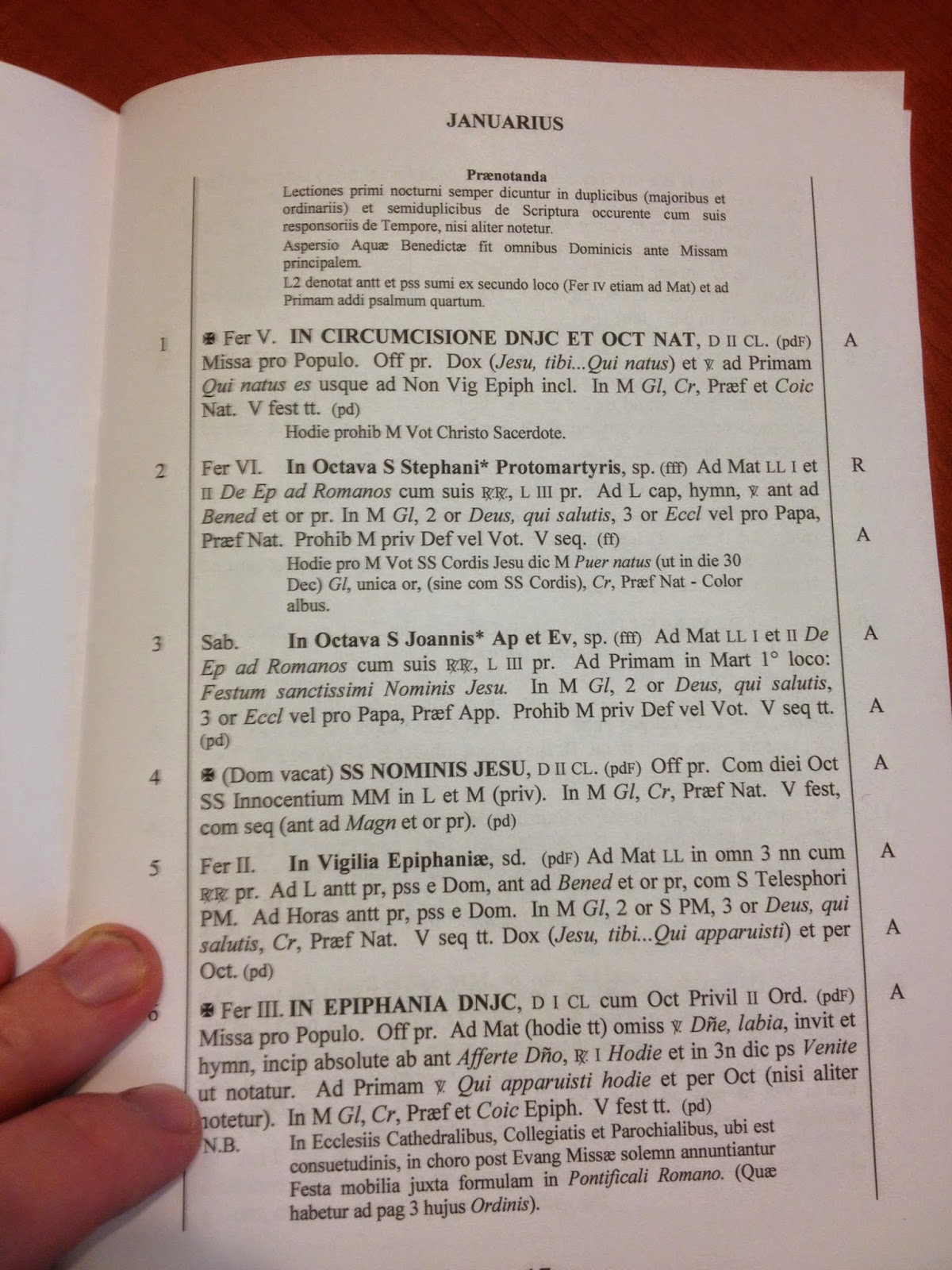
In order to be succinct, the Ordo does not give long explanations like the LMS and FSSPX ordines, but instead employs an abbreviation system. At first all these potential entries look intimidating, but the layout of the pages containing the liturgical orders of the days makes everything more intelligible.
For example, the R next to the octave day of St. Stephen indicates that the Mass and Office of the day are observed in red vestments and with a red altar frontal. The A midway through the entry directs a change to white (albus) for V seq (Vespers of the following day).
I believe most ordines begin at Advent. The St. Lawrence Press Ordo begins with January 2015 and, considerately, runs to the 10th of January, 2016.
This page is a nice example both of the clarity of the Ordo and the depth of the old Roman rite. The page is for March. The 23rd is a Lenten Monday which, noted by the X to the right, permits a votive Requiem Mass (as do all ferial Mondays of Lent). At Vespers the color changes to white for the feast of St. Gabriel the Archangel, a greater-double feast. At Mattins, the lessons and responsories in the first nocturne are proper to the feast. The ninth lesson is that of the displaced feria. The feria is commemorated with its Benedictus antiphon and collect at Lauds, as well as with a commemoration and proper Last Gospel at Mass (it is strictly proper). A private Mass may be celebrated of the feria with a commemoration of St. Gabriel and a proper Last Gospel, the prayer super populum per the Lenten feria, and the Benedicamus Domino dismissal, all done in violet for the Mass alone. Vespers is of the following feast of the Annunciation, a double of the first class, with the Incarnation doxology used in the hymns that night and during the hours on the 25th.
Certain days, such as those of the Triduum, contain long descriptions of unique rites and ceremonies proper to the day. Any church master of ceremonies would already be expected to know this information, but I suspect it would be a very helpful reminder to the sacristan, who might read it over to remember everything he needs to prepare the altar, the vestments, and any other articles necessary for the day. A thoughtful sacristan might even read ahead and ask the priest if he anticipated celebrating a votive Mass or a ferial Lenten day on a feast and then write an emendation in the generous margins.
This is an excellent Ordo for use and study by both clerics and laymen. I would recommend getting a copy yourself and putting it to some good use. To order the St. Lawrence Press Ordo for 2015, click here. They take PayPal.
Part II: Interview with the Compiler
Herein follows an interview with Rubricarius, the compiler of the Ordo and friend of this blog. He gives us some history about the Ordo as well as some very unique views of the future of the old rite and about Summorum Pontificum which should get the comment box rolling.

 A. If I may answer these questions together Rad Trad? As I mentioned earlier it was actually the $$XP itself that was publishing the Ordo from 1979 onwards with a considerable number of its clergy using it. When the trustees of the St. Pius V Association had handed over its assets to the $$PX one of the conditions was that the pre-Pius XII liturgy was to continue to be used. I understand that one of the original trustees deeply regrets now not having taken legal action when the $$PX reneged on the terms. Who knows what might have been... Anyway, as to the ukase to enforce the use of the 1962 books this was a consequence of discussions Lefebvre was having with Rome in the early 1980s. I have letters from both Michael Davies and Bishop Donald Sanborn – from opposite ends of the Traddieland spectrum - confirming this to be the case. In his letter Michael Davies states that the indult Quattuor abhinc annos was a direct consequence of these discussions. (We can see the parallels with Summorum Pontificum and Fellay’s overtures to
 Rome USA church of SS Joseph and Padarn in London


Q. Thank you, Rubricarius, for sending me your Ordo 2015 for review. I have long been an avid reader of the St Lawrence Press blog and appreciate its efforts to educate the public on the Roman liturgy as it existed prior to Pius XII and the general process of change. Could you perhaps tell us more about the specifics of your Ordo, such as the year it follows and how that came about?
A. Thank you, Rad Trad for your interest. The Ordo began back in the early 1970s as the idea of Fr. Peter J. Morgan (the first priest ordained by Mgr. Lefebvre for the Fraternity back in 1971). Fr. Morgan soon gathered a sizable group of interested clergy and somehow managed to create Mass centres almost out of thin air. He felt it was time to resurrect a traditional Ordo. What must be born in mind is that the Ordo reflected the liturgical praxis of what the St. Pius Association (the precursor to the $$PX) and other traditional clergy were using at the time. Fr. Morgan asked Mr. John Tyson, the compilator emeritus, to produce an Ordo for 1973. John is a truly exceptional and talented man and could basically think an Ordo in his head for any given year. John’s rather difficult-to-read script – it looks very like classical Armenian - was patiently deciphered and typed up on foolscap by the late Miss Penelope Renold and published in three sections by the ‘St. Pius V Information Centre’. The first volume. ‘Pars Prima’ was clearly somewhat rushed with the cover in Miss Renold’s handwriting. ‘Pars Secunda’ and ‘Pars Semestris’ followed with typed covers. The two following years saw again a simple foolscap size production but integrated into a single volume. The current format has its origins in the 1976 edition.
The ‘pre-Pius XII’ rubrics were what clergy and their supporters used at that time. What is now called the ‘EF’ had, obviously, been used for the couple of years of its existence a decade earlier – but not by everyone I would add - but no one who was supporting the cause of ‘Old Rite’ used it in the UK in the 1970s and it did not make an appearance until a decade later.
Q. Who were the principle people behind the Ordo when it began publication under the St Pius V Information Center? What sort of structure runs the administration of the St Lawrence Press Ordo today?
A. We have covered this, in part, with the first question. The driving force was Fr. Morgan who channeled the considerable talents and knowledge of John Tyson. Miss Renold did the typing and, I would conjecture, the posting to interested parties. The Ordo was published by the St. Pius V Association up to and including Ordo 1978. Ordo 1979 was published by the $$PX and they continued to publish it up to Ordo 1983. All this time Mr. Tyson was continuing to exercise his considerable talents. Since 2002 the Ordo has been published by The Saint Lawrence Press Ltd. This is a legal entity of a company limited by shares in English Law. It has three directors, including myself, and a company secretary.
Q. How did the St Lawrence Press survive the liturgical about-face of 1983, when the Society of St Pius X reversed its 1977 decision to allow celebrants of the old rite to continue their established custom and imposed the 1962 liturgy on all priests in the Fraternity? Why was the pre-Pius XII rite worth saving, from the perspective of those who continued the St Lawrence Press at the time?
A. If I may answer these questions together Rad Trad? As I mentioned earlier it was actually the $$XP itself that was publishing the Ordo from 1979 onwards with a considerable number of its clergy using it. When the trustees of the St. Pius V Association had handed over its assets to the $$PX one of the conditions was that the pre-Pius XII liturgy was to continue to be used. I understand that one of the original trustees deeply regrets now not having taken legal action when the $$PX reneged on the terms. Who knows what might have been... Anyway, as to the ukase to enforce the use of the 1962 books this was a consequence of discussions Lefebvre was having with Rome in the early 1980s. I have letters from both Michael Davies and Bishop Donald Sanborn – from opposite ends of the Traddieland spectrum - confirming this to be the case. In his letter Michael Davies states that the indult Quattuor abhinc annos was a direct consequence of these discussions. (We can see the parallels with Summorum Pontificum and Fellay’s overtures to
Anyway, Fr. Black realised that he could no longer produce the Ordo so he asked two dear friends of mine, now my fellow directors, to produce the Ordo. This decision was made immediately after Lefebvre left London England
This did cause some upset with customers so 1985 had an absolutely plain cover.
The artist Gavin Stamp was a university friend of Mr. Warwick and drew the cover image for Ordo 1986. Yours truly came across the $$PX in 1988 and became instantly fascinated by the Ordo. Despite what had happened five years earlier the majority of clergy were still using ‘pre-Pius XII’ then. I recall a whole year of Sunday’s without a hint of 1962 – happy days. The current UK
As to why it was worth saving I think that is because it was the best thing available at the time and within living memory of so many involved. A great many people identified this as ‘Old Rite’ as it was what they had experienced before the changes. What I did notice was that many people I met who were supporting the $$PX had been servers or singers at Fr. Clement Russell’s church at Sudbury
Q. How did the 1983 decision and the 1984 indult influence celebrations of the pre-Vatican liturgy among traditionalists? What sorts of groups, other than sedevacantists, continued the old rite?
A. A very interesting question. Again, what I think needs to be emphasized is that in the early days 1962 was not being used. Indeed, a very good friend of mine was close friends with an elderly priest from the NW of England twenty years ago. The elderly priest told my friend that he and a group of other parish priests just quietly refused to adopt the new Holy Week. “We thought Pius had flipped” he told my friend and that ‘normal’ service would be resumed after Pius’ death. The Old Rite though never entirely died out in England
Q. Please explain, how you became involved with the Ordo?
A. When I first discovered the ‘old rite’ in 1987 I found it all very confusing as celebrations I attended did not match the ‘Saint Andrew’s Daily Missal’ I had. When I first met Mgr. Gilbey his Masses matched it perfectly so that set me thinking. I first attended $$PX Masses in 1988 and soon discovered the Ordo. I found it fascinating as at the same time I was being instructed by a friend, now sadly departed, to learn the Breviary. I knew John Tyson of course and remember asking him about (I V) in the Ordo. I said to him ‘John, I think I have worked out commemorations except the hymn element. What do you do if the hymn does not have five verses?’ John gave one of his famous chuckles and said ‘You fool, you Tom fool, it is not one to five but of first Vespers.’ Anyway I soon became involved with proof reading the Ordo. It was all relatively primitive in those days. Although we have moved on from typing the thing it was being produced in WordPerfect which was not a WYSIWYG software programme. The symbols for holy days and days of devotion were drawn in by hand before the pages went off to the printers. Then came along Word2 and Word6 and subsequent editions by Mr.Gates and it became much easier. Eventually, and I do not recall exactly when, sometime in the mid-1990s yours truly was producing the scripts and then took over completely with the Saint Lawrence Press Ltd.
Q. Who are some past or present customers of the St Lawrence Press that our readers today would recognize?
A. Customer details are covered by legislation such as the Data Protection Act, notwithstanding basic morality, and so cannot be revealed without the person’s express consent. However, a wide range of people from all continents form the current customer base with the majority of customers coming from the United States and from France
Q. Personally, I find the Roman rite from 1911-1955 far more complicated in rubrics and kalendar than what preceded or succeeded it. How do you deal with the challenges of the Divino Afflatu system?
A. It certainly made the rubrics of the Roman rite far more complicated than they were. Indeed, if I were into conspiracy theories – which I am not - I think one could be forgiven for thinking it was a deliberate ploy to make life so complicated that any reform would be received with open arms. My view is that in reality the reform was rushed through and its ramifications only began to be understood in the years that followed. Clarifications and differing interpretations were appearing in Ephemerides Liturgicae throughout the 1920s and 1930s. Looking at extant Ordines of the period it is interesting – to compilers of Ordines at least – to see the lack of consistency in interpretation. A good example was a few years ago when the feasts of St. George, St. Mark and SS Philip and James had to be transferred out of the Paschal Octave. I consulted four Ordines from 1943, two in my collection and two in the British Library. None had exactly the same solution: three were similar but one was way off. After carefully considering the rubrics I decided none were actually correct. To those of us with an interest in such matters it was an amusing study but life should not be that complex. As to ‘dealing’ with the system I am afraid that exposure to the ‘Pius X’ rubrics was part of my formative period so I can think the system in my sleep. Indeed, when I first looked at pre-1911 praxis I found it very hard and it required a lot of effort to understand it, but I did persevere. It is far superior in my view but we are limited by the lack of availability of books at the moment to promote a serious restoration.
Q. Have you noticed any change in your clientele or in business to the St Lawrence Press since Summorum Pontificum in 2007? If so, why?
A. There was an initial flurry of interest and indeed I recall one cleric asking if we would now adopt the 1962 rubrics. Needless to say the answer was strongly in the negative. What is noticeable is that those with a more serious interest in liturgy see through 1962 quite quickly and look to move to something more traditional. There is a steadily increasing number of customers – which is much needed because many of the original customers have now passed over to Eternity. I think that, ultimately, Summorum Pontificum will be seen as something that had a damaging effect on the liturgy but the influence of which faded over time. Indeed, I expect that Summorum Pontificum will be negated by legislation from Rome
Q. In what direction do you see the future of the old rite headed?
A. After the period of specious interest following Summorum Pontificum, and I think we really have seen the A to Z of specious interest, I see a period of contraction and confusion – as we see today – that will be followed by an implosion. I take the view that there will be a more real discovery of liturgical orthopraxis and patrimony but that will take time, a couple of decades at least. I also believe we will see structural change too – rather like what you have alluded to in some of your posts mentioning the Minster system for instance. I believe that reform – in a good sense – will be from grass roots upwards, not from the top down.
Q. In what sort of research does the St Lawrence Press engage?
A. My own research interests are the reform of the Roman rite 1903 – 1963; the reform of the Roman typical editions of the liturgical books from 1568 to 1634, the celebration of Holy Week, liturgical theology in general and the psychology of religion.
Q. Given that the early traditionalists and the St. Lawrence Press stopped at 1939, what would you say in the liturgical legacy of the pope elected that year, Pius XII?
A. I don’t think the proto-traditionalists thought it terms of 1939 per se but of ‘pre-Pius XII’ As we know men like Evelyn Waugh were totally disparaging about the Pacelli pontificate. Sadly, what we have seen over the last quarter of a century or so is the development of what a blogger friend of mine termed cognitive dissonance. There is a steadfast refusal to acknowledge the well document facts of the damage done to the Roman liturgy by Pius XII. In my own view he as much a showman and narcissist as John Paul II. The inversion of the axiom lex orandi, lex credendi was an unmitigated disaster and a charter for the modernists.
Q. Some insist that the Pauline liturgical changes assimilated new doctrines and that, by contrast, the Pacellian novelties and reductions are tame, unworthy of attention in the quest to restore the Roman liturgy. Your thoughts?
A. Well, we have seen the development of a fallacious revisionism whereby any reform before the Second Vatican Council is magically ignored and excised from memory. I recall many years ago that when I came across photographs of Mass versus populum from the 1940s and 1950s my fellow ‘Traddies’ far from being interested hated me for showing them. There is the creation of a false construct by these people, they loathe Paul VI but adore old Pacelli. There are the old canards about a) the differences between 1962 and earlier edition being ‘minor’ and b) the radical nature of Paul VI’s 1970 changes. With respect to the first point if the changes are so minor, so trivial, not to be of any significance or not to be notice then why not just use pre-1962 anyway? Of course, the reality is very different and the whole point is that the 1962 brigade want to feel superior to everyone else and use legalism as a weapon against everyone else. As the second point that argument is wildly over made. What was Mass like the day before Paul VI’s Missal became law? People, very conveniently forget, that the 1962MR had not been used for almost a decade but the 1967 rite with the new Anaphorae, with various lectionaries and, of course, the vernacular and the fashion of versus populum.
We appreciate your time, Rubricarius, and thank you again for the opportunity to review you Ordo for the impending liturgical year. I speak for my readers in wishing you and the St Lawrence Press the best in your efforts to preserve the old rite and commending our prayers for that same intention.
Saturday, February 13, 2016
Turn Back the Liturgical Clock
According to my ordo recitandi from the St. Lawrence Press today I must turn back my liturgical clock, if only a few hours.
The Angelus and Sunday Vespers continue at the normal time, but ferial Vespers are said by noon and typically Mattins and Lauds are anticipated the prior evening, which we recognize in the rites of the un-reformed Triduum and Paschal Mattins on Saturday evening. Before I tried this schedule I easily conceded that it was an accommodation to monks who wanted to cheat their fast and have their meal after Vespers. After having prayed the old way for four years now I see the value of the inversion in the reversed times; the Resurrection restores order and puts things the way they should be.
The X in the right column for Monday indicates a votive Mass of the Dead may be sung this day. Votive Masses are prohibited during Lent and generally during Advent but the Roman Church did permit one Requiem Mass for deceased friends and benefactors to be celebrated on the first ferial day of the week with the accompanying Officium Defunctorum. The St. Lawrence ordo's abbreviation key indicates that the X signifies a "private Mass", however before 1960(2?) "private Mass" did not mean a low Mass celebrated in a sequestered environment, just a Mass other than the one canonically required for the day. A parish priest is only required to celebrate Mass on Sundays and Holy Days; religious orders are required to celebrate the full liturgy every day. A "private Mass" is a permitted special addition in either of those settings according to the old scheme of things. It really is a misnomer, given that a cardinal archbishop could celebrate a pontifical high Mass with full polyphony and it would be "private".
Has not the older liturgy a richness to it that encourages more effort on the part of the faithful?
Look for our usual Officium Defunctorum page in the near future. We will be praying the Office of the Dead on the first ferial day of each Lenten week for your intentions.
Also, buy a St. Lawrence Press ordo!
 |
| Lectio libri S. Laurentii |
 |
| A "private Mass"? |
Has not the older liturgy a richness to it that encourages more effort on the part of the faithful?
Look for our usual Officium Defunctorum page in the near future. We will be praying the Office of the Dead on the first ferial day of each Lenten week for your intentions.
Also, buy a St. Lawrence Press ordo!
Thursday, November 12, 2015
Ordines
My review also includes an informative and engaging interview with the compiler about the origins of his Ordo and of the traditionalist movement. Have a book and buy a copy here!
Saturday, December 6, 2014
Book Review: St. Lawrence Press Ordo Recitandi & Interview
I am grateful to the St. Lawrence Press for the opportunity to review their Ordo Recitandi Officii Divini Sacrique Peragendi for 2015, as well as for the time spent by the compiler, Rubricarius, to answer questions about the history of the Ordo, provide us with some invaluable history told from experience, and his thoughts on the future of the traditional Roman liturgy. I have never looked at an Ordo other than a quick glance at the FSSPX one while at the Oxford Oratory (more accurate than the LMS), so I cannot compare the St. Lawrence Press version's quality to other ordines, but I think the thoughtful layout and the efficient presentation will speak for themselves. This booklet, which continues the praxis of the early traditionalists in following the 1939 typical edition of the Missal, should be helpful for all gradations of use: laymen, solitary priests, and for public prayer settings. Even non-users might find the Ordo an interesting study in the traditional liturgy's kalendar and commemoration system, although this booklet does deserve to be put to practice.
Part I: Reviewing the Ordo
The first page contains immediately useful information on the dates of the variable feasts of the year and the four sets of ember days. Atop the third page is the proclamation of the variable feasts sung after the Gospel every year on the feast of the Epiphany, which would be helpful to someone working without a form.
The Ordo, which is entirely in Latin—no Classical word flourishes, mercifully—publishes exhaustive, straight forward, and concise details on such things as external solemnities, titular feasts and the dedication of churches, private and public votive Masses—normal and Requiem, and the guidelines for the Forty Hours devotion, which, despite being eleven paragraphs long, is quite simple and more thorough than what one finds in Fortescue.
Yes, there can be an external solemnity of the Sacred Heart. The rubrics on the left continue the extensive directions for the Forty Hours.
The rules around Masses for the Dead vary in strictness depending on whether or not the Mass is a sung Mass or not. This Ordo forgets not the finer details of the commemoration system, too, such as the use of the orations for the dead on the first feria of the month at Mass.
When I first heard that the Last Gospel is replaced with another text on some days, I was a bit confused when told that this only occurs when the displaced text is "strictly proper." The Ordo contains a very good explanation that any priest should be able to remember and understand when consulting the Ordo listing for a feast or Sunday which displaces another day.
Guidelines for orations, the Ordinary of Mass, and prefaces in private votive Masses, which differs in many respects from 1962.
In order to be succinct, the Ordo does not give long explanations like the LMS and FSSPX ordines, but instead employs an abbreviation system. At first all these potential entries look intimidating, but the layout of the pages containing the liturgical orders of the days makes everything more intelligible.
For example, the R next to the octave day of St. Stephen indicates that the Mass and Office of the day are observed in red vestments and with a red altar frontal. The A midway through the entry directs a change to white (albus) for V seq (Vespers of the following day).
I believe most ordines begin at Advent. The St. Lawrence Press Ordo begins with January 2015 and, considerately, runs to the 10th of January, 2016.
This page is a nice example both of the clarity of the Ordo and the depth of the old Roman rite. The page is for March. The 23rd is a Lenten Monday which, noted by the X to the right, permits a votive Requiem Mass (as do all ferial Mondays of Lent). At Vespers the color changes to white for the feast of St. Gabriel the Archangel, a greater-double feast. At Mattins, the lessons and responsories in the first nocturne are proper to the feast. The ninth lesson is that of the displaced feria. The feria is commemorated with its Benedictus antiphon and collect at Lauds, as well as with a commemoration and proper Last Gospel at Mass (it is strictly proper). A private Mass may be celebrated of the feria with a commemoration of St. Gabriel and a proper Last Gospel, the prayer super populum per the Lenten feria, and the Benedicamus Domino dismissal, all done in violet for the Mass alone. Vespers is of the following feast of the Annunciation, a double of the first class, with the Incarnation doxology used in the hymns that night and during the hours on the 25th.
Certain days, such as those of the Triduum, contain long descriptions of unique rites and ceremonies proper to the day. Any church master of ceremonies would already be expected to know this information, but I suspect it would be a very helpful reminder to the sacristan, who might read it over to remember everything he needs to prepare the altar, the vestments, and any other articles necessary for the day. A thoughtful sacristan might even read ahead and ask the priest if he anticipated celebrating a votive Mass or a ferial Lenten day on a feast and then write an emendation in the generous margins.
This is an excellent Ordo for use and study by both clerics and laymen. I would recommend getting a copy yourself and putting it to some good use. To order the St. Lawrence Press Ordo for 2015, click here. They take PayPal.
Part II: Interview with the Compiler
Herein follows an interview with Rubricarius, the compiler of the Ordo and friend of this blog. He gives us some history about the Ordo as well as some very unique views of the future of the old rite and about Summorum Pontificum which should get the comment box rolling.
A. If I may answer these questions together Rad Trad? As I mentioned earlier it was actually the
$$XP itself that was publishing the Ordo
from 1979 onwards with a considerable number of its clergy using it. When the trustees of the St. Pius V
Association had handed over its assets to the $$PX one of the conditions was
that the pre-Pius XII liturgy was to continue to be used. I understand that one of the original
trustees deeply regrets now not having taken legal action when the $$PX reneged
on the terms. Who knows what might have
been... Anyway, as to the ukase to
enforce the use of the 1962 books this was a consequence of discussions
Lefebvre was having with Rome in the early 1980s. I have letters from both Michael Davies and
Bishop Donald Sanborn – from opposite ends of the Traddieland spectrum - confirming
this to be the case. In his letter
Michael Davies states that the indult Quattuor
abhinc annos was a direct consequence of these discussions. (We can see the
parallels with Summorum Pontificum
and Fellay’s overtures to Rome USA church
of SS Joseph and Padarn in London
Q. Thank
you, Rubricarius, for sending me your Ordo
2015 for review. I have long been an avid reader of the St Lawrence Press
blog and appreciate its efforts to educate the public on the Roman liturgy as
it existed prior to Pius XII and the general process of change. Could you
perhaps tell us more about the specifics of your Ordo, such as the year it follows and how that came about?
A. Thank you, Rad Trad for your interest. The Ordo
began back in the early 1970s as the idea of Fr. Peter J. Morgan (the first
priest ordained by Mgr. Lefebvre for the Fraternity back in 1971). Fr. Morgan soon gathered a sizable group of
interested clergy and somehow managed to create Mass centres almost out of thin
air. He felt it was time to resurrect a traditional Ordo. What must be born in
mind is that the Ordo reflected the
liturgical praxis of what the St. Pius Association (the precursor to the $$PX)
and other traditional clergy were using at the time. Fr. Morgan asked Mr. John Tyson, the compilator emeritus, to produce an Ordo for 1973. John is a truly
exceptional and talented man and could basically think an Ordo in his head for any given year. John’s rather difficult-to-read script – it
looks very like classical Armenian - was patiently deciphered and typed up on
foolscap by the late Miss Penelope Renold and published in three sections by
the ‘St. Pius V Information Centre’. The
first volume. ‘Pars Prima’ was
clearly somewhat rushed with the cover in Miss Renold’s handwriting. ‘Pars
Secunda’ and ‘Pars Semestris’
followed with typed covers. The two following years saw again a simple foolscap
size production but integrated into a single volume. The current format has its origins in the
1976 edition.
The ‘pre-Pius XII’ rubrics were what clergy and their supporters
used at that time. What is now called
the ‘EF’ had, obviously, been used for the couple of years of its existence a
decade earlier – but not by everyone I would add - but no one who was
supporting the cause of ‘Old Rite’ used it in the UK in the 1970s and it did not
make an appearance until a decade later.
Q. Who
were the principle people behind the Ordo
when it began publication under the St Pius V Information Center? What sort of
structure runs the administration of the St Lawrence Press Ordo today?
A. We
have covered this, in part, with the first question. The driving force was Fr. Morgan who
channeled the considerable talents and knowledge of John Tyson. Miss Renold did the typing and, I would
conjecture, the posting to interested parties.
The Ordo was published by the
St. Pius V Association up to and including Ordo
1978. Ordo 1979 was published by the $$PX and they continued to publish
it up to Ordo 1983. All this time Mr. Tyson was continuing to
exercise his considerable talents. Since
2002 the Ordo has been published by
The Saint Lawrence Press Ltd. This is a
legal entity of a company limited by shares in English Law. It has three
directors, including myself, and a company secretary.
Q. How
did the St Lawrence Press survive the liturgical about-face of 1983, when the
Society of St Pius X reversed its 1977 decision
to allow celebrants of the old rite to continue their established custom and
imposed the 1962 liturgy on all priests in the Fraternity? Why
was the pre-Pius XII rite worth saving, from the perspective of those who
continued the St Lawrence Press at the time?
A. If I may answer these questions together Rad Trad? As I mentioned earlier it was actually the
$$XP itself that was publishing the Ordo
from 1979 onwards with a considerable number of its clergy using it. When the trustees of the St. Pius V
Association had handed over its assets to the $$PX one of the conditions was
that the pre-Pius XII liturgy was to continue to be used. I understand that one of the original
trustees deeply regrets now not having taken legal action when the $$PX reneged
on the terms. Who knows what might have
been... Anyway, as to the ukase to
enforce the use of the 1962 books this was a consequence of discussions
Lefebvre was having with Rome in the early 1980s. I have letters from both Michael Davies and
Bishop Donald Sanborn – from opposite ends of the Traddieland spectrum - confirming
this to be the case. In his letter
Michael Davies states that the indult Quattuor
abhinc annos was a direct consequence of these discussions. (We can see the
parallels with Summorum Pontificum
and Fellay’s overtures to
Anyway,
Fr. Black realised that he could no longer produce the Ordo so he asked two dear friends of mine, now my fellow directors,
to produce the Ordo. This decision was made immediately after
Lefebvre left London England
This
did cause some upset with customers so 1985 had an absolutely plain cover.
The
artist Gavin Stamp was a university friend of Mr. Warwick and drew the cover
image for Ordo 1986. Yours truly came across the $$PX in 1988 and
became instantly fascinated by the Ordo. Despite what had happened five years earlier
the majority of clergy were still using ‘pre-Pius XII’ then. I recall a whole year of Sunday’s without a
hint of 1962 – happy days. The current UK
As
to why it was worth saving I think that is because it was the best thing
available at the time and within living memory of so many involved. A great many people identified this as ‘Old
Rite’ as it was what they had experienced before the changes. What I did notice was that many people I met
who were supporting the $$PX had been servers or singers at Fr. Clement
Russell’s church at Sudbury
Q. How
did the 1983 decision and the 1984 indult influence celebrations of the
pre-Vatican liturgy among traditionalists? What sorts of groups, other than
sedevacantists, continued the old rite?
A. A
very interesting question. Again, what I
think needs to be emphasized is that in the early days 1962 was not being used.
Indeed, a very good friend of mine was close friends with an elderly priest
from the NW of England twenty years ago.
The elderly priest told my friend that he and a group of other parish priests just
quietly refused to adopt the new Holy Week.
“We thought Pius had flipped” he told my friend and that ‘normal’
service would be resumed after Pius’ death.
The Old Rite though never entirely died out in England
Q. Please
explain, how you became involved with the Ordo?
A. When I first
discovered the ‘old rite’ in 1987 I found it all very confusing as celebrations
I attended did not match the ‘Saint Andrew’s Daily Missal’ I had. When I first met Mgr. Gilbey his Masses matched
it perfectly so that set me thinking. I
first attended $$PX Masses in 1988 and soon discovered the Ordo. I found it fascinating as at the same time I
was being instructed by a friend, now sadly departed, to learn the
Breviary. I knew John Tyson of course
and remember asking him about (I V) in the Ordo. I said to him ‘John, I think I have worked
out commemorations except the hymn element.
What do you do if the hymn does not have five verses?’ John gave one of his famous chuckles and said
‘You fool, you Tom fool, it is not one to five but of first Vespers.’ Anyway I soon became involved with proof
reading the Ordo. It was all relatively
primitive in those days. Although we have moved on from typing the thing it was
being produced in WordPerfect which was not a WYSIWYG software programme. The symbols for holy days and days of
devotion were drawn in by hand before the pages went off to the printers. Then came along Word2 and Word6 and
subsequent editions by Mr.Gates and it became much easier. Eventually, and I do not recall exactly when,
sometime in the mid-1990s yours truly was producing the scripts and then took
over completely with the Saint Lawrence Press Ltd.
Q. Who
are some past or present customers of the St Lawrence Press that our readers today would recognize?
A. Customer details are covered by legislation such as the Data
Protection Act, notwithstanding basic morality, and so cannot be revealed
without the person’s express consent.
However, a wide range of people from all continents form the current
customer base with the majority of customers coming from the United States and from France
Q. Personally,
I find the Roman rite from 1911-1955 far more complicated in rubrics and
kalendar than what preceded or succeeded it. How do you deal with the
challenges of the Divino Afflatu
system?
A. It certainly made the rubrics of the Roman rite far more
complicated than they were. Indeed, if I
were into conspiracy theories – which I am not - I think one could be forgiven
for thinking it was a deliberate ploy to make life so complicated that any
reform would be received with open arms.
My view is that in reality the reform was rushed through and its
ramifications only began to be understood in the years that followed. Clarifications and differing interpretations
were appearing in Ephemerides Liturgicae
throughout the 1920s and 1930s. Looking
at extant Ordines of the period it is
interesting – to compilers of Ordines
at least – to see the lack of consistency in interpretation. A good example was a few years ago when the
feasts of St. George, St. Mark and SS Philip and James had to be transferred
out of the Paschal Octave. I consulted
four Ordines from 1943, two in my
collection and two in the British Library.
None had exactly the same solution: three were similar but one was way
off. After carefully considering the
rubrics I decided none were actually correct.
To those of us with an interest in such matters it was an amusing study
but life should not be that complex. As
to ‘dealing’ with the system I am afraid that exposure to the ‘Pius X’ rubrics
was part of my formative period so I can think the system in my sleep. Indeed, when I first looked at pre-1911
praxis I found it very hard and it required a lot of effort to understand it,
but I did persevere. It is far superior
in my view but we are limited by the lack of availability of books at the
moment to promote a serious restoration.
Q. Have
you noticed any change in your clientele or in business to the St Lawrence
Press since Summorum Pontificum in
2007? If so, why?
A. There was an
initial flurry of interest and indeed I recall one cleric asking if we would
now adopt the 1962 rubrics. Needless to
say the answer was strongly in the negative.
What is noticeable is that those with a more serious interest in liturgy
see through 1962 quite quickly and look to move to something more
traditional. There is a steadily
increasing number of customers – which is much needed because many of the
original customers have now passed over to Eternity. I think that, ultimately, Summorum Pontificum will be seen as
something that had a damaging effect on the liturgy but the influence of which
faded over time. Indeed, I expect that Summorum Pontificum will be negated by legislation from Rome
Q. In
what direction do you see the future of the old rite headed?
A. After the
period of specious interest following Summorum Pontificum, and I think we really have seen the A
to Z of specious interest, I see a period of contraction and confusion – as we
see today – that will be followed by an implosion. I take the view that there will be a more
real discovery of liturgical orthopraxis and patrimony but that will take time,
a couple of decades at least. I also
believe we will see structural change too – rather like what you have alluded
to in some of your posts mentioning the Minster system for instance. I believe that reform – in a good sense –
will be from grass roots upwards, not from the top down.
Q. In
what sort of research does the St Lawrence Press engage?
A. My own research
interests are the reform of the Roman rite 1903 – 1963; the reform of the Roman
typical editions of the liturgical books from 1568 to 1634, the celebration of
Holy Week, liturgical theology in general and the psychology of religion.
Q. Given
that the early traditionalists and the St. Lawrence Press stopped at 1939, what
would you say in the liturgical legacy of the pope elected that year, Pius XII?
A. I don’t think
the proto-traditionalists thought it terms of 1939 per se but of ‘pre-Pius XII’
As we know men like Evelyn Waugh were totally disparaging about the
Pacelli pontificate. Sadly, what we have
seen over the last quarter of a century or so is the development of what a
blogger friend of mine termed cognitive dissonance. There is a steadfast refusal to acknowledge
the well document facts of the damage done to the Roman liturgy by Pius
XII. In my own view he as much a showman
and narcissist as John Paul II. The
inversion of the axiom lex orandi, lex
credendi was an unmitigated disaster and a charter for the modernists.
Q. Some
insist that the Pauline liturgical changes assimilated new doctrines and that,
by contrast, the Pacellian novelties and reductions are tame, unworthy of
attention in the quest to restore the Roman liturgy. Your thoughts?
A. Well, we have
seen the development of a fallacious revisionism whereby any reform before the
Second Vatican Council is magically ignored and excised from memory. I recall
many years ago that when I came across photographs of Mass versus populum from the 1940s and 1950s my fellow ‘Traddies’ far
from being interested hated me for showing them. There is the creation of a false construct by
these people, they loathe Paul VI but adore old Pacelli. There are the old canards about a) the
differences between 1962 and earlier edition being ‘minor’ and b) the radical
nature of Paul VI’s 1970 changes. With
respect to the first point if the changes are so minor, so trivial, not to be
of any significance or not to be notice then why not just use pre-1962 anyway? Of course, the reality is very different and
the whole point is that the 1962 brigade want to feel superior to everyone else
and use legalism as a weapon against everyone else. As the second point that argument is wildly
over made. What was Mass like the day
before Paul VI’s Missal became law?
People, very conveniently forget, that the 1962MR had not been used for
almost a decade but the 1967 rite with the new Anaphorae, with various lectionaries and, of course, the vernacular
and the fashion of versus populum.
We
appreciate your time, Rubricarius, and thank you again for the opportunity to
review you Ordo for the impending
liturgical year. I speak for my readers in wishing you and the St Lawrence Press the best
in your efforts to preserve the old rite and commending our prayers for that
same intention.
Subscribe to:
Posts (Atom)