Showing posts with label adrian fortescue. Show all posts

Sunday, November 13, 2016

Against the Liturgists (alternatively: Why is Everyone So Dumb?)


Before the many changes visited upon the Church of Rome during the Second Vatican Council, the pontifical universities in the Eternal City conducted lectures and oral examinations in the mother tongue of the Latin rite as well as required papers to be written in Latin. For most national colleges, this presented little difficulty for students; most Eastern and Western Europeans were exposed to a variety of languages growing up and possessed the requisite skills to add another, even if difficultly, to their repertoire. Not so for American students, typically of Irish and Italian ethnic origin. After several generations of shaming and intentional integration, third generation Americans never spoke the languages of their grandparents; solidarity during the Second World War finally eviscerated any lingering divides between "WASP" Americans and their barely-white counterparts. Unable to speak either Italian or Latin competently, professors would read questions in Latin off a sheet of paper in front of them with the answers printed below, which the seminarian would politely read upside down back to the instructor.

This would be another quaint example of "Americanism" if the context were not so bleak. American bishops sent their most promising students to the Pontifical North American College—and supposedly still do—for instruction in all things Roman. It may not be the case anymore, but students then were almost explicitly told that they were the next generation of bishops, monsignori, and academics. In Phoenix from the Ashes, HJA Sire perceived that pre-Conciliar education produced numerous orthodox (Garrigou-Lagrange, Fortescue) and dissident (Lubac, Maritain, anyone with a German-ish name) thinkers, while post-Conciliar education has produced none of either. The Church has not managed to lay hands on anyone with a brain, Sire jeers, in six decades (or at least not anyone with a brain and the dare to compromise his security).

The de facto ban on original thought is no where more apparent than in the field of liturgy. The wake of the Liturgical Movement gave rise to many ripples of thought, some good, some bad. Authors across the spectrum visited original texts for the first time since the Tridentine Council and attempted to synthesize their influences to discern the true Roman tradition; if not for an out-of-control papacy the end result may not have been the Mass of Paul VI. Today where are the real liturgists? Even the bad ones? I have never been able to read Scott "Alcuin" Reid with interest. A few FSSP priests have put out generic books on the old Mass. The "liberals" have Anthony Ruff OSB, but he is more a cheerleader for the reform than a creative thinker. Where are the liturgists?

Thus far the only books concerning liturgy written after Vatican II that I wholeheartedly recommend are The Banished Heart and Worship as Revelation. Like the pre-Vatican II liturgical studies, both of these works are primarily surveys of history that draw conclusions rather than conclusions in search of scattered evidence. Perhaps the most interesting feature these books share is that neither was written by a priest or someone purporting to be a professional theologian. Geoffrey Hull is a layman and a linguist specializing in Portuguese, Celtic, and Indonesian dialects. Laurence Hemming is a deacon for a London parish and a philosophy professor specializing in crazy Germans. The perspectives of both men figure greatly in their insight in a way that a full-time cleric might find intimidating. Aidan Kavanagh wrote after "the Council," but belongs to an earlier generation.

Eastern Christendom finds itself similarly bereft of writers after Taft. Alexander Schmemann is interesting and worth reading as a speculative theologian, but he was not a liturgical historian and his ideas do not reflect the Eastern tradition as a whole, especially in calling the Church itself a Sacrament. In English-speaking Eastern Catholicism and Orthodoxy, liturgical research has stagnated into writing commentaries on Schmemann. One correspondent, an Orthodox seminarian knowledgeable in Greek, reduces this unoriginality to sloth; people are too lazy to learn other languages ("Learning Greek is a b****"). A general current of Lutheranism ran through the University of Paris' theology courses in the mid-20th century and modern protestants, looking for a friend in Orthodoxy against Romish ways, will postulate that the Orthodox believe in something akin to Luther's cosubstantiation. They believe no such thing, but the relevant manuals and dogmatic theological works exist only in Greek and no one thus far has bothered to translate it. Similarly, there is a genuine revival in liturgical writings in the Slavic Orthodox churches that no one has bothered and no one will bother translating. As Robert Taft himself said to students of St. Vladimir Seminary in 2009, if you are not learning Russian, you are not reading current liturgical study. His Traddiness enjoys Schmemann, but must all liturgy be footnotes on Schmemann?

Until Western Christianity once again employs the efforts of more than a handful of intelligent men, standards will continue to founder. For a proliferation of polyglots, let us pray to the Lord!

Thursday, January 22, 2015

Rights & Privileges


A moment of lucid self-criticism has occurred in the comments here about the relationship between the Pope and the other patriarchs and bishops throughout the Church. There is a dispute as to whether or not the reference to the Council of Florence about the rights and privileges of the Eastern Churches applies to Pastor Aeternus, the document on the papacy. If it is not part of the document I do not see how it is anything less than an interpretive note that clarifies the teaching's place in light of Florence and the historical relationship between the Pope and other bishops as well as between the Pope and the various Eastern patriarchs.

What most reflective Roman Catholics and all Eastern Catholics find troublesome in Pastor Aeternus is not the infallibility portion, but the "universal ordinary jurisdiction" point. "Ordinary" does not mean normal, it means ordinary in the sense that the bishop of a diocese is its ordinary rather than auxiliary. Cardinal Hergonrother's clarifying document Pasce agnos states:
“The Pope is circumscribed by the necessity of making a righteous and beneficent use of the duties attached to his privileges. He is also circumscribed by the respect due to the General Councils and to ancient statutes and customs, by the rights of bishops, by his relation with civil powers, by the traditional mild tone of government indicated by the aim of the institution of the papacy itself: ‘to feed’."
The "customs" and "rights of bishops" have never, to my knowledge, met a Conciliar definition. The bishopric of Constantinople hopped ahead of Antioch and Alexandria at a council in the line of patriarchs. The pentarchy of Rome, Constantinople, Antioch, Alexandria, and Jerusalem was proclaimed at two general councils. Sacramental orders were defined at Trent. Yet no binding teachings—again, to my knowledge—exists in depth about the rights of bishops. Patriarchs are even more difficult because, regardless of their historic value and fatherhood over theological and liturgical traditions, they are human inventions and not divine institutions like the episcopacy and the Petrine succession. The function of prudence is thus difficult to explain. 

One must remember that, irrespective of the Ultramontanist fervor of the 19th century, papal "ordinary jurisdiction" can never be normal. Indeed, it is the historical exception, from the earliest days onward. Some interventions were not welcomed, such as the deposition of the imposter Photios from the archbishopric of Constantinople and Clement's seemingly uninitiated letter to the Church a Corinth. Others, like the various judgments over the validity of Baptisms, the admission of controversial figures to Communion, and legal matters, were invited by others, suggesting that the initiating bishops and patriarchs thought the Bishop of Rome both had sufficient power to make episcopal adjudications outside his patriarchate and that such an occurrence was not the norm. 

The balance between Rome and the rest fell away for a variety of reasons: the Chalcedonian schism, the permanent alienation of the Greek patriarchate and its re-invention after 1453, the [positive] outcome of the Investiture Controversy, the Reformation, and the loss of the Papal states. As the various non-Latin Churches, with few exceptions, separated from the larger Church, less leverage existed to check Rome's behavior and keep the diversity of traditions at the forefront of her mind. Justinian calls to mind an formerly-exempt bishopric in Spain, exempt in that it was once free of an archbishopric above it until Pius IX gave into regal requests. Local elections of bishops were once approved by the pope and almost always revolved around local candidates. In the modern day, bishop Michael Olson of Fort Worth is abnormal in that he is from Forth Worth.

Neglecting that a balance did once exist and forgetting that human constructs exist in the Church amid Divine institutions (the Papacy and the Vatican are only the most obvious of this interplay) lets one slip into thinking "It's either 19th century Ultramontanism or nothing." This is folly. Prudence. Prudence wins out. Unfortunately, prudence is not a doctrine, nor can it ever be. I would favor a strong, exactingly worded understanding about the relationship between the Bishop of Rome and the non-Latin patriarchs. Would this be a teaching though? I doubt it. Like the pentarchy of yesteryear, it would establish human interactions with Divine things, namely bishops.

In the mean time, read Fortescue's The Early Papacy. It is valuable, not only a historical reference book, but also as an insight as to how the ancient Church understood Rome's role and how popes should behave relative to the universal Church. Lastly, take cues from the ancient church, but do not idolize a golden age. The good Dr. Fortescue said it best himself:
"Go and teach all nations, until Photius is intruded at Constantinople; and I am with you all days, even to the year 451."

Saturday, December 6, 2014

Book Review: St. Lawrence Press Ordo Recitandi & Interview


I am grateful to the St. Lawrence Press for the opportunity to review their Ordo Recitandi Officii Divini Sacrique Peragendi for 2015, as well as for the time spent by the compiler, Rubricarius, to answer questions about the history of the Ordo, provide us with some invaluable history told from experience, and his thoughts on the future of the traditional Roman liturgy. I have never looked at an Ordo other than a quick glance at the FSSPX one while at the Oxford Oratory (more accurate than the LMS), so I cannot compare the St. Lawrence Press version's quality to other ordines, but I think the thoughtful layout and the efficient presentation will speak for themselves. This booklet, which continues the praxis of the early traditionalists in following the 1939 typical edition of the Missal, should be helpful for all gradations of use: laymen, solitary priests, and for public prayer settings. Even non-users might find the Ordo an interesting study in the traditional liturgy's kalendar and commemoration system, although this booklet does deserve to be put to practice.

Part I: Reviewing the Ordo


The first page contains immediately useful information on the dates of the variable feasts of the year and the four sets of ember days. Atop the third page is the proclamation of the variable feasts sung after the Gospel every year on the feast of the Epiphany, which would be helpful to someone working without a form. 


The Ordo, which is entirely in Latin—no Classical word flourishes, mercifully—publishes exhaustive, straight forward, and concise details on such things as external solemnities, titular feasts and the dedication of churches, private and public votive Masses—normal and Requiem, and the guidelines for the Forty Hours devotion, which, despite being eleven paragraphs long, is quite simple and more thorough than what one finds in Fortescue. 


Yes, there can be an external solemnity of the Sacred Heart. The rubrics on the left continue the extensive directions for the Forty Hours.


The rules around Masses for the Dead vary in strictness depending on whether or not the Mass is a sung Mass or not. This Ordo forgets not the finer details of the commemoration system, too, such as the use of the orations for the dead on the first feria of the month at Mass.


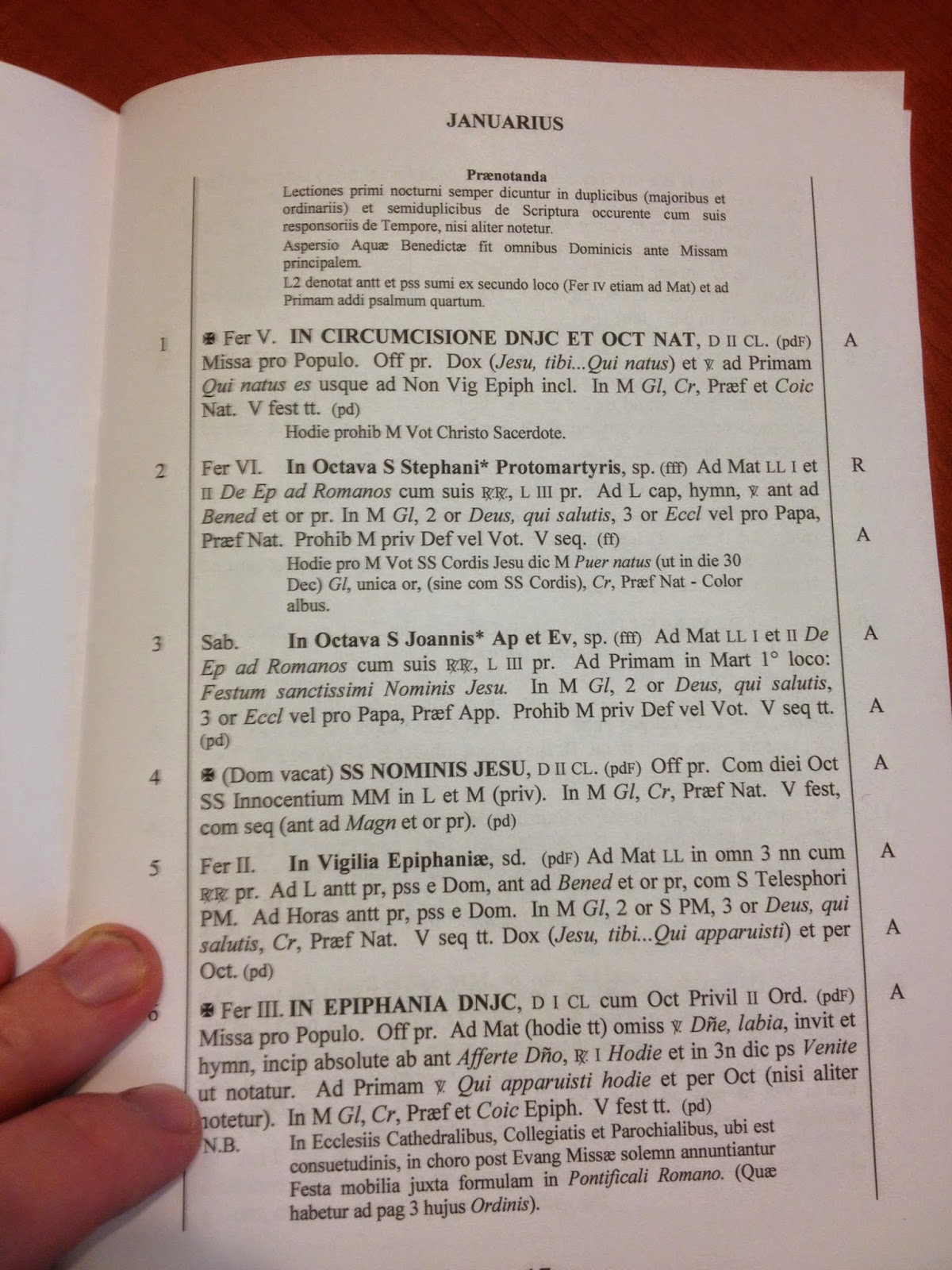
When I first heard that the Last Gospel is replaced with another text on some days, I was a bit confused when told that this only occurs when the displaced text is "strictly proper." The Ordo contains a very good explanation that any priest should be able to remember and understand when consulting the Ordo listing for a feast or Sunday which displaces another day.


Guidelines for orations, the Ordinary of Mass, and prefaces in private votive Masses, which differs in many respects from 1962.


In order to be succinct, the Ordo does not give long explanations like the LMS and FSSPX ordines, but instead employs an abbreviation system. At first all these potential entries look intimidating, but the layout of the pages containing the liturgical orders of the days makes everything more intelligible.


For example, the R next to the octave day of St. Stephen indicates that the Mass and Office of the day are observed in red vestments and with a red altar frontal. The A midway through the entry directs a change to white (albus) for V seq (Vespers of the following day). 


I believe most ordines begin at Advent. The St. Lawrence Press Ordo begins with January 2015 and, considerately, runs to the 10th of January, 2016. 


This page is a nice example both of the clarity of the Ordo and the depth of the old Roman rite. The page is for March. The 23rd is a Lenten Monday which, noted by the X to the right, permits a votive Requiem Mass (as do all ferial Mondays of Lent). At Vespers the color changes to white for the feast of St. Gabriel the Archangel, a greater-double feast. At Mattins, the lessons and responsories in the first nocturne are proper to the feast. The ninth lesson is that of the displaced feria. The feria is commemorated with its Benedictus antiphon and collect at Lauds, as well as with a commemoration and proper Last Gospel at Mass (it is strictly proper). A private Mass may be celebrated of the feria with a commemoration of St. Gabriel and a proper Last Gospel, the prayer super populum per the Lenten feria, and the Benedicamus Domino dismissal, all done in violet for the Mass alone. Vespers is of the following feast of the Annunciation, a double of the first class, with the Incarnation doxology used in the hymns that night and during the hours on the 25th. 


Certain days, such as those of the Triduum, contain long descriptions of unique rites and ceremonies proper to the day. Any church master of ceremonies would already be expected to know this information, but I suspect it would be a very helpful reminder to the sacristan, who might read it over to remember everything he needs to prepare the altar, the vestments, and any other articles necessary for the day. A thoughtful sacristan might even read ahead and ask the priest if he anticipated celebrating a votive Mass or a ferial Lenten day on a feast and then write an emendation in the generous margins. 
This is an excellent Ordo for use and study by both clerics and laymen. I would recommend getting a copy yourself and putting it to some good use. To order the St. Lawrence Press Ordo for 2015, click here. They take PayPal.

Part II: Interview with the Compiler


Herein follows an interview with Rubricarius, the compiler of the Ordo and friend of this blog. He gives us some history about the Ordo as well as some very unique views of the future of the old rite and about Summorum Pontificum which should get the comment box rolling.


Q. Thank you, Rubricarius, for sending me your Ordo 2015 for review. I have long been an avid reader of the St Lawrence Press blog and appreciate its efforts to educate the public on the Roman liturgy as it existed prior to Pius XII and the general process of change. Could you perhaps tell us more about the specifics of your Ordo, such as the year it follows and how that came about?

A. Thank you, Rad Trad for your interest.  The Ordo began back in the early 1970s as the idea of Fr. Peter J. Morgan (the first priest ordained by Mgr. Lefebvre for the Fraternity back in 1971).  Fr. Morgan soon gathered a sizable group of interested clergy and somehow managed to create Mass centres almost out of thin air. He felt it was time to resurrect a traditional Ordo.  What must be born in mind is that the Ordo reflected the liturgical praxis of what the St. Pius Association (the precursor to the $$PX) and other traditional clergy were using at the time.  Fr. Morgan asked Mr. John Tyson, the compilator emeritus, to produce an Ordo for 1973. John is a truly exceptional and talented man and could basically think an Ordo in his head for any given year.  John’s rather difficult-to-read script – it looks very like classical Armenian - was patiently deciphered and typed up on foolscap by the late Miss Penelope Renold and published in three sections by the ‘St. Pius V Information Centre’.  The first volume. ‘Pars Prima’ was clearly somewhat rushed with the cover in Miss Renold’s handwriting.  ‘Pars Secunda’ and ‘Pars Semestris’ followed with typed covers. The two following years saw again a simple foolscap size production but integrated into a single volume.  The current format has its origins in the 1976 edition.


The ‘pre-Pius XII’ rubrics were what clergy and their supporters used at that time.  What is now called the ‘EF’ had, obviously, been used for the couple of years of its existence a decade earlier – but not by everyone I would add - but no one who was supporting the cause of ‘Old Rite’ used it in the UK in the 1970s and it did not make an appearance until a decade later.

Q. Who were the principle people behind the Ordo when it began publication under the St Pius V Information Center? What sort of structure runs the administration of the St Lawrence Press Ordo today?

A. We have covered this, in part, with the first question.  The driving force was Fr. Morgan who channeled the considerable talents and knowledge of John Tyson.  Miss Renold did the typing and, I would conjecture, the posting to interested parties.  The Ordo was published by the St. Pius V Association up to and including Ordo 1978.  Ordo 1979 was published by the $$PX and they continued to publish it up to Ordo 1983.  All this time Mr. Tyson was continuing to exercise his considerable talents.  Since 2002 the Ordo has been published by The Saint Lawrence Press Ltd.  This is a legal entity of a company limited by shares in English Law. It has three directors, including myself, and a company secretary.

Q. How did the St Lawrence Press survive the liturgical about-face of 1983, when the Society of St Pius X reversed its 1977 decision to allow celebrants of the old rite to continue their established custom and imposed the 1962 liturgy on all priests in the Fraternity? Why was the pre-Pius XII rite worth saving, from the perspective of those who continued the St Lawrence Press at the time?


A. If I may answer these questions together Rad Trad?  As I mentioned earlier it was actually the $$XP itself that was publishing the Ordo from 1979 onwards with a considerable number of its clergy using it.  When the trustees of the St. Pius V Association had handed over its assets to the $$PX one of the conditions was that the pre-Pius XII liturgy was to continue to be used.  I understand that one of the original trustees deeply regrets now not having taken legal action when the $$PX reneged on the terms.  Who knows what might have been...   Anyway, as to the ukase to enforce the use of the 1962 books this was a consequence of discussions Lefebvre was having with Rome in the early 1980s.  I have letters from both Michael Davies and Bishop Donald Sanborn – from opposite ends of the Traddieland spectrum - confirming this to be the case.  In his letter Michael Davies states that the indult Quattuor abhinc annos was a direct consequence of these discussions. (We can see the parallels with Summorum Pontificum and Fellay’s overtures to Rome although back in the early 1980s at least Lefebvre was not claiming to be told what to do by putative visions of the BVM).  Lefebvre’s ukase caused great upset, particularly in the NE district of the USA.  Here in England Lefebvre announced this when he came to bless the newly acquired church of SS Joseph and Padarn in London.  A friend of mine, Dr. Thomas Glover, witnessed the argument that took place in the sacristy after Mass between Lefebvre and the then district superior, Edward Black.  Fr. Black put up a spirited defense of the existing practice with both he and Lefebvre getting angrier with each exchange.  The argument took place in French, a language which Dr. Glover is not fluent in.  Dr. Glover tried to interject in Italian and observed that Fr. Black was winning the argument but then, suddenly, just shrugged his shoulders and capitulated.  I am sure you are familiar with Fr. Cekada’s account of what happened in your country and I am sure Fr. Cekada is quite correct in maintaining that if Lefebvre had stayed for the meatloaf the problem would have been resolved. 


Anyway, Fr. Black realised that he could no longer produce the Ordo so he asked two dear friends of mine, now my fellow directors, to produce the Ordo.  This decision was made immediately after Lefebvre left London that fateful day.  So, from 1984 the Ordo was produced by the Saint Lawrence Press – not Ltd – which was what we call in England a trading partnership.  Ordo 1984 caused quite as stir as its cover had the Arms of John Paul II on the cover.


This did cause some upset with customers so 1985 had an absolutely plain cover.


The artist Gavin Stamp was a university friend of Mr. Warwick and drew the cover image for Ordo 1986.  Yours truly came across the $$PX in 1988 and became instantly fascinated by the Ordo.  Despite what had happened five years earlier the majority of clergy were still using ‘pre-Pius XII’ then.  I recall a whole year of Sunday’s without a hint of 1962 – happy days.  The current UK district superior even celebrated the major services of the Triduum at Highclere in 1991 at 10:00am and a Pentecost Vigil at the unearthly hour of 4:30am – or something like that.

As to why it was worth saving I think that is because it was the best thing available at the time and within living memory of so many involved.  A great many people identified this as ‘Old Rite’ as it was what they had experienced before the changes.  What I did notice was that many people I met who were supporting the $$PX had been servers or singers at Fr. Clement Russell’s church at Sudbury which you posted about recently.  I was much influenced by the late, and much lamented, Mgr. Gilbey.  Mgr. Gilbey never used 1962 and saw it as just an intermediate stage in the changes. 

Q. How did the 1983 decision and the 1984 indult influence celebrations of the pre-Vatican liturgy among traditionalists? What sorts of groups, other than sedevacantists, continued the old rite?

A. A very interesting question.  Again, what I think needs to be emphasized is that in the early days 1962 was not being used. Indeed, a very good friend of mine was close friends with an elderly priest from the NW of England twenty years ago.  The elderly priest told my friend that he and a group of other parish priests just quietly refused to adopt the new Holy Week.  “We thought Pius had flipped” he told my friend and that ‘normal’ service would be resumed after Pius’ death.  The Old Rite though never entirely died out in England.  Another friend told me that one could go into the Brompton Oratory in the late 1970s and early 1980s and find half a dozen or so private Masses that all followed the Ordo except one, where the 1956 changes were observed.  Not one of those good men used 1962 though.  Very few sedevacantists used the ‘pre-Pius XII rubrics.  The strict sedevacantists, such as CMRI, follow the 1956 changes but not those of 1962.  A wide range of the spectrum of Traddieland have used, and continue to use, the Ordo and I think it would be difficult to categorise them into any particular group – which is interesting in itself.

Q. Please explain, how you became involved with the Ordo?

A. When I first discovered the ‘old rite’ in 1987 I found it all very confusing as celebrations I attended did not match the ‘Saint Andrew’s Daily Missal’ I had.  When I first met Mgr. Gilbey his Masses matched it perfectly so that set me thinking.  I first attended $$PX Masses in 1988 and soon discovered the Ordo.  I found it fascinating as at the same time I was being instructed by a friend, now sadly departed, to learn the Breviary.  I knew John Tyson of course and remember asking him about (I V) in the Ordo.  I said to him ‘John, I think I have worked out commemorations except the hymn element.  What do you do if the hymn does not have five verses?’  John gave one of his famous chuckles and said ‘You fool, you Tom fool, it is not one to five but of first Vespers.’  Anyway I soon became involved with proof reading the Ordo.  It was all relatively primitive in those days. Although we have moved on from typing the thing it was being produced in WordPerfect which was not a WYSIWYG software programme.  The symbols for holy days and days of devotion were drawn in by hand before the pages went off to the printers.  Then came along Word2 and Word6 and subsequent editions by Mr.Gates and it became much easier.  Eventually, and I do not recall exactly when, sometime in the mid-1990s yours truly was producing the scripts and then took over completely with the Saint Lawrence Press Ltd.

Q. Who are some past or present customers of the St Lawrence Press that our readers today would recognize?

A. Customer details are covered by legislation such as the Data Protection Act, notwithstanding basic morality, and so cannot be revealed without the person’s express consent.  However, a wide range of people from all continents form the current customer base with the majority of customers coming from the United States and from France.  Of the main Traddie groups there has been an interesting change in the customer base.  From the early days when a large number of $$PX clergy took the Ordo the $$PX is now a minority customer.  A decade or so ago there were many orders from members of the Institute of Christ the King but, sadly, they now seem more interested in what they wear than liturgy.  Of the current major groups in Traddieland member of the FSSP take the most Ordines but the majority of sales are to individual diocesan clergy and laity.  A small number of Curial prelates take the Ordo – the fascinating thing is that none of them have any connection with PCED or CDW!

Q. Personally, I find the Roman rite from 1911-1955 far more complicated in rubrics and kalendar than what preceded or succeeded it. How do you deal with the challenges of the Divino Afflatu system?

A. It certainly made the rubrics of the Roman rite far more complicated than they were.  Indeed, if I were into conspiracy theories – which I am not - I think one could be forgiven for thinking it was a deliberate ploy to make life so complicated that any reform would be received with open arms.  My view is that in reality the reform was rushed through and its ramifications only began to be understood in the years that followed.  Clarifications and differing interpretations were appearing in Ephemerides Liturgicae throughout the 1920s and 1930s.  Looking at extant Ordines of the period it is interesting – to compilers of Ordines at least – to see the lack of consistency in interpretation.  A good example was a few years ago when the feasts of St. George, St. Mark and SS Philip and James had to be transferred out of the Paschal Octave.  I consulted four Ordines from 1943, two in my collection and two in the British Library.  None had exactly the same solution: three were similar but one was way off.  After carefully considering the rubrics I decided none were actually correct.  To those of us with an interest in such matters it was an amusing study but life should not be that complex.  As to ‘dealing’ with the system I am afraid that exposure to the ‘Pius X’ rubrics was part of my formative period so I can think the system in my sleep.  Indeed, when I first looked at pre-1911 praxis I found it very hard and it required a lot of effort to understand it, but I did persevere.  It is far superior in my view but we are limited by the lack of availability of books at the moment to promote a serious restoration. 

Q. Have you noticed any change in your clientele or in business to the St Lawrence Press since Summorum Pontificum in 2007? If so, why?

A. There was an initial flurry of interest and indeed I recall one cleric asking if we would now adopt the 1962 rubrics.  Needless to say the answer was strongly in the negative.  What is noticeable is that those with a more serious interest in liturgy see through 1962 quite quickly and look to move to something more traditional.  There is a steadily increasing number of customers – which is much needed because many of the original customers have now passed over to Eternity.  I think that, ultimately, Summorum Pontificum will be seen as something that had a damaging effect on the liturgy but the influence of which faded over time.  Indeed, I expect that Summorum Pontificum will be negated by legislation from Rome but not within Josef Ratzinger’s  lifetime. 

Q. In what direction do you see the future of the old rite headed? 

A. After the period of specious interest following Summorum Pontificum, and I think we really have seen the A to Z of specious interest, I see a period of contraction and confusion – as we see today – that will be followed by an implosion.  I take the view that there will be a more real discovery of liturgical orthopraxis and patrimony but that will take time, a couple of decades at least.  I also believe we will see structural change too – rather like what you have alluded to in some of your posts mentioning the Minster system for instance.  I believe that reform – in a good sense – will be from grass roots upwards, not from the top down. 

Q. In what sort of research does the St Lawrence Press engage?

A. My own research interests are the reform of the Roman rite 1903 – 1963; the reform of the Roman typical editions of the liturgical books from 1568 to 1634, the celebration of Holy Week, liturgical theology in general and the psychology of religion.

Q. Given that the early traditionalists and the St. Lawrence Press stopped at 1939, what would you say in the liturgical legacy of the pope elected that year, Pius XII? 

A. I don’t think the proto-traditionalists thought it terms of 1939 per se but of ‘pre-Pius XII’  As we know men like Evelyn Waugh were totally disparaging about the Pacelli pontificate.  Sadly, what we have seen over the last quarter of a century or so is the development of what a blogger friend of mine termed cognitive dissonance.  There is a steadfast refusal to acknowledge the well document facts of the damage done to the Roman liturgy by Pius XII.  In my own view he as much a showman and narcissist as John Paul II.  The inversion of the axiom lex orandi, lex credendi was an unmitigated disaster and a charter for the modernists.

Q. Some insist that the Pauline liturgical changes assimilated new doctrines and that, by contrast, the Pacellian novelties and reductions are tame, unworthy of attention in the quest to restore the Roman liturgy.  Your thoughts?

A. Well, we have seen the development of a fallacious revisionism whereby any reform before the Second Vatican Council is magically ignored and excised from memory. I recall many years ago that when I came across photographs of Mass versus populum from the 1940s and 1950s my fellow ‘Traddies’ far from being interested hated me for showing them.  There is the creation of a false construct by these people, they loathe Paul VI but adore old Pacelli.  There are the old canards about a) the differences between 1962 and earlier edition being ‘minor’ and b) the radical nature of Paul VI’s 1970 changes.  With respect to the first point if the changes are so minor, so trivial, not to be of any significance or not to be notice then why not just use pre-1962 anyway?  Of course, the reality is very different and the whole point is that the 1962 brigade want to feel superior to everyone else and use legalism as a weapon against everyone else.  As the second point that argument is wildly over made.  What was Mass like the day before Paul VI’s Missal became law?  People, very conveniently forget, that the 1962MR had not been used for almost a decade but the 1967 rite with the new Anaphorae, with various lectionaries and, of course, the vernacular and the fashion of versus populum.

We appreciate your time, Rubricarius, and thank you again for the opportunity to review you Ordo for the impending liturgical year. I speak for my readers in wishing you and the St Lawrence Press the best in your efforts to preserve the old rite and commending our prayers for that same intention.

Monday, September 8, 2014

Major Fetish in the Boutique: Sarum in the 20th Century UPDATED

Tip of the biretta to Mr. Alan Robinson for directing me to the photo gallery for St. George's church in Sudbury (London). Many will know that in the early to mid-20th century the pastor of St. George was Fr. Clement L. Russell, a priest who, much like Quintin Montgomery-Wright decades later, imported the Sarum rituals and aesthetics into the existing Roman praxis.

The church of St. George was built in a truly gothic style, albeit it with the inclusion of many features popular in England at the time: devotion to St. Joseph and Ss. Thomas More & John Fisher. St. Geroge was also the first post-Reformation (Deformation would be more accurate) church in England with a shrine to Our Lady of Walsingham. Russell managed an enormous boys choir and army of altar servers. He used his services as a way of giving young men something to do and a diversion to keep out of trouble. He had first and second Vespers for all feasts Double of the II Class or higher, as well as Mattins and Lauds for the great feasts. Quite the Englishman, he usually kept two candlesticks on his altar, per Sarum, and quibbled over the matter with the vicar general of Westminster. Russell told the vicar general that St. George's would sport six candlesticks when the rest of the parishes in the archdiocese finally started using two on ferial days and four on vigils and ember days.

All the photographs below come from this page and belong entirely to St. George's Catholic Church. The images are British Catholicism at its finest. Pure liturgical fetish eye candy! Yum yum yum!


The Baptistry


The shrine and altar of Our Lady of Walsingham. Note the
very English, very sumptuous frontal. Much of the statuary
was carved from single pieces of wood on St. George's grounds.


Some fool wreckovated the sanctuary, but fear not!—we have images below of
liturgies during the Clementine years. Judging by the altar arrangement, I would
hypothesize that St. George is now in the hands of a "hermeneutic of continuity" priest.


The original sanctuary. Note the curtains around the altar, something still seen in medieval
English churches. Above the altar is a Rood, seen in other images below. The Rood
was not a proper screen, but the effort was admirable given the times.


Solemn high Mass. The choir sits—gasp!—in the Choir. Judging by where the ministers
are situated and the sitting posture of the congregation, I would hazard a guess that this
is the Gradual and that the celebrant and subdeacon are reading the Gospel while the deacon
prepares to proclaim the Word. Note the two lead cantors singing ("ruling"?) from the
lecturn in medio choro.


A nuptial Mass, again with full choir and lead cantors. Again, probably
the Gradual.


The annual procession with relics on St. George's day. Cardinal Griffin, archbishop of
Westminster, visited on this occasion.


This picture is, for some reason, my favorite of the lot. The tall candles at the corners of
the steps leading to the altar are an English tradition. The Missal appears to be resting on
a cushion rather than a stand. Don Quoex did this, too.


A Requiem Mass


A Byzantine priest of some stripe offers the Divine Liturgy at St. George's.
From his facial features, seen in other pictures, and the cut of his vestments I would
guess that he is either Arab (Melkite) or Greek rather than Slavic. At first I was
surprised to see this picture, but then again Dr. Adrian Fortescue also imported native English
elements into the Roman rite during his life time and held the Byzantine tradition in high esteem,
almost joining the Melkite Church in Lebanon.

St. George's must have been quite spectacular until Fr. Russell's death in 1965 following an accident.

Here is an article on St. George's and Fr. Russell from the Anglo-Catholic
Historical Society:

FEATURED ARTICLE

“THE ONLY ANGLICAN CHURCH IN COMMUNION WITH ROME”:
SAINT GEORGE’S SUDBURY AND FATHER CLEMENT LLOYD RUSSELL.
By John Martyn Harwood
I have loved, O Lord, the beauty of Thy House; and the place where Thy Glory dwelleth.
[Psalm 25, Douai version]
 
If any church’s tradition could be said to be sui generis, St George’s could and this was because of the vision of one man, its founder and priest for nearly forty years. Clement Lloyd Russell was born in 1884, the son of Henry Lloyd Russell, vicar of the Church of The Annunciation, Chislehurst and a prominent Tractarian. There is an early and amusing mention of him in the infamous report of the Royal Commission on Ecclesiastical Discipline (1906) which was established to put an end to “illegal” ritual practices in the Church of England. Among the hundreds of pages of evidence is an entry about The Annunciation, Chislehurst, on 18th September 1904. The vicar strongly refutes any charge of lawlessness, taking a traditional Tractarian position and mentioning examples of past episcopal approval. He does however become a little defensive when replying to the report of a “visitor” that the festival of Corpus Christi was solemnly kept. The notice in the church porch announcing this, he maintains, was “placed there by my son, and I told him, after I became aware of it, of my disapproval”.
This indicates that Clement’s position was a good deal more advanced than the respectable High Church ritualism of his father. However, the son never experienced or embraced anything resembling “baroque” Anglo-Catholicism but remained an Edwardian High Churchman and medievalist to the end.
The younger Russell was ordained a priest of the Church of England in 1908 and for a short time was one of a tribe of curates at St Andrew’s, Willesden Green. In 1910 he experienced a crisis of conscience and was received into the Roman Catholic Church. After almost no formal training (he always maintained that he knew practically nothing about Roman Moral Theology or Canon Law) he was ordained deacon in 1914 and priest in 1915. He was sent as curate to work under a tyrannical parish priest at the Holy Rosary Church in Marylebone, London.


SUDBURY

This was a low point in Father Russell’s life but in the early 1920s he received an offer, which had the approval of Cardinal Bourne, from a very wealthy lady who wished to fund the building of a new church in one of London’s growing suburbs. He found himself in the happy position of being able to choose the site, architect, style of building, furnishings and dedication of the new church and parish. The foundation stone was laid in November 1925 and Father Russell moved into the newly built presbytery a few months later. He remained there, never taking a holiday, until his death in 1965.
Saint George’s church, in the non-descript district of Sudbury, near Harrow-on-the-Hill, Middlesex, was completed in 1927 and solemnly consecrated (a rare occurrence in those days) on the 18th April 1928. Its architect was the almost forgotten Leonard Williams, a modest church builder who died before this, his last work, was completed. Again unusually, it was entirely free from debt. At a time when “side altars” were usually wooden stands for holding statues and flowerpots, St George’s possessed four properly consecrated stone altars, designed on English medieval lines, dedicated to St George (the high altar), Our Ladye (Fr Russell’s invariable spelling), the Archangel Michael, and St Thomas of Canterbury.


THE CHURCH

He that hewed timber afore out of the thick trees: was known to bring it to an excellent work.[Psalm 74, Prayer Book version]
The church from the outside still looks much as it did in 1927 and can be seen on its current website. It is a dignified perpendicular gothic building of warm stock brick and much stone dressing. The clergy house is joined to the church which can be accessed from it. The whole composition is very charming and romantic despite the clearing of many trees which used to surround it. There are two large bells, also properly consecrated and anointed.
But it was chiefly for its furnishings that St George’s was famous. Over many years Fr Russell acquired or had made innumerable objects of piety to adorn his new creation. Slowly the altars were all vested with rich frontals in all the liturgical colours – this meant at least six or seven sets for each of the four altars. Each also had the inevitable riddle posts with angels holding candles. Between these, curtains of the highest quality hung, again in the different colours. Canopied images of the dedicated saints stood above. All the woodwork was carved and nothing of plaster was allowed in the church even temporarily.
The rector, as Fr Russell was often called, had no objection to popular devotions and was not of the austere “Benedictine” school; however the devotions had to have medieval precedents. No images of the Sacred Heart or Our Lady of Lourdes were permitted but near the back of the church, opposite the main door, was a large oak “tableau” depicting the Five Wounds of Christ and with a carved statue of the Lord at its centre. This was of course a very popular cult in late medieval England. Above were emblazoned the words (and I quote from memory for the entire shrine has since disappeared): JHESU BY THYE WOUNDES FYVE: SHEWE ME THE WAYE TO VERTUYOUS LYFE.
For many years it remained a puzzle to new parishioners especially those of simple faith but eventually the shrine acquired its devotees.
Above the Lady altar, was enthroned, in September 1928, a beautiful carved image of Our Lady of Walsingham. This was the first one based on the ancient seal to be erected in a Roman Catholic church. It was only six years after Fr Hope Patten had placed his Walsingham statue in the parish church there. Of course Fr Russell knew of all that had been achieved by the Anglicans at Walsingham and was anxious to spread the devotion in his own Communion. Thereafter the appropriate Marian Antiphon was always sung after all evening services in front of her image. In 1933 a second statue of the Blessed Virgin was unveiled in the Lady Chapel: this was a magnificent alabaster carving of medieval origin, showing her standing and holding her Son and, in the other hand, a sceptre. It had been found in Devon, restored and presented to Fr Russell. Several experts claimed that it had originally formed part of the reredos behind the high altar of Exeter cathedral, and it still retained traces of colouring. A beautiful carved wooden screen enclosed the Lady chapel, decorated with images of Saints Lawrence and Katherine in memory of the last two chapels on the ancient pilgrims’ “Walsingham Way.”
This is only a partial description of the church’s contents; there were also two carved eagle lecterns, one of which stood in the centre of the choir for use by the cantors, and additions were still being made right up to the rector’s death. In 1962, for example, the huge rood beam, rood, statues of Saints Mary and John and attendant cherubim on “wheels” were re-gilded and in the same year expensive iron gates and a fine image of St John the Baptist were added to the Baptistery.


THE SERVICES

Those who still remember St George’s before 1965 will recall its liturgical life even more than the beauty of its furnishings. Starting from modest beginnings, Fr Russell gathered around him a team of enthusiastic helpers to form choir and servers to assist him in the offering of the rich round of services he desired. By the early 1950s he had established Sung Masses and Solemn Vespers on all Sundays and great festivals, with vespers being sung even on “Days of Devotion”, including all the feasts of the Apostles. Christmas was particularly well served with solemn first vespers; solemn matins and midnight mass; sung masses of the dawn and day (celebrated at9.30 and 10.30am respectively); solemn second vespers, procession and benediction and solemn vespers with procession on each of the following four days (they were all Days of Devotion!) The grandest and most fashionable Anglo-Catholic church in Edwardian days could not have done more.
The number of singers and servers, who were all housed in the sanctuary, rarely exceeded thirty-five which the rector considered a rather inadequate figure though most clerical visitors viewed it with envy. Needless to say those who served at the high altar were not only rigorously trained but were richly attired. The cantors wore copes, the rest of the choir and most servers, full gathered surplices, like those shown on portraits of Tudor bishops, with enormous sleeves and in length reaching below the knee. Famous (or notorious) were the apparelled albs and amices worn by the acolytes and thurifer (even the apparels came in complete sets of liturgical colours) and the alb and tunicle of the crucifer. Fresh chasubles and copes for the celebrant were often added when Fr Russell heard of Anglo-Catholic churches which had abandoned “gothic” styles. He had some kind of source of secret information about such matters. Everything used in the worship of God was of the highest quality down to the candles, incense, altar breads and wine. The music of course was strictly plainsong and under the direction of men who had Benedictine monastic training.
The number of sung services was actually increasing in the years just before Fr Russell’s death whereas elsewhere, both in the Roman Catholic Church and in the Church of England, they were in steep decline. I can remember when matins on Pentecost Eve was introduced for the first time, in 1959. However, it cannot be said that any services at St George’s other than low masses were ever very well attended. This worried Fr Russell not at all. When the church was first opened only twenty Roman Catholics lived in the area and there was no real need for a new parish at all. In 1962 mass attendance was found to be 1,175 souls. The rector arranged worship in the same way for both numbers. On one dark evening, a server nervously told him, before vespers began, that there was no one in the church at all. “Nonsense” he replied, “the nave is full of angels”.


THE MAN

As can be guessed, Fr Russell was not free of eccentricities. Life in his clergy house was a strain for most curates, who did not tend to stay long. First there was the Dickensian clutter of vestment presses, cuckoo clocks (all set at slightly different times, though never British summer time), large cats as eccentric as their master, books and antique silver. Then there was the conceit that he was a beleaguered Anglo-Catholic vicar liable to be disciplined by his diocesan, though successive Cardinals actually showed astonishing indulgence towards him (it should be remembered that before the Second Vatican Council the overriding priority of the Roman Catholic hierarchy in England was the establishment of a RC school in every parish; Fr Russell never attempted to do this and never even mentioned the need for one.) “The Archbishop is coming” he would say, “We must hide the acolytes’ albs” or: “When I am dead they will come and turn all my vestments into bed covers just as the Reformers did”. Actually, in a sense, this prophecy was fulfilled. Some wag had once called St George’s “The only Anglican church in communion with Rome”. This was probably intended as a taunt but Fr Russell wore the label with great pride (perhaps he remembered his father’s church at the start of the Twentieth Century) and would often quote it to startled new-comers.
Fr Russell wrote everything by hand using the most extraordinary late medieval Gothic script. Many parishioners claimed they could not read the notices in the church porch at all. The local postman was made of sterner stuff and took great pride in being able to deliver all the rector’s letters without difficulty. He especially approved of the priest’s complete non-use of abbreviations – Saint not St or London North West rather than NW. How Father would have hated (it still makes me feel slightly guilty) my use of “Fr” in this article.
Often such highly motivated men can be ill-mannered or off-hand; Fr Russell by contrast was the mildest and most easy-going of souls, other-worldly and quite without authoritarianism. Servers and young choir members would sometimes ask him to inscribe their missals. He always used the same text for this, taken from the Book of Ecclesiastes in the Authorized Version: “Remember now thy Creator in the days of thy youth, while the evil days come not, nor the years draw nigh, when thou shalt say, I have no pleasure in them”. In his later years he allowed a poor Irishman who drank rather too much to live permanently in the clergy house and provided for him generously in his will.
Much was rumoured about Fr Russell’s supposed fascist leanings. I believe them greatly exaggerated. He certainly supported Mussolini in the 1930s but so did many others, and he admired General Franco all his life. Hitler he wrote openly against in the parish magazine after the war started. I believe that the fascist rumours were partly based on the certain fact that two members of his choir were prominent members of Mosley’s Party and later were conscientious objectors. In truth Father was not much interested in events that took place after 1530.
 

THE AFTERMATH

But now they break down all the carved work thereof: with axes and hammers.
[Psalm 74, Prayer Book version]
Clement Lloyd Russell was hit by a car, crossing the road outside his church, and died soon afterwards, on 11th January 1965. He was 80 but in good health and still running St George’s along usual lines. His death at least saved him from having to make inevitable and difficult choices, for the Second Vatican Council was in full swing. Already low masses at St George’s were being said in English. Fr Russell’s tradition would have received little sympathy from the new sort of Roman Catholic who regarded the Council documents as on par with the Four Gospels, nor from their conservative opponents, Anglo-Irish and stubbornly philistine, nor even from modern Anglo-Catholics eagerly following every trend of the Liturgical Movement. In the mid Sixties his ideals of liturgical worship could not have been more unfashionable. This needs to be clearly stated. It should also be added that he had almost no sympathy with the budding ecumenical movement. Without of course realising it, he was in his spirituality and his priorities, extremely close to Eastern Orthodoxy. If any reader thinks this far-fetched, read Russell’s own summary of his aims, which concludes this article.
The priest appointed as his successor, Wilfrid Purney, tried to maintain some continuity but the looming liturgical changes from above demoralised Fr Russell’s old supporters. The men’s choir was disbanded in June 1966 and most of the servers ceased to attend about the same time. Services began to resemble those elsewhere in the archdiocese. Fr Purney however, always kept the church looking as it had always done and no “re-ordering” was permitted. After his death the long-delayed deluge came with the arrival of those “who knew not Joseph”. Because of the late date of the building and its furnishings, those opposed to major change could not appeal to the law or preservation societies. Between 1990 and 1996 St George’s interior was completely gutted. Most of the furnishings and hangings disappeared, the consecrated stone altars were desecrated and destroyed and an extraordinary octagonal-shaped altar was placed in the centre of the church. But it would be fruitless, and perhaps libellous, to continue. Fr Russell would perhaps have simply remarked that King Edward VI’s visitors had returned to earth.
 

CONCLUSION

I want to conclude by quoting from Fr Russell’s own words because it is important to understand that he was much more than just a “character”. Here he is writing in the parish magazine in the 1940s, but he very often expressed himself in similar terms, as I heard him do so several times:
And beyond all, I want the sanctuary, especially at sung mass and at vespers and benediction, to speak to people of the glories of Heaven, and that, as far as is humanly possible, there shall be gathered there a splendour of colour and light, beauty of vesture, and ordered movement that compels the most wandering and distracted of undisciplined minds to realise that something far, far more than the satisfaction of human devotion is being accomplished – that the eternal and invisible GOD is being worshipped, and that all that is being done, is performed to render the easier, a response to the invitation “Sursum Corda!” There, at all events, is and has been my great endeavour.