Showing posts with label ultramontanism. Show all posts

Saturday, May 6, 2017

Fox in the Henhouse

Pictured: Staff writers of the Aleteia website.
The Franciscan Reign of Terror has been somewhat eclipsed recently by the antics of the new American president, but the denial-of-service attacks on our intellects by P. Bergoglio continue to buzz in the background. He releases interviews, twitter posts, and ghostwritten encyclicals with a publication cycle that would have made John Paul envious. The sycophants of the Catholic blogging, radio, and magazine worlds refuse to acknowledge any evidence that Francis "The Fox" Bergoglio is anything but praiseworthy; meanwhile, the open-eyed commentators, trad or not, are increasingly alarmed. Even Mr. Corbinian's Bear, Esq. is toying with the thought of sedevacantism as a reasonable alternative to accepting the current bishop of Rome as legitimate. (Congratulations are in order for his recently published novel, by the way.)

Most of us in Tradistan are content to get the dismay out of our systems with a bit of occasional sarcasm and delight at the thought of the pope's eventual resignation. I do not think highly of the thesis that P. Benedict's resignation was invalid, and generally consider the thesis of sedevacantism to be a cheap form of escapism that absolves the believer of the burdensome responsibility of piety towards an unworthy leader.

But the problem of a bad pope is merely the extension of the problem of bad bishops and bad priests. Rare is the layman who does not have horror stories of parish priests and pastors, whether of clearly unorthodox preaching, two-facedness, or outright perversion. Rare, too, is the Catholic who can boast a bishop worthy of imitation or admiration. Why do lower-level Catholics who have found ways to mentally and emotionally survive under bad clerics find it impossible to tolerate a bad pope?

Until Francis, the "JP2, We Love You" crowd could at least pretend that the papacy was mostly fine. They had to do a little see-no-evil, hear-no-evil to accomplish that end, but it was possible. Everyone has his breaking point, and Francis is proving to be the breaking point of many. Some of the usual ultramontanist suspects are wondering when the pope will answer the dubia (likely never), in the hopes that they can get back to their comfortable papal adoration.

One of the few Youtube videographers I follow regularly is Hans Feine, M.Div. of the Illinois-based Lutheran Satire account. His "Frank the Hippie Pope" character neatly summarizes the difficulty of working constant damage control on an out-of-control pontiff. But even the "Hippie Pope" is a whitewash of the real man, appearing in the cartoon merely as a doped up halfwit instead of a sly intellect. In reality he is a bull in the china shop, a snake in the grass, a fox in the henhouse.

But again, so what? We will always have to learn how to live with weak or evil rulers. We will always have to learn how to not simply survive but thrive under their burdensome scandal. When one reads the chronicles of the ancient kings of Israel and Judah, rare was the monarch who did not do evil in the sight of the Lord; should we expect it to be any different today? Let us file our formal complaints and move on to the hard work of perfecting ourselves and our societies, and the harder work of converting the lost to the true Church. Innocent as doves, yet clever as serpents—how else will we keep the foxes from devouring us whole?

Where's a good bear when you need one?

Tuesday, December 20, 2016

Crossing the Threshold of Popery


There is a little passage in the introduction to P. John Paul II’s 1994 interview Crossing the Threshold of Hope that started a long, internal process of reconsidering my approach to papal statements. The editor-interviewer Vittorio Messori drops this challenge to ultramontanist theologians while explaining the nature of the text to follow:
It is my duty to guarantee to the reader that the voice that resonates—in its humanity but also in its authority—is entirely that of the successor to Peter. It will now be the job of theologians and analysts of the papal teaching to face the problem of classifying a text that has no precedent and therefore poses new possibilities for the Church. (viii)
I listened to the entirely of Crossing the Threshold of Hope on an audiobook while driving from the American Midwest to New Mexico. My conversion was recent and still in its first vigor. While my reading pre-Confirmation had raised some confusion in regard to the thoughts and actions of the then-current Roman Pontiff, this book raised serious doubts. When I left the Missouri border I was a papist, but by the time I reached the deserted American Southwest I wondered if the pope was even Catholic, and if I should remain thus.

From John Paul’s limp passive voice to his failure to make clear distinctions, I grew increasingly frustrated with the pope’s muddled rhetoric. In the very first chapel he undermines the unique office of the papacy by extending the title of Vicarius Christi to the “entire college of bishops,” and also to all priests and to “each of the baptized” (13), without any clear distinction.

The formlessness of this personalist-philospher-pope’s thought became apparent in the occasional nonsense phrase that I desperately tried to make sensible, such as his description of the created world as “the foundation of a creative existence in the world” (21) or “the geography of the Pope’s prayer” (23). In response to the question of whether or not God exists, he refuses to answer clearly with a “Yes,” but rather recapitulates the history of the relevant philosophical speculation—“This question has reverberated throughout a highly developed Western civilization” (29), he says with all the squishiness of the indecisive.

Less than halfway through the book, John Paul “The Great” has begun rambling on about the greatness of the Church’s openness to the world. “Aggiornamento (updating) does not refer to the renewal of the Church; nor only to the unification of all Christians, ‘that the world may believe.’ It is also, and above all, God’s saving activity on behalf of the world” (76). Is the acceptance of the “updating” of the Church for the contemporary times necessary for salvation? It is God’s saving activity, after all. Can those who reject updatedness be saved?

Then he begins praising all the non-Christian religions of the world, claiming that, thanks to the Holy Spirit, there is “a kind of common soteriological root present in all religions” (81). What kind? Who knows. He does offer some caution regarding Buddhism, but again in the passive voice that precludes an actual warning or condemnation: “It is not inappropriate to caution those Christians who enthusiastically welcome certain ideas originating in the religious traditions of the Far East” (90). He says that Moslems “invoke the true God” (93), a common theme in the Age of Aggiornamento. His words on the validity of the Old Hebraic Covenant (in the chapter “Judaism?”) are vague, although Cdl. Ratzinger would be far more optimistic about its validity in his writings.

But it was the chapter “Is Only Rome Right?” that threw me for a loop as I sped down the Oklahoma turnpike:
Besides formal membership in the Church, the sphere of salvation can also include other forms of relation to the Church. Paul VI… spoke of the various circles of the dialogue of salvation…. It would be difficult to deny that this doctrine is extremely open. It cannot be accused of an ecclesiological exclusivism. (140-141)
The discussion of ecumenical overtures with Protestants that follows is concerned not with the salvation of those who are outside the Catholic communion, but with practical movements towards unity. “What unites us is much greater than what separates us,” he writes, just before going on about “genuine divisions” where the faith remains uncompromised (147).

The “Pope of Surprises” was not only confused but naive: “We find ourselves faced with a new reality. The world, tired of ideology, is opening itself to the truth” (164). Somehow in the midst of all this wishy-washy optimism, he finds himself surprised that preachers “no longer have the courage to preach the threat of hell. And perhaps even those who listen to them have stopped being afraid of hell” (183). Yet he ends the chapter with praise for Origen and von Balthasar’s rejection of eternal damnation, but without clear agreement or disagreement on his part. Is he the “Pope of Surprises” or the “Pope of Being Surprised”?

“Be not afraid,” is what he often repeated. Yet he gave me much reason to fear. I feared most of all that I had been scammed into conversion, that I had been lied to by the apologists who insisted that membership in the Church Catholic was necessary for salvation. I feared that they had either lied about what the Church was, or that this pope was speaking of some other religion entirely. I wondered if I ought to return to my Protestant roots, since they at least believed in the principle of non-contradiction.

But it was that brief passage in the book’s introduction, Mr. Messori’s observation that here would arise a “problem of classifying a text that has no precedent,” that helped me to cross my own threshold of hope. It is the ultramontanist who interprets every utterance of a Roman pope as infallible or potentially so; who when a pope calls a sunny day rainy, says that it must be “raining spiritually.” The legitimate exercise of Roman doctrinal clarity began to spill over into a thoughtless piety towards every casual utterance, to the extent that we still have well-meaning Catholics justifying the words of P. Francis in every interview.

The way over that threshold, I realized, was the simple rejection of Crossing the Threshold of Hope as a work of the Magisterium (that ever-elusive concept), and relegating it to the personal ramblings of a man who happened to be pope. It was a principle I eventually extended even to those officially papal writings that lacked doctrinal solemnity. John Paul’s papal documents are not quite as fast and loose with doctrine as this book-length interview, but they are frequently confusing and sometimes quite wrong. The first Vatican Council’s definition of papal infallibility was restrictive, leaving it to theologians and individual Catholics to sort out the importance of all other papal statements. Even P. Benedict XVI once said that the pope “is not an oracle; he is infallible in very rare situations.”

Words to live by. Be not afraid of discarding ultramontanism, all ye sedevacantists and neo-conservatives. When the pope of Rome speaks with all the solemnity and authority of the Holy Ghost, you will know it. Until then, unfollow @pontifex and give a mighty shrug whenever your non-Catholic acquaintances ask you to explain his most recent madness. Pray for him, but allow him to rant to an empty room.

Tuesday, December 29, 2015

The Ultramontanist Debt to Luther

Martin Luther Publicly Burning the Papal Bull
“So one is the Abraham who believes, one is the Abraham who works; one is the Christ who redeems, one is the Christ who works… distinguish between these two things as between heaven and earth.” —Fr. Martin Luther
It’s not a well publicized fact that Martin Luther hated St. Augustine and his theology. Those who study Fr. Luther’s personal copies of Augustine’s works against the Manichees have discovered that the mad Augustinian monk wrote glosses in the margins defending that ancient heretical sect against their defector’s attacks. Luther the dualist believed there were deep divisions within the life of the Trinity itself—especially during the suffering of the Crucifixion—but he also ascribed similar divisions to the human person.

How did these manifest? Mostly in the distinction between Man the Sinner and Man the Justified. Every fallen man was, to use his own word image, a pile of feces. Justification fell from Heaven upon said pile of feces like a thick layer of snow, lying over but never transforming the filth beneath. The “saved” man thus has two identities: Sinner and Justified, and never the two will merge. This is in contrast to the metaphorical Old Man and New Man of St. Paul’s theology, who represent one’s worldly and spiritual natures, and who both wish to make the Christian into the image of himself.

It is an identity crisis not unlike that posited by the ancient Greek myth of Heracles, for the son of Zeus was also the son of the mortal woman Alcmene, and he possessed two natures. When he died, burned alive on his own funeral pyre, his divine part flew upwards to Olympus, while his human part sunk down into Hades. His human soul, or shade, yearned forever for its divine counterpart; his divine self, one assumes, happily could not have cared less about the human.

Odysseus Meeting the Shade of Heracles
In like manner, Luther saw the human person as a sort of vessel for hellish and heavenly parts, neither of which could truly transform the other. Since justification sits upon the sinner like a blanket of snow, is it only the snow that is saved? One wonders what happens to Man the Sinner at the moment of death while Man the Justified is swept up into Heaven. Is the former annihilated? Used as compost? Damned, and forever yearning for the cool snow?

Dualist that he was, Fr. Luther was comfortable accepting this contradiction. Quasi-Lutherans that they are, ultramontanists are comfortable accepting a sharp, irrational dualism in the papacy.

This expresses itself especially in their attitudes towards the Bishop of Rome. Believing him (quite rightly) to be the Vicar of Christ and head of the visible Church, the Catholic ultramontanist habitually holds a sharp division between, say, John Paul the Pope and John Paul the Man. John Paul the Pope can do no wrong, and every word and action must be piously praised as coming from the Holy Ghost himself. John Paul the Man is either non-existent (having been destroyed by his elevation to the papacy) or a kind of doppelgänger that emerges when John Paul the Pope slumbers. When a papal Mass is adorned with topless natives or the man in white kisses a Koran in full view of a camera, those faults are either maniacally ignored, or they actually insist that these evil actions are praiseworthy, and that we are simply too sinful to see their merits.

Similar breaks with reality occur concerning other members of the clerical class: laymen defending pederastic priests, priests defending heretical bishops, bishops defending mad cardinals, and so forth. Clericalism is a form of dualism in which Fr. Sinner is covered in the snowy mantle of Fr. Justified—and who are you to judge when he falls?

The Sacrament of Holy Orders imprints an indelible spiritual mark on the soul, bestowing the powers to consecrate, offer sacrifice, and forgive sins. This sacrament is not, however, a magical fluffy layer of snow that makes a priest’s feces stop stinking.


Luther himself was a clericalist, returning from Rome scandalized by the excesses of the Roman clergy and full of zeal to denounce them. He was scrupulous about his own sins after he was ordained a priest, since he did not think himself worthy of the priesthood. He was so obsessed by his own unworthiness that he was nearly unable to finish saying his first Mass, much to the embarrassment of his father.

The general attitude of pre-Reformation Catholics can best be described as one of holy resignation to clerical vice. Whether they had to suffer the keeping of concubines, the buying and selling of offices, the thieving of tithes to live in exorbitance, or even outright perversities, the laity’s reaction to wicked priests was to express their disgust and move on with life. They understood and readily admitted that bishops who murdered others for their own gain were on a steep slope to Hell, and this understanding granted them a measure of peace.

Surely it can do the same for us.

Monday, December 14, 2015

Monkey See, Monkey Do

"Theaters are the new church of the masses – where people sit huddled in the dark listening to people in the light tell them what it is to be human." —1930's theater critic

The recent desecration of St. Peter's Basilica has proven to be quite the conversation starter. His Traddiness and I discussed the violent reaction this would have induced in the Catholic Romans of olden times—a new pope would need to have been elected soon thereafter—and I heard a sermon on Gaudete Sunday where the priest took the opportunity to chastise the faithful for allowing such sacrilege to make them unjoyful. Meanwhile, Mark Shea and other lukewarm hissyfitters are scourging anyone who points out the obvious about their precious Padre Jorge.

It's a demoralizing situation. The liberal Catholics who operated quietly (but freely) under Wojtyła and more surreptitiously under Ratzinger are now parading openly through the streets, waving prismatic flags and wearing tee shirts with peace signs as they make war against God. The Holy Trinity laughs at the Gentiles as they rage, but in the mean time we suffer under the weight of the yoke of their iniquities.

The Year of Mercy has turned into an orgy of indulgence, pejoratively speaking. Annulments are to be handed out for everyone, homewreckers are encouraged to desecrate the Lord's Body, and soon outright perverts will march up demanding the right to desecration. The façade of St. Peter's has been transformed into a projection screen for an anti-human environmentalist show, so how long will it be until Papa Franky removes the statues of the apostles and replaces them with carvings of endangered beasts?

"A people that continually provoke me to anger: these shall be smoke in my anger, a fire burning all the day." (Isa. 65)
"Monkey see, monkey do," was the old adage used to insult passive yes-men who facilitated the worst ideas of their leaders, never thinking twice about the consequences nor worrying to compare them against the eternal Ideas. These Monkey Catholics were anti-modernists under Pius IX, liturgical inventors under Pius XII, natural family planners under Paul VI, hermeneutical continuitists under Benedict XVI, and climate change believers under Francis I. What will they be under John Paul III, Koran-kissers? The Devil is God's ape, and today's ultramontanists are aping being Catholic. One wonders if the post-modern obsession with "authenticity" is due to this generation's inability to be clearly one thing, whether it be good or evil.

"See no evil, hear no evil," is another relevant monkey-related adage. What could it possibly take to infuriate the ultramontanists into action? Allowing pagans to desecrate Catholic churches with their perfidious ceremonies didn't do it. Watching prelates receive blessings from heathen priestesses didn't, either. We shouldn't be surprised if atheists are soon invited to preach from our cathedral pulpits. After all, we need to learn how to listen better!

Fiat Lux, indeed—"Woe to you that put darkness for light, and light for darkness." Now there is no virtue but leniency, and no vice but criticizing the pope. God help us.

"It shall no more be inhabited for ever. But wild beasts shall rest there, and their houses shall be filled with serpents, and ostriches shall dwell there, and the hairy ones shall dance there." (Isa. 13)

Thursday, January 22, 2015

Rights & Privileges


A moment of lucid self-criticism has occurred in the comments here about the relationship between the Pope and the other patriarchs and bishops throughout the Church. There is a dispute as to whether or not the reference to the Council of Florence about the rights and privileges of the Eastern Churches applies to Pastor Aeternus, the document on the papacy. If it is not part of the document I do not see how it is anything less than an interpretive note that clarifies the teaching's place in light of Florence and the historical relationship between the Pope and other bishops as well as between the Pope and the various Eastern patriarchs.

What most reflective Roman Catholics and all Eastern Catholics find troublesome in Pastor Aeternus is not the infallibility portion, but the "universal ordinary jurisdiction" point. "Ordinary" does not mean normal, it means ordinary in the sense that the bishop of a diocese is its ordinary rather than auxiliary. Cardinal Hergonrother's clarifying document Pasce agnos states:
“The Pope is circumscribed by the necessity of making a righteous and beneficent use of the duties attached to his privileges. He is also circumscribed by the respect due to the General Councils and to ancient statutes and customs, by the rights of bishops, by his relation with civil powers, by the traditional mild tone of government indicated by the aim of the institution of the papacy itself: ‘to feed’."
The "customs" and "rights of bishops" have never, to my knowledge, met a Conciliar definition. The bishopric of Constantinople hopped ahead of Antioch and Alexandria at a council in the line of patriarchs. The pentarchy of Rome, Constantinople, Antioch, Alexandria, and Jerusalem was proclaimed at two general councils. Sacramental orders were defined at Trent. Yet no binding teachings—again, to my knowledge—exists in depth about the rights of bishops. Patriarchs are even more difficult because, regardless of their historic value and fatherhood over theological and liturgical traditions, they are human inventions and not divine institutions like the episcopacy and the Petrine succession. The function of prudence is thus difficult to explain. 

One must remember that, irrespective of the Ultramontanist fervor of the 19th century, papal "ordinary jurisdiction" can never be normal. Indeed, it is the historical exception, from the earliest days onward. Some interventions were not welcomed, such as the deposition of the imposter Photios from the archbishopric of Constantinople and Clement's seemingly uninitiated letter to the Church a Corinth. Others, like the various judgments over the validity of Baptisms, the admission of controversial figures to Communion, and legal matters, were invited by others, suggesting that the initiating bishops and patriarchs thought the Bishop of Rome both had sufficient power to make episcopal adjudications outside his patriarchate and that such an occurrence was not the norm. 

The balance between Rome and the rest fell away for a variety of reasons: the Chalcedonian schism, the permanent alienation of the Greek patriarchate and its re-invention after 1453, the [positive] outcome of the Investiture Controversy, the Reformation, and the loss of the Papal states. As the various non-Latin Churches, with few exceptions, separated from the larger Church, less leverage existed to check Rome's behavior and keep the diversity of traditions at the forefront of her mind. Justinian calls to mind an formerly-exempt bishopric in Spain, exempt in that it was once free of an archbishopric above it until Pius IX gave into regal requests. Local elections of bishops were once approved by the pope and almost always revolved around local candidates. In the modern day, bishop Michael Olson of Fort Worth is abnormal in that he is from Forth Worth.

Neglecting that a balance did once exist and forgetting that human constructs exist in the Church amid Divine institutions (the Papacy and the Vatican are only the most obvious of this interplay) lets one slip into thinking "It's either 19th century Ultramontanism or nothing." This is folly. Prudence. Prudence wins out. Unfortunately, prudence is not a doctrine, nor can it ever be. I would favor a strong, exactingly worded understanding about the relationship between the Bishop of Rome and the non-Latin patriarchs. Would this be a teaching though? I doubt it. Like the pentarchy of yesteryear, it would establish human interactions with Divine things, namely bishops.

In the mean time, read Fortescue's The Early Papacy. It is valuable, not only a historical reference book, but also as an insight as to how the ancient Church understood Rome's role and how popes should behave relative to the universal Church. Lastly, take cues from the ancient church, but do not idolize a golden age. The good Dr. Fortescue said it best himself:
"Go and teach all nations, until Photius is intruded at Constantinople; and I am with you all days, even to the year 451."

Thursday, September 18, 2014

Speaking Against Bishops: You Could Go to Hell

Benedict IX: Popin' around for a while and then
flipping the Lateran house for a profit. It wasn't even
a fixer-upper!

Really....

If in the 11th century someone had called Benedict IX a philandering, murdering simoniac, who would have accused such a person of dividing the Church or paving the road to his own perdition? Ditto for Vigilius, Honorius, and John XXII.

At the very least, the blogger is adept enough to see the writing on the wall.

"Only the person who becomes irate without reason, sins. Whoever becomes irate for a just reason is not guilty. Because, if ire were lacking, the science of God would not progress, judgments would not be sound, and crimes would not be repressed.

"Further, the person who does not become irate when he has cause to be, sins. For an unreasonable patience is the hotbed of many vices: it fosters negligence, and stimulates not only the wicked, but above all the good, to do wrong."

-St. John Chrysostom, 11th sermon on Matthew

Friday, May 23, 2014

The Lyonese Missal Part IV: Feasts & Commons

source: newliturgicalmovement.org
Progressing with our exposé on the "Jansenism" of the local rites of France alleged by those who wished to effect the abandonment of those uses in favor of the Tridentine Roman liturgy. Thus far no discernible traces of Jansenism have been found in the rites of Paris or Lyon.

What has been found is a series of deviations and differences from the Roman rite which vary in their contribution to the Church catholic and their accord with custom. As mentioned the Gallican and neo-Gallican rites omit the previously utilized Roman psalter in the propers in favor of the Gallican Vulgate translation of St. Jerome. Similarly, many proper texts which once matched the Roman rite have changed, sometimes by evolution and sometimes by outright alteration. Many of the new prayers are quite beautiful and reflect the vibrant religious and literary life of the age. Others are vividly visual and replete with excessive talk of immolation and other eccentric wording. While many of the contrasts between the French rites and the Roman mother rite can be said to be in poor taste, none of them thus far show signs of heresy.

In our series let us continue with two sets of propers for both major feasts and from the Commons. Let us examine Epiphany and the Assumption feasts as well as the Common for a virgin martyr and the votive Mass of the Holy Trinity.

Epiphany

The feast of Epiphany is the third most important in the whole of the Catholic Church. Pascha relives the Resurrection from the dead of our Lord and Pentecost celebrates the sending of the Holy Spirit upon the Apostles who in turn used this dwelling presence of God to multiply the Church throughout the world. Epiphany celebrated the "appearing" of God in many venues: the appearance of the Christ child to the magi, marking the first time Gentiles ever met God; the changing of water into wine during the wedding feast at Cana manifested Jesus' divine power over matter; and the feast in general recalls Christ's spiritual birth in eternity (indeed some second century writers opposed celebrating a lesser birth in time); on the octave day the Baptism in the Jordan is celebrated, wherein the fullness of the Trinity was finally revealed to mankind and Christ began His public ministry. After Pentecost no octave is as rich in content and beauty as the eight days of Epiphany.

This Mass differs substantially from the Roman rite, in the synaxis sharing only the Collect and the Gospel pericope. The Introit in the Roman tradition and in the Lyonese Missal do have the same theme, that the Lord of all has come to dwell and rule among men, "Adore the Lord in His holy court, let the heavens rejoice and the earth be glad, and may they say among the nations: the Lord reigns" (Introit, taken from psalm 95). The epistle (Ephesians 2:8-18) reminds the faithful that they are saved by faith and that faith is a gift from God, not a human fabrication or action. Faith was given to the world by God, faith which was known only to the Jews—and even then only in part—before the coming of Christ and His salvific work which manifested God to all mankind. Is this not the purpose of the Epiphany?

The Roman gradual mentions Jerusalem, surge et illuminare, Ierusalem, the type of the Church and of heaven. The Lyonese texts eschew Jerusalem and call upon the "ends of the earth" that they "may be converted unto the Lord." These variations are not of faith, but of perspective. The Lyonese Mass, in line with St. Paul's epistle, expounds the universality of God's revelation in His appearance to men, even unto Gentiles. The Roman Mass instead celebrates the fulfillment of the type that is Jerusalem in the Church and also the quasi-type of Heaven that is the Church.

The real treasure of this Mass however is the sequence Ad Iesum accurrite:

"Run to Jesus,
Lower your hearts
To the new king of Men.

"The star broadly preaches,
And faith inwardly points
To the Redeemer of all.

"Here offer gifts
giving freely,
but given in the heart.

"This will be the most accepted
Offering of the Savior,
A sacrifice of the mind.

"Gold makes love
and the myrrh of life makes holiness,
And may frankincense be vows of the heart.

"The King is known by gold,
The Man by myrrh is nurtured,
And by incense He is the God of all nations.

"Judea, be joyful people
And do not envy the Gentiles to whom
Was revealed the mystery.

"After the shepherds,
The faithful Magi
Join in the consort.

"Who to the Jews advocates
Christ, he gathers peoples
Under one house.

"Bethlehem is today
All of the Church
Newly born.

"Christ reigns in hearts,
And in the defeat of rebels
He makes His domain. Amen."

(I apologize for the poor literary quality of the translation, it is my own)

The Gospel, Offertory, and Secret are identical with the Roman rite. The post-Communion oration builds on the Pauline text earlier, thanking God Who in His "ineffable mercy called us from the shadows and dignified us in the admirable light" for the gift of faith. Perhaps this prayer, or prayers similar to it, aroused suspicions of Jansenism, which builds upon the Calvinistic interpretation of St. Augustine's concept of free will. Under the Calvinistic and Jansenistic scheme of free will, faith is a grace that God gives to the individual which he cannot chose to accept or decline. The person is very much the chattle of God. The Catholic Church rejects this notion of grace and faith. The oration in question certainly could be read in a Jansenistic fashion when perceived in a vacuum. In context the prayer belongs to a series of prayers and texts that thank God for the gift of faith, particularly for giving it to all nations and not just to the Jews as He had in previous times.

Verdict: orthodox.

Assumption of the Blessed Virgin Mary

The Roman Mass for this day, prior to 1951, was one of the most beautiful Masses of the entire year, beginning with the Gaudeamus omnes Introit. Lyon calls for a procession prior to the Mass during which verses of the Magnificat are sung continuously. The Introit is the rather dull Tenuisti manum dexteram meam. Interestingly, the Collect for the feast is the same as in Sarum and in the Dominican rite:
"We beseech You, Oh Lord, let us be aided continually by the sacred feast of this day, whereon the Holy Mother of God underwent death in this world, and yet could not be held by the chains of death, who did bring forth Your Son Our Lord."
The Collect is something of a two-for-one, calling for the above prayer on the feast and the beautiful Famulorum Collect of the Roman rite for days within the Octave and the Octave day. The lesson is taken from the same part of the Johannine Apocalypse where Pius XII's fellow reformers found the Signum mangum Introit for the new Assumption Mass. This passage however has the preceding verse "And the temple of God was opened in the sky and His ark of the covenant was seen in the temple." This underscores Our Lady's importance: she is the new ark of the covenant that carries not the written Word, but the Word Himself; she fulfills the role of the ark and of the Temple; she is a type of the Church and the mother of the Church. She is not a solitary neon blue figurine surrounded in kitsch stars, the sort found in the dollar section of a department store.

Is it just me or is something different?

There is a sequence, Plaudamus cum superis, which follows the Marian typology closely. The Gospel is the Lucan account of the Visitation of the Virgin to her cousin St. Elizabeth, the mother of the Forerunner. A unique interpolation follows the Canon of the Mass. After the Libera nos Domine the deacon goes to the Gospel corner, the subdeacon to the epistle corner, the priest genuflect, turns to the people, and the choir sings the antiphon Sub tuum praesidium confugimus. A versicle is sung followed by an oration to the "King of kings" that through the intercession of Mary He may deign to protect the "most Christian king" and those who are under his domain. One wonders why the monarchists in France today have no interest in this rite? The post-Communion again differs from the Roman rite, but is unremarkable.

Votive Mass of the Holy Trinity

This Mass is more or less the Roman Mass with some alterations. The Introit is now Misericordia Domini plena est terra rather than the familiar Benedicta sit Sancta Trinitas. The Collect, Epistle, Gospel, and Secret are the same. The Gradual and Offertory verses as well as the Communion verses have been changed to conform to the emphasis given to the power of the Trinity in the Lyonese Introit, whereas the Roman Introit and proper chants simply repeat "Blessed" in many variations to describe the Trinity. The post-Communion is a wordy [by Latin standards] thanksgiving glorifying the Trinity in the Persons' functions and a Roman lesson in theosis:
"Lord God, Father of Our Lord Jesus Christ, from Whom all fatherhood in heaven and on earth in named, grant to us that through Your Spirit we may be strengthened inwardly in [Your] power, and to know the love of Christ, which is beyond all knowledge, that we may be filled in the fullness of God."

Virgin Martyr

The Roman Office of Virgin Martyrs is my favorite of the Commons. The Mass however is a different matter. The Roman Missal gives two Masses for Virgin Martyrs, as does Lyon. Both Lyonese Masses appear to be variations of the Roman Mass with different Introits. The Collects of both match their Roman counterparts (Deus qui inter and Indulegentiam nobis). The second Mass, Casta generatio, retains the lesson from Ecclesiasticus (the first Mass in the Roman Missal) while the first Mass in the Lyonese rite finds an epistle from 2 Corinthians ch. 10. The Gospel in the first Mass matches the first Roman Mass perfectly. The Secret and the various post-Communions use vivid language describing "the Lamb," of course Christ, which the pure virgin martyrs follow and imitate.

This Common, as with one Mass mentioned in the previous post in this series, demand a thesis that the original sin of the French rites, other than not conforming to centralization, is a mangling of texts. Many of the new texts contribute to the Church's understanding of the holy mysteries. Many restore medieval praxis. And yet some, such as the swapping of the Gospel texts and some spelling errors, display a degree of experimentation that might have demanded an intervention, albeit on a much smaller scale than the virtual suppression of the French rites that occurred under the Ultramontane purge of the liturgical fabric of the Church.

Conclusion

Next week we will wrap up the Lyonese Missal with the votive orations and compare them with the Roman prayers. I do hope some of you are enjoying this series, which I fear might only appeal to specialists.

Thursday, October 17, 2013

The Rad Trad's One Year Anniversary

Today is the one year anniversary of the Rad Trad's first ever post, a sort of meditation on the East-West schism after attending a marriage between two Catholics—one cradle and one from a Russian Orthodox/Jewish background. This blog began as the brainchild of the Rad Trad's best friend, who suggested he start this little endeavor as an outlet for relaxation and expression.

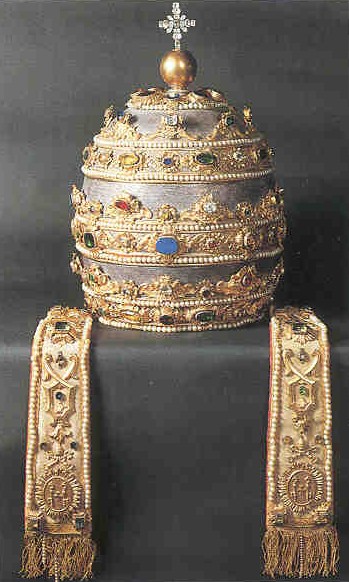
For the first several months readership was remarkably low, so low I dare not speak of numbers. Around the time Benedict XVI abdicated the Papacy the Rad Trad wrote a very brief series on the Papal Coronation as it existed before Paul VI, which garnered some interest, but not quite lasting. The two real "breakthroughs" in readership came with the Rad Trad's descriptions of Holy Week before Pius XII's novel rites and with his series Reasons for the Reform of the Roman Rite, which traced the broader causes of the 20th century upheaval in the Roman liturgy. Both sets of posts were meant to spread information and begin serious conversation about what happened to the Roman rite in the 20th century, something beyond the conventional Traditionalist claptrap ("Everything was perfect and Plasticine in 1962 until evil Freemason Bugnini came out of the shadows....") and ahistorical modern ignorance ("Well the Church always changes her liturgy, the new liturgy is true renewal, and has brought about nothing but good fruits"). These posts were featured on the St. Hugh of Cluny blog, the St. Lawrence Press blog, and various internet fora. Recently the Rad Trad has noticed an enormous increase in links via Facebook, but Blogger does not allow him to backtrack the links to the pages which advertise his posts.

As of this moment the Rad Trad has received 38,555 hits, currently averaging about 200 per day. After a day or two without a post the average drops to about 150. Days with liturgically oriented posts get 250-350 views. Every month, except June and July (likely because it was summer) readership has increased. Last month, September, was the best to date, with 7,464 hits. The five most viewed posts to date are:
  1. The Practical Effects of Ultramontanism (587)
  2. Book Review: The Banished Heart (451)
  3. Good Friday: Mass of the Pre-Sanctified (391)
  4. The Roman Rite in Transition (325)
  5. Reasons for the Reform of the Roman Rite Part I (290)
The most commented-on posts are FSSP Priest Caught Celebrating Versus Populum!, the review of Dr. Hull's Banished Heart above, and the most recent posting on the Parisian Missal.

More importantly the Rad Trad has been privileged to correspond and learn from many of his readers (you know who you are) about the faith and our Lord. It is a blessing.

from: catholicculture.org
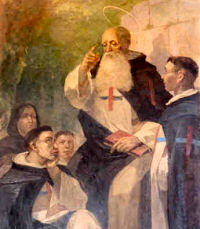
Lastly, the Rad Trad will now unveil the blog's new patron saint (and will give him a permanent presence once he figures out how to side bar material): St. Felix of Valois! The last lesson in the second nocturn of Mattins for St. Felix's feast should give readers a hint as to why the Rad Trad took Fr. Capreolus' suggestion for this saint's patronage:
"There Felix wonderfully devoted himself to the promotion of Regular Observance and of the Institute for the redemption of bondsmen, and thence he busily spread the same by sending forth his disciples into other provinces. Here it was that he received an extraordinary favour from the blessed Maiden-Mother. On the night of the Nativity of the Mother of God, the brethren lay all asleep, and by the Providence of God woke not to say Mattins. But Felix was watching, as his custom was, and came betimes into the Choir. There he found the Blessed Virgin in the midst of the Choir, clad in raiment marked with the Cross of his Order, the Cross of red and blue; and with her a company of the heavenly host in like garments. And Felix was mingled among them. And the Mother of God began to sing, and they all sang with her and praised God; and Felix sang with them; and so they finished the Office. So now that he seemed to have been already called away from glorifying God on earth, to glorify Him in heaven, an Angel told Felix that the hour of his death was at hand. When therefore he had exhorted his children to be tender to the poor and to slaves, he gave up his soul to God (upon the 4th day of November) in the year of Christ 1212, in the time of the same Pope Innocent III., being four-score-and-five years old, and full of good works."
Tonight is first Vespers of the feast of St. Luke the Evangelist. May we all be aware that the saints, God's friends, are also our own and let us be cognizant of their presence among us as St. Felix was.