Showing posts with label john paul ii. Show all posts

Tuesday, December 20, 2016

Crossing the Threshold of Popery


There is a little passage in the introduction to P. John Paul II’s 1994 interview Crossing the Threshold of Hope that started a long, internal process of reconsidering my approach to papal statements. The editor-interviewer Vittorio Messori drops this challenge to ultramontanist theologians while explaining the nature of the text to follow:
It is my duty to guarantee to the reader that the voice that resonates—in its humanity but also in its authority—is entirely that of the successor to Peter. It will now be the job of theologians and analysts of the papal teaching to face the problem of classifying a text that has no precedent and therefore poses new possibilities for the Church. (viii)
I listened to the entirely of Crossing the Threshold of Hope on an audiobook while driving from the American Midwest to New Mexico. My conversion was recent and still in its first vigor. While my reading pre-Confirmation had raised some confusion in regard to the thoughts and actions of the then-current Roman Pontiff, this book raised serious doubts. When I left the Missouri border I was a papist, but by the time I reached the deserted American Southwest I wondered if the pope was even Catholic, and if I should remain thus.

From John Paul’s limp passive voice to his failure to make clear distinctions, I grew increasingly frustrated with the pope’s muddled rhetoric. In the very first chapel he undermines the unique office of the papacy by extending the title of Vicarius Christi to the “entire college of bishops,” and also to all priests and to “each of the baptized” (13), without any clear distinction.

The formlessness of this personalist-philospher-pope’s thought became apparent in the occasional nonsense phrase that I desperately tried to make sensible, such as his description of the created world as “the foundation of a creative existence in the world” (21) or “the geography of the Pope’s prayer” (23). In response to the question of whether or not God exists, he refuses to answer clearly with a “Yes,” but rather recapitulates the history of the relevant philosophical speculation—“This question has reverberated throughout a highly developed Western civilization” (29), he says with all the squishiness of the indecisive.

Less than halfway through the book, John Paul “The Great” has begun rambling on about the greatness of the Church’s openness to the world. “Aggiornamento (updating) does not refer to the renewal of the Church; nor only to the unification of all Christians, ‘that the world may believe.’ It is also, and above all, God’s saving activity on behalf of the world” (76). Is the acceptance of the “updating” of the Church for the contemporary times necessary for salvation? It is God’s saving activity, after all. Can those who reject updatedness be saved?

Then he begins praising all the non-Christian religions of the world, claiming that, thanks to the Holy Spirit, there is “a kind of common soteriological root present in all religions” (81). What kind? Who knows. He does offer some caution regarding Buddhism, but again in the passive voice that precludes an actual warning or condemnation: “It is not inappropriate to caution those Christians who enthusiastically welcome certain ideas originating in the religious traditions of the Far East” (90). He says that Moslems “invoke the true God” (93), a common theme in the Age of Aggiornamento. His words on the validity of the Old Hebraic Covenant (in the chapter “Judaism?”) are vague, although Cdl. Ratzinger would be far more optimistic about its validity in his writings.

But it was the chapter “Is Only Rome Right?” that threw me for a loop as I sped down the Oklahoma turnpike:
Besides formal membership in the Church, the sphere of salvation can also include other forms of relation to the Church. Paul VI… spoke of the various circles of the dialogue of salvation…. It would be difficult to deny that this doctrine is extremely open. It cannot be accused of an ecclesiological exclusivism. (140-141)
The discussion of ecumenical overtures with Protestants that follows is concerned not with the salvation of those who are outside the Catholic communion, but with practical movements towards unity. “What unites us is much greater than what separates us,” he writes, just before going on about “genuine divisions” where the faith remains uncompromised (147).

The “Pope of Surprises” was not only confused but naive: “We find ourselves faced with a new reality. The world, tired of ideology, is opening itself to the truth” (164). Somehow in the midst of all this wishy-washy optimism, he finds himself surprised that preachers “no longer have the courage to preach the threat of hell. And perhaps even those who listen to them have stopped being afraid of hell” (183). Yet he ends the chapter with praise for Origen and von Balthasar’s rejection of eternal damnation, but without clear agreement or disagreement on his part. Is he the “Pope of Surprises” or the “Pope of Being Surprised”?

“Be not afraid,” is what he often repeated. Yet he gave me much reason to fear. I feared most of all that I had been scammed into conversion, that I had been lied to by the apologists who insisted that membership in the Church Catholic was necessary for salvation. I feared that they had either lied about what the Church was, or that this pope was speaking of some other religion entirely. I wondered if I ought to return to my Protestant roots, since they at least believed in the principle of non-contradiction.

But it was that brief passage in the book’s introduction, Mr. Messori’s observation that here would arise a “problem of classifying a text that has no precedent,” that helped me to cross my own threshold of hope. It is the ultramontanist who interprets every utterance of a Roman pope as infallible or potentially so; who when a pope calls a sunny day rainy, says that it must be “raining spiritually.” The legitimate exercise of Roman doctrinal clarity began to spill over into a thoughtless piety towards every casual utterance, to the extent that we still have well-meaning Catholics justifying the words of P. Francis in every interview.

The way over that threshold, I realized, was the simple rejection of Crossing the Threshold of Hope as a work of the Magisterium (that ever-elusive concept), and relegating it to the personal ramblings of a man who happened to be pope. It was a principle I eventually extended even to those officially papal writings that lacked doctrinal solemnity. John Paul’s papal documents are not quite as fast and loose with doctrine as this book-length interview, but they are frequently confusing and sometimes quite wrong. The first Vatican Council’s definition of papal infallibility was restrictive, leaving it to theologians and individual Catholics to sort out the importance of all other papal statements. Even P. Benedict XVI once said that the pope “is not an oracle; he is infallible in very rare situations.”

Words to live by. Be not afraid of discarding ultramontanism, all ye sedevacantists and neo-conservatives. When the pope of Rome speaks with all the solemnity and authority of the Holy Ghost, you will know it. Until then, unfollow @pontifex and give a mighty shrug whenever your non-Catholic acquaintances ask you to explain his most recent madness. Pray for him, but allow him to rant to an empty room.

Thursday, October 22, 2015

Some Thoughts on this Optional Memorial of John Paul the Second

Listen to those spring birds chirp!

Karol Wojtyła was the pope reigning at the time of my conversion to the Faith, the pope who appointed terrifying bishops to major episcopal sees and encouraged all manner of liturgical horrors in his own presence. For everyone my age and younger, he was the only pope they had ever known, until his death in 2005. Utterly naïve about the state of the world, and gracious to everyone except those standing up for justice and truth, he entered the next life with the taste of the Koran on his lips.

Today is his feast, of sorts, on the Novus Ordo kalendar. Let me suggest celebrating it with a fast. At the very least, we ought to do some penance for the poor soul of Marco Gusmini.

A reading from the book of Redemptoris Missio:
If we look at today's world, we are struck by many negative factors that can lead to pessimism. But this feeling is unjustified: we have faith in God our Father and Lord, in his goodness and mercy. As the third millennium of the redemption draws near, God is preparing a great springtime for Christianity, and we can already see its first signs. In fact, both in the non-Christian world and in the traditionally Christian world, people are gradually drawing closer to gospel ideals and values, a development which the Church seeks to encourage. Today in fact there is a new consensus among peoples about these values: the rejection of violence and war; respect for the human person and for human rights; the desire for freedom, justice and brotherhood; the surmounting of different forms of racism and nationalism; the affirmation of the dignity and role of women.
Responsorial Psalm:


Friday, July 11, 2014

Book Review: Undermining of the Catholic Church UPDATED

"There are only two books worth reading on the Traddie situation," a correspondent, who knows who he is, wrote me to over a year ago. "Dr. Hull's book and Undermining of the Catholic Church by Mary Ball Martinez."

Traditionalists and all stripes of Catholics have access to volumes upon volumes of material to read, published or online. The best sources are of course Scripture, the liturgical texts of the Church, and the Fathers. These sources tell us not just what to believe, but more importantly how to believe. And there are other useful books, works, and lecture series for understanding theology, liturgy, history, and philosophy. Many of these works have been reviewed on this blog, particularly ones pertaining to liturgy (Dr. Hull's book, Kavanagh's lectures, and Laurence Hemming's works among them). And yet after extensive reading and private research I must agree that, as far as the "Traddie situation" is concerned—the 20th century revolution in the liturgy and the political agenda of the Roman Church—The Banished Heart by Geoffrey Hull and Undermining of the Catholic Church by Mary Ball-Martinez are still the best books to read. Other books touch related material, but only these works address the matters at hand directly.

I have alluded to Martinez's first book, From Rome Urgently, which was a compilation of articles she wrote in the 1970s. Undermining is something of a sequel to From Rome, with greater and clearer rumination on the status of the traditionalist movement and limpid hindsight into the beginnings of the revolution in the late 19th century. 

Undermining, which can be read and downloaded free of cost here, has largely been ignored by all quarters of the Church because its thesis and narrative do not fit anyone's agenda. The liberal crowd may have agreed with its facts and found the result of the revolution positively delightful. The neo-Ultramontanists who we now identify colloquially as the "JP2 generation" would find the criticism of the renewal outright scandalous. And sedevacantists, FSSPX traditionalists, and "indult" traditionalists could not stomach that she exposed Pius XII and the early 20th century Vatican for what they really were. Consequently, her book enjoys a dedicated, narrow following like 1980s "B films."

The Thesis

Martinez's begins on the vigil of Pentecost in Rome in 1971. The Second Vatican Council closed six years earlier. Pope Paul was midway to the end of his tragic reign. Archbishop Lefebvre was not yet ready to declare himself publicly. And Catholics were gathered and praying the rosary by the thousands under the windows of the Apostolic Palace for the return of the old Mass. How did the Church arrive at this odd point? With Mystici Corporis, Martinez says. MC was the first and most vital step in dismantling the legalistic understanding of the Church that dominated the Counter-Reformation and replacing it with a model based on human beings, an opinion shared by Avery Dulles, the Jesuit Cardinal and theologian.  It was the first domino to fall, culminating in the long anticipated Council that would complete a revolution started in 1903.

In 1903, Martinez asserts, Cardinal Rampolla was elected or nearly elected Pope, only to be vetoed by the Polish cardinal under the auspices of an obscure and long forgotten treaty. The cardinals then flocked to the patriarch of Venice, whose first decision as Pope was to rescind all veto privileges. Rampolla, now saddled with the less glamorous position of Secretary of the Holy Office, spent his time training three proteges who would make his humanistic vision for the Church a reality: Giacomo della Chiesa, Pietro Gasparri, and Eugenio Pacelli. Della Chiesa had no sooner been made a cardinal than he was elected Pope Benedict XV and began to undo his predecessor's measures against modernizations, including the dissolution of Pius X's secret informant network. The First World War threw a wrench into the clique's immediate plans. When Benedict XV died prematurely the powers that were found themselves in a debacle. Pacelli was still too young and Gasparri was un-electable. As a solution they elected an aloof academic in Pius XI, hitherto the Vatican Archivist. It was during this papacy that things began to turn.

The Secretariat of State office, run by Gasparri and assisted by Pacelli, promoted policy antipodal to the teachings and desires of the Pope of the time, opposing and undermining Action Francaise and the Catholics in the Spanish Civil War in favor of French secularists at the same time the Pope was talking about the "social reign of Christ the King," a long favorite subject of traditionalists. The most reprehensible betrayal was that of the Christeros, wherein a civilian army fighting against a humanistic and even Masonic (?) president in Calles with no support from the upper clergy achieved absolute victory and were then convinced by Rome to make an un-conditional surrender and subject themselves to slaughter.

During this same period the paradigm shifted within academia and the religious orders, often with tension between the younger and older generations of priests. The Holy See, far from reigning in excesses and deviations from the accepted teachings and outlook, often aided and abetted these digressions. In the case of Teilhard de Chardin the Society of Jesus prohibited him from publishing and obstructed him from going on the speaking circuit. The Secretariat of State however, at the behest of Pius XII, arranged for him to give lectures in occupied France during the rule of the Vichy government. 

During the War Pius XII aided Jewish efforts to escape from the Holocaust and Hitler's death camps, but almost entirely ignored the political difficulties of the Church during this era. His foreign policy consistently stood against authoritarian governments that were either indifferent to Catholicism or in favor of it, but he sided with the humanists and Marxists. He permitted the Vatican to be used an an intermediary point in the War for discussions between the Allies. And he spent copious time during the War smuggling Jews from Italy into British Palestine on the eastern coast of the Mediterranean. After the War the early seeds of liberation theology and the Charismatic movement began to sprout above ground with the support of Countess Pacelli, the Pope's sister.

The time after the War was spent consolidating power and loosening discipline. The Biblicum was created in Rome to give a presence in Vatican academia to the progressive movement. The rules around the celebration of Mass and reception of Communion were relaxed to a point envied today, but risible to previous generations. And the promulgation of the dogma of the Assumption and the creation of a commission to reform the liturgy centralized spiritual authority around the Pope. Martinez at one point boldly asserts that the canonization of Pius X was part of a barter with the baroque-minded Vatican establishment to begin introducing the new liturgy, particularly the new rites of Holy Week.

Aware of his age, the Pope sent his protege to Milan, but died before making his successor a cardinal. The affable Angelo Roncalli took the papacy for a few years before Montini could become Pope in 1963. From that point on the narrative becomes familiar. We all know about the Council, the branching and flowers of the roots planted half a century earlier.

The middle section of Undermining is a series of vignettes, short biographies of the Popes from John XXIII until the then-incumbent John Paul II. Paul VI's segment is especially poignant. He was an early revolutionary, encouraging students in the Red Brigade to oppose Mussolini, who, although a bad man, was tolerant to the Church in ways unseen since before the 1840s. Later in life he may have lamented that the Red Brigade had killed his dear friend Aldo Moro, the product of the center-left political party his father had party and Pius XII advanced decades prior. He died a broken, unhappy man. Also interesting, if only for historical reasons, is her honest biography of John Paul II. She summarizes his education and seminary formation in Poland after the Russian invasion and his time at the Belgian college in Rome dispassionately and with concision. This was revolutionary in 1991 because most people were pretending he was an impoverished miner who studied at an underground seminary amid Soviet persecution. 

The last segment of the book contrasts sharply in certain aspects with From Rome Urgently. Previously she was brimming with excitement about Lefebvre, the militancy of the traditionalists, and the devotion of the faithful. She maintains these qualities in Undermining, but with considerable reservation. She wonders if Lefebvre missed his chance to make a difference in 1976 by obeying the Pope's command to bite his French tongue. The grassroots traditionalist movement collapsed and all that was left was the FSSPX and a few independents—something that will be explored in our upcoming series on the early traditionalists.

Short-Comings

Undermining is not a book without short-comings, the three greatest of which are: the lack of citations, the proclivity for conspiracy-theory language, and a lack of historical perspective.

The lack of citations is the most arrant deficiency in this work. Martinez was a journalist, writing for decades as the Vatican correspondent for National Review, the Wanderer, and other periodicals. She was not a professional historian and did not document her work very well. Much of what she learned could be documented with extensive and painful research though. I came to trust Undermining from personal experience. My first major university research project was on the role of the Holy See during the Second World War. What Martinez surmises about the Pope's efforts against the Nazis and Holocaust I corroborated independently years before encountering her book using primary information sources (journals, news articles, and records) as well as some scholarly polemics. That she recorded this information favorable to Pius XII during a time before a cottage industry for defending his War record emerged (Rabbi Dalin, Sr. Marchione etc) and given her un-favorable view of the man impressed me.

The second issue is also significant. She speaks of "the Masons" and like groups as though they are an organized secret government with a dedicated head—as though the cretins who mangled the Church in the 20th century and who are mangling Western governments and economic policy now are capable of such things. She does at points clarify what she means, but often lapses into conspiracy theories again. At one point she wrote that Pius XII, Paul VI, and Benedict XV should not be considered conspirators in the common understanding of the word. These men did not hold round tables discussions on how to undermine the Church deep within the walls of a lodge. These men acted in accordance with their rearing and education, which involved a different outlook on the Church than the one received. She does claim John XXIII and Pius IX (you read that right) were Masons, but does not expound upon the supposed significance of this too deeply.

The last pitfall is her lack of perspective. Mystici Corporis was a departure from the legalistic, cold understanding and corporate structure of the Catholic Church that emerged during the Counter-Reformation. Where she errs is in stating that the teaching was entirely novel. Indeed, it is well rooted in the letters of St. Paul, the sermons and treatises of the Cappadocian Fathers, and in the ecclesiology of Lateran IV. The footnotes and citations in MC easily verify this. Where she was right was in suggesting that the point of MC was to confuse theologians by introducing an understanding of the Church based on human beings and mysticism. Indeed, the idea of the Church as the Body of Christ bound up in the Sacraments is the teaching of the Church Fathers East and West as well as that of the Greek and Latin liturgies. The idea of the mystical Body of Christ was quite novel, and the focal point of this mystical body would be the Roman Pontiff. Martinez, with more familiarity with the deeper traditions of the Church, might have realized that MC was about spiritual centralization and taming precocious revolutionaries, not about introducing unheard of doctrines.

Final Words

Undermining of the Catholic Church by Mary Ball-Martinez is an essential work to study and parse for those who seek to understand the political changes in the Vatican that wrought decades of internal revolution in the Church of Rome. For all its problems, Undermining is the only book that connects the dots which have been hiding in the plain sight of traditionalists for years.


As an aside, if anyone wants to know how to access her first book, From Rome Urgently, email me.

UPDATE: My email address is theradtrad@gmail.com.

Tuesday, June 3, 2014

Another Post on SVism

source: Huffington Post, selfie with the Roman Pontiff
Readers will remember my post Sedevacantism several months back. It is, quite inexplicably, my most-read post ever, I suspect because there is little mainstream discussion on the subject that examines both its claims and its historical origins. For those with a continuing interest in the subject see this fellow's post on the topic at Shameless Popery. The blogger is a seminarian who follows what label makers would categorize as neo-conservative Catholicism and his post, a very basic point-by-point rebuttal to sedevacantism, seems geared toward those pulling out their hairs over Francis rather than those concerned with the broader problems in the Church. What is interesting about his post is that he felt compelled to write it. The original wave of sedevacantism came during the late papacy of Paul VI and the early years of John Paul II. Could Francis be fostering new signals on the EKG of empty-chair outlook?

Thursday, April 24, 2014

Of Impending Canonizations (and one that is not happening)

In a matter of days Pope Francis will canonize two of his many mis-understood 20th century predecessors, declaring them saints fit for universal veneration and examples given their state of life. I generally shy away from blogging about politics—and that is precisely what these canonizations are—but the significance of this event warrants some thoughts.

Why are John XXIII and John Paul II mis-understood? Because modern people think them more important and influential in the modern Church than they really were. In principle, I am entirely indifferent to the canonization of Papa Giovanni. He was elected to do three things: 1) make Pius XII's true successor, Msgr. Montini, a cardinal 2) call Pius XII's Council and 3) die. In some sense he was the first pope since Gregory XVI to live up to expectations! So why has the Roman bureaucracy undertaken effort to canonize John? It is an attempt to canonize a particular narrative and aesthetic of the Second Vatican Council.

When he died on the feast of the Transfiguration in 1978, ABC news reporter Stuart Laurence said  of Pope Montini "Romans never really in fact warmed up to Pope Paul because he was not gregarious and grandfatherly like his predecessor Pope John. John, of course, was loved. Pope Paul was only liked." Pope John represents a kinder, gentler means of looking at the transitional years of the Church than the harsh, turbulent years of Pope Paul. Paul VI's pontificate was more the reality of the transition, with the drop of Mass attendance in America (it plummeted in Europe decades earlier), the fallout over Humanae Vitae, the open resistance of Lefebvre, the failure of ecumenism and ostpolitik, and the decay of the Vatican's potency in political affairs. John's pontificate, for those lacking in perspicacity and historical knowledge, saw a fleetingly vibrant Church—rich in faith and dignity—opening itself up to a changing world with open arms. Rome has chosen to canonize a strong Church entering renewal rather than a long collapsing Church emerging from self-inflicted chaos. They have chosen to canonize a fuzzy, paternal pope rather than a morose one full of regret. The canonization might actually make Vatican II into "Pope John's Council" rather than "Pope Pius' Plan" and "Pope Paul's Burden."

The other canonization has nothing (I cannot emphasize this enough) to do with Vatican II and everything to do with crowd pleasing. He traveled everywhere. He touched everybody. He smiled for everyone. He was something for ever Catholic to behold. John Paul II was the first media superstar pontiff. He trotted the globe over the course of four decades and cemented himself into every living person's memory for good or ill. Two generations of Catholics (those born in the '60s-70s and those born in the '80s-90s) and Catholic priests know John Paul as their pope. He was against abortion. He had a warm, vague, way of inspiring confidence for people of all walks of like while maintaining the tenets necessary for orthodoxy. Conservatives could point to him as a living example of "renewal": he was clearly on board with many brands of spirituality, he favored the new liturgy, he was pro-life, he was against Russian Communism, he was friendly with people of other walks of life, and he had the occasional humorous moment when he defended orthodoxy, such as forcing a monarch to receive Communion on the tongue. He was everything a college student wants in his campus chaplain: Catholic, fun, and not too demanding.

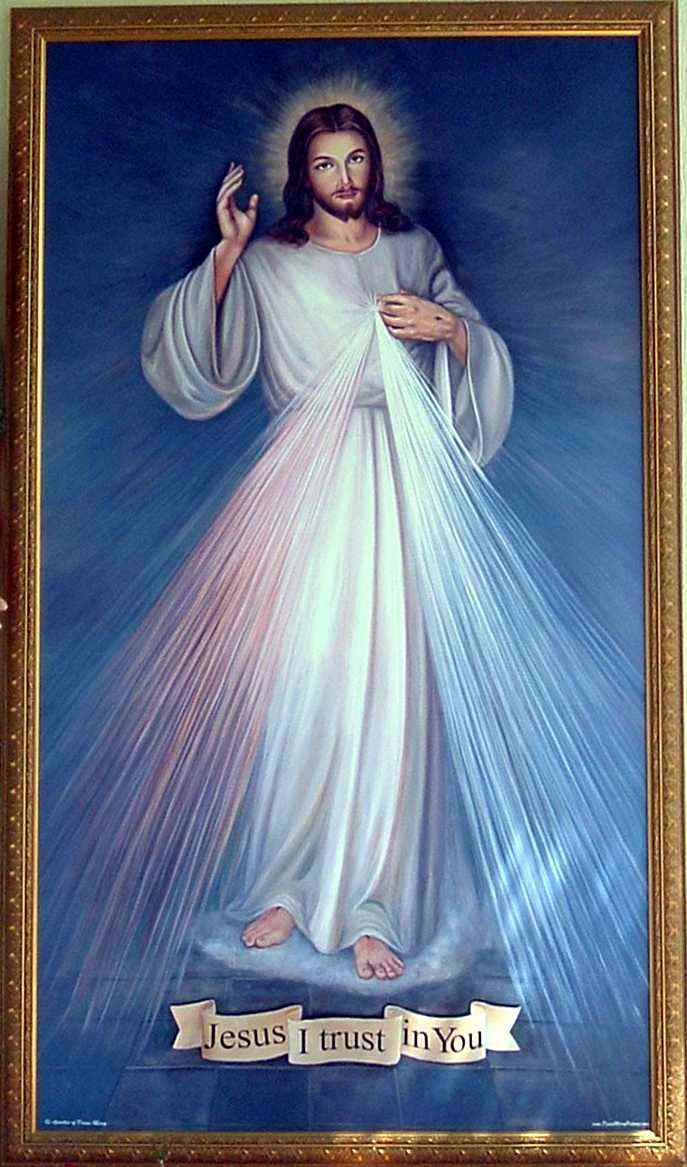
Even Traditionalists got something out of him. Many favorite saints in the Traditionalist milieu—Padre Pio, Juan Diego, and Maximilian Kolbe—were canonized by John Paul. He also gave both domesticated Traditionalists and neo-conservatives the Divine Mercy devotion (never quite understood it or the Sacred Heart). Indeed, National Review religion editor and ex-priest Malachi Martin succeeded in convincing many Traditionalists that John Paul really did believe everything they did and with the same sensus fidelium, hence the 1984 indult and attempts to smooth out relations with the potentially schismatic Lefebvre. He even invoked infallibility against women taking priestly orders!

The truth about the man is probably somewhere in the middle. He was elected because he was a charismatic man who could appeal pastorally to Catholics and non-Catholics while not disturbing the Vatican political machine, which continued to run the administrative side of the Roman Church into the ground. It is likely the same reason the prior pope and namesake of Wojtyla was elected.

The canonization of John Paul II will be an act of self-affirmation for hundreds of millions of modern Catholics following his unusual synthesis of doctrine, engagement, and outlook. "My pope is a saint," the average Mass-going Catholic between ages 20 and 50 will say in a manner akin to answering a question out of a self-help book. Whether he was actually a good pope is entirely irrelevant. Rome wants to keep its young faithful and young priests content. This, like the canonization of Celestine V by Rome and that of Emperor Constantine by Constantinople, is highly political in its motives and meant to continue to steer the barque of Peter in a particular direction.


Which brings me to my last point: the canonization I hope I never see. Readers know exactly who I mean. Given that yesterday's reformers are getting their canonization with John and today's youth are getting their's with John Paul, Traditionalists (particularly here, here, and here) are asking "Why not Pacelli?" Religiously and historically I cannot see any reason to canonize the man. His papacy was one of the all-time worst, certainly the worst since the Renaissance, replete with an immense relaxation of discipline, an undermining and re-programming of priestly education, friendly relations with Communists (except when it came at the cost the Christian Democratic party in Italy), liturgical destruction on a scale—at the time—unseen, bureaucratic centralization, and he put the people in place to finish the revolution which he began. Politically speaking his canonization would make even less sense: he wore the tiara, defined a dogma, and issued a large volume of encyclicals that go into the Magisterium file. Liberals see Pacelli as the last of the old guard while neo-conservatives have no substantial acquaintance with the popes before John Paul. Who, other than American and FSSPX-affiliated Traditionalists, gains from the canonization of Papa Eugenio?

American Traditionalists are fond of Pope Pius because the American branch of the Church seemed to be growing at an exponential rate: more vocations, more seminaries, more parishes, more converts. As Cardinal Spellman said, in a hundred years America would be a Catholic country. Then came the 1960s and the "fresh air" of the Council blew over the house of cards that was American Catholicism. The numbers touted by American Traditionalists are quite ignorant. The growth in the 1950s and 1960s was due to the Baby Boom generation, progeny of World War II veterans and their wives, reproduction at a rate unseen since the 19th century. Yet many of these Boomers were second and third generation descendants of immigrants and, often, practicing the faith out of cultural obligation. The first generation Italians would go to Mass and carry on the traditions of Catholic Italy with conviction. The second generation would continue the same out of devotion to one's parents. The third would do so out of habitual custom, far removed from the source of custom and devotion. American Catholicism had no firm roots. It was in many ways Catholicism-lite made for a protestant country: low Masses, devotions, and church organizations allowed for the "personal relationship" with God emphasized by protestants while upholding the administrative and communal side of the Church. What was missing was a strong foundation grounded in liturgy, martyrdom (very little devotion existed to the North American martyrs), local traditions, and episcopal authority. The American Church's structure was planted during the mid-19th century, when the previously mentioned trends were in vogue. The Church in Europe had long collapsed. America, demographically vibrant but spiritually frail, shattered at the shock of the Council. The growth had nothing to do with Pope Pius and its end had nothing to do with Gaudium et spes. It was about the young tree of American Catholicism that was turn up and was exposed to have not taken root. Canonizing Pope Pacelli would add him to the museum of 1950s American Catholicism. Nothing more.

The canonizations of Popes John and John Paul indicate a Vatican ready to affirm itself and the psychological needs of its devotees. For the same reason, the Rad Trad thinks a canonization of Pope Pius quite unlikely, unless Francis is overcome with nostalgia for the pope of his youth and early formation.

Alright. Enough politics for a month or two. Time to do something spiritually productive. Christ is risen after all.

Saturday, September 21, 2013

Practical Effects of Ultramontanism

Fr. Ray Blake has an interesting post reacting to one ex-SSPX commenter's difficulties with Pope Francis and the general mood that surrounds the Roman Pontiff. In the comments section one poor fellow, who struggles with homosexuality, has thought about ditching Rome for one of the Eastern Orthodox groups. It begs the question: why such a reaction? Why does the personality and the [positive or negative] aura of a given Pope matter so much to people's lives?
 
More liturgically-oriented readers have probably realized by now that the Rad Trad is not so rad of an Ultramontanist. Indeed, he has little use for the late-19th century, Jesuitical fad that provided so much material for the BBC series Bless Me, Father. What few realize today, either in Traddieland or the mainstream, is how personal and shocking the effects of Ultramontanism have been. The phenomenon has devolved from a hyper-obsession with the Petrine office into a singular focus on the personality of whoever currently wears a white cassock and lives in Vatican City. Ultramontanism can be defined as this: The reigning Pope is always right and inspired by the Holy Spirit in everything he does and everything he approves, until another Pope does something different, in which case we just do not understand it" (Rad Trad Dictionary under "U").
 
Those who remember the 1960s, '70s, and '80s are about to take a quick stroll down memory lane, but it is prudent to consider what happened when, during and after the Second Vatican Council, the Church infrastructure created by highly centralized Ultramontanism fractured and crumbled under the burden of episcopal conferences, scandalous bishops, bad (but Papally sanctioned) liturgy, ecumenism gone wild, and other degrees of abuse (warning! most of this will sound highly tonue-in-cheek, but I make these comments from an observational, sociological standpoint and do not mean them personally; I am not singling out any readers or any public figures):
  • Continue to call one's self Catholic but cease to adhere to the Church: by far the most common result. So many had put stock into every word that Pius XII said that when Paul VI assumed the Papal chair and allowed bishops and clergy to go wild the impression was that none of this was really important after all. Most ceased to attend Mass and the dissipation of morality followed. Some retained the moniker of "Catholic" and even some cultural vestiges like fish on Fridays, but the great mass of people just left and looked back to those halcyon days as something childish or of a different era.
  • Continue in the Church, but gradually lose vigor: this was the second most common result of the meltdown of the old institution. A number of people found the vernacular readings in 1964 interrupted their private Rosaries during Mass, but His Holiness approved this new practice so along they went. As the liturgy and catechesis devolved and Rome sat lax, Mass attendance became more of a cultural and mechanical function than ever before (not that many did not attend out of social obligation before the collapse of Ultramontanism). The Church became a NGO in the eyes of these people with the Pope, a funny and stodgy old man, as the CEO. He introduced what appeared to be a new program, which was less interesting than the older one, yet it was not an entirely unpleasant experience. On the whole, this reaction can be likened to a classical local restaurant with a trust-worthy owner (let us call him Bill) everyone knows and loves. One day he changes the menu and the number of people going to dinner diminishes, but enough people from the old crowd who, although they do not care for the food, still like Bill patronize the place to support their friend and relive past experiences.
  • Stay and get with the spirit of the times in an orthodox manner: forerunner to the "hermeneutic of continuity." Many of these people held to every word of Paul VI and John Paul II on social issues and especially took to the Polish Pontiff's zeal. This birthed the "JP2" crowd that the Rad Trad recalls so vividly from his university days. These folks are often good people who read the 1992 Catechism and attend Mass frequently; they have adopted the Divine Mercy chaplet (could never get the hang of it) and Taize music for meditation. Everything the Pope, but especially the 1978-2005 Pope, says is inspired by the Spirit, Who dwells amongst us and directs us toward a renewal so fruitful we can hardly comprehend it.
  • Stay and become irate: this option gave birth to the more extreme elements of Traddieland. This crowd, more than the others thus far, shows the harsh effects of Ultramontanism. If everything every Pope before the Second Vatican Council said was as divinely-inspired as the Gospel, one has great difficulty in reconciling Francis and Pius X. Many went on to participate in the Traditionalist movement and join up with "independent" chapels or the Society of St. Pius X. These groups often view the Popes from 1958 onward as material heretics who, although they ought to be infallible in everything they do, must be totally ignored for not celebrating the Tridentine low Mass, writing encyclicals on neo-Thomistic theology, promoting the Sacred Heart, and condemning everyone who does not follow these precepts. Some of this group "lightened up" and joined the Ecclesia Dei type communities like the ICRSS, FSSP, IBP, and "indult" Masses.
  • Sort of stay: sedevacantism is the even more extreme consequence of the preceding line of thought. If the Pope is perfect and the current Popes are unlike their predecessors, then they are not perfect and hence not Popes. Someone who is different is doctrinally suspect; someone who is suspect is a material heretic; someone who is a material heretic is really just a low key formal heretic; and a formal heretic cannot be Pope. Amazing how that works. Best form our own $ociety of $t $omeone and furnish the place with kitsch statues of saints popular between the pontificates of Gregory XVI and Pius XII.
  • Go Protestant: the new following of the Pope, and the ecclesiastical world which emanates from him, is so dull that one may as well go to a Protestant community and really get church'd. In the 1970s and 1980s many Catholics lost their faith and then "found" it in evangelical protestant churches where they sang, danced, and learned the [abbreviated] Bible. This phenomenon has, thankfully, declined in recent decades. Some of these folks, from personal experience, are a variation of the group summarized in the first bullet point. Consequently, because so few of them had a good hold on the faith when they were Catholics, they often equate Christianity with Protestantism and hence zone the Church outside of their peripheries. Many Protestants, particularly clergy, are finding their way to the Catholic Church these days, but these people are often converts and not reverts.
  • Go Greek (or Russian, or Arab) Orthodox: a smaller, but not insignificant, number of devout Catholics, shocked by the situation in the Papacy and the poor state of the Roman liturgy followed the path of Fr. Alex Toth and left the Church altogether for an Eastern dissident group. With few exceptions, these folks can be rabidly anti-Papal, probably reeling from the aftershock of the collapse of the idyllic vision of the Church presented by the hierarchy in the late 19th and early 20th century. The Antiochian Orthodox are by far the worst in this regard (the Rad Trad has listened to an Antiochian Orthodox priest deny his own tradition by saying Papal primacy never existed in substance and that the idea St Peter was ever in Rome is a pious myth). Those who have gone to the Russian Orthodox tend to be more friendly and practical, often searching out good liturgy and not leaving the Church out of malice. The Rad Trad has never met, to his knowledge, any Catholic who has left for the Orthodox communities, but he has been blessed to know two holy people who have gone the other way.
  • Ad orientem: people who go to the Eastern rite Catholic Churches and stay there. Byzantine Catholic Churches have been the most popular destination here, as their liturgies are more often in vernacular than the other options. The Rad Trad's own parish is about one third "transplants" who came into the church for Divine Liturgy one fine morning ten or twenty years ago and never left. They adopt the spirituality and liturgy as their own. Their view of the Papacy often differs from Church to Church. For instance, the Ukrainians are far more Rome-focused than the Melkites.
  • An old fashioned Holy Ghost throw down with the Catholic
    Charismatic movement.
    Be slain in the Spirit: last, but not least popular, is the Charismatic movement. Get "slain in the Spirit" and discover your new gifts! This group, again more popular in past decades, has a uniquely modern sort of Ultramontanism that is attached to John Paul II's confirmation of their movement ("Long life to the Charismatics"), but also to Benedict XVI's kind words for them. Their relations with Pope Francis have yet to be determined, but their personality certainly matches the aesthetic of their style: spontaneous, simple, direct, and somewhat emotion.
Why expound such a long list of subgroups of Catholics and former-Catholics? Because so many of the people within these categories, which are generalizations and not absolute, find themselves where they are because of their relationship to the Papacy. A once tightly run company under the singular direction of Pope/CEO Whoever is now a chaotic array of various people who now have a different relationship to the Bishop of Rome than people half a century ago did and it is largely not their own faults. They had bought into a system wherein Papal encyclicals substituted for good catechesis and the Catholic instinct.
 
Most Catholics, from the first century until the nineteenth, probably did not even know the Pope's name, much less his policies and particular interests. Obedience to the Church's teachings and love of one another are what is required for salvation, not enthusiasm any particular program. Vatican I certainly made the Pope's role more prominent when the Council defined Papal Infallibility, albeit in a far more moderate way than Pius IX would have liked (he wanted to be infallible in all matters). Papa Sarto's reign was the real turning point, wherein the Pope's personality became a central part of the faith (I am of course referring to his aggressive stance in the Modernism controversy). Pius XII put this on camera and John Paul II put it in Technicolor.

Yet this obsession with the interests and whims of individual Popes is not part of the faith. Excessive concentration on his words, and the endeavor to square every vowel with those of his predecessors, will drive a person into one of the many exciting opportunities above. What does such an endeavor profit? Some liberal blogs are getting quite giddy about what they think Pope Francis has said in his 12,000 word interview and some traddie blogs are becoming distasteful in their reaction to the man. I myself wish his liturgical praxis was better and his statements were clearer, but what does it matter to me what a given Pope says in an interview or what his Curial plans are? Unless he intends to make an ex cathedra statement or do something to my parish then why should I take my eyes off my Divine Office or my editions of the works of the Fathers so that I may engage in the frustrating exercise of squaring Papal politics with my own perspective?

Lastly, one may be tempted to adopt a permanent spirit of criticism toward a given Pope, past or present, and allow that mindset to permeate our prayers and our daily interactions with others. Is this the Catholic spirit? Do we focus on Peter's denial or Our Lord's command "Feed my lambs"?

As G.K. Chesterton once said, I am on the Barque of Peter and do not need to see the engine room.
 
Keep focused
 

Friday, September 6, 2013

St. Pius XII?

With all the talk last month about the impending canonization of Popes John XXIII and John Paul II, only a few are still discussing the interesting news that Pius XII, the last Pope prior to the Second Vatican Council, may also be raised to the altars and by the same dispensation as his successor, Papa Roncalli. One wonders why?
 
Rome's eagerness to canonize John XXIII and John Paul II reflect a desire to canonize the Second Vatican Council and the "Spirit" of the Second Vatican Council respectively. But what would make them want to canonize Papa Pacelli? Francis has been compared to John Paul II for his liturgical praxis, but at least this observer finds him more analogous to Paul VI than to the Pope from Poland. Which brings us to a potential answer. Pius XII made Paul VI, and in a great many ways.
 
As the Rad Trad has said before, Pius XII is the least understood Pope in centuries. He is condemned for the good he did and lauded for the ills of his pontificate. Traditionalists and liberals alike see him as the tiara-wearing, Thomistic, Latin Mass-defending bastion of orthodoxy that preceded the radical changes that began with "Pope John's Council" in 1962. This is romantic (or horrific, depending on one's perspective) rubbish. As previously stated on this blog, Pope Pius was a modernizer, neither a liberal nor a conservative, so his canonization would not necessarily vindicate either side's view. In more sensible times his cause would have had ecumenical implications with the Jewish people, but the media have blemished his reputation since the play The Deputy in 1966 and have painted him as a seething anti-Semite or passive Nazi-enabler; neither characterization could be further from the truth.
 
Yet his work on behalf of the Jewish people in the face of their extermination might be the only clear cut good on Papa Pacelli's part. His primary duty, to preserve the Catholic Church through the Second World War, was less than successful. Most of the Church hierarchy was disbanded, understandably, in Germany and Poland—less so in the lower countries which had Catholic Italy as a cultural boundary against too much Nazi secularism. The rebuilding of the European Church after the War was unsuccessful. Sure, American money—provided by Americanist bishops like Cushing and Spellman—restored the physical plants, but no revival of the faith took place in Europe. Poland had withstood secularism during the War and continued to do so, far from American influence, nestled behind the Iron Curtain. Perhaps one reason the Traditionalist movement began in France is because Church influence and Mass attendance had been declining since the reign of Louis XVI. French Catholics had no illusions, no glass house like American and English Catholics. One rarely heard Pius XII speak on matters of Church-State relations in a theological context. His concerns always seemed more practical and concerned with rights rather than public religion. More Paul VI than Pius XI in my opinion.
 
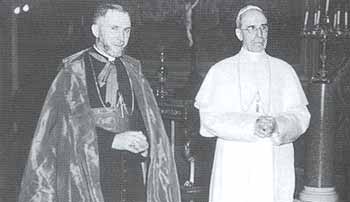
Pope Pius XII with his protégé some time after 1956, when
the Pontiff's health was in rapid decline.
Which brings us to one point too long overlooked: Pius XII made Paul VI. Sure, there are the stories of Msgr. Montini, a secretary in the Vatican, celebrating Mass with university students huddled around his altar—a forerunner to the modern day Newman center if there ever was one, which Pius XII's aristocratic nature did not meet well. And yet we find from his days as a cardinal, Eugenio Pacelli raised Giovanni Battista Montini through the ranks with startling efficiency, almost to denote his successor. Pacelli, as Vatican Secretariat of State under Pius XI, hired Montini for prestigious diplomatic work. Aside from a minor assignment in Poland, Montini worked under Pacelli's tutelage for the better part of three decades, including during the War, a time when other members of the Vatican diplomatic core, like Archbishop Angelo Roncalli, were engaged in active field work. There is, of course, the tale that Montini furtively held negotiations with Russian communists during the War, inciting the fury of his superior, by that point Supreme Pontiff, who promptly exiled him from the Vatican to the archdiocese of Milan. We should not be surprised if there had been contact between Rome and the Soviets, given the ease with which John XXIII acquired Orthodox observers at the Vatican Council a few years later, but this would indicate that the connection between the two parties was well-developed. Which causes us to re-examine the canard of Montini's exile: Msgr. Montini, a priest, was transferred from an under-secretarial position in the Vatican to one of the most important episcopal sees in the world (which had produced the previous pope at the time) and received his consecration from the Pontiff himself. If anything, Pius was denoting his eventual successor. Much is made of the fact that Montini did not get the red hat. Neither did Cushing and many others. Montini was raised to the episcopacy in 1956, three years after Pius XII's second and last consistory. Interestingly, Pope Pius also gave Frs. Suenens, Wojtyla, and Cushing their first episcopal work.
 
Captain Charles Ryder Evelyn Waugh,
convert to the faith, novelist, and
lay liturgical critic.
Lastly there is the liturgical question. Pope Paul stated explicitly in his bull Missale Romanum, which introduced the new ordinary of the Mass to the Roman rite of the Church, that this new praxis was the culmination of a renewal process which began under Pius XII. Given Montini's daily first hand knowledge of Papa Pacelli, one would be hard pressed to dispute this claim. Novelist Evelyn Waugh once wrote "many of the innovations, which many of us find so obnoxious, were introduced by Pius XII." Waugh's tone aside, he hits the "nail on the head" here. Evening Masses, vernacular Masses, people muddling through spoken responses, the new Holy Week, and other novelties came about with official approval from Pope Pius. He certainly was not a fan of other novel practices, like the lay offertory procession—which he condemned in Mediator Dei, but he did very little to stop other innovations such as Mass versus populum.
 
Depending on one's perspective, all of this could be good or could be bad, but, as the saying goes, you are entitled to your own opinion, not your own facts. Pope Francis is an enthusiast of Paul VI, the Pope of his seminary formation and early priesthood. He knows that Pius XII, far from being a 19th century stuff-shirt, was in fact a very modern Pope who set the stage for Council and the liturgical renovations of the 1960s and 1970s which formed the modern hierarchy. It is the Rad Trad's opinion that Pope Francis, God love him, may be seeking to canonize Pius XII for the same reason he intends to canonize John XXIII and John Paul II: to canonize the what people perceive as the changes associated with the Second Vatican Council.