Friday, August 23, 2013

Coming Soon: Review of Banished Heart

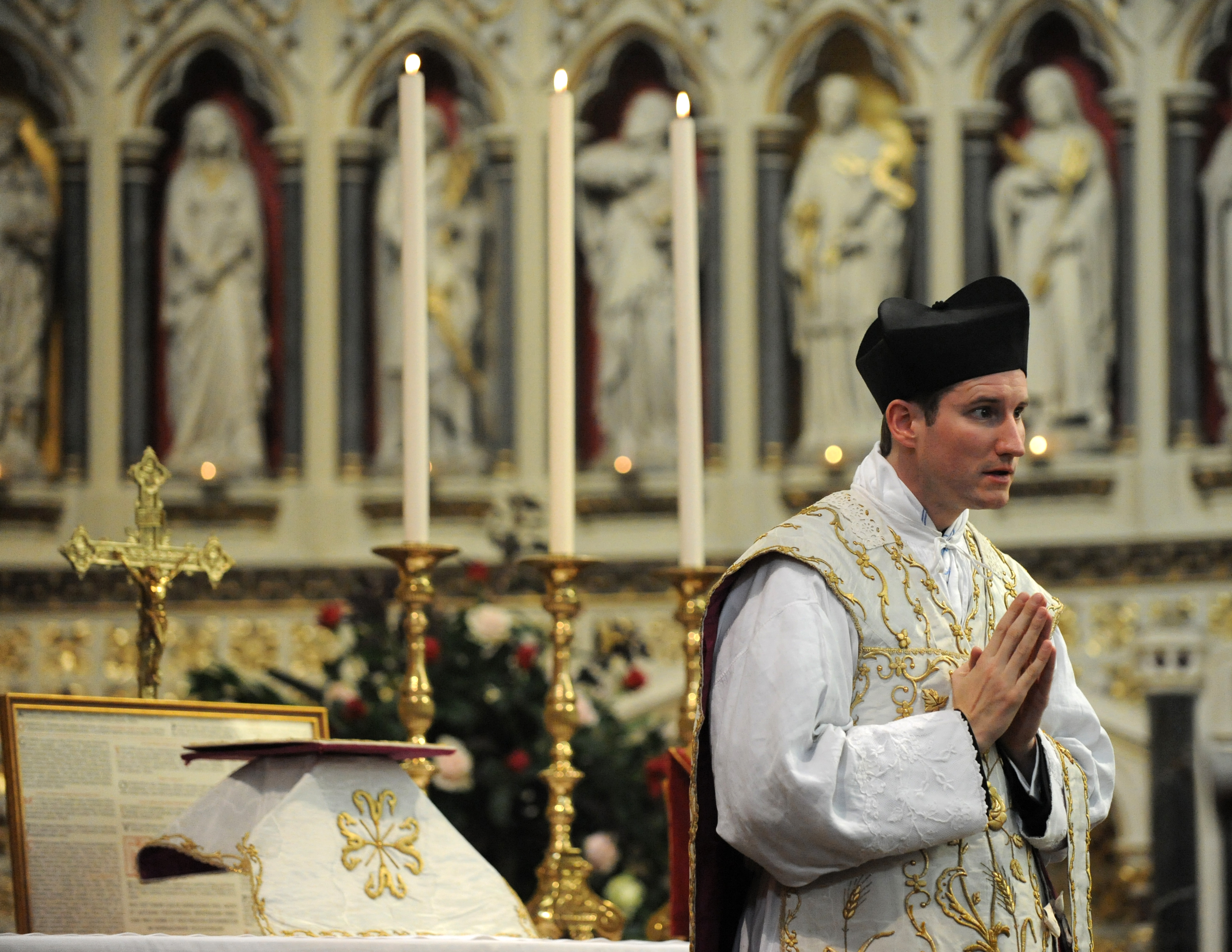
source: newliturgicalmovement.org
This weekend I hope [finally] to publish a review of Dr. Geoffrey Hull's Banished Heart: Origins of Heteropraxis in the Catholic Church. Thus far it is the best and most temperate work I have encountered on the current state of the Church, liturgically and otherwise. Should any of my readers be in Holy Orders this quote from the last page of the book may be of interest to you:
"Moreover, if the Church is to recover her true self, men preparing to receive Holy Orders will need constantly to reflect on the significance of the liturgical custom of laying out a priest's corpse with his head pointing to the altar rather than with his feet in that direction as at the funeral of a layman. For on the last day, each priest will stand versus populum to face those he was commissioned humbly to serve on earth, who will testify to his deeds, after which he shall turn around, versus ad Orientem, to hear the Sun of Righteousness render His final judgment."

Wounds of War

The Rad Trad had an interesting experience on Saturday. It went as follows.
I am sitting in a cafeteria drinking a bottle of sparkling water when a man in a Hawaiian shirt and a baseball cap bursts inside, panting and red in the face. He approaches the counter asking for water: "Help, I'm dehydrated! I need water!" The clerk gives him a plastic cup and directs him towards the soda machine's water button. He drinks and calms down. The man spots me and meanders over, apologizing "Sorry, I thought I was back in the jungle. I wasn't really dehydrated but every time it's hot I think I'm back in the jungle and I'm dehydrated again." I see the front of his hat; it is a Vietnam veterans' association hat.
Me: "No problem. Completely fine."
Him: "Sorry. I was in 'Nam, ya know? It was hot over there and ya never knew when you'd get another drink."
Me: "Are you a veteran?"
Him: "Yep. My father fought in World War II. I fought in 'Nam. My son did three tours in Iraq."
Me: "Well, thank you for your service." His face illuminates and he grabs my hand, shaking it firmly.
Him: "You're the second person in 52 years to thank me. You don't understand. When my father came back he was a hero. My son's a hero. They could wear their military clothing. Me? I was a baby killer! They thought I was a baby killer! No thanks! Nothing. I killed so many gooks I get nightmares. God I don't know how many I killed, but it gives me nightmares every night. Know how much the V.A. hospital pays me to have those nightmares there? $1,700 a month! God, it's hot it here. I feel dehydrated, like I'm back in the jungle. Sorry."
Me: "No need to apologize."
Him: "How old are you?"
Me: "Twenty three."
Him: "Oh, so you don't remember the war at all?!"
Me: "Nah, it's in history for my generation."
Him: "It was real to me. When I came back I was a baby killer! That's what my generation thought I was. And yours? They don't even know about it! I have PTSD, ya know what that is?"
Me: "I do, sir."
Him: "Well I have nightmares every night about all the gooks I killed. No one ever helped me get over it."
I get up and make my move.
Me: "Well once again, thank you for your service. I'm off, but thanks again and I'm sure your son's doing good things for us, too."
He smiles.
Him: "Aw, thanks! Geez, I'm sorry I just snapped but I was dehydrated and thought I was back in the jungle. Ugh. Okay, have a good one!"
Me: "You as well, sir!"
Point: you "win" a war like you "win" an earthquake. You just come out better than the other guy. I wish politicians, especially the ones who not only start wars, but who actively oppose the people forced to fight them, would appreciate how they damage people's lives, often irreparably. Heartless blackguards.

Wednesday, August 21, 2013

Understanding the Liturgical Crisis Spiritually

 
In our discussion of the history and theology of the liturgical revolution and its implications for the future we can put ourselves in danger of forgetting that the liturgy is given to us by God for people to pray. And its loss, or maltreatment, has very real human consequences that many are left trying to understand. The Rad Trad's area has one Latin Mass a month and no "reform of the reform" Masses. I am at least very blessed by Our Lord Jesus with a wonderful Melkite parish, which prays a marvelous Byzantine liturgy, gives useful sermons, and has faithful priests. Many faithful have less than that. A friend of this blog, who wishes to remain anonymous, is one such person. He has written a short, concise article reflecting on the spiritual meaning of the liturgical crisis and how we should deal with it looking forward.
 
The Purpose Behind the Liturgical Crisis: Some Encouraging Words
By an Anonymous Layman
 
Introduction
It is not my intention to determine in this article who is responsible for the present liturgical crisis (whether it is due to liberal liturgists, unfaithful magisterial authorities, Pope Paul VI or the Boogy man); I am not qualified to determine such a thing and I trust Holy Mother Church will answer this question after the proverbial dust has settled.  My purpose is not to point finger but to give comfort to disturbed Catholics. 
There are many who convert to Catholicism from Protestantism, dissatisfied with the Puritan mentality of worship found in most Protestant Churches.  They see the desperate need for beauty and mystery in worship and are aware that, at least on paper, the Catholic Church teaches the liturgy ought to be beautiful and reverent.  Surely such converts are disappointed when they discover that many Catholic parishes do not celebrate mass in accord with the Church’s official norms but in a whimsical, spontaneous and irreverent manner.  Seeing this liturgical crisis taking place in the Church, new converts (and even cradle Catholics with a sense of the sacred), are forced to ask “why is the Church going through this crisis?”
Has This Happened Before?
Before an answer is provided, it is important to note that the present crisis is not without precedent in the history of the Church.  During the 4th century, the vast majority of Bishops in the Catholic Church embraced the heresy of the Arians, leaving the Bishop of Rome and St. Athanasius, among a few of Bishops, to preserve the Orthodox faith.  The situation was so dire that St. Jerome noted “the whole world groaned and marvelled to find itself Arian”.  But wait, there’s more!  Millions were lost to the heresies of the “Reformers” in the 16th century and the Church had to call the Ecumenical Council of Trent to address the errors.  If the Church was preserved through such pervasive Theological errors and destructive epochs, it is safe to say God will preserve her through liturgical errors and abuses.  So if you are disturbed by the state of liturgical affairs in the Church today, relax, take a deep breath and take comfort in the providence and omnipotence of God.  Now, on to the question at hand: why is the Church going through this crisis?
Why is the Church going through this crisis?
The short answer is that God is strengthening the Church through the crisis.  He is able to use the present crisis for the good of the Church.  There is no doubt many have a vague intuition that God is working behind the scenes since they are aware that all things happen for good for those who love God and are called according to His purpose (Romans 8:28).  Yet they are still forced to ask, what good can come from the present liturgical crisis in the Church? The following are five, by no means exhaustive, lessons the Church will learn, or rather relearn, after the liturgical crisis is over.
The Liturgy is Done by Christ. Once the smoke has cleared the Church will have learned the liturgy is not something we do but is something Christ does.  Theologian Fr. Brian W. Harrison, O.S. notes:
“the liturgy is first and foremost the action of our Lord himself, not simply our action and our invention.  It is a sacred mystery that we receive and enter into, rather than something we create for ourselves.  It could even be said that neglect of this great truth is the basic source of all the postconciliar liturgical confusion, in which the human community and its activity and ‘creativity’ have come to predominate over the divine presence and the divine activity.”1
            In fine, the liturgy is not about us, it isn’t even primarily something we do, but it is primarily something God does, we just happen to be the recipients of what He is doing in the Liturgy. 
Common Liturgy Does Not Appeal to the Common “Man”.  Another lesson the Church will learn is that making the liturgy more common place does not attract more people.  For example, after the Second Vatican Council, it seems many Churches began to remove anything and everything in the Church that was beautiful (in spite of Vatican II’s admonition otherwise.)2  In light of the decreasing number of vocations and mass attendance, it is evident that the plan of some liturgist to make the mass less transcendent or more like “a successful cocktail party”3 has not succeeded in attracting more people to the Church, if anything, it has pushed more people away.
Older Does Not Mean Better.  The Church will undoubtedly learn that older does not always mean better.  Just because something was practiced in the Early Church doesn’t mean it is necessarily better than later developments in the liturgy.  For example, some cite St. Cyril of Jerusalem as a witness that early Christians received the Eucharist in the hand and that communion on the tongue was a latter accretion.  Even if the practice of communion on the tongue was a later development, which is debatable, many still believe it is a better way to receive the Eucharist than communion in the hand.  Not only is it a more reverent practice by not allowing unconsecrated hands to touch the Eucharist , but it also helps protect the Eucharist from being taken home and desecrated, or even used in occult practices (yes, this tragically really does happen). 
Both/And.  Once the liturgical crisis is over the Church will realize even more that she is a “both/and” Church.  For example, some have noted4 that the Mass before the liturgical reforms was focused more on the Mass as a Sacrifice.  Though the Mass since the reforms does not deny that it is a sacrifice and occasionally refers to it as such, the emphasis is more on a communal meal.  Some have reacted by saying that the Mass is only a Sacrifice and not a communal mean.  However, the Church teaches that the Mass is both.  For many years the former was stressed in the Sacred Litugy, now the latter is stressed.  Once the crisis in the liturgy is over, the Church will be able to step back and emphasize both aspects of the Mass from a more balanced perspective.  This will help it to realize even more that it is a “both/and” Church.  Fr. Kocik described this aspect of the Church well when he wrote the following:
“The Church has always eschewed false oppositions because she thinks in terms of ‘both/and’ rather than ‘either/or’: reason and revelation, Scripture and tradition, grace and free will, faith and good works, hierarchy and charism, marriage and celibacy, and so forth.  A new liturgical reform should aim at a more obvious balance of the ‘Tridentine’ and ‘Vatican II” accents: sacrifice and supper, cross and resurrection, priest and assembly, exterior participation and interior recollection, sacrament and word, regularity and versatility.”5
“High Liturgy” Is Attractive.  There is a reason why so many are awestruck by the Latin Mass the first time they attend it.  They see the “high liturgy” and are attracted to the sense of the sacred and other-worldliness that it brings.  They love how the rising of the smoke of incense symbolizes their prayers that rise up before God.  They are attracted to the Gregorian chant sung by the Schola which lifts up their minds to the angelic choirs in heaven.  They are attracted to the parts of the Mass in Latin which help to communicate a sense of the sacred by using a language that is not in everyday use.  The fact that many are taking interest in the Extraordinary Form of the Mass in a time when Ordinary Form parishes are dwindling in numbers will undoubtedly teach the Church in the years to come that “high liturgy” is not only reverent, but even evangelistic!
Are These Lessons New?
Some may ask: were not these things known before the present liturgical crisis?  How then will they teach the Church that which it already knows?  Indeed some in the Church knew these lessons before the liturgical crisis, but after the crisis they will be painstakingly evident to most and will serve to warn future generations of making the same mistakes.  Are these the only lessons the Church will learn?  Undoubtedly they are not, surely the centuries to come will look back on the current liturgical crisis with much more wisdom and will be able to glean more from the lessons that can be learned from our present failures.
Be Encouraged
As many are disenchanted with a Church that in practice does not always lift up its member’s minds to the heavenly liturgy, one should step back for a moment and get a greater perspective as to why God is allowing the current liturgical crisis to take place.  Is it possible, that though some in the Church have meant the recent failures in the liturgy for evil, God meant it for Good (Genesis 50:20)?  Let us pray that God will strengthen His Bride through the fires of this crisis and that once the dross is removed the beauty of her gold will be all the more evident! 
 
Sources:
1 Thomas Kocik, The Reform of the Reform, p. 175. (Ignatius, 2003).
2 “Ordinaries must be very careful to see that sacred furnishings and works of value are not disposed of or dispersed; for they are the ornaments of the house of God.” (Sacrosanctum Concilium, VII, 126)
3 James Hitchcock, The Recovery of the Sacred, p. 24. (Ignatius, 1995) quoting Colman Grabert, OSB, “Toward the Development of an Authentic English Sung Mass”, Worship, XL, 2 (February 1966), pp. 80-90
4 Letter of Alfredo Cardinal Ottaviani and Antonio Cardinal Bacci to Pope Paul VI, September 25, 1969, “By a series of equivocations the emphasis is obsessively placed upon the 'supper' and the 'memorial' instead of on the unbloody renewal of the Sacrifice of Calvary.”
5 Thomas Kocik, The Reform of the Reform, p. 101-102. (Ignatius, 2003).
 

Epistle and Gospel at Solemn Mass

 
In a previous post, "EF" Mass in 1964, we saw that the orientation and ceremonies of the traditional rites were already in a state of flux. Marko asked what traditional practice is supposed to be with regards to transferring the altar missal prior to the Gospel. The Rad Trad thinks this is a good opportunity to discuss the reading of the Epistle and Gospel at solemn Mass in the pre-Conciliar rites more generally.
 
The 1962 praxis for the Epistle, from the FSSP in Scotland
In the 1962 practice the celebrant and deacon, after the singing of the first—and usually only—collect, sit down and listen to the subdeacon chant the Epistle or lesson of the day. After he finishes the celebrant and deacon return to the missal, the celebrant blesses the subdeacon, reads the gradual, alleluia, and/or tract, and then sits again. At some point, normally at the beginning, of the alleluia the sacred ministers rise and return to the altar the "long" way (genuflecting before the altar rather than just walking up the side). The subdeacon moves the missal from the Epistle side to the "offertory" position (where the missal is from the Offertory through Communion) and the deacon receives the book of the Gospels from the M.C., places it on the altar, and assists the thurifer with the incense boat as the celebrant imposes, then blesses, incense. The deacon kneels, prays the Munda cor meum, rises, receives the celebrant's blessing, and joins the Gospel procession. We saw a variation in the 1964 Mass celebrated in the video earlier, in which the missal is transferred after the celebrant reads the gradual, alleluia, and/or tract and then everyone sits.

Fr. Wach reads the Gospel privately on Mandy Thursday.
Note that the Mass is during the day time. Source: icrsp.org
This stream of ceremony is actually a departure from the older, medieval way of doing the Fore-Mass, in which the celebrant reads all of the texts. Mozarabic rite of Toledo aside, the celebrant's reading of the Epistle and Gospel was very standard in the Latin Church by the time the Council of Trent convened. In the Roman rite as it has existed since the issuing of the 1570 Missal by St. Pius V the celebrant remains at the altar after the collects and, with the deacon by his side, reads the Epistle quietly as the subdeacon sings the text aloud. At the end of the celebrant's reading the deacon responds Deo gratias. The subdeacon then receives the celebrant's blessing. The sacred ministers return to the Introit position and the celebrant reads the gradual, alleluia and/or tract. Depending on the length of these texts the ministers may sit before taking the next step. If there is a sequence they will always sit and rise as some given verse (ex. at Requiem Masses the ministers rise at Qui Mariam absolvisti). The celebrant prays the Munda cor meum and the Jube, Domine benedicere at the center of the altar with the deacon to his right. The subdeacon moves the missal to the Gospel position, as at a low Mass or a sung Mass, and then the celebrant quietly reads the text with the subdeacon next to him. During all this the deacon is given the book of the Gospels by the M.C. and places said book on the altar. At the end of the celebrant's reading the subdeacon says Laus tibi, Christe and the celebrant imposes and blesses incense as normal. The subdeacon may move the missal to the offertory/Canon position or the deacon may do it himself during the Credo after bringing the burse to the altar. The deacon prays the Munda cor meum and the priest blesses him. Everything follows as normal.

Reading the gradual in the Dominican rite
One may wonder why this was once done. John XXIII eliminated the practice in 1960, a practice many saw as a useless repetition. "Doubling," the reading of texts by the celebrant that were sung by other ministers or the choir, was the bugaboo of many reformers. Yet doubling had its reasons. The celebrant is the one who celebrates the Mass and, although the deacon is the one charged with reading the Gospel, the celebrant, out of devotion, would read the Gospel himself. Ditto for the Epistle and other texts. It was a way for the celebrant to remain engaged with the liturgy even when he was not strictly doing his part. The Rad Trad once thought that the pre-1960 Roman practice was a low Mass intrusion because the celebrant does exactly the same things in the exact same places he would at low Mass. After some research into other rites the Rad Trad and gradations of Mass the Rad Trad has changed his mind about this opinion. In the various local rites of the Middle Ages, outside of Rome and similarly ancient rites like Milan, the wine and water were put into the chalice after the Epistle and during the gradual. These liturgies were also sung in large cathedrals and collegiate churches where the exact words of the subdeacon or deacon might be lost. Celebrants would therefor read the texts from the Epistle through the Gospel privately in order to be "up to date" on what was happening at Mass, after having performed other duties and perhaps having had difficulty paying attention to the exact words sung. In the Norman family of uses (which includes the Dominican and Sarum liturgies) the celebrant would read these texts at the sedilia. The celebrant might have read the Introit and Kyrie for the same reason, that he had been occupied with the prayers before the altar and the incensation when these prayer were initially sung by the choir. At a pontifical Mass, which is rooted in Papal Mass, the bishop reads these texts from the throne or faldstool. At Papal Mass there would be any number of interruptions which might require the celebrating Pope to read the texts he had missed; for instance, the Pope would say a certain prayer for himself in silence after the collect while the subdeacon had already gone on to the Epistle. The low Mass-like pre-1960 Roman practice may have been the result of, again, the fact that it is rooted in the 1474 curial Missal, which was used by bureaucratic officials in chapels rather than by diocesan clergy in cathedrals. The chapels of the Lateran Cathedral, St. Peter's Basilica, the Vatican, and the Sistine chapel do not have a sedilia, so the sacred ministers remained at the altar and read the related texts there. The Rad Trad sees no reason why this practice had to get axed, other than that it conflicted with the uber-communitarian approach of the reformers. Otherwise there is nothing harmful in it.

source: FSSP Roma
There was even a seasonal variation to the Roman practice. During Lent and Advent, as well as on Ember Days, the deacon and subdeacon wore vestments called "folded" chasubles, a very old custom descended directly from ancient times. When performing one's role the minister would remove his folded chasuble. In the above image the subdeacon has removed his to sing the Epistle (you can see it on his stool, along with the celebrant and deacon's birettas). After the Epistle the subdeacon resumes his folded chasuble for the gradual. While the celebrant reads the Gospel the deacon removes his folded chasuble and re-arranges it into a large stole called a "broad" stole and then gets the book of the Gospels as normal. He keeps the chasuble this way until the ablutions, at which point he returns it to its normal position. An excellent example of how this practice looked can be seen below, in a Mass from the first Sunday of Lent, 2008. The Mass was celebrated by Msgr. Angelo Amodeo (RIP), a liturgically-minded canon of the Milanese cathedral ordained by Archbishop Montini. Along with the "doubling" of the Epistle and Gospel, the folded chasuble, dating to a time before St. Gregory the Great, was axed in 1960.
 
source: orbiscatholicus.blogspot.com
 

Tuesday, August 20, 2013

Pontifical Mass Now Online

Many will remember that on April 24th, 2010 Bishop Slattery of Tulsa sang Pontifical Mass from the throne at the Basilica of the Immaculate Conception in Washington, DC. Hitherto only some video snippets from phone cameras have been available on Youtube. A week and a half ago some good soul put the entire television broadcast online for all to view. Given that the footage of Pope John XXIII's coronation Mass is in a fuzzy black and white, I would not hesitate to call this the best looking Roman liturgy available online. The bishop enters this enormous, Byzantine-styled temple in the cappa magna and vests during terce and some hymns. Full ceremonies were observed, given that the planned celebrant was actually Cardinal Castrillon-Hoyos, who had to cancel due to political backlash. It is a truly beautiful celebration and one can see why it ought to be the standard of the Roman rite.


Monday, August 19, 2013

"EF" Mass in 1964

from: Wikipedia.org
A while back, perhaps over a year, New Liturgical Movement published a video of a 1962-Missal solemn Mass sung at St. Louis Abbey in St. Louis, Missouri. The celebrant was Fr. Edward Bunn, S.J., then-president of Georgetown University. The church of the abbey, a hideous house of heteropraxis, is entirely round inside and positions its altar at the center nave. Every Mass therefore would be versus populum, but the low candle sticks and thin, insipid crucifix dissuade one from entertaining the possibility that this is also meant to be ad orientem, in imitation of the ancient Roman basilicas. The tabernacle is directly behind the main—and the Rad Trad thinks, only—altar in the church. This novelty presented a difficulty for the servers and ministers, who at times seemed unsure as to whether they ought to genuflect before the altar or just bow, and whether or not they ought to genuflect before the tabernacle when passing it.
 
Things being done the rite way at St. Mary and the Martyrs (aka the Pantheon)
in Rome, c. 2008
credit: orbiscatholic.blogspot.com
In some ways they did the 1962 Mass differently from today. Note that the missal is transferred to the Gospel (really to the Offertory) position after the celebrant reads the gradual but before the ministers sit down. Today the book is moved when the celebrant rises to give the deacon the blessing for the Gospel reading. It would really be easier to return to the older practice of the celebrant remaining at the altar and reading along himself, but that can be a moot point in 1962-ville outside of some parishes, such as one where the Rad Trad once worshipped, that were doing the Latin Mass before the canonization of 1962 under Summorum Pontificum.
 
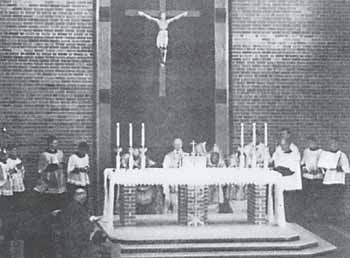
Archbishop Edwin O'Hara celebrating Mass at the consecration
of Christ the King parish in Kansas City, Missouri in 1954.
Construction on the parish, and its forward altar, began
in 1952, presumably with episcopal approbation.
From this we can see that the Liturgical Movement had a very powerful presence in the Church before vernacular and versus populum were explicitly expected by Rome or by national episcopal conferences. St. Louis Abbey was founded in 1955 by monks from Ampleforth Abbey in England. In nearby Kansas City Archbishop O'Hara had already celebrated pontifical Mass versus populum. The Jesuits entertained the Liturgical Movement long before it ever came to America, but the Society of Jesus must have felt very confident in the direction of things to have put the president of a major university on television to celebrate Mass facing the people. Although 51 years later we often tell ourselves it was a better time, this era's practices were directed toward the type of liturgy and ars celebrandi we have today. The use of Latin bound the celebrant to the text, but did not bind the architects of the church of the masters of liturgical ceremonies. Without any further delay, the Mass (starts around 18:00):