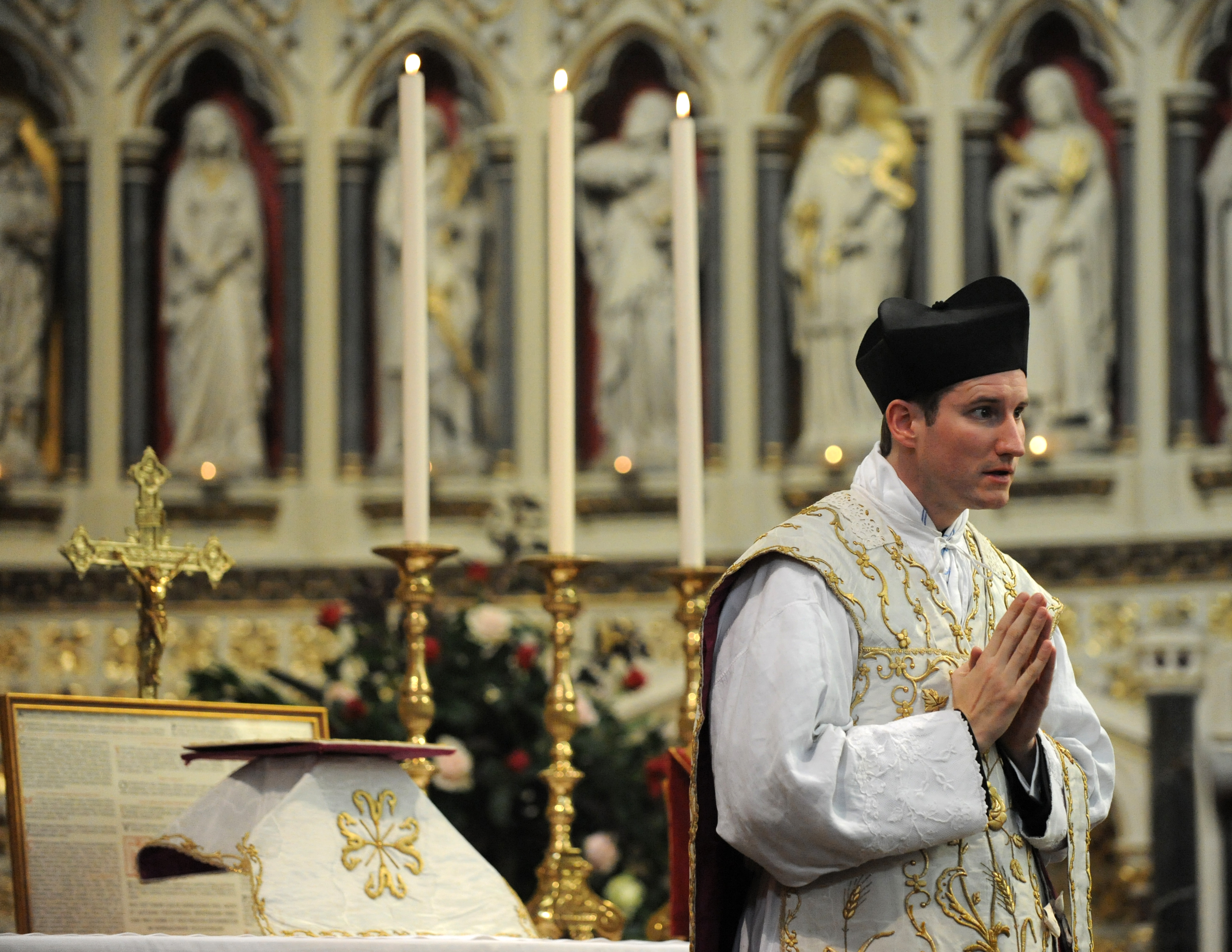
In our discussion of the history and theology of the liturgical revolution and its implications for the future we can put ourselves in danger of forgetting that the liturgy is given to us by God for people to pray. And its loss, or maltreatment, has very real human consequences that many are left trying to understand. The Rad Trad's area has one Latin Mass a month and no "reform of the reform" Masses. I am at least very blessed by Our Lord Jesus with a wonderful Melkite parish, which prays a marvelous Byzantine liturgy, gives useful sermons, and has faithful priests. Many faithful have less than that. A friend of this blog, who wishes to remain anonymous, is one such person. He has written a short, concise article reflecting on the spiritual meaning of the liturgical crisis and how we should deal with it looking forward.
The
Purpose Behind the Liturgical Crisis: Some Encouraging Words
By
an Anonymous Layman
Introduction
It is not my intention to
determine in this article who is responsible for the present liturgical crisis
(whether it is due to liberal liturgists, unfaithful magisterial authorities,
Pope Paul VI or the Boogy man); I am not qualified to determine such a thing
and I trust Holy Mother Church will answer this question after the proverbial
dust has settled. My purpose is not to
point finger but to give comfort to disturbed Catholics.
There are many who convert
to Catholicism from Protestantism, dissatisfied with the Puritan mentality of
worship found in most Protestant Churches.
They see the desperate need for beauty and mystery in worship and are
aware that, at least on paper, the Catholic Church teaches the liturgy ought to
be beautiful and reverent. Surely such
converts are disappointed when they discover that many Catholic parishes do not
celebrate mass in accord with the Church’s official norms but in a whimsical,
spontaneous and irreverent manner.
Seeing this liturgical crisis taking place in the Church, new converts
(and even cradle Catholics with a sense of the sacred), are forced to ask “why
is the Church going through this crisis?”
Has
This Happened Before?
Before an answer is
provided, it is important to note that the present crisis is not without
precedent in the history of the Church.
During the 4th century, the vast majority of Bishops in the
Catholic Church embraced the heresy of the Arians, leaving the Bishop of Rome
and St. Athanasius, among a few of Bishops, to preserve the Orthodox faith. The situation was so dire that St. Jerome
noted “the
whole world groaned and marvelled to find itself Arian”. But wait, there’s more! Millions were lost to the heresies of the
“Reformers” in the 16th century and the Church had to call the Ecumenical
Council of Trent to address the errors. If
the Church was preserved through such pervasive Theological errors and
destructive epochs, it is safe to say God will preserve her through liturgical
errors and abuses. So if you are
disturbed by the state of liturgical affairs in the Church today, relax, take a
deep breath and take comfort in the providence and omnipotence of God. Now, on to the question at hand: why is the
Church going through this crisis?
Why
is the Church going through this crisis?
The short answer is that
God is strengthening the Church through the crisis. He is able to use the present crisis for the
good of the Church. There is no doubt
many have a vague intuition that God is working behind the scenes since they
are aware that all things happen for good for those who love God and are called
according to His purpose (Romans 8:28).
Yet they are still forced to ask, what good can come from the present
liturgical crisis in the Church? The following are five, by no means
exhaustive, lessons the Church will learn, or rather relearn, after the
liturgical crisis is over.
The
Liturgy is Done by Christ. Once the smoke has cleared the
Church will have learned the liturgy is not something we do but is something
Christ does. Theologian Fr. Brian W.
Harrison, O.S. notes:
“the liturgy is first and foremost the action of our
Lord himself, not simply our action
and our invention. It is a sacred mystery that we receive and
enter into, rather than something we create for ourselves. It could even be said that neglect of this
great truth is the basic source of all the postconciliar liturgical confusion,
in which the human community and its activity and ‘creativity’ have come to
predominate over the divine presence and the divine activity.”1
In
fine, the liturgy is not about us, it isn’t even primarily something we do, but
it is primarily something God does, we just happen to be the recipients of what
He is doing in the Liturgy.
Common
Liturgy Does Not Appeal to the Common “Man”.
Another lesson the Church will learn is that making the
liturgy more common place does not attract more people. For example, after the Second Vatican
Council, it seems many Churches began to remove anything and everything in the
Church that was beautiful (in spite of Vatican II’s admonition otherwise.)2 In light of the decreasing number of
vocations and mass attendance, it is evident that the plan of some liturgist to
make the mass less transcendent or more like “a successful cocktail party”3
has not succeeded in attracting more people to the Church, if anything, it has
pushed more people away.
Older
Does Not Mean Better. The
Church will undoubtedly learn that older does not always mean better. Just because something was practiced in the
Early Church doesn’t mean it is necessarily better than later developments in
the liturgy. For example, some cite St.
Cyril of Jerusalem as a witness that early Christians received the Eucharist in
the hand and that communion on the tongue was a latter accretion. Even if the practice of communion on the
tongue was a later development, which is debatable, many still believe it is a
better way to receive the Eucharist than communion in the hand. Not only is it a more reverent practice by
not allowing unconsecrated hands to touch the Eucharist , but it also helps
protect the Eucharist from being taken home and desecrated, or even used in
occult practices (yes, this tragically really does happen).
Both/And. Once the liturgical crisis
is over the Church will realize even more that she is a “both/and” Church. For example, some have noted4 that
the Mass before the liturgical reforms was focused more on the Mass as a Sacrifice. Though the Mass since the reforms does not
deny that it is a sacrifice and occasionally refers to it as such, the emphasis
is more on a communal meal. Some have
reacted by saying that the Mass is only a Sacrifice and not a communal
mean. However, the Church teaches that
the Mass is both. For many years the
former was stressed in the Sacred Litugy, now the latter is stressed. Once the crisis in the liturgy is over, the
Church will be able to step back and emphasize both aspects of the Mass from a
more balanced perspective. This will
help it to realize even more that it is a “both/and” Church. Fr. Kocik described this aspect of the Church
well when he wrote the following:
“The Church has always eschewed false oppositions
because she thinks in terms of ‘both/and’ rather than ‘either/or’: reason and revelation, Scripture and tradition, grace and free will, faith and good works, hierarchy and charism, marriage and celibacy, and so forth. A new liturgical reform should aim at a more
obvious balance of the ‘Tridentine’ and ‘Vatican II” accents: sacrifice and supper, cross and resurrection, priest and
assembly, exterior participation and
interior recollection, sacrament and
word, regularity and versatility.”5
“High
Liturgy” Is Attractive. There
is a reason why so many are awestruck by the Latin Mass the first time they
attend it. They see the “high liturgy”
and are attracted to the sense of the sacred and other-worldliness that it
brings. They love how the rising of the
smoke of incense symbolizes their prayers that rise up before God. They are attracted to the Gregorian chant
sung by the Schola which lifts up their minds to the angelic choirs in
heaven. They are attracted to the parts of
the Mass in Latin which help to communicate a sense of the sacred by using a language
that is not in everyday use. The fact
that many are taking interest in the Extraordinary Form of the Mass in a time
when Ordinary Form parishes are dwindling in numbers will undoubtedly teach the
Church in the years to come that “high liturgy” is not only reverent, but even
evangelistic!
Are
These Lessons New?
Some may ask: were not
these things known before the present liturgical crisis? How then will they teach the Church that
which it already knows? Indeed some in
the Church knew these lessons before the liturgical crisis, but after the
crisis they will be painstakingly evident to most and will serve to warn future
generations of making the same mistakes.
Are these the only lessons the Church will learn? Undoubtedly they are not, surely the
centuries to come will look back on the current liturgical crisis with much
more wisdom and will be able to glean more from the lessons that can be learned
from our present failures.
Be
Encouraged
As many are disenchanted
with a Church that in practice does not always lift up its member’s minds to
the heavenly liturgy, one should step back for a moment and get a greater
perspective as to why God is allowing the current liturgical crisis to take
place. Is it possible, that though some
in the Church have meant the recent failures in the liturgy for evil, God meant
it for Good (Genesis 50:20)? Let us pray
that God will strengthen His Bride through the fires of this crisis and that
once the dross is removed the beauty of her gold will be all the more evident!
Sources:
1 Thomas Kocik, The Reform of the Reform, p. 175.
(Ignatius, 2003).
2 “Ordinaries must be very
careful to see that sacred furnishings and works of value are not disposed of
or dispersed; for they are the ornaments of the house of God.” (Sacrosanctum
Concilium, VII, 126)
3 James Hitchcock, The Recovery of the Sacred, p. 24.
(Ignatius, 1995) quoting Colman Grabert, OSB, “Toward the Development of an
Authentic English Sung Mass”, Worship, XL, 2 (February 1966), pp. 80-90
4 Letter of Alfredo
Cardinal Ottaviani and Antonio Cardinal Bacci to Pope Paul VI, September 25,
1969, “By a series of equivocations the emphasis is obsessively placed upon the
'supper' and the 'memorial' instead of on the unbloody renewal of the Sacrifice
of Calvary.”
5 Thomas Kocik, The Reform of the Reform, p. 101-102.
(Ignatius, 2003).