Wednesday, January 22, 2014

The Parisian Missal VI: Votive Orations & Conclusion

Rite of Versailles, another neo-Gallican use of the Roman rite.
source: wikipedia.org

Before concluding this series on the Parisian Missal let me quickly share a pair of interesting points I discovered within its pages today.

The first is the unique Gospel tone for the Vigil of Epiphany. In some sense it is reminiscent of the Dominican rite's Gospel tone for the Nativity. I cannot speak for other rites of the Norman liturgical family.


source: Order of Preachers, Province of St Joseph
Interestingly there is a Sunday "between the Circumcision and Epiphany" given in the Missal. The instructions direct that this Mass be said on the 2nd with a commemoration of the Octave day of St Stephen should it occur then; that it is ignored if it occurs on the 3rd, favoring St. Genevieve; it may be celebrated on the 4th as normal; and that should it fall on the 5th, the Vigil of the Epiphany, if is anticipated on the 4th so that the Vigil may be unobstructed. 

source: sarumuse.wordpress.com
My second discovery is that of the Parisian treatment for the feast of Corpus Christi. Unique readings are given for each of the ferial days within the octave and entirely unique Masses for the Saturday and Sunday within the Octave. Should the feast have fallen on a Friday the first set of ferial readings would have been used on Monday. What a pity that the reformers of the Roman rite did not investigate the ferial readings, based on Sunday and festive Masses, used in the Norman and Gallican rites when they sought to expand the use of Scripture within the Roman rite.

Given that the feast of Corpus Christi began, in a way, in Liege the high profile of this day in the Missal ought not surprise any readers here. The above image, lifted from Fr Anthony Chadwick's blog, shows a neo-Gallican Corpus Christi procession in the 19th century. Personally I find the two altar boys lighting candles in the bottom right corner positively cute!

On to the votive orations.

The Missal divides the sets of votive orations by intention into the following categories:
  1. Ad poscenda: things to be petitioned
  2. Ad postulandam: spiritual virtues requested
  3. Tempore famis: in time of famine
  4. Loose prayers of various intentions not confined to the above categories
Ad poscenda includes many prayers that will be familiar to anyone familiar with the Roman Mass or the Roman Office, such as A cunctis nos and Deus omnium fidelium. This last prayer caught my attention because I have contended previously that the real fault of the Parisian Missal is not Jansenism, but anti-Romanism. The prayer for the Pope, unlike in the Roman books, is not prescribed, but is given as an option (along with numerous other orations) for semi-double, simple, and ferial days. The days which prescribe Deus omnium fidelium in the Roman rite usually prescribe the prayer for the Church Dirige Domine. Other prayers in this section include petitions for Peace and Unity of the Church, for All Orders of the Church, for Persecutors of the Church, for the Church of Paris (an elaboration of Ecclesiam tuam), for the Lord Archbishop, for Prelates and their Congregations, for All the Clergy, for Ordinands, for Ordinands during the Mass of Ordination, for the King, for the King and his family, for the Dauphin (heir to the throne), for Children for the King, for the King and his Army, for the Assembly of Estates, for the City and Towns, and for Community and Family. Much ado about French political power (and it needed all the help it could muster) and nothing ado about Jansenism, free will, and types of grace.

The second second contains prayers for exclusively spiritual purposes, such as "for faith" and "for hope," virtues of faithful Catholics. One prayer, for humility, is quite indicative of the Parisian collects in its wordiness and also its emphasis on modesty:

"God, Who resists the proud and gives grace to the humble, grant unto us the virtue of true humility, which Your Only Begotten showed the faithful in the form of Himself, Who lives and reigns with You in the unity of the Holy Ghost, God for ever and ever. Amen."

This section also contains prayers pertaining to good works (certainly not Jansenism), the repulsion of evil maladies, patience, and the gift of tears.

The third section, entitled Tempore Famis, covers a broad array of needs pertaining to the people: famine, war, peace, pestilence, rain, and other similar phenomena. The prayer concerning Famine is longingly beautiful:

"Oh God, Who physically whips Your servants as they progress in mind, give us for our sins, for which we are afflicted by hunger, to wash them away by tears of penance, that we rebels who have provoked Your wrath may be subdued by mercy and humble minded. Who lives and reigns...."

The final section contains prayers for the anniversary of receiving Baptism, for sinners and penitents, for religious orders, for friends, for widows, for women in their various needs, for sailors, captives, for the suffering sick, an for the living and dead.

Many prayers match their Roman counter-parts and some are unique.

Conclusion


The Parisian Missal, as it existed in the 18th century, textually and ceremonially reveals no traces whatsoever of Jansenism, a sort of Catholic Calvinism which supposedly infiltrated the diocesan rites of the French church and made those forms troublesome, justifying Dom Prosper Gueranger's crusade to replace these local usages with the Roman books.

The real original sin of the Parisian rite is not that it is Jansenistic, but that it is not Roman enough. As covered in a previous post the Parisian Missal manuscripts of 1300 reveal a use very similar to that of Rome, with some variation. In the intervening centuries the diocese of Paris scrapped many uniquely Roman features (folded chasubles, the Octave of Ss. Peter & Paul, certain Mass formulas, the Gospel ceremonies for the Passion on Palm Sunday and Good Friday) and coterminously recovered many features of the Norman liturgy that one would find in the uses of Salisbury, Rouen, and York (ferial readings, choir ceremonies, sequences). In many places what came about was entirely new, such as the sequences and certain Mass formulas for the great feasts of the Church year. These texts are often spiritually exuberant and linguistically rich, reflecting a vibrant Catholicism among the clergy of France. Many of the new Collects and Introits, beautiful as they are, came at the cost of the existing Roman Collects and Introits. At a time when the Kings of France wished to have greater authority over episcopal selections, the mobility of bishops, and the spiritual decisions of the Church in France, the liturgy departed from Roman practices. Many of the Norman traits to be found are not direct restorations of texts, but of concepts; ferial readings rarely match up between Sarum and Paris, but they follow the same principle of expanding on the previous Sunday Mass. The bishops of France, eager to curry favor with the Court at Versailles or frustrated with the Popes, may have permitted or encouraged liturgical developments as long as some of them drifted from the Roman praxis.

A simple trimming of excessive departures from the Latin Church's liturgical tradition—like the use of dalmatics and tunicles during Lent—would have sufficed to re-align the Parisian Missal with that of other local uses. There is no question of the orthodoxy of the Missal. There is even little doubt about the heteropraxy of it. The choir ceremonies, for example, and the adaptability of the rubrics of sung Mass to the parish level better preserve some of the Roman rite than the actual Roman Missal (which assumes a private Mass as the norm outside of Holy Week).

The Parisian Missal was a liturgical flower which bloomed late and was trimmed far too early and too deeply.

Tuesday, January 21, 2014

The Parisian Missal V: the Feast of St Augustine

I had intended to finish the series on the Parisian Missal today (and I might still finish it tomorrow), but when searching in the back for the votive orations I came across this beautiful feast day Mass for St. Augustine of Hippo. Note that he has an octave for his feast. As is common in the Parisian Missal there are different readings given for some days within the octave.

Enjoy!


The King is Dead. Long Live the King?

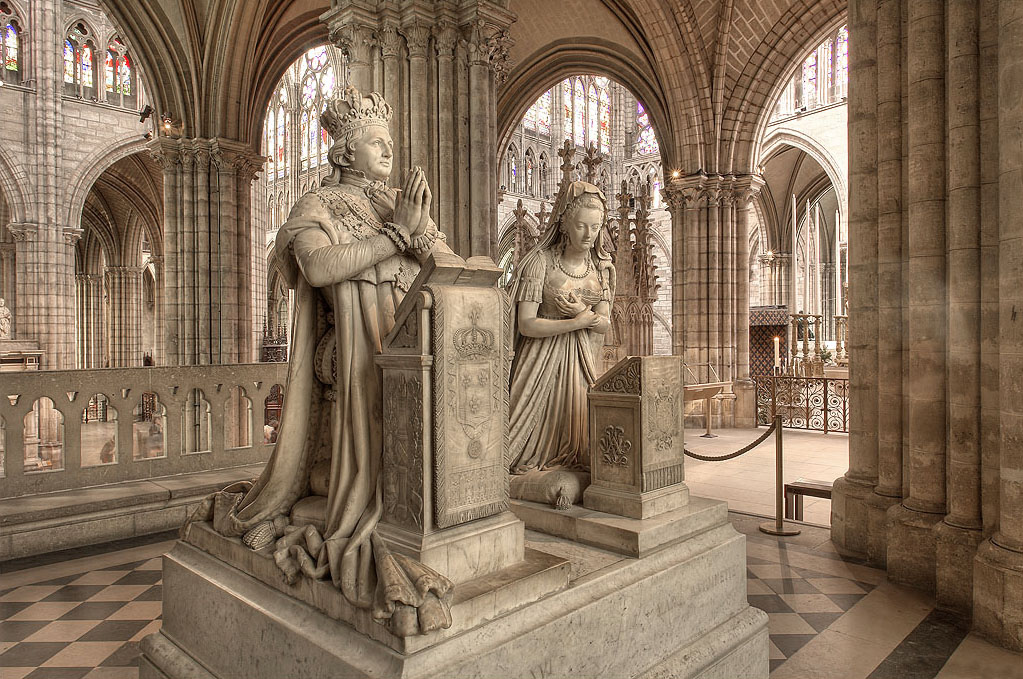
Two hundred twenty-years ago today, on this the feast of St. Agnes, the last absolute king of France died, Louis XVI. His downfall was in part his own doing, his willingness to accommodate demands for reform, his slowness to take initiative, his endorsement of the financial drain that was the American Revolution. And yet he was also a good man, caught attempting to smuggle his family into friendly Austria and away from the Revolutionary rubes. His death marked the beginning of the end of absolute rule in major Western nations, starting the slow progression into that oddest of governmental structures called modern democracy (which ought not be confused with republicanism).

As he has stated elsewhere, the Rad Trad endorses no specific forms of government, although he is more than eager to criticize his own given the grievous presidency of Barack Obama. Still, Louis' death ended the old order. As Edmund Burke wrote in his Reflections on the Revolution in France: "Chivalry is dead in Europe." The Revolution failed and brought France, and the rest of Europe for that matter, that domineering and demented dwarf who brought over two decades of havoc to the world. When the entire reformed system collapsed socialism, atheism, materialism, existentialism, and bad art filled the void and birthed modern Parisian culture, which in turn influenced 20th century American politics and high intellectual culture. Much of the nonsense taught in American universities today about the [lack of] nature of man, the importance of material equality, the wickedness of religion and of previous ages, and the infinite perfectibility of man owes itself to the movements which eventuated and succeeded the French Revolution.

So let us remember him and his family in our prayers for today and also pray that the world may recover from lingering decadence that consumed him.

Sunday, January 19, 2014

Interesting Requiem Mass


Something the Rad Trad attempts to do on this blog is to draw attention to those deceased who have played a part in the preservation of the older Roman rite. People will discuss Archbishop Marcel Lefebvre ad nauseam and neglect some more obscure, but equally important, names. We have mentioned Fr. Quintin Montgomery-Wright a few times here as well as Msgr. Ducaud-Bourget. In this lengthy excerpt from a November 11, 1995 Requiem Mass we see two men integral to the survival of the older Roman rite: Alfons Maria Cardinal Stickler and Fr. Franck Quoex.

source: ifuv.org
One could not call Cardinal Stickler a "traditionalist" either in the strict or general sense of the word, but he, like Cardinals Ratzinger and Medina, realized that the rapid liturgical transition brought considerable grief to a great many people and that something should be done to accommodate such people. Stickler openly celebrated according to older uses in the 1980s and 1990s when only he and a handful of other prelates "in good standing" would dare touch a pre-Pauline Missal (the bishops of Gabon, Cardinal Medina, and Cardinal Ratzinger are the only others that immediately spring to mind). He and his secretary, Fr. Gregory Hesse, helped Fr. Gilles Wach establish a house of studies in Gricigliano for an African society called the Institute of Christ the King, even ordaining many of their early priests (according to the pre-Pius XII books, as was their norm before c.2000). On May 12, 1996 Stickler celebrated an older rite Mass in St. Patrick's cathedral in New York City, to this day the most attended event in the history of that building. It was Mother's Day; the New York chancery ensured that the Mass was not advertised, but word spread when people learned Mozart's Coronation Mass would be the musical setting. The Roman rite owes much to Cardinal Stickler.

The other man of note in this video is not one of the ministers, but the Master of Ceremonies, Fr. Franck Quoex. Quoex, as recounted elsewhere here, was initially a seminarian with the FSSPX, but found them liturgically disinterested. He found his way to Fr. Wach and the Institute of Christ the King in Gricigliano, where he was one of the first priests ordained for the fledgling group. Quoex eventually became the Institute's liturgy professor and greatly influenced the society's liturgical praxis. Those who knew him said he was the only man in the world capable of arranging a Papal Mass should the need arise (it did not). The Institute eventually compelled him to leave when they switched to 1962 early last decade. Quoex went on to teach liturgy for the FSSP and, when he died in 2007, received an appointment to teach liturgy at the Pontifical University of the Holy Cross in Rome, where he would have had the opportunity to influence future generations of priests and bishops. Most impressive to me in this video, as someone who has MC'ed, is Quoex's unassuming deportment. Diocesan clergy, particularly prelates, are often uneasy about celebrating the liturgy in unusual ways and the MC is often tempted to arrange things himself or abjure the ministers for their mistakes. Quoex mildly adjusts Stickler during the Introit and as the Mass progresses eases the Cardinal into his prayer. The Mass is signature Quoex in some ways, very Roman: the Introit seems expanded beyond the versicle, possibly entailing more of the psalm from which it is taken, as in the early Roman liturgy; the choir is—gasp—in the choir rather than in an alcove (the usual thing to do when celebrating the old Mass in Rome); Dies irae is chanted in full while the Gradual is in recto tono, likely for the sake of the choir; the choir master is vested; the Last Gospel is said despite the absolution at the end (you can tell because the Pontificale has been moved despite the scene cutting). Quoex's kindness and affability towards those interested in the liturgy endeared the old rite to people and made them feel easier about celebrating it. He viewed the old Roman Mass as the "purest masterpiece of Western civilization." We ought to treasure it with the same mind and spirit as Fr. Quoex.

Let us thank the good Lord for giving us these two men and for what He did through them, and let us spare a moment for a prayer for the souls of those men.

Requiem aeternam dona eis, Domine, et lux perpetua luceat eis.
Te decet hymnus, Deus, in Sion, et tibi reddetur votum in Jerusalem. Exaudi orationem meam, ad te omnis care veniet. Requiem aeternam dona eis, Domine, et lux perpetua luceat eis.

Saturday, January 18, 2014

Evangelii Gaudium 247 & the Good Friday Prayer for the Jews


Pope Francis' latest work/document/encyclical/bull/exhortation/stream-of-consciousness, Evangelii Gaudium, has in some circles re-ignited the 1960s and 1970s debate concerning the [in]validity of the Old Covenant. As the Byzantine Paschal Gopsel pericope says "The Law was given by Moses; grace and truth came through Jesus Christ" (John 1:17). The words of St. John are enough for me on this matter. A better, and more detailed, summary of the Church's general outlook on modern Judaism and the idea of Covenant can be found in Fr. John Hunwicke's series on the Vatican II document Nostra Aetate, which, Hunwicke reminds us, has not earned the wrath of the SSPX, a group more than willing to pounce upon any perceived deviations within the documents of the most recent Church council.

On an entirely unrelated note, the first time I heard of Evangelii Gaudium was in the confession box at a local parish. I had to confess a sin concerning the lending of money at interest. The priest, a professed union member, spent five very long minutes telling me about "the Holy Father's latest letter. In it, and it's hundreds of paragraphs long, he really lays out how everything in our society and in our economy is just so unfair." I got three Hail Mary's.

I mention the papal document in order to opine on a liturgical and theological topic that come to my mind once and year and which I have never considered "on paper" before now. One reason is absence of opportunity. Another is that my judgment on this matter has evolved over the last four years or so. The matter is the Good Friday prayer for the Jews that existed mostly prior to Papa Ratzinger's change in 2008 and Papa Roncalli's change in 1960. The prayer that caused so much consternation is as follows:
Orémus et pro pérfidis Iudaeis: ut Deus et Dóminus noster áuferat velámen de córdibus eórum; ut et ipsi agnóscant Iesum Christum, Dóminum nostrum.
Omnípotens sempitérne Deus, qui étiam iudáicam perfídiam a tua misericórdia non repéllis: exáudi preces nostras, quas pro illíus pópuli obcæcatióne deférimus; ut, ágnita veritátis tuæ luce, quæ Christus est, a suis ténebris eruántur. Per eundem Dominum nostrum Iesum Christum filium tuum, qui tecum vivit et regnat in unitate Spiritus Sancti, Deus, per omnia saecula saeculorum. Amen.

Unlike the other solemn intercessions on Good Friday the clergy and people make no genuflection between the announcement of the intention and the actual collect.

Initially I did not think this prayer bigoted, but I did consider it unnecessarily inflammatory given the use of the term "pro perfidis Iudaeis." That all changed when then-Pope Benedict issued a shiny new prayer for the Jews to be used during 1962 rite Good Friday services. A friend of mine reacted positively to the new prayer, saying it brought us away from "tribal hate" and towards a more brotherly outlook on our antecedent religion. At this point I began to re-consider my position. Benedict's prayer, although different from the traditional one, at least asks for conversion, in stark contrast to the vague platitude in the Pauline Missal's Holy Week.

The first clue in my re-evaluation was the true contextual meaning of that term "perfidis," which does not mean "perfidious" in the modern understanding (wretched, wicked, evil), but rather "faithless." This ought not be anti-Semitic. It is merely a deduction. Anyone who does not believe in Christ lacks proper faith.

The next, and most profound, point makes the loss of this prayer a liturgical, historical, and theological travesty. The intention asks that God might "remove the veil from their hearts," which the collect proper continues to petition that the Jews might "acknowledge the light of Your Truth, Which is Christ" and that they may be "rescued from their darkness." To understand the deeper meaning and truth of this prayer we must recall what happened at the end of the Crucifixion.

"Jesus, when He had taken the vinegar, said: 'It is consummated.' And bowing His head he gave up the ghost" (John 19:30). In tract 119 St. Augustine writes "What, but all that prophecy had foretold so long before? And then, because nothing now remained that still required to be done before He died, as if He, who had power to lay down His life and to take it up again, had at length completed all for whose completion He was waiting." Our Lord's death on the Cross completes everything the Father promised in the Old Covenant and which He appointed His Son to do for our sake. The prophecies and promises are, at this point, fulfilled. Fulfillment, in the Church, does not mean something finished. Rather it means something brought to fruition.

Consequently, the covenant God made with the Jews did not vanish entirely, but became something else, something greater and, as the angel told the shepherds when He was born, a great thing "for all peoples" (Luke 2). The God Who dwelt only among the Jews and Who only revealed His intentions to them and Who only acted among them now dwells and reveals Himself and acts among all people and for the good of all. "Salvation is of the Jews" (John 4:22), but not limited to the Jews. The Old Covenant, now something greater, ends as it was. The Temple veil "was rent in two from the top even to the bottom" (Matthew 27:51). The veil, which concealed the awesome qualitative presence of God within the Temple, is entirely torn when a new, and greater, covenant is sealed in the Blood of Christ. Here is a New Covenant for all people. God, no longer hidden behind the Temple veil, is now accessible to all people. St. Paul reflects on this in his epistle to the Hebrews (9:1-8):


"The former indeed had also justifications of divine service, and a worldly sanctuary. For there was a tabernacle made the first, wherein were the candlesticks, and the table, and the setting forth of loaves, which is called the holy. And after the second veil, the tabernacle, which is called the holy of holies: Having a golden censer, and the ark of the testament covered about on every part with gold, in which was a golden pot that had manna, and the rod of Aaron, that had blossomed, and the tables of the testament. And over it were the cherubims of glory overshadowing the propitiatory: of which it is not needful to speak now particularly. Now these things being thus ordered, into the first tabernacle the priests indeed always entered, accomplishing the offices of sacrifices. But into the second, the high priest alone, once a year: not without blood, which he offereth for his own, and the people' s ignorance: The Holy Ghost signifying this, that the way into the holies was not yet made manifest, whilst the former tabernacle was yet standing."

We have come halfway to understanding the significance of the older Good Friday prayer, but only halfway.

What does a veil, curtain, or wall do? It keeps something concealed, but also protects that something from exterior elements, usually light. Our Lord said "I am the light of the world: he that followeth me walketh not in darkness, but shall have the light of life" (John 8:12). The Jewish leaders persuaded the crowds gathered in the Roman praetorium to reject Jesus and ask for the release of a bad man. After dissolving themselves of the Savior promised to them Jerusalem fell and the Temple, the place of God's covenant with them, burned to the ground. What survived was not Judaism in the pre-Christian sense, but a new sort of Judaism meant for scattered local communities and based on the Jewish people's experiences as the minority in an increasingly Christian world (the so-called "modernist" George Tyrrell wrote an interesting letter on this subject, concluding that Catholicism is the real continuation of Judaism). Rabbis replaced priests; synagogues replaced the Temple; and the Talmud became a new holy book to the Jewish people rather than the New Testament books. This reformed, leaner Judaism would help Jewish culture survive its coming difficulties and would also insulate Jewish people from the light of Christ—as it was founded partially in reaction to what Christ did. When the Father tore down the Temple veil to reveal Christ's light to all a new veil ascended to shield that light.

No one should conclude that this is anti-Semitic. Fr. Hunwicke points out that Arabs are Semites, too. This prayer is about Judaism, not Jews as an ethnic group. On some level the concepts "faithless" persons and of hiding the light of Christ with a "veil" applies to all non-believers. And yet the Jewish people, given their unique place in the chain of event that led to Christ's Incarnation, Passion, and Resurrection, surely warrant a unique place in the liturgical prayers, particularly given their once exclusive covenant with God.

I have never felt comfortable with the description of practitioners of post-Temple Judaism as our "older brothers" in the faith, given that the Judaism which preceded Catholicism no longer exists. I suspect the shift in attitude towards Judaism and the eventual revision of this prayer results from [humanly understandable] European guilt that followed the Holocaust. The pope who initially altered this prayer (John XXIII) aided Pius XII's efforts to obstruct deportations of Jews in Turkey. The pope who introduced the 1970 prayer (Paul VI) served the same Pius XII as his secretary during the War. And the pope who issued a new prayer for the 1962 Missal (Benedict XVI) was a young German man during the War and who, certainly, has a greater cultural association with the Holocaust than the other two.

And yet I maintain that the loss of this prayer is something worthy of re-consideration. It contains a wealth of lessons about covenants, the meaning of the Crucifixion, the openness of Christ's grace, and the danger of veiling Christ's light. During the first fourteen or so centuries, or more, of this prayer's use no one decided to attempt mass extermination of the Jewish people. Hitler's anti-Semitism had nothing to do with Catholicism. His was a neo-pagan, racially-based hatred steeped in the eugenicist delusions pervading secular culture in the early 20th century—not that modern "intellectuals" have disowned the spirit of this delusion. Axing this prayer added very little and pushed aside very much.

Friday, January 17, 2014

Merry Christmas from the Eparchy of Newton

The Melkite Catholic Eparchy of Newton (aka the Melkite Catholic diocese of the United States) has given a wonderful Christmas present to the faithful this year. The gift is a small book, 87 pages and about the size of the palm of my hand, called A Book of the Hours. It is an abbreviation of the Byzantine Divine Office (missing the variable daily parts) arranged for use by the faithful at any point in the day. An appendix in the back has the introductory rites for the various hours, some of the more common troparia (Greek antiphons), prayers for before and after meals, and Communion devotions.

We are thankful to the bishop of Newton, Nicholas Samra, for this kind and clairvoyant means of uniting our personal prayers with those of the Church universal.


Wednesday, January 15, 2014

Return of the Rad Trad & the Takeover of St. Nicolas du Chardonnet

The Rad Trad has decided, after some rumination and reflection on personal matters, to resume activity on this blog and run it more or less as it was prior to sabbatical.

This blog has been something of a challenge for me in the last year, compelling me to explore less obvious facets of our faith and to share them in a refreshing manner, offering, hopefully, something different than the conventional Catholic blog fare. Currently I am preparing to move from New Hampshire to Dallas, TX, but will try to wrap up the series on the Parisian rite and to write an entry on St. Vincent of Lerins for the Lesser Known Fathers series.

Oddly, readership boomed after my resignation. December became the most viewed month in the history of this blog despite the dearth of posts after December 19th. My amalgamation of thoughts on sedevacantism is now the most viewed post among the 250 I have published here, possibly because there is so little discussion of the matter outside of sedevacantist communities (I myself have never met a sedevacantist, only former sedevacantists). My post quitting the blog is also the fourth most viewed entry ever here.

Currently on my desk is a much-neglected, historically interesting book essential to anyone who wants a first hand account of the mid-20th century fallout in Rome, From Rome Urgently by Mary Martinez. From Rome Urgently is certainly a rarity, self-published in 1979, just after the election of the second Pope John Paul. Its limited print means that acquiring a copy is an expensive enterprise. The cheapest copy for this short paperback on Abebooks.com is $67; for Amazon quadruple that figure. The book is a compilation of articles Ms. Martinez wrote for various publications during the 1970s. Trained as a piano teacher in Ohio she somehow managed to find herself an accredited member of the Vatican press corps in 1973. She wrote for the Wanderer, the Remnant, the Angelus, and National Review (where her editor was the fantastical Malachi Martin, her dislike for his agenda is quite apparent in her writings). Chapter two of From Rome Urgently recounts, in great detail, the takeover of St. Nicolas du Chardonnet in Paris, the most famous traditional church in France.

In 1977 the Second Vatican Council was news twelve years old, Pope Paul had one year to live—as did Patriarch Luciani of Venice, the completely reformed liturgy had been in place for eight years, Marcel Lefebvre had declared himself publicly and incurred suspension, and a loner poet and prelate had been celebrating Mass in an older form for a large group of Parisians for the better part of the last decade. Enter Msgr. Francois Ducaud-Bourget, a priest who ran the chaplaincy at Laennec hospital in Paris and wrote small volumes of poetry, which he published in Matines out of his small apartment.

In 1970 Ducaud-Bourget continued to celebrate Mass in an older form (1962?) under the archdiocese of Paris' radar, given his minute assignment. A few weeks after the introduction of the Pauline Mass (in November 1969) the priest's hospital Masses drew 100 people. By summer over 500 assisted at his Mass. By 1975 over 1,500  attended his Masses. The hospital, understandably miffed at the overuse of space, compelled the monsignor to seek other venues. Ducaud-Bourget sought an assistant, Fr. Serralda of Spain, to take some of the crowd, but this solution was not satisfactory. Eventually the Ukrainian Catholic parish in Paris gave Ducaud-Bourget permission to hold Mass one Sunday per month within their facilities, the rest of the Masses being celebrated in rented venues. At Salle Wagram, also the setting for Last Tango in Paris, the crowd doubled to 3,000, thanks in no small part to Francois Cardinal Marty's warning to the faithful that they ought not attend Latin Masses in the diocesan bulletin (the Cardinal lamented a 26% decline in Mass attendance in the same missive).

Back in 1970 when Ducaud-Bourget witnessed an increase in attendance at his Masses the prelate asked Archbishop Lefebvre, who himself had recently obtained canonical permission to begin a seminary in Econe, what to do. Lefebvre responded, "Well, then take a church." On February 27th, 1977 he would.

Ducaud-Bourget and his company rented an auditorium from an insurance company located across the street from the parish of St. Nicolas du Chardonnet, a respectably sized 17th century baroque structure on the Left Bank. A concelebrated Sunday Mass in the Pauline rite, in the presence of forty parishioners, had reached its conclusion and the pastor, Fr. Pierre Bellego, was announcing a further reduction in the Mass schedule. Suddenly an enormous procession entered the rear of the church, headed by a gold crucifix and replete with a Gregorian chant choir. Ducaud-Bourget walked in the procession, ahead of three other clerics vested as subdeacon, deacon, and priest. A few men quickly moved the table altar out of the way and prepared the neglected main altar. Then, in front of a dazed congregation and a befuddled pastor solemn high Mass was celebrated. Fr. Bellego notified the authorities, who could not violate the sanctuary status of the church or interrupt the services (Mass was arranged to continue throughout the day). Laymen volunteered to eat and sleep within St. Nicolas in order to keep the building occupied. The power company turned off the juice, leaving the squatters in darkness for several days. The parishioners, a small collective of left-wing youth devoted to Fr. Bellego, attempted to expel Ducaud-Bourget's coterie to no avail. After three days the situation appeared to be at an impasse.

Francois Cardinal Marty
On March 1st the archbishop of Paris, Francois Cardinal Marty, decided to stand by his priest, who although a pastor actually lived at another parish in his cluster. Marty accused the occupiers of "[attempting] to suffocate the Gospel" in his denunciation of the takeover. Still, Marty did not press the matter too hard with the French civil authorities. 

Such a strange series of events really could only transpire in France. In 1905 the French state decided that it, and not the Church, owned Church property, including parishes, schools, and hospitals. The state became irate when, after passing these aggressively anti-Catholic laws, the Church refused to staff—at her own expensive—schools and hospitals she did not own. Over 40% of the schools and hospitals in France closed. More relevant to this bit of history is the ownership of churches. The Catholic Church only owns churches built after 1905 and resides in churches built prior to that year. The Church basically owns the sanctuary, but nothing more. Most older French churches have two organs, an enormous one in the rear and a small one in the sanctuary. The small one is used for most Masses because use of the large one means a fee (as an aside, I was disgusted to find the chairs at Notre Dame cathedral turned away from the altar and towards the organ for the evening's concert three years back).

Because the state owns the churches and the Church merely resides in the edifices she built and maintained, the state saw the occupation of St. Nicolas du Chardonnet as an internal Church squabble rather than as a property dispute. Msgr. Lefebvre's inability to grasp the difference costed his Society dearly when the sedevacantists swiped his American holdings in 1983. Finally, Cardinal Marty filed a court order which would obtain the assistance of a policeman in escorting the invaders from the premises. Should the occupants not leave armed assistance would have come. Somehow the court order came to the desk of Interior Minister Michel Poniatowski, who never released the document for enforcement. 

This curious and fascinating story came to an end in 1984 when Msgr. Ducaud-Bourget died and possession of St. Nicolas du Chardonnet passed onto Lefebvre and his Society of St. Pius X, who still occupy the building. St. Nicolas is one of the more liturgically competent churches following an older form of the Roman rite. Their Corpus Christi processions are positively stunning. In Paris, where cavernous medieval and baroque churches are each frequented by a hundred or so Catholics on Sunday and rot in squalid physical decline, St. Nicolas is somehow full to the brim, getting far better attendance than the other Masses celebrated under the auspices of Summorum Pontificum. Perhaps the church's association with the Integrist (French monarchism) cause sways attendance in its favor. Irrespective of one's opinion concerning French politics or the Society of St. Pius X, the remarkable religious and legal story of what happened at St. Nicolas du Chardonnet in 1977 will remain worthy of retelling for quite some time.