Friday, October 17, 2014

Lesser Known Fathers X: The Shepherd of Hermas Part I

Introduction

source: wikipedia
The Shepherd of Hermas is an account that answers two fundamental questions: what is repentance and what is the Church? The length and depth of Hermas' story prompts us to break it into three sections so that we may treat each composite part with due dignity. 

The early Church received The Shepherd of Hermas' prophecy with the utmost respect, reading it both for personal edification and during the celebration of sacred rite. So esteemed was the Shepherd, Ss. Clement of Alexandria and Irenaeus of Lyon, along with Origen and Tertullian (before he became a Montanist) considered the Shepherd to be worthy of Holy Writ and included the account in their canons of Scripture. As time passed, the Shepherd's apocalyptic and prophetic elements wore thin, gradually depleting the popularity of the ancient text. Ss. Ambrose, Augustine, and Jerome still regarded the Shepherd as worthy reading in the fourth and fifth centuries, but the councils of Rome and Carthage saw the text unfit for the Bible. St. Jerome even recounted that the Greek Christians of the eastern empire persisted in reading the Shepherd during Divine services.

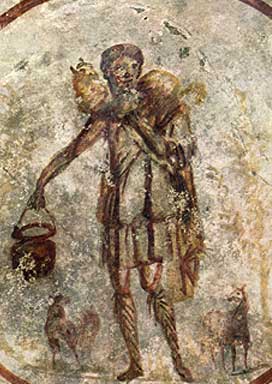
Hermas tells his story of sin and repentance, of the drift away from God and the reunion with Him through His Church. The Shepherd is not the Good Shepherd Jesus, nor is it a shepherd in a place called Hermas. The Shepherd of Hermas is the "Angel of Repentance" who guides Hermas through his visions and Divinely revealed allegories.

St. Pius I, Pope and brother of
Hermas. source: wikipedia
Our text itself was clearly written by one man and just as clearly not all written in one effort. The structure of the Shepherd of Hermas betrays the chronology of Hermas' visions and his recounting of them on paper: first "Visions," then the "Commands," and finally the "Similitudes." The last of these represents a maturity of thought and a clarity of vision not entirely present in the more direct early chapters.

Who was Hermas and when did he write? Dr. Brian Fitzgerald reminds us that Origen, born in 185AD, revered Hermas as canonical Scripture, suggest that the text pre-dates him by some time. The Muratorian fragment, one of the oldest extant lists of Scriptural Christian texts, dates to about 170AD and says of the Shepherd:
"But Hermas wrote The Shepherd very recently, in our times, in the City of Rome, where his brother Pius was occupying the chair of the church of Rome. And therefore, it ought indeed be read, but it cannot be read publicly to the people in Church or among the Prophets, whose number is complete, or among the Apostles, for it is after their time."
The notoriously unreliable Liber Pontificalis confirms the other texts in its passage on St. Pius I:
"While he was bishop, his brother, Hermas, wrote a book in which he set forth the commandment which the angel of the Lord delivered to him, coming in the garb of a shepherd."
Hermas does mention an "elder" in the beginning of the Shepherd. Our text was originally written in Greek, the literary language of the time. The Greek words for elder usually come to us as episkopos (bishop), presbuteros (priest), or poimen (shepherd). Hermas, at the end of the second vision, mentions the name of an elder named Clement. This may reference St. Clement, the pope at the end of the first century, or a priest in Rome named Clement. Despite the probable dating of the Shepherd to the mid-second century, it is not implausible that Hermas received his early visions during his youth, under the leadership of Clement of Rome.

The Visions

Hermas' story begins with a series of five visions that reveal a rough draft of sin and repentance within the Church. Hermas one day meets his former mistress and owner, Rhoda, bathing in the Tiber river. He assists her and, in passing thought, thinks to himself that he would like a woman like her for a wife. Some time later Hermas was traversing the road to Cumae, south of Rome, when he saw a vision of Rhoda. His former mistress told him that he had sinned against God and her, that she would accuse him before Lord, but the accusation had not yet come to pass. A despondent Hermas is then visited by an elderly woman who asks him why he is sad. He tells her that he thinks Rhoda will accuse him of lust. The old woman corrects him, telling him:
"God is not angry with you on account of this, but that you may convert your house, which have committed iniquity against the Lord, and against you, their parents. And although you love your sons, yet did you not warn your house, but permitted them to be terribly corrupted. On this account is the Lord angry with you, but He will heal all the evils which have been done in your house. For, on account of their sins and iniquities, you have been destroyed by the affairs of this world. But now the mercy of the Lord has taken pity on you and your house, and will strengthen you, and establish you in his glory."
She tells Hermas to repent with all his heart, as those whose names are written in the "book of the Saints" repent with all their hearts. Hermas agrees to repent, reform, and return to God. His sin was not a violation, but a neglect of his family's loss of faith, a faith which he still held.

A year later Hermas again walks to Cumae and again sees the old woman escorted by six angelic looking boys. She reminds him that his "seed have sinned against the Lord and blasphemed against the Lord." He must make the message of repentance known to his wife and his children and to the entirety of the Church. This last point establishes Hermas as a visionary and a prophet of sorts for the Church's ears. After re-iterating the impending importance of repentance the elderly woman departs. An angel visits Hermas in his dormancy. He queries the angel as to the woman's identity. Is she a pagan oracle? "The Church," the angel replies. "She was created before all things; therefor she is aged; and for her sake the world was framed."

In the third vision the elderly woman shows Hermas a great, square based stone tower being built with stones by the six young angelic boys from the previous visions, stones delivered by other humanoid beings. The angels build the tower not on a foundation over land, but over an islandless water. The outer most stones fit together so snugly that one cannot see a crease or line in the side. These stones were brought from the deep of the water in perfect condition. Stones brought from land can fit inside the outer casing, but only after masonry and cutting. Some stones are rejected for their shape or size. Among these, some are kept near the tower, some are thrown far away, some tossed back to the deep, and others outright burned. She explains that the tower represents the Church and the stones represent people. The watery foundations are the waters of Baptism which save. The angels who escort the Church-elder woman and who build the tower are the same angels whom God charged with care of His creation. The perfect stones are the Apostles, prophets, bishops, teachers, and deacons who exercised their offices blameslessly and without corruption. The stones from the water are those who suffered "for the holy Name" of God. The rougher stones placed within the framework are the youthful and less temperate in faith who, although good, required warnings from angels throughout their lives. The stones rejected and left near the tower are sinners who, although they separated themselves from the Church by sin, can still be saved if they repent. This point would especially have interested ancient readers, who hitherto would have been greatly concerned about the future of those who had left the faith through loss of faith or for fear of death. 

The woman does warn Hermas, "If the building shall be finished, they will have no more place, they will be castaways." Those thrown afar were the lawless in life. Some stones are both white and round. These are those who have the faith, but are similarly disposed to earthly passions and wealth. They can be fitted to the tower, but must have their excess cut away. Those burned have "rebelled from the living God and it entered no longer into their hearts to repent." Those stones outside the tower can not be within it, yet they may still be saved and put within the interior after "they have undergone torments, and have fulfilled the days of their sins." One Orthodox commentator begrudgingly concedes that this might be read as a precedent for the Latin concept of a purgatorial intermediate state. 

Holding up the tower are seven women: Faith and her daughter, Continence, and her successive descendants, Simplicity, Knowledge, Guilelessness, Reverence, and Love. Their power flows from the oldest to the youngest, but are inseparable from each other. She again entreats Hermas to repent and to lead others to repent before the tower the angels complete the tower, at which point the world will end and repentance will no longer be possible.

The angel tells Hermas that the woman appeared in different ways because of his double-mindedness. Double-mindedness is a common theme in the Shepherd. Contrary to the translation, it is not speaking out of both sides of the mouth, but an internal conflict springing from having a foot in the door and a foot out. This internal conflict leads to disparate actions displeasing to God. The fervent Christian does not waiver in his devotion.

Hermas' fourth vision begins like the previous, with him stopping his travels to pray and to confess his sins. A voice tells him to rid himself of his "doubtful mind." Hermas is taken aback. How could he be of doubtful mind when the Lord so clearly engages him? Suddenly a cloud of dust kicks up and Hermas assumes a cattle stampede. Emerging from the cloud was not a herd, but a great beast. In spite of his timidity, Hermas passes the beast unharmed. He notices the beast's head is black, red, gold, and white. On the other side he again see the Church-woman, this time dressed as a virgin with a white turban. She tells the seer that the beast is a "type" of the end times, of the beast of the apocalypse which will wreak havoc. The black on the beast is the world, the red its impending suffering, the gold those who escaped, and the white those purified in the tower. She commands Hermas not to tarry any longer, but to make his visions finally known—he seems to have neglected this task several times.

The last and shortest vision takes place in Hermas' house. While reclining on the soda and luxuriating, a shepherd who claims to have been sent "from the most holy angel" enters Hermas' abode and salutes the resident. Hermas at first wonders if this is a temptation, but relents to the shepherd's veracity. The pastor angelicus then tells Hermas not to be confounded, but to write down the commands and parables that he is about to reveal. You, dear readers, will have to read our next post to find out what the commands are!

Monday, October 13, 2014

Pius XII & Episcopal Consecration

A few days ago, someone asked me what Pius XII did to the rite of episcopal consecration after his encyclical Sacramentum Ordinis. Unlike his tinkering with the kalendar or hatchet job on Holy Week, his modifications to the Pontificale Romanum were relatively modest, if unfortunate. In the Acta Apostolicae Sedes for 1950, one can find a decree from Cardinal Micara "mandating the following changes and additions to the rubrics of the Roman Pontifical" to conform with the Pope's letter which "determined the form of the Sacrament of Orders" for Deacon, Priest, and Bishop.

The changes were modest, but did reflect the increasing shift towards receiving liturgy from Papal commissions who ensured the rites of the Church reflected the Pope's theology rather than the older paradigm.

Previously, an episcopal consecration employed one consecrating bishop, who would, with two other co-consecrators, lay hands on the episcopal candidate(s), but would say the prayers of the rite alone. Much like concelebration in the Byzantine rite, co-consecration of a bishop was meant as an act of brotherhood in which each participant did his own part. In the Greek rite, the concelebrants can sing litanies, distribute Communion, participate in the incensations and the like, but only the bishop says the anaphora. Similarly, the consecrating bishop carried out the elevation of the candidate and the other bishops attended as a fraternal sign; psalm 134 Ecce quam bonum was sung during the rite. after all. They laid their hands on the one who would join them among the successors to the Apostles, who Scripture called the "brethren" many times, but that was the extent of their place. In the revised form the co-consecrators carry out all the essentials of the rite along with the [now primary] consecrating bishop.

The revised rite calls for all consecrators to lay their hands on the candidates, say the words Accipe Spiritum Sanctum with the intention of consecration, and to say the preface which includes the words Pius XII decided constituted the absolutely essential form "Complete/perfect in Your priest the fullness of Your ministry and sanctify him with celestial anointing, clothing him with the ornaments of spiritual glorification." In the Roman tradition, anything about to become consecrated or sanctified in a special way is blessed with a preface: the palms on Palm Sunday, the Eucharist (prior to the silent Canon), priestly ordination, the Baptismal font, the Paschal candle, and churches when consecrated. Sadly, this changed people's association of the preface with sanctification and the "form" became the focus as though it is a stand alone prayer. 

Here is a picture of William Cardinal Godfrey's Pontificale Romanum, now owned by the esteemed Mr. Rubricarius, revised according to the Pian changes.


The chanted form was suppressed in favor of recitation by all three bishops


Again, the alterations were not drastic, but they do reflect the imbalance of liturgy and theology that came to a head during the 20th century, the centralization, and the gearing up towards a reform. I wonder, would Paul VI have been able to change the rites had his mentor not limited the essential forms to one line?
"Among the other documents of the supreme Magisterium dealing with sacred Orders, We judge worthy of special mention the Apostolic Constitution Sacramentum Ordinis, published by Our predecessor Pius XII on November 30, 1947, in which it is declared that "the matter, and the only matter, of the Sacred Orders of the Diaconate, the Priesthood, and the Episcopacy is the imposition of hands; and that the form, and the only form, is the words which determine the application of this matter, which univocally signify the sacramental effectsnamely, the power of Order and the grace of the Holy Spiritand which are accepted and used by the Church in that sense." (9) After this the same document decrees what imposition of hands and what words constitute the matter and the form in the conferring of each Order.
"Since in the revision of the rite it was necessary either to add, delete or change certain things whether to restore to the texts greater fidelity to the ancient texts or to express better the effects of the sacrament, We have deemed it necessary, both to clear up all controversy and to obviate anxiety of conscience, to declare what things in the revised rite are to be said to pertain to the essence of the rite. Hence, in virtue of Our supreme Apostolic authority, We decree and determine the following, with regard to the matter and the form in the conferring of each sacrament....." Pope Paul VI, November 18th, 1968 in Pontificalis Romani 

If anyone wants to read the old consecration rite in English, they can find it here. Interestingly, the translator puts a note within a note (not found in the Pontifical), correcting the notion that the laying of hands "was the essential rite" by citing Sacramentum Ordinis's teaching that the laying of hands is essential matter and the last words of the preface-turned-said prayer are the essential form.

Does it matter? I doubt anyone has used the pre-Pius XII rite of consecration since 1950. The last [canonical] consecration in the old rite was that of Bishop Rifan in Campos by Cardinal Hoyos. Before that was, of course, Archbishop Lefebvre at Econe. Both would have been done according to 1962. The sedevacantist bishops tend to follow Pius XII until he touched Holy Week. Daniel Dolan received his orders from bishop Mark Pivarunas of Pius XII-devout CMRI. Unlike Holy Week or the Office, this is a minor subject in my book and I doubt we will be revisiting it.


Spoken preface/essential form at 11:50

Transformation of the Lateran

As a follow up to our post on Medieval Rome, I would like to bring to readers' attention these two images that depict the slow transformation of the cathedral of Rome. The first shows the change in lay out. The transepts were enlarged to accommodate the Blessed Sacrament chapel in the south and the expanded papal tombs to the north. Along the nave, to the south were added several chapels, including one dedicated to St. Francis of Assisi, and the sacristy to the north. The most drastic change was the drastic expansion of the choir behind the altar. The Roman tradition was for the Pope to sit on the throne directly behind the altar, surrounded by clergy seated on semi-circular benches to either side. Cardinal bishops and concelebrating priests would sit towards the top, the seven deacons of Rome on the next step—with the archdeacon closest to the Pope (retained in Papal Mass until 1964), and then the lower clergy. The district subdeacons, lectors, acolytes, and choir would be situated nearer the altar. The expanded, narrow choir reflects the influence of the monastic choir tradition, in which the brethren clergy face each other with the altar of God at the end of their of sight. It might also indicate that the Curia was becoming top-heavy.


The other image is of the archbasilica before the gilded ceiling was added by Pius IV and Pius V, and before Innocent X (the last Borgia, huzzah) made the columns of the nave into niches so he could add statues, completed in 1718. The current arrangement is imposing for its beauty, but I wonder if the older arrangement, with its open spaces, was more imposing in its scale.


Resurrexi

Fr. Chadwick has picked up our post on Sarum chant and commented on his own experience running a choir that employed the, dare I say, effete Solesmes method of chant during his tenure with the ICRSS. Here is a comparison of some different interpretations of the Introit for the Mass of the Resurrection.


The Solesmes method


An "Organum" interpretation based on research into
the structure of chant in the Roman basilicas in
the 7th and 8th centuries


A recording from a Paschal Mass in 1978. This follows
the more mainstream method, one which, I think, descends
more naturally in timbre and style from the old
Roman style above

Sunday, October 12, 2014

Rite of Lyon in Pictures

From 1993, a celebration by the FSSP in Lyon in the presence of the Primate Archbishop, Albert Cardinal Decourtray.

Reverencing the Primate after the prayers before the altar


The subdeacon brings the pax brede to the Primate during the preparation for
Communion. Most non-Roman rites used the pax brede to spread the pax during Mass.
A rubric does exist for a bishop celebrating a non-Pontifical High Mass to use
the brede.

The gifts are covered by the corporal, not a pall or chalice veil. This was common during
the Middle Ages in northern Europe.

Incensing the clergy, Byzantine style with full use of the chain. The Rad Trad
knew a Roman M.C. who did this, too.
 
The subdeacon carries the paten with his maniple during the Patern noster, an interesting variation
 
The ablutions

source: www.fsspwigratzbad.blogspot.com

Saturday, October 11, 2014

Medieval Rome: Forgotten Glory?

Ancient Rome was the capital of the known and civilized world. Edward Gibbon's Decline and Fall of the Roman Empire recalls the power and honor due to the City at the height of her Imperial powers:
"In the second century of the Christian era, the Empire of Rome comprehended the fairest part of the earth, and the most civilised portion of mankind. The frontiers of that extensive monarchy were guarded by ancient renown and disciplined valour. The gentle but powerful influence of laws and manners had gradually cemented the union of the provinces. Their peaceful inhabitants enjoyed and abused the advantages of wealth and luxury. The image of a free constitution was preserved with decent reverence: the Roman senate appeared to possess the sovereign authority, and devolved on the emperors all the executive powers of government. During a happy period of more than fourscore years, the public administration was conducted by the virtue and abilities of Nerva, Trajan, Hadrian, and the two Antonines. It is the design of this, and of the two succeeding chapters, to describe the prosperous condition of their empire; and afterwards, from the death of Marcus Antoninus, to deduce the most important circumstances of its decline and fall; a revolution which will ever be remembered, and is still felt by the nations of the earth."
Gibbon was quite gifted with adjectives. In the modern day, scholars and tourists alike remember and glorify Renaissance and baroque Rome for its humanism, its revival of painting and sculpture, its place at the center of emerging nationalistic politics, and for its romantic ambiance. This is the Rome of Bernini, Michelangelo, Sixtus V, and Urban VIII. One would think Rome was a city in eternal strife, earmarked at opposite of its history with two periods of adroit artistic and political vibrancy. The understanding of Rome is natural, intuitive, grounded in artistic history and a deep appreciation for the ancient City. It is also completely and utterly wrong.

Rome, aside from these two epochs, also enjoyed a period of religious revival, prosperity, and recovery of self-identity during the high Middle Ages. Renaissance Rome sprung forth from the fountainhead of medieval Rome, not from a vacuum of dark illiteracy and religious ignorance.

Rome entered a truly dark age after the sackings and raids of the fifth century, the abandonment by the Byzantine empire, and the waves of plague which sent most of the still-living populace into the countryside. Rule of the city devolved to the Pope, known until Pius IX as the "Lord Pope," a title used even within the Magna Carta. A form of Senate continued to run the daily, micro-level affairs of the City and the old families held some level of authority, but the Popes' spiritual and administrative power over the churches meant that the Bishop of Rome was the Lord of Rome. Unfortunately, [St] Leo III crowned Charlemagne and the various families of Italy sought the papacy so they could play king-maker and live off papal beneficences. In the 9th century, the Mohammadans sacked Rome and ravaged St. Peter's Basilica. The papacy entered its absolute nadir, when the Bishops of Rome descended from Marozia—mistress of the murderous Pope Sergius III. Indeed, six popes (John XI, John XII, Benedict VII, John XIX, Benedict VIII, and Benedict IX) came from her line, with a few elderly men functioning as placeholders in between, murdered if they lived too long.

Finally, the Gregorian reforms emancipated Rome from central Italian politics and the un-Holy Frankish Clan Holy Roman Empire. What emerged was a Rome revived in continuity with its past, aware of its present, and vivacious in faith.

Ancient peoples were not so introspective and concerned with documenting their own ways as we are today. One is often struck by the absence of ritual descriptions or theological treatises on non-Scholastic during this age. The ancient and medieval Christians expressed what they believed in what they did, not in word alone. They manifested their Roman tradition of faith in their church and secular architecture, as well as in their liturgical and artistic endeavors.

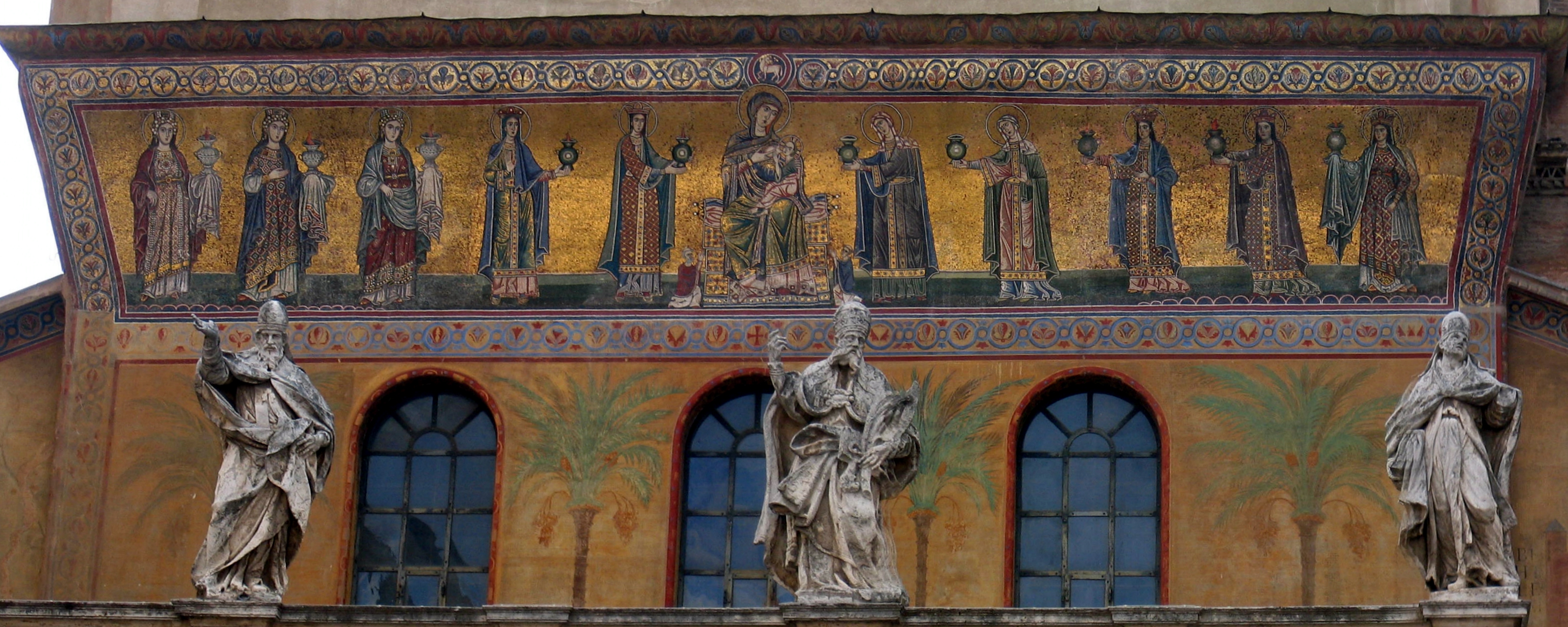
Roman art during the Middle Ages derived from the older Roman mosaic tradition. While the Orthodox Greek tradition had long ago transitioned into painted, "written" icons, less and less realistic in their appearance, the Romans, a people averse to change and innovation in religious matters, kept their mosaic tradition and even imported it into new places. The below mosaic outside of Santa Maria in Trastevere looks quite ancient, but in fact dates to the 12th century.

source: wikipedia
Unlike the Norman French and English, who built their new churches along the soaring vertical lines of gothic pillars and arches, the Roman people conscientiously kept in continuity with their received identity and tradition in all matters, especially architecture.

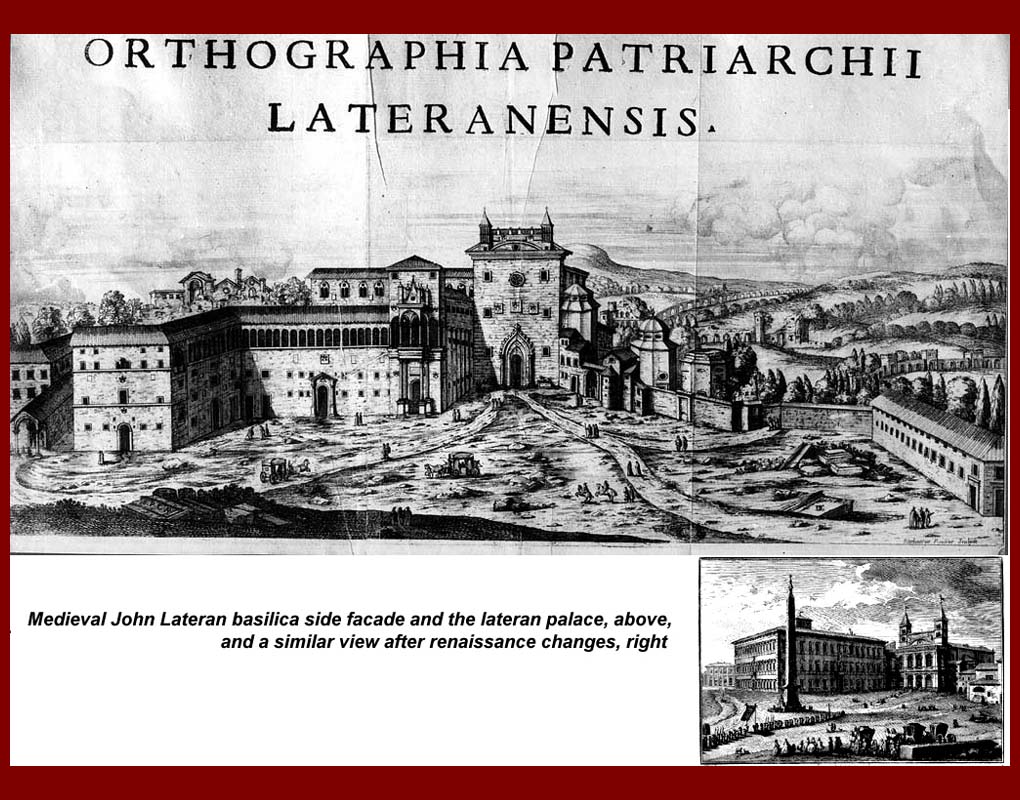
Between 1198 and 1216, one of the great men of the Middle Ages, Lothar Segni, sat atop Peter's chair. Keeping with his own doctrine of the spiritual power's place over the temporal power, he refitted the Lateran palace for the government of the Church and as an example to the world. Sadly, few if any records or reconstructions of the ancient Lateran palace exist for us today. Dante called the Lateran palace a place "above all earthly things." Below are two rare representations of what the palace and adjoining cathedral looked like prior to the tearing down of the palace and the addition of a baroque facade on the Archbasilica.

source: mmdtkw.org

source: augustineofcanterbury.org
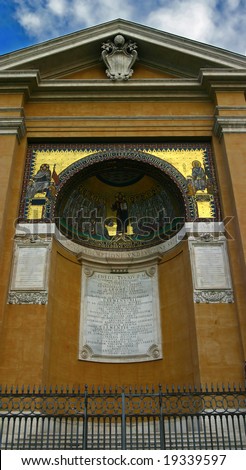
These views are from the north, not the front entrance to the cathedral, which is to the east. The Lateran palace, built by the Lateran family and given to the popes by Constantine, encompassed a large courtyard—a feature of Roman palatial architecture imitated with the building of the Apostolic palace adjacent to St. Peter's basilica and the new Lateran palace. Until the 9th century or so, the popes were elected by the people of Rome in the field in front of the cathedral. Often violence would break out and whoever won control of the Lateran complex became pope. This author once recalls reading about a victor having difficulty convincing the mob to spare his opponent's life. Next to the courtyard, at the upper left of the above picture, was the Triclinium of Leo III where Innocent III held the fourth Council of the Lateran. This remarkable hall was torn down, its former foundations replaced by roads. Its apse still stands tall in memorial to its previous function.

source: wikipedia.org

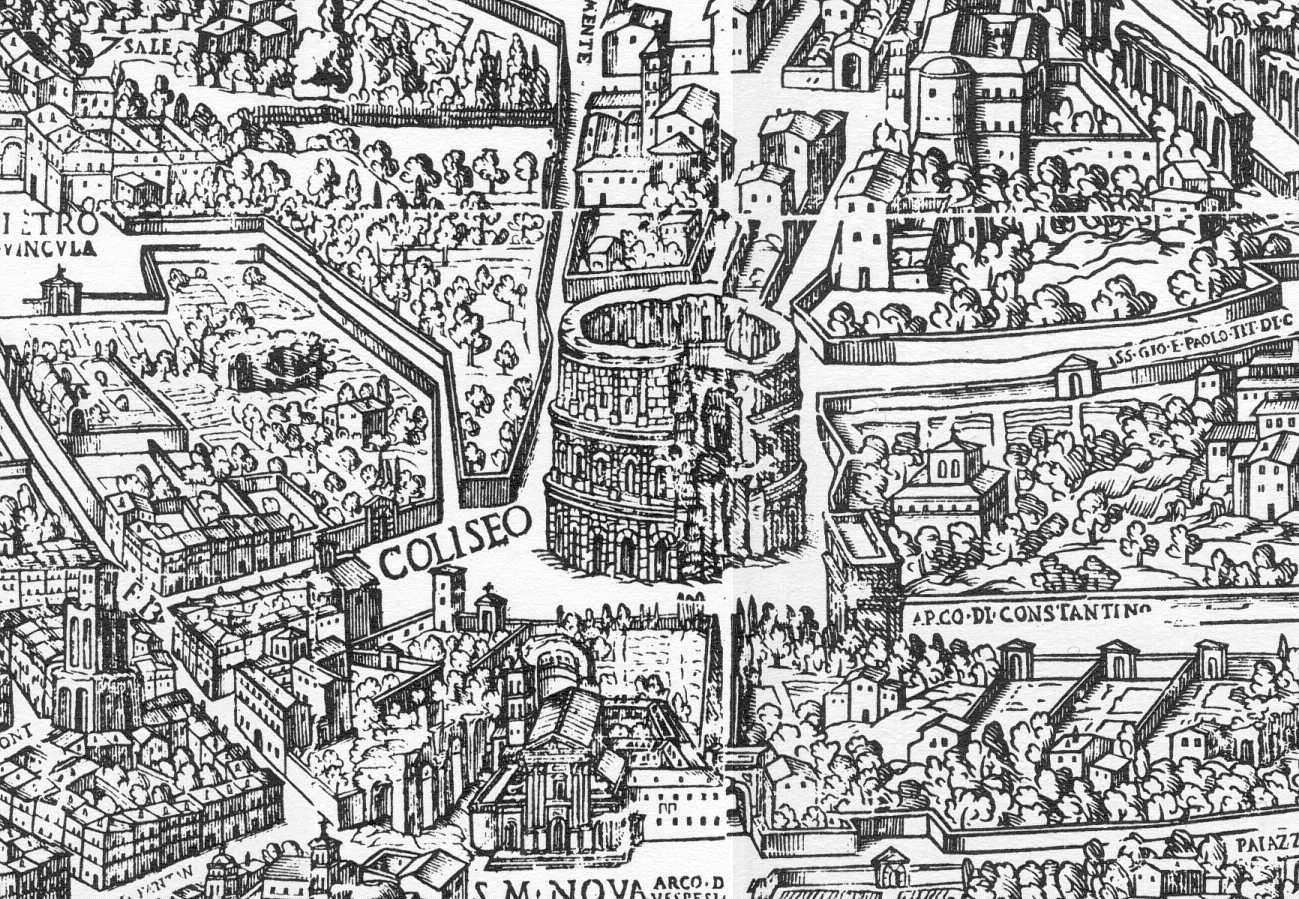
The revival of education in France and trade with the East incited by the Crusades brought Rome back to significance in the intellectual and economic realms, attracting students seeking theological knowledge and merchants looking for middle-points in their routes of trade between the Continent and the Eastern Mediterranean. The Colosseum returned to use after half a millennium of dormancy as an open market and, what we would now call, an industrial park.

The Colosseum during the Middle Ages
source: wikipedia
Above all, the Romans still realized that they were the ancient City that ruled the world and that they were now, without contradiction, the City that ruled the Christian world. As such, Rome revived many of its more catholic Catholic features. The early praxis of reading the lessons of the Mass and Office in both Greek and Latin returned, as did use of the stational churches by the Lord Pope on great feasts. The ancient, un-gallicanized rite of Mass remained in use by the pope one day a year on the feast of St. Peter's Chair in Rome. This ancient use involved numerous deacons and subdeacons, long psalms instead of simple chants, no offertory or silent prayers, a sung Canon, and concelebration. The Lateran and Vatican basilicas also retained the ancient Divine Office, which uses the same orations, antiphons, and psalms as the pre-Pius X Office, but sans introductory rites, no hymns, and a more communal ritual. Moreover, the canons recited the Offices of the Dead, the Blessed Virgin Mary, and of All Saints on ferial days per annum and provided pastoral care to the great many pilgrims. Innocent III himself was a canon of the Petrine basilica before his election and familiar with the observances. These rites remained in use until Franciscan pope Nicholas III squashed everything not done in the Franciscan Order. The Byzantine monastery in Rome also enjoyed a resurgence, with no less that six hundred monks and priests in residence in the 12th and 13th centuries. This also suggests that the Rome-Constantinople schism was not taken as seriously during this period as it would be after 1453. The clergy and people of Rome were the enemies of streamlining. Far from assuming the Church required one way of celebrating Mass, as the capital of Catholicism, they welcomed the catholicity of rites practiced within the City.

Medieval Rome was not the superpower ancient Rome was, nor was it the artistic center baroque Rome would be. But it was once again alive and acting as the center of the Christian world. Perhaps this is why modern historians are unable to see that the period between the Gregorian reform and the Avignon papacy was a glorious one, because they cannot understand how Christianity can be the lifeblood of a people.
Rossellino's proposal for the new St. Peter's basilica
source: studybluecom
Then came the Renaissance. Much would have to be lost and rebuilt because of the neglect of the popes while they lived in Avignon. St. Peter's basilica is particularly flagrant example of the paradigm shift. The roof on the old basilica was wood needed regular replacement, something ignored during those dark French years. As a result, the roof collapsed, fires occasioned the church, as one of the walls warped out by six feet. The basilica, built 1,100 years earlier, was beyond saving. Bernardo Rossellino proposed a new basilica built in the same style and with the same features as the old church, only with longer transepts to accommodate devotions and a longer choir for the new, medieval choir praxis. His proposal was canned by Julius II, who wanted a grand new church to house his tomb. Bramante began the construction of the modern basilica, a significant departure in style and outlook from the previous building. With the new basilica, Pope Julius baptized Rome into the Renaissance and gave precedent for a severe remodeling of many churches of the City along new lines. Rome became a center of baroquerie and its old identity began to fade. Lex supplicandi legem statuat credendi.

The old basilica, along with Cluny and St Paul outside of the Wall, the largest church in the world, is demolished
and covered with the new basilica.
Medieval Rome is gone, but we ought not forget how wonderful a Catholic city it was nor should we neglect its example as a city conscientiously dedicated to God.

Thursday, October 9, 2014

Weddings


The Rad Trad just saw the strangest wedding rehearsal of his life while in the Confession line. The priest told the people what to do and then told them that he would be "inviting" them to do those same things during the wedding proper: "at this point you sit down" everyone sits "and tomorrow I will invite everyone to sit down at this point." I sat aghast when he said, "Now, we'll begin with 'May the grace of our.... be with you' and you reply 'And with your spirit'." Call me old fashioned, but I would have assumed that they already knew! He also reminded them not to miss the people on the other side of the aisle during the handshake sign of peace. 

We always discuss how the Ordo Missae changed, along with the lectionary and ordination rites. Some, like myself, talk about more specific things like Holy Week. Few think about just how deep the changes went: Baptism and Marriage are really very bare and insipid now. I know a Melkite priest who absolutely loves the old Baptism rite and absolutely detests the new one. I hear nonsense like "as they come to share their love with us" I thought "Strange, I was under the impression God was confirming His love in a Sacrament." The old blessing of the ring was brief and to the point: "Bless O Lord, this ring, which we are blessing in Thy name, so that she who wears it, keeping faith with her husband in unbroken loyalty, may ever remain at peace with Thee, obedient to Thy will, and may live with him always in mutual love. Through Christ our Lord." The new blessing is long winded, self-referential, and vague:
"Lord, bless these rings which we bless in your name. Grant that those who wear them may always have a deep faith in each other. May they do your will and always live together in peace, good will, and love. We ask this through Christ our Lord.."
They clearly are not doing a Mass, but the abbreviated service. I think the groom is not a Catholic. Still, the point stands. And all the little bits and bobs for people to do (readings, bidding prayers, holding the rings, "witnesses"—as though the 150+ people in attendance are deaf, dumb, and blind), it is as if attending is not enough. I have been to a few secular wedding services and none of them were as high maintenance as a wedding according to the Pauline books. I was last in a wedding in 2012 as a groomsman. I escorted a bridesmaid and the bride's mother down the aisle prior to Mass, bought the champagne for the reception, and read from Genesis in a very low key way. The wedding was well done, but the exception in that. Nowadays, most weddings are formalized family pageants and God happens to be in attendance.

I nearly flipped when the priest inserted "You may not kiss the bride" and abjured the groom-to-be for not making it long enough.