No, not that secular commercial holiday called Christmas (not to be confused with the Holy Day called Christmas) which is preceded by a month or so of mindless ditties about snow and "40% off overpriced stuff" sales. The most wonderful time of the year for the Rad Trad is Advent, the time during which we contemplate the unspeakable mystery of the Incarnation and the period before it, an epoch of hope for a salvation not then visible.
Advent is a time for thinking about sin, more so than Lent in my book. During Christ's 40 days in the desert and the days leading up to the Triduum He at least dwelt on earth and walked among men like us. The people of prior times had no such consolation. They had hope, or at least those aware of their own sins had hope. Without sin why yearn for redemption? Without falling why rise? Without darkness why seek light? When I sin I can drive a few miles to a parish that has daily Confession and take a "spiritual shower." What about the peoples of that time before Christ, whose difficulties are recalled during Advent? Advent seems to be the proper time for reflection on sin, on one's burning need for God's mercy in every moment of life, and on the great gift given to us at the end of it, the Incarnation. As St. Athanasius wrote, "God became man so that man might become God."
My challenge to readers is, if you do not already, to pray one major hour of the older Divine Office every day of Advent and through the Octave of Christmas. Oh no, that's a whole month! Exactly. You will appreciate Christmas all the more when it comes at the end of a month's rumination on sin and forgiveness with the Church. It will mean all the more when its mysteries permeate your life for an entire week. As always, I suggest Vespers or Lauds. It is customary during Advent and Lent to pray the Office of the Dead on Mondays in addition to the Office of the day. If you do not have the time for both (although Vespers/Lauds can easily be recited in seven minutes or so) I would pick the Office of the Dead on Mondays and the regular Office on weekdays just for the sake of some balance. However, if you do this do not pray the Office of the Dead on Monday December 23rd; instead pray the Office of the day so that you might have the seasonal "O" antiphon.
On a related note, please notice that the tab for the Officium Defunctorum is now gone as there will be no more opportunities to pray for the dead this month.
A friend recently asked what the Byzantine perspective on Confirmation was. I thought I would share my reply since the perspective might differ a little from what we all learned in religious education at the hands of a lay catechist (or in my case, a Jesuit).
We often think of Baptism as "washing away Original Sin" and Confirmation as a "strengthening" (confirmo in Latin means "I strengthen") in the Church Militant.
Baptism is actually prefigured in the Great Flood and in the Parting of the Sea by Moses. It is the washing away of sin, to be sure, but it is, more importantly, the crossing over into a new and renewed creation, the new promised land and the new Jerusalem which is the Church (and which the old covenant and the old Jerusalem anticipated). We enter the Church in Baptism ("baptism" means "plunging" in Greek, hence when one is "baptized into Christ" one is plunged into the body of Christ, the Church) we enter into something pure and our sins are washed away as a consequence.
Confirmation, or Chrismation, is a similar story. The anointing with oil is actually an Old Testament style anointing to the priesthood. In this case it is the anointing into a priestly group of people (1 Peter 2:9—that passage Luther so abused). In the ancient days the priests came from the Levites. Christ has transformed all members of the Church into members of a new type of people that has this priestly charism, that is, the power and ability to spread the Gospel, which is of course not the same as Holy Orders. It is perhaps a very small participation in Christ's priesthood in spreading the Gospel. The priests and bishops in Holy Orders have a much stronger participation since they have the power to confect the Sacraments. Either way it is a very real participation in the Divine Life. Because it is a joining to a new people, Confirmation was always done in tandem with Baptism: one entered into the new creation and the new people of God at the same time. As infant Baptism (which was always done) became the norm the Byzantines Confirmed infants and the Romans reserved it for the bishop to do. There is, in both the traditional and Novus Ordo Roman books, a remnant of Confirmation of infants: the priest anoints the baptized child with Chrism saying nothing. Thankfully we do confer Confirmation after Baptism with converts now.
Also at Confirmation one receives the Holy Spirit. Because one enters into a priestly people one must receive the Holy Spirit to be guided in truth (1 John 2:20). The traditional Roman rite loses sight of this. The form in the Roman rite is "I sign you with the sign of the Cross and strengthen you with the chrism of salvation in the Name of the Father and of the Son and of the Holy Spirit." The Byzantine rite, which the new Roman books copied in this case, is far clearer "Be sealed with the gift of the Holy Spirit" which really means "Be sealed with the gift that is the Holy Spirit."
Makes me wish I appreciated my own Confirmation more!
Figuratively and—I hope not but possibly—literally.
Today at the store I saw a teenage couple, neither of them could have been more than 16 or 17 years. Her skirt barely covered the skin of her posterior and he had an enormous smile on his face. They were buying a box of those foul little rubber balloons and he made her pay. Sigh. One wonders if they are yet eligible for the new healthcare law's coverage?
At times I wonder if I am judgmental or if I am just one of a few people justifiably frustrated with the deterioration of social standards for youth and the spiritual decay it brings.
Today, in both the Byzantine and older Roman rites, is the feast of St Catherine of Mt. Sinai the virgin martyr and daughter of an Alexandrian king whose rare education endeared her to Christ to the point of death. According to tradition her remains were miraculously taken to Mt. Sinai where they were discovered by an already established monastic community, which cares for her veneration to this day.
The monastery—built around the Burning Bush—is now, of course, Eastern Orthodox, but that does not make it less interesting to us as Catholics and as people appreciative of liturgical historical. Mt. Sinai houses possibly the oldest extant icons in the Christian world, icons which were written when Byzantium was thriving and St. Gregory the Great just an infant. Below is a very short documentary on the monastery which focuses on the place's unique place in icon history.
The beginning, for the uninitiated, is the Hajmeh, the first part of the night-long celebration of Pascha which transitions into Mattins and Lauds and ends with the Divine Liturgy. The faithful take "light that never fades" from the Paschal candle blessed at the Vesperal "vigil" Liturgy earlier that [Saturday] morning. I found my first experience with this rite simultaneously awe inspiring and frightening, much how the two women felt when they encountered the Empty Tomb that day in the year 33, when the Sun was only just rising.
Today was, in the Roman rite, the last Sunday after Pentecost, a Sunday which in liturgical terms signifies the end of the world and the Last Judgment when the "Lord with woundes redde will come to judge the quick and the dedde." In the Roman rite, and by extension all the Latin uses except the Mozarabic rite, the liturgical year reflects the process of salvation history. The year begins a week after it ends. The beginning's Gospel actually has something of an apocalyptic tone, picking up on the desolation and judgment themes of the last Sunday. Advent signifies the wait of the Jews and of the entire sin-riddled world for a redeemer, which culminates in the birth of Christ. Interestingly, the first Sunday of Advent is significant because it establishes the need for salvation and the third, Gaudete Sunday, is important because it rejoices in the immanence of that salvation; the other two Sundays, of lesser import, can be superseded by the Immaculate Conception and the Christmas Vigil. After the celebration of His Nativity and the other relevant feasts (Circumcision, Epiphany, Baptism in the Jordan, and the Purification) the focus shifts to His time in the desert and His teachings on salvation in Lent, culminating in His redeeming work during Holy Week and life in the Resurrection during Paschaltide. The time after Pentecost is significant in that it is after the coming of the Holy Spirit, the age of the Church and the Saints. Revelation has ended, but the Divine Life for us believers is constant until the End finally comes. And then it starts all over again.
In contrast the Byzantine rite's kalendar does not focus as much on the seasons as it does on the major feasts on the Church. Days that we Romans would not consider feasts they do, such as Palm Sunday. Feasts dictate the liturgical year. Indeed, in any well appointed Byzantine parish there should be icons on both sides of the nave depicting various events in the process of revelation. One would notice that the icons are arranged chronologically, beginning with the birth of the Blessed Virgin and ending with her Dormition/Assumption at the end of her life. In between would be the events of Her Son's time on earth: the Annunciation (which can compete with Good Friday in the Byzantine rite), the Nativity, Theophany, Palm Sunday, Pascha, the Ascension, Pentecost and more.
In contrast with the broader approach of the Roman rite, with its many seasons, the Byzantine rite's year is very personal and seen through the eyes of our Lady. As one who has experienced both I prefer the Roman kalendar myself, particularly because of Advent, by far the richest and most beautiful time of the liturgical year in either rite (just my opinion).
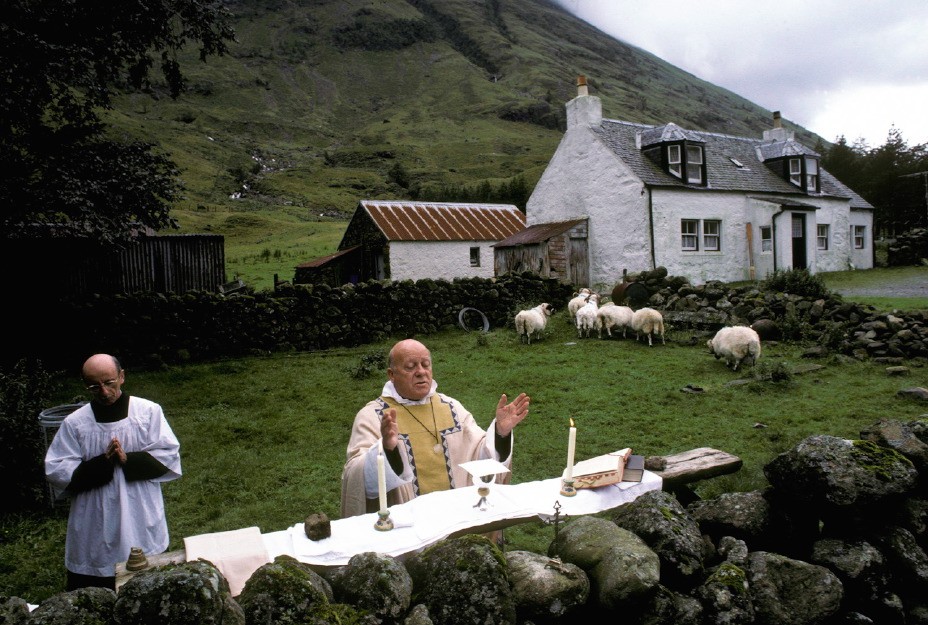
Very organic liturgy with Fr Quintin Montgomery-Wright
source: Jean Erik Pasquier's Daily Life series, 1986
A question has circulated in my minds for several years and I would like to put it to the readers. What exactly is the Roman liturgy? Who possesses it? Who has authority over it?
My personal opinion is that the Roman liturgy does not exist in a particular year or edition of Mass and Office books, but in certain distinct elements that became apparent after the liturgy's shape coagulated after the fluid years that followed the emergence from the house churches. I would venture to say that the three main features of the Roman liturgy are:
The Roman Canon: the Eucharistic prayer which is central to the Latin rite's observance of Our Lord's command and which is found at the heart of the Roman Mass and its local uses from the time of St. Gregory the Great onward.
The Roman Psalter: the distribution of the psalms marked the hours and the days, forming the Roman Church's celebration of feasts and its weekly prayers.
The Roman kalendar system: this dictated how feasts and ferial days would be observed and set the cycles of the liturgical year.
None of these elements was without change or some evolution over time. Advent, my favorite time of year, was relatively late in entering the Roman rite. The psalter is clearly ancient (as it existed before the Pian reforms), but it was not the central point of the proto-Office, the lucernarium; the focus of that service was readings, which survived in the Holy Saturday rites (making the other Pian reforms all the more difficult).
Another thing to realize with these elements is that they are elements and not a strict unit. In some sense the local rites used in religious orders and throughout Northern Europe were usages and variations of the Roman rite rather than distinct liturgies. Far from undermining their value, this means that the Roman rite consists in a multiplicity of practices united by basic liturgical principles.
Which brings us to our next question: who owns the Roman liturgy? One might be tempted to say the Roman Patriarch, the Pope. There are two problems with this simple answer in my view. The first is that, after the missionary expansion under Gregory the Great, the Roman liturgy, under my broad definition, was no longer limited to the Church of Rome, but rather became invested in all the Christian lands of Europe and beyond (Asia, North and South America, and now Africa). Many of these places, particularly in Europe, developed their own local expressions under monastic, parochial, episcopal, and devotion rule, not under the direction of a far off office in Rome. Which brings us to the second issue, that the liturgy, arguably, ought to belong to those who pray it. Right?
If both of these are true, particularly the second, then we might find ourselves in a little bit of a dilemma. Lay liturgical formation in the Roman Catholic Church is horrendous in most places, aside from the sort of parishes which promote lay knowledge of the liturgy (and not liturgy lite). Among those with liturgical knowledge there is often a fear of violating the legal norms established in the books. And yet, if everyone "said the black and did the red" would we not all be gathering at 7PM on a Saturday night at a dinner table, listen to a few Bible fragments, listen to the priest consecrate, eat and drink, and then go home? The communal and dynamic nature of the liturgy is why the Mass and Office took their shape, first in Rome and then in other dioceses. In a recent day spent in discussion with some liturgically capable men at a Catholic college I realized just how interested people are these days in the "organic" nature of the liturgy and yet how timid some are to depart at all from the rubrics. One fellow wanted to know if it would be legal to use the full Orbis factor Kyrie, with the litany-like vocative exclamations of the Middle Ages' farced settings; did those who wrote that setting follow the rubrics or did they have a different understanding? Which brings us back to the original question: what is the Roman rite and who owns it?
As a point of interest, there was, many years ago, a highly eccentric convert from Anglicanism, a Fr. Quintin Montgomery-Wright, who finding England unfriendly to non-cradle Catholics, packed up for Normandy and acted as pastor of a parish there from 1956 until his death in a car crash in 1996. Fr. Q initially said Mass in French and versus populum in the 1950s but, finding the reforms of the 1960s bothersome, pushed his altar back against the wall and switched back to Latin. He ignored the Pauline liturgy's introduction between 1968 and 1970, but did not do the "EF" liturgy either. He "tweaked" the liturgy with some French variations, as Anthony Chadwick tells us:
"Fr. Montgomery was an amazing fellow. He had stacks and stacks of vestments, and did the liturgy the old Norman way, like Sarum. There were little blue dalmatics for altar boys, and I often sang as a coped Ruler at Sunday Mass at Le Chamblac. He vested on the Lady chapel altar (the church's south transept). The Judica me psalm was said at the Lady altar and in procession. He likewise said the Prologue of St John on the way from the high altar back to the Lady chapel. At the time, I though he was just being odd, but this was the medieval and pre-Tridentine way of celebrating."
The 1568 and 1570 books that came out of Roman during the Papacy of St. Pius V and the creation of the Congregation for Rites in 1588 under Sixtus V (if I am ever elected Pope I will be Sixtus VI) did not freeze the Roman rite, but those events did slow any sort of development and eased off any communal interest or local variations. The Pauline books, and the "EF" books, were both issued by offices. How do we form the laity in the liturgy? The answer is simple, although difficult: pray it. Pray it all the time.
Hopefully interest in this subject will increase in the coming years. I believe it to be on the upswing.