 |
| source: wikipedia.org |
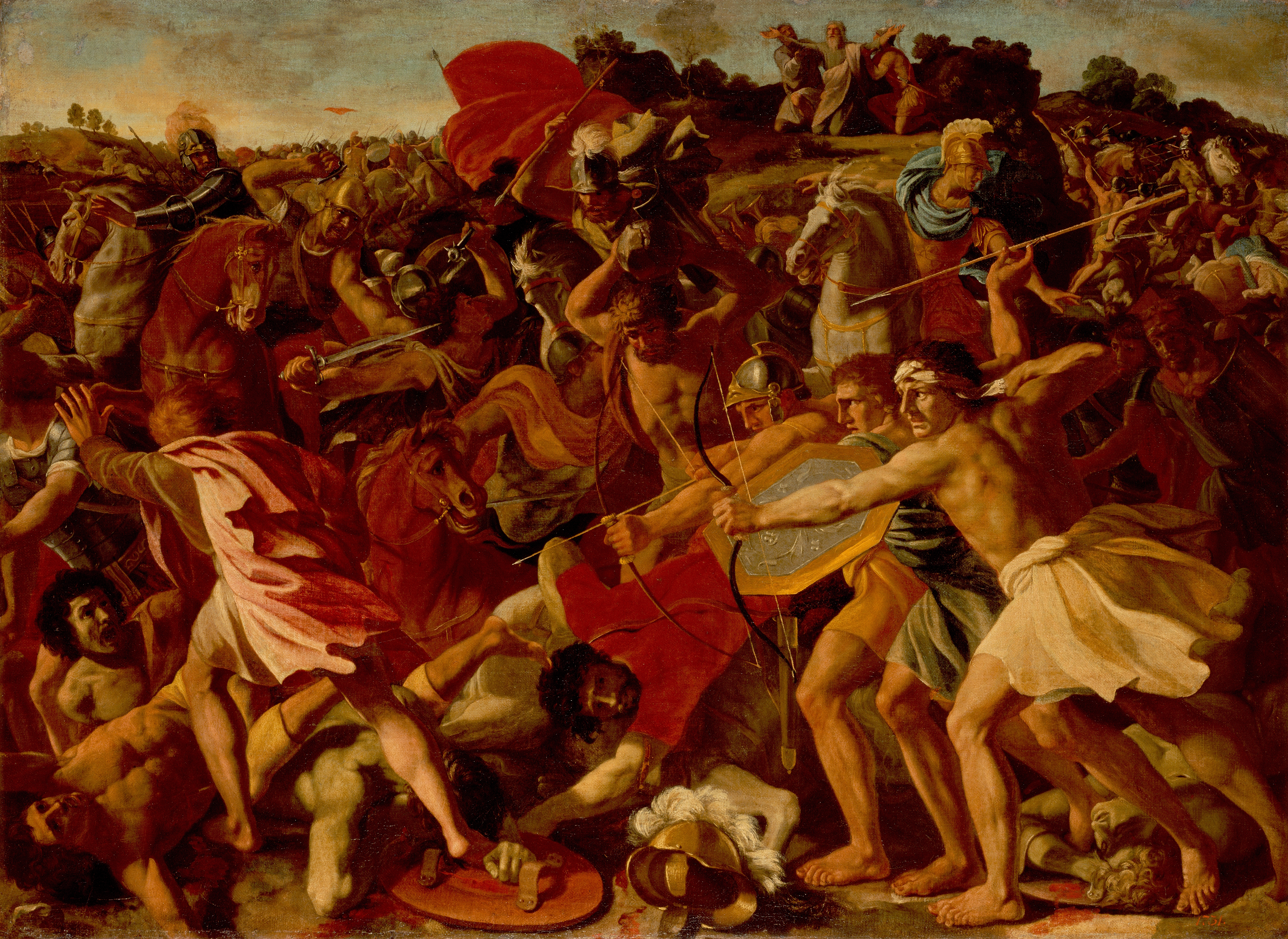
The most commonly cited evidence in favor of this dichotomy between God as portrayed in the Old Testament and in the New is the massacre of the Canaanites by Joshua and the Israelites according to Divine directive (Deuteronomy 7). Many professional "apologists"—Catholic, Orthodox, and Protestant—have put in their two cents concerning the mass death that ensued. The explanation usually goes something like this: God made them and God is just, so whatever God wants to do to the Canaanites is in accord with Divine Law. For the believer a well constructed variation of this argument suffices. For the non-believer this is petrol for the rhetorical fire. And for those with troubled faith this line of reasoning solidifies distinction between the atavistic "Old Testament God" and the benign "New Testament God."
What follows is hardly an "explanation" of what happened with the Canaanites, but the Rad Trad's private reflection on the matter.
This Was Going to End Poorly Anyway
An Egyptian Christian today may be more conducive to believing that the God of Jesus Christ and the God of the Old Testament are One and the Same than an American Christian today. The first world is so accustomed to false violence and so removed from real death that we who reside in "civilized" nations lose sight of the struggles of ancient times which are so very much alive in the world today. We practice violence in Call of Duty video games and can barely deal with the death of an octogenarian grandmother. We live in great material comfort. Even America's poor are far better off than the middle and lower classes of most other countries. We are desensitized to violence. So how could we possibly understand the way in which God's providence could utilize violence over three millennia ago? The theoretical Egyptian Christian has never really lost sight of this reality which might be why, aside from compelled conversions to Islam, Middle Eastern Christians have maintained a traditional view of the faith.
Go back to roughly 1,500 BC (or BCE if you must—what happened in 0 CE I wonder?). The Israelites have been expelled from Egypt, are the religious riff raff of the Middle East, have lived on bread for four decades, dealt with desert plumbing, and endured numerous battles for their survival. This is a brutalized, not a civilized, people, and God must deal with them according to their own understanding. The newer Catechism cites St. Irenaeus (Adv. Haer. 3, 20, 2) in saying "The divine plan of Revelation is realized simultaneously 'by deeds and words which are intrinsically bound up with each other' and shed light on each another. It involves a specific divine pedagogy: God communicates himself to man gradually. He prepares him to welcome by stages the supernatural Revelation that is to culminate in the person and mission of the incarnate Word, Jesus Christ" (53). The Canaanites were not a particularly polite people either:
For those ancient inhabitants of thy holy land, whom thou didst abhor, because they did works hateful to thee by their sorceries, and wicked sacrifices, And those merciless murderers of their own children, and eaters of men' s bowels, and devourers of blood from the midst of thy consecration, from the midst of thy consecration: And those parents sacrificing with their own hands helpless souls, it was thy will to destroy by the hands of our parents, that the land which of all is most dear to thee might receive a worthy colony of the children of God. Yet even those thou sparedst as men, and didst send wasps, forerunners of thy host, to destroy them by little and little." (Wisdom 12:3-8)
Clearly the Canaanites and the Israelites lacked the qualities necessary to produce a multicultural paradise akin to the ones the United States has created in the Middle East. These peoples had no concept of peace as Christians do, much less "first world" Christians. Violence and death came into the world by sin, but in this instance God re-directed the use of violence toward a greater eventual good: the entrance of the Son of God into the world through the line of the rulers of this new kingdom, Israel. God made an enclave for Himself betwixt two very brutal societies. Omnipotent as He is, God elected not to create an immediate state of peace. Instead He wanted mankind to learn a lesson by participating in His work, much like a child who is taught how to do addition by his parent rather than by having his parent do the problem for him.
Modern, effete ears ignore God's plan of salvation for people and instead absolute their own post-modern standard and private values, then judge God—Who exists outside of time—and people from 3,500 years ago by those values. This is spiritually deranged and intellectually dishonest.
A violent outcome in a sinful world was inevitable. Our perspective makes that difficult to understand. And those who ignore this reality of sin bifurcate the God of salvation into the mean Old Testament God and the warm New Testament God.
What Would You Have Thought?
Given the probity for human sacrifice among the Canaanites the Israelites may have displayed very little reservation about wiping out entire communities. Perhaps a more modern and extreme example will aid us in seeing the difficulty of this matter. Hernán Cortés famously waged war against the Aztecs of the New World and accidently killed off the entire populace by importing European diseases to which the Spaniards had unknowingly acquired immunity. Cortés' journal records the horrors of Aztec human sacrifice, the ritual killing of men, women, and children in order to appease idols. Some estimate that the Aztecs sacrificed 20,000 people every year. The death of an entire populace at the hands of colonialists is an objective tragedy. Yet imagine yourself to be a more timid Spanish soldier who, for military or national purposes, found yourself accompanying Cortés on his voyage. You may very well have been mortified at the deaths of hundreds of thousands, maybe millions, of natives and still have felt less remorse than you would have if this had happened in any other place, given the horrors committed by those now dead. I myself do not know how I would have felt on Cortés' journey; likely I would have eructated throughout the venture.
Perhaps a future example might also be illustrative. Are Christians hypocritical for upholding peace and defending a God Who authorizes the death of an entire people? This is certainly an appealing line for some. But in light of how the Israelites viewed the Canaanites (and, according to the Scriptures, how God viewed them), consider this example. In Texas the state routinely executes a great many capital offenders every year. Texas is also one of the more religious states in the United States. If future generations outlaw the death penalty and switch to a methodology for "reforming" criminals will they think pious Texans hypocrites for executing murderers?
These examples are not meant to be absolute. One difficulty is that the Canaanites were a whole community, not individual offenders. These parallels are only meant for mild consideration.
Enduring Standards
One fact often neglected by those of us who in modern times judge Christianity for the massacre of the Canaanites is that the massacre was never set as a prescription or standard for future behavior. Given the ambitions of the Byzantine emperor, the two centuries of the Crusades, and the long string of religious wars there was plenty of opportunity to elevate the invasion of Canaan and the killing of its inhabitants to the status of expectation, but this was not done. Christians, and Jews, treated this as a unique event not to be repeated. This suggests both a discomfort with what happened and a belief that it was meant as a step toward Christ and not a standard for His followers.
This is a simple and non-systemic reflection, not a bit of apologetics. You know where to go for that sort of thing. I am, like many of you, a simple Catholic trying to understand the Scriptures. A conclusion to this post ought to be simple: the Old Testament points toward Christ and the fullness of revelation. The war against the Canaanites is no exception.
Conclusion
This is a simple and non-systemic reflection, not a bit of apologetics. You know where to go for that sort of thing. I am, like many of you, a simple Catholic trying to understand the Scriptures. A conclusion to this post ought to be simple: the Old Testament points toward Christ and the fullness of revelation. The war against the Canaanites is no exception.

