Showing posts with label Old Testament. Show all posts

Thursday, July 5, 2018

Devotionalism: On Limiting the Divine

(source)
At the behest of a good friend of mine I have started a read-through of the entire Bible. Despite my Protestant roots, there are still some books of Holy Writ I have never completed, mainly due to the repetition and bookkeeping style of some of the sacred texts. Audiobooks are a great way to push through even the monotony of the Mosaic law and the literal numbering of the book of Numbers. I have not read the early books of the Bible since my conversion. It is a return to a landscape I used to know quite well, but has become strange and new from the distance of neglect.

In spite of my many concerns and skepticism about the historical-critical reading so popular among Bible scholars of the last two centuries, occasionally I can see their point. The two accounts of Abimelech king of Gerara nearly having his way with another man’s wife because her husband was hiding the marriage could be harmonized more easily if both accounts were about the same married couple, but the first is about Abraham and Sara, and the second about Isaac and Rebecca (Genesis chapters 20 and 26, respectively). The thought that the same trick was played twice on the same man is not impossible, but it is so darkly humorous that one cannot blame the scholars too much for attempting to retain a modicum of seriousness.

The genealogies between Eden and Abraham are treated with the same apparent level of historical veracity, which makes the harmonization of Scripture and paleoanthropology difficult. While I am not opposed to a more spiritual or allegorical reading of the Old Testament like St. Augustine’s, I also do not know that the authorial intent is anywhere along those lines. A scholar of ancient Hebrew texts I do not pretend to be, but unlike many other restless minds I do not care to worry myself to death or fabricate conspiracies over every difficulty.

But what comes through more strongly than I had remembered is the personality of God. The “God of Abraham, of Isaac, and of Jacob” is no deistic Prime Mover. He is not even an interloper in the stories of the Patriarchs. Rather, he is the protagonist throughout, with occasional digressions into the lives of his creatures. Even with the acknowledgement that the inspired writers used anthropomorphic language to describe the wishes and actions of the Divine, they were still inspired to do so by God himself.

He creates the universe apparently only to have made something good. He takes pity on Adam and gives him a mate. He is greatly disappointed in their trespass. He is disgusted by the self-destruction of mankind. He lets Abraham speak to him almost as if to an equal. He wrestles with Jacob and lets him gain the upper hand. He pours out judgment not only on Pharaoh but on his devil-gods, using the opportunity to show his wonders to his chosen people. He wishes to speak intimately with his people in the wilderness and is offended when they tell Moses to do it for them. He slays whomever makes a graven image of himself, since they were all too afraid to see him as he is. He tells Israel that he would not chasten them if he did not love them so much.

The interpretation of the Canticle of Canticles as the untamed love of God for his people did not appear in a vacuum. It is a reasonable extrapolation from the earlier books of Hebrew Scripture.

Likewise, the popular and theological characterizations of Our Lord in the Christian era take many cues from the “God of Abraham, of Isaac, and of Jacob.” St. Paul witnessed the risen Christ already glorified in the celestial realms, but the evangelists wrote from the perspective of those who knew Jesus, as it were, before he was cool. The Christ of the Gospels vacillates between aristocratic aloofness, angry table-turning, and tender compassion. One might say that the Catholic devotional instinct has become a method of focusing on that third aspect of the Divine Countenance in the hopes that the first might be ignored and the second avoided.

This is why devotions like the Sacred Heart, Divine Mercy, and many of those centered on Mary are so often narrowly tender and ignorant of the more difficult aspects of God’s interaction with man. The Novus Ordo practice of canonizing the deceased at his funeral is an outgrowth of this blind focus on love and compassion. Perhaps no one can bear the fulness of what has been revealed of the Divine Personality without a special outpouring of grace, but one suspects that few are even very willing to try.

We cannot force God to shine only his kindly countenance upon us simply because we desire it. He is the lover, we are the beloved. Sometimes he is aloof, sometimes angry, sometimes tender, and sometimes even absent. “In my bed by night I sought him whom my soul loveth: I sought him, and found him not.” How do we find God when he is distant, when his tender compassion seems very far from us?

We go on a pilgrimage. (Next up: Pilgrimages as devotion.)

Tuesday, March 28, 2017

The Book of the Church

(source)
While it goes by the name of Sirach in many Bibles, the ancient title in the Latin Church was Liber Ecclesiasticus, shortened today simply as Ecclesiasticus. It was so named because its content was used frequently for the teaching of doctrine and morals, especially for the education of catechumens. The book begins with the doctrine that there is one God, but also Wisdom and his Holy Spirit, and admonishes the soon-to-be-convert: "Never come to him with a heart that hesitates.... Submissive be thy heart, and ready to bear all.... Firm let thy feet be set on the path the Lord has chosen for thee." What better advice to give to a catechumen?

Much of the book's content is aphoristic, but much also is a series of long-form considerations on different topics: social duties, husbands and wives ("He best thrives that best wives": ch. 26), care for the poor, the choosing of friends, exhortations against sadness, and so on. All of it worthwhile advice that today's homilists would be wise to consider including in their sermons.

The mid-book monologue from Wisdom herself is famous for being the one with the most Marian imagery ("I am the mother of fair love..."). Indeed, one wishes to contrast one passage—"Eat of this fruit, and you will yet hunger for more; drink of this wine, and your thirst for it is still unquenched"—with the dominican passage in St. John's Gospel—"He who comes to me will never be hungry, he who has faith in me will never know thirst." The acquisition of wisdom leads to a desire for more wisdom, and devotion to the Theotokos leads to a desire for the God she bore.

Certain passages contradict Protestant doctrines of depravity, antinomianism, and predestination: "Do not complain that it was [God] led thee into false paths; what need has God, thinkest thou, of rebels?... Those commandments if thou wilt observe, they in their turn shall preserve thee, and give thee warrant of his favour.... A brood of disloyal sons and worthless, how should this be the Lord's desire?" (ch. 15). Luther and Calvin both would have a strong dislike for this type of wisdom.

The last five chapters or so recapitulate Hebrew history and praise holy men of years gone by: Enoch, Abraham, Jacob, Moses, Phinees, Samuel, Nathan, Elias, and so on. He ends with a magnificent soliloquy about a more contemporary high priest—Simon, son of Onias. So rare is it to hear a priest praised for his holiness and good works, it is worth reproducing at some length:
A great priest was Simon, son of Onias; in his day the house of God was repaired, to make the temple strong was his life’s task. The high part of the temple, where the building was of double thickness, and the towering walls about it, he underpinned; in his day, too, the cisterns received their full flow of water, rose beyond all measuring, sea-deep. So well he cared for his fellow-citizens; no enemy should be able to compass our ruin; nor lacked he means to enlarge the city’s span. See in what state he comes out to meet the people; entrance of temple and of temple-court lifted high above him! Bright he shone as the day-star amid the clouds, as the full moon in her season; nor sun ever shed on our own temple such generous rays as he. What shall be compared with him? Rainbow that lights up the clouds with sudden glory, rose in spring-time, lilies by the water-side, scent of olibanum on the summer air? Fire that glows brightly, and glow of incense on the fire? Ornament of pure gold, set with whatever stones are rarest; olive-tree that burgeons, tall cypress pointing to the sky? Such was he when he put on his robe of office, clad himself with the full majesty of his array; sacred the garments in which he went up to the sacred altar, yet were they ennobled by the man that wore them. (ch. 50)
God send us priests worthy of such praise!

After reading this book cover-to-cover, I doubt it would be useful to simply dump it all on a catechumen and tell him to read and discuss later. Much of it is too repetitive and poorly organized for catechesis, and many of the asides are not terribly relevant (such as instructions for throwing dinner parties in ch. 32). Selections from Ecclesiasticus could be incorporated into teaching material, especially during the inevitably long discussions of moral theology. The exhortation to combat ignorance is a good one for catechumen and mentor alike: "Speak thou never against the known truth; and if thy ignorance has erred, own thy error" (ch. 4).

Finally, as in the Apocalypse, this book ends with a blessing on the reader: "Blessed is he who lingers in these pleasant haunts, and treasures the memory of them." A pleasant haunt, indeed.

Tuesday, March 14, 2017

The Foolishness of the Egyptians

"Israel they recognized for God's children only when the first-born died."
After the Canticle of Canticles, one moves into the books St. Jerome preferred be left out of the biblical canon. The Book of Wisdom is the first of these, and though it is written in the person of King Solomon, most commentators agree that it was written by another hand, and probably much later. Indeed, the sapiential style here more closely resembles that of Ecclesiasticus (Sirach) than Proverbs and Ecclesiastes, being far more broad-ranging than Solomon's narrower considerations of court politics and personal responsibility.

Nonetheless, Wisdom is notable for its prophecy of Christ's Passion (ch. 2), its promotion of celibacy (ch. 3-4), and a universal condemnation of pagan idolatry through the example of the Egyptians (ch. 12ff.). This discourse on idolatry should be read carefully by everyone tempted to doubt the doctrine of Original Sin. The book ends abruptly after accusing Egypt of worse sins than Sodom, and of being more worthy of destruction (ch. 19), and I have to wonder if originally there was more to the manuscript.

(As an aside, the following passage seems to be one of the source texts for those who claim the sin of Sodom was not primarily one of, well, sodomy, but of inhospitality: "Did not their [the Egyptians'] own wickedness deserve the pains they suffered, a race even more inhospitable than the men of Sodom before them? These did but refuse a welcome when strangers came to their doors; the Egyptians condemned their own guests, their own benefactors, to slavery.")

Platonic philosophy may have influenced the writer, as in the following passages: "So well the Lord loved him, from a corrupt world he would grant him swift release" (ch. 4); "Ever the soul is weighed down by a mortal body, earth-bound cell that clogs the manifold activity of its thought" (ch. 9); "The power that created an ordered world out of dark chaos" (ch. 11); "What excellence must be his, the Author of all Beauty" (ch. 13). The four cardinal virtues, a categorization lifted from the Aristotelian school, are listed as well: "Temperance and prudence she teaches, justice and fortitude, and what in life avails man more?" (ch. 8). All this lends credence to a composition by a Greek-influenced author.

There is also a terrifying passage, applied to the Incarnation of the Son of God by the Church at Christmastide, but which in context refers to the descent of the avenging angel against the Egyptians at the first Passover:
Against those earlier plagues, sorcery had hardened their hearts; Israel they recognized for God's children only when the first-born died. There was a hush of silence all around, and night had but finished half her swift journey, when from thy heavenly throne, Lord, down leaped thy word omnipotent. Never lighted sterner warrior on a doomed land; never was sword so sharp, errand so unmistakable; thy word that could spread death everywhere, that trod earth, yet reached up to heaven. All at once came terror in their dreams; phantoms dismayed, and sudden alarms overtook them; and when they lay a-dying, each fallen where fall he must, they confessed what fault it was they expiated; all was foretold by the dreams that so disquieted them; they were not suffered to perish ignorant of their offence. (ch. 18)
One might read Wisdom also as a theodicy and a justification of God's punishments. No corner or cave does the inspired author give to sinners who seek to flee God's all-seeing eye. "It is the wicked that... court death, and melt away in its embrace" (ch. 1); "Since the devil's envy brought death into the world, they make him their model that take him for their master" (ch. 2); "Thou knewest well that theirs was a worthless breed... an accursed race" (ch. 12); "Sinner and sin, God hates both" (ch. 14); "Over [the Egyptians] this heavy curtain of night was spread, image of the darkness that should be their next abode" (ch. 17); "They were not suffered to perish ignorant of their offence" (ch. 18); and so forth. A worthy meditation for Lent, I suppose.

Thursday, March 9, 2017

Maybe When You're Older: or, The Canticle of Canticles

(source: Wikimedia)
The ancient Hebrews, it is said, did not allow even pious men to read Solomon's Canticle of Canticles until the age of thirty. The Catholic tradition has almost universally interpreted the literal intention of the Canticle as an allegory of Christ and the Church, a reading even the early Protestant heretics were loathe to reject. The modern lust for novelty insists on a hermeneutic of crassness, and interprets this book as a "better sex" manual for married couples—or perhaps for those who prefer other arrangements.

Like the speculated dialogue form of Ecclesiastes, the Canticle possesses multiple speakers, and the Vulgate suggests a division along the lines of Sponsa, Sponsus, Chorus Adolescentularum, and Chorus Fratrum. Knox decides not to include any speaker labels due to his agnosticism about finding a clear identification, so it was oftentimes amusing when deciding whether my wife or I would be reading a certain paragraph aloud.

There is no clear narrative to follow, and the book seems rather to include a selection of incidents presented non-chronologically, especially since the marriage of Solomon and the Sulamite woman takes place before their nighttime yearnings for one another. This disjointed narrative lends credence to the spiritual-allegorical reading, as do the many odd dreamlike incidents (such as the beating of the Sulamite by the night watchmen after the through-the-lattice encounter in ch. 5). Solomon's own professed unhappiness with all his dealings with women elsewhere also makes the allegorical reading more certain.

I will not offer any particular reading of the text, due to its obscurity and the already rich tradition of holy commentators. If the Canticle offers any solace to those in the state of marriage rather than those pursuing a life of spiritual contemplation, it is perhaps that the joys of the marital state are considered to be a worthy image of the intimate love God has for his own Bride; that it is indeed not a contradiction to call it Holy Matrimony, and that the "marriage bed undefiled" (Heb. 13) is still a blessing from on high.
As there are two evils which, solely or especially, wage war against the soul, we are given the two Books [Proverbs and Ecclesiastes] to oppose them. Of these the former, using the hoe of discipline, grubs out whatever is corrupt in our morals, and whatever is superfluous in the indulgence of the flesh; whilst the latter, by the light of reason, prudently discovers the smoke of vanity in all worldly glory, and distinguishes it faithfully from the solidity of truth, putting the fear of God and the observance of His commandments before all human interests and earthly desires.... 
Now, then, ridding ourselves of these two evils by the study of these two books, we may confidently take in hand this third discourse on holy contemplation, which, being the fruit of the preceding, should only be entrusted to sober minds and chastened ears. For it would be criminal presumption on the part of imperfect souls to occupy themselves with such a sacred subject before the flesh has been tamed by discipline and subdued to the spirit, and the vanity and cares of the world despised and abjured. 
—St. Bernard's first sermon on the Canticle of Canticles

Tuesday, March 7, 2017

A Shadow's Shadow, and the Wisdom of Solomon

(source: Wikimedia)
The reading of Solomon's Proverbs went surprisingly quickly, but my reading of Ecclesiastes was done in one day. Much of Proverbs is aphoristic, aside from the opening and closing chapters, and most of it is believed to have derived from King Solomon himself. (Some parts are directly attributed to a certain Agur son of Jace, which may be a pseudonym. The two names mean Gatherer and Vomiter.) When discussing this book with the Little Lady, she imagined a small group of scribes following Solomon around with pen and vellum, zealously inscribing his every spoken thought, even those which warned fools against angering the king.

All in all, Proverbs feels like an Hebraic commonplace book, a compendium of disjointed thoughts from varying circumstances. Modern readers unused to aphoristic wisdom writings will be more frustrated than they ought to be. Solomon's frequent juxtaposition of the wise man and the foolish man should be taken to heart, and the warnings against an unrestrained tongue are very appropriate in the age of @pontifex.

In Ecclesiastes, one feels that Solomon is reflecting on his earlier pontifications on wisdom and foolishness, and answering those who deride the search for wisdom as mere vanity. Somewhere I have read the suggestion—and I am sorry I cannot remember where—that this book was meant to be a dialogue or a contrast between the Pious Man of Wisdom and the Impious Man of Learning, and that we have lost the clear division between the two in the text. It would be a worthwhile exercise to parse out the two as a sort of stage play between two characters, Hope and Despair.

This reading seems more sustainable than the more common reading, which has Solomon merely venting his despondency at the end of his life. Too much of the text is hopeful and perfectly consonant with the earlier Proverbs, and one would have to read Solomon here as either bipolar or intentionally mischievous to read all of Ecclesiastes as a text with a unified voice. In Fr. Knox's footnotes, he suggests a number of lacunae in the text, especially where it jarringly jumps from one voice to another.

I am not stopping much yet to read commentaries on these books, but I will note that there is a fragment of a commentary on the beginning of Ecclesiastes from Dionysius to be found online. Apparently St. Jerome wrote a full commentary while intentionally avoiding any earlier glosses, but I have not yet acquired a readable copy. In any case, I find it more invigorating to begin with a direct encounter with the text, and to make use of commentaries only after it has had some time to sink in.

On to the Canticle of Canticles soon!

Thursday, March 2, 2017

Lovers of Wisdom


One of my intentions for Lent was to re-familiarize myself with the wisdom literature of the Hebrew Scriptures, starting with the original book of Proverbs all the way through (hopefully) the book of Sirach. I knew that Wisdom (or Sophia/Sapientia) appears personified as a feminine figure, but I had forgotten that she also describes herself as preexistent of creation in this earliest of wisdom books. As King Solomon writes in the eighth chapter:
The Lord made me his when first he went about his work, at the birth of time, before his creation began. Long, long ago, before earth was fashioned, I held my course. Already I lay in the womb, when the depths were not yet in being, when no springs of water had yet broken; when I was born, the mountains had not yet sunk on their firm foundations, and there were no hills; not yet had he made the earth, or the rivers, or the solid framework of the world. I was there when he built the heavens, when he fenced in the waters with a vault inviolable, when he fixed the sky overhead, and levelled the fountain-springs of the deep. I was there when he enclosed the sea within its confines, forbidding the waters to transgress their assigned limits, when he poised the foundations of the world. I was at his side, a master-workman, my delight increasing with each day, as I made play before him all the while; made play in this world of dust, with the sons of Adam for my play-fellows. (Knox trans.)
The prehistorical Wisdom of God appears elsewhere in the Old Testament, especially in Wisdom and Sirach. Because of the description of Wisdom as a woman, many commentators have applied this figure symbolically to the Virgin Mary, or as it were to the Platonic Idea of the Mother of God which existed in the mind of God before all creation. But in other ways it more perfectly symbolizes the preincarnate Christ, who St. Paul describes as "the Wisdom of God" (I Cor. 1). St. Hildegard also had visions of Divine Wisdom personified as a woman, the sort of thing that modern feminist esotericists use as an excuse to worship the quasi-pagan Goddess.

Applied to the Second Person of the Trinity, these pre-Christian glimpses into the personality of God are comforting and unusual. Wisdom feels "delight increasing with each day" of creation, and "made play" before God and made the sons of Adam her "play-fellows." It is an expression of the infinite and overflowing joy of creation, the supreme happiness of God as Creator, and the delight which he wished to impart to all his creatures. Those who suppose that God is depicted in the Old Testament as a judgmental grump and in the New as a hippy universalist, have read neither at any length or depth.

Perhaps when I have finished the Hebrew literature, I should move on to a re-read of St. Severinus Boethius's Consolation of Philosophy, which attempts a merging of Hebrew and pagan figures of Wisdom. The philosopher was literally the "Lover of Wisdom," in pretense if not in reality. Solomon as much as Socrates invites everyone to love Wisdom, and to let its dictates guide our reason and action.

Holy Wisdom, play with us!


Thursday, October 3, 2013

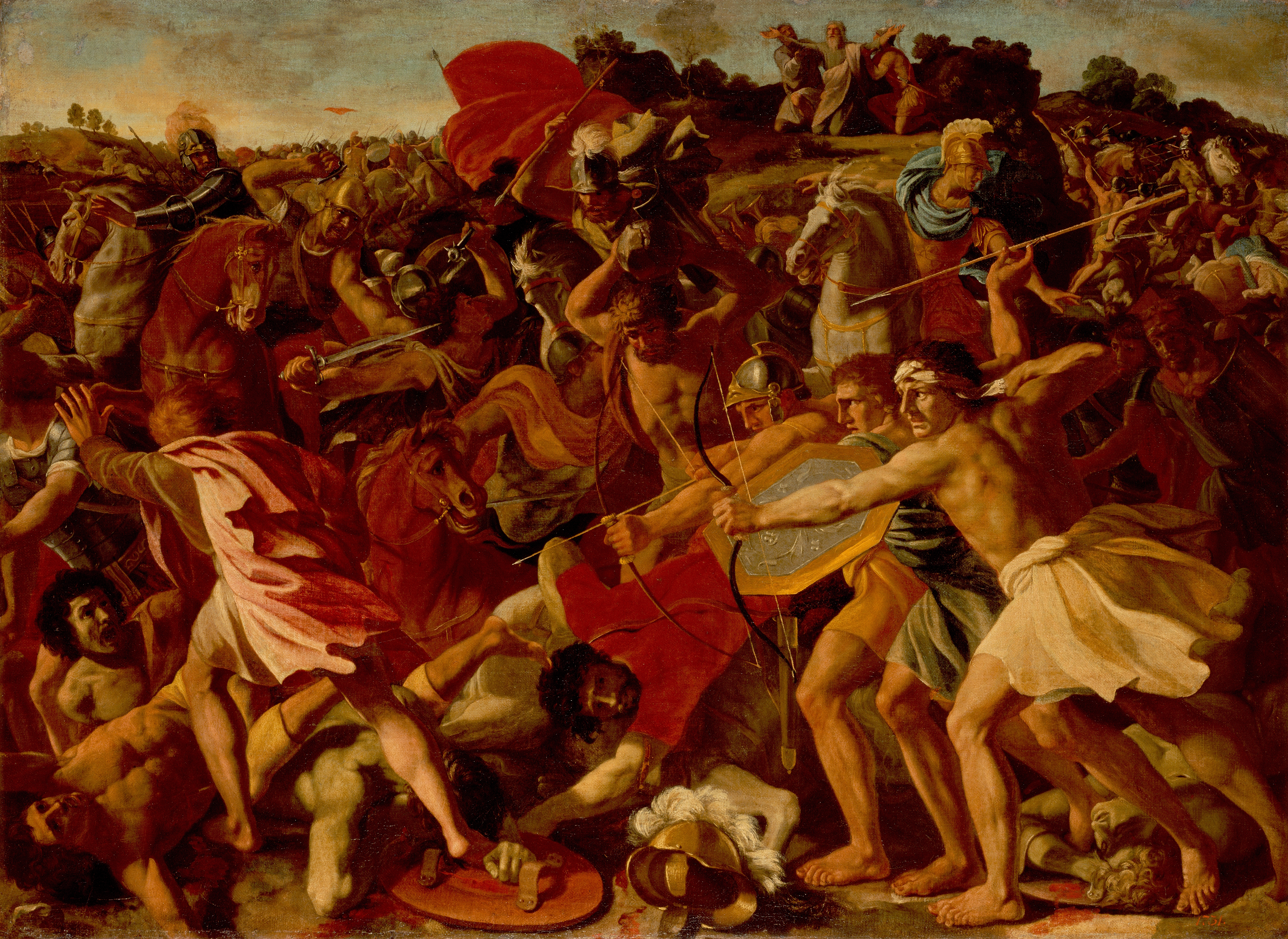
Quick Reflection on the Canaanites and the Two Gods

source: wikipedia.org
We have all heard it somewhere. There are two gods: the theatrical and distant God of the Old Testament and the warm, fuzzy God Who gave us Jesus in the New Testament. The God of the Old Testament is a distant Creator Who reigns down terror upon even the most remotely disobedient people while the New Testament God gave us His Son, the social revolutionary Who loves us all and will give us whatever we want. With such a conception of God(s), no wonder so many people read the Old Testament through foggy lenses.
The most commonly cited evidence in favor of this dichotomy between God as portrayed in the Old Testament and in the New is the massacre of the Canaanites by Joshua and the Israelites according to Divine directive (Deuteronomy 7). Many professional "apologists"—Catholic, Orthodox, and Protestant—have put in their two cents concerning the mass death that ensued. The explanation usually goes something like this: God made them and God is just, so whatever God wants to do to the Canaanites is in accord with Divine Law. For the believer a well constructed variation of this argument suffices. For the non-believer this is petrol for the rhetorical fire. And for those with troubled faith this line of reasoning solidifies distinction between the atavistic "Old Testament God" and the benign "New Testament God."
What follows is hardly an "explanation" of what happened with the Canaanites, but the Rad Trad's private reflection on the matter.

This Was Going to End Poorly Anyway

An Egyptian Christian today may be more conducive to believing that the God of Jesus Christ and the God of the Old Testament are One and the Same than an American Christian today. The first world is so accustomed to false violence and so removed from real death that we who reside in "civilized" nations lose sight of the struggles of ancient times which are so very much alive in the world today. We practice violence in Call of Duty video games and can barely deal with the death of an octogenarian grandmother. We live in great material comfort. Even America's poor are far better off than the middle and lower classes of most other countries. We are desensitized to violence. So how could we possibly understand the way in which God's providence could utilize violence over three millennia ago? The theoretical Egyptian Christian has never really lost sight of this reality which might be why, aside from compelled conversions to Islam, Middle Eastern Christians have maintained a traditional view of the faith.
Go back to roughly 1,500 BC (or BCE if you must—what happened in 0 CE I wonder?). The Israelites have been expelled from Egypt, are the religious riff raff of the Middle East, have lived on bread for four decades, dealt with desert plumbing, and endured numerous battles for their survival. This is a brutalized, not a civilized, people, and God must deal with them according to their own understanding. The newer Catechism cites St. Irenaeus (Adv. Haer. 3, 20, 2) in saying "The divine plan of Revelation is realized simultaneously 'by deeds and words which are intrinsically bound up with each other' and shed light on each another. It involves a specific divine pedagogy: God communicates himself to man gradually. He prepares him to welcome by stages the supernatural Revelation that is to culminate in the person and mission of the incarnate Word, Jesus Christ" (53). The Canaanites were not a particularly polite people either:
For those ancient inhabitants of thy holy land, whom thou didst abhor, because they did works hateful to thee by their sorceries, and wicked sacrifices, And those merciless murderers of their own children, and eaters of men' s bowels, and devourers of blood from the midst of thy consecration, from the midst of thy consecration: And those parents sacrificing with their own hands helpless souls, it was thy will to destroy by the hands of our parents, that the land which of all is most dear to thee might receive a worthy colony of the children of God. Yet even those thou sparedst as men, and didst send wasps, forerunners of thy host, to destroy them by little and little." (Wisdom 12:3-8)

Clearly the Canaanites and the Israelites lacked the qualities necessary to produce a multicultural paradise akin to the ones the United States has created in the Middle East. These peoples had no concept of peace as Christians do, much less "first world" Christians. Violence and death came into the world by sin, but in this instance God re-directed the use of violence toward a greater eventual good: the entrance of the Son of God into the world through the line of the rulers of this new kingdom, Israel. God made an enclave for Himself betwixt two very brutal societies. Omnipotent as He is, God elected not to create an immediate state of peace. Instead He wanted mankind to learn a lesson by participating in His work, much like a child who is taught how to do addition by his parent rather than by having his parent do the problem for him.
Modern, effete ears ignore God's plan of salvation for people and instead absolute their own post-modern standard and private values, then judge God—Who exists outside of time—and people from 3,500 years ago by those values. This is spiritually deranged and intellectually dishonest.
A violent outcome in a sinful world was inevitable. Our perspective makes that difficult to understand. And those who ignore this reality of sin bifurcate the God of salvation into the mean Old Testament God and the warm New Testament God.


What Would You Have Thought?

Given the probity for human sacrifice among the Canaanites the Israelites may have displayed very little reservation about wiping out entire communities. Perhaps a more modern and extreme example will aid us in seeing the difficulty of this matter. Hernán Cortés famously waged war against the Aztecs of the New World and accidently killed off the entire populace by importing European diseases to which the Spaniards had unknowingly acquired immunity. Cortés' journal records the horrors of Aztec human sacrifice, the ritual killing of men, women, and children in order to appease idols. Some estimate that the Aztecs sacrificed 20,000 people every year. The death of an entire populace at the hands of colonialists is an objective tragedy. Yet imagine yourself to be a more timid Spanish soldier who, for military or national purposes, found yourself accompanying Cortés on his voyage. You may very well have been mortified at the deaths of hundreds of thousands, maybe millions, of natives and still have felt less remorse than you would have if this had happened in any other place, given the horrors committed by those now dead. I myself do not know how I would have felt on Cortés' journey; likely I would have eructated throughout the venture.
Perhaps a future example might also be illustrative. Are Christians hypocritical for upholding peace and defending a God Who authorizes the death of an entire people? This is certainly an appealing line for some. But in light of how the Israelites viewed the Canaanites (and, according to the Scriptures, how God viewed them), consider this example. In Texas the state routinely executes a great many capital offenders every year. Texas is also one of the more religious states in the United States. If future generations outlaw the death penalty and switch to a methodology for "reforming" criminals will they think pious Texans hypocrites for executing murderers?
These examples are not meant to be absolute. One difficulty is that the Canaanites were a whole community, not individual offenders. These parallels are only meant for mild consideration.

Enduring Standards

One fact often neglected by those of us who in modern times judge Christianity for the massacre of the Canaanites is that the massacre was never set as a prescription or standard for future behavior. Given the ambitions of the Byzantine emperor, the two centuries of the Crusades, and the long string of religious wars there was plenty of opportunity to elevate the invasion of Canaan and the killing of its inhabitants to the status of expectation, but this was not done. Christians, and Jews, treated this as a unique event not to be repeated. This suggests both a discomfort with what happened and a belief that it was meant as a step toward Christ and not a standard for His followers.

Conclusion


This is a simple and non-systemic reflection, not a bit of apologetics. You know where to go for that sort of thing. I am, like many of you, a simple Catholic trying to understand the Scriptures. A conclusion to this post ought to be simple: the Old Testament points toward Christ and the fullness of revelation. The war against the Canaanites is no exception.