Showing posts with label St. John. Show all posts

Wednesday, January 27, 2016

A Sin Unto Death

Unrelated image.
Some recent discussions about the perceived duty of a Catholic to pray for and think the best of people in the midst of grave, public evils had me thinking of the first epistle of St. John. Particularly this passage in the fifth chapter:
If a man knows his brother to be guilty, yet not of such a sin as brings death with it, he should pray for him; and, at his request, life will be granted to the brother who is sinning, yet not fatally. There is a sin which kills; it is not over this that I bid him fall to prayer. (Knox trans.)
Does this mean we should not pray for certain kinds of sinners? As with so many other difficult passages, the commentary of Cornelius à Lapide is a useful guide, and I quote it below, with apologies for the length.

~

Ver. 16.—He who knows his brother to sin a sin not unto death, let him ask, and life shall begiven him for him that sinneth not unto death. (S. Ambrose, lib. 1 de Penitent. c. 9, and Tertullian, de Pudicit. c. 2, read, because he sinneth not to death.) There is a sin unto death, &c. Instead of I do not say, S. Augustine reads in this place, non præcipio, I do not command. He means, If any one knows his brother to commit any sin, let him pray for him, and God will give him repentance and forgiveness. I except, however, the sin unto death. If any one sins a sin unto death, I dare not promise, nor have any certain hope, that thou wilt obtain pardon for him. Yet I do not altogether forbid prayer in such a case. Pray if thou wilt, but with a doubt of obtaining.

You will ask, what is the sin unto death? 1st Tertullian (de pudicit. caps. 2 and 19) is of opinion from this passage that there are some sins, like those of the devils while they were yet in a state of probation, so deadly that they are absolutely irremissible in this life. Such a sin was adultery after baptism. But this is an error condemned in Scripture and the Lateran Council under Innocent III.

2d. Origen thinks it is a sin which leads to destruction, and drags down to hell.

3d. Surrianus (lib. 4 pro Epist. Epist. Pont. c. 3) thinks it is a sin which involves excommunication. For an excommunicate person is impenitent. And it is not lawful to pray for one excommunicate in the public prayers of the Church. But S. John is speaking of any kind of prayer, even in private.

4th. S. Augustine (lib. 1 in Serm. Dom.) thought it was the sin of envy, by which any one envies his brother’s grace, virtue, and salvation. But this opinion S. Augustine afterwards modified and retracted.

5th. The same S. Augustine (lib. de corrept. et grat. c. 12) and many others think it is the sin in which any one perseveres unto death. Lorinus thinks that it is the sin of hatred and murder. Others think it means the sins of the reprobate, and of those who will be damned. But it is uncertain who and what those are. Yet S. John says, he who knows his brother sin a sin not onto death.

6th. The Gloss supposes it to be a mortal sin. For to pray for such sins is the duty ex officio, so to say, of the Priest alone. But for venial sins any layman whatever may pray. But what S. John says is opposed to this, for he intimates that he is speaking, not of venial, but of mortal sins, and subjoins, “life shall be given him.”

7th.  S. Jerome (in cap. 14 Jerem.) thinks it is some very grave sin which God has determined to punish. “For he who once,” saith be, “hath been devoted to the sword, or famine, or pestilence, cannot be delivered by any prayers. Wherefore it was said to the Prophet that he should not ask in vain what he could not obtain.”

8th. Dionysius thinks it is the sin of final impenitence. Wherefore the Bishop of Rochester (Art. 17 cont. Luther) proves the doctrine of Purgatory from this passage. For S. John says we are to pray for those who are not finally impenitent, that is, who depart in a state of justification or repentance. And this surely implies prayer that they be delivered from Purgatory.

9th. Anastasius Niceenus thinks it is a sin against God, such as blasphemy, concerning which it is said (1 Sam. ii. 25), “If a man sin against God, who shall pray for him?”

10th. Gagneius thinks it is the sin of apostasy and infidelity, by which any one falls from the faith into heresy or idolatry.

11th.  S. Hilary (in Ps. cxl.) thinks it is the sin which any one commits of set purpose and malice.

12th. S. Ambrose thinks (lib. 1 de Pen. c. 8) it is every very grave sin which is remitted with difficulty.

Most of these opinions are true, and partly explain, but few touch the exact point of the difficulty.

My own opinion is, that the sin unto death is every very grave sin which, either on account of its enormity or long habit, obstinacy or malice, is irremediable according to the ordinary rule of grace which God gives. Such was the sin of Judas in betraying Christ. It was sin unto death because of its enormity; and incorrigible, because of his obstinate persistence in it. So too the sin of the Jews in blasphemy and slaying Christ was a sin unto death, because so heinous and persisted in. Therefore the sin unto death is a chronic and irremediable one, the pardon of which is despaired of, and which so provokes the wrath of God that the ordinary prayers of the saints cannot pacify it, and one therefore which with absolute certainty brings the sinner to the destruction of hell, unless some especially eminent saint, like another Moses, obtains for him from God extraordinary grace and forgiveness. This sin unto death is as if a physician was summoned to a sick man, and after examining, him were to say, I cannot heal him, he is sick unto death, the vital parts are mortifying. In like manner, says S. John, when a Christian sees a heretic and an apostate, let him say, I should not dare to pray for him, he is sinning unto death. His vitality is gone. He casts away faith, which is the principle of spiritual life. This is the mind and general opinion of S. Augustine and Jerome, Origen, Bernard, Bonaventura, S. Thomas, and many others. There is a reference to the words of Christ to the Jews (John viii 21 and 24), “I go away, and ye shall seek Me, and shall die in your sin.” From which passage we gather that though the sin unto death be of various and multiform kinds, as impenitence, obstinacy, determination to persevere in any sin until death, and so on, yet strictly by the sin unto death S. John understands and intends a sin by which a Christian departs from the faith and Church of Christ, and maliciously attacks them, and strives to draw others away into his own heresy, or idolatry. This was what some were doing in S. John’s time, to his great fear and grief. Wherefore, in order to deter the faithful from being led away, he calls such persons sinners unto death.

There is a reference to such passages as Jer. xvii. 1, “The sin of Judah is written with an iron stylus, in an adamantine nail, it is ploughed deep upon the breadth of their heart.” (Vulg.) On which verse S. Gregory says, “The finger-nail is the extremity of the body: but the diamond is so hard a stone that it cannot be cut with iron. Now by the iron style is signified the strong sentence, but by the adamantine nail the eternal result. Therefore the sin of Judah is said to be written with an iron stylus in an adamantine nail, because the offence of the Jews by the strong sentence of God is reserved for an eternal end.”

By this sin a man opposes himself directly to Christ, from whom is the only hope of salvation. He drives Him from him, yea he blasphemes Him by whom alone he can be healed. So the disease is said to be incurable which does not admit of food or medicine. Whence S. Paul saith to the Hebrews (vi. 4-6), “For it is impossible for those who were once enlightened,” &c.

From what has been said it is plain that the sin unto death is distinguished from blasphemy against the Spirit, spoken of in S. Matt. xii. 21, although it is akin to it. Christ calls the sin of the Scribes blasphemy against the Holy Ghost, because they ascribed His Divine works, such as the casting out devils, which He did by the power of the Holy Ghost, to an unclean spirit. And they did this knowingly and maliciously, because they might and ought easily have known that those works were wrought by the Holy Ghost, and not by a devil. Christ opposes such blasphemy against the Holy Spirit of God to blasphemy against the Son of Man, by which some who were offended at the human conversation and condescension of Christ calumniated His actions as man. They called him a wine-bibber, a friend of publicans and sinners. And this was a less and therefore more easily remissible sin. But as the sin spoken of in S. Matthew was the blasphemy against the Holy Ghost, so here the sin unto death is blasphemy and treachery against Christ. And both one and the other are with difficulty remitted.

This sin is not to be healed by any one but by Christ alone. For such a sinner is like unto Lazarus, of whom Martha said unto Christ, “Lord, by this time he stinketh, for he has been buried four days.” Wherefore Jesus, with great effort, weeping and lifting up His eyes to heaven, and crying with a loud voice, “Lazarus, come forth!” raiseth him again to life.

I do not say that any one should pray for it. Thus the Greek and Latin.  S. Gregory has a reading, that any one should pray for him. The meaning is, I do not forbid prayer for such, but I dare not promise that the prayer will be answered. For often God will not hear those who pray on behalf of the sin unto death, according to the words in Jeremiah, vii. 16, “Pray not thou for this people, for I will not hear thee.”

S. Bernard says (de Grad. Humil. cap. ult.), “The Apostle John says, for such a one I do not say that any one should pray. But dost thou say, O Apostle, that any one should despair? Indeed let him who loves him groan. Though he may not persume to pray, yet let him weep. Thus Martha and the Magdalen wept the death of Lazarus, and by weeping obtained his resurrection.”


Saturday, May 3, 2014

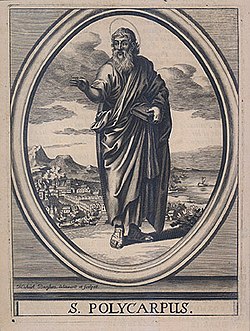
Lesser Known Fathers IX: St. Polycarp and the Philippians

Given the "proof text" approach of many Catholic apologists today, using the writings of the Apostolic and Church Fathers against protestants, only certain Fathers are read. St. Justin the Martyr is useful in "proving" the Eucharist. St. Ignatius of Antioch is useful in "proving" the idea of the Catholic Church. St. Cyprian is useful in "proving" the papacy. Yet what of great Fathers who are not so easily weaponized? Today they are forgotten by those who call nineteen century old writers to arms against Legion and his megachurches, but they are not forgotten by all. Some of us still find edification in the pastoral writings of the Fathers, as much so as in the doctrinal writings of other Fathers. One such Father who I find fascinating is St. Polycarp of Smyrna.

According to tradition Polycarp was taught by "St. John," who ordained him a bishop of the city of Smyrna. I put John in quotations because a few dispute whether his teacher was John the Apostle—writer of the Johannine Gospel, the first epistle of John, and the Apocalypse—or whether it was John the Presbyter—likely writer of the second and third epistles of John. Polycarp, who lived until the mid-second century, is remembered in his surviving letter to the Church at Philippi, where St. Paul "accurately and steadfastly taught the word of truth in the presence of whose who were then alive" (Ch. 3). The epistle is an exhortation to the laity and clergy to ignore the worldly temptations which have seduced some of the church and to return to the faith given to them by Paul and Ignatius. At some point Polycarp visited St. Anicetus, a fellow Syrian and at the time Pope of Rome. He fell asleep in the Lord in 155.

The epistle begins with a veritable Pauline greeting: "Polycarp, and the presbyters with him, to the Church of God sojourning at Philippi: Mercy to you, and peace from God Almighty, and from the Lord Jesus Christ, our Savior, be multiplied." The tone establishes that this missive has a personal connotation and not a formal one. He is acquainted with these believers and greets them in the spirit rather than in social respect.

The saint initiates the body of his letter with a reminder of that church's sufferings, "diadems of the true elect of God and our Lord." Mere works do not save, but faith. How is suffering not a "work?" Are the Christians of today to read Polycarp and surrender to the modern dichotomy between "faith" and "works?" This is not what the saint means: "[know] that by grace you are saved, not of work, but by the will of God" (Ch. 1) and "But He who raised [Jesus] up from the dead will raise up us also, if we do his will, and walk in His commandments, and love what He loved" (Ch. 2). One is saved by the will of God, not personal merit. Yet if one loves God one is united to the will of God and does what He wishes out of love for God—what we now call Sanctification or Theosis. This holiness in which one unites to the will of God is found in suffering, for Christ "suffered for own sins unto death" (Ch. 1) that "we might live in Him" (Ch. 8, 1 John 4:9). One does not suffer alone for Christ. The Christian suffers with Him as did the Apostles, who are "in their due place in the presence of the Lord, with whom also they suffered" (Ch. 9).

This same call to virtue displays ante-Nicene Trinitarianism. St. Polycarp establishes order and communion between "God" and the Son "Jesus Christ." The separation of the two persons of the Trinity as "God" and "Jesus" should not trouble us, as this terminology survives in the traditional Roman and the Byzantine liturgies, wherein God the Father is sparingly called "Father" directly, indeed perhaps only in the Our Father. "God" raised Jesus, glorified Him, sat Christ at His right hand, and gave Him the power of judgment; all these things are proper to the Godhead. Polycarp is using the ante-Nicene vocabulary for talking about the Divine inherited from the Jews which survives in the Church's liturgical life.

Chapter four opens with a famous aphorism, "But the love of money is the root of all evils." From here Polycarp gently indicts the priests, deacons, and laity of the church for losing their focus and then tries to re-direct this wayward church. What utility, the saint questions, is to be found in alternatives to virtue or the presentation of false virtue? God "clearly perceives all things, and that nothing is hid from Him, neither reasonings, nor reflections, nor any one of the secret things of the heart" (Ch. 4). God is not mocked, even in private. The saint gives a general warning against various kinds of that most powerful kinds of private sin, the sexual:
"For it is well that they should be cut off from the lusts that are in the world, since every lust wars against the spirit; and neither fornicators, nor effeminate, nor abusers of themselves with mankind [doesn't sound terribly fond of gay marriage] shall inherit the kingdom of God, nor those who do things inconsistent and unbecoming. Wherefore, it is needful to abstain from all these things, being subject to the presbyter and deacons, as unto God and Christ. The virgins also must walk in a blameless and pure conscience." (Ch. 5)
Sexuality is not necessarily a bad thing. Indeed it is quite good. The chastity outlined negatively above is one found in behaving according to one's place in life.

Perhaps priests would do well to read this letter particularly the sixth chapter, which outlines the saint's expectations of the presbyters and other clergy of the Church:
"Let the presbyters be compassionate and merciful to all, bringing back those that wander, visiting all the sick, and not neglecting the widow, the orphan, or the poor, but always providing for that which is becoming in the sight of God and man.... If then we entreat the Lord to forgive us, we ought also ourselves to forgive; for we are before the eyes of our Lord and God, and we must all appear at the judgment seat of Christ, and must every one give an account of himself. Let us then serve Him in fear, and with all reverence, even as He Himself has commanded us, and as did the apostles who preached the Gospel unto us, and the prophets who proclaimed beforehand the coming of the Lord."
In short, the priest is the fearful instrument of Christ God's mercy. The end.

Polycarp places the greatest emphasis of faith on the Resurrection and Last Judgement. Here is the strongest insight yet into how the early Church believed. Christ was the first fruit of His own work, a work from which we shall in time benefit or suffer from abusing. Reality in changed by this one event, the rising of a man—Who is God—from the dead. We are partakers in that Resurrection and will be held to account for it. Those who deny this are the "first born of Satan" (Ch. 7). Oh how does this concept of death survive for us today in the Requiem Mass of All Souls' Day! In the epistle of that Mass St. Paul warns the Corinthians that those who lived in Christ will come to the "resurrection of life," but that those who did evil will awake in the "resurrection of judgment." Death and judgment. Could any two topics be less popular? In my own family mention of either is tantamount to scandal.


After another exhortation to virtue St. Polycarp writes harsh words that should carry weight with every Catholic who sins in public, who dissents from the Church in public, and who does not practice virtue: "Be all of you subject one to another having your conduct blameless among the Gentiles, that you may both receive praise for your good works, and the Lord may not be blasphemed through you. But woe to him by whom the name of the Lord is blasphemed! Teach, therefore, sobriety to all, and manifest it also in your own conduct" (Ch. 10). 

The author winds down his letter in lamentation, regretting the loss of the priest Valens and his wife to bad faith. Evidently they fell in matters of "covetousness." Polycarp finds the loss of the two particularly painful given St. Paul's praise for the church of Philippi. He begs the Philippians not to be too harsh on Valens and his wife: "And be then moderate in regard to this matter, and do not count such as enemies, but call them back as suffering and straying members, that you may save your whole body. For by so acting you shall edify yourselves" (Ch. 11).

The saint concludes in telling the Philippians that he is sending copies of St. Ignatius of Antioch's epistles with the messenger and even divulges the name of the scribe who wrote the letter, a man named Crescens, who will pay the Philippian Christians a visit with his sister! Personally I find the human elements of these letters calming, as I do in the Pauline epistles. Modern readers can read these ancient texts and think them remote, saccharine, or even impossible. These letters were written by and for people who, like we today, must run our course in the faith and do so with the same union to the will of God and the same humility to which Polycarp exhorted the church of Philippi.

Interesting Historical Notes


  • Although a disciple of St. John, he rarely quotes John in this letter. The few times he does refer to John, such as in Chapter 8, are in reference to union with God—Theosis—indicating that this is a trait of the Johannine tradition. Also, in light of this, I would side with those who say Polycarp's John was the Evangelist and not the Presbyter.
  • He is very familiar with most all of the Pauline letters and quotes them more than any other text considered Scripture. He especially favors Philippians, Galatians, Timothy, and Ephesians. This indicates that Paul's letters, which most now agree were written in the 50s, had been in wide circulation beyond the local churches for quite some time.
  • Again, despite being from the Johannine tradition, Polycarp refers exclusively—at least in this sole surviving letter—to the Gospel according to St. Matthew and occasionally to St. Luke's account. These references are most often made to the Sermon on the Mount. The implications of this should be problematic to 20th century Biblical scholars who seek to drive a wedge between the Johannine tradition and the Synoptic texts. Evidently the bishop of Smyrna, a follower of John, saw no conflict or incongruity between the Synoptic narrative and the one he received. This could be explained by a theory that the account in St. John's Gospel draws to attention not a different Christ or different tradition, but different events and teachings not mentioned in the Synoptics. There is one Gospel and four accounts of it.
From this I think we must conclude that the New Testament texts were more broadly circulated and more widely accepted than we often realize.

Happy feast of the Invention of the Holy Cross!

Friday, March 29, 2013

Good Friday: Mass of the Pre-Sanctified

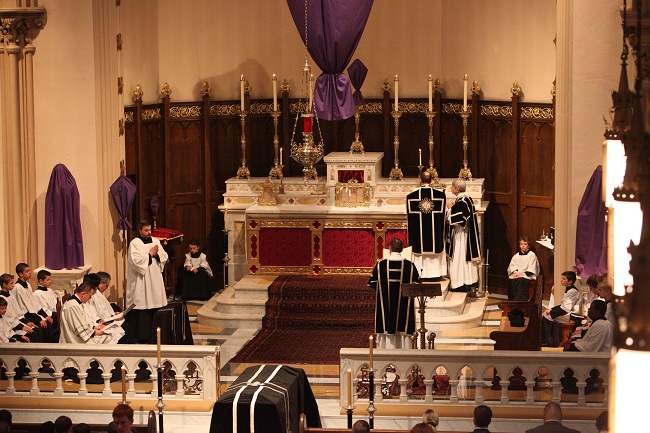
I will endeavor to give a very brief explanation of the old, pre-1956, Good Friday "Mass of the Pre-Sanctified." The name is such because the structure, vestments, music, and prayers of this services, particularly towards the end, follow the structure of a Mass, although using a Host consecrated at yesterday's Mandy Thursday Mass.


The priest and his two deacons, who wear folded chasubles rather than dalmatics, prostrate themselves before the altar for enough time to pray psalm 50, the Miserere, in silence, while servers spread a cloth on the altar. Like at Mass, the crucifix and candles remain on the altar, though unlit.


A lector sings a prophecy of the prophet Osee (or Hosea, in the Hebrew spelling), which foretells the suffering, burial, and third day rising of Christ. Then the subdeacon sings chapter 12 of the book of Exodus, which recounts the manner in which the finest lambs were killed during the first Passover in Egypt. This sacrifice liberated the Israelites from the bondage of the Pharoah. The sacrifice of the perfect victim, Christ, liberated the world from the bondage of death. God does not want a sacrifice because He wants things to be destroyed. A true sacrifice is the gift of what is precious to one's self unto another. This was the intent of the Israelites in Egypt, and more so on the Cross. A tract, psalm 139, is sung: Eripe me Domine ab homine malo—"Deliver me, Oh Lord, from the wicked man!"


Three deacons then sing the Passion of our Lord Jesus Christ according to St. John, beginning with His arrest in the Garden and ending just after His death on the Cross. The deacon of the "Mass" removes his folded chasuble, as at Mass, and sings the burial of Christ as the Gospel, suggesting that this, not the general narrative, is the most important text of the day.


Priest and subdeacon listen to the Passion.


Then deacon, now wearing the "broad stole," returns to the other ministers. Returning to the epistle corner, the priest sings the Solemn Collects, some of the oldest continuously used prayers in the Church. Moreover, these prayers give us some indication as to what the structure of the Mass was like in the mid-first millennium and for what those Christians prayed. There is a preface to announce the prayer intention, followed by Oremus—"let us pray," Flectamus genua—"Let us kneel," and Levate—"Let us stand" before the actual prayer itself.


The prayer intentions were:
  • For the welfare of the Church universal
  • For the Pope
  • For the clergy, people in religious life, virgins, and widows
  • For the enlightenment of the catechumens and the remission of their sins
  • For the cleansing of the world of errors
  • For the rescue of heretics and schismatics
  • For the conversion of the Jews
  • For the end of idolatry and conversion of the pagans
No genuflection was made during the prayer for the Jews. A genuflection was added by Pope John XXIII in the revised rite of Holy Week in 1959, although John XXIII seems to have continued to celebrate the old Good Friday in the Sistine Chapel!


The ministers, probably for mobility in ancient times, remove their outer-most vestments and the deacon retrieves the veiled crucifix from the altar and gives it to the priest. The priest, beginning at the bottom of the epistle side, steps higher and towards the center of the altar, unveiling part of the crucifix and singing Ecce lignum crucis—"Behold the wood of the cross"—as he rises. The people respond In quo salus mundi pependit. Venite, adoremus!—"On which hung the salvation of the world. Come, let us adore!"

This happens three times, after which the entire crucifix is visible. It is then laid upon a pillow or cloth and adored by the people. First the priest, then the ministers of the service, then any other present clergy, and the servers. They all adore barefoot. Then the congregation adores, making three prostrations before their kiss of the cross.


Although the Mass of the Pre-Sanctified supposedly died in 1956 under Pope Pius XII, John XXIII continued to use it in the Sistine Chapel, as seen in this 1959 celebration.


Ecce lingum crucis, in quo salus mundi pependit.


Venite, adoremus!


Whilst the laity make their adoration, the altar is prepared for the Mass of the Pre-Sanctified and the choir sings the Reproaches, which includes the Trisagion.

The crucifix is then placed upon the altar, where it would normally go, and is reverenced with a genuflection for the rest of the day.


The clergy, and laity if they wish, process to the altar of repose, where the Blessed Sacrament has been over night.


The Sacrament is then incensed by the priest, who assumes the hummeral veil and takes the Sacrament back to the main altar.


This is a full Blessed Sacrament procession, with incense and the processional cross carried before the priest and the Sacrament. The great hymn Vexilla Regis is sung.


The procession returns to the main altar.


The deacon arranges the chalice and its veil, containing the Sacrament, as it would be at Mass.


The Blessed Sacrament is then incensed by the celebrant.


The subdeacon prepares the chalice with wine and water, as he would at Mass and the "Gifts" are incensed in the same way they would have been at a regular Mass. The priest turns to the people and says the Orate, fratres... ("Pray, brethren, that my sacrifice and yours....) as at Mass.

One English friend of mine always insisted that the Mass of the Pre-Sanctified is indeed an actual Mass. He had something of a point. Its prayers are those of a Mass. It is not a simple communion service. Although there is no consecration of the Host, the actions imitate those of a Mass in order to emphasize the relation between the Mass and Calvary, that they are one and the same sacrifice of Christ.


The celebrant then sings the Pater Noster, "Our Father," and elevates the Host for public adoration as he would after consecration at Mass. He then fractures the Host as at Mass and mingles a fragment of the Blessed Sacrament with wine. Liturgical reformers particularly disliked the pious medieval belief that the fragment consecrated the wine into the blood of Christ (which Eastern Catholics and Eastern Orthodox still believe).


The priest then says the communion prayers of Mass and consumes the Host as normal. He consumes the chalice's contents saying nothing, leaving some mystery as to whether consecration occurred or not!

The priest purifies his fingers and the subdeacon cleans the chalice as normal at Mass.

Vespers, the same as yesterday except for the addition of mortem autem crucis ("even unto death on a cross") to versicle, are chanted in a monotone immediately.

The clergy then leave in silence.

This marvelous rite was replaced with a general communion services. The revised rites, from 1956 until 1969, involved a maddening three changes of vestments. Prayers and readings, in both the 1956 rite and the Pauline rite, take place at the chair, the altar, at a podium, and any where else you can find. Odd.

A blessed Good Friday to you all.