Tuesday, July 16, 2013

Western Orthodoxy?

A supposed celebration of Sarum by a Western
Orthodox priest. source: allmercifulsaviour.com
The Rad Trad recently had an interesting exchange over the Sarum Use in a previous post on local liturgical practices that fell away at Trent. At one point we touched on the anachronistic adaptation of a modified Sarum liturgy and a modified Roman liturgy by the Orthodox patriarchates of Antioch and Russia respectively. The experiment, which the Rad Trad believes to be aimed at Old Catholics and Anglicans, has ended in the Russian Church at least, according to the blogger John Ad Orientem. Glancing at the more informative comments, the Western Orthodox try was plagued with episcopal scandals and poor judgment in ordinations. One priest below laments having the celebrate the "arid" Roman rite for pre-Vatican II pseudo-Catholics rather than the rite of Chrysostom.

Most commentators lament the death of the Western endeavor and urge converts to embrace the Eastern liturgy rather than the Russian version of Anglicanorum Coetibus. One poster, the Catholic Gregory DeLassus, asks what this means for ancient Roman saints? Does it mean to be Orthodox means to be Greek or Russian or Egyptian? Here I see some wisdom in the Eastern Catholic Churches, which entered communion with Rome as entire communities and as they were—Latinizations usually coming later at the behest of Franciscan friars or self-imposition. Since the 1950s the Eastern Catholics have undergone a heavy de-Latinzation, casting away such foreign practices as Benediction, Roman vestments, and use of hosts for the Eucharist, a process by and large successful.

The closure of this chapter of the Western experiment for the Russian Orthodox reveals how difficult the Great Commission really is to fulfill. What is essential? What is Traditional? What is cultural? The Church must be available to all, but within the reasonable confines of the faith.


Sunday, July 14, 2013

Divine Office Primer

Your very own Rad Trad, one in the interminable and ever-growing plethora of internet "liturgists," has just begun plugging through Msgr. Pierre Batiffol's History of the Roman Breviary, first published in 1893 and re-published in 1895 and 1913—the latter with a new conclusion after the 1911-1913 Office reforms. The Rad Trad realizes that the work's integrity is over a century old and probably somewhat dated, but that does not mean it is without merit or value today. The first chapter has a very nice patristic overview of the origins of the various hours of the Divine Office, both in their timing and in their contents. Msgr. Batiffol covers the ancient practice of nocturnal vigils (hence where we get the term "nocturne" for the segments of Mattins) and the later coming of Vespers and Lauds. Sacred architecture and vast public worship spaces gave rise to antiphonal and metric singing as well as concluding doxologies (Gloria Patri et Filio....), replacing the pre-313 days of a solitary lector reciting a psalm at a time. Public piety and the eagerness of virgins and ascetics to pray throughout the day wrought Terce, Sext, and None. These people later became monks and, finding periods of free time between the daytime and nighttime prayers, began to slacken their discipline. Compline and Prime filled that free time. The succeeding chapter are similarly interesting. Best of all the History of the Roman Breviary is in the public domain and free for pdf download here! Take a look. 

A Prophet for Our Times

"The literary cabal had some years ago formed something like a regular plan for the destruction of the Christian religion. This object they pursued with a degree of zeal which hitherto had been discovered only in the propagators of some system of piety. They were possessed with a spirit of proselytism in the most fanatical degree; and from thence, by an easy progress, with the spirit of persecution according of their means. What was not to be done towards their great end by any direct or immediate act, might be wrought by a longer process through the medium of opinion. To command that opinion, the first step is to establish a dominion over those who direct it. They contrived to possess themselves, with great method and perseverance, of all the avenues to literary fame. Many of them indeed stood high in the ranks of literature and science. The world had done them justice; and in favour of general talents forgave the evil tendency of their peculiar principles. This was true liberality; which they returned by endeavouring to confine the reputation of sense, learning, and taste to themselves of their followers. I will venture to say that this narrow, exclusive spirit has not been less prejudicial to literate and to taste, than to morals and true philosophy. These Atheistical father have a bigotry of their own; and they have learnt to talk against monks with the spirit of a monk. But in some things they are men of the world. The resources of intrigue are called in to supply the defects of argument and wit. To this system of literary monopoly was joined an unremitting industry to blacken and discredit in every war, and every means, all those who did not hold to their faction. To those who have observed the spirit of their conduct, it has long been clear that nothing was wanted but the power of carrying the intolerance of the tongue and of the pen into a persecution which would strike at property, liberty, and life."—Edmund Burke, Reflections on the Revolution in France

Thursday, July 11, 2013

From the 1945 Psalter

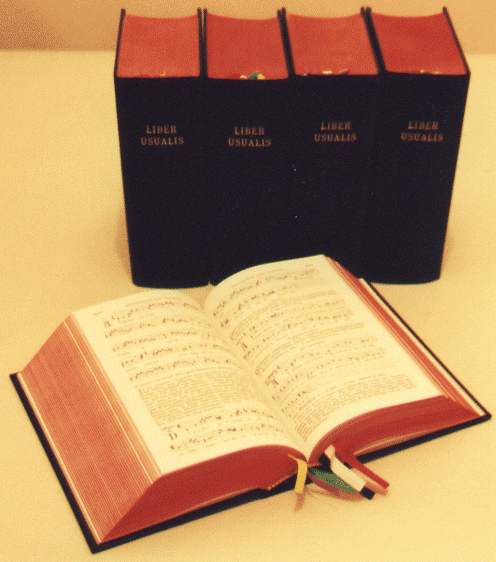
The Rad Trad found himself reading his 1961 edition of the Liber Usualis for the first time in a few months. His copy, printed at St. John's Abbey for Americans, contains an appendix with the revised psalms published by Pius XII in 1945 and with the caveat that they are for Holy Week. The Rad Trad randomly decided to compare psalm 109 to the Vulgate original. He did not like what he saw. Although not a capable singer himself, the Rad Trad wondered how anyone could possibly sing, let alone pray, this thing.
1. Dixit Dominus Domino meo: Sede a dextris meis, donec ponam inimicos tuos scabellum pedum tuorum,
2. Sceptrum potentiae tuae protendet Dominus ex Sion: Dominare in medio inimicorum tuorum!
3. Tecum principatus die ortus tui in splendore sanctitatis: ante luciferum, tamquam rorem, genui te.
4. Juravit Dominus et non paenetibut eum: Tu es sacerdos in aeternum secundum ordinem Melchisedech.
5. Dominus a dextris tuis: conteret die irae suae reges.
6. Judicabit nationes, acervabit cadavera; conteret capita late per terram.
7. De torrente in via bibet, propetera extollet caput.
Thank goodness Pope John XXIII returned to the Vulgate version!

Wednesday, July 10, 2013

Pius XII Re-Considered UPDATED

source: sipastorangelicvs.blogspot.com
"He was glorious, ol' Pius was!" recalled the porter of the lodge of the Oxford Oratory to me one night several years back. Those who remember Eugenio Pacelli tend to think of him as either the last great pope before the cruel hammer of Vatican II smashed the glass Church into shards or as a spiritual jailer from whom the Council freed us. When one thinks of Pope Pius XII the mind naturally travels to images of the native Roman Pontiff waiving to enthralled crowds from the sedia gestatoria or him wearing the tiara with pious solemnity. What everyone often forgets is who he was and what he did. Perhaps no pope in centuries is as misunderstood and inaccurately remembered as Pope Pius XII. History may be very kind or very harsh to him, but that does not preclude our contemporary endeavor to evaluate his time atop the Petrine chair with greater scrutiny than previous generations.

First, we should get the Holocaust story out of the way. Pius XII was not Hitler's pope nor was he anti-Semitic. On the contrary, one would be hard pressed to find anyone since Moses who did as much for the Jews as Pius XII. Many compare his quiet approach to Nazism during World War II with his predecessor's more visible opposition to Nazism and Fascism, ignoring that Pacelli engineered Pius XI's foreign policy as Secretariat of State for the Vatican. As Pius XII Pacelli undercut Nazi deportation attempts in Poland, France, and Italy by delaying trains and applying pressure to local authorities through the Church's prestige. More locally he ordered the churches, monasteries, and convents of Rome to house whatever Jews approached seeking refuge. His very own Castel Gandolfo housed 3,000 Jews on the run from the Nazi occupants. Hitler found Pius so loathsome he at one point considered an assassination. Pius XII and the Church emerged from the Second World War with tremendous prestige and popular approval for combating Nazi efforts. The chief rabbi of Rome, Israel Zolli, converted to Catholicism and took Eugene as his baptismal name in honor of Papa Pacelli. Golda Meir and Leonard Bernstein (who as a secular Jewish bisexual would be as far from Catholicism as London from the ISS) expressed deep sorrow when Pius XII died in 1958. His reputation did not suffer until 1963 when playwright Rolf Hochhuth wrote The Deputy, a historically imaginative bit of nonsense wherein Pius XII daydreams about the Vatican's banking issues whilst his staff cry over the sufferings of the Jewish people of Europe. Without carrying on too much concerning Pius XII's efforts between 1939 and 1944, it suffices to say that his efforts saved many Jewish lives and the people of his time recognized this.

source: angeluspress.org
Yet we can say this was Pius XII the diplomat and Pius XII the humanitarian. What of Pius XII the pope? Again, many see Pius XII as a staunch conservative in all matters and the last pontiff of a particular age. Like him or not, little could be further from the truth. Pius XII was certainly not a liberal, but he was no staunch conservative either. The best term the Rad Trad can find to describe this pope is "modernizer." His papacy was a bridge between the declining ultramontanist mood after Vatican I and the budging urge to engage directly with the non-Catholic world which triumphed at Vatican II.

Consider his personality. The cult of personality that surrounds Pope Francis did not begin with John Paul II in 1979, when he first started to travel. It began during the reign of Pius XII, whose charisma and charm made him a powerful personality at a time when television and radio began to supplant newspapers as the primary means of transmitting information. His waves, smiles, rolling voice, and other dramatic gestures rival those of Churchill, Hitler, Mussolini, and Roosevelt. Outwardly he looked like everything an optimistic, post-War, Papa-centric Church could want in a leader. He was  the product they demanded.

Next, think about the influence of his pontificate on centralization. After his election, Pacelli appointed Luigi Cardinal Maglione as Secretariat of State. After Maglione's death, the Pope absorbed the secretary's duties into the Papacy, making the him both a spiritual leader and a visible political player in the new media age. It also meant that the Pope had very direct dealings with bishops throughout the world, who, though they had the right to meet with the Pope before Pius XII, would normally interact with the Vatican through the Secretariat's office. Consequentially, the Papacy, not just the Vatican, became an administrative, political, and spiritual center for governments and dioceses. The Pope, in Mystici Corporis in 1942, went as far as to state that bishops receive their power not from the Church, generally speaking, but from the Roman Pontiff (cf. Mystici Corporis, 42). Cardinal Ottaviani stated that this was infallible. Whether it is or not is not our purpose here. The point is that Pius XII centralized not just spiritual dignity, but political power around the Holy See.

Yet Papal prestige was not enough to efface the blossoming power of liberal factions, particularly in secular universities and in religious orders. Men like Jesuit Karl Rahner lost very little sympathy among his fan base after the publication of Mystici Corporis and perhaps even gained an excitement factor that made his ideas all the more potent two decades later.

Can you imagine the diffusion of the "Spirit of Vatican II" without the "Spirit of Pius XII?" I cannot. Pius XII's governing style was not an immediate cause of the "Spirit of Vatican II," but it was certainly a necessary cause. The cardinals and bishops who went along with the changes in liturgy, Church policies, and attitude did so because they thought Rome wanted it. Is it any coincidence that most of these cardinals and bishops were appointed by Pius XII, not Paul VI or John XXIII?

Pope Pius also re-introduced some Eastern elements of thought into Rome. First the de-Latinization process in Eastern Catholic Churches began not with the Conciliar document Orientalium Ecclesiarum, but a decade earlier. The aforementioned Mystici Corporis, although brimming with statements of Papal  supremacy (42, 44, 50, 69, 91), incorporates a very Eastern and organic approach to defining the Church, returning to St. Paul's statements that the Church is the "Body of Christ" (15) visible on earth, that Christ is the Head through which grace flows, that the Church is not entirely about hierarchy (17), that the Sacraments nourish the Body (18-19), that Baptism does not just wipe out Original Sin but actually incorporates one into the Body of Christ (26), and that the Holy Ghost is the soul of the Church (31). At one point Pius even quotes St. Gregory of Nyssa's Life of Moses in bluntly equating the Church with Christ (53). The Rad Trad can hardly imagine Pius IX referencing a then-obscure Eastern Father. The Western fascination with the East, seemingly in everything save liturgy, was just beginning when the Pope published this encyclical.

Lastly there was Pope Pacelli's novel liturgical moves. Saturday night Masses substituting for Sunday worship, lay people reading at Mass, shortened Eucharistic fasts, excessive singing of hymns, and lay people speaking the priest's parts did not begin in the 1960s, but under Pius XII in a series of liturgical innovations meant to make the liturgy more accessible. If the Rad Trad is forgetting something, perhaps the more knowledgeable Rubricarius can chime in below. Above all, Pius XII assembled the team of reformers that would make the liturgical overhaul of the 1960s happen. They began their work under Papa Pacelli's patronage in 1948. Some remove blame for the liturgical novelties of the 1950s from Pius XII for health reasons; his health declined quickly after the War. Still, Pius XII was, if anything, a powerful and competent administrator. Under Pius XII a new Common of Popes was introduced, as was a new Holy Saturday liturgy in 1951 and again in 1952, a brand new Holy Week came out in 1955—the same year most octaves were eliminated and semi-doubles merged with simples and doubles, and the commemoration system was reduced in 1958. The liturgy of Vatican II c.1965 only differed in the suppression of Prime and the introduction of more vernacular in Mass. Eugene Pacelli was, beyond dispute, a very progressive pope in liturgical matters. As Pope Paul VI wrote in his Constitution Missale Romanum: "The beginning of this renewal was the work of Our predecessor, this same Pius XII, in the restoration of the Paschal Vigil and of the Holy Week Rite, which formed the first stage of updating the Roman Missal for the present-day mentality."

The Rad Trad lacks a formal opinion on Pope Pius XII. He did a lot to save lives during World War II. He centralized power and set the scene for the big changes of the 1960s. His foreign policy against the Russians was vocal, yet forgettable. And his liturgical novelties put the key in the door and turned it, leaving the handle to Paul VI. Pius XII remains an anomaly. He was no liberal nor was he a traditionalist. For the time being the Rad Trad will consider him a "modernizer." What say ye?

Monday, July 8, 2013

Lesser Known Fathers II: St. Anthony of Egypt

On the Rad Trad's bedside table is a small statue of St. Anthony of Padua, a religious token inherited from his grandmother after her passing six years ago. Visitors to the Rad Trad's quarters insist that the image is St. Francis of Assisi, but no, the Rad Trad assures them, it is Anthony of Padua. Perhaps less known in our part of the world than St. Anthony of Padua is St. Anthony of Egypt, a great desert monk and a spiritual mentor of St. Athanasius, whose biography of Anthony is the source and basis for today's post.
 
St. Anthony was born to a moderately wealthy Christian family in Egypt years before the last great persecution of Christianity by the Romans. His rearing was introverted and the puerile saint had little interest in becoming a man of letters (ch. 1). After his parents' death Anthony entered a church and during a reading of St. Matthew's Gospel he heard the words "sell what you have and give to the poor and come follow Me" (19:21). Anthony immediately gave away his possessions to villagers and 300 acres of property to pursue an ascetic life.
 
Most interesting about St. Anthony's pursuit of an ascetic life is the time in which he did it. Asceticism is often interpreted as a substitute for martyrdom in the era following the legalization of Christianity. Anthony does not fit the bill. His desire was to pray without ceasing (3). His knowledge of faith and prayer he acquired from interacting with other holy men of God rather than from study (4); St. Anthony treated prayer as an action.
 
Anthony's desert asceticism differs from communal monasticism popularized by the Rule of St. Benedict. Ora et labora in community did not figure into the Egyptian saint's spiritual destiny. He went into the desert to lean more on God's grace, to have absolutely nothing in his life other than God. While this seems fine from a material standpoint, as there are no more temptations towards wealth or power, the spiritual battle intensifies. Much of St. Athanasius' biography recounts individual experiences and conflicts between St. Anthony and the Evil One. Early on Anthony learned that the Liar is intimidating, but rules over nothing that God's creates; the Liar's power exists in the cracks where he is permitted entry. Anthony even taunts a demon "You are very despicable then, for you are black-hearted and weak as a child" (6).
 
Throughout St. Anthony's early struggles against evil he trusted that what good he did was Christ's work and not his own (7). He took on a strict diet and daily prayer routine in imitation of the Prophet Elijah, considering the Prophet to be his "mirror."
 
Like the prophets of old and like the Israelites fleeing Pharaoh, the desert would be Anthony's battlefield against evil (13). He took up residence in an empty fortress on the Nile river for two decades of solitude. His life there eludes us. He did occasionally counsel other monks to take up a solitary life: "thus it happened in the end that cells arose even in the mountains, and the desert was colonized by monks, who came forth from their own people, and enrolled themselves for the citizenship in the heavens" (14). Here is a crucial point concerning eschatology: the Kingdom of God is not distant, but rather is immanently (I do not like that word) available to us now through the work of the Church. Monks like St. Anthony sought the fullest membership in this heavenly court.
 
The most important part of the biography, according to the Rad Trad's untrustworthy opinion, is an exhortation given to monks urging them to persevere against evil by training the eye on the Kingdom of God and its reward (16-17):
"We have lived in the discipline a long time: but rather as though making a beginning daily let us increase our earnestness. For the whole life of man is very short, measured by the ages to come, wherefore all our time is nothing compared with eternal life. And in the world everything is sold at its price, and a man exchanges one equivalent for another; but the promise of eternal life is bought for a trifle. For it is written, The days of our life in them are threescore years and ten, but if they are in strength, fourscore years, and what is more than these is labour and sorrow. Whenever, therefore, we live full fourscore years, or even a hundred in the discipline, not for a hundred years only shall we reign, but instead of a hundred we shall reign for ever and ever. And though we fought on earth, we shall not receive our inheritance on earth, but we have the promises in heaven; and having put off the body which is corrupt, we shall receive it incorrupt.
 
"Wherefore, children, let us not faint nor deem that the time is long, or that we are doing something great, 'or the sufferings of this present time are not worthy to be compared with the glory which shall be revealed to us-ward (Romans 8:18)'
Working for God yesterday does not mean one cannot work for God today, he continues (18). Judas took a day off from holy labor and undid any good from his time with Christ in one night. The solution is to take the human life, in all its chaos, and order every moment of it to Divine service. Service for God need not be exotic, as the Kingdom of Heaven is within, not without (20). Our battle, he quotes St. Paul's epistle to Ephesus, is against rulers of darkness, who influence every part of the world; we need not seek them (21). St. Anthony later likens demons to stage actors who cannot produce a rise, only a fright (28). "So then we ought to fear God only, and despise the demons, and be in no fear of them" (30).
 
Demons seem to be regular visitors in the desert, as they take center stage in Anthony's discourse with the monks. He warns the monks that some demons disguise themselves as angels. Angels, the monks must recall, created a fright at first and follow it by joy and awe of God as experienced by Abraham and Mary (36). Sneaky pseudo-angels, once the monk gains his senses and faculties, are easily dismissed by the three things they detest most:
  1. The Sign of the Cross
  2. Prayer
  3. Invocation of the Name of Christ
Eventually desert dwelling saint reveals that Satan, in a human form, once confessed to him that the Lord's power had filled Egypt with monks, lessening evil's dominion in the traditionally dim desert (41).
Fr. Lazarus el Anthony prays the Liturgy in the cave of St. Anthony every night.
The monks of the mountain receive gifts from a diverse array of visitors
and arrange them in the cave. Note the Sacred Heart picture on the altar and the
1970s Jesus above the priest's head! source: National Geographic
During the last great Roman persecution of Christianity St. Anthony unsuccessfully pursued martyrdom, but the Lord had other plans (46). Anthony, advancing in years, found a cave in a mountain in Thebaid, where Coptic monks live and celebrate liturgy to this day.
 
At his newfound mountain Anthony was joined by a coterie of monks who, suffering from their alienation from the caravans, tilled dirt and, with water from a stream, produced enough wheat to fashion bread (50). The lifestyle was minimalist.
 
St. Athanasius mentions the devil's attempts against St. Anthony in the form of beasts of the desert, a phenomenon some monks, such as Fr. Lazarus above, report continuing today (52-53).
 
The next dozen or so chapters cover more demons and some miracles of health attributed to Anthony. Then comes the Arian heresy. St. Anthony had little use for Arius or his followers, bidding his monks to ignore and repel the heretics at all cost: "For there is no communion between light and darkness" (69) he says, quoting 2 Corinthians 6:14. Anthony took a special interest in eradicating the delusions of over-education Greek pagans in Egypt—we must remember Alexandria, not Rome or Athens or Constantinople, was the cultural center of the Mediterranean world at this point. He derides them for scoffing at Christ to embrace fleeting and menial gods like Cronos and Isis: "For this is your wisdom. But how, if you mock the Cross, do you not marvel at the resurrection?" (75), a question applicable to many American pagans today. Ultimately faith is best presented, even to the Greeks, by the "inworking of God" rather than by argument, although the saint never shied from argument (77):
"You by your arguments and quibbles have converted none from Christianity to Paganism. We, teaching the faith of Christ, expose superstition, since all recognize that Christ is God and the Son of God. You by your eloquence do not hinder the teaching of Christ" (78).
Towards the end of his life the saint enjoyed minor correspondence with the Roman/Byzantine emperors, giving his approval to them for worshipping Christ (81) over the pagan gods of Rome's past.

At the end of his life he warned his followers to engage not in discussion with heretics and schismatics, but concentrated solely on God. He also asked that Egypt's custom of preserving the body of a venerable deceased and displaying it be foregone for him. He preferred a Christian burial (91). The author of the biography, St. Athanasius, inherited Anthony's sheepskin garment. He was buried in secret by two monks who never disclosed the place of the saint's repose.

In the last chapter St. Athanasius speaks to the monks of Egypt with words that summarize St. Anthony's life:
"[monks ought to] believe that our Lord and Saviour Jesus Christ glorifies those who glorify Him: and leads those who serve Him unto the end, not only to the Kingdom of Heaven, but here also—even though they hide themselves and are desirous of withdrawing from the world—makes them illustrious and well known everywhere on account of their virtue and the help they render to others."


Wednesday, July 3, 2013

Lesser Known Fathers (bonus): St. Athanasius' De Incarnatione

First order of business is to tell you all to pray for JohnR, whose wife is scheduled to deliver his fifth child today! What a blessing that should be for John and what a witness to Catholic fatherhood for the rest of us!
 
Second, I wish all my fellow Americans a happy Fourth of July and hope that they enjoy their time with their families.
 
Third, and most related to the post title, St. Athanasius' De Incarnatione. "God became man so that man might become God" the saintly patriarch of Alexandria writes in section 54 of his treatment of the Incarnation of Our Lord Jesus Christ. This is the central point of the Incarnation of Christ, lifting man from his fallen state and elevating him to intimate confidence and knowledge (understood personally, not intellectually) in the Divine. Why would God do such a thing? Would not such a condescension mean a lessening of the Holy Trinity? Would the Son of God not suffer merely by taking on the human nature?

from: lent.goarch.org
Not at all. Athanasius shares St. Augustine of Hippo's view of evil: that evil is the absence, deterioration, or destruction of something good. Through the Fall of Adam and Eve evil came into the human experience. Man, created in the image of God, received from God, Who is life, his life. What is death other than the absence of life? The introduction of evil to the human person is the loss of the Divine life, hence death. By taking on human flesh and dying as a man, God the Son restored and further sanctified the human person: "by offering His own body He abolished the death [man] had incurred, and corrected [man] by His own teaching" (section 10). Again, we ask why God would do this? We can go on and on—as many have—about justification and penal substitution, but why would God even care?
 
Because man, the Saint reiterates, was made in God's own image. Death means the image of God evanesces from existence, a consequence antipodal to God's very nature. This corruption of man could only be solved through God becoming man and living the same life and dying the same death as man (section 9). The Saint calls the status of man at the time of the Incarnation "dehumanizing:" man had fallen so far from his original state and become so alien to the Divine nature that he had concocted idols, false gods, and magical incantations for himself as substitutes and superstitions (section 13). God could not allow His image to follow on this slow and painful suicide.
 
Still, could God not restore man to his original state remotely? We often ask this question concerning Our Lord's miracles. Why did He scrub the blind man's eyes with dirt rather than just give the word so that he might be healed? Man could have been fixed from a distance, but he would not have actually learned anything or made a choice for God in such a restoration. "In order to effect this re-creation, however, He had first to do away with death and corruption. Therefore He assumed a human body, in order that in it death might once and for all be destroyed, and that men might be renewed according to the Image. The Image of the Father only was sufficient for this need" (section 13).
 
The Son of God did not sacrifice Himself immediately for our salvation after His Incarnation. First He had to give His presence in our nature a point and presence that could be passed on through action, and that action is love: "That ye, being rooted and grounded in love, may be strong to apprehend with all the saints what is the length and breadth and height and depth, and to know the love of God that surpasses knowledge, so that ye may be filled unto all the fullness of God" (Ephesians 3:17). Love is inter-personal, including God's love. Indeed, God is a Trinity because God is love! So God remained among men for many years doing good and showing to man what love is and how to love one another (section 16). His works revealed Him to be God.
 
Just as His love was inter-personal, so was His death. He died on a Cross for all the people of Jerusalem and other passersby to see (section 21). The same goes for His glorious Resurrection from death and His changing of water into wine and His casting out of demons. All these things He did in public not only so that they might be of benefit, but so that people might know them and by knowing them know Him (section 23).
 
Finally, in the Resurrection death, the decay and disappearance of God's image, is no more (section 26). Indeed the Apostles in their own ministries "trample upon death as something dead" (section 27). Death is crushed and is no longer of consequence to us; the death of a martyr or believer is utterly powerless to those who hold to the sign of the Cross (section 29). Those who do not believe have no facts, but instead are convicted by Christ in the death and transitory nature of their substitute gods and idols (section 31)—how true this still is today.
 
Athanasius gives a chapter to refuting the objections of the Jews to Jesus by examining the story of salvation in the Old Testament and specific prophecies from Osee, Isaiah, and others concerning suffering, the Annointed One, death, and rising again.
 
More interesting, and pertinent to today's laxity of belief, is the Saint's refutation of the gentiles and pagans. The pagans, and the Greeks in particular, object to the Incarnation's restriction of God to a particular place and His binding in terrestrial nature. St. Athanasius begins answering this common objection by first mocking the mythical and ineffective stories of the pagan gods, how stupid they are and how they succeed not in bettering human beings (section 41). The gentiles object, why did God not make Himself known to us by nobler methods, in the mountains and waters rather than in mere flesh? (section 43) Because "For, being men, they would naturally learn to know His Father more quickly and directly by means of a body that corresponded to their own and by the Divine works done through it (ibid). "The whole of the universe was filled with the knowledge of the Lord," writes Isaiah (11:9). The Lord's influence and presence can be found everywhere which, contrary to the objections of the pagans, is precisely why He could take human flesh. Far from a redundant act, the Lord's presence, already ubiquitous, is felt more fully by material beings now that the Lord has taken physical form (section 45).


St. Athanasius' last full chapter is a series of common sense refutations of pagan religion in action. Have the pagan gods ever really done anyone any good? Have they increased the virtue of chastity and virginity? Have they effected peace among bellicose peoples like the Chaldeans and Ethiopians, or decreased the superstition latent in those cultures (section 50)? A resounding "no." The ability of Christ to do all of this sufficiently proves His Godhead to Athanasius (section 53). The "darkness of idols prevails no more" (section 55).

Despite his times, St. Athanasius' tone throughout the work is very positive and optimistic about the power of the truth of the Trinity and it inevitable triumph in the hearts of men. Paganism would recede as man became more aware of the omnipotent God Who has dwelt with him.

This short book is an excellent case study in the relevance of the Fathers to us today. The Fathers wrote in literary terms less bound in theological terminology than the Scholastics or other later thinkers. As a result their writings manage to explain concepts to us without being doctrinaire. In spite of the Latin Fathers', particularly St. Augustine, leaning on the Roman legal tradition and the Greek Fathers' dependence on [neo-]Platonism, their examination of Christian teaching is very humane and intuitive, often based on human experience with some common sense and rationality rather than harsh reason.

Why does this matter today? Because we are not living in the thirteenth century, when our neck of the world was Catholic and people had the luxury to ask if the Virgin Mary was conceived under time-exempt privilege per Scotus or protected from sin per the Greeks. They are asking more basic questions like "Does God exist" or "Who was Jesus really" or "Does God actually care about us?"—all questions which, for the mass of people, will need simpler answers.

I highly recommend De Incarnatione for some quick and light reading. You can skip the three chapters dedicated to Jews and pagans if you wish, they do not add anything to St. Athanasius' general argument.

God bless,
The Rad Trad