Showing posts with label Eastern Orthodox. Show all posts

Sunday, October 22, 2017

After the Reformation VII: The Wrong Ecumenism


My articles in this After the Reformation series have focused on culture, politics, and social dynamics after Dr. Luther's little revolution 1517. My cowriter, J, has written more extensive on the theological impact, still lingering today, from the Reformation. But now the time has come to address, if only in a cursory manner, one of the most nefarious and lasting influences of the Reformation, the misguided "ecumenical" practices of the 20th century and the total disappearance of any real, tangible effort to reunite with the dissident Eastern Churches.

The Church routinely suffered schisms in the first seven centuries. During the pre-Nicene era, schisms would often pit two bishops against each other within a city when a theological dispute became a pretext for deeper, personal disagreements to manifest themselves. This was certain the case during St. Cyprian's time in Carthage. As the early ecumenical councils proclaimed binding statements of faith groups rejecting the conciliar anathemas severed themselves from the Church while retaining a Sacramental tie. In the age of St. Athanasius and the second wind of the Arian heresy, Arians retained any number of churches in a city while Catholics held the others. Doctrinal dispute bifurcated the loyalties of cities while true Sacraments remained within the parishes. The Sacraments, the mysterious and enduring presence of Christ enacting His grace on earth through symbols, bind the Church together as glue. If anything, the presence of valid Sacraments outside the visible Church is an act of violence against the Church in need of amelioration.

Often enough time and good judgment did heal schisms (the schism of the Lombard countries and Aquileia during the "Three Chapters" controversy and the enthronement of Photios in Constantinople while Ignatios still breathed), but not always (Eutyches' hoodwinking of the Alexandrian Church and the ensuing Uniate-ish Greek patriarchate erected in the city). While some schisms were more hardened than others due to matters of faith, no major schism effected an entirely novel way of being a Christian or severed Sacramental validity. Moreover, there was no reason to think any given schism would be permanent. Even the misnamed "East-West Schism" was met with two unionist councils, Lyon and Florence, which may have had more lasting fruit if not for the fall of Byzantium and the rebuke of the reunion in 1471 under Ottoman rule.

Within the context of fifteen centuries of schisms and occasionally resolutions among churches maintaining Sacramental unity and ties to Apostolic origins, the statement of Lumen Gentium "the Church of Christ subsists in the Catholic Church" would seem a friendly if all too eager statement. In reality, it was an act of outreach to religious patterns with shared none of the aforementioned characteristics of traditional Christianity which held attached separated groups, at one level or another, to the Catholic whole. The premise of this statement is hopelessly caught up in the ignorance befitting a 1959 sociology seminar at a German university, with atheism on the rise and Roman Catholicism along with Reformation-era protestantism presumed to be the two forms of Christianity. However, 20th century Roman Catholicism does not even reflect the entire Latin Catholic tradition, much less all traditional forms of Christianity.

In short, the Reformation created a new way to be a Christian in common society displaced from the differences of singular doctrines which split parishes and episcopates a millennium earlier. In the years following 1517 established Christian institutions negotiated the new paradigm with great difficulty. The cathedrals and Strasbourg and Cologne had both Catholic and heretic canons for a time with the former even being assigned heretical services for a century by the city council. University faculties, particularly in Germanic countries, were similarly split. It was in this context that concepts of religious plurality, association betwitx Church and State, and ecclesiology developed after the Tridentine Council all the way up to Vatican II and Lumen Gentium. Since the Rhine flowed into the Tiber during the 1960s, and does again during the Bergolgian years, one can only interpret Lumen Gentium and the ensuing movement of derranged ecumenism through the narrow duality of Latin Catholicism and Protestantism. Ecumenists content themselves to invite Orthodox Christians to their silly events, provided they bring their funny hats, and dicastries in Rome will praise the Eastern Catholics Churches for being the other "lung", but any serious observer of Church history sees these moments as what they are: ignorant tourists pointing out things in a menagerie.

As protestantism becomes less relevant and more fissiparous, we would do well to rediscover the historic outreach to our "separated brethren" who are indeed alienated children of the same spiritual fathers as our ancestors did with the Eastern Churches before the Reformation. Perhaps then we can credibly pray for "peace throughout the whole world, the welfare of the holy Churches of God, and the union of them all."

Saturday, February 25, 2017

Saint Thomas & Scholasticism, a Legacy of Orthodox Christianity


Underneath the glow of candles lit before icons of the Pantokrator and the Theotokos and the sweet scent of incense a current runs in Greek Christianity that says "We have never changed or thought about anything, ever." One deacon told a very confused congregation "We don't write things down, we just do what the people before us did," a remark which only further befuddled the befuddled. Any contrast with Latin Christianity draws buzz words like "legalism", "Aristotle", "juridical", "original", "mystical", "pastoral", and "the Fathers". What the faithful do not often hear is that Scholasticism and the forces behind it are as much or more integral to Orthodox Christianity than the writings of St. Symeon the New Theologian or Palamas.

A "Scholastic" is a "school man", a variation of the word schola, school in Latin. Schools were not centers of textbook reading, flag saluting, and learning how not to offend men in dresses in prior ages. A schola, East and West, was a center of instruction through dialogue and disputation, a system of purely Greek invention, one founded on Socrates' smart aleck ways and more coherently developed in the Dialogues of his student, Plato. Dialogue proved a useful oral tool in directing conversation to concentrate on crystallizing certain points of inquiry, in finding the finer points of a thing; similarly, dialogue was a useful written tool in answering objections as a point developed and in keeping the reader's interest rather than lugubriously lecturing him like a hipster, post-modern bore. Even when Plato waned in popularity his teaching methods remained in vogue in Orthodox and Latin culture until the end of the Middle Ages.

For as much grief as modern Orthodox writers give Augustine for his reliance on Plato and the Doctor Angelicus for his extensive use of Aristotle, Greek Christian history is plentiful with more notable example of applying the language of popular philosophy to contemporary theology and binding it upon future generations. The definition of a matter of theology in the language of philosophy is not a wholesale baptism of whatever that particular Greek said, merely that certain concepts were found useful to explain a certain elements of Christian truth for all time. In defense of ICEL's caterwauling over the translation of "consubstantial" in the Nicene-Constantinopolitan Creed, the idea of substance very much belongs to Greek philosophy and not to any familiar thought in the last few centuries. Far from excusing our ignorance of "substance"—or prosopon in the case of Trinitarian theology—the Church is obligated to teach us about God using these very fitting terms. 

Similarly, the "legalistic" and exacting approach of Aquinas and the Schoolmen survives today only in courtrooms, yet for centuries was the acceptable means of settling a matter. When Leo III, Leo V, and Michael III stripped the holy images from the churches of Constantinople and rendered the Hagia Sophia as barren and dull as a Dallas church, Saint John of Damascus did not throw up his hands in objection and exclaim "We've always venerated icons! But why is a mystery, so let us do it and not discuss it!" In his third treatise against the iconoclasts, John taxonomizes numerous levels of veneration and their related sub-types:
  1. Veneration due to God, of which there are
    1. Worship
    2. Wonderment
    3. Gratitude
    4. Petition
    5. Repentance
      1. Repentance out of love
      2. Repentance out of fear for loss of love
      3. Repentance out of fear for punishment
  2. Veneration of persons or things through which God has worked
  3. Veneration due to things dedicated to God
  4. Veneration of types of God
  5. Veneration of God in other human beings
  6. Veneration of authority that comes from God
  7. Veneration of benefactors
In a like manner, Saint John examines specific ways in which something can be an image:
  1. A natural image, like God the Son is an image of God the Father
  2. A prophetic image of what is to come
  3. An imitation
  4. A Scriptural type
  5. A type of an event
  6. A memory
After a resurgence of iconoclasm in his own time, Saint Theodore the Studite got in touch with his inner-Plato and wrote a lengthy dialogue pitting the "Orthodox" against the hopeless "Heretic". Contemporaries would have read the names as the "True Worshiper" and "The One Who Chooses". Like the ancient Greeks Theodore uses his protagonist to propose his doctrine and the counterpart to present objections as each brick of teaching builds a wall of belief. 

During the same era the Roman Church produced relatively few notable theologians and no worthwhile movements of thought. Perhaps more genuinely in line with what modern would-be Hesychasts present Greek Christianity to be, the Romans did little else than what was given to them because much of their intellectual inheritance had been lost in the years following the collapse of the Western Roman Empire. The odd notable writer like Saint Gregory the Great or Saint Bede the Venerable relied heavily on Scripture for his terms and monasticism for his outlook.

"Do you like the Pope?"
"No."
"Great! You're in charge."
Amid disputes from the Greeks against the Spanish introduction of the Filioque and the "Azymites", as well as from Latins against the deteriorating relationship with the papacy, a renewed interest in theology emerged during Palaiologan Byzantium that did not preclude the Schoolmen. If anything the introduction of Saint Thomas Aquinas' writings shocked the Greek intellectual world. The Summa was probably first translated from Latin to Greek by Maximus Planudes in the early 14th century and quickly gained a following. Opinions of Aquinas and the established Latin theological traditions of Scholasticism and Scotism enjoyed a popularity irrespective of one's opinion of the Filioque, unleavened bread, and the pope. "As a star of the West, [Saint Thomas] illumined the Church of Christ" in the words of hymnographer Janus Plousiadenos (thanks, Marko!). Basilios Bessarion may not have been an outright Thomist, but Scholasticism certainly influenced his speculative theology. Among opponents of Rome, Mark of Ephesus (accomplished in many things and remembered only for giving Rome the middle finger on the eve of Byzantium's fall) criticized Aquinas' rejection of the Immaculate Conception from Scotistic grounds. 

Gennadius Scholarius recanted of his Scholasticism after leaving the Council of Florence without voting on any propositions to lead the separatist party back home. Yet, before Florence he sang Aquinas' praises:
"Would O excellent Thomas that you had not been born in the West. Then you would not have needed to defend the deviations of the Church there.... You would have been as perfect in theology as you are in ethics."
According to Hugh Barbour O. Praem, Palamite emperor John VI took an interest in Thomas and patronized Demetrios Kydones' translation of the Summa contra gentiles. Two other opponents of the Florentine Union quoted Aquinas' arguments for the Incarnation and consecrated virginity word for word and without attribution; these two opponents, Makarios Makres and Joseph Bryennios, were cited as examples of fidelity to Orthodox tradition in a letter of Athonites monks against the ecumenism of the Greek patriarch.

Why were Palaiologan Orthodox so fond of Saint Thomas when their descendants today are not? It seems likely that, aside from where Thomas "needed to defend the deviations" of Rome, the Greeks perceived him as one of the highest expressions of their own approach to theology, to argument, and to reasoning. There was no antithetical relationship between reason and mysticism, between logic and tradition; there was only truth and falsehood, and Aquinas enunciated the former more eloquently and with greater edification than any other writer centuries forward or backward, East or West; his imitators were less successful.

A separate Scholastic tradition would develop in Russia, firmly separated from Rome and independent of Constantinople after the events of 1453. Russia lacked an indigenous theological tradition, relying instead on sparsely available translations of Greek writers. There was a need for stability in both church and state which the Scholastic method supplied. Today some writers consider these centuries as the "Western Captivity of Orthodoxy."

Now that we have seen Greek Christianity's well rooted similarities to Latin Scholasticism and their amenable history with Saint Thomas, the question remains why Aquinas has fallen out of favor and into disrepute with Orthodox theologians. The answer is simple: because Orthodox Christianity, not unlike modern Roman Catholic theology, is under the intellectual domain of a small clique of thinkers who do not represent their tradition in its entirety. I will close with a quote from Patrick Reardon, a priest of the Antiochian Orthodox Church:
“What almost always passes for ‘Orthodox theology’ among English-speaking Orthodox these days is actually just a branch of the larger Orthodox picture. Indeed, it tends sometimes to be rather sectarian.
"The Orthodox Church is an ancient castle, as it were, of which only two or three rooms have been much in use since about 1920. These two or three rooms were furnished by the Russian émigrés in Paris between the two World Wars. This furniture is heavily neo-Palamite and anti-Scholastic. It relies heavily on the Cappadocians, Maximus, and Gregory Palamas (who are good folks, or course). Anything that does not fit comfortably into that model is dismissed as “Western” and even non-Orthodox.
"Consequently, one will look in vain in that theology for any significant contribution from the Alexandrians, chiefly Cyril, and that major Antiochian, Chrysostom. When these are quoted, it is usually some incidental point on which they can afford to be quoted.
"Now I submit that any ‘Orthodox’ theology that has so little use for the two major figures from Antioch and Alexandria is giving something less than the whole picture.
"Likewise, this popular neo-Palamite brand of Orthodoxy, though it quotes Damascene when it is convenient, never really engages Damascene’’s manifestly ‘Scholastic’ approach to theology.
"Much less does it have any use for the other early Scholastic theologians, such as Theodore the Studite and Euthymus Zygabenus. There is no recognition that Scholasticism was born in the East, not the West, and that only the rise of the Turk kept it from flourishing in the East.
"There is also no explicit recognition that the defining pattern of Orthodox Christology was formulated in the West before Chalcedon. Pope Leo’s distinctions are already very clear in Augustine decades before Chalcedon. Yet, Orthodox treatises on the history of Christology regularly ignore Augustine. 
"Augustine tends to be classified as a ‘Scholastic,’ which he most certainly was not.
But Western and Scholastic are bad words with these folks.
"In fact, however, Augustine and the Scholastics represent only other rooms in the larger castle.
"For this reason I urge you, as you can, to read in the Orthodox sources that tend to get skipped in what currently passes for ‘Orthodoxy.’ For my part, I believe the Russian émigré theology from Paris, which seems profoundly reactionary and anti-Western, is an inadequate instrument for the evangelization of this country and the world. I say this while gladly recognizing my own debt to Russian émigré theology.”

Monday, June 20, 2016

Great & Holy?

"Bart, I want to go first."
The Great and Holy Synod of the fourteen ten Eastern Orthodox churches commenced over the weekend in Crete with Julian Pentecost. While the impending doom of Orthodox structures is overstated, the unfolding of events exposes a decayed fruit under the shiny rind of Byzantine Christianity. William Tighe recounted an intriguing passage Vladimir Solevyev's Russia and the Universal Church on Fr. Hunwicke's blog:
"It is obvious that there are questions on which the Russian Church could and ought to negotiate with the Mother See, and if these questions are carefully avoided it is because it is a foregone conclusion that a clear formulation of them would only end in a formal schism. The jealous hatred of the Greeks for the Russians, to which the latter reply with a hostility mingled with contempt — that is the fact which governs the real relations of these two national Churches, in spite of their being officially in communion with one another. But even this official unity hangs upon a single hair, and all the diplomacy of the clergy of St. Petersburg and Constantinople is needed to prevent the snapping of this slender thread. The will to maintain this counterfeit unity is decidedly not inspired by Christian charity, but by the dread of a fatal disclosure; for on the day on which the Russian and Greek Churches formally break with one another the whole world will see that the Ecumenical Eastern Church is a mere fiction and that there exists in the East nothing but isolated national Churches. That is the real motive which impels our hierarchy to adopt an attitude of caution and moderation towards the Greeks, in other words, to avoid any kind of dealings with them. As for the Church of Constantinople, which in its arrogant provincialism assumes the title of “the Great Church” and 'the Œcumenical Church,' it would probably be glad to be rid of these Northern barbarians who are only a hindrance to its Pan-Hellenic aims. In recent times, the patriarchate of Constantinople has been twice on the point of anathematizing the Russian Church; only purely material considerations have prevented a split."
The Eastern Churches, much like the Western Church after the Reformation, have been unable to deal with the changing phenomenon of nationalism. In Western Christianity the Church and states co-existed, although the Church's universality and cultural cohesion kept it safe from any one troublemaker until Luther came along and incited the age of nationalism which would make Catholicism no longer the religion of Europe, just the religion of a majority of the peoples of Europe.

The Eastern Churches suffer from the opposite problem: they are the national religions of essentially secular nations that have not formally renounced their Christian heritage. If the Great and Holy Synod eventually solicits a general council of the various autocephalous Byzantine churches, the fathers of that council would be hard pressed to compare their endeavor with the triumphs of Nicaea in 325 or the return of the holy images to the Hagia Sophia in 787. In post-Luther, post-Bismarck, post-Hitler, Merkelized Germany 16-20% attend weekly Mass; 15% in France. In Russia, where 400 of the 700 Orthodox bishops either reside or to which they attribute their devotion, an even worse 7% attend monthly or better. If the fathers of the First and Second Vatican Councils had no right to celebrate—and they did not—would their modern Orthodox counterparts?

Attending the Melkite and Ukrainian Catholic Churches for the last four or five years has given this author some perspective that the Orthodox churches may uncomfortably have to learn. Both the Melkite and Ukrainian Churches are churches which neither renounced their historical links to Constantinople nor their historical Communion with Rome, although they both eventual forfeited their de iure Communion with the Greeks to formalize their unions with the Latins. Both have had to play balancing acts between patrimony and politics. Both have had their share of martyrs in the last century, which means theirs is a lived faith, not a faith ornamented with national history and federal favor; they have enjoyed very little. There is certainly ethnocentrism in both Churches in the United States, which is to be expected of any national church, but the faithful are not necessarily trying to sublimate their desire to wear the babushka. The yoke is imminent death clarifies things better than the best corrective lenses.

The Orthodox are left with a remarkable debacle: do they meet and acknowledge significant differences in both Sacramental theology and ecclesiology or do they put it off in favor of more mini-synods and mask the problem for another century (or two, or twelve) of fragmented nationalism? The coming weeks may not be very instructive. After the initial dropout of the Antiochian and Slavic Orthodox Churches, the remaining Greek factions may want to stray from topics of weighty discussion.

Saturday, October 10, 2015

Reading Louis Bouyer: Newman's Son or Cousin Once Removed? Orthodox Ecumenism?


Some time ago I ordered the recent English translation of Louis Bouyer's memoirs, which have received several positive reviews from Catholic writers of traditional and mainstream bends. The back cover has several short commendations from the non-FSSPX luminaries of post-1988 traditionalism: Msgr. Fabian Bruskewitz, Dr. Uwe Michael Lang, Scott "Alcuin" Reid, Tracey Rowland and Dr. Peter Kwasniewski, who also penned the forward. Everyone who endorses the book wants to make Bouyer their own in a quest to question Vatican II, the liturgical reform and the related changes. Having read half his Memoirs today, I see little ammunition for them, although I am not yet at the chapter on "the Council." Thus far Bouyer is less a son of Ottaviani and more a son of John Henry Newman, or at least a close cousin.

Bouyer's conversion parallels Newman's very closely, a fact Bouyer never shies from from broadcasting to the reader, but it is very true. Their conversions were similar, although not identical. Both entered the Church beginning with a genuine, youthful love of the Gospel in its simplicity. Bouyer emphasizes early that he never conscientiously disbelieved the Church's teachings, he just happened to be born into a protestant family. His studies of the Church Fathers, especially of the Alexandrian Fathers who inspired Newman, and of St. Thomas Aquinas nurtured a healthy diet of continuous doctrine and dogma from ancient days until the middle ages. He read the Greek Fathers, too, and, as was the fashion until quite recently, spent time with several men of the Eastern Orthodox Churches (Robert Taft once wrote that the "Western romance with the East" ended in the 1980s). Through praying the Roman Office and spending a great deal of time with Benedictines and Oratorians, he was received into the Catholic Church a few months after the Second World War began.

Unless one is an Anglo-Catholic, one has difficulty reading of the cast of characters in Newman's conversion with any excitement; modern followers of Dr. Pusey are confined to St. Giles Street in Oxford. On the contrary, Bouyer's more experiential conversion involved the who's who of early 20th century ecumenism, which, for good or ill, influenced the direction of the Church in the 1950s and 1960s. He met or knew Beauduin, Lealine, Conger, Brilioth, Ramsey, Gillet and many others before his conversion. Newman's conversion involved substantial reading and a bit of travel Bouyer's was uniquely reliant on travel and popular interaction, which placed him into the center of the rapids when the waves of change rushed into the Church.

This work has some memorable phrases and probably deserves a review on its own later. Here is a quotation about the spirit of conformity that arose within the Latin Church, speaking specifically about a fellow priest:
"The more I became familiar with this new milieu, the more I was struck by the fact that its best elements in the generation before mine, such as Father Brillet, seem never to have recovered from the brutal repression of modernism. Sheltered under a half-skin-deep, half-sincere conformism akin to a kind of family loyalty, they had concocted their own little religion within Catholicism...."
On a friend:
"I cannot complain since this excellent man paid me a very decent salary for the thankless task [of editing his book]. The poor man was saddled with a wife who must have been very beautiful once, but whose stupidity, alas, had never waned."
Of a peculiar interest to me was chapter four, "Initiation". It was not an initiation into the formal Catholic Church, but an initiation into Christian prayer life through the influence of Orthodox ecumenists around him. Bouyer met Fr. Lev Gillet, who surreptitiously received him into the Orthodox fold while still a Lutheran seminarian and on his way to ordination in the Lutheran church. Gillet was himself a Benedictine monk who left for Ukrainian Greek Catholicism, received ordination from the Ukrainian patriarch, and then was received into the Orthodox fold without renouncing a bit of his prior establishments; he happily received Bouyer secretly without asking him to change anything about his life. An episcopus vagans who was unable to rejoin the Catholic Church after marriage found his way into Orthodoxy and created "Occidental Orthodoxy" in France and named his church St. Genevieve. The Moscow patriarch got word of this and, rightly in Bouyer's mind, excommunicated the bishop. Fr. Gillet took over the effort of Western Orthodoxy, despite having written a book on the Jesus Prayer under the nom de plume "A Monk of the Eastern Church." Despite his Orthodoxy, Gillet calls Francis of Assisi, Bernard of Clairveaux, and many other Latin Churchmen saints. Kallistos Ware, in the introduction to my version, recounts Gillet's "reception" into the Orthodox fold without having to make a profession of faith and seems quite at peace with the method. I doubt many Orthodox would be at peace with this reception; I myself am not. 

To readers with more knowledgeable Orthodox connections: do the Orthodox have an ecumaniacal problem, or did they in the 20th century? If so, is it prevalent or restricted to the English and French Orthodox diaspora? Can it be traced to certain individuals or is it, like Latin ecumenism at the same time, a gradual acceptance of elements of the world at large?

To digress from the digression, read the Memoirs. Bouyer's was an eager and genuinely Christian soul with a love of Christ and a yearning to live with His truth, something we should all aspire to want.

Sunday, September 13, 2015

The Vocation of Eastern Churches in America

Outside the United States, no one would need to ask if the Eastern Churches have a vocation. Their call, like that of the Latin Church, is to administer the Sacraments and pass on the teachings of the Church to their faithful wherever they are found. The United States, however, has that ignominious distinction of being a "cultural melting pot", wherein everything is thrown into the furnace together and the resulting metal will have a few streaks of its component parts. Eastern Churches in the diaspora face confusion as to where they belong in American Catholicism. Should they "belong"? I posit that they should not "belong" or consider themselves as possessing a "vocation" in any unique sense, that their real vocation and contribution might be to uphold as natural a state of ecclesiastical affairs as possible.

My father was born in 1941, months before the bombing of Pearl Harbor, and was married in 1962, months before John XXIII called Pius XII's Council. He had no idea that there even were Eastern Catholics until a few years ago. Previously, he had assumed that Episcopalians, if they ever stopped ordaining women, "would be the closest thing to us" and that Eastern Orthodoxy was nothing more than Slavs belching guttural noises as discordantly as possible. His rearing in 1950s Catholicism was as common as can be imagined, which is quite telling. Eastern Catholics, usually Slavs or Italo-Greeks, kept quiet as the exception in a Protestant and Roman Catholic country. They sent their children to Roman Catholic parochial schools. Many, where Eastern parishes were not available, attended Roman parishes and raised their children on Roman Sacraments. As adults some of these children continued to live as Roman Catholics, imagining their parents' lineage to be an old world curio or an embarrassing piece of cultural baggage. Then there were a few now and then who would leave for the Orthodox milieu, either because they met a modern day John Ireland or because they wanted to live out the great historical drama of Byzantium more fully. Then immigration slowed, attendance dropped, people died, and the Eastern parishes were left to think about their place.

Since the Second Vatican Council, the original intent of the Eastern Churches—to reconvert the Orthodox and retain the proper traditions of those peoples—became obscured. The Pope agreed to stop converting the Orthodox in the old world and years of "Uniate" guilt set in until they could aspire to be nothing more than "Orthodox in Communion with Rome." Occasionally this has been true. The Melkite Church was the Church of Antioch, which re-entered communion with Rome until Patriarch Cyril VI Tanas until the Greeks erected their own Antiochian Orthodox Church, effectively splitting the original Petrine See into two equally sized parts. Then came Orientale Lumen, and the Eastern Churches were now to "[encourage] an atmosphere of brotherhood" with the Latin Church (OL 26).

The author of Orientale
Lumen
Orientale Lumen is not a bad document. Indeed, very little of Robert Taft's writing is bad as long as he steers clear of Latin liturgical commentary. It does, however, take for granted that Eastern Churches are a side piece in the greater Church Catholic without mandating any clear steps towards fixing that. A prior Latin bishop visited my former Melkite pastor and mandated that he force the Roman Catholics at that parish to cease attending and instead go to Roman parishes. The pastor replied that he would with great haste, only if the bishop directed all Byzantine Catholics towards his church. It is an amusing anecdote of something that would have had great effect if done two generations ago. That cannot be done now. What can be done?

The future of Eastern Christianity in America, Catholic or Orthodox, is not in immigration from Eastern Europe or even the Middle East. It is from homegrown Americans looking for a deeper Christian experience. The two strongest factors in favor of the Eastern churches are their liturgies and their parishes. Their liturgy appeals to people looking for reverence, for depth, for a robust tradition unfettered by effete committees, and for those seeking a place where traditionally sung prayers are normal; these people are not necessarily vagrant traditionalists (although there were many in the 1990s) or boutique liturgical fetishists. They are simply people who want strong prayer without attachments. Parishes similarly sell themselves on visitors looking for a community without strings. While every Eastern parish is bound to have a considerable number of people from the old countries or who attend for cultural purposes, the churches are generally friendly to those want to belong to a welcoming parish where one can become intimately acquainted with the other congregants, to have fellowship, and to pray for one another's problems. Smaller churches, regardless of rite, tend to have this appeal, bu not always as strongly as Eastern bodies. One Slavic priest said to myself and a few other 20 and 30-somethings, "You're the future of this church, not the people from Crimea."

Archbishop Tawil
Entering the Byzantine tradition years ago helped me shed political concerns about the Church and to look at her prayers as actual prayers, not talking points about Vatican II. I think a great many other people find similar comfort in Eastern parishes, albeit it for different reasons. The concerns of Eastern Churches in America, at least in the past, will carry less weight going forward. Years ago Archbishop Joseph Tawil, the Eparch of Newton, said "We must have the courage to be ourselves." This remark, aimed inevitably at a de-Latinizing mentality, can be applied more broadly. Eastern Churches must not be self-referential churches ("We are Orthodox in Communion with Rome", "We are Uniates", "We don't do St. Augustine", "Everything Eastern is original and everything Latin is new and dubious"). There is a tendency to gloat and self-aggrandize about one's church among Eastern Christians, but this tendency is certainly on the decline. Summorum gave the disaffected traditionalists a path out of the East and the Western romance with Byzantium ended in the 1990s. Eastern Churches offer a tremendous opportunity for American Catholicism at the local level, especially as church attendance in this country continues to decline and stronger communities outshine those in decay. 

Byzantine Christianity will never be dominant in America, but it can be strong and nourish the spiritual needs of those searching for Christ. This is their vocation, both in America and in the old world, both now and ever, and unto the ages of ages....

Sunday, February 8, 2015

When Did They Become Orthodox?


"I believe in one, holy, catholic, and apostolic Church" nearly all Christians who claim any sort of apostolic origin recite on Sundays. Among them are the various kinds of Orthodox Christians of the Eastern Churches. One friend, a Russian Jew born in Orthodoxy who left after falling victim to ethnocentrism, could not quite understand why they said that they believe in the "catholic" Church while not being Catholic. But they do believe they are the Catholic Church, and Orthodox, too.

The birth of "Orthodoxy" and the "Orthodox Church" is one of the minor mysteries in religious linguistics probably worthy of some level of study. The Church of Constantinople—as the Church of Rome, and the Church of Alexandria, and the Church of Aberdeen—believed itself to possess those four marks of the Church and hence to be a part of the Church Christ founded. That Church has gone by a few different names in its two thousand year history, but only a few. St. Ignatius of Antioch wrote in his letter to the Smyrnaeans 
"Where ever the bishop is let the multitude of the people be, as where there is Jesus Christ there is the Catholic Church." 
That phrase, Catholic Church, went on the shelf for the better part of the next few centuries, only coming off when the concept of "Christian" was no longer sufficient to distinguish the true Church from the odd sects engendered by heterodox thinkers or gnostic divines. "Christian," meaning "little Christs"—itself meaning "little anointed ones," a strong indication of Confirmation—by the fourth century had the same general meaning it has today. Anyone who professes Jesus Christ in some meaningful way is a Christian. Those who professed the true faith claimed membership in the "Catholic Church."

"Catholic" lived on in the Creed of Nicaea in the condemnation at the end:
"But those who say 'There was once when he was not,' and 'Before his generation he was not,' and 'He was made out of nothing,' or pretend that the Song of God is of another subsistence or substance, or created or alterable or mutable, the Catholic Church anathematizes."
Christians called the Church Catholic yet they did not always refer to themselves as Catholics. I can recall one occasion when St. Athanasius used the word Catholic substantially to describe individual believers. Most believers contented themselves with the label of Christian except for in the city of Constantinople, which, as the gateway to the east from the west and to west from the east, was the bottleneck of nearly every Christological controversy of the first millennium. Christians there described themselves as "orthodox" or "right worshippers" in contrast to the "heretic," the one who "chooses" to worship God according to his own will. The dialogues of the Greek Fathers crystallized this term in literary style and by the time of St. Theodore the Studite it was an accepted means of self-identification for the Christians of the Byzantine city. As an aside, the Roman Canon does pray for "omnibus orthodoxis.... cultoribus."

"Orthodox" signified an aesthetic, a type of Christian, a Christian who worshipped according to the rites of the Byzantine Church, who bore the scars of the heresies and the scabs of the triumphs that passed through Constantinople, and who adhered uniquely to the theology of the Greek Fathers. John Senior wrote that if philosophy is footnotes on Plato, theology is footnotes on St. Augustine. This phrase holds true only in the West. In the Greek tradition, theology is footnotes on the Cappodocian Fathers. Greek Christians prayed in the Great Entrance "May the Lord Our God remember all you orthodox Christians in His kingdom at all times...." and during the Litany of Fervent Supplication for "our orthodox fathers who here and elsewhere lie asleep in the Lord." While "orthodox" they certainly believed themselves part of the Catholic Church if not the Catholic Church. Then came the fall of Byzantium.


As political as the Roman Church was during the Middle Ages and Baroque era and as institutional as the Roman Church has been since Trent, the Constantinopolitan Church was before 1453 and more. The emperor was God's living representative on earth and the living icon of God the Father before whose image the citizens of Byzantium were to bow in reverence. He could call Councils, kidnap popes, replace the patriarch of his city, and—when he met little resistance—create Church laws that would mold the religious practice of his empire and beyond. Byzantium's triumph in Slavic lands buffered the empire from the west. The disaster of the fourth crusade and the decline of the Byzantine empire polarized Constantinople from "the West" when, hitherto, Constantinople had been more western than any eastern church. In the Palaiologian empire the Greek Church further distanced itself from "the West" during the Hesychast years of St. Gregory Palamas. Theology and liturgy became less communal and more mystical under the influence of Palamas and monastic patriarchs. Symbolism replaced realism in icons which now sat on the curtain around the Holy Place of the Hagia Sophia. Monastic patriarches replaced the organ, choral music, and the old Office with their own chants and psalter. The fall of Constantinople ossified the synthesis of the first millennium Constantinopolitan tradition with the Hesychast monastic movement, the last expression of "orthodox" Christianity.

In the midst of the newfangled Islamic city and without the institutional structures and imperial support the Greek Church previously enjoyed, Christians of Constantinople ceased to identify themselves as the Catholic Church. More troublesome to Greek Christians might have been Rome's unique hold over the title "Catholic Church." All that was left was the way of being Christian that they knew, orthodox. "Holy Orthodoxy" was born. 

One potential pitfall to this argument is that some non-Byzantine Churches of the East that accept the Councils until and excluding Chalcedon are now called "Orthodox." Coptic Christians in my experience are very fervent about the denomination "Orthodox" while Armenians accept the title, but are more content for their church to be known as the "Armenian Apostolic Church." Perhaps the solution to this flaw in my argument lies in the popularity of the term "Orthodox" itself. Could the term have been spread by the Ottoman empire to denote Christians who had nothing to do with the Pope in Rome?

The question is an interesting one and worthy of further study.

Monday, August 18, 2014

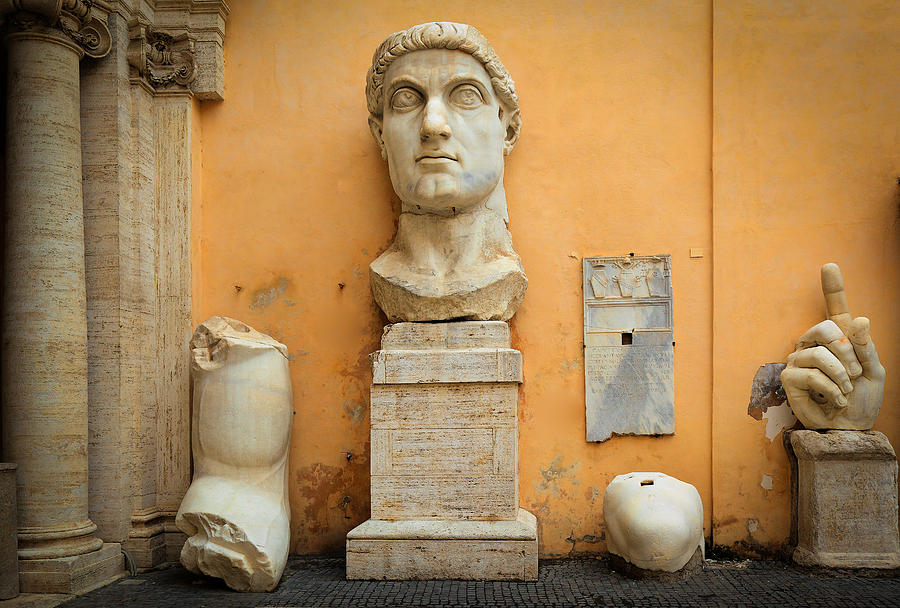
Constantinian Christianity

source: fineartamerica.com
Popular now among Catholics, Schmemann-derived Orthodox, and various stripes of protestants is the narrative that Constantine corrupted Christianity by bringing about its legality and the official juridical preference given to it by his successors. Malachi Martin promoted this telling in his Decline and Fall of the Roman Church as did Alexander Schmemann in his Church, World, Mission. A complimentary narrative purports that the schism between Rome and Constantinople occurred in 1054, was solidified in 1204, and was the consequence of papal ambition. There is some truth to the last part of the second story, but it wholly misses the point. The un-caused cause of the schism is Constantine, who created "Byzantine" Christianity.

He is called "St. Constantine, equal to the Apostles" in the Greek liturgy—"equal" in his influence in spreading Christianity and in no other way whatsoever. Emperor Constantine was accorded by Russell Kirk the same appellation Edmund Burke gave Oliver Cromwell: "a great bad man." After the miraculous apparition prior to the Battle of the Milvian Bridge, Constantine found himself the ruler of a war torn empire stirred by the upstart Catholic faith. Constantine presided at the Council of Nicaea, partially to resolve a theological dispute which caused angst within the large Christian community and partially to baptize Christianity into the reformed and Hellenized Roman Empire. 

In the years following Nicaea the bishop of Constantinople, formerly a minor bishopric of little prestige (antipodal to Jerusalem, a prestigious bishopric of no political importance) exercised greater and greater authority within the Eastern Roman Empire. The fourth ecumenical council, held at Chalcedon, effectively pushed out of the Church Coptic Christians who were duped by the heresiarch Eutyches. The same council promoted the bishop of Constantinople to Patriarch, second only to the Apostolic See of Rome. This promotion bypassed the eminence of the Petrine see of Antioch and the newly-alienated see of Alexandria in favor of political expediency. Slowly the Christianity at Constantinople became separated from Roman Christianity. By the time of the iconoclast controversy, we could say that there was such a thing as Byzantine Christianity, supported by the state and defined both by its Platonic language, its liturgy, and its prominence in conciliar decisions.

All this time the popes sat in Rome doing exactly what they should have done, absolutely nothing. Fr. Hunwicke once said it best: the strongest point of the popes during the period of Byzantine domination of theology is that they themselves contributed next to nothing. The popes of the first millennium, in stark contrast to the 20th century popes, were distinctly allergic to any kind of renovation, innovation, or evolution of the faith whatsoever. The papal reaction to the iconoclast dispute exemplifies this. While the Byzantines fought in the streets over proactive veneration of icons against the imperials who want them erased from the churches altogether, Pope Gregory III condemned iconoclasm and at the same time suggested a pastoral resolution, to put icons on the walls and ceilings of churches where veneration would not become an issue. After Greek control of the papacy detumesced and the Western Roman Empire fell apart, the Bishops of Rome and their Greek counterparts found themselves presiding over two increasingly distant parts of the universal Church.

The schism, contrary to popular opinion, did not happen in 1054. It did not happen in 1204 either. 1054 was not a breech between Rome and the rest of Christianity, which had long ago itself been separated from the former-Byzantine Empire. 1054 marked the culmination of a bickering match between Rome and Constantinople that began with the creation of a uniquely Byzantine Church, which was nurtured by the Photian affair and the triumph over the iconoclasts, and which was brought to a head by the re-assertion of Papal power. Over the two previous centuries, the popes had been a remarkably bad bunch (philanderers, simonists, murders, and the occasional heretic). Meanwhile the various patriarchates became accustomed to operating without the popes and their judgments. One could say Papal power was stronger in the 5th century than in the 10th. The all-time nadir of the Papacy came during the reign of Benedict IX, who bought and sold the papacy to marry a woman, held the Petrine chair thrice, and raised an army to dispute his uncle for the Roman see. After such a soap opera, the re-assertion of papal primacy under Leo IX, Gregory VII, and Urban II seemed absurd to the Byzantine patriarchs, who now presided over a tradition separate from that of Rome. A rift that had been taking root for centuries flowered with the dispute between Cardinal Humbert and Archbishop Michael Cerularius. The Emperor rightly ignored the separation when his kingdom was put at risk. The Crusades created a cultural animosity between the Greeks and Latins that spilled over into religion and in the years after the fall of Constantinople Greek Christians, understandably, looked to blame the Latin Church for its sins in meddling with Byzantine affairs. The Pope became the absolute head of all matters in the Latin West and the Greek Patriarch became Vice President of non-Islamic Religions in the Ottoman Empire; many patriarchs, even given their animosity towards the Roman Church, should be admired for their sufferings under the Turks. Individual cases of reunion, like that of the Melkite Church, were often disrupted or brought to naught by Turkish and Constantinopolitan intervention. Moreover, the roles of the Pope as Patriarch of Rome and "head bishop," as Armenian king Vartan II called the Roman bishop, became blurred.

At this point the "Hull thesis" takes over. The Latin Church been self-reflective and encumbered in her own legal system, her own theology, and her own devotions with no external oversight from the other patriarchates as existed centuries earlier. The Roman objectified theology and turned it into a variation of Greek logic. Conversely, the Greeks began to hold in suspicion things that were not Greek: the Roman Canon, the primacy of the Pope, St. Augustine, and the like. One epigraph in Banished Heart referred to the Pope as the "ghost of Caesar." Similarly, historian John Romer called the Orthodox churches the last "relic" of the lost Byzantine Empire. Both statements are exaggerations, but do procure strong elements of truth for modern consideration.

Now the Roman Church is in administrative and bureaucratic shambles; Mass attendance is in the gutter. The Byzantine Orthodox world is de facto run by Russian primacy, and Russia is among the most secular countries in the world; Orthodox churches are often strong centers of faith, but just as often seem to function as cultural hubs (Eastern Catholic churches are just as guilty here). The Greeks triumphantly uphold the religion of a defunct world power while the Romans have dismantled their once ubiquitous, virile praxis. And the Oriental Catholic and Orthodox Churches are forgotten.

Patriarch Gregory III of the Melkite Church
The cultural divide begun by Constantine continues to this day, separating Byzantine Christianity from both Rome and the far East. Coptic Catholics and Orthodox have inter-Communion in Egypt and have for years. The Melkites and their Antiochian Orthodox brethren also have inter-Communion, shared Sacraments, and even shared parishes; they use the Greek liturgy, but have carefully spurned any excessive embrace of non-Arabic culture. The non-Byzantine Eastern Catholics have displayed very little trouble adapting to the teachings of the last millennium without vitiating their own perspectives. Why must the Byzantines be different? Perhaps it is post "Uniate" guilt wrought by de-Latinization, pro-Orthodox ecumenism, and cultural pull. One Slavic Byzantine Catholic said to me "Well, we should all really be Orthodox and would be if not for the Union of Brest." Ignoring the fact that the Union of Brest influenced the Slavic churches and not the north African or far Eastern churches, my mind nearly prompted me to ask "Are you Catholic by birth or by faith?" I held my tongue.

The healthiest Byzantine Catholic parishes I have seen in the United States have embraced Byzantine spirituality as their future and reeled in the ethnocentrism that once dominated those churches. The Melkites and Ruthenians are doing well enough in the United States while the Ukrainian Catholic Church is struggling (but doing well in missionary areas). Was this not what Alexander Schmemann wanted his own Russian Orthodox Church to do decades ago? God became Man neither as a Greek, nor Slav, nor Roman, but as  Palestinian Jew. Constantine did not intend to drive a wedge between the various parts of Christendom, only to use part of it to strengthen his declining Empire. In that he succeeded. He was not the immediate cause of the East-West Schism, but he is the most necessary one.

This short reflection carefully advocates nothing. The purpose of this post is to summarize why the author believes the seeds of division of Byzantine Christianity (Orthodox and Catholic) from the rest of Apostolic Christendom were planted long before most think. Such a long division brings about many questions. Answers will not be found with the Moscow Patriarchate, the Congregation for Oriental Churches, or weekend conferences in Ravenna. They will only be found at the ground level.

Thursday, April 10, 2014

"The Church"?

"Well, there I'm troubled by the debate over Sacraments and that sorta stuff," said a protestant fellow student to me one night over dinner years back. "There are so many fundamental disagreements in the Christian Church."

"Not as far as I am concerned," replied the Raddiest Trad.

"The Church." It is a term used and abused like none other, but it is rarely given any proper definition. In vogue now is a propensity among practitioners of "high" Christianity to obscure very serious and heartfelt delineations between various parts of Apostolic Christianity—which I define as groups with valid Holy Orders which can be traced back to ancient patriarchal sees—almost to make "the Church" neither black nor white, but every shade of grey. One wonders how people of this tendency would react to St. Polycarp's denomination of Marcion as the "first born son of Satan."

This obscurantism comes after the collapse of several centuries of juridical identification of "the Church," which in turn meant "the Church" was defined by one's patriarchal position. Catholics de facto believed the Roman patriarchate to be "the Church" and all outside of it to be either schismatic heretics or probable "Uniate" would-be heretics. The Orthodox, continuing what was left of the Byzantine Empire, likewise identified communion with Constantinople as "the Church." Non-Chalcedonian Orthodox are tougher to pin down, as no one see defines them nor one cultural tradition, setting them apart from post-Byzantine Eastern Orthodoxy and Counter-Reformation Catholicism. At yet the absence of definite leadership is something of an enduring problem in the non-Chalcedonian Orthodox churches, perhaps the reason why the Ethopian Church re-united with Rome until cultural imperialists masquerading as missionaries bungled the situation beyond repair and Ethiopia returned to non-Chalcedonian Orthodoxy. Indeed, to be in "the Church" could mean to think Latin is heaven's native tongue, to think those born outside of Greek ancestry were un-favored, or that anyone outside of nothern Africa was not to be trusted. The Anglicans, even before the Tractarian days, further complicated the matter by positing themselves to be the via media betwixt "Romish" superstition and continental protestantism. To be English was to be Anglican which was to be authentically Christian.

How things have changed!

Nowadays most protestants believe anyone who professes Christ and attends services at some sort of ecclesial community a few times a month is a member of the "Christian Church." Some Eastern Catholics and Eastern Orthodox, although juridically out of communion with each other, consider each other both fully part of "the Church," a feeling particularly powerful within the Melkite and Orthodox patriarchates of Antioch. Most Roman Catholics and Orthodox admit some degree of communion with each other. Similarly non-Chalcedonian Orthodox and Eastern Orthodox profess a common faith. The hard line Roman Catholics and Russian Orthodox most often play party pooper in ecumenical dialogue. 

Still, this sort of thing is only true to an extent. "Communion" means many things, above all the sharing of Sacraments. It also means fellowship, community, and union with God in the sharing of the Sacraments. There is certainly a high degree of communion shared by the Melkite Catholics and the Antiochian Orthodox (inside Lebanon). Similarly there is some communion, loosely understood, between Rome and the various Orthodox Churches and between the Orthodox who accept and those who deny Chalcedon. But it is not a complete fellowship or communion. These groups normally only share Sacraments under conditions of extreme duress, such as immanent death or danger of death. Painting "the Church" as the collective of these groups—which share much in common—dangerously brushes past their serious differences.

The watery divide between the Greek and Roman Churches, in my opinion, began long before the year 1054 and did not coagulate until after the destruction of Byzantium. If one is to take an honest approach one finds the bickering between Rome and Constantinople began because of the Greek patriarch's imperially subsidized ambition in the late first millennium and became a lasting schism because of Roman stubbornness. Indeed, the anti-legalism and anti-rationalism that has come to define post-Byzantine Orthodoxy contrasts sharply with the juridical and rationalistic approach of Bellarmine and Liguori, more so than Palamas contrasts with Aquinas.

What is the point? "The Church" can, I think, be found on three levels:
  1. What we believe
  2. How we believe it
  3. With whom are we in communion
The third point is often the target of those who were earlier labelled obscurantists (seeing the organizational aspect of the Church as an artificial construct) while the most legalistic persons often focus on the second point (good luck convincing some Roman Catholic clergy that Eastern Catholics just do not have a concept of Original Sin). In the example of the Melkites and Antiochian Orthodox, the first and second points match near perfectly, but the third point is contended. Does that mean we must discount the third point? Certainly not.

The entire point of belonging to a communion is to know where the Church can be found visibly. Schism of course comes from the Greek word for "tear" or "rip." Ripping up the Church is serious business. Schism is not necessarily the same as heresy, but often relates to it. When the Alexandrian Church rejected Chalcedon few outside of Alexandria doubted that the Egyptian patriarchate had separated itself from the Church. Perhaps at that point the Church—which was Latin, Greek, Armenian etc—felt diverse enough that a consensus between her various contingent groups sufficed to define a schism. But what to do when the only remaining portions, the Greeks and Latins, withdraw from each other? What then? Re-define "the Church" to mean all groups regardless of substantial differences? The Church is communion and where communion lacks the Church lacks. Obscuring this obscures the root cause of much schism: the difference in what is believed and how it is believed.

привет!
The most substantial problem, to my view, of glossing over the institutional aspect of "the Church" and the communion which visually defines it is that one would paradoxically call the Church united and divided. Go to a rural Russian village and tell the peasants that they really believe the same things as Katharine Jefferts Schori! The institutional aspect of the Church—which is often a disaster—is still essential because it signals to the faithful where they need to be. If a "house divided against itself cannot stand" why can a Church, in several degrees of schism from itself, continue to be "the Church?" When a couple divorces and the children go off to college the spiritual bonds between the former spouses remain, although they go ignored, yet de facto there is no family any more. Communion and Church cannot be imagined. Christ came to call twelve men who He firmly united in the Holy Spirit and guided in Truth. "The Church," for the welfare of the faithful, must continue this feature, which I believe is essential. Why would one be Coptic Orthodox over Romanian Orthodox unless one was of Egyptian descent? Yet we as Catholics can at least point to Rome as the visible marker of the Church's communion. This facet of Rome may be more important than infallibility of the Pope, given that the Church already understands herself to be infallible in dogmatic matters. If one holds communion with this man, the Pope, the visible marker of the Church, one holds definite communion with the Church of Christ. The Fathers of the Church rarely talk about Matthew 16:18 when they referred to the Bishop of Rome and when they do they speak of him both as the rock and as the marker:
"On him [Peter] He builds the Church, and to him He gives the command to feed the sheep; and although He assigned a like power to all the Apostles, yet he founded a single Chair, and He established by His own authority a source and an intrinsic reason for that unity. Indeed, the others were that also which Peter was; but a primacy is given to Peter, whereby it is made clear that there is but one Church and one Chair. So too, all are shepherds, and the flock is shown to be one, fed by all the Apostles in single-minded accord. If someone does not hold fast to this unity of Peter, can he imagine that he still holds the faith? If he desert the chair of Peter upon whom the Church was built, can he still be confident that he is in the Church?" (St. Cyprian)
It is quite useless to speculate on the would-be opinion of someone deceased, but I think the above passage summarizes why Adrian Fortescue, despite his openness to Greek Christianity at the height of Pius X—a pope he rather disliked, he remained a Catholic and a Roman one at that.

Far from fomenting division, I favor building unity from a realistic point of view. I would like the Catholic Church to cut off all ecumenical dialogue with pagan sects and even with protestants, with whom we have little in common aside from most of the Bible and Baptism. The Church cannot be divided, but it certainly can be built up. If we really must do ecumenical gatherings let it be private, local conferences with Eastern Orthodox and non-Chalcedonian Orthodox. I would not oppose some level of inter-communion with the Orthodox, but I suspect that they would have a hard time selling the idea to their homeland congregations.

Talk about substantial matters and fear not to be one's self. Bishop Nicholas Samra, Melkite bishop of the American eparchy, announced at his enthronement that Melkites must have the courage "to be ourselves." We Romans, after the long overdue collapse of our business corporation hierarchy, have ignored in both liturgy and theology much of our Roman roots. Those must also be recovered to build up communion within the Church and to entice others to communion. 

The Church, by its nature, is not divided, but it certainly is troubled and has been from the beginning. 

"For peace in the whole world, the well being of the holy churches of God, and the union of all, let us pray to the Lord!" -Divine Liturgy of St. John Chrysostom

Tuesday, July 16, 2013

Western Orthodoxy?

A supposed celebration of Sarum by a Western
Orthodox priest. source: allmercifulsaviour.com
The Rad Trad recently had an interesting exchange over the Sarum Use in a previous post on local liturgical practices that fell away at Trent. At one point we touched on the anachronistic adaptation of a modified Sarum liturgy and a modified Roman liturgy by the Orthodox patriarchates of Antioch and Russia respectively. The experiment, which the Rad Trad believes to be aimed at Old Catholics and Anglicans, has ended in the Russian Church at least, according to the blogger John Ad Orientem. Glancing at the more informative comments, the Western Orthodox try was plagued with episcopal scandals and poor judgment in ordinations. One priest below laments having the celebrate the "arid" Roman rite for pre-Vatican II pseudo-Catholics rather than the rite of Chrysostom.

Most commentators lament the death of the Western endeavor and urge converts to embrace the Eastern liturgy rather than the Russian version of Anglicanorum Coetibus. One poster, the Catholic Gregory DeLassus, asks what this means for ancient Roman saints? Does it mean to be Orthodox means to be Greek or Russian or Egyptian? Here I see some wisdom in the Eastern Catholic Churches, which entered communion with Rome as entire communities and as they were—Latinizations usually coming later at the behest of Franciscan friars or self-imposition. Since the 1950s the Eastern Catholics have undergone a heavy de-Latinzation, casting away such foreign practices as Benediction, Roman vestments, and use of hosts for the Eucharist, a process by and large successful.

The closure of this chapter of the Western experiment for the Russian Orthodox reveals how difficult the Great Commission really is to fulfill. What is essential? What is Traditional? What is cultural? The Church must be available to all, but within the reasonable confines of the faith.


Monday, May 6, 2013

Further Thoughts on Catholic-Orthodox Relations

source: Reuters
In the conclusion of my last post, a review of Fr. Adrian Fortescue's The Early Papacy, I suggested many of the events the author adduces as examples of Papal primacy in the ancient Christian days ought to figure into ecumenical dialogue between the Catholics and Orthodox. As someone who worships at a Melkite parish and who is interested in liturgical matters, you might say I have some extra interest in affairs with the Eastern Orthodox.

A thousand years ago the filioque and the use of unleavened bread in the Eucharist were the main causes of controversy. Nowadays, no Easterner who knows Latin can seriously believe the filioque is heretical, nor do many think the use of unleavened bread invalidates the Sacrament. The modern issue is the role of the Pope of Rome within the universal Christian body. There are some less apparent issues involved here: the Patriarch of Constantinople has been called the "Ecumenical Patriarch" for some time, but the Russian Patriarch and the Russian Church have been the major movers within Orthodoxy in recent years. Yet, I would be more interested in dialogue concerning micro-level issues which I think are more important than the Papacy. If both sides are honest, the faith of the Fathers will define the role of the Pope.

The Pope has very little to do with the daily life of most Catholics, except when we pray for him. What might impact, or impede, attempts at unity might be social and personal practices. What immediately comes to mind:
  1. De-centralized Orthodox social teaching, which has led to much silence on Life matters and a general concession on the matter of birth control.
  2. The Orthodox practice of ecclesiastical divorce. An Orthodox person can marry up to three times, although the second and third wedding would be penitential services and exclude the crowning rites. Is there any justification for this? Might require some meditation. One Eastern Catholic priest I know indicated he would be willing to give Communion to an Orthodox divorcer because said person can receive in his own church, but would still continue the Catholic Church's policy with Catholics.
  3. Jurisdiction of local bishops. What would happen here? The Melkites and Antiochian Orthodox might have a fun time with this one.
  4. What about Western private devotions and revelations? The Eastern Christian devotions are very liturgical and not very private in nature—akathist being a prominent example. How do these churches preserve their own identity without disparaging those who have different devotional lives?
  5. Accepting converts. Eastern Catholics usually follow Roman Catholic policy in accepting most protestant baptisms and simply confirming. The Orthodox sometimes baptize, sometimes confirm, and, when the convert is a clerical of some kind, might accept by "vesting." This needs to be addressed.
  6. Those Roman episcopal conferences. They are a mess. Perhaps we could discourage our own clergy from these conferences and return to a patriarchal understanding of hierarchy. Maybe the idea of an archbishop could once again have substantial meaning in the West.
These areas appear to my poor mind as needing some attention in future conferences and discussions.

Happy Bright Week to any Orthodox readers!

Wednesday, October 17, 2012

The Great Schism: Old Wounds


As a "radical [Roman] traditionalist" I find it quite ironic that my first post has a distinctly ecumenical theme and perspective. I currently attend a Byzantine rite Catholic parish, specifically the Melkite church in Antioch, and went to my father confessor today to be absolved of my endless offences against the Lord. Afterward the priest, who for privacy will remain anonymous, and I discussed the relations between Eastern rite Catholics and the Orthodox churches. After poking some fun at archbishop John Ireland he stated his belief that the schism between the Catholic Church and the various Eastern churches called Orthodox will only be healed "when the people in the pew stop caring" about the separation.

What did he mean by this? When Catholics and the Orthodox may communicate without hesitation at each other's Masses and Divine Liturgies, and partake of the other Sacraments, or Mysteries. The priest proceeded to tell me of one Melkite priest who semi-regularly concelebrates with a Orthodox priest, albeit illicitly. Similarly, he said, there are Orthodox priests who, when on vacation, attend and communicate at Roman rite Catholic Masses when there is no church from their Orthodox tradition available. This inevitably brings up the question: what are we to think of the schism that occurred in 1054 between the archbishop of Constantinople and the Bishop of Rome, the Pope? First, we should consider that the conventional narrative about the East-West schism is quite wrong.

The conventional narrative goes something like this: Ever since the Apostolic era, the five major bishops of the world (the "patriarchs") were considered quite equal in every way, although the bishop of Rome was seen as having some sort of honorary primacy. This status of church government remained throughout the first millennium until the Westerners, or Latins, began to fiddle with the Creed and the bishop of Rome began to get uppity in his claims to have total and complete authority over the entire Church. In a fit, he ex-communicated the archbishop of Constantinople, who, upholding the purer Eastern tradition would have none of this Papal nonsense, and who then ex-communicated the Pope back. And since 1054 the two sides have not spoken.

The real story is a bit more involved, and perhaps more revealing about the current state of affairs. 

Fr. John Berg FSSP celebrates the old Roman Mass at St. Peter's tomb in the 
Clementine Chapel of St. Peter's Basilica


The case for ancient Roman primacy among the bishops of Christendom is not a very difficult case to make, but defining it in specific terms is quite a challenge. Ss. Peter and Paul died in Rome during the 60s AD. I have been honored by Almighty God to stand at the tomb of the Apostle Peter under the high altar of St. Peter's Basilica. St. Peter clearly possessed some sort of great authority over the other Apostles, and was indeed the "rock" of the Church:

And Jesus came into the quarters of Caesarea Philippi: and he asked his disciples, saying: Whom do men say that the Son of man is? But they said: Some John the Baptist, and other some Elias, and others Jeremias, or one of the prophets. Jesus saith to them: But whom do you say that I am? Simon Peter answered and said: Thou art Christ, the Son of the living God.  And Jesus answering, said to him: Blessed art thou, Simon Bar-Jona: because flesh and blood hath not revealed it to thee, but my Father who is in heaven. And I say to thee: That thou art Peter; and upon this rock I will build my church, and the gates of hell shall not prevail against it. And I will give to thee the keys of the kingdom of heaven. And whatsoever thou shalt bind upon earth, it shall be bound also in heaven: and whatsoever thou shalt loose upon earth, it shall be loosed also in heaven. Then he commanded his disciples, that they should tell no one that he was Jesus the Christ. —The Gospel According to St. Matthew 16:13-20

The Roman Church's closeness to the Prince of the Apostles and to St. Paul, the greatest preacher of the Gospel, would already give Rome a certain amount of prestige. In the second century St. Irenaeus, born in Asia Minor and eventually bishop of Lyon in Gaul, wrote:

Ad hanc enim ecclesiam propter potentiorem principalitatem necesse est omnem convenire ecclesiam, hoc est, eos qui sunt undique fideles, in qua semper ab his, qui sunt undique, conservata est ea quae est ab apostolis traditio. —Adversus Haereses, 3:2

or:
In fact, it is with this church, by reason of her more excellent origin, that every church must necessarily be in agreement—with this Church in which the tradition that comes from the apostles has always been preserved by everyone.
Certain proceeding events solidified the foundation for the Roman Church, and her bishop, to enjoy and exert power over the rest of Christendom in doctrinal and jurisdictional matters. The foremost of these was the Council of Chalcedon, which had been called to combat the monophysite heresy so popular in the far east to this day. Pope St. Leo the Great presided over the Council, but through a legate. The Pope, who only spoke Latin and knew no Greek, declined to make the journey from Rome. When Leo sent his analysis and opinion of the monophysite question to the Council, the Council concluded:

After the reading of the foregoing epistle, the most reverend bishops cried out:  This is the faith of the fathers, this is the faith of the Apostles.  So we all believe, thus the orthodox believe.  Anathema to him who does not thus believe.  Peter has spoken thus through Leo.  So taught the Apostles.  Piously and truly did Leo teach, so taught Cyril.  Everlasting be the memory of Cyril.  Leo and Cyril taught the same thing, anathema to him who does not so believe.  This is the true faith.  Those of us who are orthodox thus believe.  This is the faith of the fathers.  Why were not these things read at Ephesus [i.e. at the heretical synod held there]?  These are the things Dioscorus hid away. —Labbe and Cossart, Concilia, tom. IV, col. 368
Chalcedon offered the Pope of Rome the title "universal bishop," not a small matter. In his humility, St. Leo declined its use. Similarly St. Gregory the Great, greatest of all Roman Pontiffs after Peter, only signed himself as "bishop" when addressing international clergy, but he certainly put a stop to contemporary attempts of John IV of Constantinople to style himself as "ecumenical patriarch."

St. Gregory the Great, Pope from 590-604 AD

The second major visible turn in favor of Roman primacy, in my opinion, was the deposition of Photios as archbishop of Constantinople. In 858 AD a bright scholar named Photios, at Emperor Michael's urging, was ordained subdeacon, deacon, priest, consecrated archbishop, and enthroned in the Hagia Sophia on successive days. There was one problem: there was already an archbishop of Constantinople, Ignatios. Pope St. Nicholas, the last Pope called "the Great," sided with the humble and holy Ignatios against Michael and Photios. Emperor Michael was assassinated and went to God's Judgment seat, effectively removing Photios from the Hagia Sophia and banishing him while the new emperor sought better relations with the Pope and the West. The patriarch Photios convened his own council—which no Orthodox church officially accepts, although some Greeks do give it their ascent—and ex-communicated Pope Nicholas on the grounds of heresy and condemned the new(ish) Creed in vogue in the West. Photios was condemned by the Fourth Council of Constantinople, which Catholics accept as the eighth Church council, and Ignatios was re-instated. Years later Photios found his way back to the bishopric of Constantinople. This was a great boon and proof to the claims of the Pope to having real, tangible jurisdiction throughout the Church, even in Constantinople.

Other issues pervaded. Popes, particularly St. Leo IX, often quoted the fictitious "Donation of Constantine" in their claims to temporal authority throughout the world. By far the most divisive issue was the Latin addition "filioque" to the Latin text of the Creed: "qui ex patre filioque procedit" as opposed to the earlier "qui ex patre procedit." Easterners rightfully said that this was not the text of the Creed appointed at the Nicene Council of the Council of Constantinople, which also forbade its alteration. This emendation, which arose either in the Iberian Peninsula or Persia and which traveled to Gaul, attempted to fight remnants of the Arian heresy, which denied Christ's divinity. This clause emphasizes, especially in Latin, the closeness in divinity between the Father and the Son. In Greek though, the word for "proceed" (in Latin "procedere," which means "proceed" as in English) προϊέναι means to emanate from a single source. Not only would this clause be heretical in Greek, it would be grammatically impossible.

The other major controversy was the Western tendency to use unleavened bread for the Eucharist.


Although the Synoptic accounts would seem to indicate the Last Supper utilized unleavened bread, the early Christians simply used whatever they had, almost always leavened bread. Easterners took this to be a major violation of Tradition, and possibly invalidating. The Papacy was an issue, but not the primary or secondary one.

In 1054 Pope St. Leo IX sent Cardinal Humbert to Constantinople after the patriarch Michael condemned the use of unleavened bread. The cardinal, who possessed legatine powers, caused a stir in the patriarchal palace and, although the Pope had died, ex-communicated Michael using his defunct-legatine powers. The patriarch reacted by denying Papal authority and ex-communicating the cardinal and the dead saint. Needless to say, when Paul VI and Athenagoras lifted the ex-communications of each other, they were engaging in a needless exercise, as the initial decrees had been invalid from their inception.

Paul VI and Athengoras in Rome during the 
Second Vatican Council, c.1964

The Crusades, which had uniting potential, went quite awry when the Fourth Crusade, ignoring Pope Innocent III's strict instructions to avoid Constantinople, sacked the great Eastern city to pay war debts to the Doge of Venice (one Oratorian delightfully calls him the "dodgy Doge!"). No living person was raped, killed, or looted during that dark period in 1204, but the wounds still bleed to this day. The Eastern churches, not just Constantinople, legally reconciled, recognized Papal primacy, and the "filioque" (in the orthodox Latin and the doubtful Greek) twice, at the Council of Lyon and the Council of Florence, neither of which any Orthodox church now recognizes.

In the last council, at Florence, only one Eastern attendee, [St?] Mark of Ephesus, refused to sign the Council documents which provided the re-union, much sought by Rome for matters of faith and by Constantinople for matters of survival. Mark went as far to hold Rome and all of Western Christianity in schism and heresy. In the years after the Council the Pope was unable to keep peace in the midst of consolidating nations in Europe, much less provide protection from the ever-encroaching Muhammadans for the East. In 1453 the Ottomans arrived at Constantinople, sacked the city, massacred much of the populace, removed many crosses, and the Hagia Sophia transformed into a meeting place for the vile cult of Muhammad.

A re-construction of what the Hagia Sophia
looked like in its days as a house of God


In the years since then, over five centuries ago, the East has continued to de-centralize and the West has consolidated, both naturally. In the modern day there is very little public authority in the Orthodox churches. The Patriarch of Constantinople is the "first among equals" that the Pope was supposed to be. They have been attempting to call an ecumenical council for centuries now, without any success.

But this is all history! What does it have to do with my discussions with my confessor? Everything!

These are problems which penetrate the soul of the Roman rite Traditionalist, who one could envisage praying in front of an image of the Sacred Heart, and of the Easterner, meditating upon an icon of the Virgin. How does one find union when authority and spirituality have been divergent for nearly a millennium? It would have to be an organic effort. I am not supportive of inter-communion between the Catholic Church (in any rite) and the Orthodox church as a matter of principle: you are either in the Church, or you are not. None of this "partial communion" nonsense. I recently attended a Catholic wedding during which Russian Orthodox attendees were allowed to communicate and could not figure out how to receive in a manner congruent with the disrespect common in most Roman parishes.

I would however support permission given by local Orthodox and Catholic bishops to permit inter-communion. This allows for mutual appreciation between the clergy and laity of both groups to develop. That good will has generational effects, and does not die easily. A macro-level solution would be likely to create problems. Even if Bartholomew I became Catholic tomorrow, the Greek Orthodox Church would not simply enter the Roman communion.

Eastern hearts must be melted. Although I have noticed a genuinely ecumenical persuasion among Orthodox living in the West, many in the East still maintain that the West is heretical and its Sacraments are invalid. Some go as far as suggesting St. Augustine was a source of the West's heresies and ought to be un-canonized! Westerners, fortunately, are too ignorant of Eastern spirituality and Church history to have objections to the Orthodox on these grounds. Another major factor is the continuing cultural discontinuity between Easterners, many of whom still seek a Church on the model of Constantinople in the 5th century, and Rome, the theological deviant and invader. The end of this attitude might be best-accomplished among Orthodox living in the West, away from those social wounds.

During my university days I once attended Compline with members of the Coptic Orthodox Fellowship. In an off-handed question I asked what they do for theology and authority. The answer I received was "the Fathers." I responded with the words "but the Fathers are quite dead. We need living authority." Another person in the fellowship told me later that my comment had offended some people. I was initially contrite, until the same fellowship invited a Greek Orthodox priest to give a talk. During his speech the priest said he saw no impediment to union between the mainstream Orthodox churches and the "oriental" Orthodox churches (which reject every council from Chalcedon onward, much to the chagrin of most Orthodox). He went as far as to say "no one really believes in monophysitism any more." Other than he and I, everyone in that room did. The same priest brought handout on one Orthodoxy differed from Protestantism and from Catholicism. The first handout was barely two pages while the second was eight! We need to change our priorities!

The Catholic Church, particularly the Roman rite, has enough potential improvements to attract Orthodox interest in inter-communion to occupy the Congregation for Divine Rites for years. Without a doubt, the best thing Rome could do to demonstrate to the Orthodox that we are serious about laying bricks for the foundation of an eventual and lasting re-union would be to return to our own liturgical traditions, which are just as old, if not older, than those of most Eastern churches.

A Divine Liturgy celebrated by a bishop

Will the Orthodox take us seriously when Papal Mass 
looks like this?

And it should look like this?


I do not anticipate seeing an end to the schism, rooted it pettiness and continued in ignorance, during my lifetime (I am only 23). I do hope that serious efforts to engender respect between Rome and the rest of Christendom (those with valid Holy Orders, at least) takes place. Perhaps for some future generation the successors of Peter and his brother Andrew, depicted in the first image of this post, may be family again.

I will close with some words of Our Lord:

Sanctify them in truth. Thy word is truth. As thou hast sent me into the world, I also have sent them into the world.  And for them do I sanctify myself, that they also may be sanctified in truth.  And not for them only do I pray, but for them also who through their word shall believe in me; That they all may be one, as thou, Father, in me, and I in thee; that they also may be one in us; that the world may believe that thou hast sent me.  And the glory which thou hast given me, I have given to them; that they may be one, as we also are one: I in them, and thou in me; that they may be made perfect in one: and the world may know that thou hast sent me, and hast loved them, as thou hast also loved me. 
In the name of the Father, and of the Son, and of the Holy Ghost. Amen.

~The Rad Trad