Few symbols can summarize the banality of the current papacy better than this "Complaining is Forbidden" sign on Pope Francis's apartment door. The sign was a gift from Italian self-help writer Salvo Noé, a man with the least sincere smile that side of the Atlantic. News outlets around the world are praising the sign as a sign (ahem) that conservatives are getting too whiny about the disregard The Francis extends to their half-baked heroes like Müller and Burke. It is certainly a sign that Papa Piagnone doesn't mind the paradox of hypocrisy.
To be sure, there are plenty of whiners in the Catholic Alt-Right. Christopher Ferrara, Esq. never ceases to hiss at the Dubia cardinals, no doubt excoriating poor Cdl. Meisner even beyond the grave. Steve Skojec screams about beta masculinity at anyone who contradicts him on American politics. Frank Walker's barrel of sarcasm never runs dry. Louie Verrecchio and Ann "Crazy Eyes" Barnhardt boldly proclaim Long-Faced Francis an antipope. Anonymous traddy priests upload sermons about the dangers of gossip and Harry Potter while the world burns.
And yet...
Last week I had the pleasure of witnessing the marriage of two very close long-time friends. The wedding was beautifully done, the reception was full of decent food and fun dancing, and the send-off was cheerfully memorable. The world may be crumbling, but that is no excuse to forgo feasting and family, to ignore the good things God still gives us. Our pope is at least correct that joy is a necessary part of the Christian life, even in the midst of turmoil. The City of Man can never overcome the City of God.
While it is necessary to point out the nudity of the Emperor, it is unseemly to stare at it for any great length of time. Noe's prudent sons covered his nakedness in his drunken stupor, but if he had belligerently refused to be clothed, what could they have done but walk away? Francis doesn't want complainers near his door because he does not want any harsh truths being spoken in his hearing. No true prophets are desired in his presence.
"For the Lord hath mingled for you the spirit of a deep sleep. He will shut up your eyes, he will cover your prophets and princes that see visions. Wisdom shall perish from their wise men, and the understanding of their prudent men shall be hid."
Papa Bergoglio no longer wishes to hear what his critics have to say. He wishes to have his ears tickled and his feet massaged. The only reason to criticize his words and actions is to remove the stumbling block that is Francis from the path of one's fellow Catholics and inquirers of good will. Let not the Bishop of Rome be a scandal against the practice of the Faith.
(or, “The Great Majority of Papal Resignations are Null”)
(Jean-Paul Laurens)
Ever since Abp. Gänswein, the Pope Emeritus’ personal secretary, gave a speech last month in which he opined that Benedict XVI had abdicated the Petrine throne without abandoning the Petrine ministry, the rad trads of the Internet have more boldly begun suggesting that Francis is not a real pope at all. An out of context selection from Anne Catherine Emmerich’s prophetic visions was also quickly refurbished to prove the apocalyptic signal of a dual papacy. With every confounding utterance of Papa Bergoglio’s interview-facilitated magisterium, the Catholic on the street becomes more and more susceptible to such scandal.
But of course this conclusion is nonsense. Benedict clearly abdicated, and has repeatedly denied any extenuating pressure that would have invalidated his resignation from the papal throne. Certainly it is confusing to have “active” and “contemplative” participants in the Petrine ministry, but this becomes less confusing once one stops trying to interpret Ratzinger’s theology as if he were a scholastic or traditionalist theologian.
He is a liberal theologian, and always has been.
And as a liberal theologian, he freely uses words and concepts in paradoxical and sometimes contradictory ways. He is not so much of a liberal that he thinks that the papacy can be divided between two persons, and he is using terms like “Petrine ministry” in a non-technical way. Very much in the spirit of Hans Urs von Balthasar—who in The Anti-Roman Feeling split up the structure of the Church amidst the “Realsymbols” of the Petrine (pastoral), the Pauline (inculturation), the Jacobean (traditionalism), and the Johannine (love)—Papa Ratzinger sees truth as a multiplicity of perspectives that can complement one another. If Gänswein can be trusted to be accurately reporting Benedict’s thought, the Pope Emeritus has not remained grasping onto some part of his papal authority, but is incorporating another “Realsymbol” (perhaps the Johannine) under the umbrella of the Petrine ministry, which is greater than the person of the pope, who alone retains the “Realsymbol” of Peter. The Petrine ministry is thus presumably greater than the pontiff himself.
To complain that this is all a great deal of oddball nonsense is of course also accurate. Nobody has ever accused liberal theologians of simplicity, coherency, or even of adhering carefully to the principle of non-contradiction. In opposition to this half-hearted talk of the last few years, the actual announcement by P. Benedict was in fact quite unambiguous:
For this reason, and well aware of the seriousness of this act, with full freedom I declare that I renounce the ministry of Bishop of Rome, Successor of Saint Peter, entrusted to me by the Cardinals on 19 April 2005, in such a way, that as from 28 February 2013, at 20:00 hours, the See of Rome, the See of Saint Peter, will be vacant and a Conclave to elect the new Supreme Pontiff will have to be convoked by those whose competence it is.
That speech was so clear a Thomist could have written it. In a very real way it simply doesn’t matter how the P. Emeritus has tried to rationalize or justify his abdication and his decision to continue wearing the papal white since February 2013. His own words were clear and binding, and he is the Roman pontiff no longer. It is sad to see him descend intellectually further into his liberal past, but hardly surprising.
~
Thomas, an old friend of mine, once spent a few months convincing me to read Hermann Hesse’s Nobel-winning novel The Glass Bead Game. I avoided it for a while, having identified Hesse with the adolescent narcissism of Siddhartha and Beneath the Wheel, but was rather surprised to enjoy it once I started on it. The novel is long and a bit ponderous, but the main conceit it that it takes place in a future European utopia of contemplative learning. The university-state Castalia appropriates a neo-Buddhist style of meditation and applies it to Western classical education, the height of which is the Glass Bead Game: a contemplative aid wherein stylized glass beads represent aspects of the cultural traditions of philosophy, music, art, and science.
The plot, however, revolves around a certain Joseph Knecht, a student of Castalia who rises to become the Magister Ludi, their version of a papal figure. At the end of Das Glasperlenspiel, Knecht reveals his plan to abdicate the Magisterial role, having come to the conclusion that Castalia had long since become so insular and rarified that it now has nothing it can offer the world for its betterment. Knecht decides (possibly via the influence of a Benedictine monastery) to become a mere tutor of one young man, as a sign that he is returning to the work that Castalia was originally formed to do.
As such, Joseph Knecht retained the “ministry” of a magister while resigning as the head Magister. Thankfully for his former Castalian administrators, they did not have to justify the scandal of his resignation for long.
Upon the resignation of Joseph Ratzinger, Thomas and I had many lively discussions about the justifiability of this act, with many references to Hesse’s magnum opus. At times we wondered if Ratzinger might have read this novel, perhaps keeping Knecht’s climactic decision always in the back of his mind as a possible path of escape from an unwanted position of authority. It is well known that he asked John Paul II for permission to resign from the CDF more than once, and he took on the papal robes only with great reluctance.
The following words of Fr. Jacobus in The Glass Bead Game are close echoes to Ratzinger’s belief that a smaller, more spiritually intensified Church is in store for the future:
Times of terror and deepest misery may be in the offing. But if any happiness at all is to be extracted from that misery, it can be only a spiritual happiness, looking backward toward the conservation of the culture of earlier times, looking forward toward serene and stalwart defense of the things of the spirit in an age which otherwise might succumb wholly to material things. (363)
One can comfortably imagine Knecht and Ratzinger retiring together in a small house next to a German lake, waking up each morning to contemplate history and the spiritual life before the mist burns off the water. Joseph and Joseph both bend down to scratch Pushkin’s nape while the tea steeps. Sometimes, perhaps, they stop to consider the voids they left behind, and the lesser men chosen to fill them.
"These twain be thy fathers, these be in good sooth thy shepherds, these twain be they who laid for thee, as touching the kingdom of heaven, better and happier foundations, than did they that first planned thine earthly ramparts, where from he that gave thee thy name took occasion to pollute thee with a brother's blood. These are they who have set on thine head this thy glorious crown, that thou art become an holy nation, a chosen people, a city both Priestly and Kingly, whom the Sacred Throne of blessed Peter hath exalted till thou art become the Lady of the world, unto whom the world-wide love for God hath conceded a broader lordship than is the possession of any mere earthly empire. Thou wast once waxen great by victories, until thy power was spread haughtily over land and sea, but thy power was narrower then which the toils of war had won for thee, than that thou now hast which hath been laid at thy feet by the peace of Christ."
Pope St. Leo the Great, first sermon on the feast (second nocturne of Mattins)
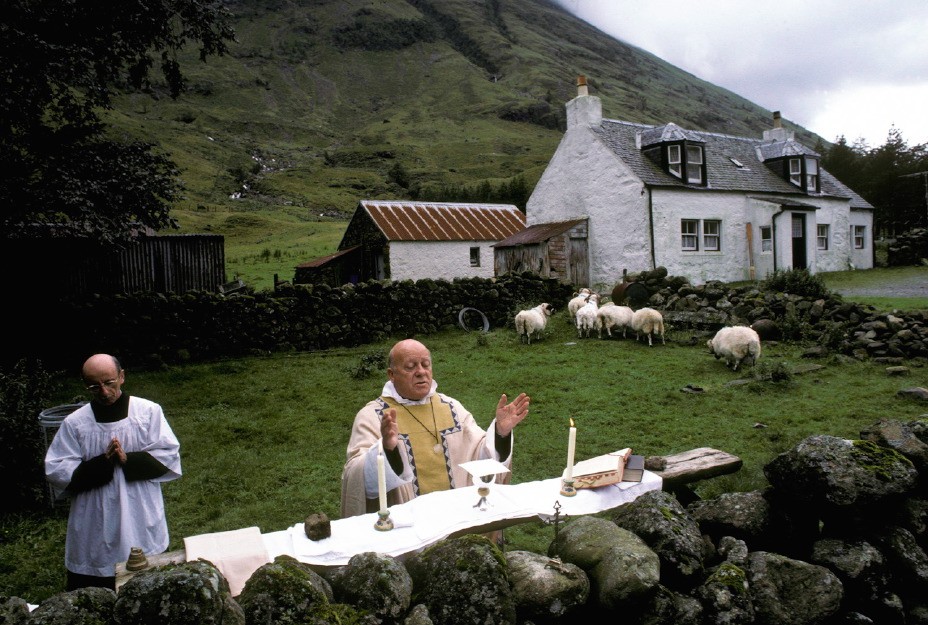
Very organic liturgy with Fr Quintin Montgomery-Wright
source: Jean Erik Pasquier's Daily Life series, 1986
A question has circulated in my minds for several years and I would like to put it to the readers. What exactly is the Roman liturgy? Who possesses it? Who has authority over it?
My personal opinion is that the Roman liturgy does not exist in a particular year or edition of Mass and Office books, but in certain distinct elements that became apparent after the liturgy's shape coagulated after the fluid years that followed the emergence from the house churches. I would venture to say that the three main features of the Roman liturgy are:
The Roman Canon: the Eucharistic prayer which is central to the Latin rite's observance of Our Lord's command and which is found at the heart of the Roman Mass and its local uses from the time of St. Gregory the Great onward.
The Roman Psalter: the distribution of the psalms marked the hours and the days, forming the Roman Church's celebration of feasts and its weekly prayers.
The Roman kalendar system: this dictated how feasts and ferial days would be observed and set the cycles of the liturgical year.
None of these elements was without change or some evolution over time. Advent, my favorite time of year, was relatively late in entering the Roman rite. The psalter is clearly ancient (as it existed before the Pian reforms), but it was not the central point of the proto-Office, the lucernarium; the focus of that service was readings, which survived in the Holy Saturday rites (making the other Pian reforms all the more difficult).
Another thing to realize with these elements is that they are elements and not a strict unit. In some sense the local rites used in religious orders and throughout Northern Europe were usages and variations of the Roman rite rather than distinct liturgies. Far from undermining their value, this means that the Roman rite consists in a multiplicity of practices united by basic liturgical principles.
Which brings us to our next question: who owns the Roman liturgy? One might be tempted to say the Roman Patriarch, the Pope. There are two problems with this simple answer in my view. The first is that, after the missionary expansion under Gregory the Great, the Roman liturgy, under my broad definition, was no longer limited to the Church of Rome, but rather became invested in all the Christian lands of Europe and beyond (Asia, North and South America, and now Africa). Many of these places, particularly in Europe, developed their own local expressions under monastic, parochial, episcopal, and devotion rule, not under the direction of a far off office in Rome. Which brings us to the second issue, that the liturgy, arguably, ought to belong to those who pray it. Right?
If both of these are true, particularly the second, then we might find ourselves in a little bit of a dilemma. Lay liturgical formation in the Roman Catholic Church is horrendous in most places, aside from the sort of parishes which promote lay knowledge of the liturgy (and not liturgy lite). Among those with liturgical knowledge there is often a fear of violating the legal norms established in the books. And yet, if everyone "said the black and did the red" would we not all be gathering at 7PM on a Saturday night at a dinner table, listen to a few Bible fragments, listen to the priest consecrate, eat and drink, and then go home? The communal and dynamic nature of the liturgy is why the Mass and Office took their shape, first in Rome and then in other dioceses. In a recent day spent in discussion with some liturgically capable men at a Catholic college I realized just how interested people are these days in the "organic" nature of the liturgy and yet how timid some are to depart at all from the rubrics. One fellow wanted to know if it would be legal to use the full Orbis factor Kyrie, with the litany-like vocative exclamations of the Middle Ages' farced settings; did those who wrote that setting follow the rubrics or did they have a different understanding? Which brings us back to the original question: what is the Roman rite and who owns it?
As a point of interest, there was, many years ago, a highly eccentric convert from Anglicanism, a Fr. Quintin Montgomery-Wright, who finding England unfriendly to non-cradle Catholics, packed up for Normandy and acted as pastor of a parish there from 1956 until his death in a car crash in 1996. Fr. Q initially said Mass in French and versus populum in the 1950s but, finding the reforms of the 1960s bothersome, pushed his altar back against the wall and switched back to Latin. He ignored the Pauline liturgy's introduction between 1968 and 1970, but did not do the "EF" liturgy either. He "tweaked" the liturgy with some French variations, as Anthony Chadwick tells us:
"Fr. Montgomery was an amazing fellow. He had stacks and stacks of vestments, and did the liturgy the old Norman way, like Sarum. There were little blue dalmatics for altar boys, and I often sang as a coped Ruler at Sunday Mass at Le Chamblac. He vested on the Lady chapel altar (the church's south transept). The Judica me psalm was said at the Lady altar and in procession. He likewise said the Prologue of St John on the way from the high altar back to the Lady chapel. At the time, I though he was just being odd, but this was the medieval and pre-Tridentine way of celebrating."
The 1568 and 1570 books that came out of Roman during the Papacy of St. Pius V and the creation of the Congregation for Rites in 1588 under Sixtus V (if I am ever elected Pope I will be Sixtus VI) did not freeze the Roman rite, but those events did slow any sort of development and eased off any communal interest or local variations. The Pauline books, and the "EF" books, were both issued by offices. How do we form the laity in the liturgy? The answer is simple, although difficult: pray it. Pray it all the time.
Hopefully interest in this subject will increase in the coming years. I believe it to be on the upswing.
Today is the feast of the dedication of the Cathedral of Our Savior, commonly known as the Archbasilica of St. John Lateran, the cathedral of the diocese of Rome and hence the foremost Church in the world. The cathedral has probably been re-built half a dozen times due to fires, earthquakes, and the Avignon papacy, yet some of the original building remains, which traces its origins to the Emperor Constantine. I had re-published an old post showing some pictures I took of the Cathedral during my visit there a few years ago. I think this better than posting images available from the internet because the display the "flow" of the cathedral and lend themselves to an appreciation of the look and scale. At the end I have added a video of the consecration of the FSSP seminary chapel in Nebraska which, although done to the 1962 rite, is textually very close to how the Mass part of the rites would have been done at the Lateran during its several re-consecrations. Happy feast!—one of my favorite of the year.
The image of Christ dominates this great cathedral built in His name
Today is the day we commemorate the (re-)dedication of the Archbasilica of Our Savior, also known as St. John Lateran. This church is great not so much for its size, grandeur, history, or architecture—although all are quite impressive, but because this church is the cathedral of Rome and, hence, the foremost church in the world. It is the Pope's cathedral, although people often mistake St. Peter's for this honor.
The throne of the Bishop of Rome
Christian worship existed at this location in the southeastern corner of Rome, near the walls of the old City, since the first century, when Ss. Peter and Paul themselves were present there. After Christianity was permitted to crawl out of the Roman woodwork Emperor Constantine began to build several major churches on behalf of the Christians. Contrary to popular opinion, Constantine did not give too much preference to Christianity over paganism during this period. He gave the Church and the Bishop of Rome considerable real estate, like the Lateran Palace, where the popes resided until the reign of Pius IX, but not in prime locations.
The Church of Our Savior eventually became the main seat of the Bishop of Rome due to its proximity to the Lateran Palace. Important stational days in Holy Week—particularly Palm Sunday, Maundy Thursday, and Holy Saturday—which are communal in nature take place here. The consecration of the Bishop of Rome, and his coronation as Pope, and special blessings took place at this cathedral, emphasizing the Pope's role as a bishop for the City. During one Maundy Thursday Pope St. Gregory the Great was performing the mandatum (re: foot-washing ceremony) and after washing twelve men's feet and thirteenth appeared. This man's luminous face was described as perfect by the Pope. The man immediately disappeared. St. Gregory concluded it was an angel, or perhaps even Our Lord Himself. This is why in the old Roman rite thirteen men's feet were washed in Maundy Thursday as opposed to the instinctive twelve.
The Cathedral of Our Savior was subjected to barbaric invasions by the Goths in the sixth century, by the Saracens in the ninth century, and earth quakes throughout. By the reign of Sergius III (r. 904-911) the Cathedral had fallen into such disarray it required a re-model, including a new roof. It was re-dedicated by Pope Sergius and given a consecration to Ss. John the Baptist and John the Evangelist, hence its vulgar name "St. John Lateran."
The Lateran Cathedral as seen from the square
In the first millennium the square in front of the Lateran Cathedral and Palace hosted the election of the Pope. After the death of the previous Pontiff the clergy would gather all Roman citizens, the cardinals (originally the priests and deacons of Rome) would elect nominees from amongst themselves, and the candidate with the greatest yell from the crowd would be the new Bishop of Rome. In the late first millennium violence often resulted and which faction could gain entrance to the Cathedral, consecrate its candidate, and enthrone him would have the Pope! During the middle ages the Archbasilica hosted five ecumenical councils, the Papal Court, and the public square of Rome. Pope Innocent III famously received St Francis of Assisi here, after first suggesting that the poor saint preach to the pigs in the public market—a suggestion which the saint immediately followed, and also saw the friar holding up the Cathedral, which was crumbling under the sins of the Church.
Pope Benedict XVI enthroned after election
As the Popes moved to Avignon, the Cathedral fell again into disarray and was partially destroyed due to a fire. It was re-modeled during the Renaissance and again during the 18th century, when the statues in the niches were added. Today the Popes still use this great Cathedral for Maundy Thursday, Ascension Thursday, Corpus Christi, pastoral visits, and enthronement after election.
I was blessed by God to be able to visit this awesome place a year and a half ago, whilst in Rome during Lent. My two friends and I, one Catholic and one then-searching, thought the Lateran to be an interesting one hour stop we could make on our way to the Colosseum. We spent five hours in the Lateran and two in the Colosseum.
The facade, a baroque addition, is impressive, but not as impressive as the one gracing St. Mary Major. I was not impressed with the Lateran until I stepped inside. What first struck me was the sheer scale of the place. I have been to St. Patrick's Cathedral in New York City several times, a larger church, but less open and hence smaller in scale.
The imposing Cosmatesque floor
My feet were sore from walking the Eternal City in boating shoes, so I ended up dragging the pads of my feet without intending to do so. This had the most spectacular effect. One can feel the texture of the mosaic floor in this Cathedral. Every bump and tile has character to it. History seeps from the ground of this place and the Spirit of God encompasses it. The words of the introit are verily said of this house of God:
Terrible is this place and This is none other than the house of God; this is the gate of heaven; and it shall be called the court of God.—Genesis 28:17
We made our way through the various side chapels over the course of an hour or two, before coming to the Chapel of St. Francis, shown below.
Depictions of the Saint and the Holy Ghost are abound in the chapel, including this one of this heart, re-calling his stigmata:
The Blessed Sacrament Chapel is next to the Papal Altar. There is a grand tabernacle surrounded by four statues of Popes. Interestingly the Popes are vested as deacons, indicating that they too are just servants at the altar of the High Priest, Christ. The Chapel is crowned by a depiction of the Last Supper and then of Our Lord's Ascension:
In the center of the Cathedral is the Papal Altar, topped by a canopy and reliquary which, although ornamented with busts of St. John the Baptist and John the Evangelist, contains the head of St. Paul. Imagine that almost every Pope from the fourth century has celebrated Mass in this place, surrounded by St. Paul and Our Lord Himself.
The Papal Altar
And the ciborium with the reliquary:
Across from the altar is the great apse of the Cathedral. A massive back wall is topped with gold mosaics containing icons of Our Lord, Our Lady, Ss. John the Baptist and John the Evangelist, and other Biblical figures. One must also recall the organic continuity of this cathedral. Icons of Ss. Francis and Dominic were not-so-deftly inserted at a later time! At the end of a long aisle, containing an organ, balconies for the cantors, and choir stalls for clergy in attendance, is the throne of the Supreme Pontiff:
Beyond the apse is a gift shop. Horrifically, the tomb of Pope Innocent III, the most powerful man of the Middle Ages, is a cross beam for the door frame! How passes the glory of the world!
Something striking about this place is the color in it. The nave is a bland white, as per Italian baroque style for public places, but the sanctuary and other locations from the early Christian era, Middle Ages, and Renaissance is thriving with life and color. Even niches between icons and mosaics were treated as opportunities to paint images, images which literally pop out into a third dimension:
The nave for contrast:
The layout is distinctly Roman, the floor is medieval, the ceiling Renaissance, the chapels Baroque, and place entirely Catholic.
The ceiling is a wonder
The Cathedral's altars, chapels, aisles, and niches are a testament to the on-going effort that is the Gospel of Christ, one held by sinners and saints, which must endure every trial and be maintained and expressed through every age. This aisle towards the entrance contained numerous chapels under renovation.
I will leave on a light note. One of my companions was quite taken with the statues of the twelve Apostles in the nave, which are gargantuan in this size given the scale of the Cathedral. Upon arriving at St. Matthew, my friend decided that since the former tax-collector no longer needed his gold, there was no excuse to let is sit unused.
Gimme!
Lastly, across from the Lateran Cathedral is the Scala Sancta, the Holy Stairs from Pilate's palace. Christ was tried atop these steps and descended them to take up His Cross for us. One may only ascend these steps on one's knees. More on them another time....
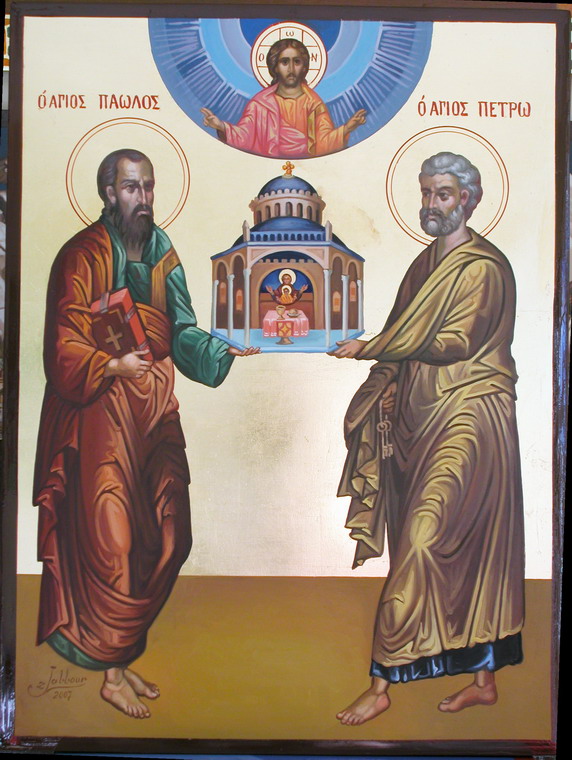
Ss. Peter and Paul sharing a rather unlikely embrace
"Dearly beloved brethren, in the joy of all the holy Feast-days the whole world is partaker. There is but one love of God, and whatsoever is solemnly called to memory, if it hath been done for the salvation of all, must needs be worth the honour of a joyful memorial at the hands of all. Nevertheless, this feast which we are keeping to-day, besides that world-wide worship which it doth of right get throughout all the earth, doth deserve from this city of ours an outburst of gladness altogether special and our own. In this place it was that the two chiefest of the Apostles did so right gloriously finish their race. And upon this day whereon they lifted up that their last testimony, let it be in this place that the memory thereof receiveth the chiefest of jubilant celebrations. O Rome these twain are the men who brought the light of the Gospel of Christ to shine upon thee These are they by whom thou, from being the teacher of lies, wast turned into a learner of the truth.
"These twain be thy fathers, these be in good sooth thy shepherds, these twain be they who laid for thee, as touching the kingdom of heaven, better and happier foundations, than did they that first planned thine earthly ramparts, wherefrom he that gave thee thy name took occasion to pollute thee with a brother's blood. These are they who have set on thine head this thy glorious crown, that thou art become an holy nation, a chosen people, a city both Priestly and Kingly, whom the Sacred Throne of blessed Peter hath exalted till thou art become the Lady of the world, unto whom the world-wide love for God hath conceded a broader lordship than is the possession of any mere earthly empire. Thou wast once waxen great by victories, until thy power was spread haughtily over land and sea, but thy power was narrower then which the toils of war had won for thee, than that thou now hast which hath been laid at thy feet by the peace of Christ.
"It well suited for the doing of the work which God had decreed that the multitude of kingdoms should be bound together under one rule, and that so the universal preaching of the Gospel should find easier entry into all peoples, since all were governed by the empire of one city. But this city, knowing not Him, Who had been pleased to make her great, used her lordship over almost all nations to make herself the minister of all their falsehoods and seemed to herself exceeding godly because there was no false god whom she rejected. But the tighter that Satan had bound her, the more wondrous was the work of Christ in setting her free." (Second nocturn of Mattins, from the festive sermon of St. Leo the Great)
In a previous post we looked at the first millennium Roman liturgy from a textual and historical perspective, at how the traditional liturgy as we have it today evolved from a remarkably similar Mass around the year 800 AD. Today I just want to "throw" some material at you for your own edification once again, this time pertaining to the setting of the first millennium and medieval Roman liturgy, namely the original St. Peter's basilica. Most of what I have below is republished from last year, but with many improvements.
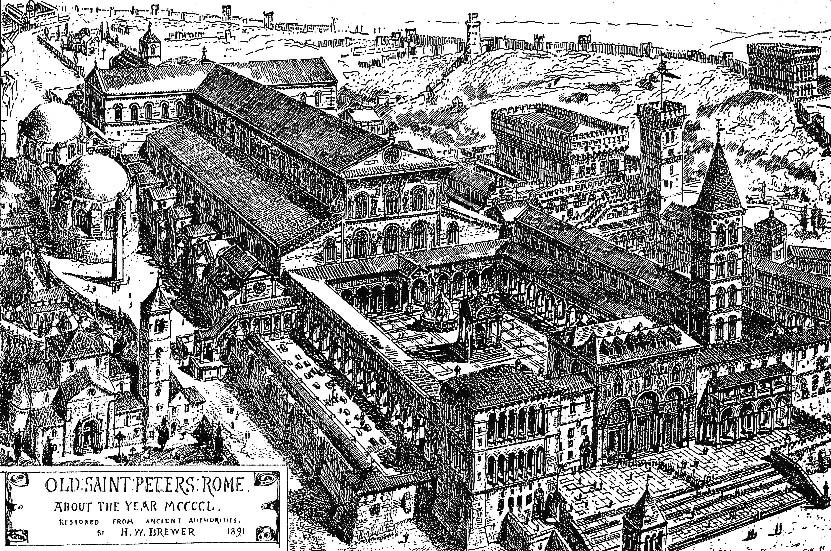
The original St. Peter's basilica was begun by Emperor Constantine over a shrine on Vatican Hill here Christians had venerated what tradition tells us was the place of St. Peter's burial since the first century—St. Peter's bones were not actually discovered until the reign of Pius XII. The basilica was completed in 360, but constantly remodeled. Originally the tomb of the first Pope of Rome was in the apse of the basilica, behind the altar. Tidal flow of pilgrims necessitated switching these two. A more elaborate throne for the Pope was constructed, as consecration of the Bishop of Rome became more usual at St. Peter's. The proliferation of Papal burials at St. Peter's and a series of ninth century invasions by Saracens necessitated further renovations. One such remodel, around the time of Leo IV, led to an altar embroidered in precious stones, ambos and doors of silver, and mosaics taken from the finest Eastern churches. Like most Roman basilicas, there was a group of canons attached to the church.
from: bible-architecture.info
A cloister preceded the entrance. I cannot help but think of Dr. Laurence Hemming's theory of the Catholic churches as temples, as fulfillment of the Temple of Jerusalem. The cloister here is more of an enclosed sacred courtyard than anything monastic. It functioned as a gathering place for people to prepare for Mass, an eschaton—a place between the world and eternity. A pineapple, which I believe predates the Christian era, sat at the center of the cloister. The faithful, as late as the eighth century, washed their hands for Communion at the fountains in this area—although reception on the hand differed drastically from the modern practice. In all, it is like the courtyards of the Temples of Solomon and Herod: a gateway through which the faithful would leave the world and prepare for the Divine. Sort of the story of salvation, eh?
Drawing of how the mosaics on the façade of the basilica,
as restored by Innocent III, would have been arranged.
source: chestofbooks.com
The inside was very much that of a Roman basilica which, before the Christian age, just meant an indoor public gathering place for Romans. The nave would be lined with colonnade, but statuary and imagery was sparse and likely introduced in the early second millennium. The primary source of color would have been through patterns and mosaics on the ceiling, particularly in the apse. While Byzantine churches tend to either depict Christ as a child in our Lady's arms or Christ the Pantocrator in the apse, Roman churches vary more, and St. Peter's would have been no exception. St. Mary Major's apse bears Christ and our Lady seats in power, while the Lateran depicts Him ascended above all the saints—and above us, lest we forget, and St. Paul outside the Wall depicts Him in blessing but with a book of judgment. St. Peter's might have also had some variation of Christ in the apse, above the stationary Papal throne.
The altar was both ad orientem and versus populum, a rarity outside of Rome. During the Canon the faithful would go into the transepts and the aisles of the nave and face eastward with the priest, meaning they did not "see" the change on the altar. Curtains may have been drawn regardless, guaranteeing people did not see the consecration until the Middle Ages at least.
The populistic arrangement, of the Pope facing the people, gives us a clear indication of where the reformers discovered their "Mass as assembly" idea, but neglects the very hierarchical arrangement, which the Bishop of Rome elevated, surrounded by his counsel and the servants of the faithful in Holy Orders. Certainly a more popularly accessible structure than a Tridentine pontifical Mass from the throne, but not remotely as democratic as the reformers would have us believe. Papal Mass continued their arrangement through 1964, the year of the last Papal Mass.
St. Peter's basilica around the year 1450
(taken from wikipedia)
A cross-section of the old basilica
(from saintpetersbasilica.org)
Neglect during the Avignon papacy left the Roman basilicas in ruins, St. Peter's included. The roof of the basilica and its re-enforcement were both wood, which had long rotted. Instability eventually caused the walls and foundations to crack and, although many maintained the basilica was still usable, the decision was made to replace it in 1505 by Pope Julius II. The decision rightly sent Romans into uproar, as the old church had been used by the City and by saints for twelve centuries.
Inside the old St. Peter's notice the elevated altar surrounded by the twisting
arches. St. Peter's tomb was below. Above is the fatal ceiling.
(image taken from jamesbrantley.net)
The fate of much of the original basilica is unknown. Elements of the portico survived, as did the Papal tombs. St. Peter's tomb received its own chapel, named for the Pope who built it. The high altar was retained and en-capsuled in the new altar. The altar sanctuary had been walled from the nave by winding pillars, supposedly taken from the Temple of Solomon. They were destroyed, although their design is retained in the new basilica's baldacchino.
Another long view inside the old basilica
Below is a reconstruction of how the sanctuary would have looked during the Middle Ages. Note the wall and doors, much like an iconostasis, betwixt the sanctuary and nave. The semi-circular benches around the Papal throne were for the canons of the basilica, the seven deacons of Rome, the archpriest, and the cardinals. The doors on the sides might have been either for the deacons, for those administering Holy Communion to the people in the transepts, or for those visiting the tomb below the sanctuary.
From New Liturgical Movement
Note the side altars, where the Roman low Mass as we know it was formed. Also, the entrance to St. Peter's tomb from doors under the stairs.
The reconstruction below, however, seems to aim at imitating a medieval version of St. Peter's basilica. The above image, of the basilica in the first millennium, shows a church which has not yet undergone various renovations consequent to medieval piety and style: the barrier above is more of a railing than a wall, there are side-chapels below but not above, and curtains around the altar—emphasizing the mystery of it all, and colonnade around the Papal throne—pointing to the unique place in the sanctuary of the chair of Peter. The walls are also sparser in the pre-Middle Ages image above. I suspect the person who created these images is of the Byzantine tradition, as he has put icons above the altars as decoration rather than more Romanesque mosaics and paintings. Still, quite an effort.
Below is a video from the same source showing a detailed view of the old basilica. I always found the old pineapple funny. It is a pagan bronze work dating to the first century and which resided in the Vatican square for no reason other than its pre-dating the basilica.
The image of Christ dominates this great cathedral built in His name
Today is the day we commemorate the (re-)dedication of the Archbasilica of Our Savior, also known as St. John Lateran. This church is great not so much for its size, grandeur, history, or architecture—although all are quite impressive, but because this church is the cathedral of Rome and, hence, the foremost church in the world. It is the Pope's cathedral, although people often mistake St. Peter's for this honor.
The throne of the Bishop of Rome
Christian worship existed at this location in the southeastern corner of Rome, near the walls of the old City, since the first century, when Ss. Peter and Paul themselves were present there. After Christianity was permitted to crawl out of the Roman woodwork Emperor Constantine began to build several major churches on behalf of the Christians. Contrary to popular opinion, Constantine did not give too much preference to Christianity over paganism during this period. He gave the Church and the Bishop of Rome considerable real estate, like the Lateran Palace, where the popes resided until the reign of Pius IX, but not in prime locations.
The Church of Our Savior eventually became the main seat of the Bishop of Rome due to its proximity to the Lateran Palace. Important stational days in Holy Week—particularly Palm Sunday, Maundy Thursday, and Holy Saturday—which are communal in nature take place here. The consecration of the Bishop of Rome, and his coronation as Pope, and special blessings took place at this cathedral, emphasizing the Pope's role as a bishop for the City. During one Maundy Thursday Pope St. Gregory the Great was performing the mandatum (re: foot-washing ceremony) and after washing twelve men's feet and thirteenth appeared. This man's luminous face was described as perfect by the Pope. The man immediately disappeared. St. Gregory concluded it was an angel, or perhaps even Our Lord Himself. This is why in the old Roman rite thirteen men's feet were washed in Maundy Thursday as opposed to the instinctive twelve.
The Cathedral of Our Savior was subjected to barbaric invasions by the Goths in the sixth century, by the Saracens in the ninth century, and earth quakes throughout. By the reign of Sergius III (r. 904-911) the Cathedral had fallen into such disarray it required a re-model, including a new roof. It was re-dedicated by Pope Sergius and given a consecration to Ss. John the Baptist and John the Evangelist, hence its vulgar name "St. John Lateran."
The Lateran Cathedral as seen from the square
In the first millennium the square in front of the Lateran Cathedral and Palace hosted the election of the Pope. After the death of the previous Pontiff the clergy would gather all Roman citizens, the cardinals (originally the priests and deacons of Rome) would elect nominees from amongst themselves, and the candidate with the greatest yell from the crowd would be the new Bishop of Rome. In the late first millennium violence often resulted and which faction could gain entrance to the Cathedral, consecrate its candidate, and enthrone him would have the Pope! During the middle ages the Archbasilica hosted five ecumenical councils, the Papal Court, and the public square of Rome. Pope Innocent III famously received St Francis of Assisi here, after first suggesting that the poor saint preach to the pigs in the public market—a suggestion which the saint immediately followed, and also saw the friar holding up the Cathedral, which was crumbling under the sins of the Church.
Pope Benedict XVI enthroned after election
As the Popes moved to Avignon, the Cathedral fell again into disarray and was partially destroyed due to a fire. It was re-modeled during the Renaissance and again during the 18th century, when the statues in the niches were added. Today the Popes still use this great Cathedral for Maundy Thursday, Ascension Thursday, Corpus Christi, pastoral visits, and enthronement after election.
I was blessed by God to be able to visit this awesome place a year and a half ago, whilst in Rome during Lent. My two friends and I, one Catholic and one then-searching, thought the Lateran to be an interesting one hour stop we could make on our way to the Colosseum. We spent five hours in the Lateran and two in the Colosseum.
The facade, a baroque addition, is impressive, but not as impressive as the one gracing St. Mary Major. I was not impressed with the Lateran until I stepped inside. What first struck me was the sheer scale of the place. I have been to St. Patrick's Cathedral in New York City several times, a larger church, but less open and hence smaller in scale.
The imposing floor
My feet were sore from walking the Eternal City in boating shoes, so I ended up dragging the pads of my feet without intending to do so. This had the most spectacular effect. One can feel the texture of the mosaic floor in this Cathedral. Every bump and tile has character to it. History seeps from the ground of this place and the Spirit of God encompasses it. The words of the introit are verily said of this house of God:
Terrible is this place and This is none other than the house of God; this is the gate of heaven; and it shall be called the court of God.—Genesis 28:17
We made our way through the various side chapels over the course of an hour or two, before coming to the Chapel of St. Francis, shown below.
Depictions of the Saint and the Holy Ghost are abound in the chapel, including this one of this heart, re-calling his stigmata:
The Blessed Sacrament Chapel is next to the Papal Altar. There is a grand tabernacle surrounded by four statues of Popes. Interestingly the Popes are vested as deacons, indicating that they too are just servants at the altar of the High Priest, Christ. The Chapel is crowned by a depiction of the Last Supper and then of Our Lord's Ascension:
In the center of the Cathedral is the Papal Altar, topped by a canopy and reliquary which, although ornamented with busts of St. John the Baptist and John the Evangelist, contains the head of St. Paul. Imagine that almost every Pope from the fourth century has celebrated Mass on this altar, surrounded by St. Paul and Our Lord Himself.
The Papal Altar
And the canopy with the reliquary:
Across from the altar is the great apse of the Cathedral. A massive back wall is topped with gold mosaics containing icons of Our Lord, Our Lady, Ss. John the Baptist and John the Evangelist, and other Biblical figures. One must also recall the organic continuity of this cathedral. Icons of Ss. Francis and Dominic were not-so-deftly inserted at a later time! At the end of a long aisle, containing an organ, balconies for the cantors, and choir stalls for clergy in attendance, is the throne of the Supreme Pontiff:
Beyond the apse is a gift shop. Horrifically, the tomb of Pope Innocent III, the most powerful man of the Middle Ages, is a a cross beam for the door frame! How passes the glory of the world!
Something striking about this place is the color in it. The nave is a bland white, as per Italian baroque style for public places, but the sanctuary and other locations from the early Christian era, Middle Ages, and Renaissance is thriving with life and color. Even niches between icons and mosaics were treated as opportunities to paint images, images which literally pop out into a third dimension:
The nave for contrast:
The layout is distinctly Roman, the floor is medieval, the ceiling Renaissance, the chapels Baroque, and place entirely Catholic.
The ceiling is a wonder
The Cathedral's altars, chapels, aisles, and niches are a testament to the on-going effort that is the Gospel of Christ, one held by sinners and saints, which must endure every trial and be maintained and expressed through every age. This aisle towards the entrance contained numerous chapels under renovation!
I will leave on a light note. One of my companions was quite taken with the statues of the twelve Apostles in the nave, which are gargantuan in this size given the scale of the Cathedral. Upon arriving at St. Matthew, my friend decided that since the former tax-collector no longer needed his gold, that was no excuse to let is sit unused!
Gimme!
Lastly, across from the Lateran Cathedral is the Scala Sancta, the Holy Stairs from Pilate's palace. Christ was tried atop these steps and descended them to take up His Cross for us. One may only ascend these steps on one's knees. More on them another time....