Showing posts with label Pope. Show all posts

Sunday, March 3, 2013

We Need a Pope Who....


I recently read a series of articles describing Latin Americans' desire to have a Pope who is either one of their own or who "understands" them and the "modern world" better than the "last two papacies." Accusations of Eurocentrism abound in these articles, as do statistics about the growth of Evangelical protestantism in Latin America.

I find this outlook to be very un-supernatural. The cardinals must pick a Pope who "understands" you? I cannot recall a Pope who "understands" what it means to be an American, nor do I want one. I just want whoever God has decided will be Bishop of Rome. The selection of the Pontiff is not a merely human affair, The old saying is that God has chosen the next Pope and the task of the cardinals is to figure out who that person is. We do not pluck Popes from the sea of red hats for only political considerations. When this has been done the results have been mixed at best.

Then there is the second dimension to this issue. Latin America is becoming very commercialized, as access to high speed communications, cheap imported products, and foreign media eases. With this has been a certain liberalization in culture which has disposed some to Liberation Theology, some to protestantism, and some to outright Marxism. Sexual indiscretion is certainly more common in some Latin American countries, thanks to foreign encouragement. One article included a story of a person who claims to be "unchurched" after leaving Catholicism over its sexual morals.

Can anyone really believe for a moment that some hip, modern, iPhone-owning, condom-OKing clerics will really improve the situation? No, of course not. Such a move would make things worse, for giving Latin America such a leader would only force more of the drink down their throats that is causing that part of the world to be religiously tipsy now. A Pope who is fine with condoms is not going to appeal to young people. Such a Pope would, which God will not give us, would only be received by the youth as condoning their own irreligious sexual rootlessness. Would a Pope with a charismatic or Evangelical prayer style bring people back to Mass or would people perceive a leader who, like them, is moving away from formal worship and towards loose and emotion "experiences?"

I have found in my own life that young people, regardless of the country and their ethnicity, are a bit bored by modernity, which to them is no longer exciting, just normal. If they do not practice religion it is more often out of ignorance and the influence of their parents than due animus towards faith. These youths are an opportunity for a teaching moment for the future Pope and his bishops. Perhaps they can teach these young people what Evelyn Waugh called an "ancient, newly learned form of words" known as prayer.

People are after meaning in their lives, and the social upheaval in Latin America suggests that part of the world is no different. Latin America needs a Pope, like the rest of the world, that will teach and re-invigorate the faith of Christ. A religious father who pats us on the back and tells us we are doing a great job is a disaster or any sinner.

Thursday, February 14, 2013

Tu Es Petrus


After the somber and penitential Mass of Ash Wednesday, the Sistine Chapel Choir erupted into Palestrina's Tu Es Petrus (Thou Art Peter). The faithful expressed their sorrow in great leaps of joy. The altar boys and concelebrants can barely contain themselves. Starting at 2:36 you can see Archbishop Georg Ganswein, the Pope's former secretary and current administrator of the Papal household, holding back his tears.

"Et ego dico tibi quia tu es Petrus et super hanc petram aedificabo ecclesiam meam et portae inferi non praevalebunt adversum eam. Et tibi dabo claves regni caelorum et quodcumque ligaveris super terram erit ligatum in caelis et quodcumque solveris super terram erit solutum in caelis"

"And I say to thee: That thou art Peter; and upon this rock I will build my church, and the gates of hell shall not prevail against it. And I will give to thee the keys of the kingdom of heaven. And whatsoever thou shalt bind upon earth, it shall be bound also in heaven: and whatsoever thou shalt loose upon earth, it shall be loosed also in heaven." —Matthew 16:18-19

Wednesday, February 13, 2013

Pope's Last Sermon

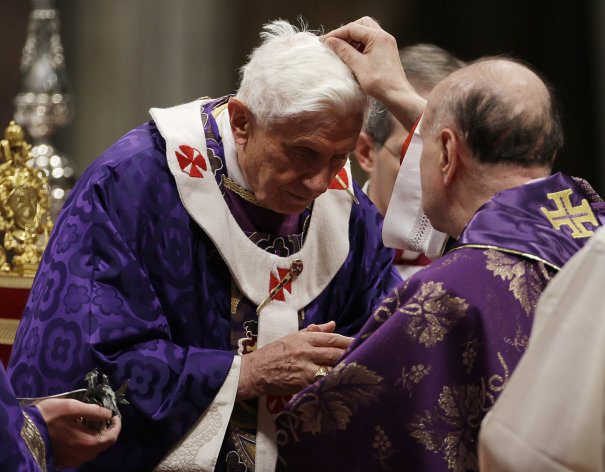
Pope receives ashes at St Peter's Basilica


Venerable Brothers,
Dear Brothers and Sisters!

Today, Ash Wednesday, we begin a new Lenten journey, a journey that extends over forty days and leads us towards the joy of Easter, to victory of Life over death. Following the ancient Roman tradition of Lenten stations, we are gathered for the celebration of the Holy Eucharist. The tradition says that the first statio took place in the Basilica of Saint Sabina on the Aventine Hill. Circumstances suggested we gather in St. Peter's Basilica. Tonight there are many of us gathered around the tomb of the Apostle Peter, to also ask him to pray for the path of the Church going forward at this particular moment in time, to renew our faith in the Supreme Pastor, Christ the Lord. For me it is also a good opportunity to thank everyone, especially the faithful of the Diocese of Rome, as I prepare to conclude the Petrine ministry, and I ask you for a special remembrance in your prayer.

The readings that have just been proclaimed offer us ideas which, by the grace of God, we are called to transform into a concrete attitude and behaviour during Lent. First of all the Church proposes the powerful appeal which the prophet Joel addresses to the people of Israel, "Thus says the Lord, return to me with all your heart, with fasting, with weeping, and with mourning" (2.12). Please note the phrase "with all your heart," which means from the very core of our thoughts and feelings, from the roots of our decisions, choices and actions, with a gesture of total and radical freedom. But is this return to God possible? Yes, because there is a force that does not reside in our hearts, but that emanates from the heart of God and the power of His mercy. The prophet says: "return to the Lord, your God, for he is gracious and merciful, slow to anger, abounding in steadfast love, and relenting in punishment" (v. 13). It is possible to return to the Lord, it is a 'grace', because it is the work of God and the fruit of faith that we entrust to His mercy. But this return to God becomes a reality in our lives only when the grace of God penetrates and moves our innermost core, gifting us the power that "rends the heart". Once again the prophet proclaims these words from God: "Rend your hearts and not your garments" (v. 13). Today, in fact, many are ready to "rend their garments" over scandals and injustices – which are of course caused by others - but few seem willing to act according to their own "heart", their own conscience and their own intentions, by allowing the Lord transform, renew and convert them.

This "return to me with all your heart," then, is a reminder that not only involves the individual but the entire community. Again we heard in the first reading: "Blow the horn in Zion! Proclaim a fast, call an assembly! Gather the people, sanctify the congregation; Assemble the elderly; gather the children, even infants nursing at the breast; Let the bridegroom leave his room, and the bride her bridal tent (vv.15-16). The community dimension is an essential element in faith and Christian life. Christ came "to gather the children of God who are scattered into one" (Jn 11:52). The "we" of the Church is the community in which Jesus brings us together (cf. Jn 12:32), faith is necessarily ecclesial. And it is important to remember and to live this during Lent: each person must be aware that the penitential journey cannot be faced alone, but together with many brothers and sisters in the Church.

Finally, the prophet focuses on the prayers of priests, who, with tears in their eyes, turn to God, saying: " Between the porch and the altar let the priests weep, let the ministers of the LORD weep and say: “Spare your people, Lord! Do not let your heritage become a disgrace, a byword among the nations! Why should they say among the peoples, ‘Where is their God?’"(V.17). This prayer leads us to reflect on the importance of witnessing to faith and Christian life, for each of us and our community, so that we can reveal the face of the Church and how this face is, at times, disfigured. I am thinking in particular of the sins against the unity of the Church, of the divisions in the body of the Church. Living Lent in a more intense and evident ecclesial communion, overcoming individualism and rivalry is a humble and precious sign for those who have distanced themselves from the faith or who are indifferent.

"Well, now is the favourable time, this is the day of salvation" (2 Cor 6:2). The words of the Apostle Paul to the Christians of Corinth resonate for us with an urgency that does not permit absences or inertia. The term "now" is repeated and can not be missed, it is offered to us as a unique opportunity. And the Apostle's gaze focuses on sharing with which Christ chose to characterize his life, taking on everything human to the point of taking on all of man’s sins. The words of St. Paul are very strong: "God made him sin for our sake." Jesus, the innocent, the Holy One, "He who knew no sin" (2 Cor 5:21), bears the burden of sin sharing the outcome of death, and death of the Cross with humanity. The reconciliation we are offered came at a very high price, that of the Cross raised on Golgotha, on which the Son of God made man was hung. In this, in God’s immersion in human suffering and the abyss of evil, is the root of our justification. The "return to God with all your heart" in our Lenten journey passes through the Cross, in following Christ on the road to Calvary, to the total gift of self. It is a journey on which each and every day we learn to leave behind our selfishness and our being closed in on ourselves, to make room for God who opens and transforms our hearts. And as St. Paul reminds us, the proclamation of the Cross resonates within us thanks to the preaching of the Word, of which the Apostle himself is an ambassador. It is a call to us so that this Lenten journey be characterized by a more careful and assiduous listening to the Word of God, the light that illuminates our steps.

In the Gospel passage according of Matthew, to whom belongs to the so-called Sermon on the Mount, Jesus refers to three fundamental practices required by the Mosaic Law: almsgiving, prayer and fasting. These are also traditional indications on the Lenten journey to respond to the invitation to «return to God with all your heart." But he points out that both the quality and the truth of our relationship with God is what qualifies the authenticity of every religious act. For this reason he denounces religious hypocrisy, a behaviour that seeks applause and approval. The true disciple does not serve himself or the "public", but his Lord, in simplicity and generosity: "And your Father who sees everything in secret will reward you" (Mt 6,4.6.18). Our fitness will always be more effective the less we seek our own glory and the more we are aware that the reward of the righteous is God Himself, to be united to Him, here, on a journey of faith, and at the end of life, in the peace light of coming face to face with Him forever (cf. 1 Cor 13:12).

Dear brothers and sisters, we begin our Lenten journey with trust and joy. May the invitation to conversion , to "return to God with all our heart", resonate strongly in us, accepting His grace that makes us new men and women, with the surprising news that is participating in the very life of Jesus. May none of us, therefore, be deaf to this appeal, also addressed in the austere rite, so simple and yet so beautiful, of the imposition of ashes, which we will shortly carry out. May the Virgin Mary, Mother of the Church and model of every true disciple of the Lord accompany us in this time. Amen!


source: Vatican Radio

Monday, February 11, 2013

Silly Man: Pope "Never Had A Chance"


The end of a Papacy is, under normal circumstance, something like the death of a family patriarch for Catholics, for the Pope is a spiritual father to us. Yes, once the Pope is gone we can say "the Pope is gone, long live the Pope," but we still ought to keep the old Pontiff's legacy in perspective and be sensitive to the feelings and faith of Catholics, something John Moody at Fox News is not doing.

While going through the stories on the odd end of the pontificate of Benedict XVI I came across this ridiculous editorial written by John Moody and which is posted on foxnews.com. Not only is this article irreverent, it is callously ignorant is outright wrong!
He never had a chance. [Really? That's your intro?]
From the moment he appeared on the balcony of St. Peter’s on April 19, 2005, to greet the faithful, Benedict XVI faced an insurmountable problem: [The Roman Curia?] He was not John Paul II. [Now get this....]
Benedict’s decision to resign the papacy is being blamed on his age – nearly 86 – and his health – never robust. He might just as well have been diagnosed with a broken papal heart. [He is not resigning because he can barely walk, nor because he can barely speak, nor because his mental powers might be diminishing. He is resigning because he spent eight years in a personal crisis over not being his Polish predecessor.]
Because his nearly eight years on the Throne of the Fisherman never really produced the results he hoped for. [Has any Pope in his lifetime seen the results he wanted?] He did not unite the conservative and progressive wings of the Catholic Church. [He did not see the Church in such American political terms] He did not re-establish its place in Europe, [thats a long-term project, you can't undo WW2 and socialism overnight] the work of a previous Pope Benedict and the reason he took that name. Nor did he expand its foothold in Asia, [that's more debatable, the Chinese usurpation of Church power is not the Pope's fault] cement its dominance in Latin America, or make serious inroads in Africa. And he did not bring to fruition the ecumenical understanding with other major faiths that he hoped would bloom during his reign. [Did he hope for ecumenical flowers?]
Benedict faced nearly impossible odds, even before he was elected. Joseph Ratzinger -- his given name -- was already white-haired [He was white-haired when he attend Vatican II half a century ago!] and stooped when he became pope. He was a German of the World War II generation, and as a boy had served, involuntarily, as a member of the Hitler Youth. [He went to jail for not attending meetings] His last job in Rome as Cardinal Ratzinger was to head the Congregation for the Doctrine of the Faith – the branch of the Vatican charged with enforcing dogma and rooting out dissent. For that, he was dubbed The Chief Inquisitor and The Rottweiler. His idea of a wild night was a single glass of Riesling and an hour of playing his piano – he was an accomplished interpreter of Beethoven and Mozart. [That's more wild that most of my nights. Perhaps he thinks John Paul II was closer to Rodrigo Borgia than Joseph Ratzinger?]
That’s who he is. But what stymied him was who he isn’t. [He's serious!]
His Polish predecessor as Pope, Karol Wojtyla of Krakow, exploded into worldwide prominence and popularity in 1978 as a strong, smiling face for a church that had not elected a non-Italian for nearly 500 years. In combining as his papal name both John and Paul, Wojtyla suggested to the Church that he would follow the prudent style of rule set forth by John XXIII and Paul VI – neither of them firebrands. [The Church's state did not improve very much under JP2's reign. Most vital statistics declined, but no one said JP2 wasn't Paul VI]
Then, John Paul revealed his true nature: a brilliant, conservative theologian, [he was not an accomplished theologian, he was more of a wise pastor if anything] a master politician and historian, a nonpareil philosopher, [The beatification sermon did not even go this far] a polished performer thanks to his youthful acting career, an unapologetic anti-communist, and an inveterate traveler. He also didn’t mind showing off. He skied. He hiked. He canoed. He sported sneakers. He watched bare-breasted African women do traditional dances. [Someone tell Cardinal Arinze! Liturgical dance!] And he never stopped talking, in any of the seven or eight languages he spoke fluently, about how God loves us.
By contrast, Benedict’s meek initial outings were public relations meltdowns. His smile, though genuine, looked somehow sinister, as if he were about to bite his audience. [I have been to a Papal audience and never felt his carnivorous threat] Determined to restore the Church’s luster in Europe, where it is often treated like a dotty old aunt, Benedict gave a lecture in Regensburg, Germany, in 2006 that appeared to denigrate Islam. [Hardly] The non-Catholic world howled; the Vatican cringed and apologized. [Not exactly]
On his first visit to the U.S. as pope, Benedict offered contrite apologies for the Church’s ham-handed treatment of the U.S. church’s sex scandal involving its priests. Even the pope’s humble mien did not satisfy some, who pronounced him cold and unfeeling toward the plight of victims of clergy abuse. [How much can he do to apologize and make amends with those whom he did not harm and still assumes guilt for letting down? Do you think the previous Pope really would have done a bit better?] He joined the Twitterati, but his first attempt was a sterile: “I am pleased to get in touch with you through Twitter. I bless all of you from my heart.” At least he stayed under 140 characters.
In nearly eight years, Benedict issued three encyclicals – direct messages to the faithful that often reveal a pope’s enthusiasms and interests. Benedict’s first – entitled “God is Love” -- is a caressing, simply worded, logic-based reassurance that our Lord loves us. Yet even his writing about love suffers in comparison with John Paul’s towering, intellectual yet intimate canon of work. [Adrian Fortescue was right. The mania with encyclicals needs to desist]
None of which lessens Benedict’s place in the line of Vicars of Christ. His decision to resign was a brave one, based on personal humility, in keeping with his message to the faithful that the things of Earth are transient, but the promise of heaven lasting and infinite.  For that he should be remembered. [What a lovely ending, after railing against the man for being a dotty German carnivore rather than a Polish ski master!]


Pope Benedict XVI Resigns


Today during the meeting for the Consistory for Canonizations Benedict XVI announced his intention to vacate the Bishopric of Rome at 8:00PM on February 28th. The text of his address is below, first in Latin (as he gave it) then in English:
Fratres carissimi,
Non solum propter tres canonizationes ad hoc Consistorium vos convocavi, sed etiam ut vobis decisionem magni momenti pro Ecclesiae vitae communicem. Conscientia mea iterum atque iterum coram Deo explorata ad cognitionem certam perveni vires meas ingravescente aetate non iam aptas esse ad munus Petrinum aeque administrandum.

Bene conscius sum hoc munus secundum suam essentiam spiritualem non solum agendo et loquendo exsequi debere, sed non minus patiendo et orando. Attamen in mundo nostri temporis rapidis mutationibus subiecto et quaestionibus magni ponderis pro vita fidei perturbato ad navem Sancti Petri gubernandam et ad annuntiandum Evangelium etiam vigor quidam corporis et animae necessarius est, qui ultimis mensibus in me modo tali minuitur, ut incapacitatem meam ad ministerium mihi commissum bene administrandum agnoscere debeam. Quapropter bene conscius ponderis huius actus plena libertate declaro me ministerio Episcopi Romae, Successoris Sancti Petri, mihi per manus Cardinalium die 19 aprilis MMV commissum renuntiare ita ut a die 28 februarii MMXIII, hora 29, sedes Romae, sedes Sancti Petri vacet et Conclave ad eligendum novum Summum Pontificem ab his quibus competit convocandum esse.

Fratres carissimi, ex toto corde gratias ago vobis pro omni amore et labore, quo mecum pondus ministerii mei portastis et veniam peto pro omnibus defectibus meis. Nunc autem Sanctam Dei Ecclesiam curae Summi eius Pastoris, Domini nostri Iesu Christi confidimus sanctamque eius Matrem Mariam imploramus, ut patribus Cardinalibus in eligendo novo Summo Pontifice materna sua bonitate assistat. Quod ad me attinet etiam in futuro vita orationi dedicata Sanctae Ecclesiae Dei toto ex corde servire velim.

Ex Aedibus Vaticanis, die 10 mensis februarii MMXIII


BENEDICTUS PP XVI
____________________________________

Dear Brothers, 

I have convoked you to this Consistory, not only for the three canonizations, but also to communicate to you a decision of great importance for the life of the Church. After having repeatedly examined my conscience before God, I have come to the certainty that my strengths, due to an advanced age, are no longer suited to an adequate exercise of the Petrine ministry. I am well aware that this ministry, due to its essential spiritual nature, must be carried out not only with words and deeds, but no less with prayer and suffering. However, in today’s world, subject to so many rapid changes and shaken by questions of deep relevance for the life of faith, in order to govern the bark of Saint Peter and proclaim the Gospel, both strength of mind and body are necessary, strength which in the last few months, has deteriorated in me to the extent that I have had to recognize my incapacity to adequately fulfill the ministry entrusted to me. For this reason, and well aware of the seriousness of this act, with full freedom I declare that I renounce the ministry of Bishop of Rome, Successor of Saint Peter, entrusted to me by the Cardinals on 19 April 2005, in such a way, that as from 28 February 2013, at 20:00 hours, the See of Rome, the See of Saint Peter, will be vacant and a Conclave to elect the new Supreme Pontiff will have to be convoked by those whose competence it is.

Dear Brothers, I thank you most sincerely for all the love and work with which you have supported me in my ministry and I ask pardon for all my defects. And now, let us entrust the Holy Church to the care of Our Supreme Pastor, Our Lord Jesus Christ, and implore his holy Mother Mary, so that she may assist the Cardinal Fathers with her maternal solicitude, in electing a new Supreme Pontiff. With regard to myself, I wish to also devotedly serve the Holy Church of God in the future through a life dedicated to prayer.

From the Vatican, 10 February 2013

BENEDICTUS PP XVI


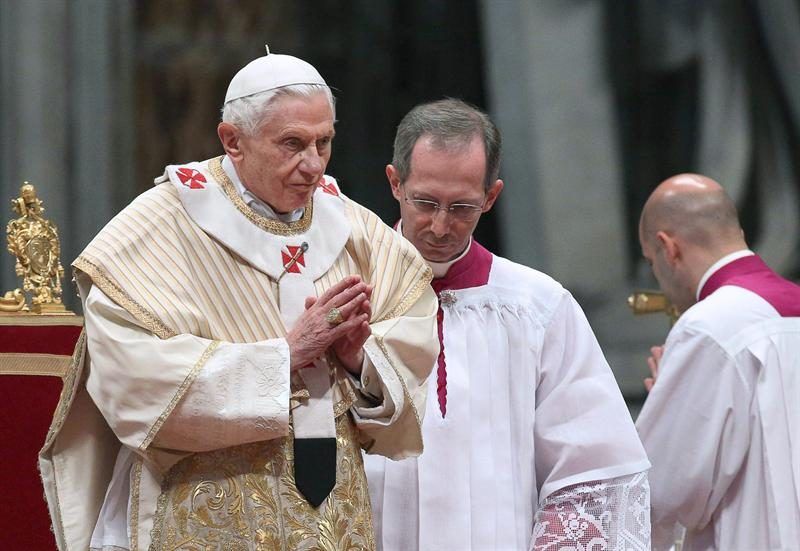
Leo XIII reigned into his nineties as Pope. Benedict was advised by a doctor to cease making transatlantic voyages and to reduce his schedule. One could say a Pope who cannot travel could at least govern the Holy See, run the Papal Household, oversee the functions of the Curia, and perform public liturgies. If Benedict is resigning then he must see himself as no longer able to even perform these functions. Fr Lombardi, Vatican spokesman, said he would move to Castel Gandolfo to set his affairs in order, then retire to a cloister within the Holy See's walls and live out the rest of his natural live, basically as a monk. To the right is a video of Fr Lombardi giving the press conference after the announcement. He is visibly nervous, shuffling papers that are already in neat stacks and fidgeting with his hands.


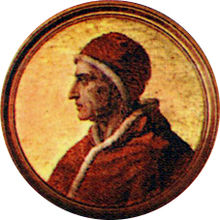
Gregory XII, the last Pope to resign
This creates a very strange dynamic: there will be two inhabitants of the Petrine chair alive at once. The last Pope to truly resign was the 13th century mystic St Peter Celestine, a hermit who was elected by a deadlocked conclave out of the blue, reigned for a few months, became aware he was not "up for the job," and resigned only to be arrested and indirectly killed by his successor, Boniface VIII. There were three claimants to the Papacy (Pope Gregory XII, and his opponents John XXIII and Benedict XIII). All three were deposed of any claims to the Papacy at the Council of Constance in 1415, leading to the election of Martin V. Some rotten skunks were kicked out by the cardinals or the people of Rome in the 9th, 10th, and 11th centuries, usually on account of their personal wickedness. Nothing quite like this has ever happened though.

Usually the previous Pope's death sets things in motion. His rooms are sealed, his seal is destroyed. The Dean of the College of Cardinals says the Requiem Mass and buries the Pope. The cardinals convene in the Sistine Chapel and elect the new Pontiff in secret. The College of Cardinals as a body makes all governing decisions during the sede vacante. The new Pope assumes office and all the governing authorities. I guess the lack or succession here is what troubles me. It will be more or less a transition, given this current Pope still lives, though his health seems to be failing him.

Many commentators long suggested he might resign someday after watching his predecessor slowly and painfully die in the public eye. John Paul used his struggle as a teaching moment, increasing the Church's credibility on life issues to the secular world. Benedict might think himself physically unable to do even this.

Pray for Pope Benedict and ask God to give us a holy pontiff after him.


Good bye, and thank you.


Wednesday, January 30, 2013

Attack on Peace?

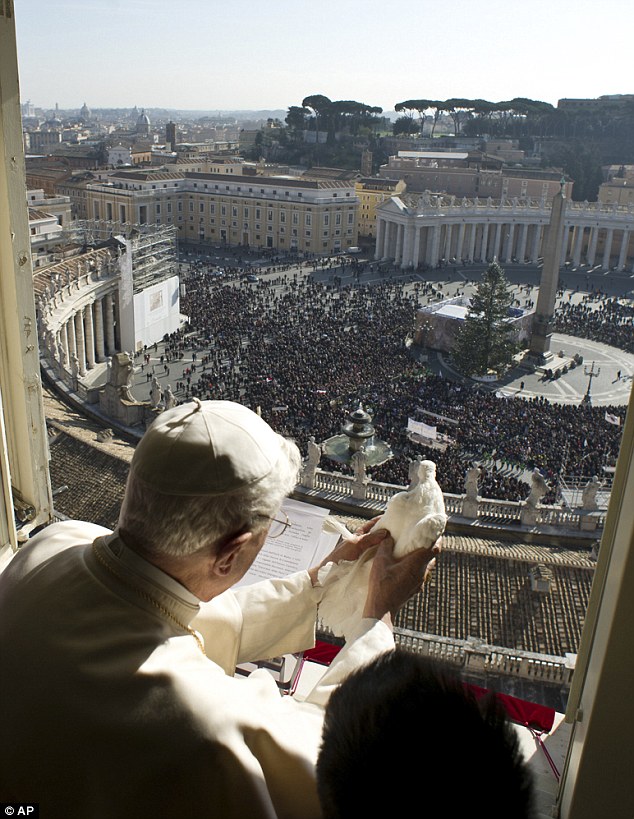
For many years now the Pope has practiced the custom of releasing a dove as a symbol of peace on certain days of the year, usually in the wake of some tide of violence. This weekend the Holy Father released a dove from his window of the Vatican Palace to commemorate the mass murder of Jews during the Holocaust, a time which he himself must recall vividly.

Pope releases a dove to commemorate the Holocaust
source: Daily Mail
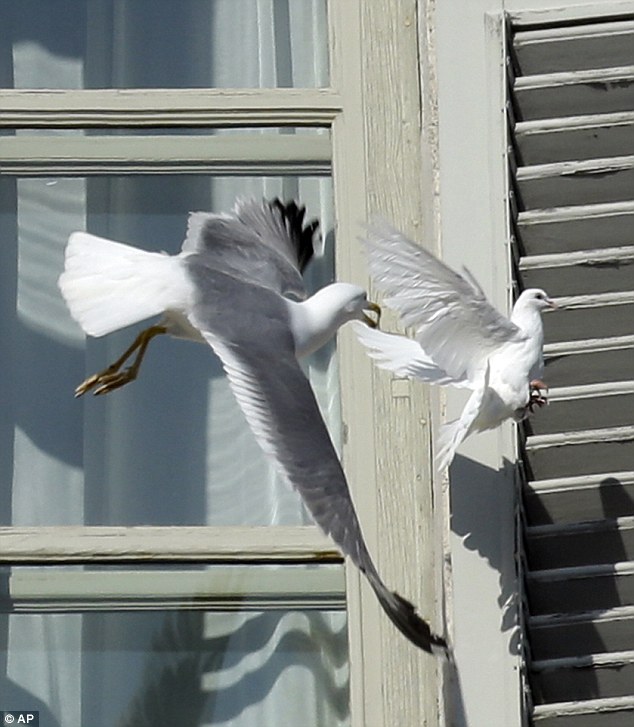
This day the small ceremony was given a twist of irony when seconds after the Pontiff released the dove, the bird was attacked by one of those nasty little winged swine known as a seagulls. Seagulls, which are most commonly found searching for french fries in the parking lot of the local McDonald's, no matter how far inland you are, make a nice analogy to modern culture for us: the fat, nasty materialist molesting peace with great violence.

The dove flees the Apostolic Palace for its life!
source: Daily Mail

Sunday, December 30, 2012

Dominus Vobiscum, Part II: the Mass of the Faithful

Padre Pio begins the Canon of the Mass

Having considered the body language and its latent ideas in the Fore-Mass—or "Mass of the Catechumens" or "Liturgy of the Word"—in the two rites, let us briefly recap. The traditional rite has a distinct focus on the altar and the crucifix at its center throughout. The readings are sacramentals, read or sung as devotions and as grand proclamations toward God and not directly related to the assembled congregation. In the newer rite, celebrated Oratory-style or American-suburban, the focal point is not the altar, but it is not any other particular point either. The orientation of the priest and lectors and deacons is undoubtedly to the people, or "assembly" as the 1969 General Instruction calls those at Mass. Ceremonies constantly move the focus from the priest at some enormous chair, to the ambo, to the cantor, to the Gospel procession, back to the ambo. The new rite's first half is quite discombobulated.

Part I: The Credo
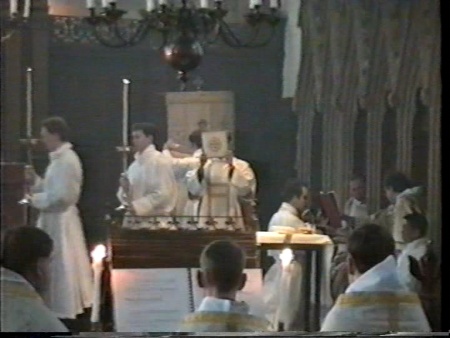
Deacon processes with burse in the Sarum rite
At this point in both rites the priest begins the Creed, a fitting start to the Mass of the Faithful. In the old rite this goes the same way as the Gloria. The priest intones the Creed with "Credo in unum Deum" and recited the rest of it quietly with his ministers. When finished they genuflect and disappear to their chairs on the side. Near the end of the Creed the deacon brings the burse to the altar with great reverence and unfolds the corporal on the altar. He then returns to the chair and escorts the priest and subdeacon to the altar to begin the Offertory.

How to receive this? The Creed, like the Gloria, is quickly recited and then the ministers leave, so to avoid any distraction that they may cause at the focal point, the altar. There is another element of reverence, not for the altar, but for the Blessed Sacrament Itself. The Roman rite, and more so in other medieval usages like the Dominican rite, avoids any unnecessary obstruction of the tabernacle or He Who dwells within it. The reverence for the altar remains in this stage and anticipation of the Offertory and the Consecration builds as the deacon lays down the corporal, a linen cloth which symbolizes the linen sheet on which Christ laid after His death on the Cross. At this point we learn something: the Mass is one continuous action, with every functional sacramental in its nature and anticipating the Eucharistic sacrifice.
Again, orientation and the lack of focus of the ceremonies creates confusion and the impression of disparate parts in the new rite. The Creed is, curiously, recited again with the priest and faithful facing each other. This could give the impression of a mutual confession of faith, but to each other? Why? The priest, from his chair, and the standing people confess God, but without any general congruity in how they do so. There is no procession, nor any other ceremony before the Offertory which anticipates the Eucharist-centered purpose of the Mass in the new form.

In some of the Eastern rites, particularly the Byzantine tradition, the Creed is preceded by a procession of clergy with the bread and chalices to be consecrated. During the Creed the priests and deacons prepare the altar and then exchange the kiss of peace. It is an action singularly focused on the Eucharistic "action," as Gregory Dix called the liturgy. The procession of the deacon with the burse in the old Roman rite is certainly a variation of this, but the focus on the Eucharistic action is quite unapparent in the Pauline rite.

Part II: the Offertory

The physical ceremony of the old Roman rite is remarkably unremarkable. The subdeacon and deacon assist the priest in preparing the host and chalice, the latter of which the deacon offers with the priest, the subdeacon takes his place at the center of the floor, and the altar is incensed, followed by the clergy in order of importance. The priest quickly turns towards the people, saying "Orate fratres" ("pray brethren"...) in a subdued voice, finishing it in silence. After reading a private prayer, called the Secret, he begins the Preface aloud, first a dialogue with the congregation, and then a monosyllabic chant. At the end, he and his ministers recite the Sanctus and begin the Canon of the Mass.

Offertory of the old Mass is quite straight forward
The new rite exemplifies liturgical deregulation. In most places, even the Papal Masses and Oratories, the option for a procession of the gifts is exercised. This entails some coterie of laity walking a ciborium of hosts (which they should not actually be touching) and a container of wine, to the priest, who then offers them, sometimes aloud and sometimes in silence. Then the gifts might be incensed. Options galore.

I do not get it....
The priest, after making some quiet prayers, says the "Orate fratres" in its entirety aloud and then says the Prayer Over the Gifts, a modernized version of the Secret, aloud, before beginning the Preface as normal. At the end the celebrant must recite the Sanctus with his congregants, unlike in the old rite where he may quickly recite it with his ministers and begin the Canon.

Here we have two insights, one new and one revisited, into the theology of the old Mass versus the new. In the older rite it is the duty and role of the priest to make the offering, which he begins at the offertory. In short, he says the Mass; the Mass is his prayer. The procession in the new rite, although in principle optional, gives the impression that the laity have more than a passive role in the offering of the sacrifice. The laity offer bread and wine toward an ambiguous end. One of the oddities of this procession is that it does not seem to have any purpose. Many of the processions in the Eastern liturgies are part of one continuous segment of the liturgy. As mentioned earlier, the offering begins immediately after the procession, which is made by those who do the offering. In the Pauline rite the people process, the priest offers, and then they dialogue. The line between priest and laity is especially blurred at this point in the new rite as now the priest has left his chair and, in practice, is likely facing the laity. Rather than the priest and congregation conversing with God, an uninformed or unformed person may be impressed that the priest and people are, again, talking to each other.

And he is still talking to me!

Part III: the Canon


At this point most analysis would be of the texts of the two rites, but there is still plenty to learn from the posturing in the Canon of the old Mass and in the various Eucharistic prayers of the new.
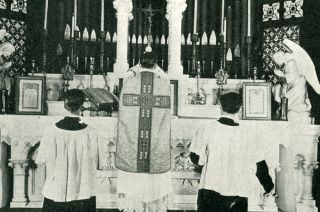
The elevation in the old rite
In the traditional rite the priest opens his arms and then bows under the crucifix to begin the Canon with the words "Te igitur, Clementissime Pater...." ("Therefore we humbly beseech Thee, most merciful Father...."). Whenever speaking of the gifts he blesses them by making the sign of the cross. At the remembrances of the living and of the dead the deacon walks away so that the priest may have a quiet moment. Before the consecration, the priest extends his flat palms over the oblations, a sign of sacrifice retained from the Hebrew temple sacrifices and ceremonies. At the moments of consecration the priest bows over the altar, with his elbows and forearems actually resting on the surface, so that he might speak the words of institution. After consecrating the bread and chalice, the celebrant immediately falls to his knees, with all the other ministers, in adoration, then rises, elevates the sacred species for public adoration, replaces the Host or Chalice on the altar, and genuflects again. The other ministers rise again. In contrast to the ministers, the laity have been kneeling since the Sanctus and will until the Pater Noster.
Minor elevation

At various points the priest asks that God might deign to send His angel to take this sacrifice to his sublime altar in heaven, a sacrifice prefigured by the Old Testament priest Melchisedeck. At this point the priest kisses the altar, a reverence for what has just occurred upon it. At the end of the Canon, the priest elevates the Host and Chalice ever so slightly as a formal offering of them to God. The Canon is hence complete. Christ is made present and offered to the Father.


Msgr. Charles Pope of the Archdiocese of Washington suggests that these are actually very charismatic, enthusiastic gestures. Bows of extreme humility, demonstrative signs of the cross, kisses on the altar, and raising the Host and Chalice in adoration and offering all indicate a very physical and joyful expression of prayer. It is a shame to think that many assume these gestures are strange excesses or mechanical actions that crept into the Mass over the years through some manner of legalism. Truth be told, if we followed one American priest's "Do the red, say the black" philosophy these gestures would never have existed; indeed, had priests over the centuries followed this mindset we might still be gathering around a supper table, eating some herbs, saying a few psalms in Hebrew, and having the priest say "this is my body" and "this is my blood" over bread and wine, then departing. This old Roman Mass is the opposite of legalistic structure. It is the expression of Holy joy!

I should also like to note that while these sanguine gestures are not always visible to the congregation, they benefit the priests and ministers in their prayers because they, somewhat like Sacraments themselves, are outward expressions of an internal truth.

The new rite, on the other hand, is somewhat lacking in this organic development, but then again it was written by a committee in 1967, not by thousands of priests over 1,500 years.

The minor elevation in a conventionally celebrated Mass according to the
Missal of Paul VI
The Canon, or any of three other "Eucharistic prayers" composed in 1967-8, begins with either the open-palms sacrificial gesture previously mentioned or with one large sign of the cross over the gifts. No other gestures are made until the consecration. During the consecration, when Mass is said facing the congregated people, priests often appear to extend the bread and wine to the people at the words "take this all of you and eat/drink it." Some priests will bend over the bread and wine while pronouncing the changing words of Christ's. The species are elevated, not reverenced, immediately and are then followed by a reverential genuflection. If using the Roman Canon the priest will cross himself at the words "every grace and blessing." At the end of the Eucharistic prayer, at the words "through Him and with Him and in Him" (per Ipsum et cum Ipso et in Ipso, the minor elevation in the old rite) the priest and deacon together raise the Host and Chalice.

The loss of enthusiasm and physical prayer in the ceremonies prescribed in the new rite are quite tragic. One gets the impression that the priest is simply reciting a narrative or reading some text aloud rather than performing an action delegated to him; in fact, I think many priests have unfortunately adopted this attitude themselves. The reduction in the number of signs of the cross made muddles the significance of the sign of the cross. Rather than being used as a gesture many think it is a blessing, as though the Eucharist could be blessed any further than It already is. Eastward rather than versus populum celebration of the new rite curtails these points of obfuscation but the priest is still talking to me! In the old rite is was normal that at high Mass the choir would sing the Sanctus before the consecration and the Benedictus or some other motet afterwards. In the Byzantine rites there may be singing or, as is the case in the Melkite Church, the consecration is sung in the same tone as other prayers, at least giving people some sense of continuity with the rest of the liturgy.
Eucharistic consecration ("anaphora") in the Byzantine rite
source: wikipedia


Part IV: Pater Noster to Communion

Kiss of Peace in the old rite
Now the priest begins the Pater Noster ("Our Father...."). After he sings this prayer he fractures the Host and places a particle of It into the Chalice. The choir begins to sing the Agnus Dei ("Lamb of God....") while the priest, crouched over the altar, makes three prayers for a worthy partaking of Holy Communion. After the first of these prayers the celebrant and deacon kiss the altar and then, symbolically, each other in the "kiss of peace." The deacon then passes the peace to the other sacred ministers. The priest strikes his breast three times before the Eucharistic Lord saying Domine non sum dignus ut intres sub tectum meum, sed tantum dic verbo et sanabitur anima mea ("Lord I am not worthy that Thou should enterest beneath my roof, but only speak the word and my soul shall be healed"). Making the sign of the Cross with both the Host and Chalice, the priest communicates.

Padre Pio communicates during Mass
The deacon sings the Confiteor ("I confess to almighty God" etc) and the priest prays for absolution for the communicants. The priest then reveals the Sacrament to the people with the words Ecce Agnus Dei, ecce Qui tollit peccata mundi ("Behold the Lamb of God, Behold He Who takes away the sins of the world") to which the people respond three times with the Domine non sum dignus.... said by the priest a few minutes earlier. People kneel at the altar rail, where ever there is space, and receive the Sacrament, Which is placed on each communicant's tongue, with a prayer by the priest that this communion may benefit the recipient unto eternal life. After communion the priest cleanses the sacred vessels and reposes the Sacrament in the tabernacle.

Byzantine communion
For some reason I do not see much room for analysis here, as the communion of the faithful is simply a separate even from the priest's. The priest, as the one saying the Mass, must make communion, but the faithful receive Him based upon the state of their souls. The priest dispenses communion, there is no mutual interaction. The focus is the Eucharist, so the priest simply says a prayer rather than speaking with the communicant. This is, again, quite similar to the Byzantine rite where the people, although standing, come to the priest or deacon, receive communion on the mouth, and the minister says "The servant/handmaiden of God [Name] receives the precious Body and Blood of Our Lord and Savior Jesus Christ for the remission of his/her sins and for eternal life."

The modern rite, in practice, is a time of the Mass I find most confuses or discomforts non-Catholic visitors to Mass and must frustrates those of a traditional persuasion.

The priest recites the Pater Noster with the congregation, normal in the East but quite a novelty in the West (it had not been done since at least the papacy of St. Gregory of the Great, which started in 590AD). The priest then concludes by wishing peace to all present and the deacon invites them to "share a sign of Christ's peace." The people, or choir, sing the Agnus Dei while the priest fractures the Host, places a particle into the Chalice, says one quick prayer, and shows the Host and Chalice to the people. The people recite the Domine non sum dignus once, not three times, the priest makes communion, with no private prayers or ceremonies, and proceeds to administer communion to the faithful, who, according to the General Instruction, "as a rule, approach in a procession." Although section 160 of the General Instruction seems to forbid communion in the hand, the United States, and basically the entire world, has an "indult" for this practice. The Body and Blood of the Lord are to be "reverenced," usually with a bow or, less commonly, a genuflection, and received either on the hand or the tongue. The priest raises the Host or Chalice, says "the Body/Blood of Christ" to which the communicant responds "Amen."

Children saying the Pater Noster in the diocese of
Greensburg. One wonders if they have been taught what
this posture means

In practice the new rite is not always this simple. In nine out of ten parishes a large chunk of people hold hands or raise them up during the Pater Noster, a posture novel to the laity in the Roman rite. The "sign of peace," which replaces the kiss of peace, is usually a handshake from some slightly disturbed neighbor, regardless of whether one is at the local parish or St. Peter's in Rome. I remember one friend of mine had attended Mass for the first time, in the old rite, the previous night at the FSSP church in Rome and the next day attended the new Mass for the first time at St. John Lateran. During the sign of peace my friend, who was sitting behind me, gave a disturbed "ummm, hello" to the man sitting next to him.

The Pope gives communion during a Mass
Communion is almost always in the hand, except in a few very pious diocese in Asia, Africa, and Eastern Europe, where the "indult" was either never requested or never implemented. One will also find certain "high" churches in major cities where communion is given while kneeling at the altar rail rather than in procession, in contradiction of the General Instruction. The Holy Father gives communion on the tongue while kneeling, but people must go up to a kneeler to receive from him. One wonders if this is to follow the General Instruction or because of practical considerations focused on his person.

The reaction most non-Catholics or non-Roman Catholics give to me at this part of Mass is "why oh why?" Why must I shake hands with my neighbor after the most important part of Mass? Surely a hello and a firm grip with a stranger or occasional acquaintance does little to improve one's preparation for communion. In the old rite the kiss of peace symbolized Christ's peace descending from His altar in heaven to His altar on earth and to His people on earth. The egalitarian and disorganized nature of this rite in the Pauline Mass obscures this meaning.

Another point of confusion is why the priest, whose role in the Mass and before God is quite distinct from that of the congregation, must communicate at the same time as everyone else and why his preparatory prayers are so limited. Even in terms of ceremony, if the priest celebrates Mass eastward rather than towards the congregation, he must turn, expose the Eucharist, say a prayer with the people, turn again, communicate, and turn to the people yet again to give communion. Madness.

Moreover, there is the un-ending concern over communion in the hand. It is true that communion was not received in the tongue in Rome until the eighth or ninth century, but communion was not put directly on the hand either. A cloth would be laid over the communicant's hand, he would receive the Host onto the cloth, and bend his body down to the Host. Too many particles of Our Lord's Body were lost and this one-by-one process was time consuming, so the practice evolved into what the old rite does. One would be hard pressed to find substantial evidence that the Eucharist was ever seen as something one had the right to touch and even manipulate with one's fingers, aside from a dubious letter attributed to St. Cyril of Jerusalem, since the earliest Christian days. Moreover there is just something odd about people walking around a church, putting a Host into their mouths, without the slightest attention to what has just happened. One associate of mine likened the traditional rite for communion akin to begging to table scraps from heaven. What can we say of the newer rite?


Communion at the annual congress in Los Angeles

I will not delve into Eucharistic ministers, since that belongs beyond the realm of body language and human interaction. It is a theological issue.


Part V: Concluding Rites

Fr Gilles Wach of the Institute of Christ the King reads the
Last Gospel at the end of a Solemn Mass in Chicago
In the older form of the Roman Mass, the priest, after cleaning the vessels with great care and reposing the Sacrament in the tabernacle, reads the communion antiphon and the post-communion prayers, which are akin to the collects mentioned in the part of this series on the Fore-Mass. The priest does this from the right side of the altar. He and his deacons again form a straight line, by their rank with respect to their service at the altar, go to the center, the priest says "Dominus vobiscum," the deacon sings the dismissal (Ite, missa est—"Go, this is the dismissal," Benedicamus Domino—"Let us bless the Lord, or Requiescant in pace—"May they rest in peace" depending on the day). The priest turns back to the altar and, in a deep bow, says a short prayer that the Holy Trinity may accept the sacrifice here offered, kisses the altar, and blesses the people whilst turning to them. He and the subdeacon then go to the left corner of the altar and recite the Last Gospel, a private prayer, while the procession lines up. The procession leaves either in a short path to the sacristy or down the aisle to the door of the church, depending on whether or not the clergy want to greet people as they leave.

The new rite does many of these things, but not in the same order or place. We return again to the "presider's chair" next to the altar for the concluding rites. There is no greeting to begin the post-communion prayer. The blessing is given before the dismissal. One oddity I find is that if the rubrics are followed and the presider and deacon's chairs are away from the altar, will the people be able to see the deacon give the dismissal? It would depend on how visible the clergy wish to be. At the Oxford Oratory the clergy kept quite out of line sight of the altar, and the dismissal seemed to resonate throughout the church without a voice attached to it (not an unpleasant sensation). There is no Last Gospel.

Blessing at the end of Mass

There is very little to say here that has not been said in the segment on the early parts of the Mass. The orientation and place at the altar in the older rite indicates a continuous action which is now drawing to its conclusion while the new primarily suggests an exchange between the priest and his deacons and the people gathered. The place of the clergy aside of, in back of, or near the altar creates a diagonal rather than direct line of sight and one becomes conscientiously aware one is talking to another human being, but hopefully still knows one is making responses to prayers.

A Succinct Conclusion

The traditional Roman rite of Mass emphasizes the altar as a space for an action, which the priest completes with the congregation doing their part behind him. Every gesture focuses on or is done in anticipation of the Eucharist or the presence of God. The priest and people face one direction and particular parts of the altar and sanctuary are used for their own purposes. The center of the altar is vacated though, until the consecration itself, when Christ takes physical presence. All parts of this Mass, including the ones one would consider didactic, like the readings, are done with this orientation and focus.

The newer rite, promulgated by Pope Paul VI in 1969, is in principle awkward and clumsy in its ceremonies and, as we have seen in the segment on the Canon, not always clear on its focus. In practice this rite is much more difficult than in principle, as most all Masses done according to this rite are done in vernacular, facing the people, and with obfuscating dialogue between the priest and laity, and the laity among themselves. This means that relations between participants is obscured and that the Mass itself becomes an agglomeration of rituals rather than one complete action.

I hope our focus on body language, the use of space, gestures, and postures has shed some new light on the importance of ritual and action in the Roman liturgy. While a cardinal, Benedict XVI suggested that the practice of Mass facing the people creates a "closed circle" between priest and laity, one which does not necessarily include God in the tabernacle or Christ's image on the Cross. To improve the general practice of liturgy in the future we must be aware of not only the short comings of certain ceremonies in their gracefulness and their theological implications, but also of the organic brilliance and piety of ceremonies that do work. May God grant my little insight may catch the attention of some others who wish to share in this effort.

Tuesday, December 25, 2012

Christ Is Born! Glorify Him!


From the first Christmas Day sermon of Pope St. Leo the Great:

Dearly beloved brethren, Unto us is born this day a Saviour, Luke ii. 11. Let us rejoice. It would be unlawful to be sad to-day, for today is Life's Birthday; the Birthday of that Life, Which, for us dying creatures, taketh away the sting of death, and bringeth the bright promise of the eternal gladness hereafter. It would be unlawful for any man to refuse to partake in our rejoicing. All men have an equal share in the great cause of our joy, for, since our Lord, Who is the destroyer of sin and of death, findeth that all are bound under the condemnation, He is come to make all free. Rejoice, O thou that art holy, thou drawest nearer to thy crown! Rejoice, O thou that art sinful, thy Saviour offereth thee pardon! Rejoice also, O thou Gentile, God calleth thee to life! For the Son of God, when the fulness of the time was come, which had been fixed by the unsearchable counsel of God, took upon Him the nature of man, that He might reconcile that nature to Him Who made it, and so the devil, the inventor of death, is met and beaten in that very flesh which hath been the field of his victory.
When our Lord entered the field of battle against the devil, He did so with a great and wonderful fairness. Being Himself the Almighty, He laid aside His uncreated Majesty to fight with our cruel enemy in our weak flesh. He brought against him the very shape, the very nature of our mortality, yet without sin. Heb. iv. 15. His birth however was not a birth like other births for no other is born pure, nay, not the little child whose life endureth but a day on the earth. To His birth alone the throes of human passion had not contributed, in His alone no consequence of sin had had -part. For His Mother was chosen a Virgin of the kingly lineage of David, and when she was to grow heavy with the sacred Child, her soul had already conceived Him before her body. She knew the counsel of God announced to her by the Angel, lest the unwonted events should alarm her. The future Mother of God knew what was to be wrought in her by the Holy Ghost, and that her modesty was absolutely safe.
Therefore, dearly beloved brethren, let us give thanks to God the Father, through His Son, in the Holy Ghost: Who, for His great love wherewith He loved us, hath had mercy on us and, even when we were dead in sins, hath quickened us together with Christ, Eph. ii. 4, 5, that in Him we might be a new creature, and a new workmanship. Let us then put off the old man with his deeds (Col. iii. 9); and, having obtained a share in the Sonship of Christ, let us renounce the deeds of the flesh. Learn, O Christian, how great thou art, who hast been made partaker of the Divine nature, 2 Pet. i. 4, and fall not again by corrupt conversation into the beggarly elements above which thou art lifted. Remember Whose Body it is Whereof thou art made a member, and Who is its Head, (1 Cor. vi. 15.) Remember that it is He That hath delivered thee from the power of darkness and hath translated thee into God's light, and God's kingdom.

Christ is born! Glorify Him!

Sunday, November 18, 2012

Dedication of the Basilicas of Ss. Peter and Paul

In the older calendar today is the commemoration of the dedication of the basilicas of St. Paul Outside the Wall and of St. Peter's on Vatican Hill.

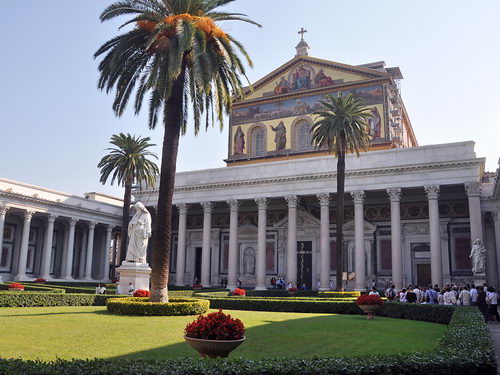
The Papal Basilica of St. Paul outside the Walls
(photo from Ferrell's Travel Blog)
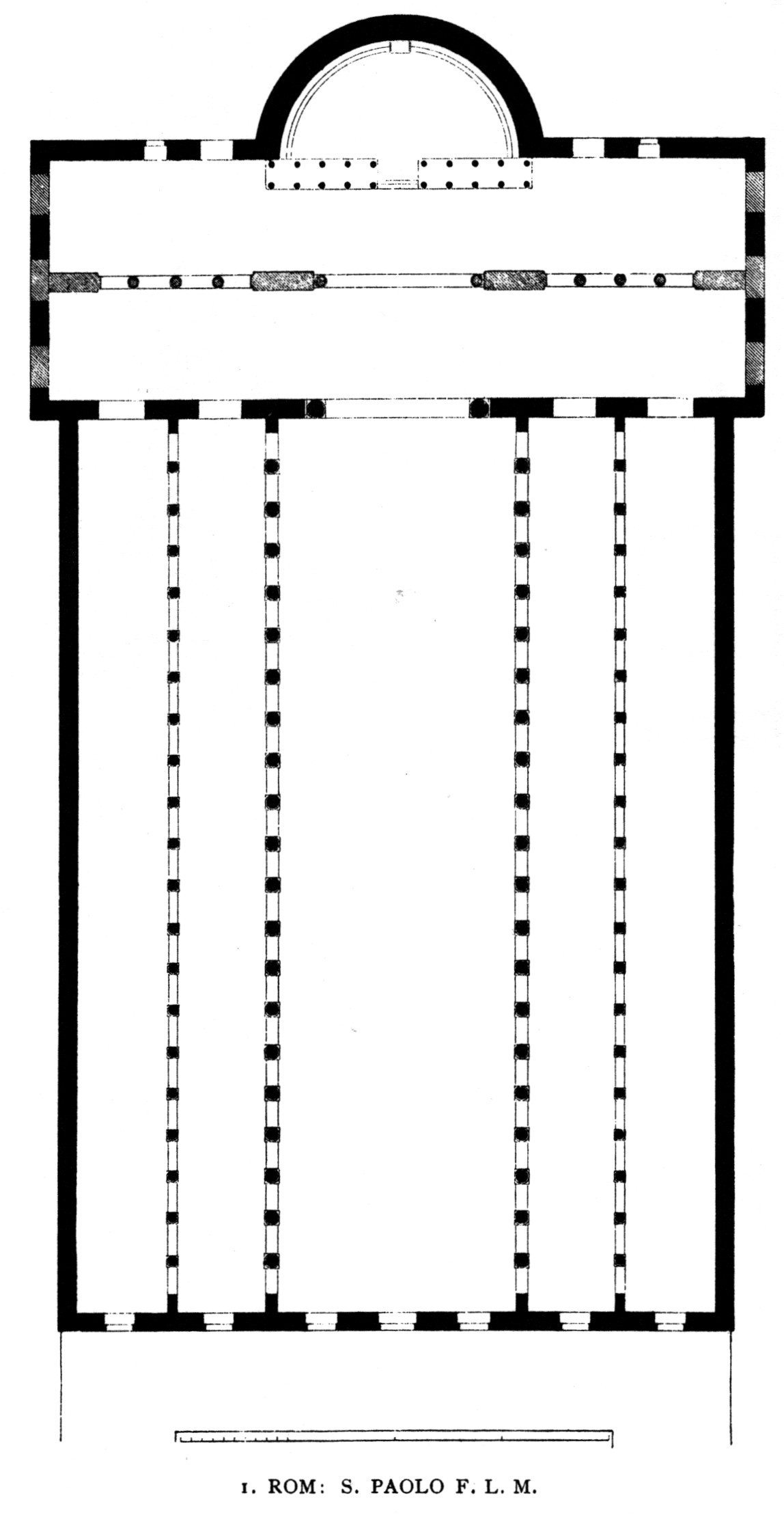
Layout of St. Paul's (from wikipedia)
St. Paul's looks much as it did centuries ago, but the structure itself is not original. A fire in the nineteenth century caused the roof and much of the structure to implode, only to be rebuilt. The layout is distinctly old-Roman. The aisles are long and straight, a larger aisle in the middle with smaller aisles on the side for the congregants to stand during the consecration. The altar is upon an elevated sanctuary and opposite a chair from which the Pope may pontificate.

The ancient Roman Christians venerated this site as the place of St. Paul's beheading and burial. As a Roman citizen the great apostle to the gentiles was spared the agony of crucifixion. His head now rests in the Roman Cathedral, but his body still resides in a tomb beneath the main altar of the basilica.

St. Paul outside the Wall remains the only Papal basilica I have not visited, so I will refrain from commenting any further.

On the other hand, I spent two days in st. Peter's and have quite a bit to say, but people tend to like pictures as much as words, so I will make this into a visual post very shortly.

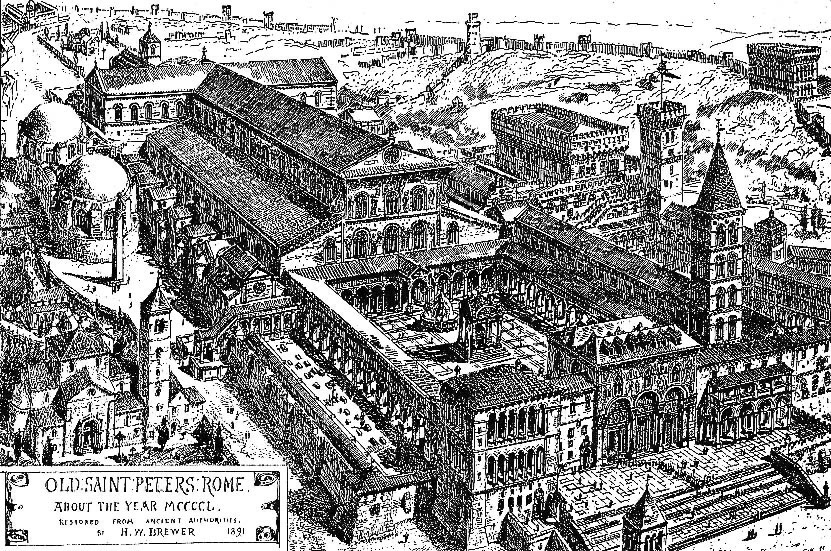
The original St. Peter's basilica was begun by Emperor Constantine over a shrine on Vatican Hill here Christians had venerated what tradition tells us was the place of St. Peter's burial since the first century—St. Peter's bones were not actually discovered until the reign of Pius XII. The basilica was completed in 360, but constantly remodeled. Originally the tomb of the first Pope of Rome was in the apse of the basilica, behind the altar. Tidal flow of pilgrims necessitated switching these two. A more elaborate throne for the Pop was constructed, as consecration of the Bishop of Rome became more usual at St. Peter's at the cost of the Lateran Cathedral, papal tombs, and a series of ninth century invasions by Saracens. One such remodel, around the time of Leo IV, led to an altar embroidered in precious stones, ambos and doors of silver, and mosaics taken from the finest Eastern churches. Like most Roman basilicas, there was a group of canons attached to the church and a cloister preceding the entrance.

St. Peter's basilica around the year 1450
(taken from wikipedia)

A cross-section of the old basilica
(from saintpetersbasilica.org)
Neglect during the Avignon papacy left the Roman basilicas in ruins, St. Peter's included. The roof of the basilica and its re-enforcement were both wood, which had long rotted. Instability eventually caused the walls and foundations to crack and, although many maintained the basilica was still usable, the decision was made to replace it in 1505 by Pope Julius II. The decision rightly sent Romans into uproar, as the old church had been used by the City and by saints for twelve centuries.

Inside the old St. Peter's notice the elevated altar surrounded by the twisting
arches. St. Peter's tomb was below. Above is the fatal ceiling.
(image taken from jamesbrantley.net)
The fate of much of the original basilica is unknown. Elements of the portico survived, as did the Papal tombs. St. Peter's tomb received its own chapel, named for the Pope who built it. The high altar was retained and en-capsuled in the new altar. The altar sanctuary had been walled from the nave by winding pillars, supposedly taken from the Temple of Solomon. They were destroyed, although their design is retained in the new basilica.

Another long view inside the old basilica
Below is a reconstruction of how the sanctuary would have looked during the Middle Ages. Note the wall and doors, much like an iconostasis, betwixt the sanctuary and nave. The semi-circular benches around the Papal throne were for the canons of the basilica, the seven deacons of Rome, the archpriest, and the cardinals.

From New Liturgical Movement
Note the side altars, where the Roman low Mass as we know it was formed. Also, the entrance to St. Peter's tomb from doors under the stairs.


Below is a video from the same source showing a detailed view of the old basilica. I always found the old pine cone funny. It is a pagan bronze work dating to the first century and which resided in the Vatican square for no reason other than its pre-dating the basilica.