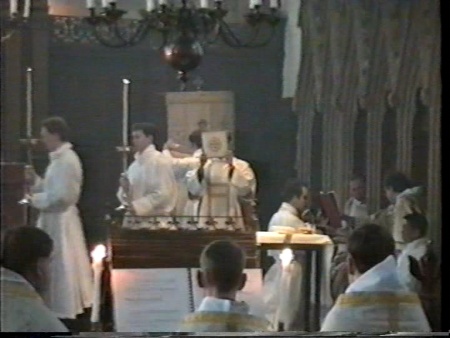
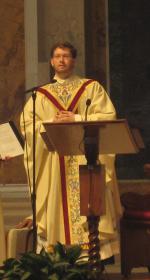
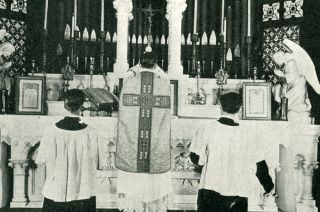
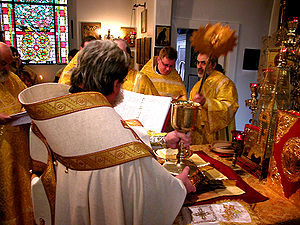
Showing posts with label body language. Show all posts

Saturday, June 8, 2013

Fall and Redemption According to St. Bernard

The Rad Trad is contemplating another series of some kind, since his readers do seem to enjoy them. His series on body language in the Mass, the Papal Coronation, and the Reasons for the Reform of the Roman Rite are by far his most read posts. Rad Trad welcomes any input from readers, or suggestions pertaining to their favorite subjects.
 
It is Saturday, which means today is Our Lady's day. We celebrate the Resurrection in some sense every Sunday, the day that glorious event took place. The Saturday before the Resurrection Our Lady remained faithful though Jesus was buried in the tomb. So we should always dedicate some time on Saturday to thinking about Mary's devotion to Our Lord. To aid this effort, consider this sermon of St. Bernard on the Apocalypse ch. 12 taken from Mattins:
 
It was indeed a serious injury that one man and one women inflected on us, dearly beloved; but thanks to God, it was also by one Man and one woman that all things were restored, and with a great increase of grace too. For "not like the offense is gift", on the contrary the benefits received are greater than the loss sustained. Yes, that was how the Maker supreme in good judgment and in kindness plied His craft: what had been bruised, He did not break. Rather, He remade it completely in such a way as to be in more advantage to us: out of the old Adam He made a new Man; Eve He transformed into Mary.

Sunday, December 30, 2012

Dominus Vobiscum, Part II: the Mass of the Faithful

Padre Pio begins the Canon of the Mass

Having considered the body language and its latent ideas in the Fore-Mass—or "Mass of the Catechumens" or "Liturgy of the Word"—in the two rites, let us briefly recap. The traditional rite has a distinct focus on the altar and the crucifix at its center throughout. The readings are sacramentals, read or sung as devotions and as grand proclamations toward God and not directly related to the assembled congregation. In the newer rite, celebrated Oratory-style or American-suburban, the focal point is not the altar, but it is not any other particular point either. The orientation of the priest and lectors and deacons is undoubtedly to the people, or "assembly" as the 1969 General Instruction calls those at Mass. Ceremonies constantly move the focus from the priest at some enormous chair, to the ambo, to the cantor, to the Gospel procession, back to the ambo. The new rite's first half is quite discombobulated.

Part I: The Credo

Deacon processes with burse in the Sarum rite
At this point in both rites the priest begins the Creed, a fitting start to the Mass of the Faithful. In the old rite this goes the same way as the Gloria. The priest intones the Creed with "Credo in unum Deum" and recited the rest of it quietly with his ministers. When finished they genuflect and disappear to their chairs on the side. Near the end of the Creed the deacon brings the burse to the altar with great reverence and unfolds the corporal on the altar. He then returns to the chair and escorts the priest and subdeacon to the altar to begin the Offertory.

How to receive this? The Creed, like the Gloria, is quickly recited and then the ministers leave, so to avoid any distraction that they may cause at the focal point, the altar. There is another element of reverence, not for the altar, but for the Blessed Sacrament Itself. The Roman rite, and more so in other medieval usages like the Dominican rite, avoids any unnecessary obstruction of the tabernacle or He Who dwells within it. The reverence for the altar remains in this stage and anticipation of the Offertory and the Consecration builds as the deacon lays down the corporal, a linen cloth which symbolizes the linen sheet on which Christ laid after His death on the Cross. At this point we learn something: the Mass is one continuous action, with every functional sacramental in its nature and anticipating the Eucharistic sacrifice.

Again, orientation and the lack of focus of the ceremonies creates confusion and the impression of disparate parts in the new rite. The Creed is, curiously, recited again with the priest and faithful facing each other. This could give the impression of a mutual confession of faith, but to each other? Why? The priest, from his chair, and the standing people confess God, but without any general congruity in how they do so. There is no procession, nor any other ceremony before the Offertory which anticipates the Eucharist-centered purpose of the Mass in the new form.

In some of the Eastern rites, particularly the Byzantine tradition, the Creed is preceded by a procession of clergy with the bread and chalices to be consecrated. During the Creed the priests and deacons prepare the altar and then exchange the kiss of peace. It is an action singularly focused on the Eucharistic "action," as Gregory Dix called the liturgy. The procession of the deacon with the burse in the old Roman rite is certainly a variation of this, but the focus on the Eucharistic action is quite unapparent in the Pauline rite.

Part II: the Offertory

The physical ceremony of the old Roman rite is remarkably unremarkable. The subdeacon and deacon assist the priest in preparing the host and chalice, the latter of which the deacon offers with the priest, the subdeacon takes his place at the center of the floor, and the altar is incensed, followed by the clergy in order of importance. The priest quickly turns towards the people, saying "Orate fratres" ("pray brethren"...) in a subdued voice, finishing it in silence. After reading a private prayer, called the Secret, he begins the Preface aloud, first a dialogue with the congregation, and then a monosyllabic chant. At the end, he and his ministers recite the Sanctus and begin the Canon of the Mass.

Offertory of the old Mass is quite straight forward
The new rite exemplifies liturgical deregulation. In most places, even the Papal Masses and Oratories, the option for a procession of the gifts is exercised. This entails some coterie of laity walking a ciborium of hosts (which they should not actually be touching) and a container of wine, to the priest, who then offers them, sometimes aloud and sometimes in silence. Then the gifts might be incensed. Options galore.

I do not get it....
The priest, after making some quiet prayers, says the "Orate fratres" in its entirety aloud and then says the Prayer Over the Gifts, a modernized version of the Secret, aloud, before beginning the Preface as normal. At the end the celebrant must recite the Sanctus with his congregants, unlike in the old rite where he may quickly recite it with his ministers and begin the Canon.

Here we have two insights, one new and one revisited, into the theology of the old Mass versus the new. In the older rite it is the duty and role of the priest to make the offering, which he begins at the offertory. In short, he says the Mass; the Mass is his prayer. The procession in the new rite, although in principle optional, gives the impression that the laity have more than a passive role in the offering of the sacrifice. The laity offer bread and wine toward an ambiguous end. One of the oddities of this procession is that it does not seem to have any purpose. Many of the processions in the Eastern liturgies are part of one continuous segment of the liturgy. As mentioned earlier, the offering begins immediately after the procession, which is made by those who do the offering. In the Pauline rite the people process, the priest offers, and then they dialogue. The line between priest and laity is especially blurred at this point in the new rite as now the priest has left his chair and, in practice, is likely facing the laity. Rather than the priest and congregation conversing with God, an uninformed or unformed person may be impressed that the priest and people are, again, talking to each other.

And he is still talking to me!

Part III: the Canon


At this point most analysis would be of the texts of the two rites, but there is still plenty to learn from the posturing in the Canon of the old Mass and in the various Eucharistic prayers of the new.

The elevation in the old rite
In the traditional rite the priest opens his arms and then bows under the crucifix to begin the Canon with the words "Te igitur, Clementissime Pater...." ("Therefore we humbly beseech Thee, most merciful Father...."). Whenever speaking of the gifts he blesses them by making the sign of the cross. At the remembrances of the living and of the dead the deacon walks away so that the priest may have a quiet moment. Before the consecration, the priest extends his flat palms over the oblations, a sign of sacrifice retained from the Hebrew temple sacrifices and ceremonies. At the moments of consecration the priest bows over the altar, with his elbows and forearems actually resting on the surface, so that he might speak the words of institution. After consecrating the bread and chalice, the celebrant immediately falls to his knees, with all the other ministers, in adoration, then rises, elevates the sacred species for public adoration, replaces the Host or Chalice on the altar, and genuflects again. The other ministers rise again. In contrast to the ministers, the laity have been kneeling since the Sanctus and will until the Pater Noster.
Minor elevation

At various points the priest asks that God might deign to send His angel to take this sacrifice to his sublime altar in heaven, a sacrifice prefigured by the Old Testament priest Melchisedeck. At this point the priest kisses the altar, a reverence for what has just occurred upon it. At the end of the Canon, the priest elevates the Host and Chalice ever so slightly as a formal offering of them to God. The Canon is hence complete. Christ is made present and offered to the Father.


Msgr. Charles Pope of the Archdiocese of Washington suggests that these are actually very charismatic, enthusiastic gestures. Bows of extreme humility, demonstrative signs of the cross, kisses on the altar, and raising the Host and Chalice in adoration and offering all indicate a very physical and joyful expression of prayer. It is a shame to think that many assume these gestures are strange excesses or mechanical actions that crept into the Mass over the years through some manner of legalism. Truth be told, if we followed one American priest's "Do the red, say the black" philosophy these gestures would never have existed; indeed, had priests over the centuries followed this mindset we might still be gathering around a supper table, eating some herbs, saying a few psalms in Hebrew, and having the priest say "this is my body" and "this is my blood" over bread and wine, then departing. This old Roman Mass is the opposite of legalistic structure. It is the expression of Holy joy!

I should also like to note that while these sanguine gestures are not always visible to the congregation, they benefit the priests and ministers in their prayers because they, somewhat like Sacraments themselves, are outward expressions of an internal truth.

The new rite, on the other hand, is somewhat lacking in this organic development, but then again it was written by a committee in 1967, not by thousands of priests over 1,500 years.

The minor elevation in a conventionally celebrated Mass according to the
Missal of Paul VI
The Canon, or any of three other "Eucharistic prayers" composed in 1967-8, begins with either the open-palms sacrificial gesture previously mentioned or with one large sign of the cross over the gifts. No other gestures are made until the consecration. During the consecration, when Mass is said facing the congregated people, priests often appear to extend the bread and wine to the people at the words "take this all of you and eat/drink it." Some priests will bend over the bread and wine while pronouncing the changing words of Christ's. The species are elevated, not reverenced, immediately and are then followed by a reverential genuflection. If using the Roman Canon the priest will cross himself at the words "every grace and blessing." At the end of the Eucharistic prayer, at the words "through Him and with Him and in Him" (per Ipsum et cum Ipso et in Ipso, the minor elevation in the old rite) the priest and deacon together raise the Host and Chalice.

The loss of enthusiasm and physical prayer in the ceremonies prescribed in the new rite are quite tragic. One gets the impression that the priest is simply reciting a narrative or reading some text aloud rather than performing an action delegated to him; in fact, I think many priests have unfortunately adopted this attitude themselves. The reduction in the number of signs of the cross made muddles the significance of the sign of the cross. Rather than being used as a gesture many think it is a blessing, as though the Eucharist could be blessed any further than It already is. Eastward rather than versus populum celebration of the new rite curtails these points of obfuscation but the priest is still talking to me! In the old rite is was normal that at high Mass the choir would sing the Sanctus before the consecration and the Benedictus or some other motet afterwards. In the Byzantine rites there may be singing or, as is the case in the Melkite Church, the consecration is sung in the same tone as other prayers, at least giving people some sense of continuity with the rest of the liturgy.

Eucharistic consecration ("anaphora") in the Byzantine rite
source: wikipedia


Part IV: Pater Noster to Communion

Kiss of Peace in the old rite
Now the priest begins the Pater Noster ("Our Father...."). After he sings this prayer he fractures the Host and places a particle of It into the Chalice. The choir begins to sing the Agnus Dei ("Lamb of God....") while the priest, crouched over the altar, makes three prayers for a worthy partaking of Holy Communion. After the first of these prayers the celebrant and deacon kiss the altar and then, symbolically, each other in the "kiss of peace." The deacon then passes the peace to the other sacred ministers. The priest strikes his breast three times before the Eucharistic Lord saying Domine non sum dignus ut intres sub tectum meum, sed tantum dic verbo et sanabitur anima mea ("Lord I am not worthy that Thou should enterest beneath my roof, but only speak the word and my soul shall be healed"). Making the sign of the Cross with both the Host and Chalice, the priest communicates.

Padre Pio communicates during Mass
The deacon sings the Confiteor ("I confess to almighty God" etc) and the priest prays for absolution for the communicants. The priest then reveals the Sacrament to the people with the words Ecce Agnus Dei, ecce Qui tollit peccata mundi ("Behold the Lamb of God, Behold He Who takes away the sins of the world") to which the people respond three times with the Domine non sum dignus.... said by the priest a few minutes earlier. People kneel at the altar rail, where ever there is space, and receive the Sacrament, Which is placed on each communicant's tongue, with a prayer by the priest that this communion may benefit the recipient unto eternal life. After communion the priest cleanses the sacred vessels and reposes the Sacrament in the tabernacle.

Byzantine communion
For some reason I do not see much room for analysis here, as the communion of the faithful is simply a separate even from the priest's. The priest, as the one saying the Mass, must make communion, but the faithful receive Him based upon the state of their souls. The priest dispenses communion, there is no mutual interaction. The focus is the Eucharist, so the priest simply says a prayer rather than speaking with the communicant. This is, again, quite similar to the Byzantine rite where the people, although standing, come to the priest or deacon, receive communion on the mouth, and the minister says "The servant/handmaiden of God [Name] receives the precious Body and Blood of Our Lord and Savior Jesus Christ for the remission of his/her sins and for eternal life."

The modern rite, in practice, is a time of the Mass I find most confuses or discomforts non-Catholic visitors to Mass and must frustrates those of a traditional persuasion.

The priest recites the Pater Noster with the congregation, normal in the East but quite a novelty in the West (it had not been done since at least the papacy of St. Gregory of the Great, which started in 590AD). The priest then concludes by wishing peace to all present and the deacon invites them to "share a sign of Christ's peace." The people, or choir, sing the Agnus Dei while the priest fractures the Host, places a particle into the Chalice, says one quick prayer, and shows the Host and Chalice to the people. The people recite the Domine non sum dignus once, not three times, the priest makes communion, with no private prayers or ceremonies, and proceeds to administer communion to the faithful, who, according to the General Instruction, "as a rule, approach in a procession." Although section 160 of the General Instruction seems to forbid communion in the hand, the United States, and basically the entire world, has an "indult" for this practice. The Body and Blood of the Lord are to be "reverenced," usually with a bow or, less commonly, a genuflection, and received either on the hand or the tongue. The priest raises the Host or Chalice, says "the Body/Blood of Christ" to which the communicant responds "Amen."

Children saying the Pater Noster in the diocese of
Greensburg. One wonders if they have been taught what
this posture means

In practice the new rite is not always this simple. In nine out of ten parishes a large chunk of people hold hands or raise them up during the Pater Noster, a posture novel to the laity in the Roman rite. The "sign of peace," which replaces the kiss of peace, is usually a handshake from some slightly disturbed neighbor, regardless of whether one is at the local parish or St. Peter's in Rome. I remember one friend of mine had attended Mass for the first time, in the old rite, the previous night at the FSSP church in Rome and the next day attended the new Mass for the first time at St. John Lateran. During the sign of peace my friend, who was sitting behind me, gave a disturbed "ummm, hello" to the man sitting next to him.

The Pope gives communion during a Mass
Communion is almost always in the hand, except in a few very pious diocese in Asia, Africa, and Eastern Europe, where the "indult" was either never requested or never implemented. One will also find certain "high" churches in major cities where communion is given while kneeling at the altar rail rather than in procession, in contradiction of the General Instruction. The Holy Father gives communion on the tongue while kneeling, but people must go up to a kneeler to receive from him. One wonders if this is to follow the General Instruction or because of practical considerations focused on his person.

The reaction most non-Catholics or non-Roman Catholics give to me at this part of Mass is "why oh why?" Why must I shake hands with my neighbor after the most important part of Mass? Surely a hello and a firm grip with a stranger or occasional acquaintance does little to improve one's preparation for communion. In the old rite the kiss of peace symbolized Christ's peace descending from His altar in heaven to His altar on earth and to His people on earth. The egalitarian and disorganized nature of this rite in the Pauline Mass obscures this meaning.

Another point of confusion is why the priest, whose role in the Mass and before God is quite distinct from that of the congregation, must communicate at the same time as everyone else and why his preparatory prayers are so limited. Even in terms of ceremony, if the priest celebrates Mass eastward rather than towards the congregation, he must turn, expose the Eucharist, say a prayer with the people, turn again, communicate, and turn to the people yet again to give communion. Madness.

Moreover, there is the un-ending concern over communion in the hand. It is true that communion was not received in the tongue in Rome until the eighth or ninth century, but communion was not put directly on the hand either. A cloth would be laid over the communicant's hand, he would receive the Host onto the cloth, and bend his body down to the Host. Too many particles of Our Lord's Body were lost and this one-by-one process was time consuming, so the practice evolved into what the old rite does. One would be hard pressed to find substantial evidence that the Eucharist was ever seen as something one had the right to touch and even manipulate with one's fingers, aside from a dubious letter attributed to St. Cyril of Jerusalem, since the earliest Christian days. Moreover there is just something odd about people walking around a church, putting a Host into their mouths, without the slightest attention to what has just happened. One associate of mine likened the traditional rite for communion akin to begging to table scraps from heaven. What can we say of the newer rite?


Communion at the annual congress in Los Angeles

I will not delve into Eucharistic ministers, since that belongs beyond the realm of body language and human interaction. It is a theological issue.


Part V: Concluding Rites

Fr Gilles Wach of the Institute of Christ the King reads the
Last Gospel at the end of a Solemn Mass in Chicago
In the older form of the Roman Mass, the priest, after cleaning the vessels with great care and reposing the Sacrament in the tabernacle, reads the communion antiphon and the post-communion prayers, which are akin to the collects mentioned in the part of this series on the Fore-Mass. The priest does this from the right side of the altar. He and his deacons again form a straight line, by their rank with respect to their service at the altar, go to the center, the priest says "Dominus vobiscum," the deacon sings the dismissal (Ite, missa est—"Go, this is the dismissal," Benedicamus Domino—"Let us bless the Lord, or Requiescant in pace—"May they rest in peace" depending on the day). The priest turns back to the altar and, in a deep bow, says a short prayer that the Holy Trinity may accept the sacrifice here offered, kisses the altar, and blesses the people whilst turning to them. He and the subdeacon then go to the left corner of the altar and recite the Last Gospel, a private prayer, while the procession lines up. The procession leaves either in a short path to the sacristy or down the aisle to the door of the church, depending on whether or not the clergy want to greet people as they leave.

The new rite does many of these things, but not in the same order or place. We return again to the "presider's chair" next to the altar for the concluding rites. There is no greeting to begin the post-communion prayer. The blessing is given before the dismissal. One oddity I find is that if the rubrics are followed and the presider and deacon's chairs are away from the altar, will the people be able to see the deacon give the dismissal? It would depend on how visible the clergy wish to be. At the Oxford Oratory the clergy kept quite out of line sight of the altar, and the dismissal seemed to resonate throughout the church without a voice attached to it (not an unpleasant sensation). There is no Last Gospel.

Blessing at the end of Mass

There is very little to say here that has not been said in the segment on the early parts of the Mass. The orientation and place at the altar in the older rite indicates a continuous action which is now drawing to its conclusion while the new primarily suggests an exchange between the priest and his deacons and the people gathered. The place of the clergy aside of, in back of, or near the altar creates a diagonal rather than direct line of sight and one becomes conscientiously aware one is talking to another human being, but hopefully still knows one is making responses to prayers.

A Succinct Conclusion

The traditional Roman rite of Mass emphasizes the altar as a space for an action, which the priest completes with the congregation doing their part behind him. Every gesture focuses on or is done in anticipation of the Eucharist or the presence of God. The priest and people face one direction and particular parts of the altar and sanctuary are used for their own purposes. The center of the altar is vacated though, until the consecration itself, when Christ takes physical presence. All parts of this Mass, including the ones one would consider didactic, like the readings, are done with this orientation and focus.

The newer rite, promulgated by Pope Paul VI in 1969, is in principle awkward and clumsy in its ceremonies and, as we have seen in the segment on the Canon, not always clear on its focus. In practice this rite is much more difficult than in principle, as most all Masses done according to this rite are done in vernacular, facing the people, and with obfuscating dialogue between the priest and laity, and the laity among themselves. This means that relations between participants is obscured and that the Mass itself becomes an agglomeration of rituals rather than one complete action.

I hope our focus on body language, the use of space, gestures, and postures has shed some new light on the importance of ritual and action in the Roman liturgy. While a cardinal, Benedict XVI suggested that the practice of Mass facing the people creates a "closed circle" between priest and laity, one which does not necessarily include God in the tabernacle or Christ's image on the Cross. To improve the general practice of liturgy in the future we must be aware of not only the short comings of certain ceremonies in their gracefulness and their theological implications, but also of the organic brilliance and piety of ceremonies that do work. May God grant my little insight may catch the attention of some others who wish to share in this effort.

Thursday, October 18, 2012

Dominus Vobiscum, Part I: the Fore-Mass


Usually when people first attend the Traditional Mass, they are struck by its reverence, its staid posturing, and its expressions of sanctity. These three things have something in common other than holiness, tradition, and prayerfulness: they are all physical.

Years ago I bought The Definitve Book of Body Language out of idle curiosity. The author emphasizes in the first chapter that 90% of communication is physical, not verbal. This begs the question: does body language have anything to do with why many are struck by the reverence of the old Mass and find this trait quite lacking in the new? What theology do posture, position, and body language suggest to the faithful?

I intend to compare the traditional Roman Mass and the Mass of Paul VI part by part in order to answer this question. For the sake of honesty, I will examine the Mass of Paul VI both how it is presented in the 2002 Missale Romanum and in the dreary practice of that Mass throughout 99% of the Catholic world.

The first post in this two part series will consider the fore-Mass, or "Mass of the Catechumens" in the old rite and "Liturgy of the Word" in the new.

Part I: Introit through the Collect

In the ancient rite the priest, deacon, and subdeacon arrive at the altar, bend their knees to Christ in the tabernacle, and immediately commence the prayers at the foot of the altar, which faces Eastward and, except in a few Roman churches, usually in the same direction as the people assembled. The ministers bow at the words "Gloria Patri et Filio et Spiritui Sancto" ("Glory be to the Father and to the Son and to the Holy Ghost), as one always does in the old rite at the mention of the name of Jesus or of the Holy Trinity. The priest and ministers then make a confession of their sinfulness, striking their breasts three times at the words "mea culpa, mea culpa, mea maxima culpa" ("through my fault, my fault, my most grievous fault"). The priest makes his own confession, and then the deacons make their own separately. After praying for forgiveness of sins, the ministers ascend the altar. The priest reverences the altar by a kiss and then incenses it.
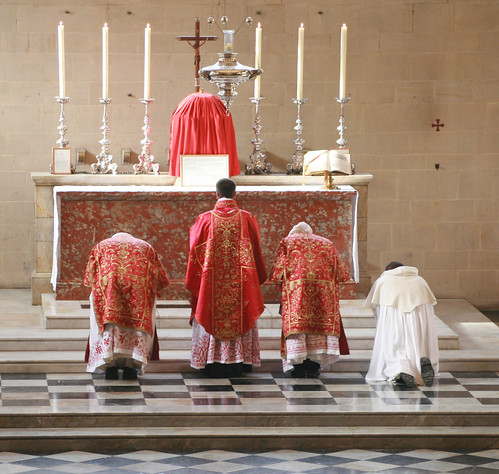
Fr. Dominic Jacob and his deacons pray before the altar at Blackfriars in Oxford

What does this communicate about the opening of the Mass? First, one should note that the choir sings a chant called the "Introit" during this segment, a series of verses from the psalms which announce or anticipate the mystery of the day. The priest's prayers are inaudible, indicating what he does at this stage is separate from what the laity does. The bows at the mention of the Holy Name of Jesus and striking of the breast imply the unworthiness of the ministers of ascending to the altar of God to offer the same Mystery He instituted. The priest then ascends to the altar, like a mountain, after his efforts at purification. His intimate act of reverence, the kiss, comes after his protestations of his human frailty. He then incenses the altar, which imbues a sweet scent upon the holy sanctuary.

The Pauline Mass is distinctly different and, as we will see, it is hard to derive the same sentiments from the instructions in the Pauline Mass and its common practice. First, let us consider what the priest ought to do: he bows or genuflects to the altar, ascends it without pause, kisses it, incenses it, and moves to the chair prominently placed to the side of the altar, where he turns to the congregated mass and begins with the words "Dominus vobiscum" ("The Lord be with you"), to which the people reply "Et cum spiritu tuo" ("And with your spirit"). The priest then exhorts the people to confess their sinfulness. The priest and people together recite a substantially shorter version of the old confession prayer together, and the priest prays for forgiveness.

Fr Nicholas Edmonds-Smith offering a by-the-book
Pauline Mass in Oxford's Oratory
In practice incense is rarely used, except for "high church" places in metropolitan areas, the priest arrives at a chair placed quite prominently towards the people, perhaps even more prominent than a bishop's throne, and adds his own interpolations to the prayers.

The opening of most Pauline Masses

What message does this convey? Certainly no sentiments of fear of God or substantial unworthiness to stand at his altar, as the priest readily approaches it. Perhaps he is actually afraid of the altar, as he leaves it immediately after kissing it, or incensing it if the priest is of that bend. The focus of the Mass then immediately shifts from the altar to the priest and his, often, prominently displayed chair. The priest's greeting is described in section 50 of the GIRM as "the mystery of the Church gathered together [made] manifest." The priest then faces the people and they recite a common confession aloud. The position of the priest and the common prayer almost indicate that they are confessing to each other and not to God, Who is mentioned but does not receive orientation in these strange rites. The priest says nothing and does nothing in which the people's view is obstructed and the congregation cannot verbally participate. The point is clear: the priest and laity are on very close footing. And we will see in the Pauline Mass, regardless of whether it is by-the-book or loosey goosey, the focus for the first half bounces around several places but never approaches the altar.

This basic relationship between the priest and the laity are quite manifested in modern church architecture. I remember reading in The Law of Civilization and Decay by Brooks Adams that the narrow structure of medieval churches and the singular view of the elevated altar was so that those in attendance could witness a miracle.


Does this space have the same purpose? Moving on....

After incensing the altar in the old Mass, the priest reads the Introit chant and recites the "Kyrie" ("Lord, have mercy") privately with his ministers at the side, where the Missal rests, preserving the view of the crucifix. The ministers then form a line, the priest begins the Gloria, recites it with his ministers, and then sits in his inconspicuous chair away from the altar. The people had been sitting until the Gloria, for which they stand, and then sit with the priest.

The Introit
What are we to make of this? Aside from the private recitation, one notes that the priest and deacons say the entire Mass at the altar, facing the tabernacle and the crucifix, while spending as little time obstructing popular view of these two things as possible. The point of this Mass is What is within the tabernacle and Who is depicted on the crucifix. Also, the people remain in a penitential posture until the angelic hymn, the Gloria. Their sentiments are to not perform actions expressing their humility before God, as the priest does, but to contemplate sin and mercy until the Gloria gives them relief.

The priest greets the people in the old rite

The priest, after the choir and people sing the Gloria, returns to the altar, turns to the people, and greets them with "Dominus vobiscum." The ministers return to the side and the priest sings the collects, or "opening prayers," concluding them with a bow to the tabernacle and crucifix at mention of the Holy Name of Jesus or of the Holy Trinity.

Again, the new rite is quite different: the Kyrie and Gloria are both said standing and by the priest and people, who face each other. The priest, again, strictly done or loosely performed, recites the opening prayer facing the people. Some more conservative priests will turn to the altar at mention of "Jesus," but this is rare.
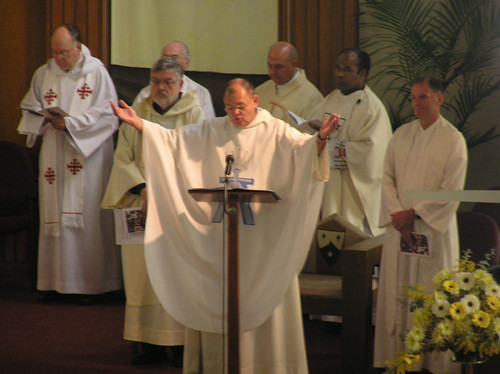
He's still talking to me!
We can no longer ignore the obsession with the priest and people doing the exact thing thing at the exact same time, while facing each other. The theology of this body language is distinctly oriented towards the community, not to the altar of sacrifice. The priest and people talk to each other. Regardless of what prayers they are reciting, many of them quite profound and beautiful, I cannot neglect that the priest and I are saying them to each other while God has to wait half an hour for some attention.

Part II: the Readings through the Gospel


Now follows a series of readings. The people sit in both rites until the Gospel (sort of).

In the old rite the subdeacon takes a book of readings, reverences the tabernacle by genuflecting, and moves back to the side of the altar where he previously stood, again facing the altar. It is useful, but not necessary in  a post on body language, to note that this reading is in Latin. The priest and deacon huddle around the Missal, following along quietly.
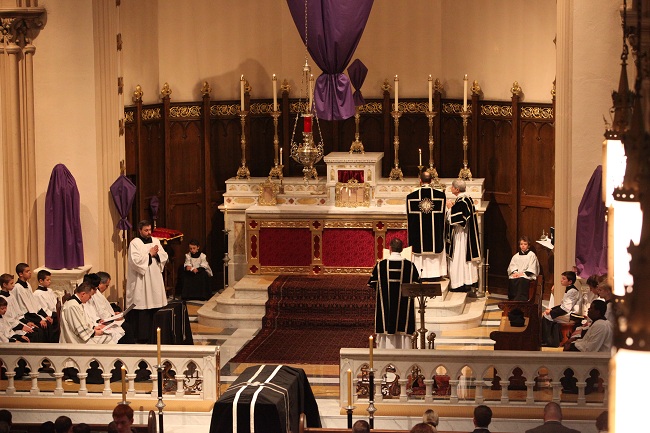
The subdeacon's reading in the old Mass
When finished, the priest blesses the subdeacon, reads the psalm and alleluia verses called the Gradual, and then comes to the middle of the altar for only the fourth time. Here he says two prayers in preparation of reading he Gospel as a private devotion. The subdeacon moves the book to the opposite end of the altar, where he and the priest read the Gospel of the Mass while the choir sings the Gradual aloud.


Priest reading the Gospel quietly

The deacon, after the priest has read the Gospel, places the Gospel book on the altar. The priest blesses incense. The deacon then kneels before the altar and asks the priest for a blessing. A small procession of candle-bearers, the thurifer (Mr. Incense), the subdeacon, and deacon then arrives at an open spot in the sanctuary. Facing north (leftward, perpendicular to the altar), the deacon places the open Gospel book in the subdeacon's hands, greets the people, incenses the book, and sings the Gospel. At the end, the Gospel book is brought to the priest, who kisses it with a prayer and is then incensed.
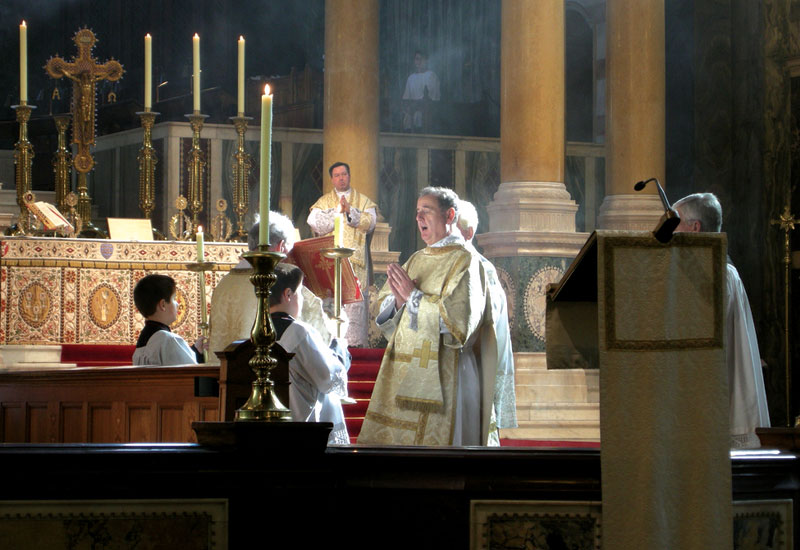
The deacon sings the Gospel during Mass at Westminster Cathedral in London
Before analyzing the meaning and impact of these gestures and ceremonies, let us consider the new rite.


A lector, in theory and in practice a lay person (not necessarily a man, either), approaches a podium (called an "ambo") facing the people and reads a lesson from the old testament, to which the people make a response. Then a psalm, with a refrain verse constantly repeated, is sung. In practice, and probably in theory, some "cantor," usually the worst member of the parish choir, leads the psalm and raises his/her arms when the people should join in the tune. Another reading, from the new testament, follows.

Would you like to read from the Book of Numbers?

The people, but in practice a guitar-equipped choir, stand and sing the alleluia.

"Sing a new song unto the Lord...."
The deacon takes the Gospel book, sometimes "enthroned" at the altar, goes to the priest, who may or may not bless incense, bows, and gets a blessing. He then processes to the ambo, with or without the candle-bears and incense, and reads the Gospel to the people. At the end he kisses the book, not the priest. Nor is the priest incensed. In practice, the deacon may hold the Gospel book quite high over his head, drawing most all attention to it.
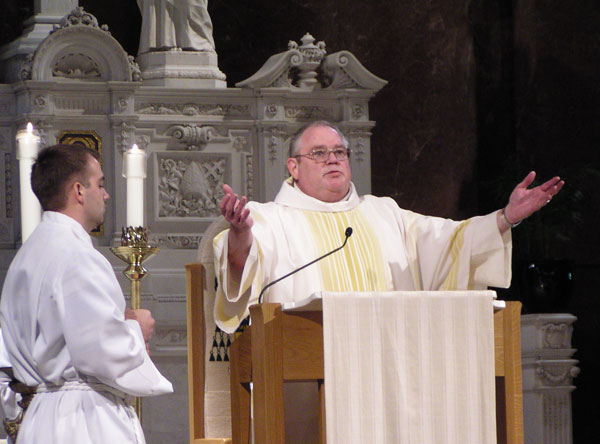


The contrast here is significant. In the old rite the priest has his own devotions and may do the readings quietly. The readings are oriented towards the altar and may rightly be called sacramental in their nature. They are theological commentaries on the day, not primarily for popular consumption. This has long been the Roman tradition.

St. Clement's in Rome. Although ancient, its sanctuary was not re-modeled during
the Renaissance. One sees that even when Latin was the vernacular, there were
ambos for the readings that did not face the people, but rather towards the customary
directions.


The Gospel is an event for which people are called to attention out of respect for the Gospel itself, but not necessarily to hear its words. At the end the priest reverences the Gospel book, the words of Christ, and is incensed. This implies honor, as only things of honor are incensed. The priest, this ceremony re-asserts, says the Mass in place of Christ. In other words, he makes it happen. These readings and ceremonies are part of his divine charge and prepare him for the Eucharistic consecration itself.

By contrast, the new rite treats everything as a matter of popular edification. The people sit and listen to lectures, sing along, and stand for the Gospel, which is the only change in their position. It is also the priest's only break, but a part in which his involvement is only a blessing. The similar posture by the priest and laity throughout the entire first half of the Pauline Mass obscures his involvement and demotes him to being a honorary participant, but of the same level as the laity. His distinct function must wait. This is not an overstatement. I can recall once in college the school's chaplain, a well-educated monk, during a marriage ceremony said, "Now the Church—that's you—gives these two it's blessing. So, raise your hands in blessing!"

These two rites greatly contrast in what their body language communicates. The old Mass focuses on the altar and the action eventually performed by God on it, as well as His servant, the priest. The people drift in and out of verbal participation, but have their own prayers and occasionally participate in the priest's especially the sung parts. The new rite focuses entirely on the laity. They talk to the priest for a while, they are given readings, they sings, and then they stand for another reading. In short, it is all about them. With these endless readings, one must wonder if the people are supposed to be praying or watching a performance by the local talent? The minister of God, His priest, is effectively obscured to the point of being unnecessary.

Next: the Credo through the end of Mass