Usually when people first attend the Traditional Mass, they are struck by its reverence, its staid posturing, and its expressions of sanctity. These three things have something in common other than holiness, tradition, and prayerfulness: they are all physical.
Years ago I bought
The Definitve Book of Body Language out of idle curiosity. The author emphasizes in the first chapter that 90% of communication is physical, not verbal. This begs the question: does body language have anything to do with why many are struck by the reverence of the old Mass and find this trait quite lacking in the new? What theology do posture, position, and body language suggest to the faithful?
I intend to compare the traditional Roman Mass and the Mass of Paul VI part by part in order to answer this question. For the sake of honesty, I will examine the Mass of Paul VI both how it is presented in the 2002 Missale Romanum and in the dreary practice of that Mass throughout 99% of the Catholic world.
The first post in this two part series will consider the fore-Mass, or "Mass of the Catechumens" in the old rite and "Liturgy of the Word" in the new.
Part I: Introit through the Collect
In the ancient rite the priest, deacon, and subdeacon arrive at the altar, bend their knees to Christ in the tabernacle, and immediately commence the prayers at the foot of the altar, which faces Eastward and, except in a few Roman churches, usually in the same direction as the people assembled. The ministers bow at the words "Gloria Patri et Filio et Spiritui Sancto" ("Glory be to the Father and to the Son and to the Holy Ghost), as one always does in the old rite at the mention of the name of Jesus or of the Holy Trinity. The priest and ministers then make a confession of their sinfulness, striking their breasts three times at the words "mea culpa, mea culpa, mea maxima culpa" ("through my fault, my fault, my most grievous fault"). The priest makes his own confession, and then the deacons make their own separately. After praying for forgiveness of sins, the ministers ascend the altar. The priest reverences the altar by a kiss and then incenses it.
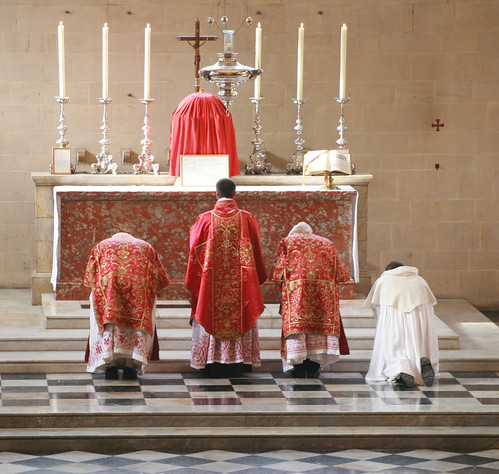 |
Fr. Dominic Jacob and his deacons pray before the altar at Blackfriars in Oxford
|
What does this communicate about the opening of the Mass? First, one should note that the choir sings a chant called the "Introit" during this segment, a series of verses from the psalms which announce or anticipate the mystery of the day. The priest's prayers are inaudible, indicating what he does at this stage is separate from what the laity does. The bows at the mention of the Holy Name of Jesus and striking of the breast imply the unworthiness of the ministers of ascending to the altar of God to offer the same Mystery He instituted. The priest then ascends to the altar, like a mountain, after his efforts at purification. His intimate act of reverence, the kiss, comes after his protestations of his human frailty. He then incenses the altar, which imbues a sweet scent upon the holy sanctuary.
The Pauline Mass is distinctly different and, as we will see, it is hard to derive the same sentiments from the instructions in the Pauline Mass and its common practice. First, let us consider what the priest ought to do: he bows or genuflects to the altar, ascends it without pause, kisses it, incenses it, and moves to the chair prominently placed to the side of the altar, where he turns to the congregated mass and begins with the words "Dominus vobiscum" ("The Lord be with you"), to which the people reply "Et cum spiritu tuo" ("And with your spirit"). The priest then exhorts the people to confess their sinfulness. The priest and people together recite a substantially shorter version of the old confession prayer together, and the priest prays for forgiveness.
 |
Fr Nicholas Edmonds-Smith offering a by-the-book
Pauline Mass in Oxford's Oratory |
In practice incense is rarely used, except for "high church" places in metropolitan areas, the priest arrives at a chair placed quite prominently towards the people, perhaps even more prominent than a bishop's throne, and adds his own interpolations to the prayers.
 |
| The opening of most Pauline Masses |
What message does this convey? Certainly no sentiments of fear of God or substantial unworthiness to stand at his altar, as the priest readily approaches it. Perhaps he is actually afraid of the altar, as he leaves it immediately after kissing it, or incensing it if the priest is of that bend. The focus of the Mass then immediately shifts from the altar to the priest and his, often, prominently displayed chair. The priest's greeting is described in section 50 of the GIRM as "the mystery of the Church gathered together [made] manifest." The priest then faces the people and they recite a common confession aloud. The position of the priest and the common prayer almost indicate that they are confessing to each other and not to God, Who is mentioned but does not receive orientation in these strange rites. The priest says nothing and does nothing in which the people's view is obstructed and the congregation cannot verbally participate. The point is clear: the priest and laity are on very close footing. And we will see in the Pauline Mass, regardless of whether it is by-the-book or loosey goosey, the focus for the first half bounces around several places but never approaches the altar.
This basic relationship between the priest and the laity are quite manifested in modern church architecture. I remember reading in
The Law of Civilization and Decay by Brooks Adams that the narrow structure of medieval churches and the singular view of the elevated altar was so that those in attendance could witness a miracle.
Does this space have the same purpose? Moving on....
After incensing the altar in the old Mass, the priest reads the Introit chant and recites the "Kyrie" ("Lord, have mercy") privately with his ministers at the side, where the Missal rests, preserving the view of the crucifix. The ministers then form a line, the priest begins the Gloria, recites it with his ministers, and then sits in his inconspicuous chair away from the altar. The people had been sitting until the Gloria, for which they stand, and then sit with the priest.
 |
| The Introit |
What are we to make of this? Aside from the private recitation, one notes that the priest and deacons say the entire Mass at the altar, facing the tabernacle and the crucifix, while spending as little time obstructing popular view of these two things as possible. The point of this Mass is What is within the tabernacle and Who is depicted on the crucifix. Also, the people remain in a penitential posture until the angelic hymn, the Gloria. Their sentiments are to not perform actions expressing their humility before God, as the priest does, but to contemplate sin and mercy until the Gloria gives them relief.
 |
| The priest greets the people in the old rite |
The priest, after the choir and people sing the Gloria, returns to the altar, turns to the people, and greets them with "Dominus vobiscum." The ministers return to the side and the priest sings the collects, or "opening prayers," concluding them with a bow to the tabernacle and crucifix at mention of the Holy Name of Jesus or of the Holy Trinity.
Again, the new rite is quite different: the Kyrie and Gloria are both said standing and by the priest and people, who face each other. The priest, again, strictly done or loosely performed, recites the opening prayer facing the people. Some more conservative priests will turn to the altar at mention of "Jesus," but this is rare.
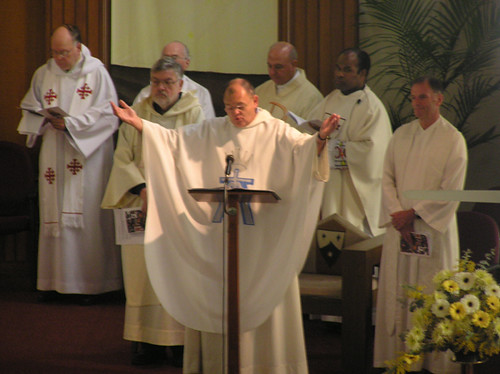 |
| He's still talking to me! |
We can no longer ignore the obsession with the priest and people doing the exact thing thing at the exact same time, while facing each other. The theology of this body language is distinctly oriented towards the community, not to the altar of sacrifice. The priest and people talk to each other. Regardless of what prayers they are reciting, many of them quite profound and beautiful, I cannot neglect that the priest and I are saying them to each other while God has to wait half an hour for some attention.
Part II: the Readings through the Gospel
Now follows a series of readings. The people sit in both rites until the Gospel (sort of).
In the old rite the subdeacon takes a book of readings, reverences the tabernacle by genuflecting, and moves back to the side of the altar where he previously stood, again facing the altar. It is useful, but not necessary in a post on body language, to note that this reading is in Latin. The priest and deacon huddle around the Missal, following along quietly.
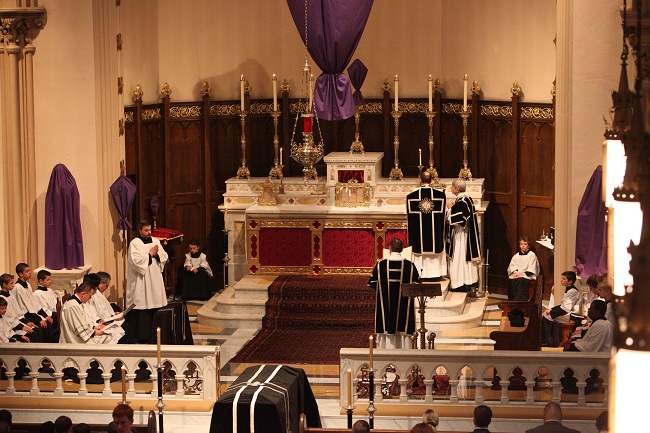 |
| The subdeacon's reading in the old Mass |
When finished, the priest blesses the subdeacon, reads the psalm and alleluia verses called the Gradual, and then comes to the middle of the altar for only the fourth time. Here he says two prayers in preparation of reading he Gospel as a private devotion. The subdeacon moves the book to the opposite end of the altar, where he and the priest read the Gospel of the Mass while the choir sings the Gradual aloud.
 |
| Priest reading the Gospel quietly |
The deacon, after the priest has read the Gospel, places the Gospel book on the altar. The priest blesses incense. The deacon then kneels before the altar and asks the priest for a blessing. A small procession of candle-bearers, the thurifer (Mr. Incense), the subdeacon, and deacon then arrives at an open spot in the sanctuary. Facing north (leftward, perpendicular to the altar), the deacon places the open Gospel book in the subdeacon's hands, greets the people, incenses the book, and sings the Gospel. At the end, the Gospel book is brought to the priest, who kisses it with a prayer and is then incensed.
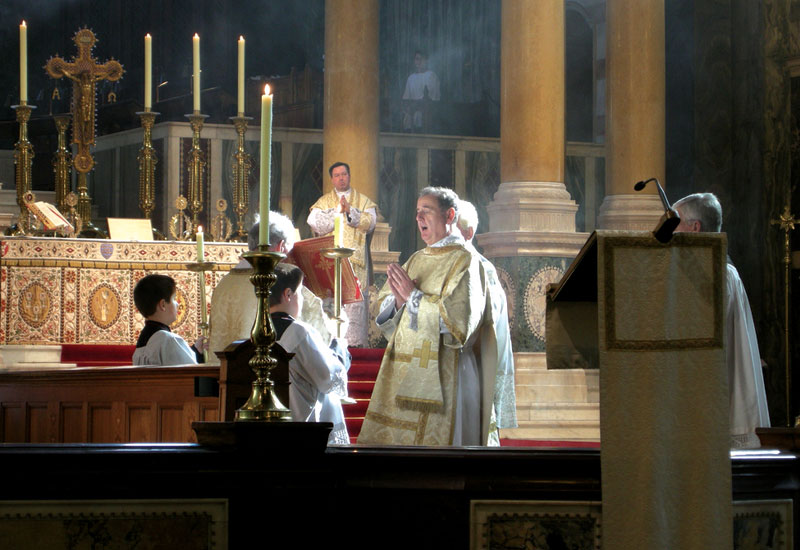 |
| The deacon sings the Gospel during Mass at Westminster Cathedral in London |
Before analyzing the meaning and impact of these gestures and ceremonies, let us consider the new rite.

A lector, in theory and in practice a lay person (not necessarily a man, either), approaches a podium (called an "ambo") facing the people and reads a lesson from the old testament, to which the people make a response. Then a psalm, with a refrain verse constantly repeated, is sung. In practice, and probably in theory, some "cantor," usually the worst member of the parish choir, leads the psalm and raises his/her arms when the people should join in the tune. Another reading, from the new testament, follows.
 |
| Would you like to read from the Book of Numbers? |
The people, but in practice a guitar-equipped choir, stand and sing the alleluia.
 |
| "Sing a new song unto the Lord...." |
The deacon takes the Gospel book, sometimes "enthroned" at the altar, goes to the priest, who may or may not bless incense, bows, and gets a blessing. He then processes to the ambo, with or without the candle-bears and incense, and reads the Gospel to the people. At the end he kisses the book, not the priest. Nor is the priest incensed. In practice, the deacon may hold the Gospel book quite high over his head, drawing most all attention to it.
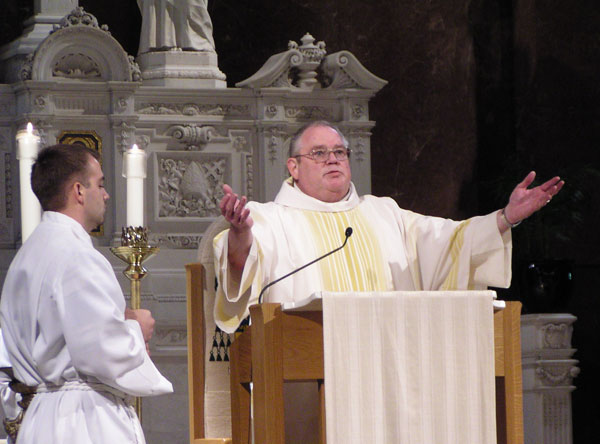
The contrast here is significant. In the old rite the priest has his own devotions and may do the readings quietly. The readings are oriented towards the altar and may rightly be called sacramental in their nature. They are theological commentaries on the day, not primarily for popular consumption. This has long been the Roman tradition.
 |
St. Clement's in Rome. Although ancient, its sanctuary was not re-modeled during
the Renaissance. One sees that even when Latin was the vernacular, there were
ambos for the readings that did not face the people, but rather towards the customary
directions. |
The Gospel is an event for which people are called to attention out of respect for the Gospel itself, but not necessarily to hear its words. At the end the priest reverences the Gospel book, the words of Christ, and is incensed. This implies honor, as only things of honor are incensed. The priest, this ceremony re-asserts, says the Mass in place of Christ. In other words, he makes it happen. These readings and ceremonies are part of his divine charge and prepare him for the Eucharistic consecration itself.
By contrast, the new rite treats everything as a matter of popular edification. The people sit and listen to lectures, sing along, and stand for the Gospel, which is the only change in their position. It is also the priest's only break, but a part in which his involvement is only a blessing. The similar posture by the priest and laity throughout the entire first half of the Pauline Mass obscures his involvement and demotes him to being a honorary participant, but of the same level as the laity. His distinct function must wait. This is not an overstatement. I can recall once in college the school's chaplain, a well-educated monk, during a marriage ceremony said, "Now the Church—that's you—gives these two it's blessing. So, raise your hands in blessing!"
These two rites greatly contrast in what their body language communicates. The old Mass focuses on the altar and the action eventually performed by God on it, as well as His servant, the priest. The people drift in and out of verbal participation, but have their own prayers and occasionally participate in the priest's especially the sung parts. The new rite focuses entirely on the laity. They talk to the priest for a while, they are given readings, they sings, and then they stand for another reading. In short, it is all about them. With these endless readings, one must wonder if the people are supposed to be praying or watching a performance by the local talent? The minister of God, His priest, is effectively obscured to the point of being unnecessary.
Next: the Credo through the end of Mass


