Showing posts with label Coptic orthodox church. Show all posts

Sunday, December 11, 2016

Coptics Attacked

Please pray for the Coptic Christians of Cairo, who today suffered the loss of 25 worshippers—mostly women and children—at St. Mark's Cathedral. At least 49 others were injured by the bomb, which was exploded on the women's side of the church.

Pray for the repose of the souls of the dead, the healing of the wounded, the comfort of the bereaved, and the swift punishment of the wicked men who committed this mass-murder.

(AP Photo/Nariman El-Mofty)

Sunday, February 8, 2015

When Did They Become Orthodox?


"I believe in one, holy, catholic, and apostolic Church" nearly all Christians who claim any sort of apostolic origin recite on Sundays. Among them are the various kinds of Orthodox Christians of the Eastern Churches. One friend, a Russian Jew born in Orthodoxy who left after falling victim to ethnocentrism, could not quite understand why they said that they believe in the "catholic" Church while not being Catholic. But they do believe they are the Catholic Church, and Orthodox, too.

The birth of "Orthodoxy" and the "Orthodox Church" is one of the minor mysteries in religious linguistics probably worthy of some level of study. The Church of Constantinople—as the Church of Rome, and the Church of Alexandria, and the Church of Aberdeen—believed itself to possess those four marks of the Church and hence to be a part of the Church Christ founded. That Church has gone by a few different names in its two thousand year history, but only a few. St. Ignatius of Antioch wrote in his letter to the Smyrnaeans 
"Where ever the bishop is let the multitude of the people be, as where there is Jesus Christ there is the Catholic Church." 
That phrase, Catholic Church, went on the shelf for the better part of the next few centuries, only coming off when the concept of "Christian" was no longer sufficient to distinguish the true Church from the odd sects engendered by heterodox thinkers or gnostic divines. "Christian," meaning "little Christs"—itself meaning "little anointed ones," a strong indication of Confirmation—by the fourth century had the same general meaning it has today. Anyone who professes Jesus Christ in some meaningful way is a Christian. Those who professed the true faith claimed membership in the "Catholic Church."

"Catholic" lived on in the Creed of Nicaea in the condemnation at the end:
"But those who say 'There was once when he was not,' and 'Before his generation he was not,' and 'He was made out of nothing,' or pretend that the Song of God is of another subsistence or substance, or created or alterable or mutable, the Catholic Church anathematizes."
Christians called the Church Catholic yet they did not always refer to themselves as Catholics. I can recall one occasion when St. Athanasius used the word Catholic substantially to describe individual believers. Most believers contented themselves with the label of Christian except for in the city of Constantinople, which, as the gateway to the east from the west and to west from the east, was the bottleneck of nearly every Christological controversy of the first millennium. Christians there described themselves as "orthodox" or "right worshippers" in contrast to the "heretic," the one who "chooses" to worship God according to his own will. The dialogues of the Greek Fathers crystallized this term in literary style and by the time of St. Theodore the Studite it was an accepted means of self-identification for the Christians of the Byzantine city. As an aside, the Roman Canon does pray for "omnibus orthodoxis.... cultoribus."

"Orthodox" signified an aesthetic, a type of Christian, a Christian who worshipped according to the rites of the Byzantine Church, who bore the scars of the heresies and the scabs of the triumphs that passed through Constantinople, and who adhered uniquely to the theology of the Greek Fathers. John Senior wrote that if philosophy is footnotes on Plato, theology is footnotes on St. Augustine. This phrase holds true only in the West. In the Greek tradition, theology is footnotes on the Cappodocian Fathers. Greek Christians prayed in the Great Entrance "May the Lord Our God remember all you orthodox Christians in His kingdom at all times...." and during the Litany of Fervent Supplication for "our orthodox fathers who here and elsewhere lie asleep in the Lord." While "orthodox" they certainly believed themselves part of the Catholic Church if not the Catholic Church. Then came the fall of Byzantium.


As political as the Roman Church was during the Middle Ages and Baroque era and as institutional as the Roman Church has been since Trent, the Constantinopolitan Church was before 1453 and more. The emperor was God's living representative on earth and the living icon of God the Father before whose image the citizens of Byzantium were to bow in reverence. He could call Councils, kidnap popes, replace the patriarch of his city, and—when he met little resistance—create Church laws that would mold the religious practice of his empire and beyond. Byzantium's triumph in Slavic lands buffered the empire from the west. The disaster of the fourth crusade and the decline of the Byzantine empire polarized Constantinople from "the West" when, hitherto, Constantinople had been more western than any eastern church. In the Palaiologian empire the Greek Church further distanced itself from "the West" during the Hesychast years of St. Gregory Palamas. Theology and liturgy became less communal and more mystical under the influence of Palamas and monastic patriarchs. Symbolism replaced realism in icons which now sat on the curtain around the Holy Place of the Hagia Sophia. Monastic patriarches replaced the organ, choral music, and the old Office with their own chants and psalter. The fall of Constantinople ossified the synthesis of the first millennium Constantinopolitan tradition with the Hesychast monastic movement, the last expression of "orthodox" Christianity.

In the midst of the newfangled Islamic city and without the institutional structures and imperial support the Greek Church previously enjoyed, Christians of Constantinople ceased to identify themselves as the Catholic Church. More troublesome to Greek Christians might have been Rome's unique hold over the title "Catholic Church." All that was left was the way of being Christian that they knew, orthodox. "Holy Orthodoxy" was born. 

One potential pitfall to this argument is that some non-Byzantine Churches of the East that accept the Councils until and excluding Chalcedon are now called "Orthodox." Coptic Christians in my experience are very fervent about the denomination "Orthodox" while Armenians accept the title, but are more content for their church to be known as the "Armenian Apostolic Church." Perhaps the solution to this flaw in my argument lies in the popularity of the term "Orthodox" itself. Could the term have been spread by the Ottoman empire to denote Christians who had nothing to do with the Pope in Rome?

The question is an interesting one and worthy of further study.

Monday, August 18, 2014

Constantinian Christianity

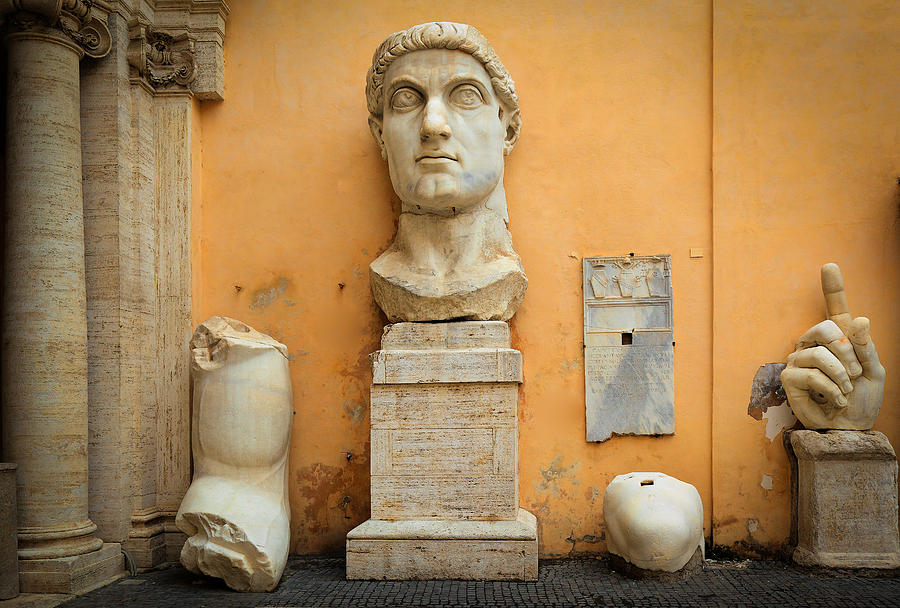
source: fineartamerica.com
Popular now among Catholics, Schmemann-derived Orthodox, and various stripes of protestants is the narrative that Constantine corrupted Christianity by bringing about its legality and the official juridical preference given to it by his successors. Malachi Martin promoted this telling in his Decline and Fall of the Roman Church as did Alexander Schmemann in his Church, World, Mission. A complimentary narrative purports that the schism between Rome and Constantinople occurred in 1054, was solidified in 1204, and was the consequence of papal ambition. There is some truth to the last part of the second story, but it wholly misses the point. The un-caused cause of the schism is Constantine, who created "Byzantine" Christianity.

He is called "St. Constantine, equal to the Apostles" in the Greek liturgy—"equal" in his influence in spreading Christianity and in no other way whatsoever. Emperor Constantine was accorded by Russell Kirk the same appellation Edmund Burke gave Oliver Cromwell: "a great bad man." After the miraculous apparition prior to the Battle of the Milvian Bridge, Constantine found himself the ruler of a war torn empire stirred by the upstart Catholic faith. Constantine presided at the Council of Nicaea, partially to resolve a theological dispute which caused angst within the large Christian community and partially to baptize Christianity into the reformed and Hellenized Roman Empire. 

In the years following Nicaea the bishop of Constantinople, formerly a minor bishopric of little prestige (antipodal to Jerusalem, a prestigious bishopric of no political importance) exercised greater and greater authority within the Eastern Roman Empire. The fourth ecumenical council, held at Chalcedon, effectively pushed out of the Church Coptic Christians who were duped by the heresiarch Eutyches. The same council promoted the bishop of Constantinople to Patriarch, second only to the Apostolic See of Rome. This promotion bypassed the eminence of the Petrine see of Antioch and the newly-alienated see of Alexandria in favor of political expediency. Slowly the Christianity at Constantinople became separated from Roman Christianity. By the time of the iconoclast controversy, we could say that there was such a thing as Byzantine Christianity, supported by the state and defined both by its Platonic language, its liturgy, and its prominence in conciliar decisions.

All this time the popes sat in Rome doing exactly what they should have done, absolutely nothing. Fr. Hunwicke once said it best: the strongest point of the popes during the period of Byzantine domination of theology is that they themselves contributed next to nothing. The popes of the first millennium, in stark contrast to the 20th century popes, were distinctly allergic to any kind of renovation, innovation, or evolution of the faith whatsoever. The papal reaction to the iconoclast dispute exemplifies this. While the Byzantines fought in the streets over proactive veneration of icons against the imperials who want them erased from the churches altogether, Pope Gregory III condemned iconoclasm and at the same time suggested a pastoral resolution, to put icons on the walls and ceilings of churches where veneration would not become an issue. After Greek control of the papacy detumesced and the Western Roman Empire fell apart, the Bishops of Rome and their Greek counterparts found themselves presiding over two increasingly distant parts of the universal Church.

The schism, contrary to popular opinion, did not happen in 1054. It did not happen in 1204 either. 1054 was not a breech between Rome and the rest of Christianity, which had long ago itself been separated from the former-Byzantine Empire. 1054 marked the culmination of a bickering match between Rome and Constantinople that began with the creation of a uniquely Byzantine Church, which was nurtured by the Photian affair and the triumph over the iconoclasts, and which was brought to a head by the re-assertion of Papal power. Over the two previous centuries, the popes had been a remarkably bad bunch (philanderers, simonists, murders, and the occasional heretic). Meanwhile the various patriarchates became accustomed to operating without the popes and their judgments. One could say Papal power was stronger in the 5th century than in the 10th. The all-time nadir of the Papacy came during the reign of Benedict IX, who bought and sold the papacy to marry a woman, held the Petrine chair thrice, and raised an army to dispute his uncle for the Roman see. After such a soap opera, the re-assertion of papal primacy under Leo IX, Gregory VII, and Urban II seemed absurd to the Byzantine patriarchs, who now presided over a tradition separate from that of Rome. A rift that had been taking root for centuries flowered with the dispute between Cardinal Humbert and Archbishop Michael Cerularius. The Emperor rightly ignored the separation when his kingdom was put at risk. The Crusades created a cultural animosity between the Greeks and Latins that spilled over into religion and in the years after the fall of Constantinople Greek Christians, understandably, looked to blame the Latin Church for its sins in meddling with Byzantine affairs. The Pope became the absolute head of all matters in the Latin West and the Greek Patriarch became Vice President of non-Islamic Religions in the Ottoman Empire; many patriarchs, even given their animosity towards the Roman Church, should be admired for their sufferings under the Turks. Individual cases of reunion, like that of the Melkite Church, were often disrupted or brought to naught by Turkish and Constantinopolitan intervention. Moreover, the roles of the Pope as Patriarch of Rome and "head bishop," as Armenian king Vartan II called the Roman bishop, became blurred.

At this point the "Hull thesis" takes over. The Latin Church been self-reflective and encumbered in her own legal system, her own theology, and her own devotions with no external oversight from the other patriarchates as existed centuries earlier. The Roman objectified theology and turned it into a variation of Greek logic. Conversely, the Greeks began to hold in suspicion things that were not Greek: the Roman Canon, the primacy of the Pope, St. Augustine, and the like. One epigraph in Banished Heart referred to the Pope as the "ghost of Caesar." Similarly, historian John Romer called the Orthodox churches the last "relic" of the lost Byzantine Empire. Both statements are exaggerations, but do procure strong elements of truth for modern consideration.

Now the Roman Church is in administrative and bureaucratic shambles; Mass attendance is in the gutter. The Byzantine Orthodox world is de facto run by Russian primacy, and Russia is among the most secular countries in the world; Orthodox churches are often strong centers of faith, but just as often seem to function as cultural hubs (Eastern Catholic churches are just as guilty here). The Greeks triumphantly uphold the religion of a defunct world power while the Romans have dismantled their once ubiquitous, virile praxis. And the Oriental Catholic and Orthodox Churches are forgotten.

Patriarch Gregory III of the Melkite Church
The cultural divide begun by Constantine continues to this day, separating Byzantine Christianity from both Rome and the far East. Coptic Catholics and Orthodox have inter-Communion in Egypt and have for years. The Melkites and their Antiochian Orthodox brethren also have inter-Communion, shared Sacraments, and even shared parishes; they use the Greek liturgy, but have carefully spurned any excessive embrace of non-Arabic culture. The non-Byzantine Eastern Catholics have displayed very little trouble adapting to the teachings of the last millennium without vitiating their own perspectives. Why must the Byzantines be different? Perhaps it is post "Uniate" guilt wrought by de-Latinization, pro-Orthodox ecumenism, and cultural pull. One Slavic Byzantine Catholic said to me "Well, we should all really be Orthodox and would be if not for the Union of Brest." Ignoring the fact that the Union of Brest influenced the Slavic churches and not the north African or far Eastern churches, my mind nearly prompted me to ask "Are you Catholic by birth or by faith?" I held my tongue.

The healthiest Byzantine Catholic parishes I have seen in the United States have embraced Byzantine spirituality as their future and reeled in the ethnocentrism that once dominated those churches. The Melkites and Ruthenians are doing well enough in the United States while the Ukrainian Catholic Church is struggling (but doing well in missionary areas). Was this not what Alexander Schmemann wanted his own Russian Orthodox Church to do decades ago? God became Man neither as a Greek, nor Slav, nor Roman, but as  Palestinian Jew. Constantine did not intend to drive a wedge between the various parts of Christendom, only to use part of it to strengthen his declining Empire. In that he succeeded. He was not the immediate cause of the East-West Schism, but he is the most necessary one.

This short reflection carefully advocates nothing. The purpose of this post is to summarize why the author believes the seeds of division of Byzantine Christianity (Orthodox and Catholic) from the rest of Apostolic Christendom were planted long before most think. Such a long division brings about many questions. Answers will not be found with the Moscow Patriarchate, the Congregation for Oriental Churches, or weekend conferences in Ravenna. They will only be found at the ground level.

Thursday, April 10, 2014

"The Church"?

"Well, there I'm troubled by the debate over Sacraments and that sorta stuff," said a protestant fellow student to me one night over dinner years back. "There are so many fundamental disagreements in the Christian Church."

"Not as far as I am concerned," replied the Raddiest Trad.

"The Church." It is a term used and abused like none other, but it is rarely given any proper definition. In vogue now is a propensity among practitioners of "high" Christianity to obscure very serious and heartfelt delineations between various parts of Apostolic Christianity—which I define as groups with valid Holy Orders which can be traced back to ancient patriarchal sees—almost to make "the Church" neither black nor white, but every shade of grey. One wonders how people of this tendency would react to St. Polycarp's denomination of Marcion as the "first born son of Satan."

This obscurantism comes after the collapse of several centuries of juridical identification of "the Church," which in turn meant "the Church" was defined by one's patriarchal position. Catholics de facto believed the Roman patriarchate to be "the Church" and all outside of it to be either schismatic heretics or probable "Uniate" would-be heretics. The Orthodox, continuing what was left of the Byzantine Empire, likewise identified communion with Constantinople as "the Church." Non-Chalcedonian Orthodox are tougher to pin down, as no one see defines them nor one cultural tradition, setting them apart from post-Byzantine Eastern Orthodoxy and Counter-Reformation Catholicism. At yet the absence of definite leadership is something of an enduring problem in the non-Chalcedonian Orthodox churches, perhaps the reason why the Ethopian Church re-united with Rome until cultural imperialists masquerading as missionaries bungled the situation beyond repair and Ethiopia returned to non-Chalcedonian Orthodoxy. Indeed, to be in "the Church" could mean to think Latin is heaven's native tongue, to think those born outside of Greek ancestry were un-favored, or that anyone outside of nothern Africa was not to be trusted. The Anglicans, even before the Tractarian days, further complicated the matter by positing themselves to be the via media betwixt "Romish" superstition and continental protestantism. To be English was to be Anglican which was to be authentically Christian.

How things have changed!

Nowadays most protestants believe anyone who professes Christ and attends services at some sort of ecclesial community a few times a month is a member of the "Christian Church." Some Eastern Catholics and Eastern Orthodox, although juridically out of communion with each other, consider each other both fully part of "the Church," a feeling particularly powerful within the Melkite and Orthodox patriarchates of Antioch. Most Roman Catholics and Orthodox admit some degree of communion with each other. Similarly non-Chalcedonian Orthodox and Eastern Orthodox profess a common faith. The hard line Roman Catholics and Russian Orthodox most often play party pooper in ecumenical dialogue. 

Still, this sort of thing is only true to an extent. "Communion" means many things, above all the sharing of Sacraments. It also means fellowship, community, and union with God in the sharing of the Sacraments. There is certainly a high degree of communion shared by the Melkite Catholics and the Antiochian Orthodox (inside Lebanon). Similarly there is some communion, loosely understood, between Rome and the various Orthodox Churches and between the Orthodox who accept and those who deny Chalcedon. But it is not a complete fellowship or communion. These groups normally only share Sacraments under conditions of extreme duress, such as immanent death or danger of death. Painting "the Church" as the collective of these groups—which share much in common—dangerously brushes past their serious differences.

The watery divide between the Greek and Roman Churches, in my opinion, began long before the year 1054 and did not coagulate until after the destruction of Byzantium. If one is to take an honest approach one finds the bickering between Rome and Constantinople began because of the Greek patriarch's imperially subsidized ambition in the late first millennium and became a lasting schism because of Roman stubbornness. Indeed, the anti-legalism and anti-rationalism that has come to define post-Byzantine Orthodoxy contrasts sharply with the juridical and rationalistic approach of Bellarmine and Liguori, more so than Palamas contrasts with Aquinas.

What is the point? "The Church" can, I think, be found on three levels:
  1. What we believe
  2. How we believe it
  3. With whom are we in communion
The third point is often the target of those who were earlier labelled obscurantists (seeing the organizational aspect of the Church as an artificial construct) while the most legalistic persons often focus on the second point (good luck convincing some Roman Catholic clergy that Eastern Catholics just do not have a concept of Original Sin). In the example of the Melkites and Antiochian Orthodox, the first and second points match near perfectly, but the third point is contended. Does that mean we must discount the third point? Certainly not.

The entire point of belonging to a communion is to know where the Church can be found visibly. Schism of course comes from the Greek word for "tear" or "rip." Ripping up the Church is serious business. Schism is not necessarily the same as heresy, but often relates to it. When the Alexandrian Church rejected Chalcedon few outside of Alexandria doubted that the Egyptian patriarchate had separated itself from the Church. Perhaps at that point the Church—which was Latin, Greek, Armenian etc—felt diverse enough that a consensus between her various contingent groups sufficed to define a schism. But what to do when the only remaining portions, the Greeks and Latins, withdraw from each other? What then? Re-define "the Church" to mean all groups regardless of substantial differences? The Church is communion and where communion lacks the Church lacks. Obscuring this obscures the root cause of much schism: the difference in what is believed and how it is believed.

привет!
The most substantial problem, to my view, of glossing over the institutional aspect of "the Church" and the communion which visually defines it is that one would paradoxically call the Church united and divided. Go to a rural Russian village and tell the peasants that they really believe the same things as Katharine Jefferts Schori! The institutional aspect of the Church—which is often a disaster—is still essential because it signals to the faithful where they need to be. If a "house divided against itself cannot stand" why can a Church, in several degrees of schism from itself, continue to be "the Church?" When a couple divorces and the children go off to college the spiritual bonds between the former spouses remain, although they go ignored, yet de facto there is no family any more. Communion and Church cannot be imagined. Christ came to call twelve men who He firmly united in the Holy Spirit and guided in Truth. "The Church," for the welfare of the faithful, must continue this feature, which I believe is essential. Why would one be Coptic Orthodox over Romanian Orthodox unless one was of Egyptian descent? Yet we as Catholics can at least point to Rome as the visible marker of the Church's communion. This facet of Rome may be more important than infallibility of the Pope, given that the Church already understands herself to be infallible in dogmatic matters. If one holds communion with this man, the Pope, the visible marker of the Church, one holds definite communion with the Church of Christ. The Fathers of the Church rarely talk about Matthew 16:18 when they referred to the Bishop of Rome and when they do they speak of him both as the rock and as the marker:
"On him [Peter] He builds the Church, and to him He gives the command to feed the sheep; and although He assigned a like power to all the Apostles, yet he founded a single Chair, and He established by His own authority a source and an intrinsic reason for that unity. Indeed, the others were that also which Peter was; but a primacy is given to Peter, whereby it is made clear that there is but one Church and one Chair. So too, all are shepherds, and the flock is shown to be one, fed by all the Apostles in single-minded accord. If someone does not hold fast to this unity of Peter, can he imagine that he still holds the faith? If he desert the chair of Peter upon whom the Church was built, can he still be confident that he is in the Church?" (St. Cyprian)
It is quite useless to speculate on the would-be opinion of someone deceased, but I think the above passage summarizes why Adrian Fortescue, despite his openness to Greek Christianity at the height of Pius X—a pope he rather disliked, he remained a Catholic and a Roman one at that.

Far from fomenting division, I favor building unity from a realistic point of view. I would like the Catholic Church to cut off all ecumenical dialogue with pagan sects and even with protestants, with whom we have little in common aside from most of the Bible and Baptism. The Church cannot be divided, but it certainly can be built up. If we really must do ecumenical gatherings let it be private, local conferences with Eastern Orthodox and non-Chalcedonian Orthodox. I would not oppose some level of inter-communion with the Orthodox, but I suspect that they would have a hard time selling the idea to their homeland congregations.

Talk about substantial matters and fear not to be one's self. Bishop Nicholas Samra, Melkite bishop of the American eparchy, announced at his enthronement that Melkites must have the courage "to be ourselves." We Romans, after the long overdue collapse of our business corporation hierarchy, have ignored in both liturgy and theology much of our Roman roots. Those must also be recovered to build up communion within the Church and to entice others to communion. 

The Church, by its nature, is not divided, but it certainly is troubled and has been from the beginning. 

"For peace in the whole world, the well being of the holy churches of God, and the union of all, let us pray to the Lord!" -Divine Liturgy of St. John Chrysostom

Sunday, May 12, 2013

Desert Fathers

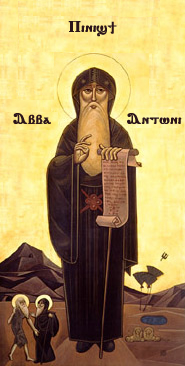
St. Anthony of Egypt
 
I came across this fascinating on a Coptic Orthodox monastery in Egypt. The community dates to the mid-twentieth century and the monastery is even newer, but the film contains some fascinating material toward the end. The beginning of the documentary recounts the formation of the community and the middle segment displays how the physical plant developed into its own sort of town, replete with a hotel for tourists/retreaters. The last third interested me, as it shows desert hermits living in caves in much the same manner as the Desert Fathers like Ss. Anthony the Great, Macarius, and John Cassian. Indeed, the last few moments feature the cave and tunnel dug by St. Macarius, into which he would flee unruly guests.