Showing posts with label monasticism. Show all posts

Monday, May 8, 2017

A Benedict Option for Laymen?

A recent short essay published by Crisis Magazine examines the problems that come with an "Abundance of Benedict Options," playing off the social engineering schema popularized by the ex-Catholic Rod Dreher:
The most famous [option] is certainly the Benedict option popularized by author Rod Dreher. But others have written about the Dominican option, the Dorothy option, the Escriva option, the Buckley option, the Boniface option, etc. I have no problems with these suggestions or reflection on this question. It is vital and important to prepare for the full flowering of western liberalism and its possible collapse under its own weight. However, most who are writing on this topic miss the contingency of this question, the participatory nature of the Church, and Ecclesial unity.
The essay by Dr. John Meinert is both short and good, basically trying to calm the contentious option-holders from beating on one another in public, in favor of admitting a variety of valid options within the Catholic sphere of moral orthodoxy.

I wonder if Dreher's repurposing of St. Benedict's name in naming his own social-religious philosophy is unnecessarily confusing. It seems that Dreher is constantly fighting off concerns that he wants laity with family to live like monks. Why invoke the Rule of the great Benedict if you are only going to abstract a few applicable ideas for the common layman? "I came up with the concept," Dreher says, "and I'm not sure what it means."

John Senior was more intentional with his invocation of the ancient Benedictine way of life. He argued that the larger Catholic culture (lay and clerical) can only find a revival if first the monasteries are purified by returning to a strict obedience to the Rule. Fix the monasteries, and the rest of the world will follow. Dr. Senior, I suspect, would accuse Mr. Dreher of putting the cart before the horse. Senior wrote in The Restoration of Christian Culture:
We are creatures of habit, as the nuns used to say. In the moral and spiritual order, we become what we wear as much as what we wear "becomes" us—and it is the same with how we eat and what we do. That is the secret of St. Benedict's Rule which in the strict sense regulated monasteries and in the wider sense, through the influence and example of monasteries, especially in their love of Our Blessed Mother, civilized Europe. The habits of the monks, the bells, the ordered life, the conversation, the music, gardens, prayer, hard work, and walls—all these accidental and incidental forms conformed the moral and spiritual life of Christians to the love of Mary and her Son. (130-31)
While Senior's vision demands a top-down purification of culture, Dreher's vision is born of an impatience with the failures of those in higher states of life in the Church. This is no surprise, considering that clerical corruption was the cause of his own schism. There is something unnatural about creating a "rule" for Catholic families that is divorced from the daily, weekly, and yearly life of a parish or monastery. It is the kind of thing one would expect in a place like pre-20th century Japan, where pockets of Catholic communities were forced to perpetuate themselves without the help of clergy of any kind after the expulsion of Western influences, not in the cybernetically connected 21st century.

Certainly, at times families need to keep themselves Catholic in spite of the local parochial influence. Dreher's vision of the family besieged on every side, even the ecclesiastical side, is not without merit. But it is dangerous to cultivate a lifestyle of seclusion, where the laity arrive at the church once a week for Sacraments, but otherwise refuse to engage with the life of the Church. I worry mostly that Dreher is implicitly recommending a kind of Protestant spirituality, wherein each family is an island that develops a habit of suspicion against all outside influence.

The health of the Church Catholic depends heavily on the holiness of her monasteries, and to a marginally lesser degree on the holiness of her priests and bishops. Any spirituality that places the natural family at its center I consider suspect, and I say this as one recently married and hopeful of a fruitful life, and who also regularly bemoans the disintegration of family life in the West. Our spiritual life revolves around the Household of Heaven, in which the Son is paradoxically greater than the Mother, in which our familial relations become mere metaphors for a more perfect life. Sacramental though our marriages be, they are not intrinsically paradigms for the life of Heaven, where we will neither marry nor be given in marriage.

I am not insensible to the need of securing the moral and traditional aspects of family life. It is an important problem, and one urgent enough that it will not simply wait for the hopeful Benedictine revival in the West. In this respect, I think families need to make peace with the fact that any moral corrections they make against the culture or against malign ecclesiastical influence are going to be limited, imperfect, and temporary. Whatever "option" we take, we should not think it to be a permanent or wholistic solution.

Friday, February 10, 2017

Bits of Butler


Our readers seemed to enjoy the recent post wherein I commented upon the nature of vocation as it relates or fails to relate to the religious life. The book on which I based most of my thought, Fr. Richard Butler O.P.’s Religious Vocation: An Unnecessary Mystery, has other interesting, more general digressions about the spiritual life that are worth sharing. For instance, he notes how important a healthy psychology is for the proper living out of the religious counsels:
Even St. Thomas’ stand in favor of admitting habitual sinners, converts and children to the religious state must be qualified in order to be understood. He is speaking abstractly, not in reference to particular people, and ideally, without reference to prohibitive conditions. He presumes in the former sinner a will fixed sufficiently to break bad habits of the past. In the convert he is speaking of one embracing Christianity as a unified faith, without the need for the kind of re-education and re-orientation required in the contemporary convert from Protestant faith, tradition, environment and psychological orientation. In the child, he is anticipating a normal development to a well-balanced maturity. (116)
The need for a more complete understanding of conversion, especially from quasi-Christian sects, is something I’ve written about before. The same warnings about needing to thoroughly deprogram the convert from his former way of life before being considered for the monastery, should apply also to candidates for the priesthood.

Butler continues about the difficulty of finding mentally healthy people in our artificial age:
Social and personal conditions of human life are far different today than they were in the Middle Ages. Most obvious is the difficulty of achieving a normal personality in a social environment which is so removed from natural principles and so corruptive to the practice of faith. The force of faith has been diminished by the spirit of compromise and the ascendency of emotional attitudes over reasoned convictions…. Opposed to the supernatural values of poverty, virginity and obedience in religious life, are the modern tendencies towards material acquisitions, sexual promiscuity, and the revolt against authority. This is the Age of Selfishness. Artificiality of custom and pettiness of concern cramp the natural generosity of youth. (117)
He also notes that a healthy sense of humor is essential for living in a religious community, not to mention life in general:
Montalembert, in the introduction to his Monks of the West, gives three classic traits which indicate a healthy religious personality: simplicity, benignity, and a sense of humor….
Humor is based on man’s reasoned perception of incongruities. A lack of a sense of humor indicates a defect of the practical reason, symptomatic of nearly every form of derangement. Because of the religious man’s recognition, naturally speaking, of the implicit incongruity of man’s ascent to God, he must learn to laugh at his own nothingness before the august presence of God—He who is, while we are who are not. A sense of humor combats the thousand petty afflictions of a confined community life in the religious state. (122-123)
Towards the end of the book, he muses on the ways in which improper beliefs about “calling” and “vocation” tend to attract the wrong kind of person to the religious life:
Even in more scholarly presentations of the subject, the religious state is seldom seen in the context of theology, in the whole economy of salvation. There is always an unmistakable emphasis on exclusiveness, on something “special” and “extra.” Little wonder that the average generous soul cringes in abject retreat, before such august presumptions. As a result, religious institutes often attract the imprudent and the truly “special” fringe characters who are easily drawn to the esoteric. If we are not getting more sound, rounded, wholesome types as candidates but more odd, narrow, unbalanced postulants, then obviously our approach to the Christian faithful is somehow distorted and misleading. (153)
Fr. Butler’s book is worth reading in its brief entirety. From the time of his religious profession in 1943 until his death in 1988, Butler received multiple academic degrees, was ordained a priest, served in various campus ministry roles, served as the Vatican’s Secretariat for Unbelievers, and published six books. It’s a pity that none of his other works appear to be in print, and that TAN no longer has Religious Vocation in stock.

Saturday, January 2, 2016

Non Nobis, Domine, Sed Nomini Tuo....


The name of Jesus has been revered throughout the history of the Church back to the days of the Old Testament, when the Jews would substitute Adonai ("Lord" or "Master") for the name God gave for Himself to Moses, Yahweh ("I am Who I am"). The name of the God Who called Himself the One Who simply is, Who is being itself, was only invoked by the high priest once a year, on the Day of Atonement. The O antiphons sung at the Magnificat on last seven days of Advent revive the Old Testament names of God in anticipation of the birth of the Son of God and His naming an octave of days later. Parents name their children symbolically, honoring either a person from the past or steering the newborn toward what the mother and father desire them to be. With God this does not suffice. In the case of God, His name reflects Who He is, the One Who is, the Lord of all.

The name of Jesus was not a new one to the Jews or Christians of the first century. Jesus etymologically derives from Yeshua, commonly Joshua today. Ye-shua literally translates as "Yahweh is salvation" and was the name of Moses's companion who led the victorious Israelite army in the conquest of Canaan. Honoring their ancestor, Yeshua was one of the most popular male names in the Second Temple period. The first Yeshua fulfilled the promise of God to deliver the Israelites from the land of bondage to a new place of freedom. The second Yeshua, as God made man, would deliver all Who believe in Him from the bondage of death. After the Resurrection and descent of the Holy Spirit at Pentecost believers veered away from naming their children after Old Testament figures in favor of martyrs of the New Testament, although Elias remained popular in Greek Christianity. Jesus would cease to be a called name; instead it would become a revered invocation of God Himself.

Lev Gillet observes that the Biblical expression "at the name of Jesus" comes to us weakly in English from weak Latin, in nomine Iesu. The presumably original Greek text bears a stronger meaning, connoting "by the means", "by the command", or "by the authority" of Jesus. The pre-Nicene Fathers did not theologize the name, but they did follow the tradition of invoking it in times of distress, eventually normalizing its liturgical usage (per Dominum nostrum Iesum Christum....). 

The name of Jesus eventually became a prayer unto its own. Latin spirituality is difficult to define before the explosion of Benedictine monasticism, though it was presumably liturgical more than personal like the monastic tradition which sprung from it. St. Augustine's small collective may have anticipated communal living and prayer on a more voluntary, less municipal level, but the common liturgical element remained. Eastern spirituality, at least as far as extant information allows us to know, possessed a more personal element. It is here that the "Jesus prayer" originated. 

The "Jesus prayer" has become the focus of Greek spirituality. "Lord Jesus Christ, Son of God, have mercy of me [a sinner]" is prayed by Athonites, but also by laymen of the Constantinopolitan tradition, non-Chalcedonians, Latin monks, and the odd Protestant. The prayer did not reach its current form until the Hesychast ascendance in the Palaiologan dynasty, the last ruling family before the fall of Byzantine Empire, when Orthodox tradition ossified more or less in its current form. The Jesus prayer is a concatenation of two separate prayers used in the first millennium, one by the monks of Sinai and the other by the faithful of Constantinople. The monks of Sinai plainly uttered the name "Jesus" as a simple prayer to remind the one saying it of Christ's personal presence. Contrary to later Athonite thought, the Sinaites believed psalms and the name of Jesus were the only spiritual refuges for those not strong enough to confront their sins directly. St. John Climacus confirmed this tradition in his Ladder (28). The second piece of the prayer was Kyrie eleison, a favored ejaculatory prayer of the monks and laity of Constantinople. The merger of these prayers resulted in our modern day Jesus prayer, popularized by the Hesychast tradition of St. Gregory Palamas.

St. Gregory Palamas did not popularize the Jesus prayer, nor did his proximate followers. In contesting Barlaam's claim that God was not Himself knowable, the Hesychasts found in the Jesus prayer the most perfect place to meet Christ God in His un-created energy, the "light of Tabor." It was in this context that Palamas defended the prayer and in which his later followers advocated its central place in Greek spiritual life. Much like how the Council of Trent and the Counter-Reformation religious orders coagulated the once fluid and vivacious Roman Church, the disaster of 1453, the dissemination of the Greek tradition to the Slavs, the expansion of Athonite monasticism, and the publication of the Philokalia stiffened a once dynamic Byzantine tradition. The Jesus prayer dominated Athos and its descending spiritual houses. Use of the Jesus prayer can substitute for part or all of the Greek Office: 500 times for Vespers or Mattins, 200 for Compline, 700 for the Typika. It should be noted that most non-Athonite communities do not see the name of Jesus as a substitute for the liturgy.

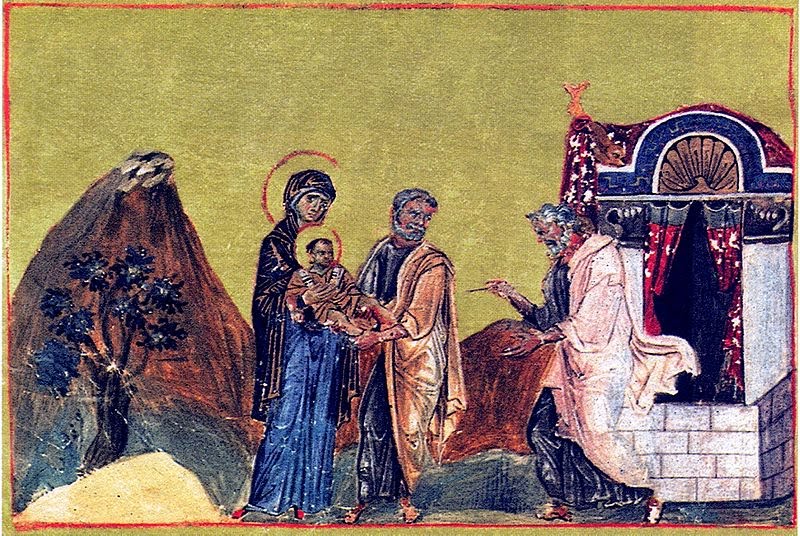
While the name of Jesus did not become its own prayer in the Latin Church, it did continue to be invoked in prayer and as an object of reverence. The Sarum rite has the feast of the "Name of Jesus" on August 7th. Compostela celebrated the feast on January 8th and Liege on January 31st, the Franciscans and Dominicans kept it on sequential January days. Innocent XIII inserted the feast into the Roman rite for the second Sunday after Epiphany, where it is given in my altar Missal. St. Pius X relocated the feast to the Sunday between the Circumcision and Epiphany, displacing the octave days of the comites Christi. Paul VI abolished the feast in promulgating the new kalendar in 1969/1970. The Roman Mass found in the post-Tridentine Missals is remarkably similar to that given in the Sarum books, sharing the Introit and Epistle, but differing in the Gospel (Sarum gives the Angel's relation of the name to Mary while Roman repeats the Circumcision pericope) and orations. While the Roman rite prays:
"O God, You Who appointed Your only-begotten Son to be the Savior of the human race, and commanded that He be called Jesus, mercifully grant that we may enjoy in heaven the vision of Him Whose holy Name we venerate on earth"
Sarum asks:
"O God, Who has caused the Name of Our Lord Jesus Christ, Your Only Begotten Son, to be loved with the greatest affection by Your faithful, and to be terrible and fearful to evil spirits, mercifully grant that all who devoutly reverence this Name of Jesus on earth may have part in the sweetness of holy consolations in this present life, and in the world to come may attain unto the fullness of joy and eternal praise."
This snippet of the Sarum sequence, given below, highlights the contrast between the post-Tridentine and Norman interpretation of the Name.


The newer Roman feast sadly neglects the historic emphasis on the personal nature of name, that the faithful can call upon "Jesus for our friend" and ask Him to repel all that may come to harm us. The odd Roman Mass instead centers on the fact that the recently born child was given a name, making the feast redundant.

We call Him the Lord, God Almighty, and Our Redeemer. Perhaps in understandable retraction from protestants haphazardly tossing around the name of the Son of God we have reverted to the Old Testament fear of uttering the name of God. This need not be. Due to Him is all reverence in worship, but on our knees we can address Him as a person to be known and kept in company, that He may forgive our sins and we may give glory to His name.

Non nobis, Domine, sed nomini tuo da gloriam....

Sunday, May 12, 2013

Desert Fathers

St. Anthony of Egypt
 
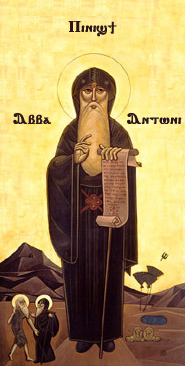
I came across this fascinating on a Coptic Orthodox monastery in Egypt. The community dates to the mid-twentieth century and the monastery is even newer, but the film contains some fascinating material toward the end. The beginning of the documentary recounts the formation of the community and the middle segment displays how the physical plant developed into its own sort of town, replete with a hotel for tourists/retreaters. The last third interested me, as it shows desert hermits living in caves in much the same manner as the Desert Fathers like Ss. Anthony the Great, Macarius, and John Cassian. Indeed, the last few moments feature the cave and tunnel dug by St. Macarius, into which he would flee unruly guests.