Thursday, May 28, 2015

St. Jude and the Hopeless Cause of Clerical Corruption

source: Echoes from the Vault
Largely forgotten outside of the popular “Hopeless Causes” devotion, St. Jude Thaddeus—one of the Twelve and brother of Our Lord and of St. James—wrote a short but effective epistle against the doctrinal and moral corruption of false teachers in the Church. While the exact identification of these heretics is uncertain (Fr. Haydock seems unreasonably certain that they are the Nicolaites and the disciples of Simon Magus), the moral attributes of these errant teachers are common even today.
For certain men are secretly entered in, (who were written of long ago unto this judgment,) ungodly men, turning the grace of our Lord God into riotousness [Latin: luxuriam], and denying the only sovereign Ruler, and our Lord Jesus Christ. (v. 4) 
As Sodom and Gomorrha, and the neighbouring cities, in like manner, having given themselves to fornication, and going after other flesh, were made an example, suffering the punishment of eternal fire. In like manner these men also defile the flesh, and despise dominion, and blaspheme majesty. (v. 7-8) 
But these men blaspheme whatever things they know not: and what things soever they naturally know, like dumb beasts, in these they are corrupted. (v. 10) 
These are murmurers, full of complaints, walking according to their own desires, and their mouth speaketh proud things, admiring persons for gain’s sake. (v. 16) 
In the last time there should come mockers, walking according to their own desires in ungodlinesses. These are they, who separate themselves, sensual men, having not the Spirit. (v. 18-19)
They entered in secretly, encouraging lust, and denying the kingship of Christ. They participate in the sins of Sodom and Gomorrha, and despise the celestial hierarchy, which even the great St. Michael would not do against Satan. Whatever these teachers do not understand, they mock. What they know, they corrupt. They complain ceaselessly, speaking constantly about their own greatness, and flattering others for their own good. These are mockers, and unspiritual schismatics.

Now of course there are many other interesting things in the Epistle of St. Jude, including references to unbiblical (but not untraditional) stories of Sts. Enoch and Moses, as well as some very colorful language about the punishments awaiting the false teachers. What interests me are the unavoidable parallels between the descriptions of these teachers and the false teachers we are afflicted with today. I will not belabor these parallels, as they are obvious to anyone who has been reading Catholic news sources for the last few years or even months, but it is somehow comforting to know that Christians have always suffered under the weight of deceivers who twist doctrine to suit what the brobdingnagian apologist Mark Shea frequently calls “pelvic issues.”

We may take some further comfort in Jude’s exhortation of how we ought to bear living under the weight of these wicked men, and how to comport ourselves while waiting for their judgment:
But you, my beloved, building yourselves upon your most holy faith, praying in the Holy Ghost, keep yourselves in the love of God, waiting for the mercy of our Lord Jesus Christ, unto life everlasting. And some [of these heretics] indeed reprove, being judged: but others save, pulling them out of the fire. And on others have mercy, in fear. (v. 20-23)
source: The Met

Saturday, May 23, 2015

Liturgical Theology of Pentecost as Told by the Vigil

source: oca.org
Pentecost is too big, too vast, too intimidating for any singular explanation, but the Roman liturgy's rich vigil for this feast nurtures the faithful with some food for thought. Let us consider the liturgy of the Roman rite for this great feast, second only to the Sunday of the Resurrection in importance.

source: traditionalmass.org
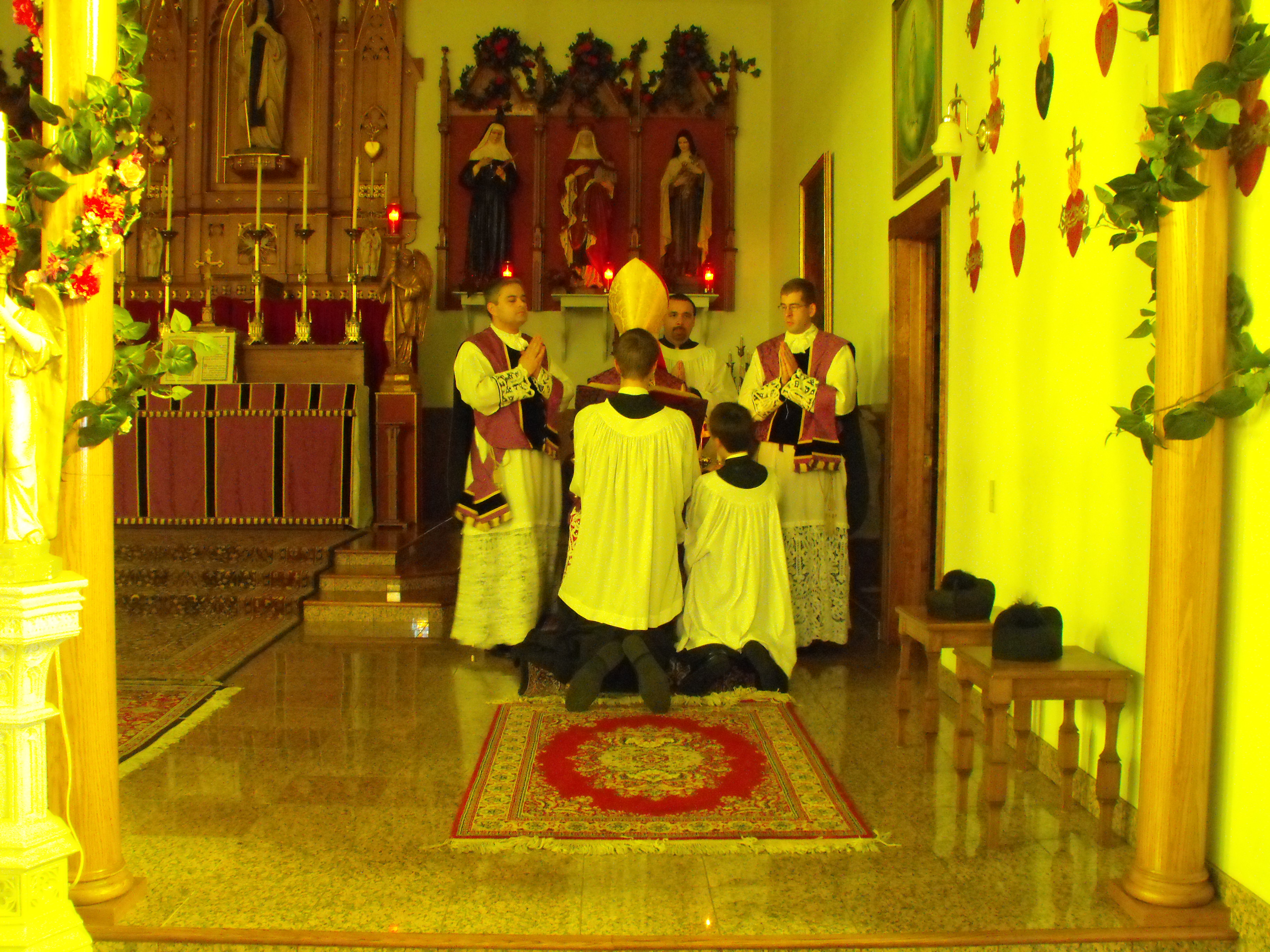
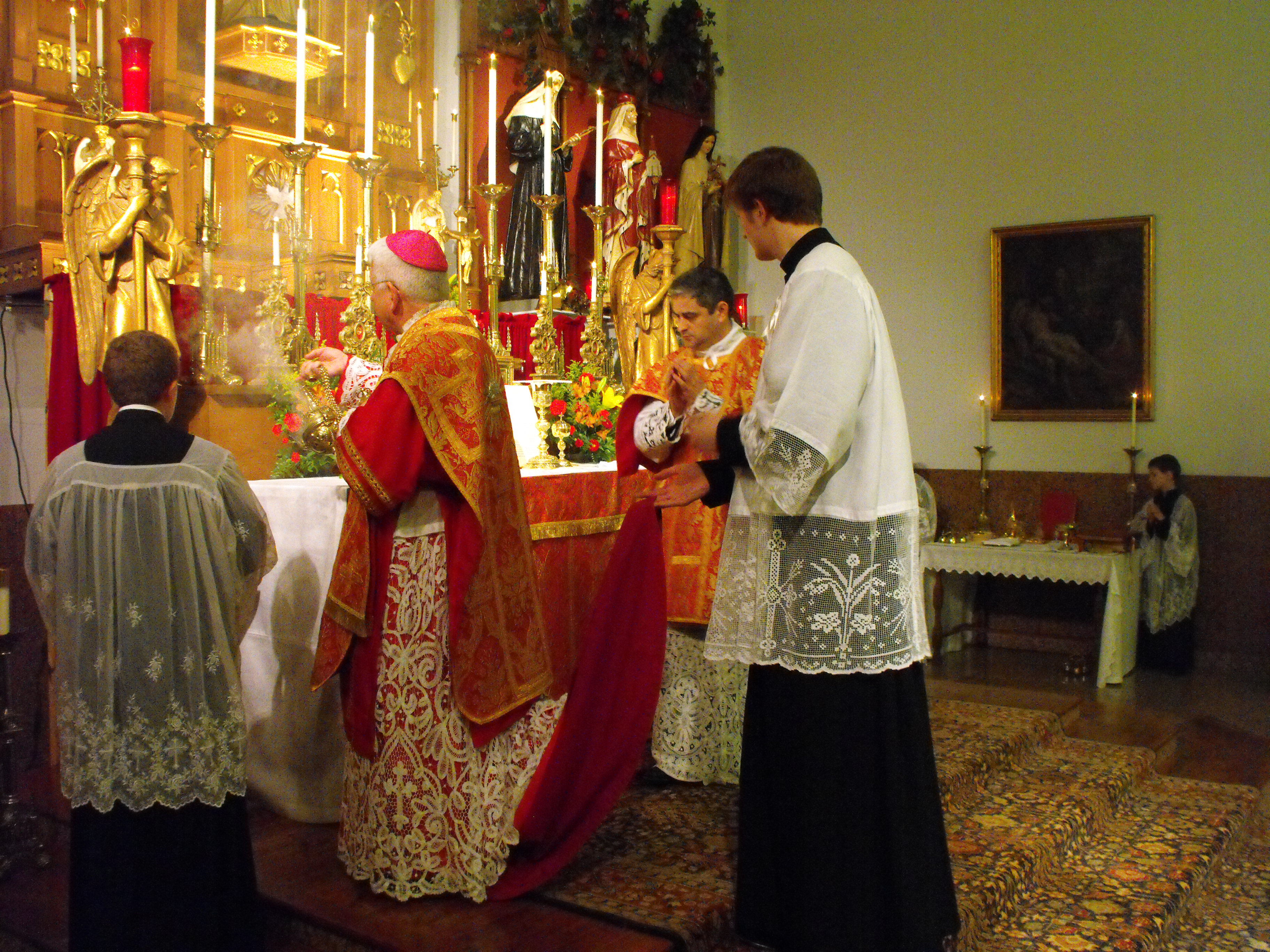
The vigil commences with the celebrant—vested in a violet chasuble—kissing the altar and following the lectors, who read six prophecies from the Old Testament, interspersed with collects sung by the celebrant. The first lesson is the familiar story of Abraham ascending a mountain with his son Isaac, prepared to sacrifice his only child in obedience to God. An angel intervenes and tells a relieved Abraham that God would never really do such a thing. All of this was proclaimed on Holy Saturday, prefiguring Christ's willingness to sacrifice everything to the Father on behalf of the world. Pentecost enters this passage late at the point when God rewards Abraham's fidelity by promising "I will bless thee and multiply thy seed as the stars of heaven, and as the sand that is by the seashore.... and in thy seed all the nations of the earth shall be blessed because thou hast obeyed My voice."

The second prophecy is an extraction from Exodus 14, wherein the Pharaoh's forces chase the Israelites through the desert and into the Red Sea, which St. Moses has just parted by the Lord's command. The Lord then tells Moses to close the Sea and drown the Egyptians, which he does. The tract continues the passage:
"Let us sing to the Lord, for He is gloriously magnified: the horse and the rider He hath thrown into the sea: He is become my helper and protector unto salvation...."
These two prophecies speak of the same thing, Baptism. Water is a symbol of creation and the essential ingredient of all that lives. Yet water is also uncertain, difficult to control. Genesis chapter 1 speaks of water roaming the earth before it had form. God used water to protect the Israelites from the Egyptians. Egypt itself is a type, a parallel, an example of sin and loss and here God saves His people—fulfilled and most perfectly expressed in the Church—through water. Through water He will "multiply thy seed as the stars of heaven," only He will no longer multiply Abraham's progeny through obedience, but Christ's Church through Sacrament. The second collect of the vigil demands this interpretation:
"O God, who by the light of the New Testament hast made clear to us the miracles wrought in earliest times, prefiguring unto us the Red Sea as an image of the sacred font, and Who in the deliverance of Thy people from the bondage of Egypt, hast foreshadowed the sacraments of the Christian dispensation; grant that all nations who have merited by faith the privilege of the children of Israel, may be born again by partaking of Thy holy Spirit."
The third prophecy, take from Deuteronomy 31, compares and contrasts closely with the Ascension of Christ. Moses, nearing death, has taken care to write down his encounters and history with God. He abjures and confronts his fellows Israelites for their infidelity to God, "For I know that, after my death, you will do wickedly, and will quickly turn aside from the way that I have commanded you." The scripture, excluded from this passage, goes on to tell us that his bones were never found. This is extraordinary. Moses joins Elijah, Enoch, and the Blessed Mother among those whose bones have not been found and the others were taken bodily by the Lord, Elijah in a chariot of fire and our Lady after her death in Jerusalem. Moses, a prefigurement of Christ who leads God's people out of bondage, many believe, Jews included, was also taken up by God. Should he have been assumed by God then an strong parallel with the Ascension presents itself. Christ of course was not assumed into heaven, but rather ascended through His own power as God. Moses brought people forth from human bondage and Christ from spiritual bondage. Both died and were raised, so to speak, and rebuked their followers for their lack of faith. Moses's followers would continue to fail God, even if they would eventually reach the promised land and create a kingdom of Israel. Christ, in a marked contrast, promises something perfect that will never be lost, a "Helper" (meaning of the word Paraclete) to preserve the faithful "in all truth." He ascends telling the Apostles to "baptize all nations in the name of the Father and of the Son and of the Holy Ghost.... For I am with you always, even until the end of the world." Moses's deliverance from slavery is made perfect in Christ's words.

The fourth prophecy again anticipates the inception of the Church in the Baptism of its members, "the Lord shall wash away the filth of the daughters of Sion, and shall wash away the blood of Jerusalem out of the midst thereof, by the spirit of judgment, and by the spirit of burning" (Isaiah chapter 4). At this point perhaps the faithful should consider what Baptism is. It is the movement of water over a person's skin with a Trinitarian formula, yes, but it is so much more, too. "Baptism" derives from a similar Greek word meaning "to immerse" or "to plunge." To be "plunged" into Christ and in the name of the Trinity is more than to enter a visible community or lose a sentence of punishments condine to one's sins. To be "plunged" into Christ is to be immersed and filled with the very life of Christ given by the Holy Spirit, Who, St. Gregory reminds the Church of Rome during Mattins of the feast, is the love of God Himself. The Holy Spirit, to be simplistic, is God's love working and doing something, creating or renewing. The Holy Spirit accomplishes this rebirth in Baptism through water, the physical essential in life and the material, again referencing Genesis chapter 1, which formlessly covered the earth before creation. Water is also like the Holy Spirit, or "Holy Wind" to take a very literal translation, in that water is not easily contained, limited, narrowed, or defined. It enters through crevices unseen and can also be lost by poor care through other unanticipated openings. It is this in water that Christ, through the Holy Spirit, renews His creation. It is for this reason so many commentators have adduced the psalm from the Vidi aquam "I saw water flowing from the right side of the Temple, alleluia; and all to whom this water came were saved...." Therefore the Church uses as her last prophecy in the vigil Ezekiel 37:1-14:
"Thus saith the Lord God, Come, spirit, from the four winds, and blow upon these slain, and let them live again. And I prophesied as He had commanded me; and the spirit came unto them; and they lived; and they stood upon their feet, an exceeding great army.... Thus saith the Lord, I will open your graves, and will bring you out of your sepulchres, O My people, and will bring you into the land of Israel.... and you shall have put My spirit in you, and you shall live, and I shall make you rest upon your own land; saith the Lord almighty."
source: traditionalmass.org
A procession then brings the sacred ministers to the baptistry where the font's waters are again blessed and infused with chrism, itself a priestly thing, as on Holy Saturday. The Paschal candle, extinguished on Ascension Thursday after the Gospel, reappears. Let not the importance of its reappearance be lost. As Dr. Laurence Hemming adumbrates in his Worship as Revelation, all the fires in a church are to be lit from the Paschal fire much as the Presence of Christ in the Sacraments comes from Christ's Incarnation and work on earth. The Paschal candle is extinguished at the end of forty days because, as with Christ and the Sacraments, its purpose, to diffuse holy fire, is accomplished. The fire remains without the candle's use just as Christ remains in the Church without a bodily physical presence. The candle returns because it symbolizes the Resurrection, the event which made this new life in the Holy Spirit possible. The celebrant plunges the candle into the font, almost baptizing the font with the candle rather the other way around. The celebrant sparges the faithful with the blessed water, infuses the chrism, and baptizes catechumens into Christ and His Resurrection. More adept parishes will also have the good sense to administer confirmation at this time, giving the neophytes the Holy Spirit and His "sevenfold gifts."

After the baptisms all who have been "baptized into Christ" on earth sing the Litanies of Saints, imploring the intercession of those in heaven who are the perfection of God's promise to Abraham, "multipl[ied] as stars of heaven." The saints, together with those on earth baptized into Christ, form the Church and carry that same Spirit and fire found on Holy Saturday. Pentecost makes the Resurrection permanent on earth, preserved in the Church unto ages of ages.

source: traditionalmass.org
Mass follows immediately during the vigil. The lesson, taken from Acts of the Apostles, recounts Paul's preaching of the Baptism of Christ, or into Christ, to the Ephesians, hitherto only aware of St. John the Baptist's baptism of repentance. The alleluia is the same as on Holy Saturday. And in the Gospel St. John tells of Jesus saying "If you love me, keep my commandments." What is the Holy Spirit other than the strength to do this? This simple, demanding sentence of Christ calls to mind James 2:18, "I will show you my faith by my works." The Holy Spirit creates, re-creates, renews, strengthens, and preserves the Church in Christ, of Christ, and for Christ, as foretold to the prophets long ago. He makes all things anew, fashioning a new, holier creation out of the materials and persons of the existing, fallen creation. And He will remain with us until the very end.

In a rare moment the Byzantine tradition has a far simpler and more understated take than the Roman Church. The Greek theology of this feast can be found in the troparion of Penteost, which I heard today at Divine Liturgy and last evening at Vespers:
"Blessed are You, O Christ our God, You have filled the fishermen with wisdom by sending down the Holy Spirit upon them, and Who through them have caught in Your net the whole world. O Lover of mankind, glory to You!"

And the Veni, Creator Spiritus (the greatest of Latin hymns?)


Friday, May 22, 2015

Josephology Part 9: The Iconographic Demotion of John the Baptist

“You have very often heard, holy brethren, and you know well, that John the Baptist, in proportion as he was greater than those born of women, and was more humble in his acknowledgment of the Lord, obtained the grace of being the friend of the Bridegroom; zealous for the Bridegroom, not for himself; not seeking his own honor, but that of his Judge, whom as a herald he preceded.” –St. Augustine 
“From Holy Scripture we also learn that some souls through the divine predilection, as those of Jeremias and of the Baptist, were sanctified before they saw the light of day. Now, what shall we say of Joseph? The Church has never made any utterance on the subject. Still, Joseph surpasses all the other saints in dignity and sanctity.” –Edward Healy Thompson

Devotion to St. John the Forerunner began very early in the Church. In the West his Nativity and Beheading are both celebrated with major feasts, and in the East he has six feasts throughout the year. There were no fewer than fifteen churches dedicated to him in Constantinople alone. His relics were and are matters of great contention, some of which were desecrated by Julian the Apostate (331-363) because he knew this would greatly offend Christian sensibilities. The Feast of the Baptist’s Nativity is believed to be one of the oldest feasts commemorating a saint ever introduced to the calendar.

What a great contrast to the devotion to St. Joseph, which was almost unknown for a thousand years of the Church’s liturgical life. Unlike the Josephite devotion, which was artificially imposed from above at various times and never organically expanded among the faithful, devotion to the Baptist started strong and only increased until modern times. How strange that the exalted place of Our Lord’s Forerunner should be so suddenly supplanted in the hearts of Latin Catholics.

(St. Francis de Sales Oratory; St. Louis, Missouri)
(St. Joseph’s Catholic Church; Wapakoneta, Ohio)
John the Baptist we know with a high level of certainty to have been sanctified by the Holy Ghost in the womb of St. Elizabeth, and thus freed from concupiscence for the rest of his life. In this glory he is a peer of St. Jeremias the Prophet, and the lesser of Our Lady who was freed from sin from the first moment of conception. As St. Gabriel prophesied to Zachary, “he will be filled with the Holy Ghost, even from his mother’s womb” (Luke 1). Because of this he is generally considered to be the third holiest of all men.

In art, John is most often depicted in his beheading or during his ministry as the Forerunner. Frequently he is baptizing Christ or pointing Him out to his own disciples.

(Annibale Carracci)
But there is another subgenre of sacred art in which the Baptist is notably present. The icons of Christ Pantocrator or Christ in Majesty would sometimes include a full or partial court of angels of saints. An early 4th century example is the “Christ the Lawgiver” mosaic in the Basilica of San Lorenzo, Milan, where He is surrounded by the Twelve Apostles.


Another frequent variation depicts Christ surrounded by the four Cherubim who symbolize the four Gospels. This imagery comes almost verbatim from St. John the Apostle’s Apocalypse: “In the midst of the throne, and round about the throne, were four living creatures, full of eyes before and behind. And the first living creature was like a lion: and the second living creature like a calf: and the third living creature, having the face, as it were, of a man: and the fourth living creature was like an eagle flying” (Apoc. 4).

(Psalter of Westminster Abbey; 13th cent.)
Most relevant to our subject is the Deësis (“supplication”) variation, which shows Christ flanked on either side by the Blessed Virgin and John the Forerunner, both with heads bowed in prayer to the enthroned King. In the East, the Deësis is sometimes presented in the context of the heavenly court, although often with just the three figures.

(St. Sophia of Kyiv; 11th cent.)
(Walters Art Museum; 16th cent.)
In the West, the Deësis more frequently lent itself to depictions of the Last Judgment, where Mary and John are beseeching the Judge for mercy. These two saints were believed to be the greatest intercessors for clemency; hence, John is always invoked in the traditional Confiteor. (In some French cathedrals, Mary was paired with St. John the Apostle, just as they were together at the foot of the Cross.)

(Marx Reichlich; 16th cent.)
(Stefan Lochner; 15th cent.)
(Santa Maria d’Arties; 16th cent.)
There the Forerunner remained for many centuries, head bowed and knee bent before the awesome judgment seat of Christ, beseeching Him for mercy on behalf of all the faithful. But one is unlikely to find John there anymore. Instead, one is rather likely to find this sort of artistic monstrosity:

(Lawrence Lovasik; 20th cent.)
What could prompt Catholic sensibilities to supplant the Forerunner with the Stepfather of Our Lord? Do we wish to see St. Joseph as a kind of forerunner of the Forerunner, a precursor to the Precursor? Why do we prefer Joseph to John? I harbor a suspicion that it is because John is too ascetic for our tastes.

Joseph was a man who led a fairly average life, after all the drama of fleeing to Egypt and back. He is relatable: a man who worked for a living, an ordinary “family man” to whom extraordinary things happened—a sort of ancient, Jewish Bilbo Baggins. John, on the other hand, is too strange and extremist for bourgeois Catholic sensibilities. At one time, the sensus fidelium placed the Baptist as the complement of the Virgin, but that rough fur coat does not translate well to modern, pink-cheeked plaster statuary.


The modern Latin Catholic appeals to the Holy Family to restore the dignity of family life and to solidify the home with strong bonds of love, but the angel prophesied rather that it would be John who would “turn the hearts of the fathers unto the children” (Lk. 1). Remember that John died for the sanctity of marriage, opposing divorce and adultery with his dying breath. He even won the respect of the wicked Herod: “For Herod feared John, knowing him to be a just and holy man: and kept him, and when he heard him, did many things: and he heard him willingly” (Mark 6). Sometimes the wicked respect those who stand against them on principle, and are open to being convinced of their errors. Herodias had John executed because she feared Herod would be convinced to divorce her. Those who have gained worldly power through licentiousness have the most to fear from moral truth.

Perhaps it is this rough, eremitic extremism that will paradoxically revive love in the family. Those who forcefully oppose the family’s disintegration are the ones who love it the most, whether they are married or not.

St. Joseph, not such a bad guy after all, pray for us!

Tuesday, May 19, 2015

The Mass of 1965?


For years I have been searching for complete footage of a Mass celebrated between 1965 and 1968, merely out of historical interest as to how people were interpreting the Consilium's directives. Above is not a full Mass, but it is a clip of Pope Paul VI ordaining priests for the diocese of Rome. By the versus populum table in front of the altar and the absence of Enrico Dante, we can safely assume that this is after 1964. By the maniple we can also assume that it is prior to 1969, perhaps even before 1967. 

Despite celebration according to the revised rubrics, the Mass also follows the ceremonial of Papal low Mass, with the pope fully vested in pontificals (mitre, gloves etc) and no assisting priest or deacons. They were likely experimenting in the Curia with how much they wanted to retain and how much they wanted to jettison. The same debate took place at the diocesan level, as evidenced by such events as these and images like this.

Sunday, May 17, 2015

Dallas Churches: The Truth

Over the past year this blog has posted a number of entries about the unique and distinctive architectural stylings which have besot the diocese of Dallas with some remarkably unattractive churches ranging from unfulfilled potential to outright horrid with most falling somewhere in the middle. We now know why. The answer is to be found at the University of Dallas.

At the heart of the University of Dallas—hidden mostly out of sight by the twenty trees in the city of Irving—rests the Church of the Incarnation. Designed to look like a womb, the students have taken to calling the church St. Fallopius.


The first view inside the edifice disorients the visitor, as he stares across the narthex atrium at the other entrance. Off to the right is a Eucharistic chapel which meshes Our Lady of Guadalupe with Soviet brutalism.


As when one enters the church proper, there is no center of view in the chapel.


On the left side of St. Fallopius' atrium is the statue of Mother and Blob, accented tastelessly by a faux-oriental, faux-copper lamp.


In front of the Mother and Blob stands, or, rather, rests a few steps down, the chlorinated font.


45 degrees left is the main worship area (cannot call it a nave and sanctuary), again disoriented.


The entrance invites one to drift to the right, where the aisle twists around this uteral space.
On the floor are some crosses and words meant to pass as Stations.


Artificial light directly above in the ceiling illuminates the "station."


The center view fools one into assuming the church proper is symmetrical when,
in truth, the concert grand piano and choir stage adjoin the altar space.


Again, the faux-copper lamps stolen from a sheikh's palace.


Not only do they use the Gather hymnal, but they spent money on
embossed copies made with high quality paper. Bad taste is expensive.


I gave myself a quick C-section and escaped the womb of St. Fallopius. Immediately outside I happened upon this ordinary, but quite well made marble statue of Our Lady in prayer. "J" told me that this statue of the Virgin was carved by a university art student for use in the chapel, but it was placed out in the elements because the style was discordant with that of St. Fallopius.

Why tell you all this information and show you these lurid images, dear readers? I have not neglected care for your senses. On the contrary, I wish to fulfill your minds. This building, directly, and the other ugly churches in the diocese of Dallas, indirectly, are the work and responsibility of one man: Lyle Novinski.

Lyle Novinski designed St. Fallopius and, quite inexplicably, established himself as an expert on liturgical art and architecture in the Catholic tradition, so much so that the previous bishop of Dallas gave him veto and reviewing rights over every new church erected within the diocese. Novinski must take efficiency and brutality as his inspirations, having eviscerated all concept of maximalism and tradition. In one lecture he regales the listeners with tales of the English bicycle wheel: take anything away and it fails, add anything and it becomes redundant. 

Unfortunately, God is not a bicycle wheel and the worship of God does not take inspiration from recreational vehicles. God is a maximalist Who demands fitting praise and worship. Arranging a metal and brick silo with a few Marian images and a stone block altar does not make St. Fallopius a church in any traditional sense, only in an efficient sense. Brutalism kills beauty, which is a great sin in itself. People are more readily captivated and oriented to God by beauty than by rhetoric or logic. Beauty is often the start of conversion, it has kept a great many weak souls within the bounds of the saving ark for centuries, and it tells the reverent among pagans that the Church offers something that they might understand. Removing beauty, as Mr. Novinski and the previous bishop of Dallas have done in many places, is a crime in itself, a great spiritual crime for which there is no immediate expiation. 

Below is a feature on the man behind St. Fallopius from a local news agency.


Thursday, May 14, 2015

On Nostalgia, Apologetics, and Apostasy

“I don’t think this was covered in Mass Confusion.”
“We remember the fish that we ate in Egypt freely: the cucumbers come into our mind, and the melons, and the leeks, and the onions, and the garlic. Our soul is dry, our eyes behold nothing else but manna.” (Numbers 11)
In addition to his series on nostalgia, His Traddiness has brought up the strange case of Michael Coren’s recent apostasy. This is assuredly a sad event and one for which we ought to offer up our prayers and fasts. It is also part of the ongoing statistical trend of Catholics leaving the Faith, or at least the practice of it, that has been happening for decades. Cradle Catholics are leaving because they are too smart not to perceive the irrelevance of what they see and hear from their prelates every week. Converts leave for these and many other reasons, not the least of which is the budding suspicion that they have been seriously deceived by the apologists who argued them into the Church.

Not all converts come in through the agency of apologetics. Some marry into the Faith, others are entranced by the beauty of our art and music, and a few just want to be a part of the same philosophical school as Thomas Aquinas. For all these, apologetics plays a secondary role, and the arguments for and against the minutiae of the Faith are not terribly worth considering. One thinks of Rex Mottram’s impatience with Fr. Mowbray’s attempts to catechize this poor, simple fellow in Brideshead Revisited.

I have indeed imparted my opinion to His Traddiness that the Catholic Answers crowd and their countless imitators on EWTN and other publishing imprints do a poor job keeping discontented Catholics in the Church. Back when I was yet unconfirmed, I must credit Catholic Answers particularly for clearing out a lot of the heretical rubble that had been keeping me from understanding what the Church actually taught. I appreciate what their staff writers and speakers did for me all those years ago, so I criticize them with no small measure of sadness.

Karl Keating, founder and occasional president of Catholic Answers, shrugged off Coren’s apostasy in a recent article, saying, “I’m not surprised to see people bouncing from one religious position to another. I’m not surprised about it, and I don’t get worked up about it.” Well, why get worked up about the loss of one of the ninety-nine sheep? All that really matters is the truth, not people: “I do get worked up about truth in advertising,” he says.


Keating is a cradle Catholic, and as such does not have a feeling for the pull that Egypt has on those who have left that pagan nation for the Promised Land flowing with milk and honey. The version of the Catholic Church promised by today’s apologists is basically the Arcadian land of 1950s triumphalism, with plenty of Vatican II quotations added in for good measure. The ur-text for Catholic Answers and other apologists is Frank Sheed’s Catholic Evidence Training Outlines, a 1925 manual with extensive instructions about how to speak publicly and deal with hecklers (easily modified for radio shows and blogging), followed by even more detailed outlines of the kinds of subjects a Catholic soapboxer in Hyde Park would have had to opine upon. The Outlines take some inspiration from St. Francis de Sales’ tracts written against the Calvinists back when that heresy was young. When Mr. Sheed was arguing petulant Anglicans into the Catholic fold, they were being received into something solid and stubbornly unprotean, with a community of fellow believers who knew what they knew and knew what they were doing. When Keating and his staff use the same arguments to push the indecisive into the twenty-first century Church, these converts are left unprepared for the pandemonium and disorientation that is about to confront them.

What happens when these CA-converted rabble call in to the radio show to point out the very obvious ecclesiastical problems, well-nigh begging for clarity and encouragement? All too often the caller is told that the priests or bishops in question are “trying their best” to deal with modern problems, that said caller should take comfort in this fact, and thank you for your call. This passive-aggressive, “Everything is Fine” approach to the confused borders on the wicked. These apologists make vocations out of the spiritual works of instructing the ignorant and counseling the doubtful (outside the Church), but fail to comfort the afflicted and counsel the doubtful within the Church.

Is it any wonder that Catholic converts apostatize, that close to one-half of them leave the Church within a year of their confirmation? The Keating answer is simply, “Oh, well. They knew the truth, and couldn’t handle it.” But in reality, these converts are undermined at every step by their parish priest, by their bishop, by their fellow Catholic, most of whom don’t believe even half of what Catholic Answers has triumphantly claimed to be the teaching and practice of the Church.

When our apologists are little more than truth-bots doling out programmed responses to every possible query, then Catholic apologetics have truly reached their final disintegration. All head and no heart, the apologist shrugs as the apostate limps back through the desert to Egypt, bruised and bloodied from the beating his supposed friends have given him. The convert nostalgically remembers his old life—being asked over to dinner to someone’s house every week after church, charitably arguing about the interpretation of some obscure Bible passage with friends at the coffee shop, not being scowled at by all of his relatives—and wonders why he is settling for scraping manna off the ground while Aaron comes by every five minutes to kick him in the ribs.

The Israelites in the desert were scourged for their own infidelity and idolatry. The Catholic convert is scourged to cover up the infidelity and idolatry of others.


Monday, May 11, 2015

Hearing the Word of God or Agreeing with It?


I heard the sad news of Michael Coren's leaving the Church in two parts, first that he left the Church and then some time later than he opted to joined Anglicanism. Hearing the first bit of news, I assumed it was another case of secular culture eroding one's belief in God, in the transcendence of grace, of the higher things in a whirlwind of Darwinian nihilism. Then I read he became an Anglican. My initial and enduring reaction was: What. The. Hell.

"No one becomes an Anglican," I thought. "Even England didn't want to join the Church of England! They had to be compelled!" Clearly, the motivations were not owing to the conspiracy of Kasper to rally the divorced to the altar rails or a pursuit of some abstract and "pure" Christianity. The Byzantine Orthodox communion would have met those needs, as would any other number of dissident groups. Something else was happening here. He changed his position on homosexual unions. Yes, he left the continuity of saints, liturgy, writings, teachers, and belief because of the modern Canadian social cause for homosexual homes.

We cannot read Michael Coren's mind or peer into his soul, but we could generalize, dear readers, that Mr. Coren's departure emanates from a rather modern problem. I do not know if Mr. Coren was a cradle Catholic or convert, but a point a friend made last week resounds with the Canadian's case. We were lost in ecstasy and a cloud of Nicaraguan smoke while discussing the apologetics industry when "J" said, "The Catholic Answers crowd is good at arguing people into the Church. They're less good at keeping them in." The "Catholic Answers crowd"—Michael Voris' "Church of nice"—follows the modern paradigm of religion as a set of private, personal intellectual propositions once can accept or decline depending on one's reception of them. The question many converts, cradle Catholics, and disbelievers alike ask is, "Does the Catholic Church agree with me?" or "Can I get along with the Catholic Church," not "Can I accept the perennial faith of the Church with humility?" In short, God believes what the individual says is true rather than that the individual believes what God says is true. Unfortunately, Michael Coren either read the story of Sodom or 2357 of the JP2 catechism and decided that he would not accept that God.

The concept of a revealed religion has become foreign to the western world and Christians do no service to themselves in adumbrating the virtues post-modern intellectual freedom, which is really slavery to the black bonds of nihilism. The older rites of the Church reflect the "dialectic of Revelation," as Aidan Kavanagh put it. God appears to man. Man does not get to decide Who or What God is. One meets and conforms the self to God and prays for union with the will of God. Concepts of happiness and acceptance are quite foreign to the faith. Joy and sense of place are the domestic traits of the Apostolic faith.

Let us pray for Michael Coren and those like him during the Litany of the Saints these Rogation days. Let us pray that they "hear the Word of God and keep it", rather than "listen to the Word of God, and think about it." Christ asked those He healed "Do you believe?" not "Do you agree?"