Monday, December 7, 2015

Walking through St. Francis de Sales Oratory: The Exterior

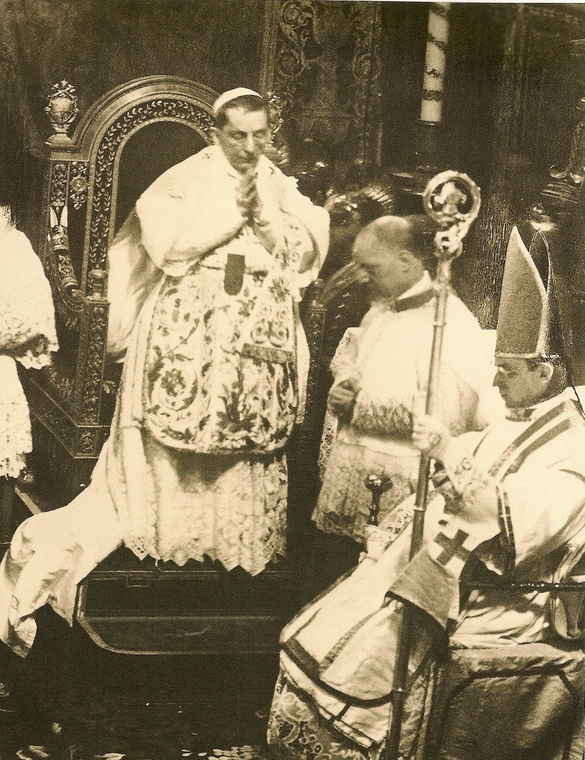
My travels recently brought me through St. Louis, Missouri. While there I visited the famous St. Francis de Sales Oratory, one of the midwestern strongholds of The Institute of Christ the King. The following are photos taken around and within the oratory. Although I took no photos during Mass, be assured that the Institute's love of lace, dusty blues, and operatic dress was well on display.

The outdoor photos were taken from the south and east (front) sides of the building. Click the photos for a higher resolution.

The famous "leaning tower" from a distance.
The original church (built by German immigrants) was destroyed a year later by a tornado. It was not fully rebuilt until 1908.
Stonework on the south side.
The baptistery is visible even from the exterior.
Telephone lines run past the front of the church.
A rather whimsical depiction of St. Francis in green.
Indeed, that website has useful information about the history of the oratory and its needed repairs.
Another view of Our Lady of Fatima.
And another. The run-down neighborhood can be glimpsed in the background.
Even the planting pots have attractive carvings.
Main doors.
This plaque may have been the only thing that kept the building from demolition during its impoverished years.
A view from the pew.
More interior shots in the next post.

(to be continued)

Saturday, December 5, 2015

Are Patriarchs Real?


Dreams of a Church decentralized along traditional lines inevitably rely on a strong role of patriarchs over the location churches who preserve their native traditions rather than positive obedience to Rome. The Bishop of Rome is St. Peter's successor; the heads of the Roman dicasteries, the Secretariat of State, Peter's Pence, and the Vatican bank are more successors of the Roman Senate, and not very good ones at that. A patriarch, so the argument goes, is the father of his particular church and so he should be its overseer, not another bishop or bureaucracy extrinsic to that church's tradition. This line of thought provokes discussion of inherent differences in ecclesiology between the ancient Byzantine Church and the rest of the Church, as well as the differences between modern Roman ecclesiology and Eastern Orthodox views on the same subject.

This writer once witnessed an exchange between a monk from Collegeville and a young student on the possibility of reunion between the Catholic and Eastern Orthodox Churches. The monk said, "Well, the ancient Church wasn't ruled by the pope. There were five people called patriarchs who governed the Church collegially. The Pope was just the most famous of them." The Pope, so it goes, was the primus inter pares in the Pentarchy, a purported model of Church government inaugurated at the first Nicene Council in 325. According to this model the local patriarch governs his individual church while the administration of the general Church belongs in principle to the five collectively and in fact belongs to the Roman Emperor with the counsel of the five collective patriarchs. This model, if it ever really existed in a substantial way, ended the following century.

The Pentarchical model is a model of patriarchs. The etymology of "patriarch" seems to give a concise definition of the position and its power, the right and duty of fatherhood over the church. However, the Nicene Council no where uses the title of patriarch. The most prominent title in the Nicene canons is that of metropolitan bishop. The sixth canon defers to the local synods and asks that the Bishop of Alexandria might have authority over his synod like the Bishop of Rome has over his.
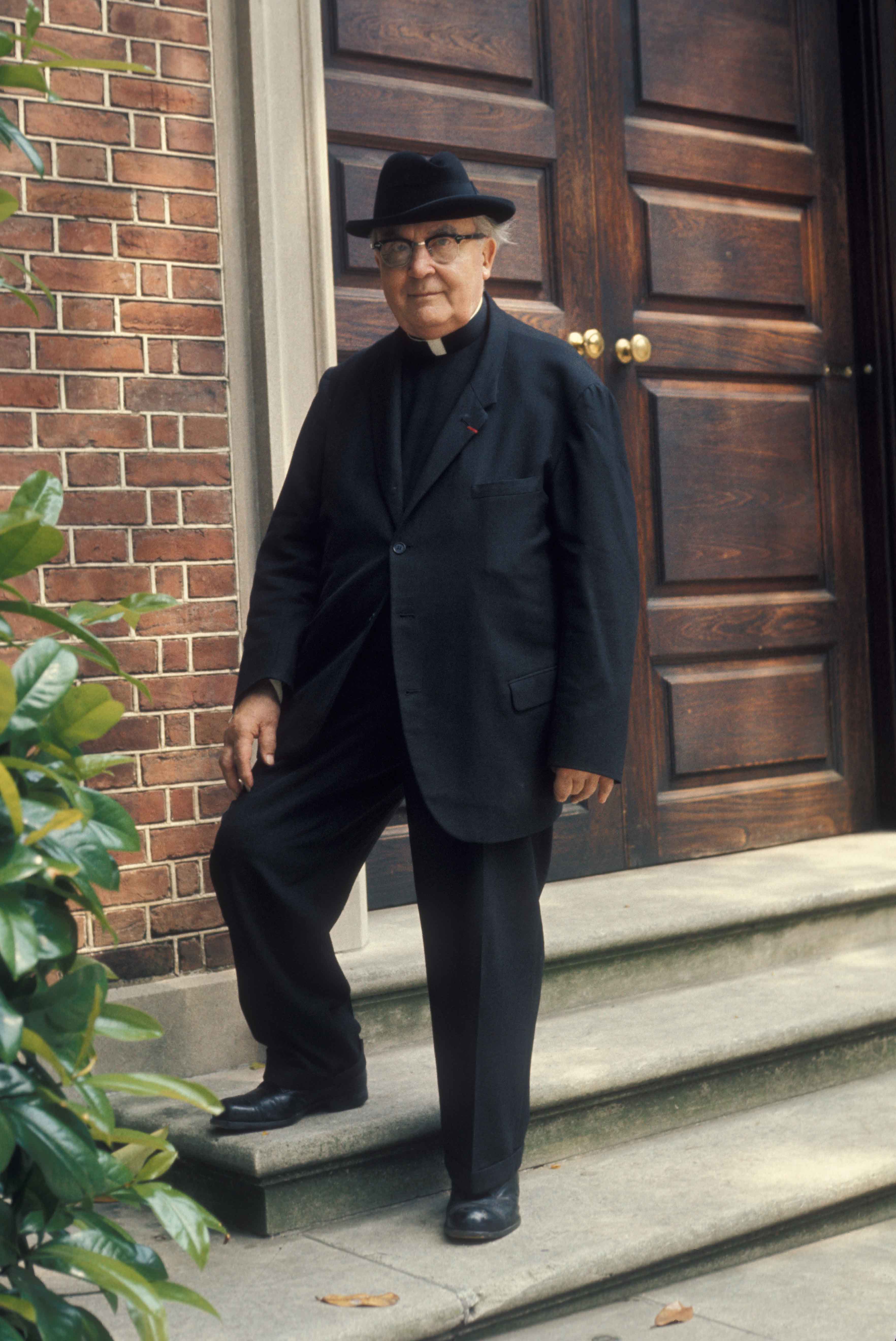
Msgr. Dvornik
As historian Francis Dvornik notes in his Photian Schism (despite the title he held a favorable opinion of the occasional archbishop), the ancient sees derived their prestige from their founders and their locations. People did not necessarily speak of St. Peter or St. Mark as the first bishops of Rome, Antioch, and Alexandria, but as the founders of those churches. St. Paul founded any number of Mediterranean churches in lesser cities that never rose to the status of the three original "patriarchal" sees. Alexandria was an ancient center of scholarship, philosophical speculation, and seafaring travel. Antioch was a multicultural trade center on the Spice and Silk Roads. And Rome was the capital of the known civilized world. It was only natural that smaller apostolic churches would look to the larger apostolic churches for guidance and that churches would divide themselves along the same administrative lines as the Empire. The Roman See enjoyed a special position because both Peter and Paul oversaw the Roman Church, met their ends and were buried there, and because of the Eternal City's place as the Imperial capital. When Irenaeus wrote of Rome "It is a matter of necessity that every Church should agree with this Church, on account of its preeminent authority" he did not reference the person of the Bishop of Rome, but instead a charism belonging to the entire Roman Church because of its origins. Rome would continue to claim a unique primacy over the other churches because of its origins in the succeeding centuries, but generally the major sees oversaw the lesser sees on account of both their apostolicity and their urban nature. All of this changed in 330.

Constantine the Great relocated the capital of his empire from Rome, a city he only visited two or three times, to the small port city of Byzantium, whose bishop of a suffragan of Heraclea. The first Council of Constantinople, which was a local council until its acceptance by non-Greek bishops in the following decades, decreed that "Because it is new Rome, the bishop of Constantinople is to enjoy the privileges of honor after the bishop of Rome" (canon 3). The Roman and Alexandrian Churches begrudgingly tolerated the imperial promotion of a minor bishopric to the second most prominent position of authority within the Church. Rome feared further intrusion on its prestige and Alexandria felt its apostolic origins were ignored in favor of political expediency. The original sees continued to assert their apostolicity while the Greek church countered, not unreasonably, that the Church should meet the needs of the time. 
Sir Steven Runciman
In practice the promotion of Constantinople might not have been so controversial if not for the caesaropapism that followed. Byzantium—which never called itself anything other than the Roman Empire—saw the Church as a visible human society. The Church and Byzantium were, aside from tolerated sects, one and the same. A breach between bishops or a dispute between clergy and public officials was tantamount to violence within God's Church. The Emperor was in a way the living icon of God the Father, from whom the Son in the episcopacy and the Spirit in the Church came. As Byzantine historian and Orthodox believer Steven Runciman once described the situation, the Emperor and bishops were partners, but the Emperor was undoubtedly the senior partner.

To the Latin Church this idea was utterly foreign. Most of Europe ceased to be a part of the Empire by the Council of Chalcedon. The reconquests of Justinian brought some of Spain and Italy back into devotion to Constantinople, but most of Europe was permanently lost. The Latin Church maintained Communion with other peoples who no longer belonged to the same socio-political fabric as the city of Rome. Britannia ceased to be a part of the Roman Empire by 410, yet the skeletal Christian community retained relations with Rome until the Saxons subdued them into paganism and set the stage for missionary efforts during the Gregorian papacy. Byzantium's recession from Italy only crystallized the Latin ecclesiology. Wishing to retain influence in the universal Church, the popes continued to assert their judgments in Eastern affairs. In practice, the popes and the city of Rome could no longer rely on the Emperor for protection. From the eighth until the eleventh century the popes made a series of frail alliances with Frankish kings, Italian nobles, Norman adventurers, and the odd Greek to ensure the City's stability and the Church's security. 

The Latin and Greek views were not incompatible because they are different, for different ideas can be found complementary. St. Augustine's understood the Trinity as God's full expression of personhood. By contrast St. Gregory the Theology took the Three Divine Persons and the first commandment as given facts of revelation with the Trinity as the only possible explanation for both. The Latin and Greek ecclesiologies were incompatible because the two churches had less and less to do with each other. 

Historians following the tradition of Runciman characterized this breach as a gradual separation of the Bishop of Rome from the other four patriarchs of the Pentarchy, that the collegiate pares lost the primus. This is the commonly accepted narrative of secular historians eager to point the finger at the expansionist papacies of Nicholas I and Gregory VII and of Eastern Orthodox polemicists, and one for which Ultramontane Roman commentators have had no answer. Greek Patriarchs would continue to cite the first few ecumenical councils to support their place in the Pentarchy while Nicholas I asserted the more ancient position of Alexandria over Constantinople, which he derided as a newfangled see. The underlying difference is that the Greek had a more substantial understanding of patriarchs than the Latins.

The first several councils never spoke of patriarchal government of the Church, of patriarchal sees, and their innate privileges. The word patriarch never appeared until Justinian coined it. The councils spoke of the authority and honor of three ancient bishops, one elevated bishop, and one honored bishop (Jerusalem). Nicaea I and Constantinople I defer much authority to metropolitan bishops, but there were many metropolitan bishops, not just five. Rome, Alexandria, and Antioch garnered mention at Chalcedon because of their roots; Constantinople owed its place at the Council because of its position; and Jerusalem, a city destroyed centuries earlier and rebuilt as Aelia, was given a special place of honor because of its location, not because of any inherent right it was owed. Each bishop enjoyed a distinct level of authority in his jurisdiction. The Bishop of Rome had far more power in the West than any contemporary Eastern bishop possessed among his brother bishops. The Bishop of Alexandria likewise enjoyed a substantial, if less extensive and more limited, power among churchmen in his native lands. Aside from historicity, little distinguished the Bishop of Antioch from other archbishops in exercise of power. If there are any defining features of a patriarch, ecclesiastical authority over suffragan bishops is not one of them; none of the supposed ancient patriarchates possessed qualitatively similar traits.

No one looks too sure.
The next logical assumption is that a patriarch is the guardian of a particular tradition. The Greek Patriarch represents the Greek liturgical, theological, cultural, and spiritual tradition. The Coptic Pope fulfills the same role for the Egyptian church and so on. This is true today; it may not have been true in the fifth century. Theology and liturgy were in flux. "Spirituality" was hard to define and culture was a mix of Roman law, Greek philosophy, and whatever local customs predated the pax Romana. 

Patriarchs sprung up in Slavic lands over the next millennium along the Alexandrian and Antiochian line, that of a graduated archbishop with some authority in the national synods, but not substantial power over the entire church he governed. The Latin church witnessed atavistic patriarchs, too. The Patriarch of Aquileia played a major role in the Three Chapters drama, but not because of its titular name. The Patriarchate of Venice is merely honorary. Latin primates in France and England functioned much like Slavic patriarchs would in Eastern Europe. The Bishop of Rome never stylized himself as "Patriarch of the West" until the multiplication of papal titles in the baroque era.

Amid contemporary challenges in the Church, Christians peer into the rear view mirror of history and find Divine revelation in the early councils when they should see inspiration. The ancient Church, political expediency aside, never behaved as though the five bishops mentioned distinctly at the first, second, and fourth ecumenical councils were meant to govern the Church collectively and in perpetuity. Those councils recognized the ecclesiology of older times in nodding to the three Petrine sees, honored the one see's geography, and elevated another because of the needs of the day. Were a patriarch a figure of substance the Pentarchy would be indefensible today. There are five claimants, three Catholic and two Orthodox (neither in communion with the other), to succeed St. Peter as the Patriarch of Antioch while there is not one purported Patriarch in the New World. This writer is interested in seeing how the Eastern Orthodox "great council" progresses because it should reveal how those oriental churches understand who a patriarch is today, fourteen centuries since an emperor presided at anything presuming to be an ecumenical council. The Greek Patriarch is now bishop of very little in contrast to the major Slavic metropolitans and patriarchs. The Latin church has its share of trouble with those incarnations of frivolous bureaucracy, the permanent national episcopal conferences, but those are matters primarily of administration, not ecclesiology. Constantinople and Antioch no longer exist; Jerusalem and Alexandria have minority Christian populations; Rome is a city of non-practicing Catholics and tourists. The Bishop of Alexandria left Communion with the universal Church in 451; the Pentarchy is predicated on the Greek Alexandrian church, not the Coptic church. Neither the ancient nor the imperial understanding of the ancient patriarchs suffices today. Hopefully church leaders will consider our common past more astutely as they envisage our common future in the the coming centuries.

Thursday, December 3, 2015

Considering the Legacy of John Senior: Part 2

From the student-created IHP course catalog. (source)
[Part 1]

It was at the University of Kansas that Senior accomplished his greatest academic and spiritual work, his magnum opus which was also an opus Dei. The Integrated Humanities Program (IHP), founded in 1970 with Dennis Quinn and Franklyn Nelick, was a classics or “great books” program that passed down ancient Christian and pre-Christian wisdom as a true oral tradition.

Senior had become very seriously Catholic by this time. He encouraged his students to read the Rule of St. Benedict, and sent some of them on pilgrimages to the Fontgombault monastery in France, which was one of a few still celebrating the pre-Novus Ordo rites of the Church. Many of his students had converted to the Faith, some joined the religious life to found Our Lady of Clear Creek Monastery in Oklahoma (a daughterhouse of Fontgombault), and others are priests and bishops today (including Bp. James Conley of Lincoln, Nebraska). His intellectual-spiritual children and grandchildren are seemingly as numerous as the sand of the sea.

The success of the IHP was hotly opposed by many in the administration, who had received calls from concerned parents that their children were being subjected to brainwashing by a cult figure. A local Unitarian minister formed the “Committee for Academic and Religious Freedom” with the aim of abolishing all religious freedom within the IHP. The local Catholic archdiocese was even convinced to oppose the program, which was finally abolished in 1979 by the Kansas faculty after a thorough witch hunt. Senior, Quinn, and Nelick soon filed a libel suit which was settled in their favor, but they continued to teach at Kansas.


Meanwhile, Senior had published The Death of Christian Culture in 1978 through Arlington House. Parts of the book were pieced together from previously published essays, and the final result is a mighty jeremiad against the suicidal literary-cultural movement of the West. Here, Senior condemns the “Perennial Heresy” which he had described with such affection in The Way Down and Out, and corrects it with the Perennial Philosophy. The various chapter titles—“Eastward Ho!—Hum,” “The Real Absence,” “The Emperor’s New Literature,” “Dark Night of the Church,” etc.—gives the reader a sense of his thoughts on cultural and spiritual matters.

He retired from teaching in 1983 due to a severe heart condition, and the same year published The Restoration of Christian Culture through Ignatius Press, a decision one can hardly imagine the publisher making today. In Restoration he more strongly pushes for a revival of Benedictine monasticism and Marian devotion. Chapters such as “The Air-Conditioned Holocaust” and “A Final Solution to Liberal Education” proved that he had lost none of his bitter wit.

Senior’s close relations to the Society of Pius X were a matter of some concern for his fellow Catholics, even to the traditionalists. He wrote articles arguing for the possibility that the Society’s break with the pope in the ’80s was justified (republished as “The Glass Confessional” and “Lost at Sea” in The Remnants by Remnant Press, 2013), and his son Andrew remained friendly with the Society and Dr. David Allen White, a brilliant English professor who is still a close collaborator with Bp. Richard Williamson. Both Andrew Senior and Dr. White wrote introductory notes to recent editions of Death and Restoration. On his deathbed, the elder Senior angrily dismissed a priest who tried to comfort him with the assurance that nobody really knows what happens to us after we die. “I may have lived awhile with the New Church,” he replied, “suffered under it, but I will not die in it.”

John Senior’s legacy deserves repeated consideration. Even the imperfections of his Christian Culture diptych cannot eradicate its moments of brilliant clarity. A short excerpt from one of them is enough to prove the point:
Generations brought up in centrally heated and air-conditioned homes and schools, shot from place to place encapsulated in culturally sealed-off buses, who swim in heated, chlorinated pools devoid of current, swirl or tide, where even the build-up from one’s own pushing of the water is suctioned off by vacuums so as not to spoil the pure experience of sport-for-sport’s sake... poor little rich suburban children who have all these delights, and living in constant fluorescent glare, have never seen the stars, which St. Thomas, following Aristotle and all the ancients, says are the first begetters of that primary experience of reality formulated as the first of all principles in metaphysics, that something is. (Restoration, p. 83)
The spiritual tradition he handed down bears fruit to this day, and shows little sign of stopping. He was perhaps right in warning his students and friends—if one can indeed separate the former group from the latter—to avoid his book on occult literary themes, but even that work can serve as an indirect warning against certain spiritual temptations. If the esoteric tradition is in fact the Perennial Heresy, it deserves a thorough explication to show that it is no mere passing Harry Potter-esque fad.

On April 8, 1999, Senior passed away and was buried in Our Lady of Peace Cemetery in Kansas by Fr. Ramon Angles of the SSPX. He was joined two years later by his wife, and their tombstone reads, “Love is strong as death.”

(source)

Wednesday, December 2, 2015

Considering the Legacy of John Senior: Part 1

Curiously, Dr. John Senior is remembered today less for his work in the traditionalist movement than he is for a book list that appeared as an appendix in his great work, The Death of Christian Culture. This list of “The Thousand Good Books” is meant to be something of an antidote to the extreme demands of the many “Great Books” lists popularized by many academic programs—the “merely good” books that are useful for fertilizing and tilling the soil of children’s souls from the nursery to youth.

Dr. Senior’s own youth is shrouded in a bit of mist. He was born in 1923 in Stamford, Connecticut, and grew up in Long Island, New York. In the 1930s he was enamored with Marxism. He married Priscilla Wood in 1945, and received his BA (1946), MA (1948), and PhD (1957) in Comparative Literature from Columbia University. The Seniors had three children, Penelope, Matthew, and Andrew.

In 1959, Senior published The Way Down and Out: The Occult in Symbolist Literature through Cornell University Press, apparently while teaching at Cornell. In this volume he acknowledges a great debt to Raymond Weaver, a professor at Columbia University who was instrumental in first bringing the works of Herman Melville out of obscurity and into the world of academic appreciation. Weaver’s book Herman Melville: Mariner and Mystic was the first major study of the American novelist, and it was encouraged by Carl Van Doren (himself the brother of Mark Van Doren, another mentor of Senior’s).

In The Way Down and Out, the nearly forty year-old Senior shows an obsession with the subject of the occult. He spends half the book describing esoteric traditions in detail, with the rest attempting—and, I think, succeeding—in finding occult intent in the works of many poets and novelists: Blake, Hugo, Baudelaire, Rimbaud, Huysmans, Yeats, and others. The symbolist poets, he says, were attempting to revive the ancient esoteric priesthood by becoming priests themselves through the composition and promulgation of poetry. Most if not all of them failed in the attempt, Senior argues, but such was their intent.

Later in life, Senior asked people not to read this book. It is not difficult to understand why. Orthodox Catholics could easily be scandalized by the writings of the pre-Catholic Senior, for The Way Down and Out is the work of a still half-pagan mind. To take but one example, he writes that Baudelaire’s Les Fleurs du Mal is “a book as pure as that by any monk, and the fact that it was suppressed as immoral is a bitter joke, like a lesser burning of St. Joan” (p. 96). This is a far cry from the condemnation of Baudelaire that would appear in The Death of Christian Culture (1978).

Senior described his own conversion in an essay written shortly before his death,
My conversion started at thirteen, when, having visited the orchard of forbidden pears, I followed Marx and Freud, as most students of my generation did, until, through the good offices of an extraordinary teacher at college met my Socrates and truth, from whence I followed Plato to Platonism and, in the depths of intellectual if not moral despair, Oriental doctrine which brought me face to face with Nothing. Many of my friends and colleagues from this time, driven by the thirst for truth beyond Existence ended in insanity and death from overdoses of drugs and bogus Buddhist meditations. By what then seemed merely chance, my Angel interfered: Meditating on the famous proposition of Heraclitus that the “way up and the way down are the same”—which the Gnostics take to mean that, since opposites are one, the law of contradiction is void—I happened (oh happy chance!) to take up St. Thomas who says the way up and down are indeed the same, except as to direction. 
To my astonishment, as I mounted up the gangplank to the Ark, I was all but trampled by a horde of crazy Catholics rushing to embrace in the name of “Renewal” the very horror I was leaving. (“The Last Epistle” from The Remnants, p. 128-9)
Senior was received into the Church soon after the publication of The Way Down and Out, in 1960. That year he also moved west to teach at the University of Wyoming. Esquire Magazine named him one of the country’s top fifty teachers in 1966. In 1967 he relocated again to take a position at the University of Kansas, where in 1970 he founded the Integrated Humanities Program with Dennis Quinn and Franklyn Nelick. It was a program doomed to fail dramatically and yet succeed in ways beyond Senior’s wildest hopes.

(to be continued)

Sunday, November 29, 2015

Salve crux, quae in corpore Christi dedicata es


The Apostle Andrew was born at Bethsaida, a town of Galilee, and was the brother of Peter. He was a disciple of John the Baptist, and heard him say of Christ, Behold the Lamb of God, whereupon he immediately followed Jesus, bringing his brother also with him. Some while after, they were both fishing in the Sea of Galilee, and the Lord Christ, going by, called them both, before any other of the Apostles, in the words, Follow Me, and I will make you fishers of men. They made no delay, but left their nets, and followed Him. After the death and Resurrection of Christ, Andrew was allotted Scythia as the province of his preaching, and, after labouring there, he went through Epirus and Thrace, where he turned vast multitudes to Christ by his teaching and miracles. Finally he went to Patras in Achaia, and there also he brought many to the knowledge of Gospel truth. Aegeas the Pro-consul resisted the preaching of the Gospel, and the Apostle freely rebuked him, bidding him know that while he held himself a judge of his fellow men, he was himself hindered by devils from knowing Christ our God, the Judge of all.

Then Egeas, being angry, answered him, Boast no more of this thy Christ. He spake words even such as thine, but they availed Him not, and He was crucified by the Jews. Whereto Andrew boldly answered that Christ had given Himself up to die for man's salvation; but the Pro-consul blasphemously interrupted him, and bade him look to himself, and sacrifice to the gods. Then said Andrew, We have an altar, whereon day by day I offer up to God, the Almighty, the One, and the True, not the flesh of bulls nor the blood of goats, but a Lamb without spot and when all they that believe have eaten of the Flesh Thereof, the Lamb That was slain abideth whole and liveth. Then Aegeas being filled with wrath, bound the Apostle in prison. Now, the people would have delivered him, but he himself calmed the multitude, and earnestly besought them not to take away from him the crown of martyrdom, for which he longed and which was now drawing near.

Come a short while after, he was brought before the judgment-seat, where he extolled the mystery of the cross, and rebuked Aegeas for his ungodliness. Then Aegeas could bear with him no longer, but commanded him to be crucified, in imitation of Christ. Andrew, then, was led to the place of martyrdom, and, as soon as he came in sight of the cross, he cried out, O precious cross, which the Members of my Lord have made so goodly, how long have I desired thee! how warmly have I loved thee! how constantly have I sought thee! And, now that thou art come to me, how is my soul drawn to thee! Welcome me from among men, and join me again to my Master, that as by thee He redeemed me, so by thee also He may take me unto Himself. So he was fastened to the cross, whereon he hung living for two days, during which time he ceased not to preach the faith of Christ, and, finally, passed into the Presence of Him the likeness of Whose death he had loved so well. All the above particulars of his last sufferings were written by the Priests and Deacons of Achaia, who bear witness to them of their own knowledge. Under the Emperor Constantine the bones of the Apostle were first taken to Constantinople, whence they were afterwards brought to Amalfi. In the Pontificate of Pope Pius II his head was carried to Rome, where it is kept in the Basilica of St Peter.

Saturday, November 28, 2015

Who Was Papa Sarto?

Looking toward the future
Hammer of the modernists. A great liturgical reformer. A stodgy dinosaur. A chain cigarette smoker. A pastoral pope with the mind of a parish priest. Pope Pius X, who occupied the Petrine See from 1903 until his death in 1914, has been called all of these things by various factions. All these labels bear a small amount of truth to them, but ignore the fact that precious little is actually remembered about the man. Traditionalists have made him into their favorite pope—although all rad trads know Gregory the Great owns the top place, that is, until the election of Sixtus VI—without much consideration of his real legacy and the Vatican that created it.

J's latest offering on modern Catholic blogosphere vocabulary has generated copious comments on the liturgical changes that Pius X put into force, changes which were just as radical as those effected by Pius XII to Holy Week and Paul VI to the Ordo of Mass, although they were less distasteful in their result. This same who tossed out the psalter used by the ancient Church of Rome since probably the fourth century and which St. Benedict of Nursia proactively sought to imitate in his Rule also went on a zealous hunt against theological and disciplinary dissidents in an effort to preserve what I have termed the "Perfect Society" model of the Church. What could be more modernistic than discarding a fifteen century old liturgical tradition?

Guiseppe Sarto was not the College of Cardinals' first choice for the Apostolic See. An often reliable and much condemned correspondent for National Review, Mary Ball-Martinez, wrote in her Undermining of the Catholic Church that Mariano Cardinal Rampolla del Tindaro, Secretariat of State, was originally elected only to be vetoed by the Archbishop of Krakow on charges of Freemasonry. Mainstream thought, whenever it heard this far-fetched claim, quickly dismissed it. Recent research and leaked papers from the 1903 conclave now validate at least part of Martinez's claim. Sarto assigned the dubious Rampolla to the Holy Office and gave the Secretariat of State to the conclave secretary, Msgr. Merry del Val. A parish priest and unlikely patriarch now found himself at the center of a political institution that had hardly moved since the the Peace of Westphalia.

What differentiates the pontificates of Pius X and Pius XII, at least in this observer's view, is that Pius XII displayed a unified program of policies which he indefatigably followed. Consider, for example, the concerted effort to save Jewish lives during the Second World War, the various offices involved in implementing the new Holy Week, the general concordance of his encyclicals, and the movement towards new methods of communication. Pacelli's Vatican modernized and dealt with the prevailing issues of the time with a somewhat uniform mind, athwart the baroque remnants of prior pontiffs. Pius X's Vatican seems much less unified. Rampolla promoted the careers of his three prized students (della Chiesa, Gasparri, and Pacelli). Benigni hunted dissidents with his own home-grown intelligence network and ghost wrote official documents. Liturgical reformers reformed the Divine Office along the lines of the Jansenist breviaries on vogue in France. Everyone seemingly followed his own desires and none the pope's, which early in his papacy were a return to chant and more frequent Communion.

Was Pius X in complete control of his Vatican or was he, like Leo XIII at the end of his life, a functionary for the larger factions? His inexperience in playing politics and possibly apolitical nature (coming from peasant stock, not a noble) could very well have disincentivized Sarto from favoring or suppressing the urges of any one group. He let them do as they please, or by consent or by surrender. Pius XII had firm control. Did Pius X? If not, it would be difficult to ascribe to him any specific legacy, much less the proto-Lefebvrian image so many assign the parish priest turned pope.

Sarto and his second successor, Pius XI, may have been relatively inactive personally as pontiffs because they were compromise candidates between the reactionary political forces, liberal reformers, and the Rampolla clique, the most powerful of them all. The Rampolla clique eventually got their own Pope in Benedict XV, who died after having expended almost all his effort on preserving the Church through the First World War. Gasparri had already made a bad name for himself and Pacelli was too young to elect in 1922, so another Sarto, another compromise came about in the form of Achille Ratti. The only remaining mystery, if we are right thus far, is why did Pius XII canonize the nominal obstruction of his mentor's program? Was Pius XII above politicking? Was it a humble concession to the miracles attributed to Papa Sarto? Was it a nod to conservative elements in the Curia, to re-boot the liturgical reform program? We may never know. What can be known is this: Pius X, the great reactionary pope of the 20th century, may have been less a reactor than a spectator in his own see.

Passing the baton

Friday, November 27, 2015

I'm Going to Die

As November, a time for prayers for the faithful departed, draws to a close and Advent, a time for consideration of the Second Coming, draws nigh, it benefits us to think more carefully about our own lives, our use of time, and how the good Lord will judge us when our number is called and we cry ne me perdas illa die.

I had the unusual experience of walking through a cemetery near one of my normal haunts, Cafe Pretensé. I had not been in a cemetery in years. The ones I knew in my home area in Connecticut were almost all religious, affixed either to old Congregationalist churches or explicitly Catholic ones. The passing of years imbued the headstones with a mossy dignity befitting of an angel or a crucifix, whatever religious iconography had been selected as a memorial for the departed, so his loved ones could remember him until they finally stopped making their once-a-year visits and all remembrance of that individual had passed to ashes. This graveyard did not evoke the same ethos. Headstones, some looking quite expensive, reminded me of just how much effort people expend on creating meaning in their lives while ignoring the greater meaning.

At least a third of the graves in this cemetery bore Freemasonic imagery, the square and the compass. Others had more entertaining icons of life: guitars, musical notes, a Bible; one entire headstone was a comically proportioned fish flapping about in a sea of stone. These images are not necessarily who these people were, but who they tried to be and who they wanted to be remembered as being.

We are children of God, made in His image and His likeness, possessing a mind and a will, but, like the lower animals, a body as well. Through Adam we are fallen and flawed. Nothing will raise us from that state except the waters of Baptism and the embracing love of Christ. The state of the man outside the Church is not that of Calvinistic wretchedness. Privately I would describe the average man of irreligion to be an unfulfilled person. Many of material success are content, many are not. None, in my experience, are ever very satisfied, even those who get their proverbial kicks by dominating the politics and associations of a work environment. In the lower realms of the socio-economic ladder, fissiparous activities—strange vacations, poor music, substances—perform the same function. Very few of the self-described "spiritual" people of today spend time meditating on the source of their displeasure, merely assuming that it originates in an unmet goal rather than an unmet person, the Life Bestower.

I have always harbored a mild sympathy, but never an affinity, for romantics. Fr Chadwick spends considerable time promoting Romanticism, although I suspect his conception of it and my own differ. The Romantics were soul-searchers who felt that the old social trappings of art and religion had failed them, and who could not accept the modern paradigm of business and material success. Some of them seemingly yearned for a simpler, more adventurous past (considerable American literature in this mode) while others proactively repelled rationalism, all the while too influenced by modernity to embrace the mysticism of the Christian age. There were Christian Romantics; Newman may have been one of them, at least until he went through disillusionment and accepted the reality of the Church. Romanticism was not an explicitly Christian movement, but it may have been the last trend in the West that promoted implicitly Christian ideas about nature, art, literature, morality, and friendship. They were the last genuine soul-searchers before the middle class was born and dissuaded the lost sheep from searching for their Shepherd.

Admirable, but myopic?
I recently finished Hemingway's first bestseller, A Farewell to Arms. At some level I think Hemingway, despite his propensity to philander, was a genuine lost soul who, like those resting in the graveyard down the road from Cafe Pretensé, pursued happiness when he should have pursued satisfaction. Hemingway was involved in both World Wars, in no small part due to boredom, he lived in pre-Castro Cuba where he enjoyed big fishing, and he loved bull fighting. War, taunting raging animals, and oceanic hunting bring one to the point of death where one shivers with life. Had he been born a century earlier and on the other side of the Atlantic, Ernest Hemingway may well have been a Romantic.

The fact is that I am going to die. No, I am not in immediate danger of death, but I will, at some point, be just as dead as those in the cemetery near Cafe Pretensé. Relatives will dote flowers on my grave for a year after my death. Then it will be once a year. The following generation will forget me and any strange sculpture on my headstone. I will be quite dead and quite in the ground. And none of it will matter. At the moment of my death I will stand before the "awesome judgment seat of Christ" and have to answer to the two greatest commandments. Did I love the Lord God with my whole heart and whole soul? And did I love my neighbor as myself? I may turn into a reputable bull fighter, guitarist, or fisherman, but none of it will save me on the last day, nor will it give me satisfaction in this life, only moments of happiness.

When Newman came into the Church he was unwelcomed by the Ultramontanists and never as happy as he was in his naive days as an Anglican, when everything ancient was new. In the Church Newman did find the continuance of the "organ and oracle.... of a supernatural doctrine." He was home. He found happiness with the Oratory and with the Church he found the path to eternal life in the One he sought since childhood.

This reflection may all be for naught. My last visit to a night club convinced me that there are still some lost souls in the world, but the great majority have been conditioned to dissolution, [un-]comfortably numb to greater realities. Eventually all of us will die and move to what comes next. Happiness on earth derives from things on earth. Satisfaction on earth descends from heaven.