Sunday, June 29, 2014

Ss. Peter & Paul


"Dearly beloved brethren, in the joy of all the holy Feast-days the whole world is partaker. There is but one love of God, and whatsoever is solemnly called to memory, if it hath been done for the salvation of all, must needs be worth the honour of a joyful memorial at the hands of all. Nevertheless, this feast which we are keeping to-day, besides that world-wide worship which it doth of right get throughout all the earth, doth deserve from this city of ours an outburst of gladness altogether special and our own. In this place it was that the two chiefest of the Apostles did so right gloriously finish their race. And upon this day whereon they lifted up that their last testimony, let it be in this place that the memory thereof receiveth the chiefest of jubilant celebrations. O Rome these twain are the men who brought the light of the Gospel of Christ to shine upon thee These are they by whom thou, from being the teacher of lies, wast turned into a learner of the truth." Sermon of St. Leo the Great, 2nd nocturn of Mattins of the feast


O Roma felix, quae duorum Principum
Es consecrata glorioso sanguine:
Horum cruore purpurata ceteras
Excellis orbis una pulchritudines.

Saturday, June 28, 2014

Correcting the Moderates


I read Fr. Hunwicke and generally like what he has to say, but on this matter he and some of those who comment on his blog are just plain wrong! Of what could I be speaking? Of how far back to turn the clock on the Roman rite. As his Holiness, Sixtus VI, has written before there were actually five different incarnations of the Roman rite last century, which can loosely be categorized as:
  1. 1900-1910: the ancient rite, although swollen with Double rank feasts.
  2. 1911-1954: the liturgy of St. Pius X. A new breviary, loosely based on the old Roman Office and the neo-Gallican psalters. New, but balanced, kalendar system.
  3. 1955-1964: the liturgy of Pius XII. Deranged Holy Week, novel kalendar system, reduction in many prayers, and experimentation in the liturgy to come.
  4. 1965-1969: the liturgy of Vatican II. The Pian (XII) rite without Prime and with varying degrees of vernacular.
  5. 1970-present: the liturgy of Paul VI.
Fr. Hunwicke essentially proposes to go back before the nineteen regrettable years of Pius XII and the liturgical destruction of that papacy. Some readers and commentators agree with the good, learned, and wise Fr. Hunwicke about the shortcomings of the "EF" Mass and Office, but disagree that now is the time to worry about such things. Should we not be more concerned with spreading use of the "EF" and of traditional Roman Catholicism, hitherto satisfied with what Pope Benedict gave us in Summorum Pontificum? Would it not be better to worry about such things in say 100 years, when surely Traddieland will have had its victory? His Traddiness says "No and hell no!"

While the pre-Pius XII liturgy is vastly superior—and I cannot emphasize that enough—to what came after it, that ritual is still not entirely the old rite. I propose to turn the clock all the way back to 1570, with its full psalter and kalendar system. Yes the kalendar is sparsely populated with saints, but that is a good thing. It means a chance to re-consider which saints from the Counter-Reformation period and from more modern times (like Padre Pio) should be added as well as an opportunity to re-visit the isse of ownership of the liturgy. Does it belong to a congregation in Rome or to those who use it?—which includes 1400 years of dead Roman Catholics, many of whom have gone to their eternal reward after praying the old rite.

I am convinced a return to a living liturgical tradition will be a key element in the recovery of the Roman Church from her long malaise and spiritual dormancy. If God is a living God and the Church is His body, why ossify the liturgy in the tomb of 1962? Rigor mortis is no less attractive in liturgical matters than it is in a morgue. The 1570 rite has the potential to be that living liturgy the Roman Church needs because it could be developed organically. In my research on the French rites and some other local liturgies I have observed that few of the Roman simplex rank saints are celebrated and in their place is celebrated French or Portuguese or English saints, depending on the area, emphasizing that the saints, those friends of God, did the same things we do now, in the same way, and in the same place, giving us hope for our salvation. I have also proposed a return to the "minster" manner of running a diocese, a proposal which I doubt will ever get any traction, but some religious communities are thriving and diocesan ordinaries should ask why.

End of rant. For more on the pre-Pius XII rite, see the Saint Lawrence Press. To understand what my proposal would look like in action, take a peek at the Current Tridentine Ordo.

Learning Something New

Last night, after a wonderful excursion into the world of gastronomy, a friend and I were taking a stroll through a shopping district when we came up a fellow with quartercards who wanted "Just a minute of our time."

"Do you know Jesus?" he asked.
"Yes. Or at least we think so. Laudetur Iesus Christus!"
"Uh, oh. Cool! So do you guys go to church?" he continued.
"Yes," I replied. "A Greek Catholic church."
"Does that mean everything is in Greek?"
"No, my friend. In ancient times the Catholic Church had many places that gave rise to their own traditions of worship and theology. To be a 'Greek Catholic' just means following the way of worship that came out of Greek Christianity."
"Oh, well that's, uh, that's really cool."
"Thank you for your time and God bless," I closed.
"Yeah. Yeah, man thanks and have a good night."


The Lyonese Missal Part V: Two More Masses, Votive Prayers & Conclusions

Initially I intended to finish this series on the purportedly Jansenistic rites of France by considering the votive prayers of the Lyonese Missal. One reader was kind and enterprising enough to find and share with me a copy of the Rouen rite, which shares lineage with Sarum of course. I will do a one post overview of that Missal rather than an entire series and then we will begin our series of the lesser known founders of the traditionalist movement before the great hijack of the late 1970s.

Before covering some select votive orations let me share with readers two interesting votive Masses from the Missal, one for the celebration of a synod and the other for the election of a bishop, remnants of the days of local episcopal election and local synods that carried primatial weight.


The votive orations themselves are largely unremarkable in their content. Some orations, as with the proper texts of the Masses, are the exact same as in the Roman rite, with the same collects, but other orations, often the secrets and most commonly the post-Communions, differ. For example in the Roman rite the familiar collect A cunctis nos is followed by the secret Exaudi nos and the post-Communion Mundet et muniat. The Lyonese rite has A cunctis nos and the post-Communion Mundet et muniat, but with the secret Oblationem nostram, a prayer not found in the Roman liturgy.

The Missal contains some unique prayers, such as one specifically for the Lyonese church, for the King, for the Queen if she is pregnant, for the royal court, to know the will of God and others. The prayer for knowledge of the will of God again does not seem to bode well for accusations of Jansenism, given that it petitions "you may illuminate our minds with the light of clarity." As with the Parisian rite, these differences are deviations, but not heretical.

Conclusion

The local rites of France drew of the ire of the Ultramontanists who wished in their heart of hearts for everything Catholic to be everything Roman, for Roman liturgy and theology to become the only acceptable expression of the Catholic faith. Diocesan uses dating to the middle ages and new variations that developed either through legitimate variation or 17th century anti-Roman politicking fell to the cruel ax of centralization.

The rites of Paris do not directly descend from the glorious Norman family of rites. Instead it is clearly the Roman rite with conscientious differences, differences that could be categorized in any number of ways: ritual returns to the cathedral liturgies of France, new prayers that reflect a vibrant religious and literary culture, and unambiguous departures from uniquely Roman liturgical traditions such as the folded chasuble. The Lyonese use is more medieval in its origins, always a variation of the Latin liturgy and never the Roman original. Its rites, particularly the rites surrounding pontifical Mass, preserve many now lost aspects of liturgical theology, such as the apocalyptic significance of the seven candles held by the acolytes (also done in 8th century Rome according to the Ordo Romanus Primus). 

Certain facets of the Lyonese rite definitely depart from the Roman patrimony, not the least of which is the use of the Gallican psalter of St. Jerome over the traditional old Roman psalter in the proper chants. Earlier manuscripts of both the Lyonese and Parisian rites clearly indicate that the Roman texts were once followed. Aside from some of the late 20th century vernacular versions of the Pauline rite, a translation is not heretical. The use of the Gallican text instead of the old Roman one suggests bishops were giving in to the anti-Roman spirit in fervor in the royal court of the 17th century. It does not suggest rampant heresy. The need for correction does not necessary mean deviation.

Happily, I am told, the FSSP clergy in Lyon still celebrates this rite semi-regularly. Let us hope that this French gem, untainted by the Jansenists, is not lost in the vault of liturgical history as so many other Latin traditions are.

Tuesday, June 24, 2014

Sign the Petition

Or write to Cardinal Dolan....

Holy Innocents is a wonderful little spiritual refuge on 37th street in New York. A neo-gothic church and debtless parish, recently re-modeled at a cost of $300,000, it has a daily 1962 Mass and has been noted to do the real old rite with increasing frequency. It is also the primary pro life shrine in the Big Apple. The church has enormous foot traffic daily and is under the pastoral care of the ubiquitous Fr. George Rutler. There really is no reason to close this parish, so sign the petition and write to the Cardinal.


Share this! Google + it! Post it on your blogs and Facebook pages!

St. John the Baptist, Ordinary Time & Us

source: wikipedia.org
"This is my first time wearing a green stole," said the gleeful deacon, recently ordained on St. Joseph's day during Lent. It was the Monday after Pentecost Sunday and a deacon, priest, and his all Traddiness were in the sacristy of an English church preparing for Mass. "I like Ordinary time," he continued.
"There is no such though," I rebutted.
"Now don't get me started!"
"Gentlemen," interjected the priest, "it is time for Mass now."

To this day I do not believe in "Ordinary time," that prolonged green season turgid with readings that have no natural cycle to them and which, somehow, masks all but a few feasts. Recently we relaxed our festivities after the fifty days of celebrating the Resurrection and then the octave of Pentecost. Now we should be returning to a more general consideration of the mysteries of Christ and a penitential spirit. Personally I interpret the kalendar differently from most traditionalists and reformers. In my view the temporal and sanctoral cycles could be eschewed as categories in favor of "Time of Christ" and "Time of Mysteries." The period from the first Sunday of Advent until Pentecost Sunday re-live the actual life and ministry of Christ, His salvific work on our behalf, His Incarnation, Passion, Resurrection, Ascension, and the sending of the Spirit. The second part, the "Time of Mysteries"—a poorly concocted and spontaneous title—is the time to reflect on what the things Christ did actually mean and how they should influence us. The Church does not return to strict penance and fasting after None on Ember Saturday, but rather begins the celebration of Trinity Sunday, finally celebrating the Godhead completely revealed to mankind. The Jews knew God, but only as one person and not as a Father. Christ revealed Him as a Father and, after the Resurrection, was known to His Apostles as God. And through the Holy Spirit the Triune God became known to the entire world. Of course the Trinity was revealed at the Baptism in the Jordan, but the Trinity was not comprehended or realized until some time later, after the Ascension.

Then we came to Corpus Christi, the feast of the Body of Christ. The Church is a Sacramental body, the "Body of Christ" as St. Paul wrote to the Church at Corinth. The Eucharist is, more than bricks and mortar, the fabric of the Church. 

Now, only two weeks removed from Pentecost, we are asked to celebrate and consider St. John the Baptist. Pentecost, as I wrote here, is a feast concerned with baptizing people into the Risen Christ and diffusing the Church through the whole of the world. With John the Forerunner we return to Baptism. St. John is, more than any other saint I think, the archetype of what the Christian should be. He was given a name different from his father's, one that was to be special to God. St. Ambrose wrote:
"His name is John that is, it is not for us to choose a name now for him to whom God hath given a name already. He hath a name, which we know, but it is not one of our choosing. To receive a name from God is one of the honours of the Saints. Thus was it that Jacob's name was no more called Jacob but Israel, because he saw God face to face. Thus was it that our Lord Jesus was named before He was born, with a name not given by an Angel, but by the Father. "
He was a holy man from the womb, proclaiming the presence of Christ before birth and continuing to do so more perfectly after. And above all he pointed those attracted to him towards Jesus. Is this not our lot?

We did not proclaim Christ in the womb perhaps, but at Baptism we became saints, "holy ones," in a new birth, having been reborn of "water and the Holy Spirit." At Baptism and Confirmation we are given names used before God and the Church. In our Baptism we are called both to repent, as was John's call of baptism, and to live a new life sanctified by the Resurrection of Christ, as is the Baptism of Trinity. And above all we must point to Christ for others. Most of us will not have particularly interesting or noteworthy lives. Our spiritual battlefield is the office, the classroom, the home, the restaurant. There are myriad ways to show God in these settings if only we have the fortitude to ask for the opportunity. Before Christ rose from the dead and gave us the Trinitarian Baptism, St. John showed us what Baptism does, completing his place as the Forerunner to our Lord Jesus Christ.

St. John the Baptist, pray for us.

Monday, June 23, 2014

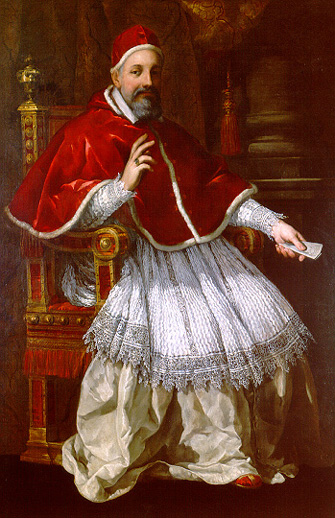
Urban VIII?


Does any body know if the following verses, taken from the hymn Ut queant laxis, are "improvements" to a lost original text made by Pope Urban VIII? I could be off on this one, but did Paulus Diaconus really write this!?

Nuntius celso veniens Olympo,
Te patri magnum fore nasciturum,
Nomen, et vitae seriem gerendae
Ordine promit