Wednesday, February 11, 2015

Holy God We Praise Thy Name....


A hymn a friend of mine heard endlessly as a child in the FSSPX.... I have never heard it sung in a church and by the grace of God never will. The Ordinariate community here in Fort Worth sings high brow hymns with occasional insight, elevated language, and festive relevance out of The English Hymnal. Growing up in the typical Pauline liturgical setting, I was exposed to barn-burning, up tempo classics like Let Us Build the City of God and Lord of the Dance. I dreaded Immaculate Mary until I heard the far superior British version, which may well be my favorite vernacular hymn. The St. Gregory Society, where I attended Mass in Connecticut, never sang hymns. It was a blissful hour of plainsong bookended by thunderous organ preludes and postludes.

Hymns are a uniquely Western interest. Yes, the Greek and other Eastern Churches have them in their traditions, but they occupy a minor place liturgically if at all—unless one counts the Akathist for feasts, a thirty minute "hymn." Protestant and modern-Roman hymns are generally bosh: saccharine sentimentality which appeals to emotions, familiarity, and melodic memory. Lost are deeper ideas of beauty, meaning, and encounter with the Divine. Liturgical hymns, such as those of the Office, conclude with a Doxology, a contrast to hymns inspired after secular music's alternation of verses with a chorus. More popular hymns imitated the secular musical pattern rather than the liturgical one. Any English hymn will follow this pattern, but the pattern is not necessarily a Protestant one. Even great Christmas hymns from the 15th century like Resonet in laudibus exchanges verses with the chorus Gaudete, gaudete Christus natus hodie....

What makes a hymn good? What makes a hymn liturgically suitable? At its heart I have always favored the St. Gregory Society's hymnless approach. I love the hymns the Ordinariate church sings, but what criteria separate those pieces from the devotionalist hymns the FSSP sings or the Gather hymnal doggerel of the common parish?

Sunday, February 8, 2015

Rare Transitional Missal


When Did They Become Orthodox?


"I believe in one, holy, catholic, and apostolic Church" nearly all Christians who claim any sort of apostolic origin recite on Sundays. Among them are the various kinds of Orthodox Christians of the Eastern Churches. One friend, a Russian Jew born in Orthodoxy who left after falling victim to ethnocentrism, could not quite understand why they said that they believe in the "catholic" Church while not being Catholic. But they do believe they are the Catholic Church, and Orthodox, too.

The birth of "Orthodoxy" and the "Orthodox Church" is one of the minor mysteries in religious linguistics probably worthy of some level of study. The Church of Constantinople—as the Church of Rome, and the Church of Alexandria, and the Church of Aberdeen—believed itself to possess those four marks of the Church and hence to be a part of the Church Christ founded. That Church has gone by a few different names in its two thousand year history, but only a few. St. Ignatius of Antioch wrote in his letter to the Smyrnaeans 
"Where ever the bishop is let the multitude of the people be, as where there is Jesus Christ there is the Catholic Church." 
That phrase, Catholic Church, went on the shelf for the better part of the next few centuries, only coming off when the concept of "Christian" was no longer sufficient to distinguish the true Church from the odd sects engendered by heterodox thinkers or gnostic divines. "Christian," meaning "little Christs"—itself meaning "little anointed ones," a strong indication of Confirmation—by the fourth century had the same general meaning it has today. Anyone who professes Jesus Christ in some meaningful way is a Christian. Those who professed the true faith claimed membership in the "Catholic Church."

"Catholic" lived on in the Creed of Nicaea in the condemnation at the end:
"But those who say 'There was once when he was not,' and 'Before his generation he was not,' and 'He was made out of nothing,' or pretend that the Song of God is of another subsistence or substance, or created or alterable or mutable, the Catholic Church anathematizes."
Christians called the Church Catholic yet they did not always refer to themselves as Catholics. I can recall one occasion when St. Athanasius used the word Catholic substantially to describe individual believers. Most believers contented themselves with the label of Christian except for in the city of Constantinople, which, as the gateway to the east from the west and to west from the east, was the bottleneck of nearly every Christological controversy of the first millennium. Christians there described themselves as "orthodox" or "right worshippers" in contrast to the "heretic," the one who "chooses" to worship God according to his own will. The dialogues of the Greek Fathers crystallized this term in literary style and by the time of St. Theodore the Studite it was an accepted means of self-identification for the Christians of the Byzantine city. As an aside, the Roman Canon does pray for "omnibus orthodoxis.... cultoribus."

"Orthodox" signified an aesthetic, a type of Christian, a Christian who worshipped according to the rites of the Byzantine Church, who bore the scars of the heresies and the scabs of the triumphs that passed through Constantinople, and who adhered uniquely to the theology of the Greek Fathers. John Senior wrote that if philosophy is footnotes on Plato, theology is footnotes on St. Augustine. This phrase holds true only in the West. In the Greek tradition, theology is footnotes on the Cappodocian Fathers. Greek Christians prayed in the Great Entrance "May the Lord Our God remember all you orthodox Christians in His kingdom at all times...." and during the Litany of Fervent Supplication for "our orthodox fathers who here and elsewhere lie asleep in the Lord." While "orthodox" they certainly believed themselves part of the Catholic Church if not the Catholic Church. Then came the fall of Byzantium.


As political as the Roman Church was during the Middle Ages and Baroque era and as institutional as the Roman Church has been since Trent, the Constantinopolitan Church was before 1453 and more. The emperor was God's living representative on earth and the living icon of God the Father before whose image the citizens of Byzantium were to bow in reverence. He could call Councils, kidnap popes, replace the patriarch of his city, and—when he met little resistance—create Church laws that would mold the religious practice of his empire and beyond. Byzantium's triumph in Slavic lands buffered the empire from the west. The disaster of the fourth crusade and the decline of the Byzantine empire polarized Constantinople from "the West" when, hitherto, Constantinople had been more western than any eastern church. In the Palaiologian empire the Greek Church further distanced itself from "the West" during the Hesychast years of St. Gregory Palamas. Theology and liturgy became less communal and more mystical under the influence of Palamas and monastic patriarchs. Symbolism replaced realism in icons which now sat on the curtain around the Holy Place of the Hagia Sophia. Monastic patriarches replaced the organ, choral music, and the old Office with their own chants and psalter. The fall of Constantinople ossified the synthesis of the first millennium Constantinopolitan tradition with the Hesychast monastic movement, the last expression of "orthodox" Christianity.

In the midst of the newfangled Islamic city and without the institutional structures and imperial support the Greek Church previously enjoyed, Christians of Constantinople ceased to identify themselves as the Catholic Church. More troublesome to Greek Christians might have been Rome's unique hold over the title "Catholic Church." All that was left was the way of being Christian that they knew, orthodox. "Holy Orthodoxy" was born. 

One potential pitfall to this argument is that some non-Byzantine Churches of the East that accept the Councils until and excluding Chalcedon are now called "Orthodox." Coptic Christians in my experience are very fervent about the denomination "Orthodox" while Armenians accept the title, but are more content for their church to be known as the "Armenian Apostolic Church." Perhaps the solution to this flaw in my argument lies in the popularity of the term "Orthodox" itself. Could the term have been spread by the Ottoman empire to denote Christians who had nothing to do with the Pope in Rome?

The question is an interesting one and worthy of further study.

Tuesday, February 3, 2015

Man & the Machine


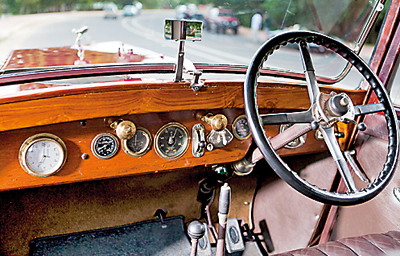
Step into the driver's seat of a pre-World War II car and find yourself in a very foreign world. The dashboard sports no buttons, save in a few odd American cars. No gadgets and few instruments. It should all be simple and straight forward. Put your key into the column, turn, and voila! Nothing happens. Nowadays keys, in everything other than cars, unlock things. Back then they unlocked the controls to your car, but did not start it.

To start it turn the fuel intake up all the way, pull the Spark lever on the wheel down to retard, and push the starter button. If your car is a Rolls-Royce or a few other quirky models you cannot start the car with just the battery. Turn the power switch from Battery to Battery & Magneto. Then press start, turn up the spark, slowly lower the throttle back to a normal level, and switch the power back to battery. The first few disparate metal pangs will overcome you with the ominous feeling something is very wrong until the front jumps, the sounds increase in frequency, and the engine finally turns over. Old cars are just great.

My father nurtured my interest in antique automobiles. When he was my age he collected classic cars and other antique vehicles. A "classic car" is not synonymous with antiquity or popular sentiment. A classic car is a high priced, limited edition car made between 1925 and 1948. His parents bought him his first car, a 1939 Ford Deluxe, at age 13 hoping that if he was "working on it" in the garage he would stay away from the local gangs. It worked and fostered a very contagious obsession. In the 1960s the cars we now call classics were remarkably cheap to purchase. Lightyears removed from contemporary vehicles in design and features, classics were tall, sported pronounced fenders, lacked power steering, rarely made over 200 horsepower, and were difficult to brake. Moreover, they predated the standardization of car production after World War II, meaning repairs and maintenance were expensive. In his 20s my father owned both a V-12 and a V-16 Cadillac, a Lincoln KB, a Rolls Phantom II, a Model A Ford, a Packard, and a few other collectibles in addition to his more road worthy '57 Chevy Bel Air and '63 Corvette Stingray. Like most men at the time, before student loan debt saddled those in their 20s with financial limitation, my father found cars were fun and met the male need for mechanical relationships.

Men love machines. Why? The machine is man's escape. We rarely confront our emotions like women, probably because we are less self-reflective. For all my ego I do not spend much time thinking about myself or my life other than in the shower, something I could say for most men I know. When life becomes difficult we tend to want to step outside ourselves and do something involved that does not require noise or thinking. A machine is the perfect solution. One fellow I knew used to mow his lawn whenever his wife bothered him. I go for a drive. Indeed, the liturgy itself is a kind of machine wherein one forgets one's self, one's problems, one's emotions and gives one's soul and mind to the ritual worship of the One Who Is. This is why men go to Vespers and women go to the Sacred Heart devotion on Fridays. Men are wired for machines it seems, which is perhaps why some of us find it so easy to appreciate fine automobiles even if we do not own them.
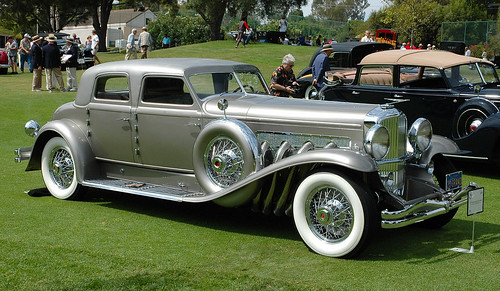
"The mighty Duesenberg", the best car made until
it went out of business because of the Depression.
Another facet of older cars that continues to fascinate me is the quality of the designs and execution, both mechanically and stylistically. Cars built for wealthier clientele, in contrast to modern cars for the rich, hardly ever resembled each other. A customer bought the chassis, engine, electrical system, and drivetrain, from the car company but a "coachbuilder" created the body. Coachbuilding died more or less after the War, surviving for a short period in England until 1964. Coachbuilding meant hand building. Indeed, the best cars at the time were all hand built, from Packard to Pierce Arrow. The car maker in Derby did not enjoy the distinct reputation for custom construction it does today. I often muse when the presenters of Top Gear do some gimmick with dated cars from the 1980s that in thirty years today's cars will not be on the road. They have too many damn computers, plastic parts, and non-mechanical bits to break. Old cars' simplicity helped ensure their longevity. Duesenberg (which in 1928 could do 100mph in second gear) managed to put reliable power brakes on cars with adjustable fluids long before anyone else. And of course Rolls-Royce never did anything revolutionary with their cars. They just made cars to a higher standard than anyone did until the 1980s, which is why over sixty percent of the cars they have made since 1904 are extant.

No....
Today's cars lack the same appeal to me, not just because they are eye soars in contrast to the elegant and graceful examples of yesteryear, but because they are too civilized, too computerized, too refined for me. As a lover of mechanical things, why would I want something that offers me no intimacy with the machinery? Even a 1950s American car that drives like a boat still has a tangible engine that can be "tinkered with" and some semblance of control by the driver. When strolling the town last weekend with a friend we happened upon a new Ferrari worth half a million dollars. That car has paddle shifters which imitate a manual shift without the exacting effort, a navigation system, and a racing mode that pushes all the power to the wheels when starting from a stand still. These features alienate the driver from his machine for the sake of performance which he will likely never use. I would not be surprised if the man who owned that car is a sixty year old businessman who needed a means of compensating for his recently lost libido.

Contemporary cars make the driver into a passenger with a round piece of composite fiber in front of him. Unlike my father, I will never own a V-16 car or a Stingray, but I can meet my masculine need for escapism by getting a manual shifter at least before the modernists take even that away from me.

Saturday, January 31, 2015

Burying the Alleluia


Today is the fourth Sunday after Epiphany (you were that right), which means tonight the Alleluia is sung for the last time until Mass on Holy Saturday. A double alleluia is affixed to the dismissal at Vespers as a farewell until the same words revive after the Vesperal Mass in seventy days. In typical Roman fashion, this is a somber and "low key" way of doing something very great in importance, preparing for the great fast and Lent. The Byzantine churches will have meatfare and cheesefare Sunday in the coming weeks, wherein the faithful slowly say adios to meat and dairy products, although fish cooked in oil is allowed typically on Palm Sunday (a feast rather than a penitential day in the Greek rite). 

A Melkite priest once pointed out the oddity of allowing the universally exercised option to sing "Praise to you, Lord Jesus Christ" during the new Roman Mass in Lent. The old Office substituted Laus tibi, Domine, etc for Alleluia after the Deus in adiutorium, but the Mass always utilized a tract based on the psalms instead. As the Alleluia prefaced the Gospel throughout the year, its absence startles the faithful when the words of Christ are sung. The option "Praise to you, Lord Jesus Christ" is especially odd because Alleluia is Hebrew for "Praise to you, O God." Clearly, the Consilium was influenced by the Department of Redundancy Department's findings! Bishop John of Syracuse wrote Pope St. Gregory the Great once to complain of the novelty of "singing the Alleluia outside of Paschaltide" after the manner of the "Greeks." Gregory retorted that the Roman Church had adopted the practice some time ago, but its exclusion during Lent remained.

Antiphon from psalm 140 at the Vespers part of the pre-Sanctified Liturgy.
The melody is an English translation of the Ukrainian-Slavonic tune.

By contrast, the Byzantine churches will not cease the Alleluia, but will continue to sing it throughout Great Lent, even on Good Friday. Indeed, the Great Doxology will continue to be sung between Orthros and the Divine Liturgy (of which the Roman Gloria is merely an excerpt). The Byzantine rite's excessive and eccentric praxis knows no bounds during the Great Lent. The changes to the liturgy, aside from the longer anaphora of St. Basil the Great and some changes to a few prayers, are really more additions. The Akathist to the Mother of God is sung on Fridays in preparation for the Annunciation on March 25th, something I continue to do. Unlike the Roman rite, which has a unique Mass for every day of Lent, the Byzantine rite never celebrates the Divine Liturgy outside of Sundays and feasts, but sees Communion as necessary to endure the Fast, so the Pre-Sanctified Liturgy "of St. Gregory" is celebrated. Some days will witness a long penitential service called the Canon of St. Andrew of Crete, with its many prostrations and kisses of the ground. 

After the high of Christmastide, let us prepare to lower and humiliate ourselves during the Fast and accept the wisdom of the Church in our preparation.

Monday, January 26, 2015

The Cost of Good Taste


Good taste has a cost, at least a social cost. In past times, the best of taste was affordable to those of who lived in their society's mount Olympus of status, either made or hereditary. The old money are now irrelevant and the new money concern themselves more with creature comfort than creativity. Luxury trumps beauty in cost, as beauty is more or less out of production except for in a few furtive and well concealed places. Good taste has experienced a degree of democratization unthinkable perhaps in earlier times. Say that you read Chaucer or Homer for fun and they will mock you, but Shakespeare has become far more acceptable among people with a smidgen of education than he once was.

Why has good taste become more socially affordable? State run schools did nothing for it. My father recounts his music teacher in high school forcing them to listen to Beethoven's symphonies while the students ignored it and bought Bill Haley's Rock Around the Clock after school. Perhaps the myth that education makes a person intelligent has contributed to this insular trend. The mad rush of middle class and upper-middle class families to put their children through higher education exposes a significant part of the populace, at least momentarily, to things of permanent and everlasting gravity before they progress to skills-based endeavors for their careers. Another possibility is that travel has made good taste more accessible. It seems everyone with a degree or above the median income figure knows someone who has seen the Sistine chapel ceiling or the Mona Lisa, which hardly could have been said a few decades ago. The downside of this newfangled accessibility is that good taste costs money to perpetuate and create, a lot of money. Money which individual middle class consumers neither have nor wish to spend. The good taste of the past is objectified, treated as an interesting museum piece while little concern is made for the future aside from outdoor shopping parks.

No where is this problem more arrant and apparent than in ecclesiastical architecture. Diocesan churches built in the last sixty years, aside from the brutal stylistic cues reflective of the commissioning parties' theological tendencies, are religious shopping parks. They are informal, comfortable, non-combative except during Christmas, and everyone can do whatever they want in whatever place they want. As much as I dislike the baroque altar and plaster statues, they did emphasize the Divine in an unambiguous way cushioned auditorium seating fails to do. And many in the congregation will have seen the Sistine chapel.


Without good taste among those with wealth, taste is doomed to be ossified and stilled in amber, a relic for those of future times to discover. In recent days I have revived a passion for antique automobiles instilled in me by my father. When he was my age (25) he drove to work every day in a 1935 Rolls-Royce Phantom II that he bought from a pair of Yale students for the measly sum of $1,100 only to sell it a decade later at the apparent profit of $4,500 (the moron who owns it now turned it into a hot rod). That car was built during the Great Depression for an English client and would have been the ultimate status symbol of the time, an outward sign of one's social class. When my father bought that car it was thirty years old, considered technologically Byzantine, and impractical—before the classic car market developed. Now, cars of that sort are owned by collectors while new Rolls-Royces are over-sized aluminum boxes stuffed with leather and walnut veneers—something has to distinguish it from its BMW parts. The car is a loud, tasteless way to say "I've made it" rather than a stylish way to say "I've got it." 

When I see an article about some seemingly small enterprise like learning calligraphy for making altar cards or iconography I become excited, much as I do when young people attempt the forgotten medium of poetry. Good taste wed with creativity will survive, albeit in smaller and smaller circles, hiding from both new money and equality!