Tuesday, January 31, 2017

Painted Churches of Texas I: St. Mary of the Assumption

Ecce quam et quam iucundum habitare fratres in unum!

This past weekend a group of friends, His All Traddiness included, ventured down to something called Austin, TX, a town famous for drunk escapades on 6th street, Whole Foods, and for fifteen years the home of Rick Perry. Its rural surroundings—possibly the only hills in the barren state of Texas—quietly hold a treasure of delectable barbecues and painted churches.

Readers will recall J's post on St. Peter's, the "painted" church of Lindsay, TX. Painted churches are not an historical anomaly in central Texas, which saw a remarkable settlement of Slavic and German migrants from central and Eastern Europe. They built modestly sized parishes and furnished them in baroque fashion to the best of their ability. Statues and ornate reredros graze the sanctuaries, but when of the ceilings, walls, cornices, and other crevices that would be gilt and covered in 18th century masterpieces in the old world? These immigrants took brushes to the plain Texan wood and created something quite extraordinary in these little low Mass chapels.

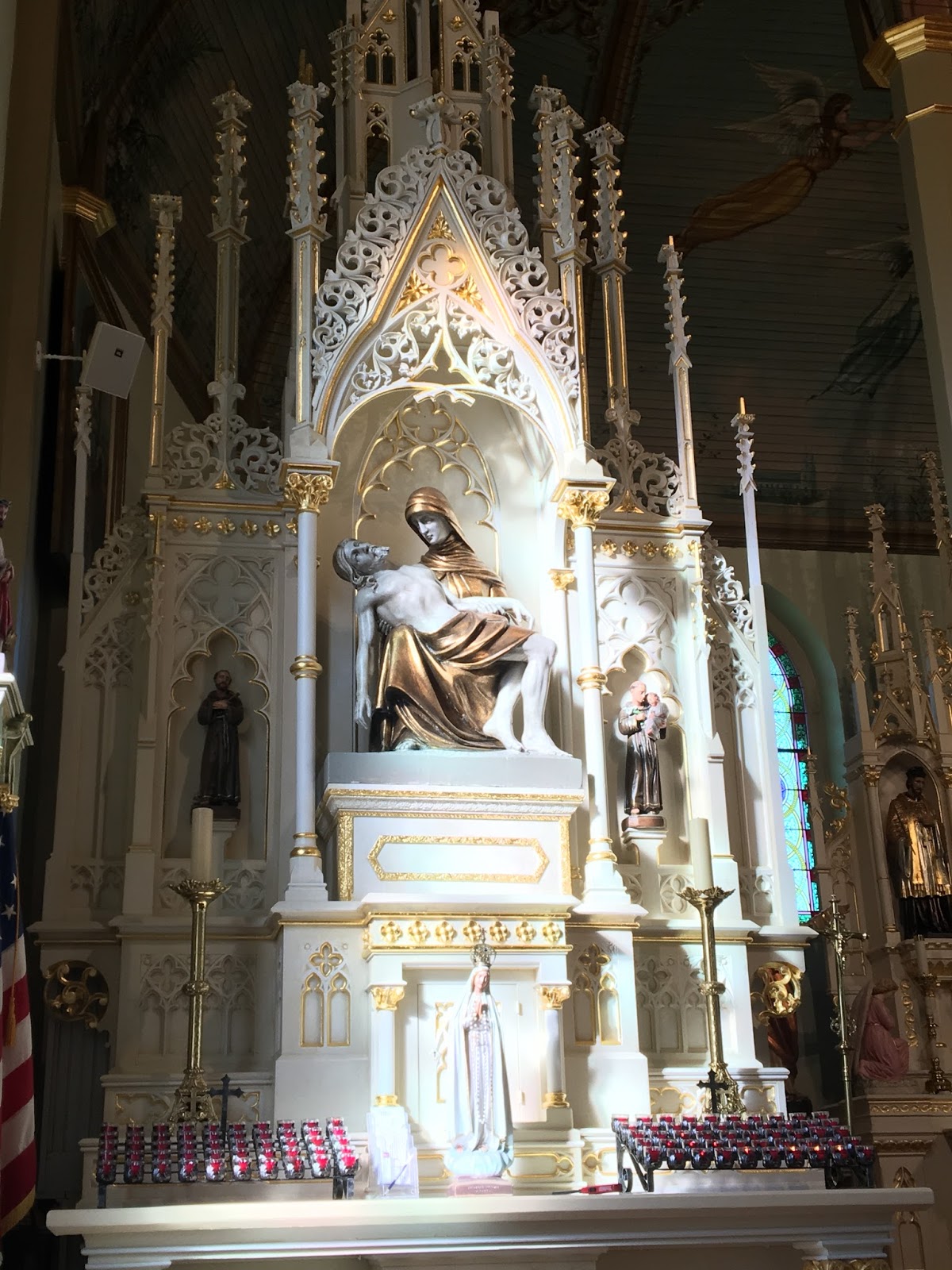
The first church in this series is St. Mary of the Assumption in Flatonia, TX. The community dates to 1865, but the current edifice is a few decades newer. As with all the painted churches we saw, there is an adjacent cemetery; one would be baptized, married, communicated, and buried in the same tradition and among the same people, a contrast to our mobile society not lost on my cadre.


A side altar. St. Joseph has some grey streaks. The Infant of Prague reflect the Czech origin of the parish.

The high altar. The periodic statues of the Sacred Heart and Immaculate Heart have aged very well
compared to others. Ss. Cyril and Methodius, Greek missionaries to Latin lands, are visible on
the Epistle side. The Paul VI forward altar matches the existing design of the church. We did
not notice it until getting closer.


The Baptismal font, capped by the Forerunner baptizing Our Lord in the Jordan, is preserved in
it original place and has withstood the Pacellian and Pauline novelties. The Bapistry is still
a gated, fenced area of this modestly sized church, which could hold perhaps 70 souls.


The parish doors look to be candidates for "renewal."

A perspective on just how modest the parish is. For an immigrant built built by a few dozen poor,
farming families they certainly accomplished something more attractive and lasting than
modern church architects or traditionalists have managed in recent times.

The pulpit has a sounding board to carry the echo.


Thursday, January 26, 2017

Te lucis ante terminum

Through the miracle of time I have rediscovered the office of Compline. Although it was the first hour I really learned to say on my own accord I fell out of the practice of saying it in the years since finishing school and finding my life regulated by the daily and monthly pulse of American corporate finance, month end close, and quarterly reports to the Street. I began Vespers several years ago and anticipate Mattins and Lauds for Sundays and major feasts, but the non-major hours (horae minores are during the day???) rarely appear in my life, save Sundays and long vacations.

I was introduced to the old Latin liturgy long ago in the form of the "Traditional Latin Mass," but did not discover the Divine Office until 2011, when I went to Oxford and found the Office to be the pulse of St. Aldate Street. The Dominicans said the full Liturgy of the Hours in English daily while the Oratorians, where my shadow haunted for latria, used the 1962 Vespers for Sundays and the eve of major feasts. At some level I grew to love the Office more than the Mass if only because the Mass is required out of obligation, whereas a layman only attends the Hours out of devotion. Upon return to the States I began saying Compline according to the Tridentine form before going to bed. For a tired mind looking for an evening blessing, Compline is more focused than "Bless mommy, bless daddy, good night, Lord."

Compline is an altogether different sort of Office, both in structure and purpose, from the rest of the hours in the Roman breviary. The major hours (Vespers, Mattins, Lauds) descend from the vigil of psalms and readings that took place at night before the Eucharistic sacrifice in ancient days and which solidified in their extant, pre-1911 form by the age of St. Benedict, if not earlier. The daytime hours (Terce, Sext, None) grew out of non-cleric devotion in the major Roman basilicas by those who wished to pray and sanctify the entire day; because those who sang it were commoners unable to print book on demand, the psalter remained fixed for these hours. Prime and Compline have their origin in the monasteries around Jerusalem and functioned as "fillers" for gaps in the day when a monk might lapse in his prayer. St. John Cassian remarked during his 382 AD visit to Bethlehem that Prime had not yet been adopted everywhere in the East. Similarly, he knows nothing of the tradition already practiced by St. Basil of reciting psalm 90 (Qui habitat in adiutorio) before bed. When Benedict left Rome and brought the basilica psalter with him, he may have brought a newly settled custom of praying other psalms with psalm 90 before sleep.

Compline's distinction in structure and repetition in text makes it an easy hour to commit to memory and hence very suitable for those tiresome moments before bed when creative thought and reflection fail. The words themselves carry a weight of reassurance and tenderness:
Procul recedant somnia,
Et noctium phantasmata;
Hostemque nostrum comprime,
Ne polluantur corpora.
For a brief while I attempted the Divino Afflatu rendition of this hour, but found the variable psalms and antiphons antithetical to the very purpose of this Office. Indeed, Compline helped me realize that Pius X and Paul VI's overhaul of the Roman Office was far more radical than what the latter did to the Missal.

Compline represents a marvelous entry point into the Roman Office and deeper liturgical prayer. This prayer for a safe rest under Our Lord's watch, like an "apple to His eye", is approachable in its brevity and constancy while being less mundane than the horae minores of the day: a Confession, a few psalms, a short hymn, a canticle, and a prayer to Our Lady; most remarkable to me, at least in the Tridentine Office, is that the last words on the Christian's lips before sleep are the Pater, the Ave, and the Apostles' Creed. Seven Office sanctify the day, but only one the night!

Wednesday, January 25, 2017

St. Joseph the Burly

The following photo (not for the faint of heart) appeared recently on Christopher West's Facebook page, with the author's usual semi-disturbing commentary. Mr. Grump thinks that Joseph looks more like a blacksmith than a Roman occupation-era carpenter, or like I imagine Beorn from The Hobbit, but that's what happens when I am not consulted on these matters. I suppose we can thank our lucky stars that the art student did not also see fit to make the Virgin look like an American pop star.


Tuesday, January 24, 2017

Waiting for the Call


A recent visit to Café Preténse with the Little Lady was punctuated by a visit with an old friend who had recently been tossed back into the world by a small-minded women’s religious order. In the course of our conversation, she let slip that another mutual friend of ours—currently married and mother of a cheery little tyke—had undergone months of scruples related to the religious life when she and her then-boyfriend had asked their pastor for advice about proceeding towards marriage. This sorely misguided priest started the process of marriage discernment by asking them both if they had fully discerned against the religious life, rather than getting to know them in their own situations and individual histories. Our mutual friend spent almost half a year tormenting herself about whether or not she had a religious vocation (not for the first time) while her longsuffering man looked on, until she finally allowed him to propose marriage.

The “process of discernment” is a semi-mystical mental torture device that could only exist in a first-world land where youths are encouraged to spend years deciding between too many professional choices instead of taking up the responsibilities of marriage and parenthood at a young age. Young Catholics are told to pray and listen quietly for God’s “calling” to their individual souls, to try and sort out what the Spirit is telling them to do with their lives. The priesthood, socially active religious life, contemplative orders, the married state, and “singleness” are all said to be valid “callings” for the young Catholic.

Baloney, says Mr. J. Grump. Being raised Evangelical Protestant (as I never tire of reminding our longsuffering readers), I was presented with a similar choice by a well-meaning youth pastor in my pre-college years: between a life of “ministry” and mere church-going. The “ministry” was divided into various parts, such as missionary work, pastoral positions, song and dance, and evangelism, although the married life was expected as the norm. I decided early on that I had no interest in a life of “ministry,” since I didn’t want the failure of other people’s spiritual lives to hang on my poor advice.

The American Catholic approach is more sinister, although I could not quite put my finger on the nature of the problem until reading Richard Butler, O.P.’s Religious Vocation: An Unnecessary Mystery (1961). Fr. Butler also had no patience for the baloney of vocational discernment as it exists in common parish life.
The mind of man, however, tends to multiply mysteries unnecessarily. Given the light, he often prefers darkness. Perhaps it is just a natural tendency to intellectual sloth: whatever is difficult to grasp I will dismiss as mystery; a mystery is inexplicable and therefore does not require, since it cannot achieve, thorough understanding…. Religious vocation—the call to follow Christ by observing His counsels [poverty, chastity, and obedience] as well as His commands—is a matter of public revelation. The human response to this divine invitation is a matter of public history. And yet an aura of mystery has beclouded this simple invitation in the popular mind to the point of complication and confusion for both the observer of and the participant in religious life—an established state in which one can achieve, more safely and securely, the common Christian goal of perfection in charity….
The specific crime is that of relegating religious vocation to the realm of Gnosticism, making of it an esoteric private inspiration. At least that is the unmistakable tone of their conversation and propaganda on the subject…. Religious life is not an extra, not a luxury, not a peculiar path for exceptional souls in the pursuit of Christian perfection. It is necessary for the apostolic work of the Church and for the personal salvation of some of its members….
We have to sympathize with the perplexed young soul, pondering an eternal future and seeking a safer route, who is vaguely instructed: “My dear friend, in your heart of hearts, ask yourself if God is not calling you.” The anxious reader of such advice is sent out on a scavenger hunt for a divine communication. His search is bound to be futile. He is not sure, and neither am I, exactly what one’s “heart of hearts” is. He does not know where to look, or, for that matter, what to look for. What is this “call?” How do you get it? And how do you know when you have it? (4-5, 7, 8)
Butler’s observation on the degradation of spiritual advice in these matters eventually delves deeper into St. Thomas Aquinas and the Church Fathers, and there is a great deal of eye-rolling at the scrupulosity of spiritual directors who demand that young people spend months or years asking God and themselves if they “have a vocation.” The solution is actually quite simple: we are all called (vocare) to observe the counsels, but all required to observe the commands. A calling is not a command, and never can be. Not all can make themselves eunuchs for the sake of the Kingdom. Not all can live without the marriage bed. Not all can submit their will entirely to another. The desire to live the religious life of the three counsels is not one to be excessively deliberated over—“In fact, [St. Thomas] says, don’t seek advice except from those who will encourage you!” (26)—and one desirous of this life should simply seek out the nearest monastery and begin to live the counsels as much as possible until he is accepted into an order. Those who know their own weakness, whether by birth or because of the long-term effects of past sin, should not scruple about marrying or otherwise finding an alternative to a life dedicated solely to the good of the Church.

The term “vocation” in ecclesiastical usage “more directly and properly applies to the divine selection of candidates to the priesthood,” but only in the sense that the candidate for ordination is called by the bishop, “for there is no directly revealed call [from God] to certain individuals to the priesthood, except in extraordinary cases like that of St. Paul” (155).

For my own part, I lost interest in the priesthood during the abuse scandal revelations, and in the religious life after my first exposure to the rapping Franciscans (I imagine this was similar to a person forever swearing off marriage after accidentally seeing his grandparents engage in adult activities). There is little to love in the religious life as it is lived today, aside from the occasional pockets of stubborn traditionalism, and the priesthood is faring much worse. We are ripe for a modern-day Rabelais to satirize our ecclesiastical state.

Mr. Grump and his Little Lady left the Café with concern for our newly-secularized friend, but with some hope that she would still pursue the counsels. The poor judgment of postulant directors notwithstanding, the practice of the counsels is not meant to be easily abandoned by those who earnestly desire it. As Fr. Butler writes elsewhere in his book,
The only impediment to entering religious life considered by St. Jerome was the physical obstacle of a father lying prostrate across the threshold to prevent a child from entering the cloister; and in this case, St. Jerome advised stepping over him to fulfill this holy resolve and get to the convent. (26)
  

Saturday, January 21, 2017

American Righteousness: Reinventing History

"He won't vote for my bill, so I'm thinking of blackmailing him," said my friend. "I have concrete evidence he's an active gay."
"He's a family values Republican, isn't he?" I guessed.
"Yes, of course."

So went a discussion with a friend and career lobbyist who travels the country to get bills for his causes through various state and federal channels. This exchange would have been archived in my mind if not for a related exchange at the office yesterday while my coworkers and I watched Donald Trump's presidential inauguration on YouTube during lunch.

You see, readers abroad, Evangelical Christians (hereafter 'Vangies) became a force in American politics in the 1980s when a chap named Falwell endorsed Ronald Reagan and drove Southern religionists to the polls en masse on the basis of their Bible faith. They wanted America to be Reagan and Winthrop's "city on a hill", a moral example for the rest of the world. After their influence in culture brought about a new age of prudishness in the '90s to counteract the Wall Street excesses and cocaine vibe of the '80s, they got their own president in George W. Bush in 2000. After the 2004 re-election of the personable and likable, but indecisive and occasionally inept, Bush, their power waned as the Republican party put forth two dullish candidates. But last year they became relevant again, as billionaire playboy Donald Trump staged a hostile takeover of the Republican party with the support of celebrity pastors and preachers throughout the Bible Belt. The 'Vangies voted for the thrice married playboy over the ostentatiously religious Ben Carson and Lyin' Ted Cruz for a host of reasons that can be covered by other writers. The 'Vangies voted in numbers like it was 1984 again. And yet a significant number of the 'Vangies refused to vote for Trump, who claims to want to repeal the Johnson Amendment, which disempowered religious groups from making political endorsements while keeping their tax exempt status. The reason why some 'Vangies, at least the ones I call coworkers, refused to vote for the man "with synthetic hair" (cf. Jeremy Clarkson) has to do with the recent re-invention of American history by the Religious Right and its projection of its own values into other people's past.

Frederick Jackson Turner called the "frontier" the essence of the American story, the constant search for the new by rugged individuals shunning accepted society and means. As far as geography and ingenuity go, Turner was right. The essence of early American politics is different, though. America's first president was a Deist who frequented Anglican services; the second was a Unitarian, hence not a Christian by any post-Reformation standard; the third was something between a Deist and an atheist who detested the Catholic Church; the sixth was agnostic and swore his oath of office on a stack of legal papers, hardly the makings of a righteous governor. Early American leaders were children of the Enlightenment without the brutal rearing of the French Revolution. They took Christianity for granted as the religion of the masses and occasionally partook of it themselves in moments of need, but it was something of a foible to them, a security blanket for Turner's frontiersmen. Two centuries later came the idea that America was founded as a fundamentally Christian country, when in fact the Puritans who settled Massachusetts were expelled by Anglicans because they were stark raving mad spiritual terrorists. 

How does this figure into the copious number of 'Vangies who went #NeverTrump and who derided the bombastic billionaire as he took power? Our favorite sociologist, Robert Nisbet, made two startling observations about the role of protestant theology in religious culture. First, that "Three principle elements of Christianity were left in Protestant theology: the lone individual, an omnipotent, distant God, and divine grace." Second, that "In Protestantism there has been a persistent belief that to externalize religion is to degrade it. Only in the privacy of the individual soul can religion remain pure. There has been little sympathy for the communal, sacramental, and disciplinary aspects of religion." Attending services and living a Christian life is not enough to be a good Christian by this scheme of things. If one is really saved, a la Calvin, one should behave like one who is saved. While this sounds like it should elicit behavior in the protestant akin to a Catholic who attends Mass and Confession, it is not. While the admonition not to judge another's soul still holds, external displays of belief (the Sacraments, pilgrimage, penance, liturgy) are unavailable in a privatized religion, so what is private must be displayed in public for all to see.

For four decades now the Religious Right has sought leaders who will both advance their agenda and display their own virtues as a form of cultural evangelism. As a businessman, many 'Vangies were able to embrace Trump for the first reason, yet many refused him because he fails miserably on the latter. 

"I was reading a blog about what happens when you don't elect righteous leaders."
"He never said he was sorry for all the things he did, how mean he is."
"He has no repentance."
"He isn't really Christian."
"No way, no how."

As I rolled my eyes I was asked why the Catholic Church does not have special services for the Fourth of July and other American holidays. I attempted to explain that there will often be Masses said for the welfare of the country on that day, but that services geared specifically towards gratitude for the nation, as if it were of Divine Right, would be inappropriate. "You know," one lectured, "most patriotic songs are about what? They are about God!" There was no point in telling her that the Church does not worship countries, much less countries that never officially held the faith in the first place.


"No one is a better Christian than I am,
folks, no one."
This issue may well become a moot point in the rapidly secularizing American society. President Trump himself seems to lack any religious scruples, which is fitting since the first president lacked them, too. The real thing to be grasped is a lesson rather than a problem. A large, possibly deteriorating force in American politics is still grasping for the outwardly pious family values Republicans of the '90s and in doing so ensure their own irrelevance.

A devout Catholic with any knowledge of history can still be patriotic, serve in the armed forces in good conscience, and be an upstanding member of the community. What he cannot do is pretend that America was created to be God's paradise on earth or Winthrop's City on a Hill. I would be more sympathetic if people simply expressed a desire for a leader worthy of admiration, which is unlikely, but more possible in our age than a "righteous" one.

In the words of Geoffrey Hull, "In the American philosophy man's highest purpose is to assert his 'inalienable right' to 'Life, Liberty, and the pursuit of Happiness' on earth. Eternal life is an optional extra for those who choose to believe in it" (238). 

Thursday, January 19, 2017

Here at the End of All Things


With the centennial of the appearance of the Virgin Mary at Fatima rapidly approaching, a fresh round of eschatological predictions have begun in the traddosphere and beyond. While I’m a bit of a wet blanket on the Fatima Parade, I can’t ignore the historical significance of the Mother of God initiating a major celestial sign seen even by blasphemers and unbelievers. The hundredth anniversary of her appearances would not be an unreasonable time for her to reappear and remind us of our duties towards God.

I grew up in an atmosphere of calm, Protestant assurance that the End Times, they were a-comin’. My family’s bookshelves were filled with prophetic insights into the events of the 1970s and 80s, with authors like Hal Lindsey, Salem Kirban, and Jack Chick forming the apocalyptic imagination of my childhood. The creation of the modern state of Israel in 1948 was considered a special sign that God was preparing to wrap things up in a big way, and all that was left was to get a few other political powers in place. Dispensationalist Zionism survives into the new millennium in large part because of the shockingly successful Left Behind series of novels, but also because world events continue to provide raw material for terrifying speculations.

We Catholics have our own forms of eschatological speculation, although there are so many schools of thought that a newcomer can scarcely make heads or tails of them. Aside from a few clear doctrines like the Resurrection of the Dead and the Final Judgment, most of the details are up for grabs. There will be a great apostasy towards the end, and the Antichrist is likely to be a final individual opponent of Christ and his Church. Some of the other beliefs—the three days of darkness, the coming chastisement, the great monarch—are all fascinating but far less certain.

When I came into the Church, I intentionally ignored the internal eschatological speculations as much as possible, having decided that I had had my fill of those in my younger years. But an intense interest in the Second Coming is not necessarily intellectual restlessness; it is a yearning for the hope of our deliverance from this world of death and defeat. The world is a burden to us, even though it is often joyful and enlightening. Too much does this world drag us down, too much are we disillusioned by Church politics and world politics, too much are we exhausted from fighting our own concupiscence. We hear so many stories of our brethren in other parts of the world suffering and dying for the Faith, and we greatly desire the hope of Christ’s return to put an end to the futility of this life. It is a virtuous desire to see ultimate Justice have its Day.
And when he broke the fifth seal, I saw there, beneath the altar, the souls of all who had been slain for love of God’s word and of the truth they held, crying out with a loud voice, “Sovereign Lord, the holy, the true, how long now before thou wilt sit in judgement, and exact vengeance for our blood from all those who dwell on earth?” (Apoc. 6)
I do not know if the formulations of eschatological timelines is wisdom or mere idleness, but the fulfillment of Our Lady’s warnings of war should be enough for us to take her seriously. The fact that the centennial of her appearance coincides with the 500-year anniversary of Fr. Luther’s reformation should also give us pause, as should the Holy Father’s celebration of this event. We do not know what events are already in motion, whether in preparation for the end of all things, or for a temporal judgment against “those who have mastery of the world in these dark days” (Eph. 6).

The end times will not be lovely, and they will not be pleasant to live through, but our desire must always be set towards them. The final prayer of Holy Writ—“Come, Lord Jesus”—should be our constant prayer, as well. Come now in our souls, and come again to end this world.

Tuesday, January 17, 2017

A Reading from the Book of Numbers (against the Variable Lectionary) UPDATED

I read them the Numbers....
source: Cornell Catholic Community's Facebook page
"Oh, Rad Trad! How are you today, Rad Trad?"

A doey, dopey eyed student asked me as I walked into the chapel for a weekday Mass during my student days. This shorts-wearing man was the perfect JP2 Catholic: young, pro-life, liturgically liberal, Ultramontane in all matters, and he read the new Catechism every night before going to sleep. A kind, simple soul of exceptional devotion whose capacity for creative thought had been circumscribed by too many sports related concussions.

"Would you like to prepare a reading today, Rad Trad?"
"If it will make you feel better, alright," I acquiesced.

I reviewed the material in the lectionary for any Hebraic words or turns of phrase that might rattle my dyslexic eyes and found none. After the Collect Opening Prayer I assumed my place at the ambo and began with the immemorial words, "A reading from the book of Numbers."

A rare thought, gentle and fleeting, like a dandelion petal, that comes to a man only a few times in his life if he is careful enough to nurture it, came to me: "What the hell am I doing?"

The year was 2011, the apogee of Benedict XVI's pontificate, which in retrospect shared much with Pius XII's in looking much better on the outside than on the inside. We were reviving the "never abrogated" 1962 Missal and calling it the "extraordinary form," sticking the Big Six on the altar of Pauline Masses, and telling ourselves that the average parish Mass is not how Paul VI really wanted it. Liturgical conferences with Scott Alcuin Reid abounded and "mutual enrichment" was the defining phrase of obedient clergy. The new Mass could learn much from the old form's prolix reverence, mystery, orientation, and sense of the sacred. But, so the other side of the enrichment went, the old Mass could be inferior to the new in any number of ways, not least of which was the expanded lectionary. As I read figures for building dimensions and storage capacity to the JP2 generation and some paid staff, I concluded the benefits of the expanded lectionary were doubtful.

Peter Kwasniewski rightly points out that the expanded lectionary has allowed grave passages of Holy Writ to be omitted or relegated to obscure times of the year so that they do not appear whenever the church is full; most infamously, St. Paul's admonition against unworthy participation in the Lord's Supper never made it into the lectionary of Paul VI. Dr. K likens the new lectionary to a Cliff Notes version of Shakespeare that includes a large quantity of material, but which censors any passages unsavory to modern ears and modern morals. Quantity over quality.

Another, less often considered problem of the new lectionary is that it drowns any sense of rhythm and thematic continuity with its "Scripture for Scripture's sake" methodology. Keeping with the motif of the Bard, Shakespeare's sonnets are best understood when read aloud so that the pattern of speech and repeated images may mature line to line. The old lectionary used a few sonnets in whole; the new lectionary reads them all in sequence, but never more than five or six of the fourteen lines at a time.

Criticism of the older lectionary and support for the pedantic three year cycle of Paul VI rest on the ahistorical assumption that the Eucharistic sacrifice is the appropriate place for ad libitum readings of Scripture. The original setting for Scriptural lessons, East and West, was the Mattins of the all-night vigil, from which only the Roman rite retained consistent readings; the Byzantine rite does maintain extensive pericopes during Vespers of Great Lent and major feasts. As with the Mass, Romans initially observed the vigil only for Sundays and great feasts, which is reflected in the coherence of the passages for the most ancient feasts (Pascha, Pentecost, Theophany, Christmas, Peter & Paul, Andrew, John the Baptist, and the like). Rome eventually followed the Constantinopolitan custom of observing the vigil every night and began to read Scriptures sequentially through different books each month. Mass, with its instructive lessons geared toward the solemnization of a particular mystery celebrated on a given day, remained unique to feasts, Sundays, and days of penance; there was no daily Mass in St. Peter's Basilica, but there was a daily Office. Local churches had particular Masses for saints more often than the Roman Church, which contented itself with Common Mass formularies for martyrs, bishops, and virgins; by the time of St. Pius V's Missal, half the days of the year were still of either Simplex of Ferial rank, so the repetition of the numerous Commons was hardly as dull and numbing as it was by the time of Papa Sarto's reforms and the rite of Iste Confessor. The considerable number of Ferial and Simplex days also permitted votive Masses of Saints and of Requiem when appropriate, providing a variety of Mass options with unified Scriptural lessons concerning the saint or mystery observed. All of this would gradually change, and perspective with it, in the years after Trent.

The Tridentine Council required the Breviary of every ordained cleric in the Latin Church. Pius V's breviary lessons are similar to those in medieval books, but subsequent popes shortened many readings to lessen priests' burden; contrary to the curt Roman Office, Cluny covered such extensive passages of Holy Writ that a monk with a bat would roam the choir during Mattins to tap anyone who had fallen asleep during the daily reading of many chapters. Mass replaced the Office as the daily observance of parishes and cathedrals, especially Mass in the spoken form, wherein words are less audible to the faithful, faithful who were often speakers of Romance tongues descended from Latin. Similarly, the number of saints multiplied and their feasts were almost always assigned a Duplex rank with a Common Mass, compelling priests to recite the same Masses week after week. By the time of Vatican I one could hardly go a week without a Mass or two that began Os iusti. Vatican I considered a two year lectionary, yet nothing came of it. The 19th and early 20th century Liturgical Movement and Ressourcement revived chatter about the limited use of Scripture in the Roman liturgy, especially when contrasted with the supposedly more Biblical protestant churches. A more tempered perspective might have led these reform-minded gentlemen to realize the Roman liturgy utilized Scripture very effectively in its structures, just not in its contemporary incarnation.

There are a few possible solutions for the limited use of Scripture in the old liturgy, at least in its various forms since the 20th century began. First and foremost would be to reduce the rank of feasts so as to allow the Ferial Mass to be repeated or a votive Mass to be said; the occurring Scripture, at least in the genuine old rite, could also be said in the Office under this scheme. Second, if Ferial Masses can be repeated provide alternative, cogent readings on the same mystery or event from other parts of Scripture, as was the Norman praxis in the middle ages; were the Roman rite to revive the octaves Pacelli removed, different readings pertaining to the feast could also be read during the eight days. Third and finally, Mattins needs to return to cathedrals, collegiate churches, and parishes, even in a reduced form for non-obligatory settings that would permit just one nocturne with the assigned readings; the rhythm of the liturgy is not in the Mass, it is in the Office, which Byzantine churches have managed to keep while Roman counterparts have to bribe the faithful with Communion to get anyone interested in a service.

One must also consider that a practicing Roman Catholic need only attend Mass on Sundays and Holy Days. Not even the most devout are able to attend Mass on a daily basis. The average Roman Christian who does what is required of him will likely hear different lessons at each Mass. Just before Pius X's changes about half of "green Sundays" would have been exceeded by feasts, often from Commons, but not the same Commons. From 1911-1955 feasts of Our Lady, St. Lawrence, the parish patron, and the Apostles could still be celebrated on Sundays, but in practice this only happened a few times a year. Since 1962 only half a dozen feasts can replace the Sunday Mass and none of them probably use Commons. The issue of a limited lectionary was belonged to a narrow segment of the Mass going population from the beginning.

If a Catholic wants to hear a variety of Scripture in a Church, would he not have been better off attending the Office all along?

Update: I seem to have neglected one other possibility for expanded, reasonable use of Scripture at Mass. What of the unique Masses for dioceses and congregations for Counter-Reformation saints that did not make it into the Roman Missal after the saints' canonization? And what of the unique Masses for pope saints suppressed by Papa Pacelli in 1942? Both could be revived without disturbing ancient texts (in the former case) and would even revive some (in the latter case).