Showing posts with label Holy Saturday. Show all posts

Thursday, May 7, 2020

Ancient Initiation


Holy Saturday has passed. If you followed it as I did, you watched the blessing of the fire and Exultet, left for two hours, and returned to a live stream during the Litanies of the Saints. Very few Christians were initiated into the Church's Sacraments this year.

In prior years, and Deo volens in the future, catechumens would be cleansed in the healing waters of Baptism after the celebrant exorcised and blessed those waters. While the history of the Roman Mass and Office are well documented other facets are not. The inversion of Confirmation and Communion ages in most countries is recent enough that it requires little research. However, changes to the rites of those Sacraments themselves are more obscure.

Baptism, Confirmation, and Confession as they are given in the Rituale Romanum and Pontificale Romanum reflect the administration of those Sacraments for other a thousand years. Indeed, all the antiquarianism of the Consilium did not yield a return to public penance and public absolution. Nor did it effect a return to the passive form of Baptism given in the older books.

The Gelasian Sacramentary is an 8th century Frankish recension of the Roman orations and feasts c.700 AD. It probably reflects the practice of the Roman Church at that time, but separating what was Roman and what was local is not that straight forward. All the same, its texts for Holy Saturday are very near what comes to us in the Curial Missal published by S Pius V and which happily continues to this day. The ceremony in both the Frankish-Roman Sacramentary and the Roman Missal concludes the pre-Mass ceremonies with the initiation of candidates into the Church.

In the Gelasian book, after the blessing of the font and waters the "celebrant"* baptizes using this ritual.

C: Do you believe in God the Father Almighty?
R: I do believe.
C: And do you believe in Jesus Christ, His only Son Our Lord, Who was born and suffered?
R: I do believe.
C: And do you believe in the Holy Ghost, the Holy Church, the remission of sins, and the resurrection of the flesh?
R: I do believe.

After each "I do believe" the celebrant immerses the candidate in the holy water thrice. Most ancient sources describe full submersion, which was most likely here given that the neophytes were almost always children by 700 AD, but sprinkling, splashing, and pouring are all attested as methods, too.

The celebrant then, as retained in the traditional Rituale Romanum, anoints the neophyte with sacred Chrism saying these words:

"The almighty God, Father of our Lord Jesus Christ, has caused you to be born over again of water and the Holy Spirit and pardoned you all your sins. May He now anoint you with the chrism that sanctifies in Christ Jesus our Lord, and bring you to everlasting life."

Then follows a very familiar Confirmation. The Sacramentary does not use the term "Confirmation" anywhere, since Baptism and Confirmation were part of the same ritual at this point and initiation was almost always performed by the bishop, but the text does state "Therefor, they are given the seven gifts of the Spirit by the bishop by placing his hands over them with these words." The words given are the same as in the Pontificale and Rituale of S Pius V without the interpolated "Amen" between the seven spiritual gifts:

"Almighty everlasting God, who once gave new life to these servants of yours by water and the Holy Spirit, forgiving them all their sins; send forth on them from heaven your Holy Spirit, the Advocate, along with His sevenfold gifts, the Spirit of wisdom and understanding, the Spirit of counsel and fortitude, the Spirit of knowledge and piety, fill them with the Spirit of holy fear. We ask this through our Lord Jesus Christ, your Son, who lives and reigns with you, in the unity of the Holy Spirit, God, forever and ever."

The only addition in the post-Tridentine books is the accretion of "and seal them with the sign of the cross of Christ, in token of everlasting life" before "We ask this...."

As with Baptism, the form of Confirmation is very different from either the more recent Roman books or traditions of the Eastern Churches. The bishop merely anoints the "front" of the neophyte with the words "The sign of Christ unto life ever lasting." The neophyte responds "Amen." The bishop greets him as a Christian: "Peace be with you" and receives the reply "And with your spirit."

Without a break the Litanies (of Saints) begin immediately followed by the Gloria in excelsis and the Mass starts.

* = "Celebrant" is an ambiguous term here given that a bishop would normally be the celebrant in a ceremony such as this and he is referenced separately. It may refer to this service when a bishop is not present, in which case Baptism could be given, but Confirmation reserved to the bishop.

It may also mean specifically the celebrant of the Sacrament of Baptism. A few odd sources suggest that the bishop would baptize the first few candidates and a deacon would complete the rest.

Saturday, March 31, 2018

He Descended into Hell: Holy Saturday (REPOST)


First, let me say that contrary to many contemporary opinions the old Holy Saturday liturgy was not at the wrong time. It was at an unusal time, morning, rather than after the canonical hour of None, around 3:00 pm or 4:00 pm, but it was never a night time liturgy. Also, it is not Easter's Mass done the day before, nor is it a midnight Mass, as at Christmas. It is a Mass and liturgy meant to help us anticipate the Resurrection. Let us see what the Church has given us.

The liturgy begins after None, the last "little hour" of the afternoon. The deacon and subdeacon still wear the folded chasubles, their penitential vestments. The clergy and laity gather outside the church, where, hopefully, someone has lit a fire. The priest, vested in violet, sings three luminously themed prayers: the first referring to the "brightness of Your Son," the second calling God the "Creator of all lights," and the third an actual blessing. This is very reminiscent of the Eastern blessing at the end of Divine Liturgy, which quotes St. James in calling God the "Father of Lights," of all that is perfect, luminous, and good.

A server ignites coals and the priest imposes and blesses incense. He sparges the Holy Fire with blessed water and then incenses it. He also blesses five grains of incense which he be inserted into the Pascal Candle, representing the light of Christ throughout Easter season, inside the church.


The deacon then changes his penitential folded chasuble for a white dalmatic and maniple. He takes a large, triple-branched candle and, lighting a new wick from the Holy Fire, enters the church exclaiming Lumen Christi—"The Light of Christ." This happens twice more until we are in the church proper.


A deacon with the triple-candle preparing to enter the church.


The deacon then petitions the priest for a blessing, approaches the Paschal Candle, which is off to the Gospel side of the altar, and sings the Exultet, a long blessing. The Exultet is rich with imagery of light in the night and the deliverance from Egypt. This day is the deliverance from our spiritual Egypt: Sin and Death. Part way through, the deacon inserts the five grains of incense, calling them an "evening sacrifice," and lights the Paschal Candle. The video to the left is a singing of the Exultet at St. Peter's Basilica two years ago. I find the continued use of the prayer in the newer rites odd, given that none of the actions mentioned in the text are performed, nor is the intention any longer to bless! The prayer concludes with a petition for the Pope and the, no longer extant, Holy Roman Emperor. The lights of the church go on at the words Vere beata nox—"Oh, truly blessed night!" In the middle ages, when this ceremony took place in day light, the windows of the church would be covered in dark cloth, which would be removed at those words, washing the church in God's light after a spiritual slumber.


The deacon returns to his penitential folded-chasuble and, along with the priest and subdeacon, read twelve prophecies, which are chanted by lectors in the middle of the choir. The prophecies together form the story of salvation, both in anticipation and in prediction of Christ:
  1. Genesis 1:1-31, 2:1-2: The creation of the world by God, the ruler of all things. He sees that it is good.
  2. Genesis chapters 5-8: The Great Flood and God's commissioning of Noah to build an ark. The ark is a foreshadowing of the Church, which God gives us to protect us from the Flood of Sin.
  3. Genesis 22:1-9: Abram is about to offer his son, Isaac, but an angel intervenes. For his love of God, the Lord makes a covenant with him and renames the man Abraham.
  4. Exodus 14:24-15:1: God lets the Israelites pass through Egypt unto freedom through the Red Sea, which drowns the pursuing forces of the Pharoah. Baptism will be our watery means of passing unto freedom.
  5. Isaiah 54:17, 55:1-11: God has heard the cry of His people and will honor the promises to David.
  6. Baruch 3:9-38: God has absolute knowledge and dominion over His creation.
  7. Ezekiel 37:1-14: The bones of the fallen will rise again under the spirit of the Lord.
  8. Isaiah 4:1-6: The Lord will wash away the "filth of Jerusalem" and build a covenant.
  9. Exodus 12:1-11: God prescribes the Passover sacrifice of a lamb to the Jews, which will deliver them from God's plague over the first-borns of Egypt. They will be free. Christ is the perfect, spotless Lamb, the perfect sacrifice. He will intercede for us before the Father.
  10. Jonah 3:1-10: The prophet Jonah convinces the city of Nineveh to repent of their sins and do penance, averting their impending destruction. Penance is necessary to pay the debt of sin, not just to be forgiven.
  11. Deuteronomy 31:22-30: Moses provides for his death and the continuation of the Israelites into the promised land. This succession of leaders will continue until Christ.
  12. Daniel 3:1-24: King Nabuchodonosor attempts to kill three Jewish children for not worshiping his idols. They are thrown into a fire, but angels guard them.
In between these readings are sung various prayers and sung psalms. A procession forms and heads to the baptismal font. The priest blesses the empty font and the water in it by plunging the Paschal Candle three times. He sprinkles water towards the four points of the compass and then the faithful with Holy Water from the font, and then infuses Holy Oils into it. He proceeds to baptize and confirm any converts present in the normal manner. The procession then returns to the altar as the choir sings the Litany of Saints, doubling the invocations and answers (ex: choir: Pater de caelis, Deus, Miserere nobis people: Pater de caelis, Deus, Miserere nobis). If there is no font, everything until the Litany is excluded.


Everyone kneels for the duration of the Litany, which takes the place of the Introit of the Mass. The intention of the Litany is mainly to pray for converts, but also for the Church as a whole, as She enters the Paschal mystery. The priest, deacon, and subdeacon remove their outer vestments and prostrate themselves.


Towards the end of the Litany the priest and his ministers rise and head to the sacristy to vest in white vestments for Mass. Servers prepare the altar with the missal and put on the best, most festive frontal.


The altar candles are lit from the Paschal Candle. The ministers of Mass return and sing a normal solemn high Mass. The Gloria is the lovely Lux et Origo setting. The Epistle is from St. Paul's letter to the Colassians, in which the Apostles tells us that if we are dead with Christ, Christ will rise and us with Him.

The priest sings Alleluia for the first time in two months. Absorbed in joy, he sings it three times, each higher and each repeated by the choir. The Gospel, taken from St. Matthew's account of the myrrh-bearing women finding the empty tomb, is accented by the fact that candles are not carried in the procession, emphasizing that the Resurrection has not yet happened for us, but that we are anticipating it. All of this subtlety is indicative of the restraint of the old Roman rite.


The celebrant reads the Gospel before the deacon sings it.


As this is a vigil, the Creed is not sung. There is no verse or chant prescribed for the offertory, so the organ  is played or Latin hymns are sung.


The preface is of Easter. During the Canon of the Mass, the Communicantes prayer is unique: "Communicating, and keeping this most holy night of the Resurrection of our Lord Jesus Christ according to the flesh; and also reverencing the memory...." The Pax is not given and the Agnus Dei is omitted. This may be for two reasons: (1) the Lamb is not yet risen and with us or (2) this liturgy is so old that it pre-dates the eighth century introduction of the Agnus Dei


After communion and the cleansing of the vessels, a short Holy Saturday Vespers is sung rather than a communion chant. It is psalm 116, surrounded by a triple Alleluia. The priest begins the antiphon on the Mangificat: Vespere autem sabati....  During the Magnificat everyone is incensed as usual. The priest sings the post-communion prayer, which I have given below:
Pour forth, O Lord, we beseech thee, the Spirit of thy love into our hearts, and by thy mercy make all them to be of one mind to whom Thou hast given to eat of thy mystic Passover. Through our Lord, Jesus Christ, your Son, Who liveth and reigneth with Thee in the unity of the Holy Ghost, God for ever and ever. Amen.

The dismissal is Ite, missa est, alleluia! Alleluia. The Deo gratias response is also given a double alleluia. The priest says the Placeat, gives the blessing, and recites the Last Gospel as normal. It is traditional to end the liturgy with the Regina Coeli.
Queen of Heaven, rejoice! Alleluia!
For He Who you did merit to bear, Alleluia!
Has risen as He said, Alleluia!
Pray for us to God, Alleluia! 
These rites would end about four hours after they started. The main point of celebrating this liturgy early was so that Paschal Mattins and Lauds could start at a reasonable time. The twentieth century de-emphasis of the Divine Office saddens me. Paschal Mattins and Lauds are the most important liturgical event of the entire week, more so than any Mass or office. In these offices we formally begin the celebration of the Resurrection. In Eastern Churches the people wander the church looking for Christ, but not finding Him! He is risen! They then sing Mattins and Lauds at midnight, followed by Divine Liturgy. The Divine Liturgy is of Easter Sunday, it is not a vigil nor is it a midnight Mass, as we have on Christmas. The reformers lost this critical difference and canned the most important office of the year in the process.

In the West there would be a Resurrection ceremony, which would find the sepulcher created on Good Friday empty, the crucifix would be adored again as on Good Friday, and Mattins and Lauds would be sung. Mattins has one nocturn, with lesson from a sermon of Pope St. Gregory the Great, in which the saintly pontiff says we, the Church, must come to Christ's tomb bearing gifts like the women if we are to be surprised and rejoice. The Te Deum is sung de tempore for the first time in two months. At Lauds, the first antiphon declares that an angel descended from heaven to roll back the stone. The antiphons for this Lauds are among the most beautiful of the year. There is no hymn at Mattins or Lauds. The dismissal has a double Alleluia, as at Mass. The office ends with the Regina Coeli again. Easter has begun at this point.


Saturday, April 15, 2017

He Descended into Hell: Holy Saturday


First, let me say that contrary to many contemporary opinions the old Holy Saturday liturgy was not at the wrong time. It was at an unusal time, morning, rather than after the canonical hour of None, around 3:00 pm or 4:00 pm, but it was never a night time liturgy. Also, it is not Easter's Mass done the day before, nor is it a midnight Mass, as at Christmas. It is a Mass and liturgy meant to help us anticipate the Resurrection. Let us see what the Church has given us.

The liturgy begins after None, the last "little hour" of the afternoon. The deacon and subdeacon still wear the folded chasubles, their penitential vestments. The clergy and laity gather outside the church, where, hopefully, someone has lit a fire. The priest, vested in violet, sings three luminously themed prayers: the first referring to the "brightness of Your Son," the second calling God the "Creator of all lights," and the third an actual blessing. This is very reminiscent of the Eastern blessing at the end of Divine Liturgy, which quotes St. James in calling God the "Father of Lights," of all that is perfect, luminous, and good.

A server ignites coals and the priest imposes and blesses incense. He sparges the Holy Fire with blessed water and then incenses it. He also blesses five grains of incense which he be inserted into the Pascal Candle, representing the light of Christ throughout Easter season, inside the church.


The deacon then changes his penitential folded chasuble for a white dalmatic and maniple. He takes a large, triple-branched candle and, lighting a new wick from the Holy Fire, enters the church exclaiming Lumen Christi—"The Light of Christ." This happens twice more until we are in the church proper.


A deacon with the triple-candle preparing to enter the church.


The deacon then petitions the priest for a blessing, approaches the Paschal Candle, which is off to the Gospel side of the altar, and sings the Exultet, a long blessing. The Exultet is rich with imagery of light in the night and the deliverance from Egypt. This day is the deliverance from our spiritual Egypt: Sin and Death. Part way through, the deacon inserts the five grains of incense, calling them an "evening sacrifice," and lights the Paschal Candle. The video to the left is a singing of the Exultet at St. Peter's Basilica two years ago. I find the continued use of the prayer in the newer rites odd, given that none of the actions mentioned in the text are performed, nor is the intention any longer to bless! The prayer concludes with a petition for the Pope and the, no longer extant, Holy Roman Emperor. The lights of the church go on at the words Vere beata nox—"Oh, truly blessed night!" In the middle ages, when this ceremony took place in day light, the windows of the church would be covered in dark cloth, which would be removed at those words, washing the church in God's light after a spiritual slumber.


The deacon returns to his penitential folded-chasuble and, along with the priest and subdeacon, read twelve prophecies, which are chanted by lectors in the middle of the choir. The prophecies together form the story of salvation, both in anticipation and in prediction of Christ:
  1. Genesis 1:1-31, 2:1-2: The creation of the world by God, the ruler of all things. He sees that it is good.
  2. Genesis chapters 5-8: The Great Flood and God's commissioning of Noah to build an ark. The ark is a foreshadowing of the Church, which God gives us to protect us from the Flood of Sin.
  3. Genesis 22:1-9: Abram is about to offer his son, Isaac, but an angel intervenes. For his love of God, the Lord makes a covenant with him and renames the man Abraham.
  4. Exodus 14:24-15:1: God lets the Israelites pass through Egypt unto freedom through the Red Sea, which drowns the pursuing forces of the Pharoah. Baptism will be our watery means of passing unto freedom.
  5. Isaiah 54:17, 55:1-11: God has heard the cry of His people and will honor the promises to David.
  6. Baruch 3:9-38: God has absolute knowledge and dominion over His creation.
  7. Ezekiel 37:1-14: The bones of the fallen will rise again under the spirit of the Lord.
  8. Isaiah 4:1-6: The Lord will wash away the "filth of Jerusalem" and build a covenant.
  9. Exodus 12:1-11: God prescribes the Passover sacrifice of a lamb to the Jews, which will deliver them from God's plague over the first-borns of Egypt. They will be free. Christ is the perfect, spotless Lamb, the perfect sacrifice. He will intercede for us before the Father.
  10. Jonah 3:1-10: The prophet Jonah convinces the city of Nineveh to repent of their sins and do penance, averting their impending destruction. Penance is necessary to pay the debt of sin, not just to be forgiven.
  11. Deuteronomy 31:22-30: Moses provides for his death and the continuation of the Israelites into the promised land. This succession of leaders will continue until Christ.
  12. Daniel 3:1-24: King Nabuchodonosor attempts to kill three Jewish children for not worshiping his idols. They are thrown into a fire, but angels guard them.
In between these readings are sung various prayers and sung psalms. A procession forms and heads to the baptismal font. The priest blesses the empty font and the water in it by plunging the Paschal Candle three times. He sprinkles water towards the four points of the compass and then the faithful with Holy Water from the font, and then infuses Holy Oils into it. He proceeds to baptize and confirm any converts present in the normal manner. The procession then returns to the altar as the choir sings the Litany of Saints, doubling the invocations and answers (ex: choir: Pater de caelis, Deus, Miserere nobis people: Pater de caelis, Deus, Miserere nobis). If there is no font, everything until the Litany is excluded.


Everyone kneels for the duration of the Litany, which takes the place of the Introit of the Mass. The intention of the Litany is mainly to pray for converts, but also for the Church as a whole, as She enters the Paschal mystery. The priest, deacon, and subdeacon remove their outer vestments and prostrate themselves.


Towards the end of the Litany the priest and his ministers rise and head to the sacristy to vest in white vestments for Mass. Servers prepare the altar with the missal and put on the best, most festive frontal.


The altar candles are lit from the Paschal Candle. The ministers of Mass return and sing a normal solemn high Mass. The Gloria is the lovely Lux et Origo setting. The Epistle is from St. Paul's letter to the Colassians, in which the Apostles tells us that if we are dead with Christ, Christ will rise and us with Him.

The priest sings Alleluia for the first time in two months. Absorbed in joy, he sings it three times, each higher and each repeated by the choir. The Gospel, taken from St. Matthew's account of the myrrh-bearing women finding the empty tomb, is accented by the fact that candles are not carried in the procession, emphasizing that the Resurrection has not yet happened for us, but that we are anticipating it. All of this subtlety is indicative of the restraint of the old Roman rite.


The celebrant reads the Gospel before the deacon sings it.


As this is a vigil, the Creed is not sung. There is no verse or chant prescribed for the offertory, so the organ  is played or Latin hymns are sung.


The preface is of Easter. During the Canon of the Mass, the Communicantes prayer is unique: "Communicating, and keeping this most holy night of the Resurrection of our Lord Jesus Christ according to the flesh; and also reverencing the memory...." The Pax is not given and the Agnus Dei is omitted. This may be for two reasons: (1) the Lamb is not yet risen and with us or (2) this liturgy is so old that it pre-dates the eighth century introduction of the Agnus Dei


After communion and the cleansing of the vessels, a short Holy Saturday Vespers is sung rather than a communion chant. It is psalm 116, surrounded by a triple Alleluia. The priest begins the antiphon on the Mangificat: Vespere autem sabati....  During the Magnificat everyone is incensed as usual. The priest sings the post-communion prayer, which I have given below:
Pour forth, O Lord, we beseech thee, the Spirit of thy love into our hearts, and by thy mercy make all them to be of one mind to whom Thou hast given to eat of thy mystic Passover. Through our Lord, Jesus Christ, your Son, Who liveth and reigneth with Thee in the unity of the Holy Ghost, God for ever and ever. Amen.

The dismissal is Ite, missa est, alleluia! Alleluia. The Deo gratias response is also given a double alleluia. The priest says the Placeat, gives the blessing, and recites the Last Gospel as normal. It is traditional to end the liturgy with the Regina Coeli.
Queen of Heaven, rejoice! Alleluia!
For He Who you did merit to bear, Alleluia!
Has risen as He said, Alleluia!
Pray for us to God, Alleluia! 
These rites would end about four hours after they started. The main point of celebrating this liturgy early was so that Paschal Mattins and Lauds could start at a reasonable time. The twentieth century de-emphasis of the Divine Office saddens me. Paschal Mattins and Lauds are the most important liturgical event of the entire week, more so than any Mass or office. In these offices we formally begin the celebration of the Resurrection. In Eastern Churches the people wander the church looking for Christ, but not finding Him! He is risen! They then sing Mattins and Lauds at midnight, followed by Divine Liturgy. The Divine Liturgy is of Easter Sunday, it is not a vigil nor is it a midnight Mass, as we have on Christmas. The reformers lost this critical difference and canned the most important office of the year in the process.

In the West there would be a Resurrection ceremony, which would find the sepulcher created on Good Friday empty, the crucifix would be adored again as on Good Friday, and Mattins and Lauds would be sung. Mattins has one nocturn, with lesson from a sermon of Pope St. Gregory the Great, in which the saintly pontiff says we, the Church, must come to Christ's tomb bearing gifts like the women if we are to be surprised and rejoice. The Te Deum is sung de tempore for the first time in two months. At Lauds, the first antiphon declares that an angel descended from heaven to roll back the stone. The antiphons for this Lauds are among the most beautiful of the year. There is no hymn at Mattins or Lauds. The dismissal has a double Alleluia, as at Mass. The office ends with the Regina Coeli again. Easter has begun at this point.


Sunday, April 10, 2016

Holy Saturday: Two Last Thoughts

Does the ICRSS cleric reminisce to his seminary days before 2004?
I am sure I am as tired of writing about the old Holy Week as readers are tired of seeing it appear on their blogger subscription block, so I will finish with two last thoughts, partially inspired by this fellow's thoughts.

First, the proper time of the Vesperal liturgy on Holy Saturday. There is not one. Yes, Egeria recounts three Eucharistic liturgies celebrated in Jerusalem between Holy Saturday and the morning of Pascha, which does not bode well for the midnight-Massers. Moreover, the ordines and Sacramentaries of the 8th century that recount the Mass portion's nocturnal celebration are limited to the original context of the Mass itself, which pre-dates the development of the so-called Paschal Vigil service itself. Properly understood a vigil is an all-night prayer service that culminates with the celebration of the feast itself. The Office of Mattins was once called the "vigils" and in some monasteries it still is. Given the primitive Roman Church's propensity to celebrate multiple Masses for a feast (Christmas, Circumcision, Nativity of St. John the Baptist, and Palm Sunday among them) one cannot pinpoint a proper time for any one of them. I would like to modify my earlier thesis that the Roman Church integrated a Mass into its all-night vigil service by asserting that, in imitation of Jerusalem, the Romans likely had a Mass between the reception of converts and Vespers. The Mass bifurcated between the traditional lucernarium that began Vespers; in this case, the Roman praxis would be older than the Byzantine. And yet the original context of that service (the reception of adult converts in a Christian city during an all-night watch) ceased to exist by the 9th century and so the service itself changed.

The dichotomy of the Vesperal liturgy is that it places the Exsultet ("o vere beata nox") at the beginning of the service and ends with Vespers, traditionally sung at sunset. From this point, there can be no "right time". The only general rule would be that the service has to conclude by the time Vespers are usually sung. The service could logically begin as early as 10AM or as late as 4:30PM. The earlier celebration in parishes and cathedral permits the celebration of Paschal Mattins, in the middle ages the most important Office of the year, as evidenced by the various Resurrection ceremonies observed then (not during the Saturday Mass), while the later time would be more easily accommodated in monasteries. The variance in time reflected local needs and allowed communities with different resources to celebrate the liturgy as fully as possible.

This brings up the second point, which is that the old Holy Saturday was more "progressive" than either the 1955 or 1970 reforms. Pope Pius warned against "antiquarianism" and then proceeded to fabricate rites that purported to "restore" what we vaguely think was done in the first millennium, in turn implying that what had been done for the preceding century was a corruption. The context of the Holy Saturday rites changed when adult converts were replaced by infant baptisms, which could be done on any day. The ceremony became an independent rite in recognition that it now functioned as a proper vigil in the vernacular sense of the word, a day of watch before the greatest feast. This is how Latin Catholics understood this day for a thousand years. A college friend once derided my interest in restoring the pre-Pacellian Holy Week: "Why don't you just use whatever Mass Peter and Paul practiced, if you can find it? I'm sure that will go over well." The opposite is true. The old rite represents nineteen centuries of liturgical development while the 1955 and 1970 rites are poorly informed historical re-enactments of what some people believe was done in the "early Church," that fleeting epoch of Christian mythology.

Now, no more talk of Holy Week until next year!

Sunday, October 25, 2015

Pius XII: True Reform?

source: sgg.org
Our post on Byran Houghton generated some passing discussion on the liturgical reforms of Pius XII and the curious tendency of some traditionalists not only to accept their legality, but to embrace the Pacellian wisdom, glorifying the Black Nobleman's work as "true reform." Bryan Houghton, Michael Davies, Brunero Gherardini and countless others accepted part or all of Pius XII's liturgical novelties—particularly Holy Week. While most of the emerging traditionalist movement used pre-Pius XII (not necessarily "pre-1955"), a strange Gallican tendency preferred early Paul VI and eventually settled on 1962. The Fraternity of St. Pius X's preference for 1962 compelled its descendants in the FSSP, ICRSS, IBP, monastic communities and "indult" Masses to follow suit. The general consensus is that something was wrong with the liturgy before Pius XII and something had to be changed, but not everything; Pius XII changed just enough, Paul VI changed too much. Why?

Sadly, the reasoning is likely laced in the politics of the time. Pius XII, the first pope of the media age, filled every seminarian and priest's newspaper and television, always wearing the tiara and uttering the pontifical blessing from his lips. Papa Pacelli embodied the outward immutability of the baroque Church, if, of course, one ignores what he actually did. Pope John's Council and Pope Paul's New Mass, as Michael Davies entitled both of those phenomena, broke the baroque statue of the Church and left those reared in the eccentric obedience of the time grasping for a means of understanding what had just happened. They latched on to Pius XII as a contrast to the changes of Paul VI, true change versus false change, true renewal versus false renewal.

On closer inspection, these aspirations are quite facile. Giovanni Battista Montini, not Siri of Genoa, was Pius XII's protege and handpicked successor (one does not get rid of a priest with an under-secretary job by making him archbishop of the prior pope's see and instantly papabile). The same people who accomplished Paul VI's reforms also accomplished Pius XII's and were in fact hired by Pius XII (he personally found Bugnini). At a time when the pope was too sick to hold a consistory or meet with bishops, he was well enough to get regular reports on the progress of liturgical changes. All this will be familiar to regular readers, but to newer ones this may be a surprise.

There stands another possibility, however, that early proponents of the post-War Liturgical Movement, disappointed with the Pauline liturgy, projected their hopes onto the liturgy of Papa Pacelli. Louis Bouyer, whose arrant disillusionment with the reform would startled modern day conservatives, recounts that in the 1940s, before it was legal he celebrated the Holy Saturday Vesperal Mass after nightfall. The Paschal vigil Mass obsessed liturgists, who, far from acknowledging that its daytime celebration was a pastoral accommodation, saw the morning or noontime vigil as a great corruption, a departure from the ancient practice. They welcomed Pius XII's experimental vigil in 1951, and the next one in 1952, and the third one in 1955 (four Masses for one day in four years!). In reality, the "vigil," as it existed as a distinct ceremony from the all-night Paschal celebration of the first millennium, never took place at night; its creation separated it from the Resurrectional liturgy and put them both in the daytime. However, those who wanted to return to the ancient praxis as best they knew it may have seen in Pius XII's Holy Saturday a nod toward the primitive practice devoid of Paul VI's textual deviations.

Rather than asking "What is true reform?" Catholics would better use their time by asking "What is true tradition?"

Thursday, April 9, 2015

Rite of Gricigliano

You have heard of the Rite of Econe. It is the 1962 liturgy with bows toward the Cross, St. Joseph in the Canon, the Confiteor before Communion, perhaps birettas in the sanctuary, and, in some daring places, no kneeling at the prayer for the Jews on Good Friday. This, not the 1962 typical edition, is what most traditionalists use as their base liturgy. But there once existed another usage of the 1962 Roman liturgy, one which was short lived and has since fallen into disuse: the Rite of Gricigliano.

Nowadays the Institute of Christ the King does 1962 with a few tweaks: Tenebrae in the evenings of Holy Week, violet during the Candlemas processions, proper doxologies during former octaves at the little hours of the Office, proper Last Gospels and commemorations, as well as the former ritual for solemn high Mass wherein the priest reads the lessons while they are sung. This is not the Rite of Gricigliano, but the rite of 1962 in the hands of Frenchmen. The Rite of Gricigliano is the old rite in the hands of a German.

When they began in 1990 in Gabon, the Institute of Christ the King was doing the pre-Pius XII Roman liturgy, as were most traditionalists outside of the FSSPX. Indeed, even many of Msgr. Lefebvre's independent allies used the old rite. This continued when they moved to their current house at Gricigliano in Tuscany. Their liturgy professor and master of ceremonies Abbé Franck Quoex assiduously taught and practiced the Roman liturgy with Pius XII's accession as the cutoff date, a praxis confirmed to me by a former rector of the Institute's seminary. The 1962 Missal was in the "hell" section of the library, with all the other books no one ever used. The Pacellian-Johannine book was be withdrawn from hell in case an astute jurist visited from Rome only to be returned swiftly to the folios and flames. Internal politics and the expulsion of a great number of priests caused for some changes within the Institute early last decade (a blog is not the appropriate place to discuss these issues). Around 2003, when a photographer took the photographs of Holy Week on this blog, the Institute ceased to use the old rite.


Rome decided to put all its traditional eggs in one legally uniform basket. The Pope, or those writing with his pen, resolved to place all communities using a pre-Conciliar form of the liturgy under the facies of the indult Ecclesia Dei and the pontifical commission of the same name. Fr. Wach was told to switch to 1962 and most of the Institute did. They were celebrating Holy Week according to 1962 by 2005 in most locations, but a few places held out with the inventiveness and ingenuity of a German priest within the Institute who did not obstruct the liturgical transition, but rather made it a process. Good Friday in many places saw the Gregorian Mass of the Pre-Sanctified celebrated, but with the administration of Communion—reserved on the credence table—during Vespers. Holy Saturday was done at the Pian times and with the Pian lessons rather than the ancient ones. The baptismal font would be blessed rather than a container of water during the Vigil and Pian Lauds replaced ancient Vespers. Thus was born the Rite of Gricigliano, a mix-and-match of the old and transitional forms of the Roman rite, a rite meant to transition from the old to the transitional! This went on for a few years. The oratory in St. Louis last celebrated the Rite of Gricigliano in 2008. I have heard of some celebrations in Europe that lasted as long. 

As more communities reconsider their usages, the larger priestly groups are more entrenched in the Pian and Johannine years because of oversight. A diocesan bishop will neither know nor care about happened in 1956, but the local FSSP rector might! The Rite of Gricigliano lasted less than a decade. Now the Roman options of between the old rite, the middle rite, and the new rite.

Saturday, April 4, 2015

Holy Saturday: Anticipation (repost)


First, let me say that contrary to many contemporary opinions the old Holy Saturday liturgy was not at the wrong time. It was at an unusal time, morning, rather than after the canonical hour of None, around 3:00 pm or 4:00 pm, but it was never a night time liturgy. Also, it is not Easter's Mass done the day before, nor is it a midnight Mass, as at Christmas. It is a Mass and liturgy meant to help us anticipate the Resurrection. Let us see what the Church has given us.

The liturgy begins after None, the last "little hour" of the afternoon. The deacon and subdeacon still wear the folded chasubles, their penitential vestments. The clergy and laity gather outside the church, where, hopefully, someone has lit a fire. The priest, vested in violet, sings three luminously themed prayers: the first referring to the "brightness of Your Son," the second calling God the "Creator of all lights," and the third an actual blessing. This is very reminiscent of the Eastern blessing at the end of Divine Liturgy, which quotes St. James in calling God the "Father of Lights," of all that is perfect, luminous, and good.

A server ignites coals and the priest imposes and blesses incense. He sparges the Holy Fire with blessed water and then incenses it. He also blesses five grains of incense which he be inserted into the Pascal Candle, representing the light of Christ throughout Easter season, inside the church.


The deacon then changes his penitential folded chasuble for a white dalmatic and maniple. He takes a large, triple-branched candle and, lighting a new wick from the Holy Fire, enters the church exclaiming Lumen Christi—"The Light of Christ." This happens twice more until we are in the church proper.


A deacon with the triple-candle preparing to enter the church.


The deacon then petitions the priest for a blessing, approaches the Paschal Candle, which is off to the Gospel side of the altar, and sings the Exultet, a long blessing. The Exultet is rich with imagery of light in the night and the deliverance from Egypt. This day is the deliverance from our spiritual Egypt: Sin and Death. Part way through, the deacon inserts the five grains of incense, calling them an "evening sacrifice," and lights the Paschal Candle. The video to the left is a singing of the Exultet at St. Peter's Basilica two years ago. I find the continued use of the prayer in the newer rites odd, given that none of the actions mentioned in the text are performed, nor is the intention any longer to bless! The prayer concludes with a petition for the Pope and the, no longer extant, Holy Roman Emperor. The lights of the church go on at the words Vere beata nox—"Oh, truly blessed night!" In the middle ages, when this ceremony took place in day light, the windows of the church would be covered in dark cloth, which would be removed at those words, washing the church in God's light after a spiritual slumber.


The deacon returns to his penitential folded-chasuble and, along with the priest and subdeacon, read twelve prophecies, which are chanted by lectors in the middle of the choir. The prophecies together form the story of salvation, both in anticipation and in prediction of Christ:
  1. Genesis 1:1-31, 2:1-2: The creation of the world by God, the ruler of all things. He sees that it is good.
  2. Genesis chapters 5-8: The Great Flood and God's commissioning of Noah to build an ark. The ark is a foreshadowing of the Church, which God gives us to protect us from the Flood of Sin.
  3. Genesis 22:1-9: Abram is about to offer his son, Isaac, but an angel intervenes. For his love of God, the Lord makes a covenant with him and renames the man Abraham.
  4. Exodus 14:24-15:1: God lets the Israelites pass through Egypt unto freedom through the Red Sea, which drowns the pursuing forces of the Pharoah. Baptism will be our watery means of passing unto freedom.
  5. Isaiah 54:17, 55:1-11: God has heard the cry of His people and will honor the promises to David.
  6. Baruch 3:9-38: God has absolute knowledge and dominion over His creation.
  7. Ezekiel 37:1-14: The bones of the fallen will rise again under the spirit of the Lord.
  8. Isaiah 4:1-6: The Lord will wash away the "filth of Jerusalem" and build a covenant.
  9. Exodus 12:1-11: God prescribes the Passover sacrifice of a lamb to the Jews, which will deliver them from God's plague over the first-borns of Egypt. They will be free. Christ is the perfect, spotless Lamb, the perfect sacrifice. He will intercede for us before the Father.
  10. Jonah 3:1-10: The prophet Jonah convinces the city of Nineveh to repent of their sins and do penance, averting their impending destruction. Penance is necessary to pay the debt of sin, not just to be forgiven.
  11. Deuteronomy 31:22-30: Moses provides for his death and the continuation of the Israelites into the promised land. This succession of leaders will continue until Christ.
  12. Daniel 3:1-24: King Nabuchodonosor attempts to kill three Jewish children for not worshiping his idols. They are thrown into a fire, but angels guard them.
In between these readings are sung various prayers and sung psalms. A procession forms and heads to the baptismal font. The priest blesses the empty font and the water in it by plunging the Paschal Candle three times. He sprinkles water towards the four points of the compass and then the faithful with Holy Water from the font, and then infuses Holy Oils into it. He proceeds to baptize and confirm any converts present in the normal manner. The procession then returns to the altar as the choir sings the Litany of Saints, doubling the invocations and answers (ex: choir: Pater de caelis, Deus, Miserere nobis people: Pater de caelis, Deus, Miserere nobis). If there is no font, everything until the Litany is excluded.


Everyone kneels for the duration of the Litany, which takes the place of the Introit of the Mass. The intention of the Litany is mainly to pray for converts, but also for the Church as a whole, as She enters the Paschal mystery. The priest, deacon, and subdeacon remove their outer vestments and prostrate themselves.


Towards the end of the Litany the priest and his ministers rise and head to the sacristy to vest in white vestments for Mass. Servers prepare the altar with the missal and put on the best, most festive frontal.


The altar candles are lit from the Paschal Candle. The ministers of Mass return and sing a normal solemn high Mass. The Gloria is the lovely Lux et Origo setting. The Epistle is from St. Paul's letter to the Colassians, in which the Apostles tells us that if we are dead with Christ, Christ will rise and us with Him.

The priest sings Alleluia for the first time in two months. Absorbed in joy, he sings it three times, each higher and each repeated by the choir. The Gospel, taken from St. Matthew's account of the myrrh-bearing women finding the empty tomb, is accented by the fact that candles are not carried in the procession, emphasizing that the Resurrection has not yet happened for us, but that we are anticipating it. All of this subtlety is indicative of the restraint of the old Roman rite.


The celebrant reads the Gospel before the deacon sings it.


As this is a vigil, the Creed is not sung. There is no verse or chant prescribed for the offertory, so the organ  is played or Latin hymns are sung.


The preface is of Easter. During the Canon of the Mass, the Communicantes prayer is unique: "Communicating, and keeping this most holy night of the Resurrection of our Lord Jesus Christ according to the flesh; and also reverencing the memory...." The Pax is not given and the Agnus Dei is omitted. This may be for two reasons: (1) the Lamb is not yet risen and with us or (2) this liturgy is so old that it pre-dates the eighth century introduction of the Agnus Dei


After communion and the cleansing of the vessels, a short Holy Saturday Vespers is sung rather than a communion chant. It is psalm 116, surrounded by a triple Alleluia. The priest begins the antiphon on the Mangificat: Vespere autem sabati....  During the Magnificat everyone is incensed as usual. The priest sings the post-communion prayer, which I have given below:
Pour forth, O Lord, we beseech thee, the Spirit of thy love into our hearts, and by thy mercy make all them to be of one mind to whom Thou hast given to eat of thy mystic Passover. Through our Lord, Jesus Christ, your Son, Who liveth and reigneth with Thee in the unity of the Holy Ghost, God for ever and ever. Amen.

The dismissal is Ite, missa est, alleluia! Alleluia. The Deo gratias response is also given a double alleluia. The priest says the Placeat, gives the blessing, and recites the Last Gospel as normal. It is traditional to end the liturgy with the Regina Coeli.
Queen of Heaven, rejoice! Alleluia!
For He Who you did merit to bear, Alleluia!
Has risen as He said, Alleluia!
Pray for us to God, Alleluia! 
These rites would end about four hours after they started. The main point of celebrating this liturgy early was so that Paschal Mattins and Lauds could start at a reasonable time. The twentieth century de-emphasis of the Divine Office saddens me. Paschal Mattins and Lauds are the most important liturgical event of the entire week, more so than any Mass or office. In these offices we formally begin the celebration of the Resurrection. In Eastern Churches the people wander the church looking for Christ, but not finding Him! He is risen! They then sing Mattins and Lauds at midnight, followed by Divine Liturgy. The Divine Liturgy is of Easter Sunday, it is not a vigil nor is it a midnight Mass, as we have on Christmas. The reformers lost this critical difference and canned the most important office of the year in the process.

In the West there would be a Resurrection ceremony, which would find the sepulcher created on Good Friday empty, the crucifix would be adored again as on Good Friday, and Mattins and Lauds would be sung. Mattins has one nocturn, with lesson from a sermon of Pope St. Gregory the Great, in which the saintly pontiff says we, the Church, must come to Christ's tomb bearing gifts like the women if we are to be surprised and rejoice. The Te Deum is sung de tempore for the first time in two months. At Lauds, the first antiphon declares that an angel descended from heaven to roll back the stone. The antiphons for this Lauds are among the most beautiful of the year. There is no hymn at Mattins or Lauds. The dismissal has a double Alleluia, as at Mass. The office ends with the Regina Coeli again. Easter has begun at this point.


Wednesday, April 1, 2015

Roman & Byzantine Triduum (repost)

Awareness of the old Holy Week in the Roman rite has grown since then-Pope Benedict XVI's Summorum Pontificum in 2007, as many eager clergy and faithful sought to understand both the 1962 liturgy and what preceded it. What many do not know, but will in a few moments, is just how close the old Roman Triduum is to the last three days of Great Week in the Byzantine liturgical tradition.

I found this especially jarring when I first realized it, as "restoration" to a more pristine liturgy, as supposedly exists in the East, was often presented as a premise for the Pian and Pauline reforms. It should not be so surprising. Rome and Constantinople are only a few hundred miles apart and were, until the papacy of St. Gregory the Great, under the same cultural and political body. Even after Rome's de facto separation from the Byzantine Empire Constantinopolitan liturgy came to Rome via Milan and via Europe (France and Spain picked up Eastern Roman traditions and practices from North African Christians). The Crusades would have a reciprocal effect centuries later. Contrary to our instinct to view the Rome-Constantinople schism as the compass for liturgy, the two cities probably have more in common than the Byzantine tradition has with the Thomist Christians of India or the Nestorians or the other various non-Chalcedonian Churches we call "Oriental."

Before we look at the specific rites, let us lay down a few basic principles necessary to understanding the commonality of the two rites:
  1. A liturgical day begins the evening prior to the calendar day with Vespers. This derives from the Mosaic tradition (Exodus 29:38-39) of offering sacrifice in the morning and evening. The Temple eventually came to a regular schedule of prayer hours, much like the Divine Office, which is, in most ways, a Christianized version of the ancient Jewish public prayer. Saturday evening Vespers begin Sunday in the Byzantine tradition, as first Vespers begin a feast—and in some sense, Sunday—in the Roman tradition.
  2. The celebration of the Eucharist, call it Mass or Divine Liturgy, is integral to the mysteries and prayer of a given day, but does not encompass all of it. The Divine Office and Eucharist together comprise the observance of a feast, Sunday, or feria.
  3. The entire liturgy comprises the opus Dei, not just the Eucharist or any other one portion of it. Opus Dei does not indicate work men do to glorify God, but rather work He does for us and on our behalf. Indeed the word liturgy comes to us from a Greek term for "work of public service," the service being something God does for the public and not the other way around. With this in mind the Catholic must realize that God is present and "working" among the Church in all the rites of Holy Week
Now, let us look at the Triduum!

Mandy/Great and Holy Thursday

Archbishop Soroka washes feet at Ss. Cyril and Methodius
from: blogs.thetimes-tribune.com
In the Byzantine tradition, dark vestments are used on this day. My parish, which has limited means, uses crimson red. The day begins Wednesday evening with Vespers, with the usual introductory rites and psalm 103 ("Bless the Lord, my soul..."). Psalms 140, 141, and 129 are sung, the emphasis being "crying out" to the Lord. The stichera (hymns), which emphasize Judas' betrayal of the "Creator and Maker of all" to the Jews, are sung thereafter. The emphasis on the guilt of Judas never ceases, which impressed me the first time I heard these hymns. All Christians are aware of the great betrayal, but I never thought of singing "the Apostle and Apostate" and the "spawn of the vipers" as a liturgical act. The Evening Hymn is sung, followed by prophecies from Exodus, Isaiah, and Job. This marks a quiet transition into the Divine Liturgy proper, wherein the institution narrative from St. Paul first epistle to the Church in Corinth is read. The Cherubic Hymn is replaced by the normal communion verse "Make me this day a sharer in your mystical supper, Oh Son of God...." (interestingly, this is sung as the Communion antiphon this day in the Ambrosian rite). These verses are repeated several times, even after Communion. The blessing at the end, which normally speaks of "Our Lord Jesus Christ, Who is risen from the dead," instead reflects on the Lord's humility in washing His Apostles' feet and dying for us and them.

In the Melkite Church, and presumably the Chalcedonian-Orthodox of Antioch, the Sacrament of Anointing of the Sick is given to all the faithful between Vespers and the Divine Liturgy proper. During the periods of time when the Eastern Christians suffered persecution under Islam, or suffered an organizational duress, there were fewer and fewer priests available to give absolution for sins, a faculty which in the Eastern and Western tradition must be given explicitly by the bishop; otherwise one could confess to a priest or any other person, but not receive absolution. As a means of forgiving sins priests would give the Unction of the Sick prior to the Eucharistic Sacrifice during Great Week, interpolating it into the vesperal liturgy for Holy Thursday. As St. John Chrysostom wrote 1,600 years ago, "Is there anyone among you sick? Let him call in the priests of the church, and let them pray over him, anointing him with oil in the name of the Lord. And the prayer of faith shall save the sick man, and the Lord shall raise him up, and if he has committed sins, he shall be forgiven."

In most parishes, but not my small parish, the celebrant washes the feet of twelve men after communion and before the dismissal. If the celebrant is a bishop, he is sure to wash the feet of some clergy. The same goes for an abbot in a monastery. The washing takes place outside of the Royal Doors, in the nave of the church. Mattins on Thursday morning continues the theme of betrayal, which is much stronger than in the Roman rite.

Tenebrae sung at St. Mary's in Norwalk, CT USA, an excellent little parish.
The Roman rite, oddly, does not begin with Vespers, as there are no first Vespers during Holy Week. But it does begin, powerfully, with the Wednesday evening service of Tenebrae—Mattins and Lauds of Mandy Thursday. There are no introductory rites and the psalms are actually ferial, not festal. The lessons from the Book of the Lamentations of Jeremias speak of tragic desolation of a lonely city—quomodo sedet sola civitas. The responsories speak of Christ asking for the cup to pass from Him and of His immanent betrayal. The antiphons on the Mattins psalms speak of fear, silence, disturbance, trembling, and judgment. After each psalm a candle on the hearse is extinguished, eventually leaving the church in darkness. Whereas Mattins and Lauds usually lead us out of the darkness of night into the service of God throughout the day, here we go from day into obscurity and trembling as the Divine Redemption begins to unfold. Lauds begins with psalm 50 and then 89, the antiphon on which says "The Lord was brought as a lamb to the slaughter, and He opened not His mouth." The Miserere psalm is repeated again as part of the would-be suffrages and the remaining candles on the altar are snuffed, darkening the church. The clergy take their books and smash them to create an earthquake-like noise, reminiscent of the one following the Crucifixion.

Mass is sung after None, in practice in the morning. The introit is Nos autem gloriari and the Gloria is sung, but the rest of the Mass pertains to the Last Supper. The Epistle is the same as in the Byzantine liturgy and the Gospel is St. John's account of Christ washing the Apostles' feet. The vestments are white for the Mass but not for the rest of the day. My own cheesy interpretation of this is that it is like a going-away for a beloved friend who you know you will not see again for a long time; festive, but surreal and sad. In reality this is probably a Roman oddity: Byzantium used dark vestments, Milan used black, and the Gallican and Norman rites used red. After Mass a procession brings the Blessed Sacrament to an altar of repose and the Vespers follows. The altars of the church are stripped and washed. At a side altar, in the afternoon, the celebrant washes the feet of thirteen men, after having repeated the Gospel of the Mass. The priest wears a penitential violet for this ceremony, which many once considered a possible Sacrament.

Should the Roman celebrant be a diocesan bishop oils are blessed for use throughout the coming year during the Mass. The Canon of the Mass stops, the only time when this happens in the Roman rite, and olive oil is then blessed and "breathed" on by the bishop and twelve priests, making it a work of Christ's priesthood which he imparted to His Apostles that night. The work of Christ during the Canon of Mass and during the blessing of oils is the same Melchizedek priesthood.

Good/Holy and Great Friday
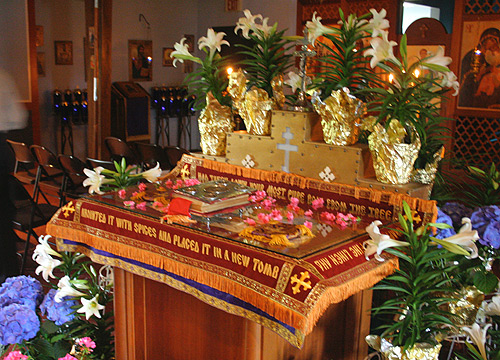
A typical epitaphios
from: orthodoxytoday.org
In the Byzantine rite Great and Holy Friday begins with a long Mattins on Thursday evening. The Byzantine rite, which is actually sparse in its Scripture readings compared to the Roman rite, has twelve lessons on this day, beginning with chapters 13-18 of the Gospel of St. John. In some churches twelve candles are lit and gradually extinguish after each reading. A crucifix with an icon-style corpus is placed in the nave and all adore it. A hymn describing Christ as the "Bridegroom of the Church" transfigured by the nails of the Cross  precedes the adoration. After the Little Hours, around 3:00 PM, a Deposition from the Cross service takes place. It is a Vespers service and the Gospel Passion according to St. Matthew, although with interpolations from all the accounts, is sung by the deacon. The reading encompasses Christ's burial in the tomb of St. Joseph of Arimathea. At the end of the service the icon-styled corpus is removed from the Cross and "buried" in an embroidered cloth called the epitaphios, which is placed within a bier. Once again all adore. Compline follows.

In the Roman rite the day once again begins with Tenebrae and the exact same ceremonies as the previous Tenebrae on Mandy Thursday. The last nocturne of Mattins contained excerpts from St. Paul's Epistle to the Hebrews, wherein the Apostle describes the two-edged sword of faith, hopes he maintains his, and emphasizes that faith is a living thing. The versicle before the second Miserere at Lauds adds mortem autem crucis.

On Friday, in the morning or around noon, the Mass of the Pre-Sanctified takes place. Structured like a Mass, the celebrant and his deacons wear their normal vestments, albeit the black of Masses of death, and take their places according to Mass ceremonial. A prophecy from Osee and from the book of Exodus are read. The Passion according to St. John is sung, followed by collects for the needs of the Church and then, in three successive and dramatic stages, a Cross is unveiled for public adoration. The clergy and the people "creep" to the Cross in three double-genuflections. A Blessed Sacrament procession brings the Host consecrated the previous day to the altar and a "Mass" begins with the offertory and incensation of the altar. The Host is elevated and a fragment is mixed with the wine in the chalice. The celebrant consumes the Host and the contents of the chalice and purifies his fingers and the vessels as usual. Vespers follows immediately, as yesterday. Compline is sung in the late afternoon. Around 3:00 PM a deposition service takes place, during which the corpus is removed from the Cross and "buried" in a sepulcher created in  side chapel. Some churches in England and Northern Europe will put a crown of thorns and nails in the tomb.
A Deposition service

[Great and] Holy Saturday

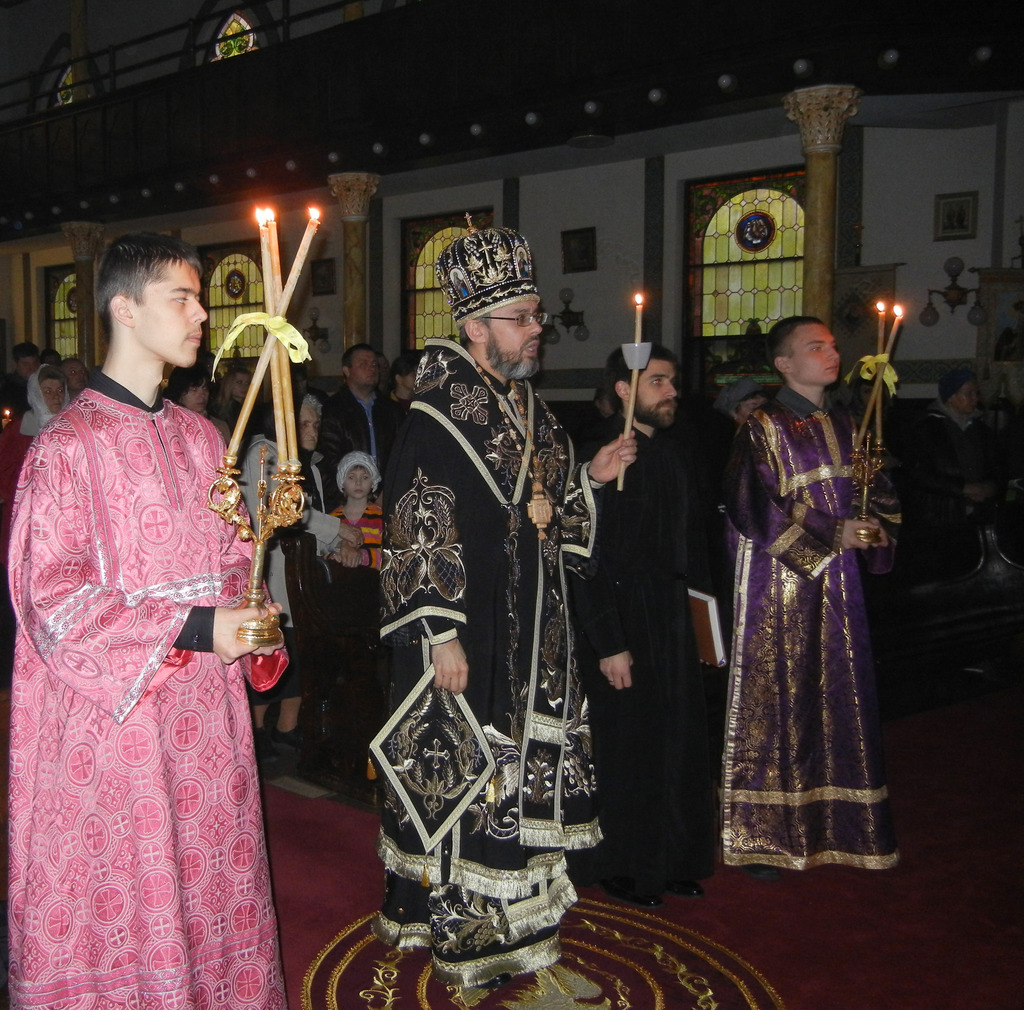
A bishop before the change of vestments
source: uocofuse.org
On the last day of the Triduum the story gets really interesting. Great and Holy Saturday starts Friday evening with Mattins (often called "Jerusalem Mattins," as many Byzantine and Roman ceremonies were inspired or transposed from the Church in Jerusalem), a lengthy service with opening rites, six psalms, and then psalm 118 sung with long interpolations praising Christ's adoration by the angels in the tomb and the conquest of Hades. The Canon follows, concluding with the Laudate psalms from Lauds. The message at the end is that the proscription to rest on the seventh day was a prophecy of Christ's Saturday in the tomb, intimating that the eighth day would be a new creation! A litany, dismissal, and Marian hymn conclude Mattins.

The Vesperal Liturgy, theoretically something in the afternoon of Saturday, in practice takes place in the morning for pastoral reasons. It begins with, you guessed it, Vespers! Black, or whatever dark color is available, is the color of the day thus far. The stichera begin to anticipate the Resurrection of the Lord ("for you alone manifested resurrection to the world!") and the lamentation of Hades ("my power is destroyed"). Fifteen Old Testament prophecies are read and any converts are baptized. The Canticle of the Three Children segues into the Divine Liturgy of St. Basil the Great. Prior to the Gospel, St. Matthew's account of the Resurrection, the clergy change their black vestments for white—quite a sight! A hymn of "silence" and "trembling" replaces the Cherubic hymn. The Hirmos is one of Jesus comforting His Mother rather than the usual "It is truly right...." Bread and figs are blessed at the end. During the Vesperal Liturgy converts are baptized and chrismated into the Church.
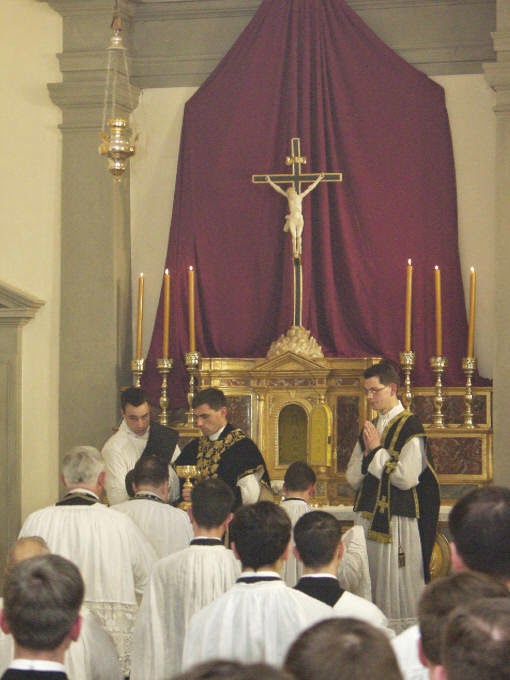
The deacon awaiting the Paschal fire in the old Roman Holy Saturday liturgy.
The Roman rite parallels strongly. Tenebrae again commences the liturgical day on Friday night. The Vesperal Liturgy starts Saturday after None, in practice mid-morning. Penitential violet is worn. A fire is blessed outside using three collects and the fire is brought into the church by a triple-wicked candle held by the deacon. The Paschal Candle is blessed and lit by the deacon during the Exsultet. Twelve prophecies from the Old Testament (four of which are to be found in the Byzantine rite) are read, telling of the gradual plan of salvation. The baptismal font is blessed and converts are baptized. The place of the baptisms, in a formerly-empty font, after the reading of the prophecies of old anticipating Christ have an un-mistakable purpose: baptism realizes for us the end of the prophecy and the beginning of the actual salvation; as the church is born anew by blessing, fire, and water from Christ, so too are these converted sinners; they are part of God's eighth day of Creation. The Litany of Saints begins and transitions into the actual Mass, taking the place of the Introit. The ministers change from violet to white vestments. At the Gloria bells are rung in joy. At the Gospel no candles are carried, as Christ's Resurrection, liturgically, is anticipated, but has not actually happened yet. There is no offertory chant and the Agnus Dei is omitted after the Canon. After communion a short Vespers with psalm 116 and the Magnificat are sung. A large [and well deserved] meal follows the Mass with Compline in the late afternoon or early evening.

Pascha
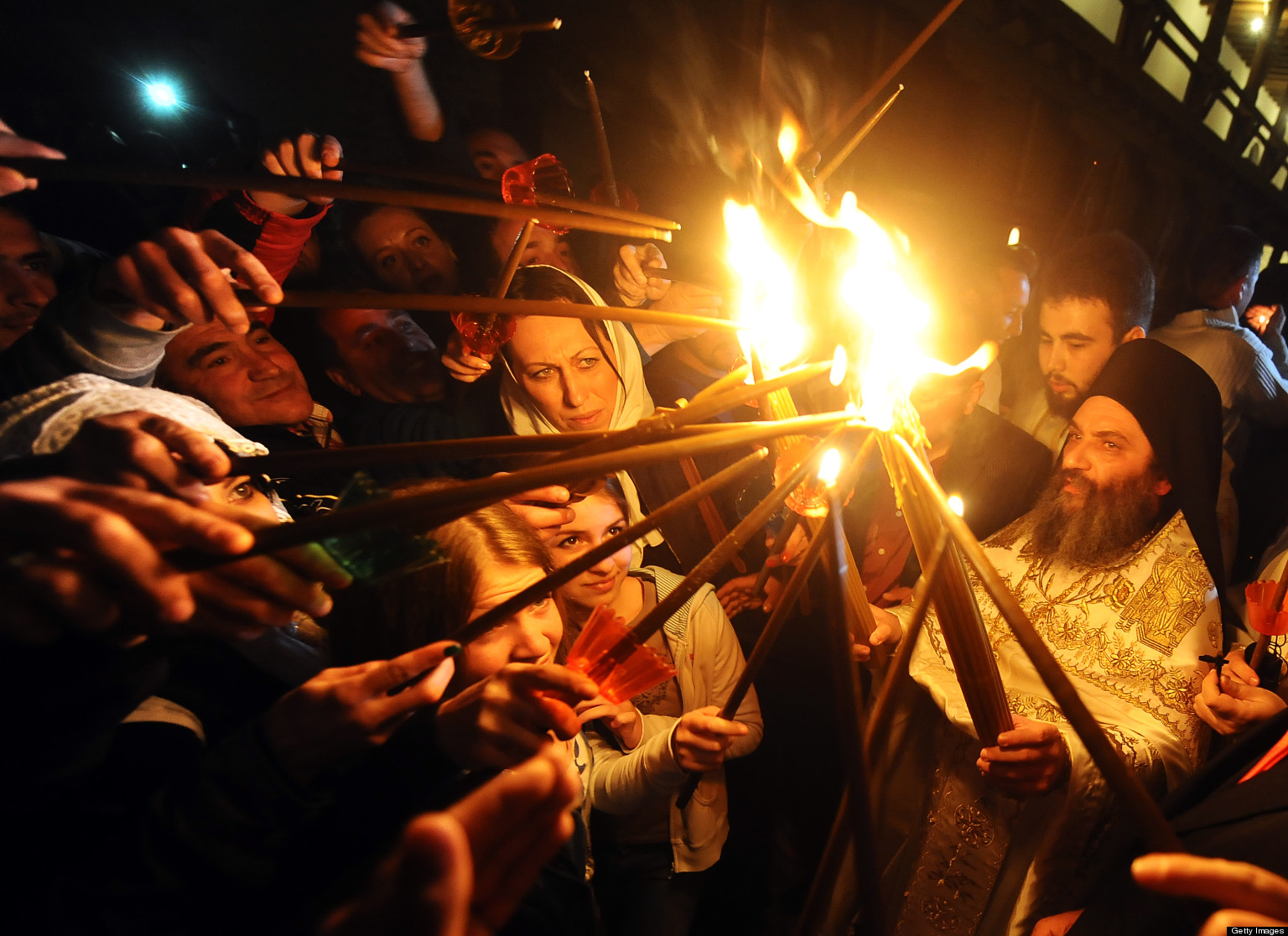
from: Huffington Post

Pascha in the Byzantine rite could be said to start with the Liturgy of St. Basil the Great in the morning, but it is most firmly felt on Saturday evening, usually an hour or so before midnight, when Pascha Sunday is about to begin. After the midnight office the epitaphios with the corpus of the Lord is venerated once again. All lights are extinguished save for the trikirion, a small candlestick on the altar. The celebrant invites all to come and receive the "light not overtaken by night." The people congregate outside after lighting their own candles and are met by the clergy. The constantly repeated "Christ is risen from the dead and by His death He has trampled upon death and has given life to those who were in the tombs" is sung. An account of the Resurrection is then sung and the celebrant, with his blessing cross, knocks on the door of the church and announces the "King of Glory" to the poor man pretending to be the Evil One inside. The procession bursts into the church, bathed in light and fully illuminated. Mattins follows. The Paschal Canon is sung in full with the litany and Magnificat at the end. Twice during Mattins a deacon censes the people and gives them the Paschal greeting "Christ is risen! He is truly risen!" At the end the priest reads the Paschal sermon of St. John Chrysostom. The hours are sung in a very abbreviated form, entirely without psalms, and the Divine Liturgy of St. John Chrysostom follows. After the Liturgy the faithful venerate an icon of the Resurrection rather than a blessing cross.

In Rome Pascha began with the Gloria during the Holy Saturday rites. On Saturday evening Paschal Mattins and Lauds are sung. Throughout Northern Europe the images in the churches would be unveiled and the Cross would be "raised" from the sepulcher and adored once more, as on Good Friday. A procession would then arrive at the high altar, vested with the best frontal and all candles in the church lit. Mattins is just psalms 1-3 and a sermon of Pope St. Gregory the Great. No canticles or hymns. The celebrant and cantors them vest in the best copes and begin Lauds. The antiphons on the first and third psalms commemorate the angel rolling back the stone on the Lord's tomb and the earthquake that followed respectively—we are clearly re-visiting the Resurrection at this moment! Haec dies... "This is the day the Lord has made, let us be glad and rejoice therein" replaces the chapter and there is no hymn before the Benedictus. The dismissal has a double-alleluia and the Regina coeli finally ends the service.

Worth Noting

After these long, and possibly trivial, descriptions the similarities might be obscured by an overload of information, so let us consider the Triduum day-by-day:
  • Thursday: it actually begins Wednesday night, in shadows. The office marks the point of transition between days. The office and Eucharist together form the complete prayer of the Church, as the Mass/Divine Liturgy is limited in what it can say to two readings. Tenebrae contains the full realm of Christ's betrayal, His worries, human fear, darkness, and also the institution of the Eucharist. The same is true in the Byzantine rite, which examines the Agony in the Garden and the betrayal in depth at Vespers. Also notable is that the foot-washing does not interrupt the Mass/Divine Liturgy in either rite and follows the Biblical flow of events by coming after the Eucharist. Lastly, priesthood is diffused and manifested by the use of holy oils. The blessing of oil in the Roman rite and the forgiveness of sins by oil in the Byzantine rite are two sides of Christ's one priestly function which he passed on to His Apostles that night (it also makes the concoction of "Chrism Masses" in the Roman rite something of a travesty).
  • Friday: begins with Mattins on Thursday evening in both rites. A Cross is revealed and adored in both. Vespers precedes the Deposition ceremony in both rites, which are both held when Our Lord has, liturgically, died, at 3:00 PM. The sepulcher and the epitaphios serve the same purpose.
  • Saturday: again begins with Mattins the evening prior, although Tenebrae gets shorter as the Triduum progresses whereas Saturday Mattins in the Byzantine rite is very long. In both rites the Resurrection is anticipated, not outright celebrated. The Byzantine tradition emphasizes the Harrowing of Hades directly while the Roman tradition does so implicitly. The Vesperal Liturgy in both rites would presumably be celebrated in the afternoon but for pastoral reasons is celebrated in the morning. Both include Vespers, a large number of prophecies meant to reveal the story of salvation leading to baptism and God's new Creation in the Resurrection, and a joyful transition from a penitential service into a joyful Mass/Divine Liturgy. The inclusion of Baptism in both rites is also critical. Water, aside from being the "matter" used in Baptism is also representative of matter, creation, the world, and chaos. By blessing it and using it for Baptism, Christ and His Church sanctify it and reserve it and the rest of the restored creation for His use.
  • Pascha: tomorrow still begins tonight! The Cross/epitaphios is venerated one last time and the church is illuminated for Paschal Mattins and Lauds, which is when the Resurrection is actually celebrated.
The Rad Trad hopes his readers got something out of this lengthy piece. The crossover between the two is significant and should give Roman liturgists who flirt with the "East" some reason to re-evaluate how we have done our Triduum in the last few decades, what basic ideas and frames of mind we have put aside, and what needs to be recovered.  Heck, maybe the Latin Mass Society or Una Voce could start doing the old Holy Week on the grounds of ecumenism.... Ironic, is it not, that one is more likely to see the Roman Triduum at an Eastern Catholic or Eastern Orthodox parish than at any Roman Catholic parish?