Showing posts with label mandy thursday. Show all posts
Showing posts with label mandy thursday. Show all posts
Thursday, April 13, 2017

Tuesday, March 29, 2016
He Just Has Bad Knees
While Mr. Grump was unable to attend a Holy Thursday Mass last week, and thus was deprived of his usual immediate occasion of Triduum-related grumpiness, he was pleased to find some photos of the Roman Ordinary doing what he does best: kneeling.

This is nothing new, of course. Photos of Padre Jorge kneeling have circulated before now, although most of them have shown him kneeling at a confessional booth or prie-dieu, which are arguably easier than the quicker genuflection required at Mass. The repeated moving and kneeling required for foot-washing, though, must be awfully taxing on one's knees. I know it would be on mine.
The usual Tenebrae service on Spy Wednesday was also unattended by yours truly for practical reasons. Good Friday at least was solemnly celebrated with the proper Vespers, even if the woman in the nearest pew was rather loudly chewing gum throughout. Holy Saturday was spent finishing Dante's magnificent Paradiso—read at the Holy Father's request—and breaking the Lenten fast in diverse and delicious ways. (The Inferno also includes a vivid reminder that Our Lord spent the first Holy Saturday breaking into Hell and stealing all the Devil's most treasured things.)
Mr. Grump had intended to spam the lot of you with a mini-series of St. Joseph-related posts in March, but lacked the energy and choleric enthusiasm. He is considering doing some other hagiographical studies, if he can ever get his books and papers in order.

 |
| source |
The usual Tenebrae service on Spy Wednesday was also unattended by yours truly for practical reasons. Good Friday at least was solemnly celebrated with the proper Vespers, even if the woman in the nearest pew was rather loudly chewing gum throughout. Holy Saturday was spent finishing Dante's magnificent Paradiso—read at the Holy Father's request—and breaking the Lenten fast in diverse and delicious ways. (The Inferno also includes a vivid reminder that Our Lord spent the first Holy Saturday breaking into Hell and stealing all the Devil's most treasured things.)
Mr. Grump had intended to spam the lot of you with a mini-series of St. Joseph-related posts in March, but lacked the energy and choleric enthusiasm. He is considering doing some other hagiographical studies, if he can ever get his books and papers in order.
Thursday, March 24, 2016
Mandy Thursday: Reconciliation of Penitents
Christ welcomed His betrayer a His table. How much more earnestly does He welcome one who repents and turns to Him?
Wednesday, April 1, 2015
Roman & Byzantine Triduum (repost)
Awareness of the old Holy Week in the Roman rite has grown since then-Pope Benedict XVI's Summorum Pontificum in 2007, as many eager clergy and faithful sought to understand both the 1962 liturgy and what preceded it. What many do not know, but will in a few moments, is just how close the old Roman Triduum is to the last three days of Great Week in the Byzantine liturgical tradition.
 I found this especially jarring when I first realized it, as "restoration" to a more pristine liturgy, as supposedly exists in the East, was often presented as a premise for the Pian and Pauline reforms. It should not be so surprising. Rome and Constantinople are only a few hundred miles apart and were, until the papacy of St. Gregory the Great, under the same cultural and political body. Even after Rome's de facto separation from the Byzantine Empire Constantinopolitan liturgy came to Rome via Milan and via Europe (France and Spain picked up Eastern Roman traditions and practices from North African Christians). The Crusades would have a reciprocal effect centuries later. Contrary to our instinct to view the Rome-Constantinople schism as the compass for liturgy, the two cities probably have more in common than the Byzantine tradition has with the Thomist Christians of India or the Nestorians or the other various non-Chalcedonian Churches we call "Oriental."
Before we look at the specific rites, let us lay down a few basic principles necessary to understanding the commonality of the two rites:
- A liturgical day begins the evening prior to the calendar day with Vespers. This derives from the Mosaic tradition (Exodus 29:38-39) of offering sacrifice in the morning and evening. The Temple eventually came to a regular schedule of prayer hours, much like the Divine Office, which is, in most ways, a Christianized version of the ancient Jewish public prayer. Saturday evening Vespers begin Sunday in the Byzantine tradition, as first Vespers begin a feast—and in some sense, Sunday—in the Roman tradition.
- The celebration of the Eucharist, call it Mass or Divine Liturgy, is integral to the mysteries and prayer of a given day, but does not encompass all of it. The Divine Office and Eucharist together comprise the observance of a feast, Sunday, or feria.
- The entire liturgy comprises the opus Dei, not just the Eucharist or any other one portion of it. Opus Dei does not indicate work men do to glorify God, but rather work He does for us and on our behalf. Indeed the word liturgy comes to us from a Greek term for "work of public service," the service being something God does for the public and not the other way around. With this in mind the Catholic must realize that God is present and "working" among the Church in all the rites of Holy Week
Now, let us look at the Triduum!
Mandy/Great and Holy Thursday
 |
| Archbishop Soroka washes feet at Ss. Cyril and Methodius from: blogs.thetimes-tribune.com |
In the Byzantine tradition, dark vestments are used on this day. My parish, which has limited means, uses crimson red. The day begins Wednesday evening with Vespers, with the usual introductory rites and psalm 103 ("Bless the Lord, my soul..."). Psalms 140, 141, and 129 are sung, the emphasis being "crying out" to the Lord. The stichera (hymns), which emphasize Judas' betrayal of the "Creator and Maker of all" to the Jews, are sung thereafter. The emphasis on the guilt of Judas never ceases, which impressed me the first time I heard these hymns. All Christians are aware of the great betrayal, but I never thought of singing "the Apostle and Apostate" and the "spawn of the vipers" as a liturgical act. The Evening Hymn is sung, followed by prophecies from Exodus, Isaiah, and Job. This marks a quiet transition into the Divine Liturgy proper, wherein the institution narrative from St. Paul first epistle to the Church in Corinth is read. The Cherubic Hymn is replaced by the normal communion verse "Make me this day a sharer in your mystical supper, Oh Son of God...." (interestingly, this is sung as the Communion antiphon this day in the Ambrosian rite). These verses are repeated several times, even after Communion. The blessing at the end, which normally speaks of "Our Lord Jesus Christ, Who is risen from the dead," instead reflects on the Lord's humility in washing His Apostles' feet and dying for us and them.
In the Melkite Church, and presumably the Chalcedonian-Orthodox of Antioch, the Sacrament of Anointing of the Sick is given to all the faithful between Vespers and the Divine Liturgy proper. During the periods of time when the Eastern Christians suffered persecution under Islam, or suffered an organizational duress, there were fewer and fewer priests available to give absolution for sins, a faculty which in the Eastern and Western tradition must be given explicitly by the bishop; otherwise one could confess to a priest or any other person, but not receive absolution. As a means of forgiving sins priests would give the Unction of the Sick prior to the Eucharistic Sacrifice during Great Week, interpolating it into the vesperal liturgy for Holy Thursday. As St. John Chrysostom wrote 1,600 years ago, "Is there anyone among you sick? Let him call in the priests of the church, and let them pray over him, anointing him with oil in the name of the Lord. And the prayer of faith shall save the sick man, and the Lord shall raise him up, and if he has committed sins, he shall be forgiven."
In most parishes, but not my small parish, the celebrant washes the feet of twelve men after communion and before the dismissal. If the celebrant is a bishop, he is sure to wash the feet of some clergy. The same goes for an abbot in a monastery. The washing takes place outside of the Royal Doors, in the nave of the church. Mattins on Thursday morning continues the theme of betrayal, which is much stronger than in the Roman rite.
In the Melkite Church, and presumably the Chalcedonian-Orthodox of Antioch, the Sacrament of Anointing of the Sick is given to all the faithful between Vespers and the Divine Liturgy proper. During the periods of time when the Eastern Christians suffered persecution under Islam, or suffered an organizational duress, there were fewer and fewer priests available to give absolution for sins, a faculty which in the Eastern and Western tradition must be given explicitly by the bishop; otherwise one could confess to a priest or any other person, but not receive absolution. As a means of forgiving sins priests would give the Unction of the Sick prior to the Eucharistic Sacrifice during Great Week, interpolating it into the vesperal liturgy for Holy Thursday. As St. John Chrysostom wrote 1,600 years ago, "Is there anyone among you sick? Let him call in the priests of the church, and let them pray over him, anointing him with oil in the name of the Lord. And the prayer of faith shall save the sick man, and the Lord shall raise him up, and if he has committed sins, he shall be forgiven."
In most parishes, but not my small parish, the celebrant washes the feet of twelve men after communion and before the dismissal. If the celebrant is a bishop, he is sure to wash the feet of some clergy. The same goes for an abbot in a monastery. The washing takes place outside of the Royal Doors, in the nave of the church. Mattins on Thursday morning continues the theme of betrayal, which is much stronger than in the Roman rite.
 |
| Tenebrae sung at St. Mary's in Norwalk, CT USA, an excellent little parish. |
The Roman rite, oddly, does not begin with Vespers, as there are no first Vespers during Holy Week. But it does begin, powerfully, with the Wednesday evening service of Tenebrae—Mattins and Lauds of Mandy Thursday. There are no introductory rites and the psalms are actually ferial, not festal. The lessons from the Book of the Lamentations of Jeremias speak of tragic desolation of a lonely city—quomodo sedet sola civitas. The responsories speak of Christ asking for the cup to pass from Him and of His immanent betrayal. The antiphons on the Mattins psalms speak of fear, silence, disturbance, trembling, and judgment. After each psalm a candle on the hearse is extinguished, eventually leaving the church in darkness. Whereas Mattins and Lauds usually lead us out of the darkness of night into the service of God throughout the day, here we go from day into obscurity and trembling as the Divine Redemption begins to unfold. Lauds begins with psalm 50 and then 89, the antiphon on which says "The Lord was brought as a lamb to the slaughter, and He opened not His mouth." The Miserere psalm is repeated again as part of the would-be suffrages and the remaining candles on the altar are snuffed, darkening the church. The clergy take their books and smash them to create an earthquake-like noise, reminiscent of the one following the Crucifixion.
Mass is sung after None, in practice in the morning. The introit is Nos autem gloriari and the Gloria is sung, but the rest of the Mass pertains to the Last Supper. The Epistle is the same as in the Byzantine liturgy and the Gospel is St. John's account of Christ washing the Apostles' feet. The vestments are white for the Mass but not for the rest of the day. My own cheesy interpretation of this is that it is like a going-away for a beloved friend who you know you will not see again for a long time; festive, but surreal and sad. In reality this is probably a Roman oddity: Byzantium used dark vestments, Milan used black, and the Gallican and Norman rites used red. After Mass a procession brings the Blessed Sacrament to an altar of repose and the Vespers follows. The altars of the church are stripped and washed. At a side altar, in the afternoon, the celebrant washes the feet of thirteen men, after having repeated the Gospel of the Mass. The priest wears a penitential violet for this ceremony, which many once considered a possible Sacrament.
Should the Roman celebrant be a diocesan bishop oils are blessed for use throughout the coming year during the Mass. The Canon of the Mass stops, the only time when this happens in the Roman rite, and olive oil is then blessed and "breathed" on by the bishop and twelve priests, making it a work of Christ's priesthood which he imparted to His Apostles that night. The work of Christ during the Canon of Mass and during the blessing of oils is the same Melchizedek priesthood.
Mass is sung after None, in practice in the morning. The introit is Nos autem gloriari and the Gloria is sung, but the rest of the Mass pertains to the Last Supper. The Epistle is the same as in the Byzantine liturgy and the Gospel is St. John's account of Christ washing the Apostles' feet. The vestments are white for the Mass but not for the rest of the day. My own cheesy interpretation of this is that it is like a going-away for a beloved friend who you know you will not see again for a long time; festive, but surreal and sad. In reality this is probably a Roman oddity: Byzantium used dark vestments, Milan used black, and the Gallican and Norman rites used red. After Mass a procession brings the Blessed Sacrament to an altar of repose and the Vespers follows. The altars of the church are stripped and washed. At a side altar, in the afternoon, the celebrant washes the feet of thirteen men, after having repeated the Gospel of the Mass. The priest wears a penitential violet for this ceremony, which many once considered a possible Sacrament.
Should the Roman celebrant be a diocesan bishop oils are blessed for use throughout the coming year during the Mass. The Canon of the Mass stops, the only time when this happens in the Roman rite, and olive oil is then blessed and "breathed" on by the bishop and twelve priests, making it a work of Christ's priesthood which he imparted to His Apostles that night. The work of Christ during the Canon of Mass and during the blessing of oils is the same Melchizedek priesthood.
Good/Holy and Great Friday
 |
| A typical epitaphios from: orthodoxytoday.org |
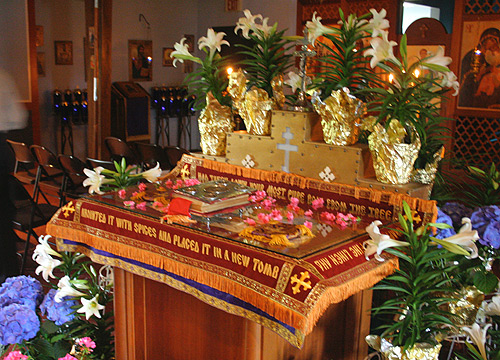
In the Byzantine rite Great and Holy Friday begins with a long Mattins on Thursday evening. The Byzantine rite, which is actually sparse in its Scripture readings compared to the Roman rite, has twelve lessons on this day, beginning with chapters 13-18 of the Gospel of St. John. In some churches twelve candles are lit and gradually extinguish after each reading. A crucifix with an icon-style corpus is placed in the nave and all adore it. A hymn describing Christ as the "Bridegroom of the Church" transfigured by the nails of the Cross precedes the adoration. After the Little Hours, around 3:00 PM, a Deposition from the Cross service takes place. It is a Vespers service and the Gospel Passion according to St. Matthew, although with interpolations from all the accounts, is sung by the deacon. The reading encompasses Christ's burial in the tomb of St. Joseph of Arimathea. At the end of the service the icon-styled corpus is removed from the Cross and "buried" in an embroidered cloth called the epitaphios, which is placed within a bier. Once again all adore. Compline follows.
 In the Roman rite the day once again begins with Tenebrae and the exact same ceremonies as the previous Tenebrae on Mandy Thursday. The last nocturne of Mattins contained excerpts from St. Paul's Epistle to the Hebrews, wherein the Apostle describes the two-edged sword of faith, hopes he maintains his, and emphasizes that faith is a living thing. The versicle before the second Miserere at Lauds adds mortem autem crucis.
On Friday, in the morning or around noon, the Mass of the Pre-Sanctified takes place. Structured like a Mass, the celebrant and his deacons wear their normal vestments, albeit the black of Masses of death, and take their places according to Mass ceremonial. A prophecy from Osee and from the book of Exodus are read. The Passion according to St. John is sung, followed by collects for the needs of the Church and then, in three successive and dramatic stages, a Cross is unveiled for public adoration. The clergy and the people "creep" to the Cross in three double-genuflections. A Blessed Sacrament procession brings the Host consecrated the previous day to the altar and a "Mass" begins with the offertory and incensation of the altar. The Host is elevated and a fragment is mixed with the wine in the chalice. The celebrant consumes the Host and the contents of the chalice and purifies his fingers and the vessels as usual. Vespers follows immediately, as yesterday. Compline is sung in the late afternoon. Around 3:00 PM a deposition service takes place, during which the corpus is removed from the Cross and "buried" in a sepulcher created in side chapel. Some churches in England and Northern Europe will put a crown of thorns and nails in the tomb.
 |
A Deposition service[Great and] Holy Saturday |
 |
| A bishop before the change of vestments source: uocofuse.org |
On the last day of the Triduum the story gets really interesting. Great and Holy Saturday starts Friday evening with Mattins (often called "Jerusalem Mattins," as many Byzantine and Roman ceremonies were inspired or transposed from the Church in Jerusalem), a lengthy service with opening rites, six psalms, and then psalm 118 sung with long interpolations praising Christ's adoration by the angels in the tomb and the conquest of Hades. The Canon follows, concluding with the Laudate psalms from Lauds. The message at the end is that the proscription to rest on the seventh day was a prophecy of Christ's Saturday in the tomb, intimating that the eighth day would be a new creation! A litany, dismissal, and Marian hymn conclude Mattins.
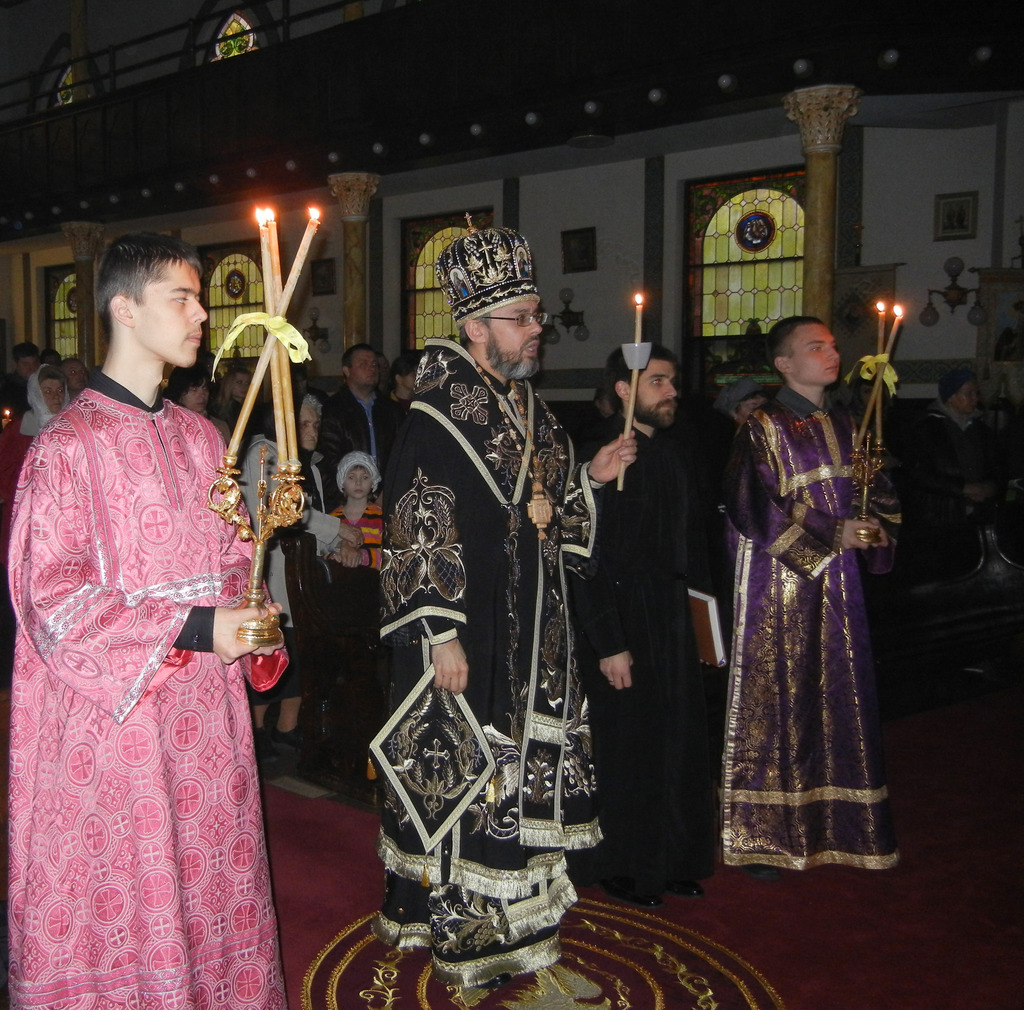
The Vesperal Liturgy, theoretically something in the afternoon of Saturday, in practice takes place in the morning for pastoral reasons. It begins with, you guessed it, Vespers! Black, or whatever dark color is available, is the color of the day thus far. The stichera begin to anticipate the Resurrection of the Lord ("for you alone manifested resurrection to the world!") and the lamentation of Hades ("my power is destroyed"). Fifteen Old Testament prophecies are read and any converts are baptized. The Canticle of the Three Children segues into the Divine Liturgy of St. Basil the Great. Prior to the Gospel, St. Matthew's account of the Resurrection, the clergy change their black vestments for white—quite a sight! A hymn of "silence" and "trembling" replaces the Cherubic hymn. The Hirmos is one of Jesus comforting His Mother rather than the usual "It is truly right...." Bread and figs are blessed at the end. During the Vesperal Liturgy converts are baptized and chrismated into the Church.
The Vesperal Liturgy, theoretically something in the afternoon of Saturday, in practice takes place in the morning for pastoral reasons. It begins with, you guessed it, Vespers! Black, or whatever dark color is available, is the color of the day thus far. The stichera begin to anticipate the Resurrection of the Lord ("for you alone manifested resurrection to the world!") and the lamentation of Hades ("my power is destroyed"). Fifteen Old Testament prophecies are read and any converts are baptized. The Canticle of the Three Children segues into the Divine Liturgy of St. Basil the Great. Prior to the Gospel, St. Matthew's account of the Resurrection, the clergy change their black vestments for white—quite a sight! A hymn of "silence" and "trembling" replaces the Cherubic hymn. The Hirmos is one of Jesus comforting His Mother rather than the usual "It is truly right...." Bread and figs are blessed at the end. During the Vesperal Liturgy converts are baptized and chrismated into the Church.
 |
| The deacon awaiting the Paschal fire in the old Roman Holy Saturday liturgy. |
The Roman rite parallels strongly. Tenebrae again commences the liturgical day on Friday night. The Vesperal Liturgy starts Saturday after None, in practice mid-morning. Penitential violet is worn. A fire is blessed outside using three collects and the fire is brought into the church by a triple-wicked candle held by the deacon. The Paschal Candle is blessed and lit by the deacon during the Exsultet. Twelve prophecies from the Old Testament (four of which are to be found in the Byzantine rite) are read, telling of the gradual plan of salvation. The baptismal font is blessed and converts are baptized. The place of the baptisms, in a formerly-empty font, after the reading of the prophecies of old anticipating Christ have an un-mistakable purpose: baptism realizes for us the end of the prophecy and the beginning of the actual salvation; as the church is born anew by blessing, fire, and water from Christ, so too are these converted sinners; they are part of God's eighth day of Creation. The Litany of Saints begins and transitions into the actual Mass, taking the place of the Introit. The ministers change from violet to white vestments. At the Gloria bells are rung in joy. At the Gospel no candles are carried, as Christ's Resurrection, liturgically, is anticipated, but has not actually happened yet. There is no offertory chant and the Agnus Dei is omitted after the Canon. After communion a short Vespers with psalm 116 and the Magnificat are sung. A large [and well deserved] meal follows the Mass with Compline in the late afternoon or early evening.
Pascha
 |
| from: Huffington Post |
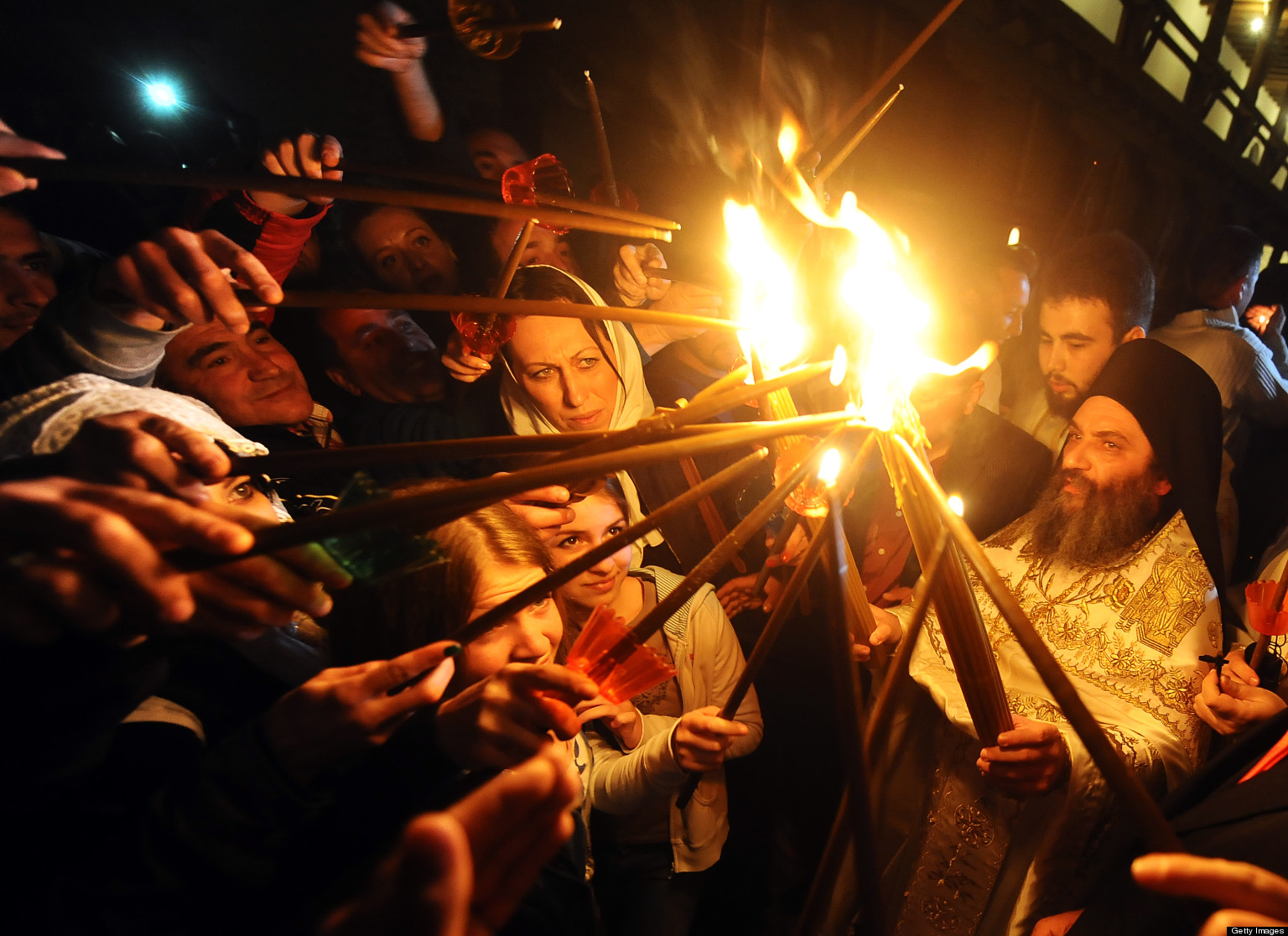
Pascha in the Byzantine rite could be said to start with the Liturgy of St. Basil the Great in the morning, but it is most firmly felt on Saturday evening, usually an hour or so before midnight, when Pascha Sunday is about to begin. After the midnight office the epitaphios with the corpus of the Lord is venerated once again. All lights are extinguished save for the trikirion, a small candlestick on the altar. The celebrant invites all to come and receive the "light not overtaken by night." The people congregate outside after lighting their own candles and are met by the clergy. The constantly repeated "Christ is risen from the dead and by His death He has trampled upon death and has given life to those who were in the tombs" is sung. An account of the Resurrection is then sung and the celebrant, with his blessing cross, knocks on the door of the church and announces the "King of Glory" to the poor man pretending to be the Evil One inside. The procession bursts into the church, bathed in light and fully illuminated. Mattins follows. The Paschal Canon is sung in full with the litany and Magnificat at the end. Twice during Mattins a deacon censes the people and gives them the Paschal greeting "Christ is risen! He is truly risen!" At the end the priest reads the Paschal sermon of St. John Chrysostom. The hours are sung in a very abbreviated form, entirely without psalms, and the Divine Liturgy of St. John Chrysostom follows. After the Liturgy the faithful venerate an icon of the Resurrection rather than a blessing cross.
In Rome Pascha began with the Gloria during the Holy Saturday rites. On Saturday evening Paschal Mattins and Lauds are sung. Throughout Northern Europe the images in the churches would be unveiled and the Cross would be "raised" from the sepulcher and adored once more, as on Good Friday. A procession would then arrive at the high altar, vested with the best frontal and all candles in the church lit. Mattins is just psalms 1-3 and a sermon of Pope St. Gregory the Great. No canticles or hymns. The celebrant and cantors them vest in the best copes and begin Lauds. The antiphons on the first and third psalms commemorate the angel rolling back the stone on the Lord's tomb and the earthquake that followed respectively—we are clearly re-visiting the Resurrection at this moment! Haec dies... "This is the day the Lord has made, let us be glad and rejoice therein" replaces the chapter and there is no hymn before the Benedictus. The dismissal has a double-alleluia and the Regina coeli finally ends the service.
Worth Noting
After these long, and possibly trivial, descriptions the similarities might be obscured by an overload of information, so let us consider the Triduum day-by-day:
- Thursday: it actually begins Wednesday night, in shadows. The office marks the point of transition between days. The office and Eucharist together form the complete prayer of the Church, as the Mass/Divine Liturgy is limited in what it can say to two readings. Tenebrae contains the full realm of Christ's betrayal, His worries, human fear, darkness, and also the institution of the Eucharist. The same is true in the Byzantine rite, which examines the Agony in the Garden and the betrayal in depth at Vespers. Also notable is that the foot-washing does not interrupt the Mass/Divine Liturgy in either rite and follows the Biblical flow of events by coming after the Eucharist. Lastly, priesthood is diffused and manifested by the use of holy oils. The blessing of oil in the Roman rite and the forgiveness of sins by oil in the Byzantine rite are two sides of Christ's one priestly function which he passed on to His Apostles that night (it also makes the concoction of "Chrism Masses" in the Roman rite something of a travesty).
- Friday: begins with Mattins on Thursday evening in both rites. A Cross is revealed and adored in both. Vespers precedes the Deposition ceremony in both rites, which are both held when Our Lord has, liturgically, died, at 3:00 PM. The sepulcher and the epitaphios serve the same purpose.
- Saturday: again begins with Mattins the evening prior, although Tenebrae gets shorter as the Triduum progresses whereas Saturday Mattins in the Byzantine rite is very long. In both rites the Resurrection is anticipated, not outright celebrated. The Byzantine tradition emphasizes the Harrowing of Hades directly while the Roman tradition does so implicitly. The Vesperal Liturgy in both rites would presumably be celebrated in the afternoon but for pastoral reasons is celebrated in the morning. Both include Vespers, a large number of prophecies meant to reveal the story of salvation leading to baptism and God's new Creation in the Resurrection, and a joyful transition from a penitential service into a joyful Mass/Divine Liturgy. The inclusion of Baptism in both rites is also critical. Water, aside from being the "matter" used in Baptism is also representative of matter, creation, the world, and chaos. By blessing it and using it for Baptism, Christ and His Church sanctify it and reserve it and the rest of the restored creation for His use.
- Pascha: tomorrow still begins tonight! The Cross/epitaphios is venerated one last time and the church is illuminated for Paschal Mattins and Lauds, which is when the Resurrection is actually celebrated.
The Rad Trad hopes his readers got something out of this lengthy piece. The crossover between the two is significant and should give Roman liturgists who flirt with the "East" some reason to re-evaluate how we have done our Triduum in the last few decades, what basic ideas and frames of mind we have put aside, and what needs to be recovered. Heck, maybe the Latin Mass Society or Una Voce could start doing the old Holy Week on the grounds of ecumenism.... Ironic, is it not, that one is more likely to see the Roman Triduum at an Eastern Catholic or Eastern Orthodox parish than at any Roman Catholic parish?
Wednesday, April 16, 2014
Quomodo Sedet Sola Civitas

I just returned from Tenebrae, over two and a half hours of psalms and lessons. Really the depth of the old Triduum Office is beyond comprehension. The psalms are about battle, liberation, forgiveness, and defeat of one's enemies. The first lessons are the Lamentations of Jeremiah for the fall of the chosen people, of Jerusalem. The second are of St Augustine on how God can redirect evil for the good. And the first are form St Paul on the Last Supper and the Eucharist. The responsories paint the darkness of Judas' betrayal behind the broader themes of the night and contrast strongly with the festive, celebratory nature of the Mass of the day. And of course the extinction of the candles, leaving us in darkness and the "earthquake" (smashing books) that ends the night. It made quite an impression on myself and many others.
During the strepitus a friend bashed a book containing hymns such as Holy God We Praise Thy Name while I took out my rage lamented Christ's betrayal with a 1962 Missal, possibly damaging the spine.
Tomorrow off to the Maronites for Mandy Thursday, the washing of feet, and a night of Confession. Good Friday Vespers with the shroud burial and Jerusalem Mattins of Holy Saturday the following night. And Divine Liturgy of Pascha with the Melkites in Houston Saturday night/Sunday morning.
Tuesday, April 8, 2014
Roman and Byzantine Triduum (repost with new material)
The rites of Holy Week quickly approach us now that we are passing through Passiontide in anticipation of the Passion and Resurrection of Our Lord. Herein is [mostly] a repost of a past article I wrote concerning the striking similarities between the Roman and Byzantine (Eastern Roman if one thinks about it) rites for Holy Week with a few new thoughts interspersed to entice readership. Enjoy!
Awareness of the old Holy Week in the Roman rite has grown since then-Pope Benedict XVI's Summorum Pontificum in 2007, as many eager clergy and faithful sought to understand both the 1962 liturgy and what preceded it. What many do not know, but will in a few moments, is just how close the old Roman Triduum is to the last three days of Great Week in the Byzantine liturgical tradition.
Awareness of the old Holy Week in the Roman rite has grown since then-Pope Benedict XVI's Summorum Pontificum in 2007, as many eager clergy and faithful sought to understand both the 1962 liturgy and what preceded it. What many do not know, but will in a few moments, is just how close the old Roman Triduum is to the last three days of Great Week in the Byzantine liturgical tradition.
I found this especially jarring when I first realized it, as "restoration" to a more pristine liturgy, as supposedly exists in the East, was often presented as a premise for the Pian and Pauline reforms. It should not be so surprising. Rome and Constantinople are only a few hundred miles apart and were, until the papacy of St. Gregory the Great, under the same cultural and political body. Even after Rome's de facto separation from the Byzantine Empire Constantinopolitan liturgy came to Rome via Milan and via Europe (France and Spain picked up Eastern Roman traditions and practices from North African Christians). The Crusades would have a reciprocal effect centuries later. Contrary to our instinct to view the Rome-Constantinople schism as the compass for liturgy, the two cities probably have more in common than the Byzantine tradition has with the Thomist Christians of India or the Nestorians or the other various non-Chalcedonian Churches we call "Oriental."
Before we look at the specific rites, let us lay down a few basic principles necessary to understanding the commonality of the two rites:
- A liturgical day begins the evening prior to the calendar day with Vespers. This derives from the Mosaic tradition (Exodus 29:38-39) of offering sacrifice in the morning and evening. The Temple eventually came to a regular schedule of prayer hours, much like the Divine Office, which is, in most ways, a Christianized version of the ancient Jewish public prayer. Saturday evening Vespers begin Sunday in the Byzantine tradition, as first Vespers begin a feast—and in some sense, Sunday—in the Roman tradition.
- The celebration of the Eucharist, call it Mass or Divine Liturgy, is integral to the mysteries and prayer of a given day, but does not encompass all of it. The Divine Office and Eucharist together comprise the observance of a feast, Sunday, or feria.
- The entire liturgy comprises the opus Dei, not just the Eucharist or any other one portion of it. Opus Dei does not indicate work men do to glorify God, but rather work He does for us and on our behalf. Indeed the word liturgy comes to us from a Greek term for "work of public service," the service being something God does for the public and not the other way around. With this in mind the Catholic must realize that God is present and "working" among the Church in all the rites of Holy Week
Now, let us look at the Triduum!
Mandy/Great and Holy Thursday
|
| Archbishop Soroka washes feet at Ss. Cyril and Methodius from: blogs.thetimes-tribune.com |
In the Byzantine tradition, dark vestments are used on this day. My parish, which has limited means, uses crimson red. The day begins Wednesday evening with Vespers, with the usual introductory rites and psalm 103 ("Bless the Lord, my soul..."). Psalms 140, 141, and 129 are sung, the emphasis being "crying out" to the Lord. The stichera (hymns), which emphasize Judas' betrayal of the "Creator and Maker of all" to the Jews, are sung thereafter. The emphasis on the guilt of Judas never ceases, which impressed me the first time I heard these hymns. All Christians are aware of the great betrayal, but I never thought of singing "the Apostle and Apostate" and the "spawn of the vipers" as a liturgical act. The Evening Hymn is sung, followed by prophecies from Exodus, Isaiah, and Job. This marks a quiet transition into the Divine Liturgy proper, wherein the institution narrative from St. Paul first epistle to the Church in Corinth is read. The Cherubic Hymn is replaced by the normal communion verse "Make me this day a sharer in your mystical supper, Oh Son of God...." (interestingly, this is sung as the Communion antiphon this day in the Ambrosian rite). These verses are repeated several times, even after Communion. The blessing at the end, which normally speaks of "Our Lord Jesus Christ, Who is risen from the dead," instead reflects on the Lord's humility in washing His Apostles' feet and dying for us and them.
In the Melkite Church, and presumably the Chalcedonian-Orthodox of Antioch, the Sacrament of Anointing of the Sick is given to all the faithful between Vespers and the Divine Liturgy proper. During the periods of time when the Eastern Christians suffered persecution under Islam, or suffered an organizational duress, there were fewer and fewer priests available to give absolution for sins, a faculty which in the Eastern and Western tradition must be given explicitly by the bishop; otherwise one could confess to a priest or any other person, but not receive absolution. As a means of forgiving sins priests would give the Unction of the Sick prior to the Eucharistic Sacrifice during Great Week, interpolating it into the vesperal liturgy for Holy Thursday. As St. John Chrysostom wrote 1,600 years ago, "Is there anyone among you sick? Let him call in the priests of the church, and let them pray over him, anointing him with oil in the name of the Lord. And the prayer of faith shall save the sick man, and the Lord shall raise him up, and if he has committed sins, he shall be forgiven."
In most parishes, but not my small parish, the celebrant washes the feet of twelve men after communion and before the dismissal. If the celebrant is a bishop, he is sure to wash the feet of some clergy. The same goes for an abbot in a monastery. The washing takes place outside of the Royal Doors, in the nave of the church. Mattins on Thursday morning continues the theme of betrayal, which is much stronger than in the Roman rite.
In the Melkite Church, and presumably the Chalcedonian-Orthodox of Antioch, the Sacrament of Anointing of the Sick is given to all the faithful between Vespers and the Divine Liturgy proper. During the periods of time when the Eastern Christians suffered persecution under Islam, or suffered an organizational duress, there were fewer and fewer priests available to give absolution for sins, a faculty which in the Eastern and Western tradition must be given explicitly by the bishop; otherwise one could confess to a priest or any other person, but not receive absolution. As a means of forgiving sins priests would give the Unction of the Sick prior to the Eucharistic Sacrifice during Great Week, interpolating it into the vesperal liturgy for Holy Thursday. As St. John Chrysostom wrote 1,600 years ago, "Is there anyone among you sick? Let him call in the priests of the church, and let them pray over him, anointing him with oil in the name of the Lord. And the prayer of faith shall save the sick man, and the Lord shall raise him up, and if he has committed sins, he shall be forgiven."
In most parishes, but not my small parish, the celebrant washes the feet of twelve men after communion and before the dismissal. If the celebrant is a bishop, he is sure to wash the feet of some clergy. The same goes for an abbot in a monastery. The washing takes place outside of the Royal Doors, in the nave of the church. Mattins on Thursday morning continues the theme of betrayal, which is much stronger than in the Roman rite.
|
| Tenebrae sung at St. Mary's in Norwalk, CT USA, an excellent little parish. |
The Roman rite, oddly, does not begin with Vespers, as there are no first Vespers during Holy Week. But it does begin, powerfully, with the Wednesday evening service of Tenebrae—Mattins and Lauds of Mandy Thursday. There are no introductory rites and the psalms are actually ferial, not festal. The lessons from the Book of the Lamentations of Jeremias speak of tragic desolation of a lonely city—quomodo sedet sola civitas. The responsories speak of Christ asking for the cup to pass from Him and of His immanent betrayal. The antiphons on the Mattins psalms speak of fear, silence, disturbance, trembling, and judgment. After each psalm a candle on the hearse is extinguished, eventually leaving the church in darkness. Whereas Mattins and Lauds usually lead us out of the darkness of night into the service of God throughout the day, here we go from day into obscurity and trembling as the Divine Redemption begins to unfold. Lauds begins with psalm 50 and then 89, the antiphon on which says "The Lord was brought as a lamb to the slaughter, and He opened not His mouth." The Miserere psalm is repeated again as part of the would-be suffrages and the remaining candles on the altar are snuffed, darkening the church. The clergy take their books and smash them to create an earthquake-like noise, reminiscent of the one following the Crucifixion.
Mass is sung after None, in practice in the morning. The introit is Nos autem gloriari and the Gloria is sung, but the rest of the Mass pertains to the Last Supper. The Epistle is the same as in the Byzantine liturgy and the Gospel is St. John's account of Christ washing the Apostles' feet. The vestments are white for the Mass but not for the rest of the day. My own cheesy interpretation of this is that it is like a going-away for a beloved friend who you know you will not see again for a long time; festive, but surreal and sad. In reality this is probably a Roman oddity: Byzantium used dark vestments, Milan used black, and the Gallican and Norman rites used red. After Mass a procession brings the Blessed Sacrament to an altar of repose and the Vespers follows. The altars of the church are stripped and washed. At a side altar, in the afternoon, the celebrant washes the feet of thirteen men, after having repeated the Gospel of the Mass. The priest wears a penitential violet for this ceremony, which many once considered a possible Sacrament.
Should the Roman celebrant be a diocesan bishop oils are blessed for use throughout the coming year during the Mass. The Canon of the Mass stops, the only time when this happens in the Roman rite, and olive oil is then blessed and "breathed" on by the bishop and twelve priests, making it a work of Christ's priesthood which he imparted to His Apostles that night. The work of Christ during the Canon of Mass and during the blessing of oils is the same Melchizedek priesthood.
Mass is sung after None, in practice in the morning. The introit is Nos autem gloriari and the Gloria is sung, but the rest of the Mass pertains to the Last Supper. The Epistle is the same as in the Byzantine liturgy and the Gospel is St. John's account of Christ washing the Apostles' feet. The vestments are white for the Mass but not for the rest of the day. My own cheesy interpretation of this is that it is like a going-away for a beloved friend who you know you will not see again for a long time; festive, but surreal and sad. In reality this is probably a Roman oddity: Byzantium used dark vestments, Milan used black, and the Gallican and Norman rites used red. After Mass a procession brings the Blessed Sacrament to an altar of repose and the Vespers follows. The altars of the church are stripped and washed. At a side altar, in the afternoon, the celebrant washes the feet of thirteen men, after having repeated the Gospel of the Mass. The priest wears a penitential violet for this ceremony, which many once considered a possible Sacrament.
Should the Roman celebrant be a diocesan bishop oils are blessed for use throughout the coming year during the Mass. The Canon of the Mass stops, the only time when this happens in the Roman rite, and olive oil is then blessed and "breathed" on by the bishop and twelve priests, making it a work of Christ's priesthood which he imparted to His Apostles that night. The work of Christ during the Canon of Mass and during the blessing of oils is the same Melchizedek priesthood.
Good/Holy and Great Friday
|
| A typical epitaphios from: orthodoxytoday.org |
In the Byzantine rite Great and Holy Friday begins with a long Mattins on Thursday evening. The Byzantine rite, which is actually sparse in its Scripture readings compared to the Roman rite, has twelve lessons on this day, beginning with chapters 13-18 of the Gospel of St. John. In some churches twelve candles are lit and gradually extinguish after each reading. A crucifix with an icon-style corpus is placed in the nave and all adore it. A hymn describing Christ as the "Bridegroom of the Church" transfigured by the nails of the Cross precedes the adoration. After the Little Hours, around 3:00 PM, a Deposition from the Cross service takes place. It is a Vespers service and the Gospel Passion according to St. Matthew, although with interpolations from all the accounts, is sung by the deacon. The reading encompasses Christ's burial in the tomb of St. Joseph of Arimathea. At the end of the service the icon-styled corpus is removed from the Cross and "buried" in an embroidered cloth called the epitaphios, which is placed within a bier. Once again all adore. Compline follows.
In the Roman rite the day once again begins with Tenebrae and the exact same ceremonies as the previous Tenebrae on Mandy Thursday. The last nocturne of Mattins contained excerpts from St. Paul's Epistle to the Hebrews, wherein the Apostle describes the two-edged sword of faith, hopes he maintains his, and emphasizes that faith is a living thing. The versicle before the second Miserere at Lauds adds mortem autem crucis.On Friday, in the morning or around noon, the Mass of the Pre-Sanctified takes place. Structured like a Mass, the celebrant and his deacons wear their normal vestments, albeit the black of Masses of death, and take their places according to Mass ceremonial. A prophecy from Osee and from the book of Exodus are read. The Passion according to St. John is sung, followed by collects for the needs of the Church and then, in three successive and dramatic stages, a Cross is unveiled for public adoration. The clergy and the people "creep" to the Cross in three double-genuflections. A Blessed Sacrament procession brings the Host consecrated the previous day to the altar and a "Mass" begins with the offertory and incensation of the altar. The Host is elevated and a fragment is mixed with the wine in the chalice. The celebrant consumes the Host and the contents of the chalice and purifies his fingers and the vessels as usual. Vespers follows immediately, as yesterday. Compline is sung in the late afternoon. Around 3:00 PM a deposition service takes place, during which the corpus is removed from the Cross and "buried" in a sepulcher created in side chapel. Some churches in England and Northern Europe will put a crown of thorns and nails in the tomb.
|
A Deposition service[Great and] Holy Saturday |
|
| A bishop before the change of vestments source: uocofuse.org |
On the last day of the Triduum the story gets really interesting. Great and Holy Saturday starts Friday evening with Mattins (often called "Jerusalem Mattins," as many Byzantine and Roman ceremonies were inspired or transposed from the Church in Jerusalem), a lengthy service with opening rites, six psalms, and then psalm 118 sung with long interpolations praising Christ's adoration by the angels in the tomb and the conquest of Hades. The Canon follows, concluding with the Laudate psalms from Lauds. The message at the end is that the proscription to rest on the seventh day was a prophecy of Christ's Saturday in the tomb, intimating that the eighth day would be a new creation! A litany, dismissal, and Marian hymn conclude Mattins.
The Vesperal Liturgy, theoretically something in the afternoon of Saturday, in practice takes place in the morning for pastoral reasons. It begins with, you guessed it, Vespers! Black, or whatever dark color is available, is the color of the day thus far. The stichera begin to anticipate the Resurrection of the Lord ("for you alone manifested resurrection to the world!") and the lamentation of Hades ("my power is destroyed"). Fifteen Old Testament prophecies are read and any converts are baptized. The Canticle of the Three Children segues into the Divine Liturgy of St. Basil the Great. Prior to the Gospel, St. Matthew's account of the Resurrection, the clergy change their black vestments for white—quite a sight! A hymn of "silence" and "trembling" replaces the Cherubic hymn. The Hirmos is one of Jesus comforting His Mother rather than the usual "It is truly right...." Bread and figs are blessed at the end. During the Vesperal Liturgy converts are baptized and chrismated into the Church.
The Vesperal Liturgy, theoretically something in the afternoon of Saturday, in practice takes place in the morning for pastoral reasons. It begins with, you guessed it, Vespers! Black, or whatever dark color is available, is the color of the day thus far. The stichera begin to anticipate the Resurrection of the Lord ("for you alone manifested resurrection to the world!") and the lamentation of Hades ("my power is destroyed"). Fifteen Old Testament prophecies are read and any converts are baptized. The Canticle of the Three Children segues into the Divine Liturgy of St. Basil the Great. Prior to the Gospel, St. Matthew's account of the Resurrection, the clergy change their black vestments for white—quite a sight! A hymn of "silence" and "trembling" replaces the Cherubic hymn. The Hirmos is one of Jesus comforting His Mother rather than the usual "It is truly right...." Bread and figs are blessed at the end. During the Vesperal Liturgy converts are baptized and chrismated into the Church.
|
| The deacon awaiting the Paschal fire in the old Roman Holy Saturday liturgy. |
The Roman rite parallels strongly. Tenebrae again commences the liturgical day on Friday night. The Vesperal Liturgy starts Saturday after None, in practice mid-morning. Penitential violet is worn. A fire is blessed outside using three collects and the fire is brought into the church by a triple-wicked candle held by the deacon. The Paschal Candle is blessed and lit by the deacon during the Exsultet. Twelve prophecies from the Old Testament (four of which are to be found in the Byzantine rite) are read, telling of the gradual plan of salvation. The baptismal font is blessed and converts are baptized. The place of the baptisms, in a formerly-empty font, after the reading of the prophecies of old anticipating Christ have an un-mistakable purpose: baptism realizes for us the end of the prophecy and the beginning of the actual salvation; as the church is born anew by blessing, fire, and water from Christ, so too are these converted sinners; they are part of God's eighth day of Creation. The Litany of Saints begins and transitions into the actual Mass, taking the place of the Introit. The ministers change from violet to white vestments. At the Gloria bells are rung in joy. At the Gospel no candles are carried, as Christ's Resurrection, liturgically, is anticipated, but has not actually happened yet. There is no offertory chant and the Agnus Dei is omitted after the Canon. After communion a short Vespers with psalm 116 and the Magnificat are sung. A large [and well deserved] meal follows the Mass with Compline in the late afternoon or early evening.
Pascha
|
| from: Huffington Post |
Pascha in the Byzantine rite could be said to start with the Liturgy of St. Basil the Great in the morning, but it is most firmly felt on Saturday evening, usually an hour or so before midnight, when Pascha Sunday is about to begin. After the midnight office the epitaphios with the corpus of the Lord is venerated once again. All lights are extinguished save for the trikirion, a small candlestick on the altar. The celebrant invites all to come and receive the "light not overtaken by night." The people congregate outside after lighting their own candles and are met by the clergy. The constantly repeated "Christ is risen from the dead and by His death He has trampled upon death and has given life to those who were in the tombs" is sung. An account of the Resurrection is then sung and the celebrant, with his blessing cross, knocks on the door of the church and announces the "King of Glory" to the poor man pretending to be the Evil One inside. The procession bursts into the church, bathed in light and fully illuminated. Mattins follows. The Paschal Canon is sung in full with the litany and Magnificat at the end. Twice during Mattins a deacon censes the people and gives them the Paschal greeting "Christ is risen! He is truly risen!" At the end the priest reads the Paschal sermon of St. John Chrysostom. The hours are sung in a very abbreviated form, entirely without psalms, and the Divine Liturgy of St. John Chrysostom follows. After the Liturgy the faithful venerate an icon of the Resurrection rather than a blessing cross.
In Rome Pascha began with the Gloria during the Holy Saturday rites. On Saturday evening Paschal Mattins and Lauds are sung. Throughout Northern Europe the images in the churches would be unveiled and the Cross would be "raised" from the sepulcher and adored once more, as on Good Friday. A procession would then arrive at the high altar, vested with the best frontal and all candles in the church lit. Mattins is just psalms 1-3 and a sermon of Pope St. Gregory the Great. No canticles or hymns. The celebrant and cantors them vest in the best copes and begin Lauds. The antiphons on the first and third psalms commemorate the angel rolling back the stone on the Lord's tomb and the earthquake that followed respectively—we are clearly re-visiting the Resurrection at this moment! Haec dies... "This is the day the Lord has made, let us be glad and rejoice therein" replaces the chapter and there is no hymn before the Benedictus. The dismissal has a double-alleluia and the Regina coeli finally ends the service.
Worth Noting
After these long, and possibly trivial, descriptions the similarities might be obscured by an overload of information, so let us consider the Triduum day-by-day:
- Thursday: it actually begins Wednesday night, in shadows. The office marks the point of transition between days. The office and Eucharist together form the complete prayer of the Church, as the Mass/Divine Liturgy is limited in what it can say to two readings. Tenebrae contains the full realm of Christ's betrayal, His worries, human fear, darkness, and also the institution of the Eucharist. The same is true in the Byzantine rite, which examines the Agony in the Garden and the betrayal in depth at Vespers. Also notable is that the foot-washing does not interrupt the Mass/Divine Liturgy in either rite and follows the Biblical flow of events by coming after the Eucharist. Lastly, priesthood is diffused and manifested by the use of holy oils. The blessing of oil in the Roman rite and the forgiveness of sins by oil in the Byzantine rite are two sides of Christ's one priestly function which he passed on to His Apostles that night (it also makes the concoction of "Chrism Masses" in the Roman rite something of a travesty).
- Friday: begins with Mattins on Thursday evening in both rites. A Cross is revealed and adored in both. Vespers precedes the Deposition ceremony in both rites, which are both held when Our Lord has, liturgically, died, at 3:00 PM. The sepulcher and the epitaphios serve the same purpose.
- Saturday: again begins with Mattins the evening prior, although Tenebrae gets shorter as the Triduum progresses whereas Saturday Mattins in the Byzantine rite is very long. In both rites the Resurrection is anticipated, not outright celebrated. The Byzantine tradition emphasizes the Harrowing of Hades directly while the Roman tradition does so implicitly. The Vesperal Liturgy in both rites would presumably be celebrated in the afternoon but for pastoral reasons is celebrated in the morning. Both include Vespers, a large number of prophecies meant to reveal the story of salvation leading to baptism and God's new Creation in the Resurrection, and a joyful transition from a penitential service into a joyful Mass/Divine Liturgy. The inclusion of Baptism in both rites is also critical. Water, aside from being the "matter" used in Baptism is also representative of matter, creation, the world, and chaos. By blessing it and using it for Baptism, Christ and His Church sanctify it and reserve it and the rest of the restored creation for His use.
- Pascha: tomorrow still begins tonight! The Cross/epitaphios is venerated one last time and the church is illuminated for Paschal Mattins and Lauds, which is when the Resurrection is actually celebrated.
The Rad Trad hopes his readers got something out of this lengthy piece. The crossover between the two is significant and should give Roman liturgists who flirt with the "East" some reason to re-evaluate how we have done our Triduum in the last few decades, what basic ideas and frames of mind we have put aside, and what needs to be recovered. Heck, maybe the Latin Mass Society or Una Voce could start doing the old Holy Week on the grounds of ecumenism.... Ironic, is it not, that one is more likely to see the Roman Triduum at an Eastern Catholic or Eastern Orthodox parish than at any Roman Catholic parish?
Thursday, March 27, 2014
The Lyonese Missal Part II: Holy Week & Pascha
Cornelius Jansen was a bishop and faithful servant of the Christ who in his last days made his private writings vulnerable to the judgment of the Church. Indeed the Church found some of his ideas on grace and man's cooperation with it to be a deviation from her tradition, condemning them, but not the humble Jansen. Some of Jansen's intellectual followers could not heed his example and, if we are to believe certain French Ultramontanists, they peppered the local rites of the French church with their heterodox beliefs. As part of our on-going investigation into these claims, which resulted in the eventual suppression of many diocesan rites in France, we will now look into Holy Week and Pascha in the rite of Lyons.
Part I: Palm Sunday

Palm Sunday in the Lyonese Missal is a relatively low key affair when compared to the Missa sicca, blessings, distribution of palms, procession, and dramatic entry into the church in the pre-Pius XII Roman rite. Still, it contributes, or rather maintains, to the Latin tradition a very Gallican understanding of time and space in the liturgy. The day begins with a procession in silence to St. Irenaeus "on the mount," shown to the right, where the shrine of the saint of Lyons once stood before it was destroyed by the Calvinists (already I see a disincentive for Catholics to adopt Jansenistic ideas in this diocese). The deacons and subdeacons wear violet folded chasubles, as in the Roman rite, and the "concelebrants" are fully vested. The lord Archbishop wears a violet cope and a mitre. From St. Irenaeus the procession heads to the cemetery of St. Just. Arriving at St. Just cemetery the choir sings psalm 50, the Miserere, for the dead and follow it with the standard collect. The procession then enters St. Just. Palms are arranged on the altar. The Archbishop blesses the palms from the epistle side using three collects; the first asks for a share in the triumph of the Cross, the second asks that the Lord "bless us with songs" as He did the people of Jerusalem and that we may sing to Him with palms and songs of glory at His second coming, and the third that the people receive the palms with faith. They are then sprinkled with lustral water, incensed, and distributed to the singing of Pueri Hebraeorum—as in the Roman rite. A procession follows immediately. The antiphons during the procession differ a bit from the Roman rite, emphasizing the plotting of the Sanhedrin against Christ rather than the wonder of the people of Jerusalem. There is no ceremony at the door of the cathedral nor the singing of Gloria, Laus, et Honor tibi sit as in the Roman Church, but an antiphon is sung upon entering Locuti sunt adversum me lingua dolosa. A collect ends the service and the lord Archbishop vests for Mass.
Interestingly this service, although in the whole far simpler than the unreformed Roman rite, it does preserve some interesting elements not apparent in the Tridentine liturgy, which is essentially a reduced version of the Roman rite made for bureaucratic use. For one consider the idea of procession. In the Roman rite one starts the service within the main church, makes a circle around the block, and returns. In this use the procession begins at a distant cemetery and nearby church and then arrives at the cathedral. The significance is not at first apparent. Our Lord had just raised Lazarus from the dead after the mourning and weeping of Martha. He then goes down from Bethany with His Apostles and disciples, then enters Jerusalem, the city of the Temple and of David. Here the procession begins in a cemetery with weeping and prayers for the dead who, like Lazarus, we expect to rise to a new life when Christ returns to judge the quick and the dead. The procession then continues downhill, arriving at the cathedral, the new temple and type of the new Jerusalem where Christ is king and which we touch now and will embrace in eternity. The Roman rite's Missa sicca is perhaps more beautiful and historic than the Lyonese blessing, but the Lyonese procession offers much insight into the Church's view of time, death, judgment, and the age to come.

The Introit and Collect are the same as in the Roman rite, but again the Gallican psalter replaces the pre-Vulgate Latin commonly used in antiphons in the Roman tradition. Psalm 21, the Roman gradual, is shortened to a few verses. Whereas in the Roman rite three deacons, not petitioning the celebrant for a blessing, sing the Passion according to St. Matthew, and then the deacon of the Mass sings the burial narrative as the Gospel, in the rite of Lyons one deacon, not petitioning a blessing, sings the entire Passion in the Gospel tone. When Christ "gives up the ghost" all prostrate and kiss the ground. The burial, the Gospel in the Roman rite, is not given distinctive ceremony, but is sung in a higher pitch, possibly an echo of the Roman use. The celebrating Archbishop does not kiss the book.
The propers for the rest of the Mass differ from Rome, but are unremarkable except that the Secret seems to be based on texts used in the Roman Office during the Triduum. At private Masses the account of Christ's entry into Jerusalem found in Matthew may be read in place of St. John's prologue at the end of Mass.
Part II: Mass of the Lord's Supper and Mandatum
At the Mass of the Lord's Supper the Gloria, Creed, and Ite missa est are only sung in the Mass is the conventual Mass in the cathedral at which the lord Archbishop will consecrate the holy oils for the year according to the Lyonese pontifical books. Otherwise neither the Gloria nor Creed are sung and the dismissal is Benedicamus Domino. Two hosts are consecrated: one for the priest's communion today and the other for the Mass of the Pre-Sanctified tomorrow.
The Introit and Collect are entirely different from Rome. While the Roman texts focus on the impending Passion and the betrayal of Judas, the Lyonese Introit, borrowed from Hebrews 5:10, introduces Christ's priesthood this night, His bridging heaven and earth. The Collect begs God that "we may deserve to achieve rising to our justification" in Christ. Would not a Jansenist think justification a foregone conclusion?
The epistle and Gospel match the Roman rite. The gradual differs, but again focuses on the priesthood of the Lord. The Offertory verse does not match, but the secret does, a rarity in Gallican books. The changes to the Canon for the day are precisely the same as in the Roman rite. The Agnus Dei is omitted, as is the Kiss of Peace, but the pre-communion prayers are the same. The Communion antiphon is "I have wanted with great desire to eat this Passover meal with you all before I leave." The post-Communion oration differs, again giving special attention to priesthood.
 |
| Mass of the Lord's Supper in the Lyonese rite, 1934. |
After Mass the Blessed Sacrament is taken in procession, headed by a subdeacon carrying the cross between two torchbearers. Pange lingua is sung and the thurifer incenses the Blessed Sacrament throughout. A baldachin stands over the altar of repose. Assisting clergy surround the four corners of the baldachin according to rank. The collect Respice is sung. The choir then sings O Salutaris Hostia. The Archbishop gives benediction of the Blessed Sacrament and then reposes the Sacrament. The clergy return to the main choir, sing Vespers, strip the altars, and retire until the Mandatum in the afternoon.
The Mandatum takes place in the afternoon. The Archbishop vests in amice, alb, cincture, stole, and mitre. The rubrics envision that he washes the feet of twelve fellow priests, although a provision exists for the washing of the feet of twelve paupers. They sit at the ready, feet bare. The Archbishop washes their feet while the choir sings seven antiphons, many distinct from the Roman rite. These antiphons emphasize fraternity, Ecce quam bonum. After the footwashing the Archbishop sings a collect. Two barefoot torchbearers and a subdeacon wearing a violet tunicle wait for the Archbishop to bless incense and the deacon, who is vested in white dalmatic. The deacon and company then process to the pulpit where he sings St. John's Gospel beginning at 13:16, an abbreviation of the Gospel of the Mass. While this differs from the pre-Pius XII Roman rite, it is far closer to the Roman praxis than either the 1962 or 1970 Holy Weeks. At the words "Arise, let us go" in the Gospel all rise and go to the place in choir where the lord Archbishop will bless bread. The deacon turns to face eastward and continues to sing the Gospel until the end of chapter 15. The Archbishop sings a collect, sprinkles the bread with lustral water, it is distributed, with wine, to any who want it. Thursday in Holy Week thus ends.
Part III: Good Friday
Good Friday begins with a solemn celebration of the little hours, presumably in aggregation. The liturgical color for the little hours is violet and the clergy, lord Archbishop included, sing the Office barefoot. After None, the ministers vest as for Mass, but without the outer vestments, the chasubles—folded or unfolded. Could this be a relic of the medieval Missa sicca rather than an intended separation of the synaxis and the Eucharist as was the intention of Pius XII?
The Archbishop reverences the altar without a kiss and then proceeds to his throne. A subdeacon then sings the lesson Dixit Dominus ad Moysen as in the second reading of the Roman rite. The reading is followed by a tract then then Oremus without a genuflection. The ensuing collect gives thanks for the "mocking, beating, and crucifixion" suffered by Christ for us sinners. Then a second reading, the suffering servant prophecy from Isaiah 53, is read. Psalm 139 is then sung as a tract, Eripe me Domine ab homine malo.
The lord Archbishop is then given his pastoral staff. The deacon, not asking for a blessing, takes the Gospel book, goes to the pulpit, and without introduction sings the Passion according to St. John. As with the Palm Sunday reading the entire Passion is sung in the Gospel tone, when Christ "gives us the ghost" all prostrate and kiss the floor, and the deacon sings what was [likely] once the burial Gospel narrative in a higher tone of voice. The lord Archbishop does not kiss the book at the end.
The lord Archbishop then sings the solemn intercessions from the throne, intercession which match the Roman Missal and the Parisian Missal, particularly in the prayer for the king, although the king was long dead and not long living when the Lyonese rite was last in use. They are sung in the preface tone, with genuflections between the introduction and the actual prayer. No genuflection is made during the prayer for the Jews. During these collects the Treasurer of the diocese, presumably a canon of the cathedral, goes to the sacristy, dons an amice, alb, stole, cincture, violet cope, and a "hat." Four subdeacons, including the two who read prophecies earlier, assume violet folded chasubles. They receive the veiled Crucifix from the sacristan and escort it to the altar. The Treasurer takes the Crucifix, covered in red, and places it on the altar. He removes his hat, genuflects, and with the other ministers returns to his place in the choir.
The lord Archbishop then unveils the Crucifix with the familiar three part Ecce lignum crucis of the Roman rite. Two subdeacons hold the Crucifix up so the Archbishop may adore it. Then the other clergy adore according to rank. The precentor intones the reproaches, which lack the Pange lingua and the Trisagion of the Roman rite. While the congregation adores the Crucifix the choir sings psalm 68 with the antiphon Sicut Moyses exaltavit serpentem in deserto, ita exaltari oportet Filium hominis; ut omnis qui credit in ipsum non pereat, sed habeat vitam aeternam.
At the end of the adoration the Archbishop sings a collect from his throne (an inelegant amalgamation of Roman collects from my view). The Treasurer replaces the Crucifix at the center of the altar.
At this point the lord Archbishop finally dons the chasuble and approaches the altar with his six concelebrants, seven deacons, and seven subdeacons. The Archbishop prays the Confiteor and receives the absolution as normal at Mass. The assisting ministers do the same. The Archbishop ascends the altar and kisses it. A corporal is prepared on the altar and the subdeacon puts water and wine into the chalice while the Archbishop says nothing. The Archbishop washes his hands, again saying nothing. A deacon, accompanied by two torchbearers and the thurifer, brings the Blessed Sacrament to the altar, Which is then incensed by the celebrant. While all kneel the Archbishop is to rise, approach the Sacrament with reverence, meditate on the Passion of Christ for a moment in silence, then place the Eucharist on the corporal, uncovers the chalice, and says Per Ipsum et cum Ipso et in Ipso, est tibi Deo Patri omnipotenti in unitate Spiritus Sancti, omnis honor et gloria concluding aloud with the usual per omnia saecula saeculorum. Amen. He then sings the Pater Noster as usual, then the Libera nos, doing all the normal Mass-things with the paten, fracturing the Host, placing a particle in the chalice, and saying the Communion prayer Perceptio. The rest follows as in the Roman Mass of the Pre-Sanctified. The ministers return to the sacristy as the choir sings Vespers in a monotone.

Part IV: Holy Saturday
Holy Saturday begins with the little hours sung in choir. Unlit candles are on the altar. After the hours the lord Archbishop, at an unspecified location, strikes a flint to ignite a new fire over a small candle, a fire which he blesses with three collects, the first two exactly the same as in the old Roman rite and the third an elaboration of the third Roman collect. Similarly, the prayer to bless the five grains of incense is an elaboration of the relatively straight forward Roman oration. The Archbishop sprinkles the fire and incense with lustral water. The sacred ministers then don white vestments, but do not assume the chasuble, dalmatic, or tunicle. All then sit in choir for the reading of four prophecies and collects (the first exactly from the Roman rite, the second is the Exodus from Egypt followed by a unique collect about liberation from sin, the third is the parting of the Red Sea followed by the collect from the fourth Roman prophecy, and the fourth is from Isaiah 55—also found in the Roman rite—followed by the collect Deus qui ecclesiam tuam also of the Roman rite).
After a tract the Archbishop sings the collect Omnipotens sempiterne Deus, sung in the Roman rite when the celebrant is to bless the baptismal font. Here is it a prelude to a litany. All kneel at the end of the collect and the cantors begin a litany of saints, rising after Sancta Maria, ora pro nobis and continuing to sing. The litany is comprised mainly of early to mid first millennium Roman and Gallican saints. At the end of the litany the foremost deacon dons the dalmatic, takes the book of chants, and proceeds to the pulpit, in front of which is the Paschal candle. He then sings the Exultet while the Archbishop listens with his pastoral staff. The deacon does everything he would do in the un-defiled Roman Holy Week. Of particular interest is that the grains of incense are to be dipped in Holy Chrism prior to their insertion into the Paschal candle. The deacon lights the Paschal candle from the new holy fire using a "triangular" candle, from which the torchbearers light their candles and all the other candles in the cathedral. The candle is to remain lit on Sundays, Double feasts, and Semi-Doubles of Paschaltide as well as during the Pentecost Vigil.
After the blessing of the Paschal candle a new litany is sung and all process to the baptistry. The words and actions are exactly as in the Roman rite except the prayers Infusio and Commixtio are not said. Instead an antiphon is sung as the procession heads to the sacristy. After the antiphon the choir begins the third and final litany of saints. The ministers finally put of the chasubles, dalmatics, tunicles, and copes according to their order, head to the altar, and begin Mass with the prayers at the foot of the altar as usual. The litany functions as the Introit. The synaxis is exactly the same as in the Roman rite except that the celebrant does not introduce the Alleluia, perhaps owing to too many Archbishops not blessed with singing talents.
There is no Offertory verse. The secret is not the Roman one, but it does make a very Eastern reference to those "renewed in Baptism." The preface is of Paschaltide. The adjustment to the Canon are the same as in Rome. The Kiss of Peace is given, but the Agnus Dei is not sung nor is a Communion antiphon. The post-Communion prayer is: "O God, Who through the Paschal mystery did teach to leave the old life and to walk in the new spirit, grant that by this sacrament Your Son may grant us His life, Who took and killed our death." Beautiful!
The dismissal is Ite missa est without the Roman double Alleluia. Rather than pray the last Gospel the lord Archbishop intones Vespers and goes to the sacristy to swap his chasuble for a cope. The Office continues as normal.
Part V: Pascha

"Christ is risen from the dead...." Byzantine? Lyonese too! The Lyonese Mass of the Resurrection begins not with the familiar Roman Resurrexi, but with "Christ is risen from the dead, Alleluia! Death is swallowed in victory, Alleluia! O death where is your victory? O death where is your sting? Alleluia! Alleluia!" This is also the Parisian Introit for Pascha. The Collect and readings are the same as in the Roman rite, but the gradual and sequence are entirely different. I have never heard the sequence set to music, but the text is more holistic than in the Roman rite and less vivid. Towards the end it parallels the deliverance from Egypt and petitions the same for our souls.
The Offertory verse is borrowed from 1 Corinthians 5, as is the Communion verse of the Roman rite. Staying consistent with the Egyptian themes of deliverance, the secret asks for a "leaven of honesty and truth." The Paschal preface is used. The changes to the Canon are the same as yesterday and the same as in the Roman rite. A length antiphon is sung between the first and second invocations of the Agnus Dei, telling people "Taste and eat" the "bread which is come down from heaven." The Communion antiphon comes from psalm 117. The post-Communion is the same as that stunning prayer from yesterday. The dismissal is Ite missa est and the Johannine prologue is said in the recession as normal.
Conclusion
I am open to correction, but I have yet to find a tinge of Jansenism, supposition of the state of the soul, an exclusive view of Christ's sacrifice, or an undermining of free will. Rather I find a dynamic liturgy with many heartfelt prayers, some very odd texts, a very Catholic understand of time and space, a very Byzantine view of the Resurrection, and a very strong Catholic culture.
Tuesday, October 8, 2013
The Parisian Missal II: Holy Week & Pascha
We now continue our probe of the longstanding allegations of Jansenism against the neo-Gallican liturgies of Paris and surrounding dioceses with a look into the Holy Week rites and the feast of the Resurrection as celebrated in the Parisian Missal. To reiterate from the previous post on the subject, here are the criteria used for Jansenism, from New Advent's encyclopedia (precepts of Jansen condemned by Innocent X's bull Cum occasione in 1653):
- Some of God's commandments are impossible to just men who wish and strive (to keep them) considering the powers they actually have, the grace by which these precepts may become possible is also wanting
- In the state of fallen nature no one ever resists interior grace
- To merit, or demerit, in the state of fallen nature we must be free from all external constraint, but not from interior necessity
- The Semipelagians admitted the necessity of interior preventing grace for all acts, even for the beginning of faith; but they fell into heresy in pretending that this grace is such that man may either follow or resist it
- To say that Christ died or shed His blood for all men, is Semipelagianism (it is condemned because Christ did die for the sake of all)
Palm Sunday
 |
| St. Genevieve monastery source: Wikipedia.org |
The rites of Palm Sunday begin prior to Terce, as the lord Archbishop of Paris blesses lustral water for use in the blessing of palms. The setting for the rites is the main altar of St. Geneveieve, a monastery founded for the saint's honor by King Clovis I and destroyed by the despicable anti-Christ Revolution. In some sense this parallels what was done in Rome in the first millennium, when the Pope would bless palms at St. Mary Major and then process with the Roman clergy and faithful to the Lateran Cathedral for Mass. The Archbishop blesses water wearing choir dress and a black stole. The proper blessing of the palms takes place from the epistle side of the altar. There are two short collects—far in beauty and didactic quality from the Tridentine Roman rite—for the blessing. The first addresses "God, Whose Son for the salvation of mankind descended to earth from heaven, and at the appointed hour of His Passion came to Jerusalem on an ass and was willing to be called and praised as King by the crowds, bless and make worthy the leaves of these palms, that all who bear them, by the gift of your blessing, overcome the temptation of the ancient foes in this age, and in the next may be worthy to appear to you with the palm of victory and the fruits of good works, through our Lord Jesus Christ etc...." The prayer, somewhat loquacious and banal, could not be more objectionable to Jansenism. They speak of good works, being made worthy of salvation, and participating in the Divine life. Hardly the makings of irresistible grace and the impossibility of keeping on the path to salvation. The second prayer appears to be a re-worded version of the prayer used in the Roman rite after the aspersion and incensation of the palms. The palms are distributed, with no music prescribed, and the Asperges me takes place as usual, with the celebrant in amice, alb, cincture, stole, and cope (if he is the Archbishop, maniple otherwise).
The procession leaves the church and, either at the Crucifix at the nearest cemetery or at the nearest public place, the deacon sings chapter 21 of St. Matthew with full Gospel ceremonies, recounting Our Lord's entrance into Jerusalem. The clergy and all in attendance venerate the Crucifix, if the ceremony takes place in a cemetery, and the procession continues with the singing of the hymn Ave Rex noster. The Archbishop or celebrating priest has the option of delivering his sermon after the Gospel rather than at Mass. The procession stops at the gates of the city of Paris (if the Archbishop celebrates) or at the doors to the church (if a priest celebrates with his parish) and the Gloria, laus, et honor tibi sit ceremony takes place as in the Roman rite. The Missal even gives advice on how to reduce the ceremonies of the day should the weather be prohibitive. The procession enters the church, presumed to be Notre Dame Cathedral, Terce is sung, the celebrant assumes the chasuble, and Mass begins.
 |
| The Passion sung on Palm Sunday in the old Roman rite |
The Introit, Collect, Epistle, and Tract are exactly as in the Roman Missal for Palm Sunday. The Gradual is taken from psalm 21, as opposed to 72 in the Roman rite. The Passion and Gospel from St. Matthew are exactly as in the Roman rite, but done with different ceremonies. In the Roman rite three deacons of the Passion—vested in amice, alb, cincture, stole, and maniple—sing the Passion until the burial, at which point the deacon of the Mass removes his folded chasuble, dons the broad stole, recites the Munda cor meum, and sings the burial as the Gospel of Mass with full ceremony. Here the deacon of the Mass does everything as a Gospel reading. Wearing his black dalmatic (no folded chasubles in this rite), he receives the celebrant's blessing, carries the Gospel book in a normal procession to the ambo, incenses the book, but does not sign himself or the book, nor does he greet the people with Dominus vobiscum. Instead he announces Passio Domini nostril Iesu Christi secundum Mattheum and sings the text straight through with a short pause for silence at Our Lord's death. One wonders if the reformers of the 1950s and 1960s were imitating this (minus the extra parts for lay lectors). The Creed is sung. The propers for the Mass of the faithful are different. The secret asks that the faithful "feel" with Christ, Who was "Humbled and made obedient even unto death." The Communion verse is the greeting from chapter 1 of the Apocalypse/Revelation of St. John. The post-Communion oration speaks of Christ's Passion as the "remedy You have provided" for our sins, so that we may not come to the judgment of suffering. If anything, this sort of language would disturb a Roman theologian not because the prayer is Jansenistic—for it certainly is not, but because it does not speak in basic, legalistic terms in vogue at the time.
Monday, Tuesday, and Wednesday
The Masses all differ somewhat from the Roman rite, but like the Roman rite they focus their attention on the coming Passion. The Spy Wednesday Mass has different readings (Wisdom 2 and Jeremiah 26) from the Roman rite (Isaiah 62/3 and 53), but the same unique, Ember Mass-like structure.
Mass of the Lord's Supper
 Thursday's unique liturgical features begin after Lauds with the absolution of public penitents by the Archbishop of Paris. The choir, prostrated, sings the seven penitential psalms and then, with the Archbishop, who wears a red stole, makes its way to the Cemetery of the Holy Innocents. Apparently parish priests were capable of reconciling public penitents, too, as the Missal notes some might do the ceremony after Sext or None. Either way psalms 6, 31, 37, 50, 101, 129, and 142 are sung followed by some versicle prayers, five collects, and then the actual absolution. In the first collect the priest or Archbishop notes that he is "first in need" of the Lord's mercy; the second asks that those who have "deviated" from the Holy Church may receive the fruits of penance; the third is a simple prayer for forgiveness, as is the fourth; the fifth, and longest, addresses God as the maker and restorer of mankind and beseeches Him, in so many words, not to let the souls of the penitent slip away to damnation. Then, mercifully, comes the overdue absolution. Again, the language differs from what the Roman mindset of the time expected, but nothing heterodox permeates the text. If anything the concept of God as the restorer of mankind should enjoy a prominent place in the family of rites within the Latin Church.
A note reminds the sacristan that at Mass two hosts are to be consecrated and that at the cathedral the chrism will be blessed. The liturgical color is red (white being a Roman quirk).
The Iudica me psalm is omitted from the prayers at the foot of the altar, even though the Gloria is sung, as in the Roman rite. The first half of the Mass emphasizes Christ's priesthood and relationship with His friends, the Apostles, whereas the Roman rite tends toward the betrayal and Passion in the Introit and Collect. The Introit in the Parisian rite borrows from the Epistle to the Hebrews (ch. 5) and the Collect asks for "an example of the humility and the mystery of His love" that we can follow, as He died for our sins and "rose for our justification." The word "justification" comes across as odd in this place, but the surrounding texts does not necessarily hint at unorthodoxy. Perhaps one may read that in saying the death of Christ gives us "justification," Christ covers for our sins as the Reformers believed. But the Catholic understanding of "justification" is holiness and sanctification, what the Greeks call theosis or deification. The constant talk of "restoration" of mankind in other texts for Holy Week suggest the more orthodox interpretation rings true.
The readings are the same as in the Roman rite. The Gradual, from Hebrew chapter 4, again emphasizes Christ's priesthood whereas the Roman Gradual borrows from Philippians. The Creed is sung, as in the Roman rite. The offertory verse is from Ephesians 5 ("Christ loved us and gave himself as an oblation and victim to God, in sweet fragrance"), as opposed to psalm 117 in the Roman rite. Here we see the theology of the Mass of the Lord's Supper in the Parisian rite developing. The Roman rite has a very diverse array of themes within its Mass, encompassing the entire day's role in salvation (the betrayal, the foreshadowing of the Sacrifice of the Cross, the Eucharist, the institution of the priesthood etc.). In contrast the Parisian rite has a narrow focus on Christ as a priest preparing to offer Himself for the sins of the people. This is an entirely orthodox concept, in line with St. Paul's epistles and the typology of the Old Testament temple system. If anything, it also reminds one of the sacrificial nature of the Passover meal Christ ate that night, which prefigures His own delivery of us from death.
The variations in the Canon of Mass are exactly as in the Roman Missal. After the Communion of the faithful and ablution of the vessels the Blessed Sacrament is incensed and carried in a "usual procession" to the altar of repose, placed on the altar, incensed again, and reposed in a place prepared (presumably some sort of receptacle). The procession returns to the sanctuary and completes the Mass with Vespers. Vespers here are done as in the Roman rite on Holy Saturday: psalms are sung with antiphons, followed by the Magnificat and the post-Communion prayer, which doubles as a Vespers collect. The psalms are 114, 115, 119, 120, and 127. The altar is not incensed during the Magnificat, but the clergy in choir are. The dismissal is Ite, missa est.
After Mass the acolytes strip the altar. Before Compline the celebrant washes the altar with wine and then immediately proceeds to the Mandatum. The Archbishop washes the feet of twelve clerics; the dean washes the feet of twelve boys; and the parish priest washed the feet of twelve paupers. With all the ceremonies of a Mass, the deacon sings the Gospel of the day and then the celebrant washes the feet of the appointed persons. The antiphons differ from those of Rome, but are Scriptural and pertinent. The collect at the end is the same as in the Roman rite. After the Mandatum the celebrant blessed bread and wine for the faithful using the same prayer most of us use before meals ("Bless us oh Lord, and these Thy gifts....); a lector sings chapter 13 of St. John's Gospel; finally comes Compline.
Good Friday
The little hours are not sung in choir, but are sung apparently. The Mass of the Pre-Sanctified takes place after None. A procession, without candles or incense or a cross, brings the ministers, vested in black, to the main altar. After a quiet prayer, as in the Roman rite, the ministers rise, ascend the altar, the celebrant kisses it, and the ministers move to the Epistle corner. As in the Roman rite a lector reads the lesson in the Epistle place (in this case Exodus chapter 12, the second lesson in the Roman rite). Psalm 108 follows as a tract and it all concludes with the same kneel-stand-pray structure as in the Roman rite, in this case with a rather banal collect. The second lesson is the suffering servant prophecy from Isaiah 53; the Missal instructs no title to be sung, which is fine because the printer forgot to put the title in anyway. Two cantors in albs sing psalm 139 as a tract, the same as in the Roman books. As on Palm Sunday, the deacon of the Mass prays the Munda cor meum and carries the Gospel book in procession, but goes to a lecturn in medio choro rather than to the ambo and sings the entire Passion, again combining the Passion and Gospel of the Roman rite into one text, without introduction or incense. Unlike on Palm Sunday, but like a Requiem Mass, the celebrant does not kiss the Gospel book at the end.
The solemn collects are nearly the same as in the Roman rite. Either anti-Roman hostility or printing error has omitted the "N" usually put as a placeholder for the Pope's name (it may well be a printing error given the mistaken omission of a Scriptural reference for the Isaiah prophecy). The prayer for the "Holy Roman" Emperor is changed to a prayer for the "Most Christian" King of France. As in the Roman rite, no genuflection is made in the prayer for the conversion of the Jews.
 A more substantial, and beautiful, variation comes during the unveiling of the cross. The ministers and choir return to the sacristy and removed their outer vestments and all remove their shoes. The choir returns to the sanctuary. Two deacons (wearing amice, alb, cincture, red stole, and red maniple) carry a crucifix from the sacristy to the altar while four priests in copes (two in red and two in black) act as cantors. The cantors sing Popule meus, and the Latin and Greek versions of the Trisagion in alteration with each other. Each time the Trisagion is sung all genuflect. The deacons hand the crucifix to the celebrant, who unveils it as in the Roman rite (Ecce lignum cruces etc.). All make three genuflections and adore the crucifix. After the adoration, while the choir sings Pange lingua, the cantors shed their copes. The subdeacon sings the verses found as responses to Crux fidelis in the Roman rite in alteration with the choir, which sings the aforementioned Pange lingua. Then the clerics stand before the crucifix and sing Vexilla Regis in alteration with the choir, singing Vexilla Regis prodeunt as a refrain while the choir sings the actual verses. Here we see that the choir element of the adoration of the cross was lost in the 1570 Roman Missal because that "Tridentine" rite was actually made for the Papal chapel and not for public churches or cathedrals. This set of ceremonies was, and is probably more in line with the Roman tradition that what one sees in any Roman Missal from 1474 through present day. The dramatic transfer of the crucifix from the sacristy to the altar, with the Trisagion sung, is lost because of the limited space in the Papal chapel; so the Roman (Papal) ceremony stuck the crucifix on the altar, making the Trisagion superfluous, so the hymn migrated to the reproaches. Much of this survived in the Dominican rite.
The faithful then adore the cross.
At the end of the adoration a short antiphon is sung ("Above all the woods of tree, you alone are high, on which the life of the world hung, on which Christ triumphed, and death conquered death forever"). The ministers resumes their outer vestments (chasuble, dalmatic, and tunicle), pray an abbreviated version of the prayers at the foot of the altar at the Epistle side, and a procession (with cross, candles, and two thurifers) heads to the altar of repose. The Blessed Sacrament is incensed, brought to the altar, and placed on a corporal. The deacon and subdeacon put water and wine into the chalice and the celebrant immediately sings the Pater noster. No offertory-like liturgy as in the Roman rite. The priest's communion follows the Roman rite exactly.
Again, after the ablutions Vespers follows immediately. Psalms 123, 128, 139, 140, and 141 are sung. The antiphon on the Magnificat recalls our Lord commending His spirit. When the Archbishop celebrates, for some reason, Vespers are sung from the altar and not in choir. Compline follows immediately.
Holy Saturday
The little hours are sung today, after which the images and statues of the church are unveiled and a large candle is placed on a large stand in line with the center of the altar, but outside of the sanctuary area. A an abbreviated version of the Litany of the Saints is sung by six white-coped cantors using the processional ceremonies (ex. Cantors: Pater de caelis Deus, miserere nobis; Choir: Pater de caelis Deus, miserere nobis); the saints contained within the litany seem ad hoc. A fire is lit, either in the sacristy (had better be well ventilated) or (more likely) in the vestibule. The sacred ministers wear white, with stole and maniple, but no outer vestments (chasuble, dalmatic, or tunicle). The fire is blessed using the exact same three prayers as in the Roman rite. The grains of incense, held by a coped acolyte, are blessed with the Roman prayer as well. The fire is aspersed and incensed. There seems to be no triple candle or any unique way of bringing the fire to the Paschal candle.
 The deacon asks the celebrant's blessing, as in the Roman rite, and, according to the Gospel ceremonies, sings the Exsultet, although to a different melody than that of the Roman rite. Like in the old Roman rite, and unlike in the post-1955 Roman rite, the deacon actually carries out the actions mentioned within the texts of the prayers (lighting the candle, inserting the incense).
The Paschal Candle remains burning until Compline on Pascha the next day. It also burns at Mass and at Vespers throughout the Octave, from first Vespers until Compline on Ascension Thursday, and from the last prophecy at the Pentecost vigil until Compline on Pentecost Sunday. It should also be lit on great feasts that fall within Paschaltide.
After blessing the Paschap Candle the ministers return to the sacristy and assumed violet vestments, including chasuble, dalmatic, and tunicle. They return to the altar, the celebrant kisses the altar, they go to the Epistle corner, and read along as lectors read the prophecies aloud. The first prophecy is the account of Creation from Genesis, as in the Roman rite; it concludes with the genuflection and collect as in the Roman celebration. The second prophecy, Exodus 14, is comprised of the same text, tract, and collect as in the fourth lesson in the Roman rite. The third lesson, from Isaiah 4, has the same text and tract as the eighth Roman lesson, but the collect differs; its organic language recalls Christ's parable of the vineyard workers and of the concept of yielding "good fruit"; the prayer speaks of the faithful as "branches" of Christ "the true vine" who brought us out of Egypt "through the font of baptism" and asks that the "thorns of sins" do not prevail, but that we may be endowed "with good fruits perpetually." The collect is a bit wordy, but somewhat insightful and reminds one of the organic nature of the Church. The final prophecy is from Isaiah 55, save for the first sentence the same as prophecy five in the Roman liturgy. There is no tract and the collect at the end asks God to protect those whom He has called to the Church in the impending baptism.
The priest sings a prayer facing the people, that the Lord may look kindly upon the devotion of the people and sanctify the bodies and souls of those about to enter the mystery of baptism. The ministers assumed white vestments (maniples, stoles, and copes). Coped cantors begin another litany; this litany addresses the Holy Spirit (Spiritus Sancte Deus, miserere nobis), but not the Father and only the Son in the opening (Christe, audi nos); St. Genevieve is mentioned in the litany; the emphasis at the beginning on the Holy Spirit suggests that this litany calls down the Paraclete upon those about to be baptized. A procession forms and heads to the baptistery. The blessing of the font and water uses the exact same texts and ceremonies, and nearly the same melodies, as in the Roman rite. The one difference is that the holy oils are infused, then the catechumens baptized, then the altar, cross, clergy, and faithful are sprinkled with the water from the font. In the Roman rite the aspersion precedes the infusion of oils.
The procession returns to the sanctuary as the choir sings a third and final abbreviated litany, again distinct from the others. The ministers put on white Mass vestments and begin the prayers at the foot of the altar, with the Iudica me, while the litany functions as an Introit, as in the Roman rite. Textually the first half of the Mass is identical to the Roman liturgy. Two choir boys, not the celebrant, introduce the Alleluia. The secret is different, but it is a very simple prayer for the neophytes. The Paschal preface is sung and the variations in the Canon are the same as in the Roman books. As in the Roman rite the Agnus Dei is omitted and psalm 116, with a triple Alleluia antiphon, is sung as Vespers. However Gloria Patri et Filio etc is not sung in the psalm nor during the Lavabo at the offertory; the reason is that the Resurrection is anticipated, but has not yet happened! The antiphon on the Magnificat again varies from the Roman rite, but says the same general thing, recounting the women heading to the tomb. The post-Communion prayer is again for the newly baptized. The dismissal is Ite, missa est and the Last Gospel is read. There is no double Alleluia on the dismissal in the rite of Paris.
Pascha
 The Mass of Pascha—or Easter Sunday—differs little from the Roman rite. The Introit is "Christ has risen from the dead, alleluia. Death is swallowed up in victory, alleluia. Oh death, where is your victory? Oh death, where is your sting? Alleluia." It is not quite as beautiful as the Resurrexi Mass in the Roman rite, wherein the Lord speaks actively announcing His own resurrection, but there is a Byzantine quality to be loved in this variation. The theme of Christ conquering death is the point of Pascha in the Greek tradition: "Christ is risen from the dead and by His death He has trampled upon death and given life to those who were in the tombs" is repeated constantly in the Divine Liturgy from Pascha until Pentecost.
The collect is the same, as is most of the Gradual. The verse in the Alleluia is different, coming from Roman rather than Corinthians. The sequence is the same, as is the Gospel. The offertory verse is taken from psalm 117: "I do not die, but live, and will speak of the works of the Lord." The Secret is different, but the rest of the Mass is, again, the same. The dismissal is Ite, missa est.
Quick Thoughts
The Parisian rite displays an emphasis on sin and God's remaking of us that is hard to reconcile with Jansenism, steeping the claims against its Missal by Dom Prosper Gueranger in great doubt. The dramatic and communally oriented language is one that perhaps made the Ultramontanists uncomfortable, but thus far little in the Parisian liturgy could be interpreted reasonably as heterodox. Despite the organic language in some of the prayers, the liturgy on the whole has a stronger emphasis on sacrifice and immolation than even the Roman rite. The logorrhea of the rite focuses on sacrificial language to the point of diminishing return. Some of the prayers are repetitive, while others are actually very insightful. The ceremonies of Holy Saturday are very brief in contrast to those of the Roman rite, yet the adoration of the cross on Good Friday reminds us of something lost to Rome. In short, whatever its defects, the Parisian rite, as we have known it thus far, had its own legitimate and distinct place in the Latin liturgical tradition and the evidence proffered to justify its suppression is not thus far compelling.
Although with the Pope's name omitted on Good Friday, one can see why some would take issue with the rite....
Subscribe to:
Posts (Atom)