Showing posts with label Laurence Paul Hemming. Show all posts

Monday, December 15, 2014

Judaism & the Pauline Rite

Elsewhere we have cited Jean Guitton's radio interview in which he stated his friend, Papa Montini, aimed to approximate the Roman rite with the "Calvinist Mass." To many Catholics of the age, the transition from Latin to vernacular, from orientation to versus populum, and from chant to hymns appeared to mirror the process of de-Catholicizing England and the Germanic countries during the Reformation. The common perception that the Pauline Mass was inspired, in whole or part, by protestantism is integral to several studies of the new liturgy, notably Michael Davies' Pope Paul's New Mass and Anthony Cekada's Work of Human Hands. Ecumaniacs of the 1960s and 1970s egged on the Church about her sudden convergence with protestantism and her disregard for her past. There is a sliver of truth to this narrative, but it is on the whole a simplistic reduction for those looking to ignore what really happened in the 20th century.

The new liturgy is a baked outcome of a strange batter of ingredients: clerical lethargy, boredom with the devotional culture, Jansenism, Modernism, pro-protestant ecumenism, neo-Scholastic minimalism and focus with form-matter-intent, an archaeologist obsession with the "early Church" (whatever that was), and, we often forget, Judaism.

The Second World War and Holocaust had just ended. Religious scholarship of both Christianity and Judaism returned to European academia. Modern religious scholarship, like most bad things (Nazism, Communism, protestantism, Wagner, and beer) comes from Germany. In the 19th century linguistic scholarship boomed in Germany and, with it, textual criticism of Christian and Jewish literature. The consensus held in academic circles corresponded to the biases of academic circles at the time against religion. They held the New Testament books to be second and third century divinizations of an historically doubtful Jewish rabbi with a simply message of peace. Early Christianity was re-imagined as a simplistic, communitarian potluck devoid of strong clergy. Judaism did not escape unscathed, either.

One cannot really say that the Rabbinical Judaism of today is the Judaism of Christ's age. Since the 19th century people have understood the synagogue to the Jewish equivalent of a church and the rabbi to be the equivalent of a priest. The synagogue is the worship house and the rabbi leads the prayer rites and provides the community with instruction. That is certainly modern Judaism, the Judaism those wishing to return the Church to her primitive roots sought to imitate, but it betrays an ignorance of first century Judaism.

When one reads of the question of the Canon of Scripture, one finds numerous debates which revolve around which books Christ quotes to which people. The Pharisees, Saducees, and Hellenistic Jews accepted different books ranging from the five Mosaic books alone to the Greek books contained in the Septuagint. These points did not make Hellenistic Jews any less Jewish than the Pharisees. What defined a Jew at the time was ethnic origin, the observance of the Mosaic commandments, and one's relationship to the Temple. This last point cannot be ignored in any way. Jerusalem was a temple surrounded by a city, not a city housing  temple. The Temple was where God's Chosen People worshipped Him according to laws and rites revealed to them by Him through special prophets and continued with the aid of the Levitical priesthood. The rest was important, but additional. The Rabbinical model filled the abyss of a void created when the Temple was destroyed in 70, Jerusalem was destroyed in 135, and Jew expelled from Palestine until 1948. Judaism, to survive, moved from a Temple model to a synagogue model. Formerly, synagogues were akin to community and educational centers with a religious function. Rabbis were not strictly necessary. "Rabbi" was a generic term for a preacher, sometimes educated, sometimes not. The rabbi found himself in the synagogue eventually, expounding on the codified Hebrew Scriptures to members of a scattered community in some remote part of the Diaspora, far from Jerusalem. The priesthood, the place of worship, and the state were replaced with teacher, local community, and minority status. Imagine, as a Catholic, being trapped in some isolate part of northern China with some other Catholics and no priest. On Sundays, you gather as a group and perhaps get some spiritual advice from a particularly devout member of the circle. This is what happened to the Jewish people.


That Rabbinical Judaism influenced Christianity cannot be doubted. St. Paul came from the Pharisaical tradition that spawned the Rabbinical movement, a student himself of Rabban Gamaliel (rabban was a title of high status among rabbis). This influence is evident in St. Paul's epistolary and preaching style, which lived on in the Apostolic Fathers. This influence is not evident in the Patristic and Apostolic era's liturgical praxis because it did not exist. When one reads early accounts of the Christian house liturgies, one is struck at the level of organization (how many priests and deacons concelebrate, who houses the Eucharist, how many plates are used, who takes Communion to the sick etc). While the particular practices have either faded or been absorbed into the traditions of Rome, Byzantium, Antioch, Syria, Armenia, Alexandra and the others that come to us today, a clear taxis emerged. They worshipped in houses rather than grand edifices because houses were what was available to them. When Christianity emerged from the Diocletian persecution's catacombs and entered the Constantinian sun, the believers built grand churches and consecrated them as the Temples were consecrated. More recent scholarship by Margaret Barker and Laurence Hemming reveals that the Temple, not the synagogue, was the template the early—and certainly medieval—Christians sought to emulate. Hemming's Liturgy as Revelation even notes the strong textual parallels between the Roman Mass and Office for the Dedication of a Church (created c.500 for the consecrated of the Pantheon as "St. Mary and the Martyrs) and the previous Temple, as well as with the heavenly Jerusalem to come. The Church's rite are the maturation and fulfillment of the Temple rites, which prefigured Christ's perfect Sacrifice, a Sacrifice made present again on the altars of the Church. The priesthood is no longer Levitical, but Christ's. The Temple is no longer limited to one physical space because the Sacrifice of Christ can be renewed anywhere. 

The spiritual archaeologists, seeking a plain and communitarian "early Church," erroneously took Rabbinical Judaism as the normative model rather than the Temple Judaism which prefigured Christ and which He fulfilled. In doing so, they took the parish rather than the cathedral as the normative setting for the liturgy. They took the reduced parish liturgy rather than episcopal celebration as the normative standard. And they took an earthy community rather than a heavenly one as the normative attendees. Unfortunately, bad thoughts do not die with those who think them.

In related news, Anthony Cekada is trying to get his Work of Human Hands back into print. To bring attention to this endeavor he has returned to making one chapter summary videos on YouTube. I find Cekada's research very valuable, particularly with regard to the figures around the reform process and the variable parts of the new Mass (orations and the lectionary). Still, one gets the same trite words about Modernism vs. "traditional" (neo-Scholastic Latin moral) theology one finds among those whose knowledge of theology begins with St. Thomas' Summa and whose scope is limited to the Roman patriarchate. His latest video, below, provides invaluable information when he is not calling Eastern Christians "woolly" and "schismatic" without qualification. If readers have time, I recommend his earlier videos on the reform process, "Adroit Choices, Giant Voices," and the offertory. His sly style is both entertaining and accessible thanks to his helpers, Fr. Chuck and Fr. Retreaux.


Thursday, November 27, 2014

Liturgy & Tradition: Sensus Fidelium


"When the Church is self-referential, inadvertently, she believes she has her own light," Cardinal Bergoglio said to the College of Cardinals before the Conclave that elevated him to the Petrine See. Bergoglio's message continued the engagement with existential modernity begun by other dubious figures like Henri de Lubac, Karl Rahner, and Rudolf Steiner decades earlier, but this isolated statement reveals a rare moment of clarity from the modern Roman See. When the Church is self-referential, she disables herself from spreading the Gospel because she does not know what she is or what she does. 

Such is the contemporary state of the Roman liturgy. Many readers have asked over the last two years what the point of the liturgy is. They are being cynical. The question carries the utmost gravity. Is it a divinely imparted ritual with its own powers? Is it a set of didactic actions that ornament the more important mechanical acts of transmitting grace? What is it? If we do not know what the liturgy is, then we are truly lost. The liturgy, in my own private opinion, is the sensus fidelium of the Church expressed according to separate, non-contradicting traditions and lived out in the Church universal. There is no citation for this definition in an ecumenical council—nor is there a definition of the Resurrection. Previous generations needed no definitions or binding statements to understand the relationship between the liturgy and the faith. If they believed it, they prayed it. They did not leave what they believed out of their worship, nor did they believe in novelties unfounded in the traditions of the Church. Liturgy does not merely teach belief and transmit grace. It revives and renews the sacred mysteries of Christ in time for the faithful. In doing so, one encounters Christ, the angels and saints, and glimpses into the greater spiritual reality of the Lord while remaining on earth, blurring the lines which separate the eternal and the temporal. One leaves the liturgy and the "mystical supper" of Christ not only having learned what to believe, but also how to believe when he returns to the world outside the temple.

Christ taught simply. His teachings tell the listener as much about how to engage Him as much as they do what to think of Him. Chesterton wrote that when he first read the Gospel, contrary to everything he was told about a kind rabbi divinized by his followers, Jesus spoke authoritatively as God. As God, He commanded love, fidelity, and trust in Him as well as care and attention towards one's neighbor. Above all, He taught the forgiveness of sins and the metanoia of the sinner. The last part concerns us. How does one orient one's self to God and away from sin? How does one see the world and God as He wishes? In conjunction with being the setting for the Sacraments, where the Holy Spirit acts and makes the work of Christ immediately accessible to the believer, the liturgy shows us this. It only makes sense. When a friend asks about the Catholic faith, one does not give him a catechism. One takes him to Mass or the Divine Liturgy.

"I have passed on to you what I have received," St. Paul wrote to the Church in Corinth some time in the 50s, merely a generation after the Passion of the Lord. The Apostle to the Gentiles passed on to the Corinthians both the tradition of the Lord's work and the tradition of what He commanded His followers to do. The two were inseparable. Belief and the primitive liturgy were received by believers simultaneously. They did not remain static, however. Passing on something does not preclude its development, its clearer enunciation, its deepening. Chapter 23 of St. Vincent of Lerins' Commonitorium applies to the liturgy as much as to doctrine:

"But some one will say, perhaps, Shall there, then, be no progress in Christ's Church? Certainly; all possible progress. For what being is there, so envious of men, so full of hatred to God, who would seek to forbid it? Yet on condition that it be real progress, not alteration of the faith. For progress requires that the subject be enlarged in itself, alteration, that it be transformed into something else. The intelligence, then, the knowledge, the wisdom, as well of individuals as of all, as well of one man as of the whole Church, ought, in the course of ages and centuries, to increase and make much and vigorous progress; but yet only in its own kind; that is to say, in the same doctrine, in the same sense, and in the same meaning."

Local churches developed their liturgical rites around their own settings, needs, and cultural tendencies. The Roman rite is, to say the least, highly efficient. More so than the Eastern rites, replete with hymns and elaborate gestures, the Roman rite uses the words of Holy Writ as its almost exclusive textual basis for the propers and many of the prayers, reflective of the Roman legal tradition's emphasis on the binding power of authoritative words. The more philosophical Greeks had a mystical and excessive liturgy consonant with its philosophical tradition. And the various far Eastern rites too reveal their origins. The Roman Patriarchate tolerated variation more than any other patriarchate until Trent, permitting, often begrudgingly, "dialects" of the Roman rite like the French, English, and Portuguese uses as well as further departures like Toledo, Milan, and L'Aquila. The multiplicity of uses in the Latin Church multiplied the spiritual wealth of the Western Church and gave her saints and thinkers recognized across national borders. Uses were often suppressed, but local variety was accepted as the norm with Rome as the original, the standard, the canon. One can trim the branches of a tree, but not the trunk.

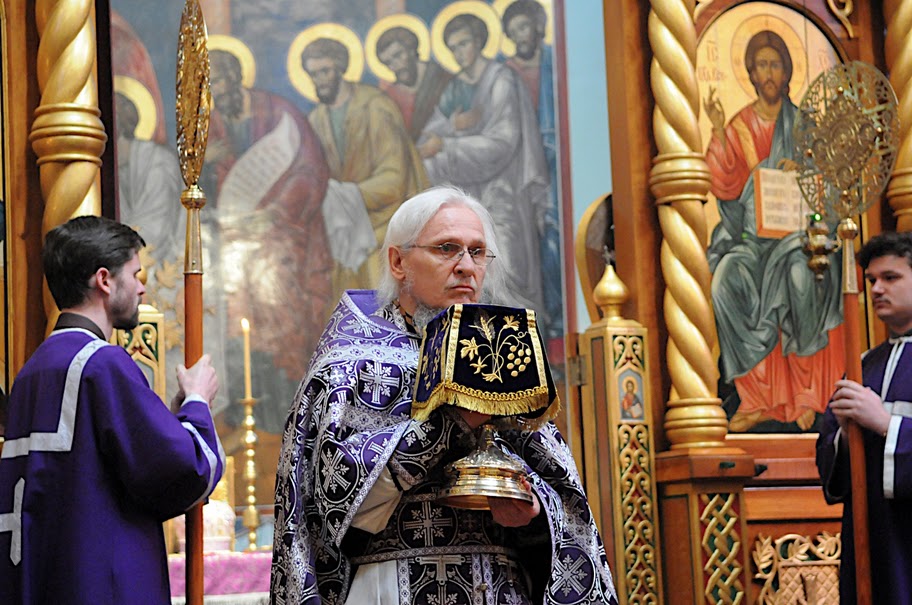
"That we may receive the King of All, invisibly
escorted by angelic hosts."
source: preachersinstitute.com
These various dialects teach the Christian to perceive the world in a divine language. Language, Noam Chomsky begrudgingly admits, is something for which human beings seem uniquely wired. Language creates learning, interaction, and introspection. The liturgy, in a very real way, makes all these things possible with the Holy Trinity. The liturgy of the Church, Alexander Schmemann taught, is the continued presence of the Lord in the world and in time. Laurence Hemming develops this idea and notes the medieval concept of the liturgy as the opus Dei, the work of God which man engages and shares. In prior times, the bells of monasteries and cathedrals signaled the various canonical hours and stages of the Mass in town. The liturgy was the pulse of the community, not a feature of it. Schmemann's interpretation of the entirety of the liturgy of the Church as Christ's continued presence is not verified by baroque and modern writers, but by the liturgy itself. In it, the Christian meets God as He is, not as He is imagined to be or desired. The understanding of God in the liturgy may be deepened or hallowed by previous generations, but the sensus cannot be changed. The literal encounter with God liturgically, but not exclusively in the Sacraments, finds confirmation in the oldest texts of the Church. On Holy Saturday the deacon, in the blessing of the Paschal candle, sings of "this night," not "a night we remember," as the night of the passage to salvation. Then the cynosures of pre-Incarnational salvation history are recounted by the lectors, the story of the fall of both Man and creation. Then, water, a symbol of creation and the fundamental element of creation itself, is blessed and made into the matter of our salvation in Christ, Who Himself first made it holy in creating it and then re-sanctified it by seeking St. John's baptism in the Jordan. He brought the world back into Himself in that act and segmented a new creation that the baptized join. So water is blessed and sprinkled on the faithful. Catechumens join that new creation in Baptism themselves. This transcends decoration around simple Sacraments of Baptism and Communion. Indeed, it is this liturgical context that those Sacraments make sense. The re-visitation of the divine mysteries continues in the morning with the Mass, "I am risen and am still with you." The Church uses the psalm in the present tense and does not adapt it to a commemorative tone. Similarly, the collect of Pascha refers to the Resurrection as having transpired hodierna. The Byzantine rite also speaks of the Resurrection as a current reality, singing countless times "Christ is risen from the dead...." On Holy Saturday, Pascha, and the other Sundays, ferial days, and feasts of the year, the faithful see the Trinity, the Sacraments, and the Saints as they really are and are united to heaven in the sacred rites, when God comes down from heaven and gives the Christian a glimpse above in a heavenly tongue.

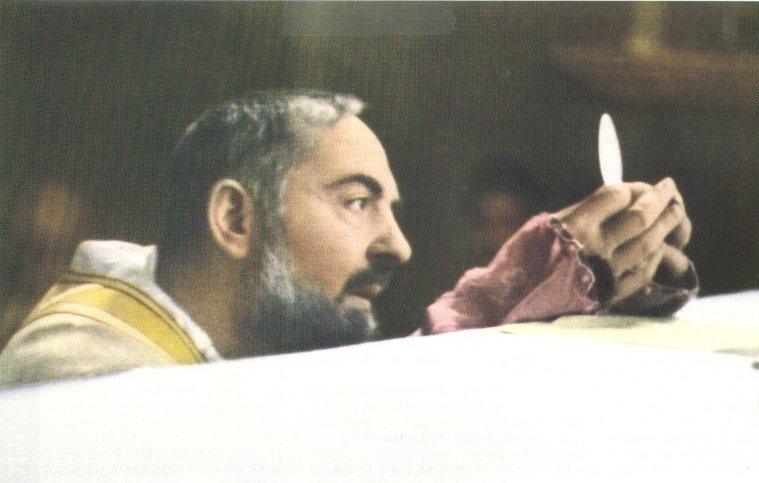
"All of Paradise is close to the altar when I celebrate Mass. The angels
attend my Mass in legions. The Virgin assists me."

To those who think this "high" interpretation inappropriate or misguided, the author poses the question: why consecrate a church? The objection to interpreting the liturgy as a very real thing which imbues the sensus fidelium by bringing the faithful to the sacred acts of Christ usually rests on the misguided belief that a religious act is either real or symbolic, but never both. Yet Baptism is both real and symbolic. It symbolizes creation, restoration, the eighth day, the Divine Adoption, and the cleansing of spiritual dirt. And still, it actually accomplishes all these things and incorporates a person into the Body of Christ, the Church. The Cathedral of Our Savior at the Lateran palace in Rome was the first church ever to be consecrated in the sense that churches are consecrated. It is not a Sacrament and the rejection of a high view of the liturgy would necessarily elicit one to interpret the actions as a series of exorcisms and drawn-out, pious actions of instruction. Does the church then become a house of God? Can there be such a thing as a house of God in a post-Mosaic Law Church without the authority of the Church to develop and deepen its tradition to allow for such an act of consecration? The Church does indeed symbolize the Temple of Jerusalem and the future New Jerusalem of heaven, but it is actually a very real house of God where, as in heaven, God lives and dwells and, for a few hours a week, acts. If the liturgy is anything less, then it is just bad literature.

The purpose of the liturgy, especially during the great periods of the year, is to unite the faithful to God so that they might know Him and save their souls. He gathers them to Himself and to His new Jerusalem, the Church, and to His Body, again, the Church. The belief and the sensus fidelium of the Church is diffused among the various rites and usages the Church enjoins and has practiced through out the ages. Christ's Body, the Church on earth, is much like His physical body when He was present among us in flesh in that it is organic and prone to growth. I recall years ago reading interviews with both a prominent sedevacantist and a priest of the FSSPX. Both were asked if a pope could create a new rite of Mass and both answered "In theory, yes, but the New Mas is bad, so we reject it." I think a more prudent reply excludes the possibility that the pope, or any bishop, can create a new liturgy or discard large portions of the old liturgy. Many of the additions to the Roman rite over the years—introductory rites in the Office, hymns, prayers before the altar, the offertory, the monastic choir ceremonies, the Eastern feasts imported etc—were just that, additions, neither replacements nor fabrications. If we concede this point, then we lose part of the sensus fidelium and instead embrace the inner-mind of some dodgy bishop. Worse yet, we lose the greater meaning of the mysteries and lessen the Sacraments, turning them into transmission channels for grace and nothing more. To retain the sensus fidelium and keep the faith, we ought to guard the liturgy of the Church with Davidic fortitude lest we embrace Christ as we want Him to be and not as He actually is.

My fellow Americans: Happy Thanksgiving. Fast tomorrow!

Saturday, March 22, 2014

Book Review: Worship as Revelation by Laurence Paul Hemming


Unfortunately I do not have the time to give this book a proper full length review, but I can provide some insight into the content and value of an excellent little volume by Dr Laurence Paul Hemming, a British academic and a deacon for the archdiocese of Westminster. 

Worship as Revelation begins with a commentary on the rites for the dedication of a new church, a new temple of God. The chapter, titled "I Saw the New Jerusalem," lays the groundwork for Hemming's concept of worship as an encounter with the Divine, a participation in the opus Dei. The central words to the rites often repeated, are "I saw." In the presence of the physical temple we see God and the holy things He has prepared for us. The prayers of the priest for the sins of the people make this place holy, as the prayers of the Aaronic priests sanctified the Temple of Jerusalem. The atoning offering within the church is not a new one, as were the offerings of calves in the old Temple, but a renewed one in a renewed world. The re-dedication of the Temple of Jerusalem following its desecration by Antiochus Epiphanes was celebrated for eight days, a prefigurement of Christ's resurrection and renewal of creation on the eighth day of the week, the beginning of the last era of the world. For this reason the dedication of a church is, or rather was, observed for an octave every year, as were over a dozen other feasts. Secondly, the temple or church is the bride of Christ and where the Bridegroom Christ appears. In doing so He bridges the things of heaven and the things of earth, as one of the Mattins antiphons for the feast of a dedication indicates.

Hemming, a scholar of philosophy, traces the loss of this understanding to a pattern of intellectual decadence originating in René Descartes, who although he recovered his Catholic faith after a brief intellectual crisis, made himself the focal point of existence. All he could know initially was that he existed, and from that he could deduce that God exists. Indeed, for Descartes the existence of God was more certain than the rules of mathematics, but the relationship between God and man was still inverted in this schematic. Hemming hardly pins the burden of problems in liturgical theology on Descartes, but does indicate that the tendency to view God from one's own perspective rather than how He actually is might originate in his line of thought.

To the modern mind a man is what he does. To the Christian mind what a man is sets what he does. A Christian, by virtue of his Baptism, is a participant in the liturgy, in the opus Dei. The 19th century debate in philosophy and politics over the identity of modern man, his new needs, and his sense of judgment traced similar shapes of thought in the Liturgical Movement and its unhealthy obsession with the "pastoral." Lost in all of this was a concept of who the Christian is rather than what he supposedly needs.  In such an inverted order of perspective the liturgy is of man, for man, and about God rather of God, for God, and to the benefit of man.

For such a small book Worship as Revelation covers immense philosophical material related to the liturgy, particularly ideas about time and why the Papal stational churches of Lent paralleled Christ's own path to Jerusalem. Another interesting discussion concerning time is the proper translation of the Greek prologue of St. John's Gospel, which would read something to the effect of "Before all time was  and still is the Word...."

Near the end Hemming reflects on the consequence of privatizing the liturgy, of making mandatory spoken recitation of the breviary for example, often with the unintended consequence of making rarer celebrations of the Office in the temple of God, the church. Even more damaging is the constant change in the Roman rite, change which more often than not erased ancient meanings of gestures and prayers. Hemming finds that the violence against the Roman rite began not with Vatican II, but with Pius X's assault on the psalter and kalendar: "the alterations to the breviary exhibited.... an objectification of the liturgy as a whole—something subject to papal fiat" (143). And while grateful to an extent for Summorum Pontificum Hemming approaches the "hermeneutic of continuity" with a healthy skepticism based on scholarship of the liturgical language used in older and newer editions of the Roman Missal. Indeed, Hemming rightly argues for a wholesale return to the liturgy without any of the 20th century reforms (154). A recovery of proper worship and a more fundamentally liturgical outlook in the Catholic Church would mean discarding the Cartesian objectification of things sacred outside of the self and embracing the encounter and experience (in an orthodox sense) of God in time, of entering into God, from Whom we as Christians gain our identity, rather than going in and out of the Divine at our own wills.

Worship as Revelation concludes in a brief study of the liturgical cycle of Epiphany and Candlemas, the period during which Christ appeared to gentiles, took possession of the rule of the world, was worshipped in adoration by those to whom He had appeared, revealed the mystery of water and wine, confirmed His priesthood according to the line of Melchizedek, commemorated His heavenly birth by being baptized by the Forerunner in the Jordan, and took His place in the Temple before the illuminating figure of His Virgin mother—who would symbolize in her ritual action what Jerusalem could become in her Son. 

I strongly recommend this book for those who wish to approach liturgy from a philosophical perspective and would like to define in more specific terms the suppositions of men like Aidan Kavanagh. The gradual accretion of concepts means one must read this book in order of chapter rather than skipping around from chapter to chapter as one can do in some other more disparate books. It is written in a readable way, without long and turgid quotes. The author's perspective is not quite as fresh as Kavanagh's or Schmemann's, but Hemming's contribution is in giving a well defined Latin shape to their general liturgical views. Get a copy!