Showing posts with label St. Vincent of Lerins. Show all posts

Thursday, November 27, 2014

Liturgy & Tradition: Sensus Fidelium


"When the Church is self-referential, inadvertently, she believes she has her own light," Cardinal Bergoglio said to the College of Cardinals before the Conclave that elevated him to the Petrine See. Bergoglio's message continued the engagement with existential modernity begun by other dubious figures like Henri de Lubac, Karl Rahner, and Rudolf Steiner decades earlier, but this isolated statement reveals a rare moment of clarity from the modern Roman See. When the Church is self-referential, she disables herself from spreading the Gospel because she does not know what she is or what she does. 

Such is the contemporary state of the Roman liturgy. Many readers have asked over the last two years what the point of the liturgy is. They are being cynical. The question carries the utmost gravity. Is it a divinely imparted ritual with its own powers? Is it a set of didactic actions that ornament the more important mechanical acts of transmitting grace? What is it? If we do not know what the liturgy is, then we are truly lost. The liturgy, in my own private opinion, is the sensus fidelium of the Church expressed according to separate, non-contradicting traditions and lived out in the Church universal. There is no citation for this definition in an ecumenical council—nor is there a definition of the Resurrection. Previous generations needed no definitions or binding statements to understand the relationship between the liturgy and the faith. If they believed it, they prayed it. They did not leave what they believed out of their worship, nor did they believe in novelties unfounded in the traditions of the Church. Liturgy does not merely teach belief and transmit grace. It revives and renews the sacred mysteries of Christ in time for the faithful. In doing so, one encounters Christ, the angels and saints, and glimpses into the greater spiritual reality of the Lord while remaining on earth, blurring the lines which separate the eternal and the temporal. One leaves the liturgy and the "mystical supper" of Christ not only having learned what to believe, but also how to believe when he returns to the world outside the temple.

Christ taught simply. His teachings tell the listener as much about how to engage Him as much as they do what to think of Him. Chesterton wrote that when he first read the Gospel, contrary to everything he was told about a kind rabbi divinized by his followers, Jesus spoke authoritatively as God. As God, He commanded love, fidelity, and trust in Him as well as care and attention towards one's neighbor. Above all, He taught the forgiveness of sins and the metanoia of the sinner. The last part concerns us. How does one orient one's self to God and away from sin? How does one see the world and God as He wishes? In conjunction with being the setting for the Sacraments, where the Holy Spirit acts and makes the work of Christ immediately accessible to the believer, the liturgy shows us this. It only makes sense. When a friend asks about the Catholic faith, one does not give him a catechism. One takes him to Mass or the Divine Liturgy.

"I have passed on to you what I have received," St. Paul wrote to the Church in Corinth some time in the 50s, merely a generation after the Passion of the Lord. The Apostle to the Gentiles passed on to the Corinthians both the tradition of the Lord's work and the tradition of what He commanded His followers to do. The two were inseparable. Belief and the primitive liturgy were received by believers simultaneously. They did not remain static, however. Passing on something does not preclude its development, its clearer enunciation, its deepening. Chapter 23 of St. Vincent of Lerins' Commonitorium applies to the liturgy as much as to doctrine:

"But some one will say, perhaps, Shall there, then, be no progress in Christ's Church? Certainly; all possible progress. For what being is there, so envious of men, so full of hatred to God, who would seek to forbid it? Yet on condition that it be real progress, not alteration of the faith. For progress requires that the subject be enlarged in itself, alteration, that it be transformed into something else. The intelligence, then, the knowledge, the wisdom, as well of individuals as of all, as well of one man as of the whole Church, ought, in the course of ages and centuries, to increase and make much and vigorous progress; but yet only in its own kind; that is to say, in the same doctrine, in the same sense, and in the same meaning."

Local churches developed their liturgical rites around their own settings, needs, and cultural tendencies. The Roman rite is, to say the least, highly efficient. More so than the Eastern rites, replete with hymns and elaborate gestures, the Roman rite uses the words of Holy Writ as its almost exclusive textual basis for the propers and many of the prayers, reflective of the Roman legal tradition's emphasis on the binding power of authoritative words. The more philosophical Greeks had a mystical and excessive liturgy consonant with its philosophical tradition. And the various far Eastern rites too reveal their origins. The Roman Patriarchate tolerated variation more than any other patriarchate until Trent, permitting, often begrudgingly, "dialects" of the Roman rite like the French, English, and Portuguese uses as well as further departures like Toledo, Milan, and L'Aquila. The multiplicity of uses in the Latin Church multiplied the spiritual wealth of the Western Church and gave her saints and thinkers recognized across national borders. Uses were often suppressed, but local variety was accepted as the norm with Rome as the original, the standard, the canon. One can trim the branches of a tree, but not the trunk.
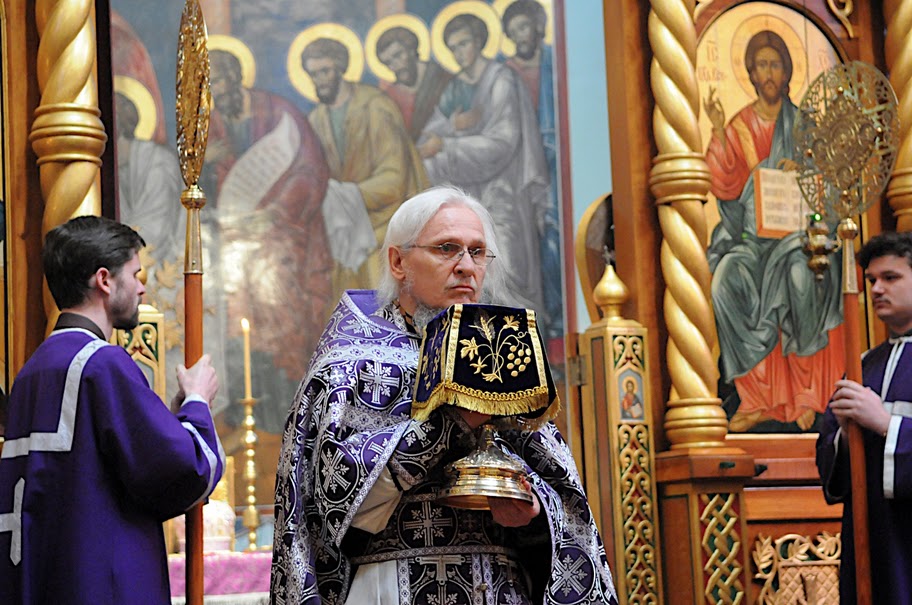
"That we may receive the King of All, invisibly
escorted by angelic hosts."
source: preachersinstitute.com
These various dialects teach the Christian to perceive the world in a divine language. Language, Noam Chomsky begrudgingly admits, is something for which human beings seem uniquely wired. Language creates learning, interaction, and introspection. The liturgy, in a very real way, makes all these things possible with the Holy Trinity. The liturgy of the Church, Alexander Schmemann taught, is the continued presence of the Lord in the world and in time. Laurence Hemming develops this idea and notes the medieval concept of the liturgy as the opus Dei, the work of God which man engages and shares. In prior times, the bells of monasteries and cathedrals signaled the various canonical hours and stages of the Mass in town. The liturgy was the pulse of the community, not a feature of it. Schmemann's interpretation of the entirety of the liturgy of the Church as Christ's continued presence is not verified by baroque and modern writers, but by the liturgy itself. In it, the Christian meets God as He is, not as He is imagined to be or desired. The understanding of God in the liturgy may be deepened or hallowed by previous generations, but the sensus cannot be changed. The literal encounter with God liturgically, but not exclusively in the Sacraments, finds confirmation in the oldest texts of the Church. On Holy Saturday the deacon, in the blessing of the Paschal candle, sings of "this night," not "a night we remember," as the night of the passage to salvation. Then the cynosures of pre-Incarnational salvation history are recounted by the lectors, the story of the fall of both Man and creation. Then, water, a symbol of creation and the fundamental element of creation itself, is blessed and made into the matter of our salvation in Christ, Who Himself first made it holy in creating it and then re-sanctified it by seeking St. John's baptism in the Jordan. He brought the world back into Himself in that act and segmented a new creation that the baptized join. So water is blessed and sprinkled on the faithful. Catechumens join that new creation in Baptism themselves. This transcends decoration around simple Sacraments of Baptism and Communion. Indeed, it is this liturgical context that those Sacraments make sense. The re-visitation of the divine mysteries continues in the morning with the Mass, "I am risen and am still with you." The Church uses the psalm in the present tense and does not adapt it to a commemorative tone. Similarly, the collect of Pascha refers to the Resurrection as having transpired hodierna. The Byzantine rite also speaks of the Resurrection as a current reality, singing countless times "Christ is risen from the dead...." On Holy Saturday, Pascha, and the other Sundays, ferial days, and feasts of the year, the faithful see the Trinity, the Sacraments, and the Saints as they really are and are united to heaven in the sacred rites, when God comes down from heaven and gives the Christian a glimpse above in a heavenly tongue.

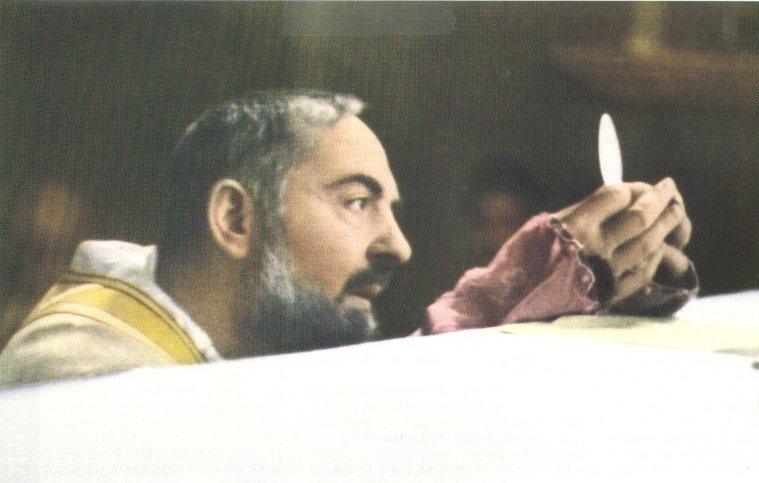
"All of Paradise is close to the altar when I celebrate Mass. The angels
attend my Mass in legions. The Virgin assists me."

To those who think this "high" interpretation inappropriate or misguided, the author poses the question: why consecrate a church? The objection to interpreting the liturgy as a very real thing which imbues the sensus fidelium by bringing the faithful to the sacred acts of Christ usually rests on the misguided belief that a religious act is either real or symbolic, but never both. Yet Baptism is both real and symbolic. It symbolizes creation, restoration, the eighth day, the Divine Adoption, and the cleansing of spiritual dirt. And still, it actually accomplishes all these things and incorporates a person into the Body of Christ, the Church. The Cathedral of Our Savior at the Lateran palace in Rome was the first church ever to be consecrated in the sense that churches are consecrated. It is not a Sacrament and the rejection of a high view of the liturgy would necessarily elicit one to interpret the actions as a series of exorcisms and drawn-out, pious actions of instruction. Does the church then become a house of God? Can there be such a thing as a house of God in a post-Mosaic Law Church without the authority of the Church to develop and deepen its tradition to allow for such an act of consecration? The Church does indeed symbolize the Temple of Jerusalem and the future New Jerusalem of heaven, but it is actually a very real house of God where, as in heaven, God lives and dwells and, for a few hours a week, acts. If the liturgy is anything less, then it is just bad literature.

The purpose of the liturgy, especially during the great periods of the year, is to unite the faithful to God so that they might know Him and save their souls. He gathers them to Himself and to His new Jerusalem, the Church, and to His Body, again, the Church. The belief and the sensus fidelium of the Church is diffused among the various rites and usages the Church enjoins and has practiced through out the ages. Christ's Body, the Church on earth, is much like His physical body when He was present among us in flesh in that it is organic and prone to growth. I recall years ago reading interviews with both a prominent sedevacantist and a priest of the FSSPX. Both were asked if a pope could create a new rite of Mass and both answered "In theory, yes, but the New Mas is bad, so we reject it." I think a more prudent reply excludes the possibility that the pope, or any bishop, can create a new liturgy or discard large portions of the old liturgy. Many of the additions to the Roman rite over the years—introductory rites in the Office, hymns, prayers before the altar, the offertory, the monastic choir ceremonies, the Eastern feasts imported etc—were just that, additions, neither replacements nor fabrications. If we concede this point, then we lose part of the sensus fidelium and instead embrace the inner-mind of some dodgy bishop. Worse yet, we lose the greater meaning of the mysteries and lessen the Sacraments, turning them into transmission channels for grace and nothing more. To retain the sensus fidelium and keep the faith, we ought to guard the liturgy of the Church with Davidic fortitude lest we embrace Christ as we want Him to be and not as He actually is.

My fellow Americans: Happy Thanksgiving. Fast tomorrow!

Wednesday, February 26, 2014

Lesser Known Fathers VIII: St. Vincent of Lerins & the Importance of Antiquity


Precious little do we know about St. Vincent of Lerins. Many biographies of the Saint muse, rightly, that if not for his surviving work, the Commonitory, none would remember him. Writing in early fifth century Gaul St. Vincent seeks to "commit to writing such things as I have faithfully received them from the holy fathers." In St. Vincent's time "holy father" did not mean the Pope in Rome, but one's immediate spiritual father, the person who taught one the faith, which prompts Vincent to emphasize that he received things from them with fidelity.

If one receives something, another must pass it. The Latin word for "to pass" is tradere, which gives us our word "tradition." Tradition and antiquity make the faith trustworthy. Far from being corruptions, antiquity places belief nigh its source, with the Apostles and ultimately Our Lord Himself. Given St. Vincent's era, when even Our Lord's divinity was in question, the author of the Commonitory held tradition in the highest esteem. Vincent derives a test for examining the novel doctrines of his own time and ours:
"Moreover, in the Catholic Church itself, all possible care must be taken, that we hold that faith which has been believed everywhere, always, by all. For that is truly and in the strictest sense Catholic, which, as the name itself and the reason of the thing declare, comprehends all universally. This rule we shall observe if we follow universality, antiquity, consent." (Chapter III)
As an example St. Vincent adduces the case of the re-baptism of heretics so common in earlier centuries. Agrippinus and St. Cyprian of Carthage insisted on the re-baptism of those who had fallen from the faith, either by heresy or, most often, by apostasy under the threat of death. They had visibly left the Body of Christ. Did they require another baptism to re-admit them? Logic may say yes, but tradition said no. St. Stephen, "prelate of the Apostolic See," condemned the novel practice as a deviation from what had been handed to the Church by the holy fathers.

We must be vigilant of any deviation from the Gospel of Christ as the Church has received it. Vincent quotes St. Paul: "As we said before, so now I say again: If any one preach to you a gospel, besides that which you have received, let him be anathema" (Galatians 1:9). St. Paul did not intend to isolate this warning to the Galatians. This danger shadows over all men of great intellect in danger of falling victim to their minds, as did Origen. It hovers over those of ego and greed, like Nestorius and Donatus, who leveraged their novel doctrines to gain clout in the political sphere.

Why, then, if it is Divine Law, does God permit heretics to run about the Church so freely? Contemporary Catholics, particularly those of a more traditional persuasion, have asked this question unrelentingly for decades. St. Vincent asked the same question fifteen centuries earlier and surmised that, as was the case with Moses in the Desert, God permits conveyors of novelty to demonstrate their prophecies, their ideas, and their concepts before the Church so that the Church may in time pass judgment upon them. Vincent of course presumes that these innovations end in chaos and disorder. Without exception, history has proven him correct.

Vincent then condemns the wickedness of Nestorius, Apollinarius, and Donatus for twisting the Scriptures, the Word of God, and using them to inculcate strange ideas disconnected from the received wisdom of the Church concerning the nature of Jesus. He defends the Trinity against the blasphemous concept that Christ only acted as a Savior and suffered Crucifixion, asking how would sins be forgiven through the supplication of a feigned act? No, the supplication must be performed by an actual person with both human and divine nature.

However, one condemnation clearly troubles St. Vincent, that of Origen. With Origen came Christian philosophy and what people now call theology. The same Vincent who condemns Origen in the same chapter asks, "Who would not rather be wrong with Origen than right with anyone else?" Origen, whose intellectual lineage includes many great saints, drew the just ire of the first millennium Church because of one remarkably wrong idea: that the soul pre-exists the body. In Origen's system of thought God creates the soul before the body and at the end of time will revive and save all souls, including that of the Devil and his fallen angels. While many saints believed in a refashioning and renewal of creation and many believe(d) in universal salvation, Origen somehow managed to create the most demented combination of the two. The Alexandrian was not without learning. None were more learned. Yet Origen was still a man with a mortal mind, a mind which subordinated part of God's revelation in favor of his own private philosophy:
Hence it came to pass, that this Origen, such and so great as he was, wantonly abusing the grace of God, rashly following the bent of his own genius, and placing overmuch confidence in himself, making light account of the ancient simplicity of the Christian religion, presuming that he knew more than all the world besides, despising the traditions of the Church and the determinations of the ancients, and interpreting certain passages of Scripture in a novel way, deserved for himself the warning given to the Church of God, as applicable in his case as in that of others, If there arise a prophet in the midst of you,... you shall not hearken to the words of that prophet,...because the Lord your God does make trial of you, whether you love Him or not.
The errors of men like Origen and Nestorius then, or Rahner and Kung today, are trials for the Catholic Church and for its faithful. For this trial St. Vincent creates a test, revealed early in the Commonitory, for examining new ideas in Christianity: for something to be Catholic is must be "believed always, everywhere, and by everybody." In other words, there was never a time when the faithful did not, in some way, believe in a doctrine. What of schism then? The Church has endured many schisms over the centuries since the deaths of the Apostles. Is the Church split then? Does she now hold multiple variations of a doctrine? Not so, says St. Vincent. Once a part of the body tears itself off, it is no longer a member or limb and the Church is better for it.

In Chapter 23 St. Vincent writes the most enduring lines in the entire Commonitory, words raised to even greater stature by the First Vatican Council:
"But some one will say, perhaps, Shall there, then, be no progress in Christ's Church? Certainly; all possible progress. For what being is there, so envious of men, so full of hatred to God, who would seek to forbid it? Yet on condition that it be real progress, not alteration of the faith. For progress requires that the subject be enlarged in itself, alteration, that it be transformed into something else. The intelligence, then, the knowledge, the wisdom, as well of individuals as of all, as well of one man as of the whole Church, ought, in the course of ages and centuries, to increase and make much and vigorous progress; but yet only in its own kind; that is to say, in the same doctrine, in the same sense, and in the same meaning."
In short, if it ain't like your Mama's catechism don't listen to it!

St. Vincent concludes in re-iterating his criteria for the heart and mind of the Church: antiquity, universality, and consent. If a new idea barren of ancient origin and in conflict with the universal opinion of the ancient Church should arise then it is to be consigned to the dustbin without hesitation. Let your criteria be the same!

Aside: I used this edition of the Commonitory because I cannot stand to read regular text on an internet page. I need at least the semblance of a book a pdf provides. The introduction, interesting for its historical context, is a neurotic bit of mid-19th century Anglicanism. At the time many Anglicans were presenting their community as the via media between the "Roman" Church and "protestantism," understandably drawing attention from the hierarchy, who were surprised to find themselves no longer protestants. There are epigraphs from Thomas Cranmer and a passage from John Jebb of Limerick, condemning the "Romish" and "Popish" errors to have crept into Catholicism since the 5th century. I suspect that the purpose of these quotations are to convince less "high" Anglicans that a saint could indeed be safe reading and that Vincent was not solely the domain of "Roman" Catholicism. For those of you who fancy 19th century Anglophonic religious history, take a peak!

Wednesday, January 15, 2014

Return of the Rad Trad & the Takeover of St. Nicolas du Chardonnet

The Rad Trad has decided, after some rumination and reflection on personal matters, to resume activity on this blog and run it more or less as it was prior to sabbatical.

This blog has been something of a challenge for me in the last year, compelling me to explore less obvious facets of our faith and to share them in a refreshing manner, offering, hopefully, something different than the conventional Catholic blog fare. Currently I am preparing to move from New Hampshire to Dallas, TX, but will try to wrap up the series on the Parisian rite and to write an entry on St. Vincent of Lerins for the Lesser Known Fathers series.

Oddly, readership boomed after my resignation. December became the most viewed month in the history of this blog despite the dearth of posts after December 19th. My amalgamation of thoughts on sedevacantism is now the most viewed post among the 250 I have published here, possibly because there is so little discussion of the matter outside of sedevacantist communities (I myself have never met a sedevacantist, only former sedevacantists). My post quitting the blog is also the fourth most viewed entry ever here.

Currently on my desk is a much-neglected, historically interesting book essential to anyone who wants a first hand account of the mid-20th century fallout in Rome, From Rome Urgently by Mary Martinez. From Rome Urgently is certainly a rarity, self-published in 1979, just after the election of the second Pope John Paul. Its limited print means that acquiring a copy is an expensive enterprise. The cheapest copy for this short paperback on Abebooks.com is $67; for Amazon quadruple that figure. The book is a compilation of articles Ms. Martinez wrote for various publications during the 1970s. Trained as a piano teacher in Ohio she somehow managed to find herself an accredited member of the Vatican press corps in 1973. She wrote for the Wanderer, the Remnant, the Angelus, and National Review (where her editor was the fantastical Malachi Martin, her dislike for his agenda is quite apparent in her writings). Chapter two of From Rome Urgently recounts, in great detail, the takeover of St. Nicolas du Chardonnet in Paris, the most famous traditional church in France.

In 1977 the Second Vatican Council was news twelve years old, Pope Paul had one year to live—as did Patriarch Luciani of Venice, the completely reformed liturgy had been in place for eight years, Marcel Lefebvre had declared himself publicly and incurred suspension, and a loner poet and prelate had been celebrating Mass in an older form for a large group of Parisians for the better part of the last decade. Enter Msgr. Francois Ducaud-Bourget, a priest who ran the chaplaincy at Laennec hospital in Paris and wrote small volumes of poetry, which he published in Matines out of his small apartment.

In 1970 Ducaud-Bourget continued to celebrate Mass in an older form (1962?) under the archdiocese of Paris' radar, given his minute assignment. A few weeks after the introduction of the Pauline Mass (in November 1969) the priest's hospital Masses drew 100 people. By summer over 500 assisted at his Mass. By 1975 over 1,500  attended his Masses. The hospital, understandably miffed at the overuse of space, compelled the monsignor to seek other venues. Ducaud-Bourget sought an assistant, Fr. Serralda of Spain, to take some of the crowd, but this solution was not satisfactory. Eventually the Ukrainian Catholic parish in Paris gave Ducaud-Bourget permission to hold Mass one Sunday per month within their facilities, the rest of the Masses being celebrated in rented venues. At Salle Wagram, also the setting for Last Tango in Paris, the crowd doubled to 3,000, thanks in no small part to Francois Cardinal Marty's warning to the faithful that they ought not attend Latin Masses in the diocesan bulletin (the Cardinal lamented a 26% decline in Mass attendance in the same missive).

Back in 1970 when Ducaud-Bourget witnessed an increase in attendance at his Masses the prelate asked Archbishop Lefebvre, who himself had recently obtained canonical permission to begin a seminary in Econe, what to do. Lefebvre responded, "Well, then take a church." On February 27th, 1977 he would.

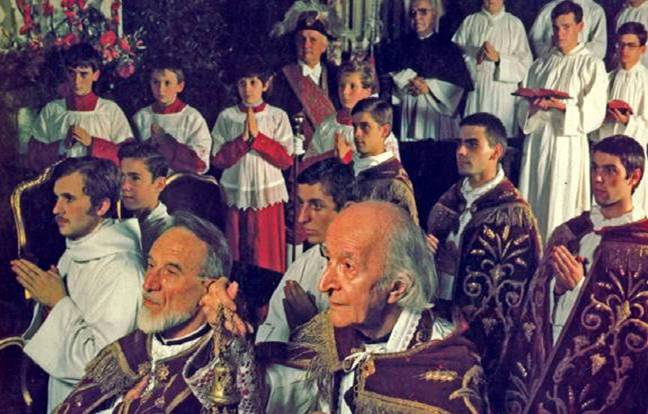
Ducaud-Bourget and his company rented an auditorium from an insurance company located across the street from the parish of St. Nicolas du Chardonnet, a respectably sized 17th century baroque structure on the Left Bank. A concelebrated Sunday Mass in the Pauline rite, in the presence of forty parishioners, had reached its conclusion and the pastor, Fr. Pierre Bellego, was announcing a further reduction in the Mass schedule. Suddenly an enormous procession entered the rear of the church, headed by a gold crucifix and replete with a Gregorian chant choir. Ducaud-Bourget walked in the procession, ahead of three other clerics vested as subdeacon, deacon, and priest. A few men quickly moved the table altar out of the way and prepared the neglected main altar. Then, in front of a dazed congregation and a befuddled pastor solemn high Mass was celebrated. Fr. Bellego notified the authorities, who could not violate the sanctuary status of the church or interrupt the services (Mass was arranged to continue throughout the day). Laymen volunteered to eat and sleep within St. Nicolas in order to keep the building occupied. The power company turned off the juice, leaving the squatters in darkness for several days. The parishioners, a small collective of left-wing youth devoted to Fr. Bellego, attempted to expel Ducaud-Bourget's coterie to no avail. After three days the situation appeared to be at an impasse.

Francois Cardinal Marty
On March 1st the archbishop of Paris, Francois Cardinal Marty, decided to stand by his priest, who although a pastor actually lived at another parish in his cluster. Marty accused the occupiers of "[attempting] to suffocate the Gospel" in his denunciation of the takeover. Still, Marty did not press the matter too hard with the French civil authorities. 

Such a strange series of events really could only transpire in France. In 1905 the French state decided that it, and not the Church, owned Church property, including parishes, schools, and hospitals. The state became irate when, after passing these aggressively anti-Catholic laws, the Church refused to staff—at her own expensive—schools and hospitals she did not own. Over 40% of the schools and hospitals in France closed. More relevant to this bit of history is the ownership of churches. The Catholic Church only owns churches built after 1905 and resides in churches built prior to that year. The Church basically owns the sanctuary, but nothing more. Most older French churches have two organs, an enormous one in the rear and a small one in the sanctuary. The small one is used for most Masses because use of the large one means a fee (as an aside, I was disgusted to find the chairs at Notre Dame cathedral turned away from the altar and towards the organ for the evening's concert three years back).

Because the state owns the churches and the Church merely resides in the edifices she built and maintained, the state saw the occupation of St. Nicolas du Chardonnet as an internal Church squabble rather than as a property dispute. Msgr. Lefebvre's inability to grasp the difference costed his Society dearly when the sedevacantists swiped his American holdings in 1983. Finally, Cardinal Marty filed a court order which would obtain the assistance of a policeman in escorting the invaders from the premises. Should the occupants not leave armed assistance would have come. Somehow the court order came to the desk of Interior Minister Michel Poniatowski, who never released the document for enforcement. 

This curious and fascinating story came to an end in 1984 when Msgr. Ducaud-Bourget died and possession of St. Nicolas du Chardonnet passed onto Lefebvre and his Society of St. Pius X, who still occupy the building. St. Nicolas is one of the more liturgically competent churches following an older form of the Roman rite. Their Corpus Christi processions are positively stunning. In Paris, where cavernous medieval and baroque churches are each frequented by a hundred or so Catholics on Sunday and rot in squalid physical decline, St. Nicolas is somehow full to the brim, getting far better attendance than the other Masses celebrated under the auspices of Summorum Pontificum. Perhaps the church's association with the Integrist (French monarchism) cause sways attendance in its favor. Irrespective of one's opinion concerning French politics or the Society of St. Pius X, the remarkable religious and legal story of what happened at St. Nicolas du Chardonnet in 1977 will remain worthy of retelling for quite some time.