"When the Church is self-referential, inadvertently, she believes she has her own light," Cardinal Bergoglio said to the College of Cardinals before the Conclave that elevated him to the Petrine See. Bergoglio's message continued the engagement with existential modernity begun by other dubious figures like Henri de Lubac, Karl Rahner, and Rudolf Steiner decades earlier, but this isolated statement reveals a rare moment of clarity from the modern Roman See. When the Church is self-referential, she disables herself from spreading the Gospel because she does not know what she is or what she does.
Such is the contemporary state of the Roman liturgy. Many readers have asked over the last two years what the point of the liturgy is. They are being cynical. The question carries the utmost gravity. Is it a divinely imparted ritual with its own powers? Is it a set of didactic actions that ornament the more important mechanical acts of transmitting grace? What is it? If we do not know what the liturgy is, then we are truly lost. The liturgy, in my own private opinion, is the sensus fidelium of the Church expressed according to separate, non-contradicting traditions and lived out in the Church universal. There is no citation for this definition in an ecumenical council—nor is there a definition of the Resurrection. Previous generations needed no definitions or binding statements to understand the relationship between the liturgy and the faith. If they believed it, they prayed it. They did not leave what they believed out of their worship, nor did they believe in novelties unfounded in the traditions of the Church. Liturgy does not merely teach belief and transmit grace. It revives and renews the sacred mysteries of Christ in time for the faithful. In doing so, one encounters Christ, the angels and saints, and glimpses into the greater spiritual reality of the Lord while remaining on earth, blurring the lines which separate the eternal and the temporal. One leaves the liturgy and the "mystical supper" of Christ not only having learned what to believe, but also how to believe when he returns to the world outside the temple.
Christ taught simply. His teachings tell the listener as much about how to engage Him as much as they do what to think of Him. Chesterton wrote that when he first read the Gospel, contrary to everything he was told about a kind rabbi divinized by his followers, Jesus spoke authoritatively as God. As God, He commanded love, fidelity, and trust in Him as well as care and attention towards one's neighbor. Above all, He taught the forgiveness of sins and the metanoia of the sinner. The last part concerns us. How does one orient one's self to God and away from sin? How does one see the world and God as He wishes? In conjunction with being the setting for the Sacraments, where the Holy Spirit acts and makes the work of Christ immediately accessible to the believer, the liturgy shows us this. It only makes sense. When a friend asks about the Catholic faith, one does not give him a catechism. One takes him to Mass or the Divine Liturgy.
"I have passed on to you what I have received," St. Paul wrote to the Church in Corinth some time in the 50s, merely a generation after the Passion of the Lord. The Apostle to the Gentiles passed on to the Corinthians both the tradition of the Lord's work and the tradition of what He commanded His followers to do. The two were inseparable. Belief and the primitive liturgy were received by believers simultaneously. They did not remain static, however. Passing on something does not preclude its development, its clearer enunciation, its deepening. Chapter 23 of St. Vincent of Lerins'
Commonitorium applies to the liturgy as much as to doctrine:
"But some one will say, perhaps, Shall there, then, be no progress in Christ's Church? Certainly; all possible progress. For what being is there, so envious of men, so full of hatred to God, who would seek to forbid it? Yet on condition that it be real progress, not alteration of the faith. For progress requires that the subject be enlarged in itself, alteration, that it be transformed into something else. The intelligence, then, the knowledge, the wisdom, as well of individuals as of all, as well of one man as of the whole Church, ought, in the course of ages and centuries, to increase and make much and vigorous progress; but yet only in its own kind; that is to say, in the same doctrine, in the same sense, and in the same meaning."
Local churches developed their liturgical rites around their own settings, needs, and cultural tendencies. The Roman rite is, to say the least, highly efficient. More so than the Eastern rites, replete with hymns and elaborate gestures, the Roman rite uses the words of Holy Writ as its almost exclusive textual basis for the propers and many of the prayers, reflective of the Roman legal tradition's emphasis on the binding power of authoritative words. The more philosophical Greeks had a mystical and excessive liturgy consonant with its philosophical tradition. And the various far Eastern rites too reveal their origins. The Roman Patriarchate tolerated variation more than any other patriarchate until Trent, permitting, often begrudgingly, "dialects" of the Roman rite like the French, English, and Portuguese uses as well as further departures like Toledo, Milan, and L'Aquila. The multiplicity of uses in the Latin Church multiplied the spiritual wealth of the Western Church and gave her saints and thinkers recognized across national borders. Uses were often suppressed, but local variety was accepted as the norm with Rome as the original, the standard, the canon. One can trim the branches of a tree, but not the trunk.
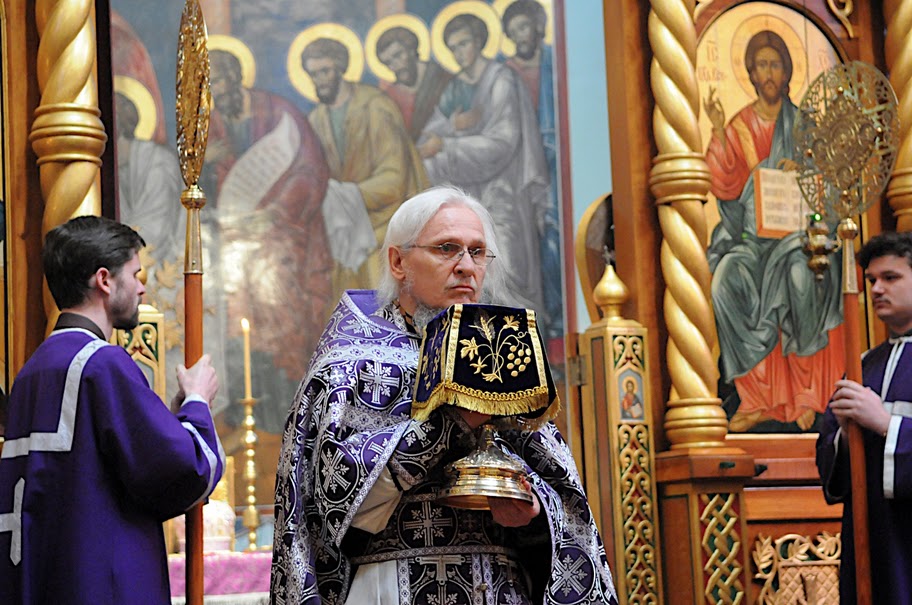 |
"That we may receive the King of All, invisibly
escorted by angelic hosts."
source: preachersinstitute.com |
These various dialects teach the Christian to perceive the world in a divine language. Language, Noam Chomsky begrudgingly admits, is something for which human beings seem uniquely wired. Language creates learning, interaction, and introspection. The liturgy, in a very real way, makes all these things possible with the Holy Trinity. The liturgy of the Church, Alexander Schmemann taught, is the continued presence of the Lord in the world and in time. Laurence Hemming develops this idea and notes the medieval concept of the
liturgy as the
opus Dei, the work of God which man engages and shares. In prior times, the bells of monasteries and cathedrals signaled the various canonical hours and stages of the Mass in town. The liturgy was the pulse of the community, not a feature of it. Schmemann's interpretation of the entirety of the liturgy of the Church as Christ's continued presence is not verified by baroque and modern writers, but by the liturgy itself. In it, the Christian meets God as He is, not as He is imagined to be or desired. The understanding of God in the liturgy may be deepened or hallowed by previous generations, but the
sensus cannot be changed. The literal encounter with God liturgically, but not exclusively in the Sacraments, finds confirmation in the oldest texts of the Church. On Holy Saturday the deacon, in the blessing of the Paschal candle, sings of "this night," not "a night we remember," as the night of the passage to salvation. Then the cynosures of pre-Incarnational salvation history are recounted by the lectors, the story of the fall of both Man and creation. Then, water, a symbol of creation and the fundamental element of creation itself, is blessed and made into the matter of our salvation in Christ, Who Himself first made it holy in creating it and then re-sanctified it by seeking St. John's baptism in the Jordan. He brought the world back into Himself in that act and segmented a new creation that the baptized join. So water is blessed and sprinkled on the faithful. Catechumens join that new creation in Baptism themselves. This transcends decoration around simple Sacraments of Baptism and Communion. Indeed, it is this liturgical context that those Sacraments make sense. The re-visitation of the divine mysteries continues in the morning with the Mass, "I am risen and am still with you." The Church uses the psalm in the present tense and does not adapt it to a commemorative tone. Similarly, the collect of Pascha refers to the Resurrection as having transpired
hodierna. The Byzantine rite also speaks of the Resurrection as a current reality, singing countless times "Christ
is risen from the dead...." On Holy Saturday, Pascha, and the other Sundays, ferial days, and feasts of the year, the faithful see the Trinity, the Sacraments, and the Saints as they really are and are united to heaven in the sacred rites, when God comes down from heaven and gives the Christian a glimpse above in a heavenly tongue.
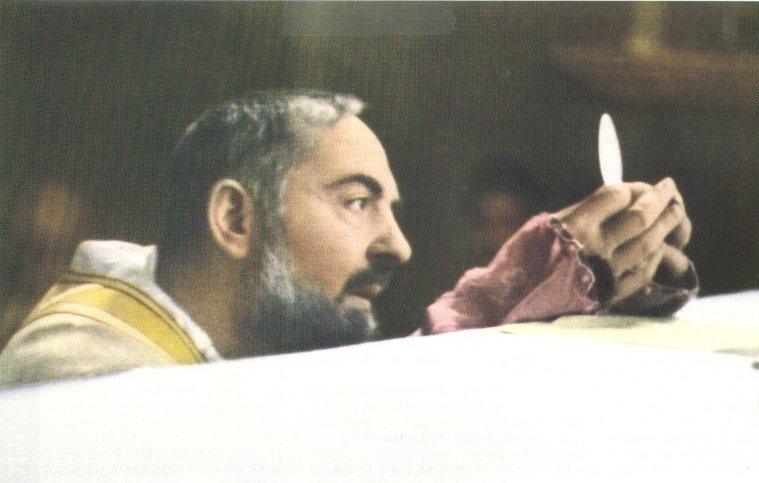 |
"All of Paradise is close to the altar when I celebrate Mass. The angels
attend my Mass in legions. The Virgin assists me." |
To those who think this "high" interpretation inappropriate or misguided, the author poses the question: why consecrate a church? The objection to interpreting the liturgy as a very real thing which imbues the
sensus fidelium by bringing the faithful to the sacred acts of Christ usually rests on the misguided belief that a religious act is either real or symbolic, but never both. Yet Baptism is both real and symbolic. It symbolizes creation, restoration, the eighth day, the Divine Adoption, and the cleansing of spiritual dirt. And still, it actually accomplishes all these things and incorporates a person into the Body of Christ, the Church. The Cathedral of Our Savior at the Lateran palace in Rome was the first church ever to be consecrated in the sense that churches are consecrated. It is not a Sacrament and the rejection of a high view of the liturgy would necessarily elicit one to interpret the actions as a series of exorcisms and drawn-out, pious actions of instruction. Does the church then become a house of God? Can there be such a thing as a house of God in a post-Mosaic Law Church without the authority of the Church to develop and deepen its tradition to allow for such an act of consecration? The Church does indeed symbolize the Temple of Jerusalem and the future New Jerusalem of heaven, but it is actually a very real house of God where, as in heaven, God lives and dwells and, for a few hours a week, acts. If the liturgy is anything less, then it is just bad literature.
The purpose of the liturgy, especially during the great periods of the year, is to unite the faithful to God so that they might know Him and save their souls. He gathers them to Himself and to His new Jerusalem, the Church, and to His Body, again, the Church. The belief and the
sensus fidelium of the Church is diffused among the various rites and usages the Church enjoins and has practiced through out the ages. Christ's Body, the Church on earth, is much like His physical body when He was present among us in flesh in that it is organic and prone to growth. I recall years ago reading interviews with both a prominent sedevacantist and a priest of the FSSPX. Both were asked if a pope could create a new rite of Mass and both answered "In theory, yes, but the New Mas is bad, so we reject it." I think a more prudent reply excludes the possibility that the pope, or any bishop, can create a new liturgy or discard large portions of the old liturgy. Many of the additions to the Roman rite over the years—introductory rites in the Office, hymns, prayers before the altar, the offertory, the monastic choir ceremonies, the Eastern feasts imported etc—were just that, additions, neither replacements nor fabrications. If we concede this point, then we lose part of the
sensus fidelium and instead embrace the inner-mind of some dodgy bishop. Worse yet, we lose the greater meaning of the mysteries and lessen the Sacraments, turning them into transmission channels for grace and nothing more. To retain the
sensus fidelium and keep the faith, we ought to guard the liturgy of the Church with Davidic fortitude lest we embrace Christ as we want Him to be and not as He actually is.
My fellow Americans: Happy Thanksgiving. Fast tomorrow!

