
Wednesday, August 14, 2013
Gaudeamus omnes in Domino
From the Rad Trad's library table. Carnations are blessed in the Melkite Church today. I got mine at the end of our vesperal Divine Liturgy tonight (good to be back).


Tuesday, August 13, 2013
Lesser Known Fathers IV: St. Isaac the Syrian and the Ascetical Life

Today's continuation of our Lesser Known Fathers series brings us to a saint somewhat obscure to us in the West, particularly those of us in the Roman rite. St. Isaac of Syria died around the year 700 AD at an unknown age. He and St. John of Damascus are generally held by Easterners to be the last of the Church Fathers, whereas the Latin Fathers end with Pope St. Gregory the Great. The "Catholicos," an oriental term denoting something akin to a patriarch, of the Assyrian Church, which was rife with Nestorianism, made Isaac a bishop, a disastrous venture which ended after a matter of months. He moved to Mount Matout and became an anchorite, a solitary hermit usually among a community of like hermits who meet once or twice a day for liturgical purposes. He famously believed that all would be reconciled to God in the end. In his ascetical practices he devoted his time to the study of Scripture and to writing tracts that would be read as instruction to later monks. Today's piece, On Ascetical Life, is one such work.
Syrian monks tended to make the spiritual journey into a threefold process: purification from sinful tendencies; Illumination by God; and the divine vision. St. Isaac re-imagines the process as Way of the Body; Way of the Soul; and Way of the Spirit. The last point the Saint gives the least attention because it is the least attained of the three. Not a systematic treatise, On Ascetical Life reads as a collection of wisdom germane to the first and second Ways that the Saint wishes to impart to future monks.
Way of the Body
The first words of the first treatise are "It is difficult to find anyone who is able to bear honors" (I:2), meaning that few can accept honors of this world without losing their souls or their minds to the passions of this world. "No one is able to draw near God without leaving the world far behind" (I:4), he continues. The "world" is a term the Saint uses for earthly passions and desires: pursuit of wealth, gluttony, lust, greed, power and popularity (II:30), not necessarily a state of life. The Saint found that for himself living in popular society did not work, but other saints like Thomas More were quite able to live among men of power and avoid their malevolent influence.
The body without the physician of the soul will meander through sin and vice unchecked. Pain without healing not only remains, but it compounds the frustration and discomfort of the afflicted one who refuses medicine (II:3). The soul is no different. Sin is our wound, our disease, our ailment, and it is an ill that God can heal under one condition: contrition. Contrition is an act of the will, and will only remain should one decline the Divine medicine (II:4). Is this not one of the seven petitions in the prayer Jesus taught us? "Forgive us our trespasses as we forgive those who trespass against us"? God's mercy is communion with God in a way invisible to the senses: "Do you desire to have communion with God in your mind by receiving the perception of that delight which is not subject to the senses? Cleave to mercy. For if [mercy] is found within you, it is formed by that holy beauty which it resembles. All acts of mercy will make the soul a partaker without delay, in the unique glory of the divine rank" (I:32). Mercy, aside from an act of God and an act of healing, is an act of humility. All acts, particularly in the Way of the Body, must be geared towards humility, specifically in liberating the mind from the passions of the body. Humility is a step in the purification so prominent in the Syrian tradition.
Nature is rife with the consequences of sin and man ought to use nature as his first teaching moment concerning sin (V:5-6). He who fails to see the natural place of sin, either in the world or in his own life, tends to downplay and detumesce his view of the swelling within his soul. The only possible result is that such a man will sin even more (V:17). Man must wean from sin and hold the passions and honors in contempt in order to have communion with God and become so familiar with Him so as to "find Him a housemate" (V:14). This is the Way of the Body.
Saint Isaac, although a hermit writing for the benefit of hermits, gives advice that a single lay person, a married person, a child, a priest, a nun, or a Pope could follow to a degree suitable to his or her state of life. "A man who wishes to grow in God must first wean his soul from the world, as an infant is weaned from its mother's breasts" (IV:4); this is accomplished by purifying the body through the traditional practices of the Jews and Christians: fasting and praying. The Saint singles out vigils and all-night watches as highly efficacious in tuning one's attention to God for protracted periods of time (IV:25). Eventually the mind will be freed from the body's passions, a freedom that St. Isaac equates not with freedom to do something, but freedom from sin. General freedom the Saint condemns out of hand, judging it a chaotic state that eventually makes one "slave of slaves" (IV:35).
This is probably as far as most of us will get. St. Isaac uses the term "temptation loosely," meaning both occasions of sin and tests. The first is bad, but the second should not be resisted. The first we should pray never comes to us (III:57). The second kind is a necessary condition for knowledge and intimacy with God: "Before being tempted one prays to God as a stranger. But when one has entered tribulations because of his love and has not undergone change, then, as one who has laid obligations on God, he is considered God's housemate and friend, who has contended for the sake of [God's] will against the army of his enemies. This is the meaning of: 'Pray lest you enter into temptations'" (III:58).
Way of the Soul
The next phase of the journey is the Way of the Soul, equivalent to the Illumination phase in other Syrian traditions. At this point one has left sin and now must fill his mind with the things of God and heaven. Catholics often think of themselves as either in a state of grace or in a state of sin. At face value this is true, but it does not tell the entire story. One could think of one's soul as a number line, with the negative numbers as sin and the positive numbers as various states of knowing God. Passing the Way of the Body gets one out of the negatives, but still leaves a person at the zero in the center. The Way of the Soul begins a person on the path to the positive numbers, to holiness.
St. Isaac constantly exhorts the reader to reflect on the Scriptures and to contemplate their meaning, a sort of lectio divina. In these practices a person derives wisdom not just from the obvious meanings of the text, but from the actions and subtleties of the stories within. How the men and women of Scripture acted should influence how we act (III:62).
Such an undertaking is only possible when one is spiritually still, past the Way of the Body, and a stable receptacle for God's grace and friendship. The soul is not naturally subject to the passions, meaning that by nature the soul should be above these animalistic instincts. The current order is a perversion of how things ought to be. The ascetic's task is to restore that order and make the soul a fitting dwelling place for what is holy. "For when outside waters," the Syrian saint writes, "do not enter into the fountain of the soul, its natural waters spring up—wondrous thought they are, which are being continually moved toward God" (III:2). One does not "purify" the mind by Scripture and by ascetic prayer, but rather puts in the mind in a state of purity. The Saint holds this taxonomy to be critical. By combatting the body, the soul, the world, and demons one does not eliminate knowledge of evil things. One becomes captivated with God, subduing the body and mind in the process (III:9-10).
Lastly, participating in the "work of the cross" raises one in the Way of the Soul and confirms one in the Way of the Body (II:21). First there is affliction of the body, concerning which he quotes Abba Isaiah in saying "If the mind desires to ascend the cross before the senses cease from weakness, the anger of God will attack it" (Logos 17). The physical must be subdued and sensibly so. Suffering for the sake of suffering profits nothing. The second facet of the work of the cross is contemplation and its accompanying consolation. Philosopher Roger Scruton writes extensively about consolation in the context of physical beauty, but the Saint is thinking about consolation with regards to spiritual beauty, which God brings on His own accord and own time: "For the things of God comes of their own accord when you are not aware of them, if the place of your heart is pure and undefiled. If the small pupil of your soul has not been purified do not presume to gaze at the sphere of the sun lest you be deprived altogether of sight (which is sincere faith and humility and heartlfelt confession and a little work according to your strength) and you be cast into one of the immaterial places which is darkness without God, like that one who presumed to enter the banquet in dirty cloths"—a reference to Matthew 22:2-14 (II:23).
Clearly one should not approach the Way of the Soul before having purified the senses, but doing so is far too common. Many a charismatic movement in Church history has led people into a spiritual "experience," usually an emotional high, without sufficiently preparing those persons. The same can hold true of individuals and their own prayers. The spiritual path is just that. A path.
Way of the Spirit
This last segment gets the least attention from St. Isaac, likely because it is least often reached and the most ineffable. One cannot put the experience of God found in deep contemplation and consolation into too many words without betraying some element of truth or mystery. Contemplation is a immersion in the Divine mysteries (II:25). In the Way of the Spirit, the contemplation level of prayer never is unceasing. God send temptations to the idle to keep them busy (V:58), but those in the Way of the Spirit are beyond such interventions. Reception of the Holy Spirit at this point replaces sensory temptation to sin. "But when the power of the Spirit enter and dwells in the intelligible powers of the pious soul, then instead of laws that are [written] in ink, the commands of the Spirit are fixed in the heart which the heart learns secretly from the Spirit without having need of the help of sensible materials mediated by the senses," Isaac teaches (VI:19). Man achieves a higher teaching, a holier instruction: "Whenever the mind learns from material things, its learning is followed by error and forgetfulness. But when its instruction is in those things which are incorruptible, its memory, which is also not corrupted, will be founded on their intelligible nature" (VI:20).
The last point carries tremendous relevance to the lay person, who has less time that an ascetic to pray. The lay person often takes on a ritual, regular schedule of prayer, and that is fine. Still the lay person, or monk for that matter, can still run the risk of letting prayers become monotonous. Daily novelty is not the answer. Instead one should take on whatever prayers or devotion one can maintain and from which one can consistently learn. Pray, holy reading, and contemplation are eventually better teachers in the faith than matters of study that one must re-call like a computer.
And so this installment of the Lesser Known Fathers come to an awkward end. As St. Isaac is uneager to write more about the Way of the Spirit, the Rad Trad will not put words in his mouth. Most of the above advice and wisdom may seem obvious and intuitive, but how arduous and onerous are these things to practice? On our own they are impossible. But all we need to accomplish them is to want to do them. St. Isaac writes that all one need do to find forgiveness is to desire. Holiness is the same. Do we want it? If so, give St. Isaac the Syrian a look.
One other note: the Rad Trad is still entertaining thoughts about a patron saint for the blog and is open to suggestions. Pseudo-John proposed St. Philomena, though the Rad Trad would prefer someone more embedded in the Roman Church's past than the 19th century. Throw out ideas!
One other note: the Rad Trad is still entertaining thoughts about a patron saint for the blog and is open to suggestions. Pseudo-John proposed St. Philomena, though the Rad Trad would prefer someone more embedded in the Roman Church's past than the 19th century. Throw out ideas!
On the Vigil of the Assumption of the Mother of God,
The Rad Trad
Monday, August 12, 2013
Patron Saint
I am considering putting this minor little blog under the patronage of a saint, to whom I would pray regularly for you readers. Any suggestions?
Sunday, August 11, 2013
Re-Visiting the Mass of Paul VI Part II: Consilium's Revenge!
Circumstances once again forced your humble writer to skip the regular Melkite Divine Liturgy to which he has become so accustomed and again attend a rendition of the Pauline Mass. The Rad Trad noticed three available Masses at the nearest parish, an octagonal-shaped building with a fountain that doubles as a baptismal font in the center of the nave. He picked the 8:00AM Mass, the second of the three, thinking that it was early enough to dissuade the more enthusiastic madness that sometimes accompanies the new liturgy. Oh boy, was he wrong.
Upon entering the "worship" part of the parish, as opposed to the large complex of offices occupied by various lay "ministers of XYZ," the Rad Trad was of two minds as to where he ought go:
- Pick a chair/pew spot: despite the low attendance, about 100 or 150, most people were seated at the aisles, meaning entering a pew, none of which faced the altar squarely (we will find out why in a moment), and exiting in a pinch would be impossible. He would have to seat in the middle.
- The Blessed Sacrament chapel, hidden behind the main entrance to the church proper: bingo!
 |
| Even this arrangement betters what was seen today |
Before actually entering the Blessed Sacrament chapel the Rad Trad had a quick look at the architecture of the place. The "sanctuary" is comprised of a square wooden table (legs exposed, aside from two liturgical-green strips of cloth draped off the right side for effect and two candles of uneven height on the left side) and an ambo. The two objects occupy symmetric space and neither is at the dead center of the sanctuary from the center aisle or the entrance to the church. The focal point is Fr. Someone's elevated presidential throne.
The Blessed Sacrament chapel was a wholly oriental affair, and I do not mean Byzantine or Syro-Malabar! The chapel itself is formed by enormous wood and paper Japanese screen walls. The tabernacle, if you can call it that, was a wooden-framed box about two feet high and eight inches wide. The rest of the "tabernacle" was glass. Within was a "ciborium," a very large metal (gold or brass) dish with a lid on it. I resolved that, despite the absurdity, it was better here than "out there" in the nave and that for the foreseeable future this chapel would be Fortress Rad Trad. Still, horror struck when during Mass a man approached the tabernacle, produced a pyx, opened the door of the tabernacle, popped the lid off the ciborium and placed it on a conveniently placed glass shelf above, and took a Host or two! Off in the distance the Rad Trad was still interrupted from his rosary, Our Lady's consolation in his hour of desperate need, by pertinent bits of information such as "Our opening song will be number whatever-the-hell in the Gather Hymnal, Alleluia, Sing to Jesus'." Lord, have mercy! Enter the solo guitar!
During the reading of the Holy Gospel the Rad Trad ventured out of the chapel to show a little attention to the Words of Our Lord Jesus Christ. During the Gospel (Luke 12 today) the priest kept staring up from the pages of the lectionary for long periods of time, possibly to gauge the crowd's reaction. I marveled at the shapelessness of the church while hearing the words "What sort of steward, then, is faithful and wise enough for the master to place him over his household to give them their allowance of food at the proper time?" proclaimed from the ambo. What sort of liturgical function was this? Do the people who produce this sad bit of theatre realize with what they are entrusted?
 |
| "And the Lawd said unto Moses...." |
The Rad Trad actually likes his sermons to be based on the Scriptures of the day and wishes more Ecclesia Dei/SSPX type groups would follow that path once in a while rather than an instruction or mini-lecture on whatever general topic amuses the priest that week. Conversely, scriptural sermons in the Pauline rite, outside of very few places in my experience, take the lowest, cheesiest, least interesting, and most agreeable approach to the Word of God. Today was no exception. Today's Gospel passage lends itself to all sorts of interesting possibilities for a sermon much needed in today's Church: God's call to holiness, stewardship of one's gifts, our eventually accountability before God for said gifts, or even a relevant sermon on yesterday's glorious saint, deacon Lawrence of Rome, who was custodian of the Church's gifts and intermediary with the poor. Was anything near this preached? No. Instead the priest, a man in his late 20s or early 30s, spoke of treasure hunts when he was a child and how God just gives us wonderful stuff. The more serious material need not be preached in a dry, Scholastic fashion which condemns every plausible fault a person might have, but surely we could do better than this!
The "bidding" prayers, totally unrelated to the litanies of the ancient Church or the prayers before the Rood screen in Sarum, were mostly impromptu. People called their intentions allowed. Two teenagers in shorts, the only excited ones in the building, jumped from their seats to grab a tray of hosts and a carafe of wine and walked them up to the priest. Rad Trad does not recall what ditty was belted out during the Presentation of the Gifts, as he was too busy debating the canonical requirements for Mass attendance:
- New rule: Mass attendance defined as the Gospel through the people's communion
- Old rule: offertory through priest's communion
 The Rad Trad considered abrogating the new rule unilaterally, but decided to see how things played out as some poor, miserable looking teenage boy placed five (!!!) chalices for consecration on the table. Canon II was used in an expedient fashion. Rad Trad found himself standing next to the usher. During the Our Father the congregation locked hands and raised them high! Not only families, but the entirety of the people present held hands, locking across aisles! The usher, finding the Rad Trad un-compliant, extended her hand across the Rad Trad's front side, leaving it in his line of sight. During the handshake of peace people jumped across the aisles. The poor boy who was recruited to serve the Mass leaped into the bleachers to see his family. Then a mob of half a dozen old ladies in pant-suits got their hand-sanitizer and gathered 'round the table, chit-chatting about whatever old ladies discuss while the priest fractured the Sacrament. At this point the Rad Trad decided to employ the hermeneutic of continuity and merge the old and new Mass attendance rules. Rather than leaving immediately after the priest's communion or waiting for the laity to finish communion entirely, the Rad Trad would make his way to the door after the priest's communion, during which time some of the not-so-extraordinary ministers (a.k.a. the laity) would receive, hence completing a generous interpretation of the Sunday obligation.
At my last visit to the Mass of Paul VI I witnessed the new liturgy done as best as can be expected at most American parishes, which is not a very high standard at all. As lacking as it was there were still some minor attempts to create reverence. Here no such pretensions existed. It was all about the laity. At the last parish almost all the congregation was white-haired. Today a majority were. There were three or four families with children who looked bored out of their minds. Today's insight was into how disinteresting young people find the new rite. Back in elementary school and high school the Rad Trad held to the faith devotionally and intellectually, but Mass and the Sacraments just never "clicked" in practice until he found the old rite. The old rite is inherently didactic. Once when attending Mass in Oxford a small child yelled at the elevation "Look, it's Jesus!" The Rad Trad did not mind the interruption. What is the future of this parish? What of the diocese? This particular Mass is actually the norm in the diocese, aside from a few scatted once-a-month 1962 Masses and a Feeneyite center in the middle of no where. Eventually the structure of a diocese like this will implode. As much as people complain about closing parishes, why keep a parish with only a few hundred people open and extend a priest over several locations? Why pay the bills and a staff for three poorly attended parishes instead of one moderately attended one? It will not only be the passing of the old that eventuates the collapse of the old diocesan structure, but the fact that most youth, outside of very sane circles, have not received the faith in any meaningful way and will probably lapse in college or after moving out of home. This last point is particularly depressing, as it endangers the souls of many, but it is the reality.
The Rad Trad actually thinks that in a generation or two the oratory system, not necessarily the Congregation of the Oratory, might be conducive to a revival at the diocesan level. Both Oratories and, in the Boston area, friaries have been very successful in getting people to pray regularly, publically, and reverently every day. These communities are also successful because a decent number of clergy means confession can be held daily, which conduces people to think more about sin even when it is not preached from the pulpit. It also means daily Masses or celebrations of the Office when people are on lunch break or heading home from work. It even means enough people to head groups geared towards different age groups: the elderly, catechesis for young people, Legion of Mary, a service group, and a group for men—which is very important in keeping the faith masculine and robust. Yet this is the complete opposite of what happened today. The current order is somewhere between aging and death. But how long before re-birth? How painful will the death be when, in a generation or two, the old order and diocesan arrangement does collapse? Who "steps in"?
Some of this is meant to be cathartic, not bitter towards anyone. But the questions asked above are all serious.
Questions. Questions. Questions.
Friday, August 9, 2013
On the Validity and Legality of the Mass of Paul VI
JohnR, a friend of this blog, recently alluded to something in a comment on the previous post concerning Fr. Anthony Cekada's thesis in The Work of the Human Hands: A Theological Critique of the Mass of Paul VI that the new Mass is invalid. His opinion is ubiquitous in sedevacantist-ville while the opinion that the new Mass is likely valid but certainly illegal was, at least once, popular in SSPX-land. The premises for both these opinions are utterly banal and without theological, historical, or legal merit, yet they exist and the Rad Trad, being in a devious mood, would like to look into them a bit more.
Validity
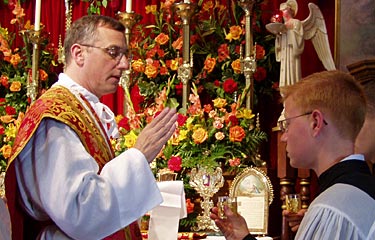 |
| Fr. Anthony Cekada celebrating Mass very Romanly |
Toward the end of Work of Human Hands Fr. Cekada argues on Thomistic grounds that the Order of Mass promulgated in 1969 is absolutely invalid in Latin or vernacular. Some hardline SSPXers used to argue that the common mistranslation of pro multis invalidated the consecration of the chalice; taken to its logical conclusion, there would be no Mass in that case and the consecration of the bread, since the Church does not consecrate outside of Mass, would also be invalid. But back to the more general validity issue. The reason Fr. Cekada gives is that the institution narrative in the new rite is treated as just that: a narrative, as opposed to a consecration formula. The words in the new rite, he says, do not contain the intention to consecrate and hence no consecration is possible, even if a validly ordained priest who intends to consecrate speaks the narrative words with the proper intention. Your eyes are not under the spell of glaucoma. You read it correctly. A validly ordained priest with the right intention speaking the words of consecration, which are the same in the new and old rites, cannot consecrate validly. So, is Fr. Cekada right?
His invalidity stance rests on intention within the "form" of the consecration. The old rite gradually builds up the priest's intention, from the sacrificial offertory prayers, through the thanksgiving prayers early in the Canon, transitioning into prayers for the living and dead, and concluding the Canon with an act of offering the Victim to God (Per ipsum....). The new rite certainly lacks this continuous flow, but I think Fr. Cekada would concede that it is not absolutely necessary. His position is specifically concerned with the consecration itself. At this point a little bit of history goes a long way.
When does the consecration happen? At Hoc est enim corpus meum and Hic est enim calix sanguinis mei? That has certainly been the prevailing teaching since the Scholastic era in the high Middle Ages, but it is not as clear cut as one may think. Around the 11th or 12th century priests, at the behest of the faithful often yelling from the nave, elevated the host and chalice during the Canon for their benefit and view. Some say this form of piety was a soft substitution for actual reception of the Blessed Sacrament, owing to the infrequency of reception that arose in the Dark Ages and which continued for centuries afterward. It is also at this point when scholars and theologians begin to question the specific moment of the "change." We are so accustomed to seeing those specific words of the priest as the formulation for the change that we read the rest of the Canon of Mass around it. But consider this: five centuries earlier the same Canon was sung, without pause, aloud in the tone of a preface in its entirety. A preface tone indicates that the prayer is concerned with blessing or consecrating something. The various signs of the cross and gestures made throughout the Canon differed diocese to diocese, sometimes greatly. Sarum, for example, has very few reverences (later genuflections) and a very different series of actions at the Per ipsum. For whatever reason at the end of the first millennium priests began to recite the Canon rather than sing it aloud and the gestures flourished as private signs of devotion in a private prayer. A consequence of these gestures was the partitioning of the Canon, in the priest's experience, into varying parts. The institution of the elevation of the elements had the same consequence, making the institution narratives a unique segment of the Canon.
Yet, without these gestures and motions we could read the Canon's text straight through and see that that institution narrative may well have been seen in earlier times as just that, a narrative. It is the justification, within the text of the prayer, for why the Church celebrates the Mass. It is hardly a story time, but rather is a public supplication to God on the grounds that we are obeying His Only Begotten Son's precepts. In those days one would of course agree that the change had taken place by the end of the Canon, although today we pinpoint it at the institution narrative. Months ago the Rad Trad published an appendix from an English translation of the Ordo Romanus Primus which contains a replication of what a Paschal Mass celebrated by the Pope may have looked like around the year 800 here. As readers will see the celebrant continues through the Canon unabated, without any special notice.
 How does this influence our view of Fr. Cekada's thesis? The Rad Trad readily acknowledges that the change, the transubstantiation, happens at the narrative. Why? Two reasons: (1) the priest is given the power to consecrate and he intends to consecrate at this moment and (2) because the Church has agreed for a millennium to treat this particular point as the moment of transubstantiation. What the Rad Trad cannot do, and what the sedevacantist theory does do, is ignore the first ten or eleven centuries when the moment of change is at best vague or a little iffy. The Church, in her kindness and respect for tradition, cannot and does not uproot and ignore the prayers, beliefs, or intentions of previous generations of the faithful. It is for this reason that the Addai and Mari rite is valid. Liturgical historicity takes precedent over, admittedly Church sanctioned, Scholastic theology concerning forms. By ignoring this principle and by ignoring the history of the Canon itself one looks away from a legitimate reading of the narrative as a narrative. Hence the idea that somehow treating this part of the Canon as what it originally was invalidates it on defect of form is myopic. Also, need the function of the institution words as a narrative and as consecration formula clash?
I have never met a priest or lay person who has read the narrative and thought any other intention other than consecration is latent in the words contained therein. One would think someone other than Fr. Cekada had caught on to the structural defects supposedly present in the altered Canon or new Eucharistic prayers.
Yes, it is very valid.
Licit?
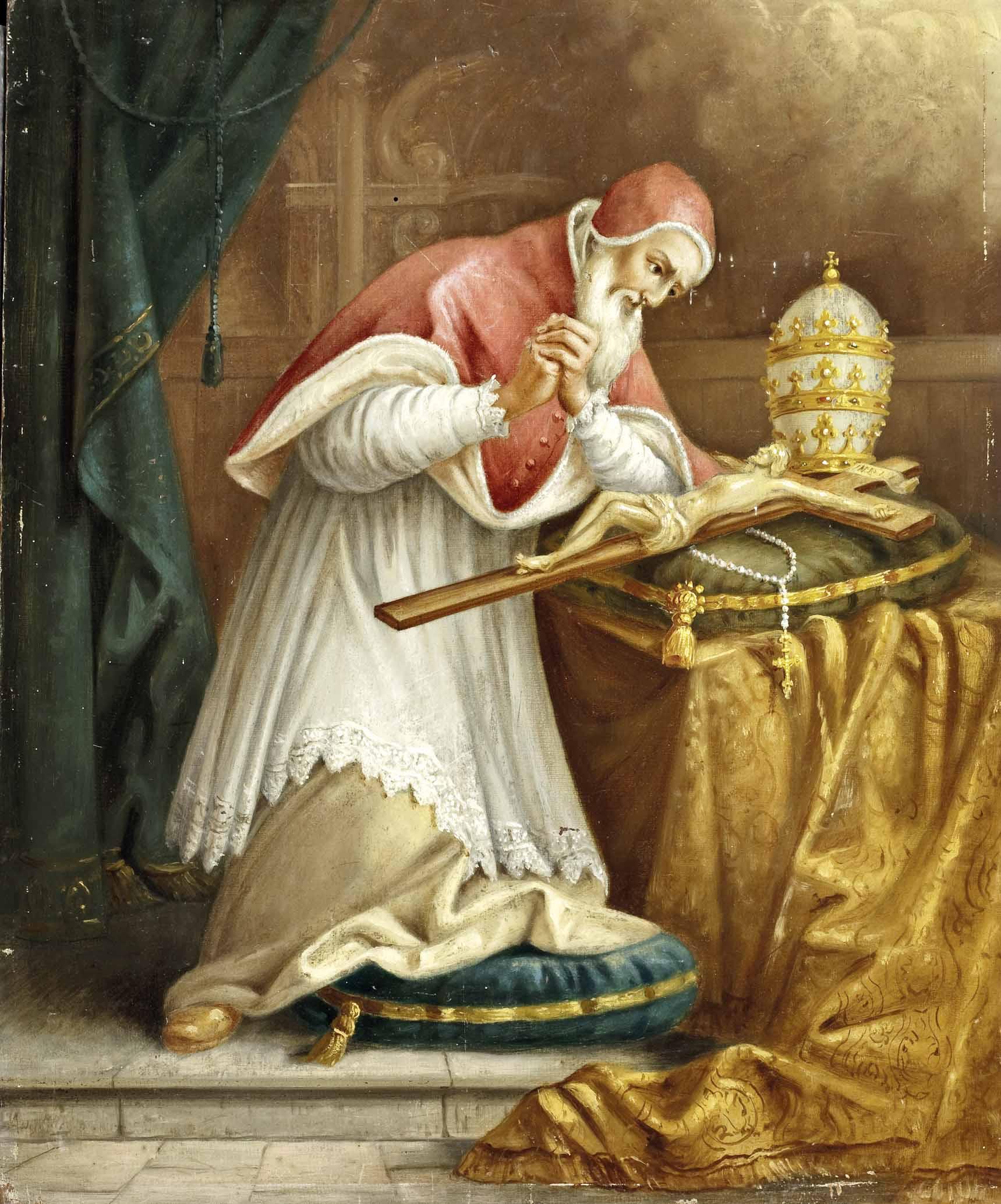 |
| St. Pius V, Pope of Quo Primum |
Part of the fallout within the Society of St. Pius X over Bishop Fellay's failed attempt to give his institution canonical standing was Rome's demand that the Society sign on to the "legitimacy" of the new rite. This sounds odd, but it really just means the legality. In short, was the "new Mass" promulgated in a valid, legal action by the proper authority? Some apparently say no. Others, like one Paul Kramer in his article Legal Status of the Tridentine Mass, argue that since Quo Primum is a dogma of the faith Paul VI avoided going into schism by merely publishing, rather than promulgating, the new Mass.
First, we will discuss Quo Primum. Both of these positions are really variations of each other and they rest on the principle that St. Pius V's bull Quo Primum made the 1570 Missal, or at least the Ordo Missae within it, a dogma of the faith that cannot be violated and which guaranteed that it could never be taken away. This is wrong at two levels:
- Quo Primum is primarily a legal document promulgating use of a certain liturgical book within the Latin Church. As a legal and administrative act it cannot bind a successor of equal status should he take the proper steps to depart from it.
- Neither Pius V, nor any following pope, thought it was such. Two years earlier the same Pius V published Quod a nobis promulgating a Roman Breviary for general use which contains the same rules of use and prohibitions against alterations and threats of Divine retribution as Quo Primum. Urban VIII did not go into schism or heresy by changing the hymns and no one has suggested the 1911 breviary changes were illegal or invalid (although they were unwise).
Confusion over this point may have been compounded when Benedict XVI wrote that the 1962 Missal was never abrogated, which begs the question: how is any following liturgy legal? Were priests who held out in the 1970s and onward justified in their use of 1962? The Rad Trad, no canonist, does know of one distinction in Canon Law that could serve us well here and which may not, legally at least, justify those who adhered to 1962 after the promulgation of the 1969 Ordo. In Canon Law there is a taxonomy of "derogation" and "abrogation." The former is the partial removal or replacement of the existing law while the latter is its outright suppression. To abrogate the 1962 Missal, Paul VI would have had to issue some sort of legal document explicitly prohibiting use of that Missal. This was clearly never done. The "extraordinary" rite was never abrogated. All well and good? New Mass illegal? Not so fast.
The Pauline liturgy was not introduced to the Latin Church by the abrogation of the "traditional" liturgy. For example, John XXIII compressed festal categories into Class I, Class II, and Class III, not abrogating the old calendar entirely, but derogating the ranking system within it in his Rubricarum Instructum. The same holds true for his changes to the breviary lessons, not abrogating the [not so] old Mattins, but derogating the particular way of picking lessons in place in 1955 (both changes were ultimately made by Pius XII, although John XXIII pulled the trigger on the 1960 set). Similarly the 1962 Missal was not abrogated with the publication of the 1965 Missal, but anything in it that differed from 1965 was derogated (use of Latin in readings, the Introibo prayers, the "doubling" of certain texts, ordinary of the first half of Mass in Latin, the communion formula, the Last Gospel, and some other details). 1962 was not strictly "abrogated" but it was by no means usable. The 1967 document Tres abhinc annos introduced further changes by derogating what was different in the 1965 Missal: optional use of a weekday lectionary, optional use of different orations, the Canon was not abrogated but the rubrics governing the priest's actions during it were derogated and replaced, the entire Canon is said aloud, and other alterations; interestingly, IV.17 in that document is the first official instance, to the Rad Trad's knowledge, of a rubric that assumes Mass facing the people could be ordinary and normal outside of a few Roman parishes. On the feast of the Assumption in 1968 the new Eucharistic prayers (2-4) were introduced, again not replacing the entire existing liturgy, but replacing and derogating certain rules and rubrics, this time governing the Canon, therein. A new Pontificale came about that same year.
Here comes the 1969 change. Paul VI did not introduce a new Missal or a new Mass in 1969. He introduced what was mostly a new text for the ordinary of the Mass. The Canon and Eucharistic prayers, lectionary, rubrics, calendar, and Divine Office remained unchanged from the previous year. Even some parts of the ordinary itself were unchanged, given the significant alterations in 1964-8. Perhaps the most dramatic different between 1968 and 1969 is the contrasting offertory prayers, but most everything else matches. The Missal introduced by Paul VI in 1970 again did not "abrogate" 1962 or even whatever was used in 1969, but de facto derogated whatever differed from it: the old sacramentary and [again, no so] old lectionary was replaced. Otherwise, 1970 and 1969 match up very closely.
The idea that the new liturgy is somehow canonically illegal or that the 1962 liturgy was abrogated relies on the view that the Pauline rites were introduced and imposed instantaneously rather than gradually and under transitional, derogation-based legal auspices.
Thank you for reading a such dry and disinteresting post,
The Rad Trad
Wednesday, August 7, 2013
Update
The Rad Trad has had a very unpleasant last week or so. He combatted a nasty cold while preparing for a job interview that took place today, only to discover that the position was basically an IT job when the Rad Trad's background is in Finance! Preposterous! This Friday or Saturday there will be a post on the ascetical treatises of St. Isaac the Syrian and soon there after my [over due] review of Dr. Hull's Banished Heart.
As a quick preview of Banished Heart, I do not know what sort of reviews the work received in 1995 when the first edition was released, but the latest edition went somewhat un-noticed aside from a review in the Usus Antiquior journal. It is worth asking why the book has gone un-noticed outside of more scholarly circles while Fr. Cekada's well-researched Work of Human Hands and Michael Davies' elementary Pope Paul's New Mass continue to get traction. The Rad Trad firmly believes that most of the traditionalists of the 1970s-1990s are, or were, ultramontanists in search of Pius X and hence were wary of criticizing the Pope, Papal authority, or the actions preceding the introduction of the new liturgy (which readers of this blog hopefully realize by now was a very gradual process). An example of this attitude is a story Msgr. Fellay tells of Cardinal Journet, having read the infamous #7 of the 1970 GIRM, storming into Paul VI's office and showing the Pontiff the troublesome excerpt; the Pope then breaks down in tears, revealing that he had not read the text before signing it. This is ridiculous.
 |
| Pope Paul VI. He knew what was going on! |
Banished Heart, thus far, tells of an over-extension of Papal authority into other liturgical traditions, both East and West, and the legalistic view of the Church that resulted from it. Anything that was not Roman was to be suspected of heterodoxy. Early in the book Dr. Hull asks questions such as "Is validity everything?" Some uber-traddies, such as sedevacantists, curtail the moral argument here by suggesting that the new liturgy is somehow invalid. Yet it is a serious question. Do a low Mass and a solemn Papal Mass with full ceremony not have different value? I think readers see where this is heading. Banished Heart does not play into the conventional narrative that Vatican II and Bugnini, a possible Mason, crept out of the shadows to destroy the liturgy and replace it with a primarily ecumenical service. Thus far my only criticism of Dr. Hull's work is that it contains no working definition for the traditional Roman liturgy which, given the book's subtitle, Origins of Heteropraxis in the Catholic Church, might be relevant.
The book presents challenging questions to Roman Catholics of all backgrounds, to Eastern Catholics, and to the Eastern Orthodox, whose separation from the Apostolic See in Rome is given a very different light than the one usually shone upon it by mad Romanists or by culturally-rooted Eastern prejudices.
Lastly, I am sorry for ignoring your comments, some of which have asked me direct questions. I will try to reply to a few of them in due course.
The Rad Trad, over and out.
Subscribe to:
Posts (Atom)