Thursday, January 30, 2014

Texan Romanesque

The Rad Trad has long maintained that the construction of new churches would best be done along the lines of the Romanesque style which emerged early in the Christian age and continued until the dominance of the gothic style during the high Middle Ages.

Why Romanesque? It is classically Roman and immediately identifiable with Catholicism. It is not as expensive and difficult to build as gothic. It does not require the specialization of baroque. And it can be augmented over time by emendations of any style (icons, statues, baroque paintings, Roman frescoes, mosaics, it all works). 

A local church, relatively new, seems to have anticipated the Rad Trad's advice. The church is enormous by modern standards (seats 1,900 and there are seven Sunday Masses). The diocese built the church anticipating its use by the Hispanic community, which tends to mean a more modest collection plate. Hence the Romanesque style was very fitting: lovely and not too expensive. Then the area's growth took off and so did Mass attendance. They collect $65,000 per week (not a typo) and have started to expand the church by adding stations of the Cross and stained glass. The church is well conceived, a pity the priests in residence do not see its liturgical potential (everything it nice but the sanctuary). The only thing missing architecturally is a confessional or two, but confession is done in another building. The Blessed Sacrament is reserved in a chapel.


Wednesday, January 29, 2014

Landed Safely

Thanks for your prayers, especially to John, who recommended the Itinerarium!

Yes, I really flew JetBlue and really rode in this puddle-hopping crapbox.
My 74 inches of height could not fully extend in the restroom....

Tuesday, January 28, 2014

Prayer Request

Tomorrow I am flying to Dallas from Boston, the culmination of my re-location, meaning I will be away from this blog for a few days. I can fly, but not without nerves. I ask your prayers for both my safety and serenity.

Thank you.

God bless,
The Rad Trad

Quo Vadis, FSSPX?

Msgr. Marcel Lefebvre, archbishop of Dakar, superior of the Holy Ghost
Fathers, Apostolic Delegate for French speaking Africa, participant
in Vatican II, and founder of the FSSPX.
source: dici.org

In 1970 a retired missionary Archbishop named Marcel Lefebvre founded a pious brotherhood in Econe, Switzerland under the jurisdiction of the local ordinary. Lefebvre reacted to the requests of French seminarians ostracized by the national seminary in Rome for wearing the cassock and praying the Rosary. Lefebvre eventually broke his silence in 1974, beginning a circuit of old rite Masses throughout Europe which eventually included St. Mary Major in Rome. During a Mass at Lille he attracted the attention of Rome for calling the 1969 Ordo Missae and other new rituals "sacrements bâtards" ("illegitimate Sacraments"). In 1975 the Seminary of St. Pius X, run by his brotherhood, ordained its first class of priests and gave them to dioceses for incardination, as was the original purpose of the Econe seminary.

Seminary of St. Pius X in Econe
source: sspx.org
All this changed in 1976 when Pope Paul VI, declining in age and increasingly isolated by the Vatican bureaucracy, upheld the dissolution of the brotherhood and seminary by the local ordinary. As the brotherhood, or FSSPX, had established canonical priories outside of Econe they protested that the local bishop could only remove their faculties within his diocese and had no authority over the organization as a whole. They may have been right, but Paul VI, as one can see in the correspondence recorded in Michael Davies' near hagiography of Lefebvre, really did not care. An interesting article on the matter can be found in the Catholic Herald's archives.

Consequently, Lefebvre found himself, canonically, a man without a diocese, religious order, honorary see, or place in another kind of fraternity. A cleric without an assignment is de facto suspended a divinis. Lefebvre pressed on and ordained a new set of priests in 1976 without permission, suspending the new priests as well. Every ordination class since then incurred canonical suspension at the laying of hands. The FSSPX makes the case that the suspension was unjust—and it may have been—and that the current state of the Church warrants their arrangement. All that is fine, but this post will not weigh their arguments.

Msgr. Lefebvre celebrates Mass in
the presence of Cardinal Gagnon
source: fsspx.org
Lefebvre quieted down and, although he continued ordaining priests, more or less accepted the wider results of his suspension. Many these days forget that numerous priests scattered throughout the world's dioceses initially resisted the liturgical changes and kept with conventional catechism. These men sometimes worked in unison with the FSSPX for the sake of networking, resource sharing, and keeping up moral, but they were still diocesan clergy. When Fr. Peter Morgan came to England from Econe most of his collaborators were diocesan priests still in good standing with their bishops, even if their bishops did not like it. In continental Europe, particularly in France, many practicing Catholics attended Lefebvre's "rally Masses" by the thousands—many with five digit attendance figures. Lefebvre could have been the visible figure who could lead the then-nascent traditionalist movement to keep traditional liturgical and catechetical practice within the Church's legal system and diocesan structure. When he withdrew from public sight to his seminary in Econe, Lefebvre let the traditionalist movement—which had the potential to attract a significant fraction of the Catholic world—whither and decay. A few odd cases in Evreux, Campos, and Gabon can be found where diocesan clergy continued the old liturgy, but generally any conservative tendencies died after losing their lifelines. From then on the FSSPX, as an organization, became almost exclusively identified with Catholic tradition.

At this point I would like to end the history, now that the familiar narrative begins: the three Roman visitors to Econe, the 1979 audience with John Paul II, the visit of Cardinal Gagnon, the Ratzingerian protocol, and the Econe consecrations. My private opinion is that, as pope, Benedict XVI de-restricted the 1962 rite and lifted the 1988 decree Ecclesia Dei because he felt the liturgical changes, although justified, happened too quickly and because he thought he played some role in the melt down of relations between Msgr. Lefebvre and the Vatican in 1987/1988.

Bishop Bernard Fellay after an ordination Mass
What concerns the Rad Trad about the FSSPX is not their past (far too young to care), but their future. The year is 2014. In another year the FSSPX will arrive at the 40th anniversary of its first and last canonically sanctioned ordination—which included bishop Tissier de Mallerais, the most radical of the four men Lefebvre consecrated to the episcopacy. The next class of seminarians to begin ordination studies with the FSSPX will commence the third generation of clergy within that organization that never knew a normal relationship with a bishop, either the bishop of Rome or the bishop of Rhode Island. Instead of tangible relations with other priests and with Rome or a canonical administration of the Sacraments (save the few cases when the Roman Penitentiary grants them absolution jurisdiction) forty years of priests will have known nothing but the "true Sacraments," "eternal Rome," and assumptions about Modernism. Amid their Platonic formation, would these men know the opportunity for a regularization if it came to them?

The former superior claimed forces within the Vatican derailed the regularization while the current superior, bishop Bernard Fellay, reported the Pope himself added new and more stringent criteria for reconciliation. More mainstream commentators suggested that the FSSPX missed the last boat to normality. Why did that ship sail in 2012? Could it not have sailed before then?

Bishop Fellay is a spry 55, but in a decade or so he will have to think concrete thoughts about the future of Msgr. Lefebvre's brotherhood. How could he normalize three generations of priests who have rarely had a positive thought about their local bishop or the neighboring parish in the last half century? Would the situation in 2024 justify consecrating another bishop or four? Will 2028 be like 1988 or will the situation have changed?

June 30, 1988 at Econe
Most problematic for a reconciliation is that time has accustomed the FSSPX to independence from canonical structures. Lefebvre expelled nine priests in 1983 for, among other things, rejecting diocesan tribunals' decisions on the nullity of certain marriages. Somehow the FSSPX now exercises, and has for some time, its own judgment on the validity of marriages done in the mainstream of the Church. Their bishops, who Lefebvre wished to function as auxiliaries, routinely substitute for the local bishop in signing the necessary paper to found monasteries and the like. For all practical purposes the FSSPX is an autocephalous body.

We cannot doubt Msgr. Lefebvre's intentions, but we can certainly doubt his wisdom. He rightly found the state of the Church in the 1970s appalling and, in his missionary instinct, sought to do something about it. Sadly he made many mistakes in decisions that required prudence and landed his pious brotherhood with its current debacle. They ignore the Pope, but do not deny him; hence one can call them disobedient, but they are not schismatic. They ignore a general council, but do not reject its legality; they are not heretical. They say that they were maltreated in 1976; but regardless of what was right then, they do not enjoy legal status. They are not outside the fold, nor are they exactly within it. Anyone interested in pre-1969 liturgy has them to thank, in part, for preserving older liturgical use. Cardinal Ratzinger among others have admitted that the FSSPX has forced Rome to re-evaluate the post-Conciliar period. And still does this warrant their current situation? Benedict XVI had "unfinished business" with the FSSPX after 1988 and still hoped to heal the wounds that opened after the Council which launched his ecclesiastical track. The Roman authorities circa 2009 saw the growth in the traditional seminaries and perhaps hoped to put all the traddy eggs in one basket. And bishop Fellay can remember, as a student, the days when the old Mass was the norm. With a new pope who has no demonstrable connection to the "Mass of the Ages" or the Second Vatican Council and a new generation of clergy with really no connection to him, bishop Fellay must ask himself "Quo vado?"

Saturday, January 25, 2014

Attack of the Trads: What Catholic Liturgists and Laymen Can Learn from Star Wars


For some time I have searched in vain for some sort of cultural analogue that would assist advocates of traditional Roman liturgical praxis in explaining their objections to the 20th century reforms without delving too deeply into the obscure concerns of people with specialized knowledge (the pre-1911 psalter was a fact of life since the age of St Benedict, but no clergy alive have ever really known it). Last week my priest and I were chatting about my impending move. "Go to Texas you will," he said in his best Yoda voice. The other day I recalled this amusing imitation and the parallels between what happened to the Roman liturgy in the 20th century—all the reforms—and the Star Wars films is really uncanny.

I am 24 years old. I am just old enough to have clear memories of what the original Star Wars films were like in their theatrical releases (1977, 1980, and 1983). My father bought the first VHS package of the trilogy in 1992 and I watched the films regularly, a few times per year, until 1997. As a child I had fond memories of the films, sometimes wearing a Darth Vader costume while watching them and acting out the scenes during recess at school with the other boys. Then in 1997 George Lucas issued a "special edition" of the original films amid chatter that a new trilogy was immanent. Although 7 years old going on 8 and unable to grasp the general movement of the series, I could tell something was amiss in these modified films. I found some of the changes agreeable and even helpful: cleaned and digitized picture, the greater movement of the fighters during the Death Star battle, and the deeper look into Cloud City; Lucas could even have updated some of the technological aesthetics, such as the screens and buttons on the computers. Instead of focusing on updating in accordance with the latest technology Lucas focused on purifying perfectly fine films in order to align them with his newly invented vision, to put these films in line for the new movies.

Some scenes in the "special edition," particularly those in Return of the Jedi, have absolutely no significance and contribute nil to the story. Why did there have to be an inane alien band singing a pseudo-Jazz ditty? Why did the pit in which Han and Luke were to die require the addition of a bulbous worm? Why the hell did Jabba the Hutt need to repeat Greedo's lines in A New Hope? And why did Greedo now have to shoot first? In 1997 some of these scenes were technically impressive, but they added nothing to the plot and did not aid Lucas in telling the saga any better than the unmodified originals.

Yes, the 1977-1983 trilogy still existed, but something had cut into its heart, its integrity, its spirit. It was more or less the same story and same characters, but it was changing and anticipating something new. Then in 1999 "something new" finally came. The Phantom Menace.

The Phantom Menance had potential, unlike Attack of the Clones. The political subtext was brilliantly constructed throughout the new films and Ian McDiarmid played Palpatine quite well from the first movie onward. Liam Neeson's Jedi character very much captured the soul and spirit of the Jedi as portrayed by [Catholic convert] Alec Guinness in the first films. Lucas wasted these few positives and instead pursued an endless barrage of spectacular special effects of no teleological significance, countless menial minor characters, and stale dialogue that only functioned to move the films along so Lucas could collect his $1+ billion in box office receipts. And of course there was the disastrous cast, which included Hayden Christensen and Natalie Portman, two actors who would not have found set assembly work on a decent movie. The new films were "valid," but only did the bare minimum in satisfying audiences which expected movies in continuity with their predecessors.

Perhaps the greatest crime in the new movies is that Anakin Skywalker, lauded as a "cunning warrior" and a "good friend" in the original films, displays no warmth and kindness whatsoever. The father who saves his son in the original films attempts to kill his wife in the new ones. The man whose fall was a tragedy has absolutely no sense of goodness in the new films. And, worst of all, Darth Vader dropped from ultimate bad@$$ to hormonal, whiny teenager.

And yet did we not all see it coming in the "special edition?" Before Lucas made Darth Vader a wimp he made Han Solo one by having Greedo shoot first. Before Revenge of the Sith implemented meaningless special effects the improved Return of the Jedi did the same thing. Some time after he stopped the Star Wars and Indiana Jones films in the 1980s George Lucas' creative powers dried up and the reservoir has yet to be replenished. The same mind behind the new—and banal—films is the same which constructed the improved "special edition" films of 1997. Surely one who looks at the 1997 emendations and the timeline involved can deduce that they belong to the same forces as the new trilogy. 

And yet many younger fans, who grew up on the newer films and have no memory of the pristine older films in theaters or cassette do not question the changes. Their view of Star Wars is from the new films looking back. The changes to the older films must have made them more in line with Lucas' true vision of his created universe. And why should the younger generation question these changes and these new films? The series belongs to Lucas—or did before he cashed in with Di$ney. He is the man with all the authority over the films. Star Wars belongs to the Lucan magisterium.

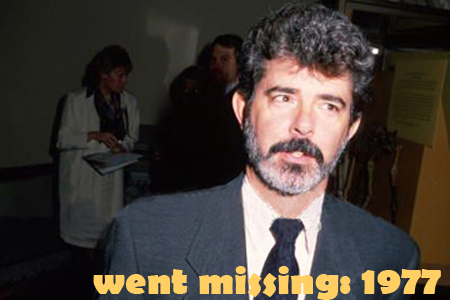
Seen this man?
source: omega-level.net
A friend of mine who had seen the new films confessed, years back, to having never seen the originals in any edition. We watched them over the course of a week or two. She found them enthralling: the epic, classical story told in a fresh environment; the creativity in making new worlds; the personality which emanated from the characters from their first introductions; the seamless use of effects in driving the story; and the enduring appeal of these films in their re-watching. Then there is also the uncomfortable implication that the new films lack a great many of these wonderful qualities.

Future generations of film viewers will have to deal with the reality that the new movies are now part of the saga and the story continuum, even if they lack the style, aura, appeal, personality, and depth of the films which preceded them. They are somehow "two forms of the same rite" even though those of us who recall the older films when they were the only films do not really buy into it. And while, as I said above, the older films could well have done with some aesthetic updates many of the changes were puzzling and clearly meant to transition into the newer films. 


Translation key:
  • Original version of original films: the old Roman liturgy
  • Possible updates of films: more popular singing, public Divine Office, fewer Double feasts, less bureaucratic management of liturgy
  • 1997 Special Edition: 1911 breviary reform, 1955 Holy Week reform, 1955 kalendar reform, 1960 rubrical reform
  • Post-1980s George Lucas: Popes Pius XII & Paul VI
  • New trilogy: Pauline Mass, Liturgy of the Hours, new Pontifical and Ritual Books, 1970 lectionary and Sacramentary
  • Hayden Christensen: Archbishop Annibale Bugnini/Masons—yes some find it fashionable to blame him rather than admit who is really responsible; his performance was bad, but ultimately he was not the one who behind the new trilogy


Thursday, January 23, 2014

Take Action!

Wells Cathedral in England, run by the Church of England, has scheduled a screening of the heretical and blasphemous film The Last Temptation of Christ, during which Christ actually gets down from the Cross and contemplates a temporally satisfying life. The film is scheduled to show on Friday the 25th, so make your objection known now. With these sorts of things quantity of dissatisfaction exceeds quality. A one or two line objection would do.

From Zephyrinus:

Contact details:
  • The Bishop's Office:  Please note that although the See is vacant at present the diocesan website suggests making contact by either: writing to the Bishops' Office, The Bishop's Palace, Wells, Somerset BA5 2PD, phoning 01749 672341 or emailing the Bishop of Taunton: bishop.taunton@bathwells.anglican.org
     
  • The Chancellor of the Diocese: The Worshipful Timothy Briden at timothybriden@lambchambers.co.uk
     
  • Lambeth Palace: Revd Dr Malcolm Brown, Director of Mission and Public Affairs at malcolm.brown@c-of-e.org.uk

Divine Office During the Time of the Fathers

"Not long had the Church of Milan begun to employ this kind of consolation and exhortation, the brethren singing together with great earnestness of voice and heart. For it was about a year, or not much more, since Justina, the mother of the boy-Emperor Valentinian,persecuted Your servant Ambrose in the interest of her heresy, to which she had been seduced by the Arians. The pious people kept guard in the church, prepared to die with their bishop, Your servant. There my mother, Your handmaid, bearing a chief part of those cares and watchings, lived in prayer. We, still unmelted by the heat of Your Spirit, were yet moved by the astonished and disturbed city. At thistime it was instituted that, after the manner of the Eastern Church, hymns and psalms should be sung, lest the people should pine away in the tediousness of sorrow; which custom, retained from then till now, is imitated by many, yea, by almost all of Your congregations throughout the rest of the world."
From Confessions of St. Augustine, book 9, ch. 7.15