Showing posts with label Angels. Show all posts

Friday, October 2, 2015

Dionysius the Areopagite on the Angels

(Eugène Delacroix)
Today is the feast of the Guardian Angels, placed on the general Roman kalendar in 1608 by P. Paul V, having been previously celebrated as a local feast in many places for some time.

From The Celestial Hierarchy, ch. ix:

There remains for us the reverent contemplation of that sacred Order which completes the Angelic Hierarchies, and is composed of the Divine Principalities, Archangels and Angels.

The choir of the holy Archangels is joined with the Angels because it belongs to the interpreting Order, receiving in its turn the illuminations from the First Powers, and beneficently announcing these revelations to the Angels; and by means of the Angels it shows them forth to us in the measure of the mystical receptivity of each one who is inspired by the divine illumination. For the Angels, as we have said, fill up and complete the lowest choir of all the Hierarchies of the Celestial Intelligences since they are the last of the Celestial Beings possessing the angelic nature. And they, indeed, are more properly named Angels by us than are those of a higher rank because their choir is more directly in contact with manifested and mundane things.

The Word of God has given our hierarchy into the care of Angels, for Michael is called Lord of the people of Judah, and other Angels are assigned to other peoples. For the Most High established the boundaries of the nations according to the number of the Angels of God.

If someone should ask why the Hebrews alone were guided to the divine illuminations, we should answer that the turning away of the nations to false gods ought not to be attributed to the direct guidance of Angels, but to their own refusal of the true path which leads to God, and the falling away through self-love and perversity, and similarly, the worship of things which they regarded as divine.

For there is one Sovereign and Providence of all, and we must never suppose that God was leader of the Jews by chance, nor that certain Angels, either independently, or with equal rank, or in opposition to one another, ruled over the other nations; but this teaching must be received according to the following holy intention, not as meaning that God had shared the sovereignty of mankind with other gods, or with Angels, and had been chosen by chance as ruler and leader of Israel, but as showing that although one all-powerful Providence of the Most High consigned the whole of mankind to the care of their own Angels for their preservation, yet the Israelites, almost alone of them all, turned to the knowledge and light of the true God.

Therefore the Word of God, when relating how Israel devoted himself to the worship of the true God, says, “He became the Lord’s portion.” Moreover it shows that he too, equally with other nations, was given into the charge of one of the holy Angels, in order that he might know through him the one Principle of all things. For it says that Michael was the leader of the Jews, clearly showing that there is one Providence established superessentially above all the invisible and visible powers, and that all the Angels who preside over the different nations lift up to that Providence, as to their own Principle, as far as is in their power, those who willingly follow them.

(Benjamin West)

Wednesday, October 24, 2012

St. John Chrysostom on Baptism

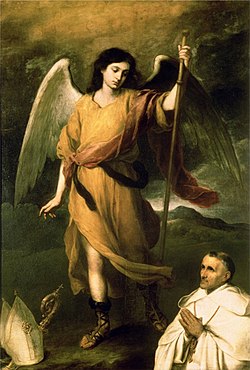
St. Raphael the Archangel
Today is the feast of St. Raphael, the archangel mentioned in the book of Tobias. In the first nocturn of Matins St. Bonaventure teaches us that angels point us to God in times of difficulty or when we lose our way: "an Angel does not bestow compuction, but bestows us the way" (5th Sermon on Angels). They pray for us to God (Apocalypse Ch. 8) and excuse us before God, unlike the devils who accuse us.

The "Golden Mouth" speaks of baptism
as a source of grace that we cannot
deplete, like the sun.
But the most marvelous lessons in today's office are to be found in the third nocturn, where St. John Chrysostom teaches us about baptism. His springboard for this lesson is the story of the five-time divorced woman at the well, who is reproached by Our Lord concerning her sinful life:

What manner of mystery is this? What does it reveal? for it is not written without a purpose : but the future is foretold in figure and similitude lest the unexpected occurrence of a wondrous event should in any way disturb the faith of the hearers. What, then is here described ? In the future a baptism was to be given, full of power and of the greatest grace, a baptism that would wash away all sin, that would restore life to dead men. These facts then are depicted figuratively, in the pool and in all the other circumstances. And first in this figure the water is set forth, which washes away stains of the body, and those things that are not actually dirty, though they were thought to be so, such as coming in contact with a corpse, or a leper, and such like: it is to be seen that many things under the old law are cleansed by water, in accordance with this idea.
But let us now return to the subject. First defilements of the body are washed out, and then God heals various infirmities by means of water. For because God would bring us nearer to the grace of baptism, he not only cleanses defilements but heals diseases. For those figures which come nearest to the reality, in baptism, the Passion, and others are seen more clearly than the older ones. For it is the same with those who form a king's bodyguard : they are more splendidly apparelled than those at the other end of his equipage. And the angel came down and troubled the water, and imbued it with healing power; so that the Jews might learn that the Lord of Angels had far more power to heal all the diseases of the soul. But just as here it was not simply the natural property of the water that healed, (otherwise it would have always have done so) but it happened through the work of the Angel : so it is not simply water that works on us, but after the water has received the grace of the Spirit, then it looses us from all sin.
Around this pool lay a great multitude of impotent folk, of blind, halt, withered, waiting for the moving of the water. But then those who wished for healing were prevented by infirmity from receiving it, while now everyone is able to come forward. For the Angel does not trouble the water, but the Lord of Angels brings all things to come to pass. We may no longer say, While I am coming, another steppeth down before me. But even should the whole world come, the grace would not be used up, neither would its power nor effectual working come to an end. For as the sun's rays shine forth each day without burning out, and as they spread abroad without losing any of their light : far less is the operation of the Spirit diminished by the multitudes who receive it. Now this miracle took place so that as men learned that could heal bodily diseases, and as they become accustomed to this fact over a period of time: so they might they the more readily believe that it could also heal diseases of the soul. —35/36th Sermon on St. John's Gospel
Happy feast day!