Showing posts with label St. John Chrysostom. Show all posts

Thursday, December 21, 2017

Chrysostom on Naming the Christ Child

(Georges de La Tour)
From St. John Chrysostom’s fourth sermon on the Gospel of Matthew.

For this cause too the angel came bringing His name from Heaven, hereby again intimating that this is a wondrous birth: it being God Himself who sends the name from above by the angel to Joseph. For neither was this without an object, but a treasure of ten thousand blessings. Wherefore the angel also interprets it, and suggests good hopes, in this way again leading him to belief. For to these things we are wont to be more inclined, and therefore are also fonder of believing them.

So having established his faith by all, by the past things, by the future, by the present, by the honor given to himself, he brings in the prophet also in good time, to give his suffrage in support of all these. But before introducing him, he proclaims beforehand the good things which were to befall the world through Him. And what are these? Sins removed and done away. “For He shall save His people from their sins.”

Here again the thing is signified to be beyond all expectation. For not from visible wars, neither from barbarians, but what was far greater than these, from sins, he declares the glad tidings of deliverance; a work which had never been possible to any one before.

But wherefore, one may ask, did he say, “His people,” and not add the Gentiles also? That he might not startle the hearer yet a while. For to him that listens with understanding he darkly signified the Gentiles too. For “His people” are not the Jews only, but also all that draw near and receive the knowledge that is from Him.

And mark how he has by the way discovered to us also “His dignity,” by calling the Jewish nation His people. For this is the word of one implying nought else, but that He who is born is God's child, and that the King of those on high is the subject of his discourse. As neither does forgiving sins belong to any other power, but only to that single essence.

Forasmuch then as we have partaken of so great a gift, let us do everything not to dishonor such a benefit. For if even before this honor, what was done was worthy of punishment, much more now, after this unspeakable benefit. And this I say not now for no cause, but because I see many after their baptism living more carelessly than the uninitiated, and having nothing peculiar to distinguish them in their way of life. It is, you see, for this cause, that neither in the market nor in the Church is it possible to know quickly who is a believer and who an unbeliever; unless one be present at the time of the mysteries, and see the one sort put out, the others remaining within. Whereas they ought to be distinguished not by their place, but by their way of life. For as men's outward dignities are naturally to be discovered by the outward signs with which they are invested, so ours ought to be discernible by the soul.

Sunday, March 27, 2016

Sunday of the Resurrection: Christ is Risen!


"If any man be devout and love God, let him enjoy this fair and radiant triumphal feast. If any man be a wise servant, let him rejoicing enter into the joy of his Lord. If any have labored long in fasting, let him now receive his recompense. If any have wrought from the first hour, let him today receive his just reward. If any have come at the third hour, let him with thankfulness keep the feast. If any have arrived at the sixth hour, let him have no misgivings; because he shall in nowise be deprived thereof. If any have delayed until the ninth hour, let him draw near, fearing nothing. If any have tarried even until the eleventh hour, let him, also, be not alarmed at his tardiness; for the Lord, who is jealous of his honor, will accept the last even as the first; he gives rest unto him who comes at the eleventh hour, even as unto him who has wrought from the first hour.
"And he shows mercy upon the last, and cares for the first; and to the one he gives, and upon the other he bestows gifts. And he both accepts the deeds, and welcomes the intention, and honors the acts and praises the offering. Wherefore, enter you all into the joy of your Lord; and receive your reward, both the first, and likewise the second. You rich and poor together, hold high festival. You sober and you heedless, honor the day. Rejoice today, both you who have fasted and you who have disregarded the fast. The table is full-laden; feast ye all sumptuously. The calf is fatted; let no one go hungry away.
"Enjoy ye all the feast of faith: Receive ye all the riches of loving-kindness. let no one bewail his poverty, for the universal kingdom has been revealed. Let no one weep for his iniquities, for pardon has shown forth from the grave. Let no one fear death, for the Savior’s death has set us free. He that was held prisoner of it has annihilated it. By descending into Hell, He made Hell captive. He embittered it when it tasted of His flesh. And Isaiah, foretelling this, did cry: Hell, said he, was embittered, when it encountered Thee in the lower regions. It was embittered, for it was abolished. It was embittered, for it was mocked. It was embittered, for it was slain. It was embittered, for it was overthrown. It was embittered, for it was fettered in chains. It took a body, and met God face to face. It took earth, and encountered Heaven. It took that which was seen, and fell upon the unseen.
"O Death, where is your sting? O Hell, where is your victory? Christ is risen, and you are overthrown. Christ is risen, and the demons are fallen. Christ is risen, and the angels rejoice. Christ is risen, and life reigns. Christ is risen, and not one dead remains in the grave. For Christ, being risen from the dead, is become the first fruits of those who have fallen asleep. To Him be glory and dominion unto ages of ages. Amen."

A blessed Pascha to all!

Tuesday, August 5, 2014

Transfiguration: Paving the Way of the Cross

source: toledofavs.com
The modern trend with regards to the Transfiguration of our Redeemer is to emphasize His glory and divinity, which he revealed to Elias, Moses, Peter, James, and John. The Hesychast theology following the tradition of Palamas even extends this to include the manifestation of the uncreated, uncaused Divine energy of God. The ancient view is both simpler and more intuitive than either of these when we read the Gospel as a whole. From the Fathers in today's Mattins:
"The Lord takes chosen witnesses, and in their presence, reveals His glory. That form of body which He had in common with other men, He so transfigured with light, that His Face did shine as the sun, and His raiment became exceeding white as snow. Of this metamorphosis the chief work was to remove from the hearts of the disciples the stumbling at the Cross. Before their eyes was unveiled the splendour of His hidden majesty, that the lowliness of His freely-chosen suffering might not confound their faith. But none the less was there here laid by the Providence of God a solid foundation for the hope of the Holy Church, whereby the whole body of Christ should know with what a change it is yet to be honoured. The members of that body whose Head hath already been transfigured in light may promise themselves a share in His glory." Sermon of St. Leo the Great on the Transfiguration, taken from the second nocturne
"Since the Lord had spoken much concerning dangers, much concerning His Own sufferings, much concerning death, and the killing of His disciples, and had laid upon them many hard and grievous things, and since all these were in this present life, and already hanging over them, whereas the good things were matter for hope and waiting as, for example, that whosoever should lose his life for His sake should find it, for that the Son of Man should come in the glory of His Father, and reward every man according to his works. Therefore, to assure them by their own eyes, and show them what the glory is wherein He will come, He manifested and unveiled it to them, as far as in this life they were able to grasp it, lest they and especially Peter should grieve over their own deaths, or the death of their Lord." 57th Sermon on Matthew by St. John Chrysostom, taken from the third nocturne
As an addendum, I would like to point out one of my favorite features of the icon of the Transfiguration. something that has always amused me. The three Apostles are blinded by the light and unable to see. John and James are looking away, overpowered by the radiance of the Lord's illuminated majesty. Peter, however, has to say something. Indeed, Peter always has to say something. Throughout the four Gospels he relentlessly speaks up at inopportune times and gets himself in trouble. After receiving the keys to the Kingdom of Heaven he passes on his chance to be quiet and earns the Lord's sharp condemnation "Get behind Me, Satan." There may be some theological significance to Peter's orientation toward the Lord in the icon—he did suggest the erection of three tabernacles—yet I cannot help but think there was an element of humor on the iconographers' part in having Peter attempt to get the Lord's attention while more important things transpire.

Saturday, May 24, 2014

Proskomide


Above is an explanation of a service I have seen countless times during Orthros (Mattins & Lauds), but never heard aloud aside from a few words. A priest of some Orthodox community explains the Proskomide, the preparation rites for the bread and wine prior to the Divine Liturgy. The prayers are heuristic and indicative of a liturgical theology that takes the reality of the opus Dei during the Eucharist seriously.

As an aside, the priest is likely wrong when he says that the Liturgy of St. John Chrysostom originates in St. John Chrysostom. I am told that St. Basil is the most likely to have had extensive influence on the Byzantine rite named for him. The Liturgy of St. John Chrysostom, like the "Ambrosian rite" of Milan, is probably named for the most prominent bishop of the diocese that used it.

Sunday, April 20, 2014

Christ is Risen! He is Truly Risen


Christ is risen from the dead and by His death He has
trampled upon death and has given life to those who were
in the tombs!

No greater words have been or will be spoken about the Resurrection than these words given by St. John Chrysostom sixteen centuries ago:
"If any man be devout and love God, let him enjoy this fair and radiant triumphal feast. If any man be a wise servant, let him rejoicing enter into the joy of his Lord. If any have labored long in fasting, let him now receive his recompense. If any have wrought from the first hour, let him today receive his just reward. If any have come at the third hour, let him with thankfulness keep the feast. If any have arrived at the sixth hour, let him have no misgivings; because he shall in nowise be deprived thereof. If any have delayed until the ninth hour, let him draw near, fearing nothing. If any have tarried even until the eleventh hour, let him, also, be not alarmed at his tardiness; for the Lord, who is jealous of his honor, will accept the last even as the first; he gives rest unto him who comes at the eleventh hour, even as unto him who has wrought from the first hour.
"And he shows mercy upon the last, and cares for the first; and to the one he gives, and upon the other he bestows gifts. And he both accepts the deeds, and welcomes the intention, and honors the acts and praises the offering. Wherefore, enter you all into the joy of your Lord; and receive your reward, both the first, and likewise the second. You rich and poor together, hold high festival. You sober and you heedless, honor the day. Rejoice today, both you who have fasted and you who have disregarded the fast. The table is full-laden; feast ye all sumptuously. The calf is fatted; let no one go hungry away.
"Enjoy ye all the feast of faith: Receive ye all the riches of loving-kindness. let no one bewail his poverty, for the universal kingdom has been revealed. Let no one weep for his iniquities, for pardon has shown forth from the grave. Let no one fear death, for the Savior’s death has set us free. He that was held prisoner of it has annihilated it. By descending into Hell, He made Hell captive. He embittered it when it tasted of His flesh. And Isaiah, foretelling this, did cry: Hell, said he, was embittered, when it encountered Thee in the lower regions. It was embittered, for it was abolished. It was embittered, for it was mocked. It was embittered, for it was slain. It was embittered, for it was overthrown. It was embittered, for it was fettered in chains. It took a body, and met God face to face. It took earth, and encountered Heaven. It took that which was seen, and fell upon the unseen.
"O Death, where is your sting? O Hell, where is your victory? Christ is risen, and you are overthrown. Christ is risen, and the demons are fallen. Christ is risen, and the angels rejoice. Christ is risen, and life reigns. Christ is risen, and not one dead remains in the grave. For Christ, being risen from the dead, is become the first fruits of those who have fallen asleep. To Him be glory and dominion unto ages of ages. Amen."

Thursday, February 13, 2014

Liturgy and Preparing for Lent

Christmastide came to a close two weeks ago with the feast of the Purification of Our Lady, Candlemas, on February 2nd. We are now approaching the 'gesima season during which we prepare for the exercises and endurance race that is Lent. My singing voice leaves something to be desired, but during Vespers this Saturday night I will sing the dismissal with the double Alleluia and the Deo gratias with the double Alleluia, my last bit of liturgical joy for the next month and a half.

source: atonementparish.blogspot.com
In past times, and in some places now, the coming of Lent was a process of transition. The Roman tradition anticipates Lent by introducing a penitential spirit in the liturgy: violet vestments, the "burial" of the Alleluia (in the Middle Ages it was literally buried), the excision of the Gloria from the Mass on the Lord's day, and the dismissal Benedicamus Domino which we use on days of penance, almost to say Serviamus Domino. The Roman Divine Office becomes very brutal during Lent. The Office of the Dead is prayed on Mondays of Simple rank, which will be every Monday this year. As we run our course in the faith we must recall and pray for our friends who did the same with divers degrees of success. Vespers loses the Suffrages of the Saints and replaces them with what is likely the detritus of an Office for the Dead of past time, a series of intercessory prays followed by the Miserere, psalm 50.

As stated earlier, it is my private belief that the season of Advent, replete with apocalyptic tones and an emphasis on the Coming, is most appropriate to consider sin and judgment. For the non-catechumen Lent is a different story. The Masses of the 'gesima season introduce us to what we should consider during Lent. The first Sunday, Septuagesima Sunday, prescribes for the Gospel the parable of a landowner hiring servants at the various hours of the days. The jealous men who worked the entire day caterwaul at the wages of those who worked less than they. The master of the house reminds the greedy workers that he can pay them as he wishes, the "first shall be last and the last shall be first." Above all, the message is that the Kingdom of God is available to all who seek it, although many turn away: "Many are called, but few are chosen." For those who follow the Byzantine tradition this sermon will form the foundation of the greatest sermon ever given, St. John Chrysostom's Paschal sermon which is read at Mattins. The following week's Gospel pericope presents us with the parable of a sower whose seed takes root and grows according to the environment in which it is planted. And the last Sunday tells us of a blind man whose cries to Our Lord "Son of David, have pity on me" stir His compassion; Our Lord gives the man his sight and tells him "Your faith has saved you." The three considerations the Church gives us for Lent then are:
  1. We are all called to eternal life with God and regardless of when we accept Him and repent of our sins we are assured of the same reward as those who lived their entire lives in holiness. The stories of saints are the stories of sinners.
  2. The gifts of God, faith the first of them, grow and sanctify the soul according to their nurturing. Do we pray? Do we serve others? Do we help others mechanically or are acts of random kindness still a part of our lives? Mechanical prayer can be useful in keeping the mind disciplined, but the sinner must mean the prayer at some point in order to let the Holy Spirit work within the soul. Kindly the Roman liturgy varies greatly during Lent: different readings at every single Mass, different psalms at the major hours daily owing to the absence of feasts, and different collects. The Church gives the man of prayer a tool to sow his seeds in the most fecund places.
  3. Faith saves us and even illuminates us. The blind man must have been blinded by light when he first recovered his vision after being lost in the throes of darkness for the duration of his life. Is sin not the same thing? Conversion, in an instant or in a progression, illuminates the sinner and basks him in the light of Christ. Peter, James, and John found this light profoundly blinding when they ascended Mount Tabor with Our Lord and yet the light they saw was only a hint of the light that is Christ's Divine essence. The Hesychast Byzantine tradition calls the light of Transfiguration the "uncreated energies." The Byzantine tradition even refers to Baptism as the "Mystery of Illumination." Fittingly the last Gospel before Lent is about illumination and the last act of Lent is the Baptism of converts to Christ.
Fasting dampens the noise of earthly distractions and attunes the soul to what the Church asks us to consider during Lent. Severe penance? No. Self-inflicted brutality? No. Fasting helps us to think and pray about the three simple topics above: calling, fostering, and seeing in the faith.

Lent. It is coming.


Sunday, March 31, 2013

Christ is Risen! Hades is Embittered!

Christ raises Adam and Eve from their tombs in Hades, trampling on the fallen gates of the house of Death

 If any be pious and a lover of God, let him rejoice in this fair and radiant festival. If any be a faithful servant let him enter into the joy of his Lord. If any be weary with fasting,
let him now enjoy his payment. If anyone has labored from the first hour, let him receive today his just reward. If anyone has come after the third hour, let him now be thankful that the feast is at hand. If anyone has waited until after the sixth hour, let him not be anxious, no loss shall be his own.
If anyone has tarried until the ninth hour, let him draw near also, shedding all his doubts.If anyone has come only at the eleventh hour, let him not be fearful because of his delay.For the Master is bountiful and receives the last even as the first. He gives repose to him who came at the eleventh hour just as to one who labored from the first. The tardy are shown mercy and the timely are made whole.
To the one he gives, on the other he bestows. He honors the deed and praises the intention. Let all therefore enter into the joy of our Lord, (let both the first and those who came later receive their wages) let rich and poor dance with one another. You sober and you heedless celebrate the day.
You who have fasted and you who have not rejoice in this occasion. The table is full-laden let all enjoy the feast. The calf is fatted, let no one go forth hungry. Let all partake of the banquet of faith, let all partake of the riches of goodness. Let none mourn his poverty, for the kingdom stands before us.
Let none lament his failings, forgiveness has risen from the tomb.
Let none fear death, for the death of the Savior has set us free. He quenched death when it had tasted his flesh. He despoiled Hades when he descended thereto foreseeing this, Isaiah cried:
'Hades was embittered when it met you face to face.’
It was embittered for it was made void,It was embittered for it was mocked,It was embittered for it was slain,It was embittered for it was despoiled. It was embittered for it was led off in chains.It received a body and encountered God,It received earth and came face to face with heaven.It received what it saw and fell where it could not see.
Death where is thy sting,Hades where is thy victory?
Christ is risen and you are cast down,Christ is risen and the demons are fallen,Christ is risen and the angels rejoice,Christ is risen and life is made free.Christ is risen and there is none dead in the tomb.For Christ is risen from the dead as the first fruits of those that fell asleep.To him be glory and power forever and ever. Amen.
Easter Sermon of St. John Chrysostom

Christos Anesti! Alithos Anesti!

Friday, March 29, 2013

Good Friday: The Last Hours and Last Words


Sermon of St. John Chrysostom on Matt. XXVII. 45-48.

Now from the sixth hour there was darkness over all the earth until the ninth hour. And about the ninth hour Jesus cried with a loud voice, and said, Eli, Eli, lama sabachthani? That is to say, my God my God, why have you forsaken me? Some of them that stood there, when they heard that said, this man calls for Elias. And straight way one of them ran, and took a sponge, and filled it with vinegar, and put it on a reed, and gave Him to drink.

This is the sign which before He had promised to give them when they asked it, saying, An evil and adulterous generation seeks after a sign, and there shall no sign be given to it, but the sign of the prophet Jonas; Matthew 12:39 meaning His cross, and His death, His burial, and His resurrection. And again, declaring in another way thevirtue of the cross, He said, When you have lifted up the Son of Man, then shall you know that I am He. John 8:28 And what He says is to this purport: When you have crucified me, and think you have overcome me, then, above all, shall you know my might.

For after the crucifixion, the city was destroyed, and the Jewish state came to an end, they fell away from their polity and their freedom, the gospel flourished, the word was spread abroad to the ends of the world; both sea and land, both the inhabited earth and the desert perpetually proclaim its power. These things then He means, and those which took place at the very time of the crucifixion. For indeed it was much more marvellous that these things should be done, when He was nailed to the cross, than when He was walking on earth. And not in this respect only was the wonder, but because from heaven also was that done which they had sought, and it was over all the world, which had never before happened, but in Egypt only, when the passover was to be fulfilled. For indeed those events were a type of these.

And observe when it took place. At midday, that all that dwell on the earth may know it, when it was day all over the world; which was enough to convert them, not by the greatness of the miracle only, but also by its taking place in due season. For after all their insulting, and their lawless derision, this is done, when they had let go theiranger, when they had ceased mocking, when they were satiated with their jeerings, and had spoken all that they were minded; then He shows the darkness, in order that at least so (having vented their anger) they may profit by the miracle. For this was more marvellous than to come down from the cross, that being on the cross He should work these things. For whether they thought He Himself had done it, they ought to have believed and to have feared; or whether not He, but the Father, yet thereby ought they to have been moved to compunction, for that darkness was a token of His anger at their crime. For that it was not an eclipse, but both wrath and indignation, is not hence alone manifest, but also by the time, for it continued three hours, but an eclipse takes place in one moment of time, and they know it, who have seen this; and indeed it has taken place even in our generation.

And how, you may say, did not all marvel, and account Him to be God? Because the race of man was then held in a state of great carelessness and vice. And this miraclewas but one, and when it had taken place, immediately passed away; and no one was concerned to inquire into the cause of it, and great was the prejudice and the habitof ungodliness. And they knew not what was the cause of that which took place, and they thought perhaps this happened so, in the way of an eclipse or some naturaleffect. And why do you marvel about them that are without, that knew nothing, neither inquired by reason of great indifference, when even those that were in Judæaitself, after so many miracles, yet continued using Him despitefully, although He plainly showed them that He Himself wrought this thing.

And for this reason, even after this He speaks, that they might learn that He was still alive, and that He Himself did this, and that they might become by this also more gentle, and He says,  Eli, Eli, lama sabachthani? Matthew 27:46 that unto His last breath they might see that He honors His Father, and is no adversary of God. Wherefore also He uttered a certain cry from the prophet, even to His last hour bearing witness to the Old Testament, and not simply a cry from the prophet, but also in Hebrew, so as to be plain and intelligible to them, and by all things He shows how He is of one mind with Him that begot Him.
But mark herein also their wantonness, and intemperance, and folly. They thought (it is said) that it was Elias whom He called, and straightway they gave Him vinegar to drink. Matthew 27:48 But another came unto Him, and pierced His side with a spear. What could be more lawless, what more brutal, than these men; who carried theirmadness to so great a length, offering insult at last even to a dead body?

But mark thou, I pray you, how He made use of their wickednesses for our salvation. For after the blow the fountains of our salvation gushed forth from thence.

And Jesus, when He had cried with a loud voice, yielded up the Ghost. This is what He said, I have power to lay down my life, and I have power to take it again, and,I lay it down of myself. John 10:18 So for this cause He cried with the voice, that it might be shown that the act is done by power. Mark at any rate says, that Pilatemarvelled if He were already dead: Mark 15:44 and that the centurion for this cause above all believed, because He died with power. Mark 15:39

This cry rent the veil, and opened the tombs, and made the house desolate. And He did this, not as offering insult to the temple (for how should He, who says, Make not my Father's house a house of merchandise), John 2:16 but declaring them to be unworthy even of His abiding there; like as also when He delivered it over to theBabylonians. But not for this only were these things done, but what took place was a prophecy of the coming desolation, and of the change into the greater and higher state; and a sign of His might.

And together with these things He showed Himself also by what followed after these things, by the raising of the dead. For in the instance of Elisha; one on touching a dead body rose again, but now by a voice He raised them, His body continuing up there, on the cross. And besides, those things were a type of this. For that this might be believed, therefore is that all done. And they are not merely raised, but also rocks are rent, and the earth shaken, that they might learn, that He was able to strike themselves blind, and to rend them in pieces. For He that cleft rocks asunder, and darkened the world, much more could have done these things to them, had it been Hiswill. But He would not, but having discharged His wrath upon the elements, them it was His will to save by clemency. But they abated not their madness. Such is envy, such is jealousy, it is not easily stayed. At that time then they were impudent in setting themselves against the actual appearances; and afterwards even against the things themselves, when a seal being put upon Him, and soldiers watching Him, He rose again, and they heard these things from the very guards; they even gave money, in order both to corrupt others, and to steal away the history of the resurrection.

Marvel not therefore if at this time also they were perverse, being thus altogether prepared to set themselves impudently against all things; but observe this other point, how great signs He had wrought, some from Heaven, some on earth, some in the very temple, at once marking His indignation, and at the same time showing that what were unapproachable are now to be entered, and that Heaven shall be opened; and the work removed to the true Holy of Holies. And they indeed said, If He be the King of Israel, let Him come down now from the cross, Matthew 27:42 but He shows that He is King of all the world. And whereas those men said, Thou that destroyest thistemple, and buildest it in three days, Matthew 27:40 He shows that it shall be made forever desolate. Again they said, He saved others, Himself He cannot save,Matthew 27:42 but He while abiding on the cross proved this most abundantly on the bodies of His servants. For if for Lazarus to rise on the fourth day was a great thing, how much more for all those who had long ago fallen asleep, at once to appear alive, which was a sign of the future resurrection. For, many bodies of the saints which slept, arose, it is said, and went into the holy city, and appeared to many. For in order that what was done might not be accounted to be an imagination, they appear, even to many, in the city. And the Centurion too then glorified God, saying, Truly this was a righteous man. And the multitudes that came together to that sight, returned beating their breasts. Luke 23:47-48 So great was the power of the crucified, that after so many mockings, and scoffs, and jeers, both the centurion was moved to compunction, and the people. And some say that there is also a martyrdom of this centurion, who after these things grew to manhood in the faith.

And many women were there beholding afar off, which had followed Him, ministering unto Him, Mary Magdalene, and Mary the mother of James, and Joses, and the mother of Zebedee's sons.

These things the women see done, these who were most inclined to feel for Him, who were most of all bewailing Him. And mark how great their assiduity. They had followed Him ministering to Him, and were present even unto the time of the dangers. Wherefore also they saw all; how He cried, how He gave up the ghost, how the rocks were rent, and all the rest.

And these first see Jesus; and the sex that was most condemned, this first enjoys the sight of the blessings, this most shows its courage. And when the disciples had fled, these were present. But who were these? His mother, for she is called mother of James, and the rest. But another evangelist Luke 22:48 says, that many also lamented over the things that were done, and smote their breasts, which above all shows the cruelty of the Jews, for that they gloried in things for which others were lamenting, and were neither moved by pity, nor checked by fear. For indeed the things that were done were of great wrath, and were not merely signs, but signs of anger all of them, the darkness, the cloven rocks, the veil rent in the midst, the shaking of the earth, and great was the excess of the indignation.

But Joseph went, and begged the body. This was Joseph, who was concealing his discipleship of late; now however he had become very bold after the death of Christ. For neither was he an obscure person, nor of the unnoticed; but one of the council, and highly distinguished; from which circumstance especially one may see his courage. For he exposed himself to death, taking upon him enmity with all, by his affection to Jesus, both having dared to beg the body, and not having desisted until he obtained it. But not by taking it only, nor by burying it in a costly manner, but also by laying it in his own new tomb, he shows his love, and his courage. And this was not so ordered without purpose, but so there should not be any bare suspicion, that one had risen instead of another.

And there was Mary Magdalene, and the other Mary, sitting over against the sepulchre. 

For what purpose do these wait by it? As yet they knew nothing great, as was meet, and high about Him, wherefore also they had brought ointments, and were waiting at the tomb, so that if the madness of the Jews should relax, they might go and embrace the body. Do you see women's courage? Do you see their affection? Do you see their noble spirit in money? Their noble spirit even unto death?

Let us men imitate the women; let us not forsake Jesus in temptations. For they for Him even dead spent so much and exposed their lives, but we (for again I say the same things) neither feed Him when hungry, nor clothe Him when naked, but seeing Him begging, we pass Him by. And yet if you saw Himself, every one would strip himself of all his goods. But even now it is the same. For He Himself has said, I am he. Wherefore then do you not strip yourself of all? For indeed even now you hear Him say, You do it unto me; and there is no difference whether you give to this man or to Him; you have nothing less than these women that then fed Him, but even much more. But be not perplexed! For it is not so much to have fed Him appearing in His own person, which would be enough to prevail with a heart of stone, as (because of His mere word) to wait upon the poor, the maimed, him that is bent down. For in the former case, the look and the dignity of Him who appears divides with you that which is done; but here the reward is entire for your benevolence; and there is the proof of the greater reverence towards Him, when at His mere word waiting upon your fellow-servant you refresh him in all things. Refresh him, and believe Him, who receives it, and says, You give to me. For unless you had given to Him, He would not have counted you worthy of a kingdom. If you had not turned away from Him, He would not have sent you to hell, if you had overlooked a chance person; but because it is He Himself that is despised, therefore great is the blame.

Thus also Paul persecuted Him, in persecuting them that are His; wherefore too He said, Why do you persecute me? Acts 9:4 Thus therefore let us feel, as bestowing on Christ Himself when we bestow. For indeed His words are more sure than our sight. When therefore you see a poor man, remember His words, by which He declared, that it is He Himself who is fed. For though that which appears be not Christ, yet in this man's form Christ Himself receives and begs.

But are you ashamed to hear that Christ begs? Rather be ashamed when thou dost not give to Him begging of you. For this is shame, this is vengeance and punishment. Since for Him to beg is of His goodness, wherefore we ought even to glory therein; but for you not to give, is of your inhumanity. But if you believe not now, that in passing by a poor man that is a believer, you pass by Him, you will believe it then, when He will bring you into the midst and say, Inasmuch as you did it not to these, you did it not to me. But God forbid that we should so learn it, and grant rather that we may believe now, and bring forth fruit, and hear that most blessed voice that brings us into the kingdom.

But perhaps some one will say, You are every day discoursing to us of almsgiving and humanity. Neither will I cease to speak of this. For if you had attained to it, in the first place, not even so ought I to desist, for fear of making you the more remiss; yet had ye attained, I might have relaxed a little; but if you have not arrived even at the half; say not these things to me, but to yourselves. For indeed you do the same in blaming me, as if a little child, hearing often of the letter alpha, and not learning it, were to blame its teacher, because he is continually and for ever reminding him about it.

For who from these discourses has become more forward in the giving of alms? Who has cast down his money? Who has given the half of his substance? Who the third part? No one. How then should it be other than absurd, when you do not learn, to require us to desist from teaching? You ought to do the contrary. Though we were minded to desist, you ought to stop us and to say, we have not yet learned these things, and how is it you have desisted from reminding us of them? If it befell any one to suffer from his eye, and I happened to be a physician, and then having covered it up and anointed it, and having applied other treatment, I had not benefited it much, and so had desisted; would he not have come to the doors of my surgery and cried out against me, accusing me of great remissness, for that I had of myself withdrawn, while the disease remained; and if, on being blamed, I had said in reply to these things, that I had covered it up, and anointed it; would he have endured it? By no means, but would immediately have said; And what is the advantage, if I still suffer pain. Reason thus also with respect to your soul. But what if after having often fomented a hand that was lifeless and shrunk, I had not succeeded in mollifying it? Should I not have heard the same thing? And even now a hand that is shrunk and withered we bathe, and for this reason, until we can stretch it out perfectly, we will not desist. Would that you too were to discourse of nothing else, at home and at market, at table and at night, and as a dream. For if we were always careful about these things by day, even in our dreams we should be engaged in them.

What do you say? Am I forever speaking of almsgiving? I would wish myself that there were not great need for me to address this advice to you, but that I were to speak of the battle against the Jews, and heathens, and heretics; but when you are not yet sound, how can any one arm you for the fight? How should he lead you to the array, yet having wounds and gashes. Since if indeed I saw you thoroughly sound in health, I should lead you forth to that battle array, and you would see by the grace of Christ ten thousands lying dead, and their heads cast one upon another. In other books at any rate, many discourses have been spoken by us touching these things, but not even so are we able thoroughly to triumph in the victory, because of the remissness of the multitude. For when we conquer them ten thousand times over in doctrines, they reproach us with the lives of the multitude of those who join our congregations, their wounds, their diseases in their soul.

How then shall we with confidence show you in the battle array, when you rather do us mischief, being straightway wounded by our enemies, and made a mock of? For one man's hand is diseased, and shrunk so as not to be able to give away. How then should such a one hold a shield, and thrust it before him, and avoid being wounded by the jeers of cruelty. With others the feet halt, as many as go up to the theatres, and to the resorts of the harlot women. How shall these then be able to stand in the battle, and not to be wounded with the accusation of wantonness? Another suffers and is maimed in his eyes, not looking straight, but being full of lasciviousness, and assailing women's chastity, and overthrowing marriages. How then should this man be able to look in the face of the enemy, and brandish a spear, and throw his dart, being goaded on all sides with jeers. We may see also many suffering with the belly not less than the dropsical, when they are held in subjection by gluttony and drunkenness. How then shall I be able to lead forth these drunken men to war? With others the mouth is rotten; such are the passionate, and revilers, and blasphemers. How then shall this man ever shout in battle, and achieve anything great and noble, he too being drunk with another drunkenness, and affording much laughter to the enemy?

Therefore each day I go about this camp, dressing your wounds, healing your sores. But if you ever rouse yourselves up, and become fit even to wound others, I will both teach you this art of war, and instruct you how to handle these weapons, or rather your works themselves will be weapons to you, and all men will immediately submit, if you would become merciful, if forbearing, if mild and patient, if you would show forth all other virtue. But if any gainsay, then we will also add the proof of what we can show on our part, bringing you forward, since now we rather are hindered (at least as to your part) in this race.

And mark. We say that Christ has done great things, having made angels of men; then, when we are called upon to give account, and required to furnish a proof out of this flock, our mouths are stopped. For I am afraid, lest in the place of angels, I bring forth swine as from a style, and horses mad with lust.
I know you are pained, but not against you all are these things spoken, but against the guilty, or rather not even against them if they awake, but for them. Since now indeed all is lost and ruined, and the church has become nothing better than a stable of oxen, and a fold for asses and camels, and I go round seeking for a sheep, and am not able to see it. So much are all kicking, like horses, and any wild asses, and they fill the place here with much dung, for like this is their discourse. And if indeed one could see the things spoken at each assemblage, by men, by women, you would see their words more unclean than that dung.

Wherefore I entreat you to change this evil custom, that the church may smell of ointment. But now, while we lay up in it perfumes for the senses, the uncleanness of the mind we use no great diligence to purge out, and drive away. What then is the advantage? For we do not so much disgrace the church by bringing dung into it, as we disgrace it by speaking such things one to another, about gains, about merchandise, about petty tradings, about things that are nothing to us, when there ought to be choirs of angels here, and we ought to make the church a heaven, and to know nothing else but earnest prayers, and silence with listening.
This then let us do at any rate, from the present time, that we may both purify our lives, and attain unto the promised blessings, by the grace and love towards man of our Lord Jesus Christ, to whom be glory world without end. Amen.

Wednesday, October 24, 2012

St. John Chrysostom on Baptism

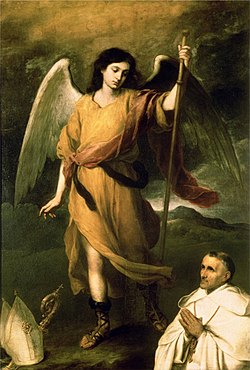
St. Raphael the Archangel
Today is the feast of St. Raphael, the archangel mentioned in the book of Tobias. In the first nocturn of Matins St. Bonaventure teaches us that angels point us to God in times of difficulty or when we lose our way: "an Angel does not bestow compuction, but bestows us the way" (5th Sermon on Angels). They pray for us to God (Apocalypse Ch. 8) and excuse us before God, unlike the devils who accuse us.

The "Golden Mouth" speaks of baptism
as a source of grace that we cannot
deplete, like the sun.
But the most marvelous lessons in today's office are to be found in the third nocturn, where St. John Chrysostom teaches us about baptism. His springboard for this lesson is the story of the five-time divorced woman at the well, who is reproached by Our Lord concerning her sinful life:

What manner of mystery is this? What does it reveal? for it is not written without a purpose : but the future is foretold in figure and similitude lest the unexpected occurrence of a wondrous event should in any way disturb the faith of the hearers. What, then is here described ? In the future a baptism was to be given, full of power and of the greatest grace, a baptism that would wash away all sin, that would restore life to dead men. These facts then are depicted figuratively, in the pool and in all the other circumstances. And first in this figure the water is set forth, which washes away stains of the body, and those things that are not actually dirty, though they were thought to be so, such as coming in contact with a corpse, or a leper, and such like: it is to be seen that many things under the old law are cleansed by water, in accordance with this idea.
But let us now return to the subject. First defilements of the body are washed out, and then God heals various infirmities by means of water. For because God would bring us nearer to the grace of baptism, he not only cleanses defilements but heals diseases. For those figures which come nearest to the reality, in baptism, the Passion, and others are seen more clearly than the older ones. For it is the same with those who form a king's bodyguard : they are more splendidly apparelled than those at the other end of his equipage. And the angel came down and troubled the water, and imbued it with healing power; so that the Jews might learn that the Lord of Angels had far more power to heal all the diseases of the soul. But just as here it was not simply the natural property of the water that healed, (otherwise it would have always have done so) but it happened through the work of the Angel : so it is not simply water that works on us, but after the water has received the grace of the Spirit, then it looses us from all sin.
Around this pool lay a great multitude of impotent folk, of blind, halt, withered, waiting for the moving of the water. But then those who wished for healing were prevented by infirmity from receiving it, while now everyone is able to come forward. For the Angel does not trouble the water, but the Lord of Angels brings all things to come to pass. We may no longer say, While I am coming, another steppeth down before me. But even should the whole world come, the grace would not be used up, neither would its power nor effectual working come to an end. For as the sun's rays shine forth each day without burning out, and as they spread abroad without losing any of their light : far less is the operation of the Spirit diminished by the multitudes who receive it. Now this miracle took place so that as men learned that could heal bodily diseases, and as they become accustomed to this fact over a period of time: so they might they the more readily believe that it could also heal diseases of the soul. —35/36th Sermon on St. John's Gospel
Happy feast day!