Showing posts with label St. Raphael. Show all posts

Saturday, October 24, 2015

St. Raphael, Protector of Holy Marriage

(Jan Steen)
Today’s feast is that of St. Raphael, “one of the seven who stand before the Lord” (Tob. 12). His name means “God has healed”; in the book of Tobit he heals the elder Tobias of his blindness, and also heals the marriage of the younger Tobias and Sara of its demonic infestation. The purification of their marriage prompts Tobias to pray at length with his new bride:
Then Tobias exhorted the virgin, and said to her: “Sara, arise, and let us pray to God to day, and to morrow, and the next day: because for these three nights we are joined to God: and when the third night is over, we will be in our own wedlock. For we are the children of saints, and we must not be joined together like heathens that know not God.” 
So they both arose, and prayed earnestly both together that health might be given them. And Tobias said: “Lord God of our father, may the heavens and the earth, and the sea, and the fountains, and the rivers, and all thy creatures that are in them, bless thee. Thou madest Adam of the slime of the earth, and gavest him Eve for a helper. And now, Lord, thou knowest, that not for fleshly lust do I take my sister to wife, but only for the love of posterity, in which thy name may be blessed for ever and ever.” 
Sara also said: “Have mercy on us, O Lord, have mercy on us, and let us grow old both together in health.” (Tob. 8)
These three nights of abstaining from lawful pleasures stems from the earlier advice of the angel:
“Hear me, and I will shew thee who they are, over whom the devil can prevail. For they who in such manner receive matrimony, as to shut out God from themselves, and from their mind, and to give themselves to their lust, as the horse and mule, which have not understanding, over them the devil hath power.

“But thou when thou shalt take her, go into the chamber, and for three days keep thyself continent from her, and give thyself to nothing else but to prayers with her. And on that night lay the liver of the fish on the fire, and the devil shall be driven away.

“But the second night thou shalt be admitted into the society of the holy Patriarchs.

“And the third night thou shalt obtain a blessing that sound children may be born of you.

“And when the third night is past, thou shalt take the virgin with the fear of the Lord, moved rather for love of children than for lust, that in the seed of Abraham thou mayst obtain a blessing in children.” (Tob. 6)
St. Raphael reminds Tobias that end of marriage is posterity, not the indulgence of lust. Those who approach the Sacrament with a desire for luxury are allowing the devil into their midst.

The parents of St. Thérèse of the Child Jesus dedicated the first year of their marriage to God by abstinence, in the hopes of bearing holy children. It was a common custom in the recent past for newly-married Catholic couples to abstain on their first night (called “St. Joseph’s Night”), in remembrance of the advice given to Holy Tobias. This practice is even alluded to in the first novel of Evelyn Waugh’s Sword of Honour trilogy, with the description of Gervase and Hermione Crouchback’s honeymoon.

But the book of Tobit is not all about diminishing the pleasures of life. The return of Tobias to his father’s house with a new wife in tow is seasoned with this charming description:
Then the dog, which had been with them in the way, ran before, and coming as if he had brought the news, shewed his joy by his fawning and wagging his tail. (Tob. 11)
Woof!

(Peter Rittig)

Wednesday, October 24, 2012

St. John Chrysostom on Baptism

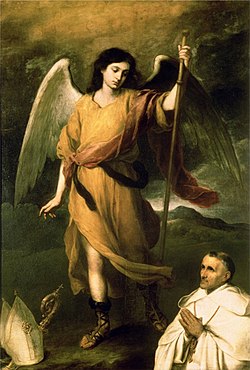
St. Raphael the Archangel
Today is the feast of St. Raphael, the archangel mentioned in the book of Tobias. In the first nocturn of Matins St. Bonaventure teaches us that angels point us to God in times of difficulty or when we lose our way: "an Angel does not bestow compuction, but bestows us the way" (5th Sermon on Angels). They pray for us to God (Apocalypse Ch. 8) and excuse us before God, unlike the devils who accuse us.

The "Golden Mouth" speaks of baptism
as a source of grace that we cannot
deplete, like the sun.
But the most marvelous lessons in today's office are to be found in the third nocturn, where St. John Chrysostom teaches us about baptism. His springboard for this lesson is the story of the five-time divorced woman at the well, who is reproached by Our Lord concerning her sinful life:

What manner of mystery is this? What does it reveal? for it is not written without a purpose : but the future is foretold in figure and similitude lest the unexpected occurrence of a wondrous event should in any way disturb the faith of the hearers. What, then is here described ? In the future a baptism was to be given, full of power and of the greatest grace, a baptism that would wash away all sin, that would restore life to dead men. These facts then are depicted figuratively, in the pool and in all the other circumstances. And first in this figure the water is set forth, which washes away stains of the body, and those things that are not actually dirty, though they were thought to be so, such as coming in contact with a corpse, or a leper, and such like: it is to be seen that many things under the old law are cleansed by water, in accordance with this idea.
But let us now return to the subject. First defilements of the body are washed out, and then God heals various infirmities by means of water. For because God would bring us nearer to the grace of baptism, he not only cleanses defilements but heals diseases. For those figures which come nearest to the reality, in baptism, the Passion, and others are seen more clearly than the older ones. For it is the same with those who form a king's bodyguard : they are more splendidly apparelled than those at the other end of his equipage. And the angel came down and troubled the water, and imbued it with healing power; so that the Jews might learn that the Lord of Angels had far more power to heal all the diseases of the soul. But just as here it was not simply the natural property of the water that healed, (otherwise it would have always have done so) but it happened through the work of the Angel : so it is not simply water that works on us, but after the water has received the grace of the Spirit, then it looses us from all sin.
Around this pool lay a great multitude of impotent folk, of blind, halt, withered, waiting for the moving of the water. But then those who wished for healing were prevented by infirmity from receiving it, while now everyone is able to come forward. For the Angel does not trouble the water, but the Lord of Angels brings all things to come to pass. We may no longer say, While I am coming, another steppeth down before me. But even should the whole world come, the grace would not be used up, neither would its power nor effectual working come to an end. For as the sun's rays shine forth each day without burning out, and as they spread abroad without losing any of their light : far less is the operation of the Spirit diminished by the multitudes who receive it. Now this miracle took place so that as men learned that could heal bodily diseases, and as they become accustomed to this fact over a period of time: so they might they the more readily believe that it could also heal diseases of the soul. —35/36th Sermon on St. John's Gospel
Happy feast day!