Sunday, May 12, 2013

Reaction to Fr. Sven Conrad's "Renewal of the Liturgy in the Spirit of Tradition"

I recently had time to read Fr. Sven Conrad, FSSP's article Renewal of the Liturgy in the Spirit of Tradition: Perspectives Towards the Liturgical Development of the West and will give a quick review of it here. Before making any comments, I would like to thank our resuscitated cardinal, Désiré, for linking me to this article some time ago. You may find the article here.
Fr. Sven Conrad, FSSP
source: newliturgicalmovement.org
Renewal of the Liturgy is essentially comprised of three sections: the first considering the development of the Roman rite over the last millennium, the second tracing the outlook of the reformers of the 1950s and 1960s, and the last segment provides some outlook in thinking about future reforms. Although quoted sparingly, Joseph Ratzinger's liturgy perspective provides the framework for Fr. Conrad to construct a conservative take on Ratzinger's concept of "organic" liturgy development. Implicit in Conrad's article is the thesis that the reforms of the 1950s and 1960s were less than organic in their nature.
Conrad creates a thesis of liturgical development in the first section, broken into three subsections—covering some basic history, hypothesized rules of development, and the Tridentine Council. Conrad establishes the variability of certain prayers of the Mass during the Middle Ages and traces the development of the Curial Missal to St. Gregory VII and Innocent III. The Curial Missal would eventually become the basis of the "Tridentine" Mass of 1570, used in various incarnations until 1969.
More importantly, Conrad sets down two rules of liturgical progression. The first is a historical remark: that local variations in the Latin rite are not matters of chance or corruption, but legitimate variations of the Roman rite, which is of Apostolic origin. The second rule, more Ratzingerian than the first, is that liturgical change and progression is small and most visible in secondary customs (the prayers at the foot of the altar would likely be an example of this). The Carolingian reforms, claims the author, solidified the basic form and orations of the Roman rite, leaving the details to local custom. Liturgical practices in cathedrals and monasteries enriched the spiritual life of Europe. The proper place for development of legislation was in tempering excesses and possible abuses, such as the restrictions the Council of Trent imposed on votive Masses of the Dead.
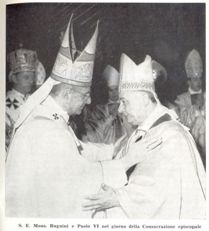
Archbishop Annibale Bugnini with Pope Paul VI
source: doctrinaliturgica.com
With these assumptions in mind, Conrad takes us to Pius XII and Vatican II. Conrad spends a lot of ink of the Memoria of Pius XII's commission for liturgical reform, which the author interprets as a very conservative document, mainly concerned with sorting out the bloated sanctoral cycle in the extant calendar. Although the portion on Vatican II is called the Vatican II Connection, it ought to be titled the Bugnini Connection. An entire subsection is, deservedly, devoted to Archbishop Annibale Bugnini's thought and opinions, as illustrated in his own memoirs. Here Conrad educates the reader with Bugnini's theology of liturgical reform, which assumes the liturgy to be an extension of the ministry of Christ, but then proceeds to devalue the external and the private in favor of the Archbishop's communitarian approach. I spent a good deal of time trying to convince people that the liturgical reform did not appear out of thin air, yet did not approach the theology of the reformers. Conrad gives us some insight I intentionally omitted. Our author then dedicates considerable time to the short-comings of the new rite's premises, like taking parish Mass rather than Pontifical Mass as the presumed liturgical norm, and the blurring of the lines between the lay and ordained that resulted from this idea. The result is a debased, de-ritualized, and un-concentrated liturgy. In many ways, says Conrad, this was the result of the subordination of liturgy to theological pre-conceptions:
"With all respect to the experts and, above all, to the authority of the Church, one cannot avoid the impression that this reform followed fundamentally different guidelines than every preceding liturgical development.... At the same time, we must emphasize a decisive aspect: The Second Vatican Council for the first time in history subordinated the assessment of established rites to a theological premise."

 In his last segment, Conrad turns our attention to the ever-enduring question of liturgical reform. He sides with Msgr. Klaus Gamber in wishing that the new and old rites might co-exist for some period of time for the benefit of the new rite:
"The new form should be linked up with it own tradition. In which the old form is a living point of reference and both should reciprocally enrich each other."
Perhaps Fr. Conrad is actually a certain priest whose last name starts with the last letter of the English alphabet....
Moreover, Conrad is optimistic that a more positive view of the Middle Ages will ensure more qualitative reform. In the Middle Ages liturgy was not just a part of life, but it was life.
In the last section, Is Reform Necessary?, Fr. Conrad touches on many points of contention among traditionalists and the reform-of-the-reform movement. Are there too few readings in the 1962 Missal? Should certain things, like the door ceremony on Palm Sunday, be restored? Should the liturgy be a matter of canon law at all? How can the ceremonies of the old rite inspire the Pauline liturgy?
Conrad, understandably, avoids concrete suggestions, but illuminates the wisdom of the eastern rites, which retain the form of their liturgical usages while adapting to the needs of the age, avoiding revolution at the same time.
On to my reaction:
Pros:
  • Establishes a thorough framework and retains his principles while considering both the Pian and Pauline attempts at reform.
  • Invaluable insight into the mind and fundamental assumptions of Archbishop Annibale Bugnini. At least read the article for this insight.
  • Makes a convincing case that the liturgy is neither a matter for theological subjugation nor of positive legislation.
  • Admits there are some serious problems in the 1962 liturgy, but did the Pauline reform solve these defects or not?
Cons:
  • Is the author genuinely Ratzingerian, or was Benedict XVI just popular when this was written? The theme of organic development, although trendy, may not stand up to historical scrutiny.
  • Quiet on the many drastic reforms in the Roman rite that pre-dated the Pauline revision, and which set the stage for it. Perhaps the author wishes to concentrate on the Pauline rite only?
  • The last section of the article fell flat when it failed to find anything the Pauline rite could learn from 1962 other than some ceremonial.
Conclusion: this exposition ought to convince any reader of serious flaws in the assumptions of those who instituted the new rites, assumptions which differ in principle from those of previous liturgical reformers and practitioners. The author shies from more exacting analyses or concrete suggestions, either intentionally or because he has constrained himself to Joseph Ratzinger's liturgical ideas. On the whole, a very informative article worth reading, and one that suggests liturgical theology is slowly returning to its proper place after a long exile.

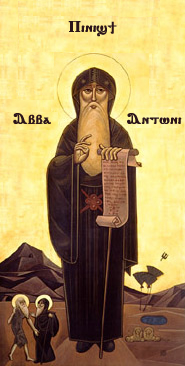
Desert Fathers

St. Anthony of Egypt
 
I came across this fascinating on a Coptic Orthodox monastery in Egypt. The community dates to the mid-twentieth century and the monastery is even newer, but the film contains some fascinating material toward the end. The beginning of the documentary recounts the formation of the community and the middle segment displays how the physical plant developed into its own sort of town, replete with a hotel for tourists/retreaters. The last third interested me, as it shows desert hermits living in caves in much the same manner as the Desert Fathers like Ss. Anthony the Great, Macarius, and John Cassian. Indeed, the last few moments feature the cave and tunnel dug by St. Macarius, into which he would flee unruly guests.


Thursday, May 9, 2013

Ascension of the Lord: Theosis in the Roman Church?


From the first sermon on the Ascension of Pope St. Leo the Great:

"After the blessed and glorious Resurrection of our Lord Jesus Christ, wherein the Divine Power raised up in three days the true Temple of God Which the iniquity of the Jews had destroyed, God was pleased to ordain, by His Most Sacred Will, and in His Providence for our instruction and the profit of our souls, a season of forty days which season, dearly beloved brethren, doth end on this day. During that season the bodily Presence of the Lord still lingered on earth, that the reality of the fact of His having risen again from the dead might be armed with all needful proofs. The death of Christ had troubled the hearts of many of His disciples their thoughts were sad when they remembered His agony upon the Cross, His giving up of the Ghost, and the laying in the grave of His lifeless Body, and a sort of hesitation had begun to weigh on them.
"Hence the most blessed Apostles and all the disciples, who had been fearful at the finishing on the Cross, and doubtful of the trustworthiness of the rising again, were so strengthened by the clear demonstration of the fact, that, when they saw the Lord going up into the height of heaven, they sorrowed not, nay they were even filled with great joy And, in all verity, it was a great an unspeakable cause for joy to see the Manhood, in the presence of that the multitude of believers, exalted above all creatures even heavenly, rising above the ranks of the angelic armies and speeding Its glorious way where the most noble of the Archangels lie far behind, to rest no lower than that place where high above all principality and power, It taketh Its seat at the right hand of the Eternal Father, Sharer of His throne, and Partaker of His glory, and still of the very man's nature which the Son hath taken upon Him.
"Therefore, dearly beloved brethren, let us also rejoice with worthy joy, for the Ascension of Christ is exaltation for us, and whither the glory of the Head of the Church is passed in, thither is the hope of the body of the Church called on to follow. Let us rejoice with exceeding great joy, and give God glad thanks. This day is not only the possession of Paradise made sure unto us, but in the Person of our Head we are actually begun to enter into the heavenly mansions above. Through the unspeakable goodness of Christ we have gained more than ever we lost by the envy of the devil. We, whom our venomous enemy thrust from our first happy home, we, being made of one body with the Son of God, have by Him been given a place at the right hand of the Father with Whom He liveth and reigneth, in the unity of the Holy Ghost, one God, world without end. Amen."

Monday, May 6, 2013

Further Thoughts on Catholic-Orthodox Relations

source: Reuters
In the conclusion of my last post, a review of Fr. Adrian Fortescue's The Early Papacy, I suggested many of the events the author adduces as examples of Papal primacy in the ancient Christian days ought to figure into ecumenical dialogue between the Catholics and Orthodox. As someone who worships at a Melkite parish and who is interested in liturgical matters, you might say I have some extra interest in affairs with the Eastern Orthodox.

A thousand years ago the filioque and the use of unleavened bread in the Eucharist were the main causes of controversy. Nowadays, no Easterner who knows Latin can seriously believe the filioque is heretical, nor do many think the use of unleavened bread invalidates the Sacrament. The modern issue is the role of the Pope of Rome within the universal Christian body. There are some less apparent issues involved here: the Patriarch of Constantinople has been called the "Ecumenical Patriarch" for some time, but the Russian Patriarch and the Russian Church have been the major movers within Orthodoxy in recent years. Yet, I would be more interested in dialogue concerning micro-level issues which I think are more important than the Papacy. If both sides are honest, the faith of the Fathers will define the role of the Pope.

The Pope has very little to do with the daily life of most Catholics, except when we pray for him. What might impact, or impede, attempts at unity might be social and personal practices. What immediately comes to mind:
  1. De-centralized Orthodox social teaching, which has led to much silence on Life matters and a general concession on the matter of birth control.
  2. The Orthodox practice of ecclesiastical divorce. An Orthodox person can marry up to three times, although the second and third wedding would be penitential services and exclude the crowning rites. Is there any justification for this? Might require some meditation. One Eastern Catholic priest I know indicated he would be willing to give Communion to an Orthodox divorcer because said person can receive in his own church, but would still continue the Catholic Church's policy with Catholics.
  3. Jurisdiction of local bishops. What would happen here? The Melkites and Antiochian Orthodox might have a fun time with this one.
  4. What about Western private devotions and revelations? The Eastern Christian devotions are very liturgical and not very private in nature—akathist being a prominent example. How do these churches preserve their own identity without disparaging those who have different devotional lives?
  5. Accepting converts. Eastern Catholics usually follow Roman Catholic policy in accepting most protestant baptisms and simply confirming. The Orthodox sometimes baptize, sometimes confirm, and, when the convert is a clerical of some kind, might accept by "vesting." This needs to be addressed.
  6. Those Roman episcopal conferences. They are a mess. Perhaps we could discourage our own clergy from these conferences and return to a patriarchal understanding of hierarchy. Maybe the idea of an archbishop could once again have substantial meaning in the West.
These areas appear to my poor mind as needing some attention in future conferences and discussions.

Happy Bright Week to any Orthodox readers!

Book Review: "The Early Papacy" by Adrian Fortescue


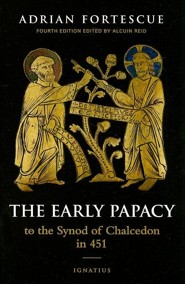
I have not had occasion to write a book review in a while, but I recently read a [very] short work by Fr. Adrian Fortescue worthy of some attention called The Early Papacy to the Synod of Chalcedon in 451.

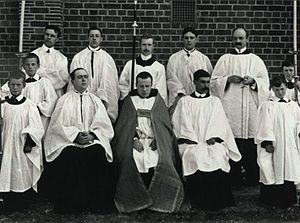
First a few words about the author. Fr. Adrian Fortescue was a very capable linguist and patristic scholar, and something of a frustrate eccentric. He was one of the few clerics in Church history to have shot another man dead and not have been worse off for it. During his travels to Asia Minor and the Middle East, Dr. Fortescue studied the ancient churches of those countries, ecclesial bodies which had long fallen out of the Western mind. Indeed, the re-introduction of the Greek Fathers owes much to Fortescue's introduction to them and his trilogy on Eastern Christendom. Fortescue is most renowned among Catholics nowadays as the author of Ceremonies of the Roman Rite Described, which has gone through so many editions that only the original chides against fiddleback chasubles is recognizable.

Fr. Fortescue at his parish of St. Hugh's in Letchworth
source: Wikipedia
Above all, Dr. Fortescue was a Roman Catholic priest in early twentieth century England, an England slowly re-building its Catholic community, dealing with the Oxford Movement in the Anglican Church, and the spirit of Vatican I. It was in this setting that Fortescue was challenged to demonstrate the existence of a Papacy before the year 451, the year of the Council of Chalcedon. Many "high" Anglicans became enamored with the Branch Theory derived by Palmer and popularized by the Tractarian Movement. One assertion latent, although not always explicit, in this theory is that the "Papacy" as it exists now is a corruption or a series of politically-driven accretions to the ancient and venerable Bishopric of Rome. Fortescue, obedient to the teaching of Pastor Aeternus, believed the Catholic claim of a continual office through the ages with no apparent reservation, but still thought an inquiry and demonstration of the ancient Papacy worthwhile. He wrote a series of long articles addressing this matter and published them in the Tablet (for my American readers, think an English version of the National Catholic Reporter or Register).

Dr. Alcuin Reid's introduction manages to de-contextualize the presumed context of this collection of articles. One might assume Fortescue intended to unleash a rhetorical flurry of polemical assertions in line with the language and spirit of the First Vatican Council. The post-Vatican I Church was the era of The Early Papacy but certainly not the context. Dr. Fortescue was no ultramontanist. No one with absolutely blind obedience to Rome could write such racy lines as:
"We have stuck out for our position all our lives—unity, authority, St. Peter the rock and so on. I have too, and I believe it; I am always preaching that sort of thing, and yet is it not now getting to a reductio ad absurdam? Centralization grows and goes madder every century. Even at Trent they hardly foresaw this this kind of thing. Does it really mean that one cannot be a member of the Church of Christ without being, as we are, absolutely at the mercy of an Italian lunatic?
".... Give us back the Xth century Johns and Stephens, or a Borgia! They were less disastrous than this deplorable individual."
[St.?] Photius, archbishop of Constantinople
source: wikipedia.org
These comments he wrote concerning Papa Sarto, but he could be similarly critical of, if less acerbic toward, Leo XIII. Point is, if you think Fortescue was a blind Roman puppy, think again. He defended the Papacy because, as a patristic scholar, he believed in it—even when the Bishop of Rome frustrated the English vicar.

Fortescue begins the book by questioning the cutoff date of 451, which he rightly calls arbitrary. One may argue compellingly that while schisms between dioceses existed prior to the Council of Chalcedon, 451 was the first time an entire segment of Christendom (the far eastern churches, in this case) broke communion with the general body. This is not true, as the Assyrian churches split off after the Council of Ephesus decades earlier. The priest muses over the date in a way which exposes his quick whit and humor:
"Go and teach all nations, until Photius is intruded at Constantinople; and I am with you all days, even to the year 451."
Herein we see the faithful assumption of Fortescue: that the Church of ancient times is continuous with the Church of the Middle Ages, which is continuous with the Church today. One Church runs through these eras of history and our Lord's promise to the Apostles held in 451 and still holds today. With this Catholic premise established, Fortescue lays down what he views as the Catholic Church's four essential claims about the office of the Bishop of Rome:
  1. He is the chief primate throughout all Christendom
  2. He has episcopal jurisdiction without limit, in contrast to the diocesan jurisdiction of a bishop
  3. Communion with this man marks you as a member of the Church of Christ, and lack of communion puts you outside the Church of Christ
  4. He speaks without error on matter of religious belief
Fortescue considers each of these points in an individual chapter, beginning with a short suggestion of what we should see in the patristic corpus concerning that topic. The author warns us not to read too much into arguments from silence, as the Holy Trinity Itself was not defined in any way until 325, but silence concerning the term "Trinity" before Nicaea does not make the earliest Christians followers of Arius.

The exposition on each of these points uses a fair illustration of the relationship between the early Church and the Bishop of Rome, the chief-most of Christian bishops and the successor of St. Peter. He draws heavily on Ss. Cyprian, Ambrose, Augustine, the early Popes themselves, legal decisions from the Roman emperor, and even people from the far eastern churches of Syria and Armenia.

The first point, of Papacy primacy throughout the Church, is so uncontroversial it is not worth my recounting. The second, of the Pope's universal jurisdiction, comes with an important caveat from Dr. Fortescue: the Papacy is not a gradation of Holy Orders above that of bishop; the Pope is a bishop like any other, but his jurisdiction does not end at the walls of the diocese of Rome. This statement subtly tempers the assumptions of any ultramontanist reader.

The chapter on the third point, communion with the Roman bishop, is most elucidating. Use of the term "communion" in the Eastern understanding was less common in Fortescue's age than it is in the post-Vatican II era, so his use of it is significant. As a matter of common sense, our author reasons that one must be in communion with the Pope to be Catholic simply because the Pope is a Catholic. A society which is fragmented, in which people belong to different groups, really no longer exists. The communion of the Church of Christ does still exist and its visible mark is union with the Pope. Fortescue details St. Cyprian's views on schisms in his own time, particularly that of Fr. Novatian, from the Church, specifically from the communion centered in Rome. Similar accounts of St. Ambrose's battle against the Donatists follow.
St. Clement, last Pope of the first century

Most compelling in that chapter is Fortescue's evidence from Eusebius, St. Jerome, and from the Popes themselves: the Bishops of Rome decided who to admit to their communion and no one else. These were men accustomed to obedience.

The final chapter, concerning Papal Infallibility, is also a must-read for many Catholics and non-Catholics who think this charism means that the Pope can bind people to believe whatever he wishes. Fortescue gives us a firm belief among the Christians of antiquity that the Church does not err. The Pope, by virtue of his universal jurisdiction, is encompassed in that belief and the promise of Christ's to guide the Church in "all truth." Infallibility does not, nor should it be construed to, mean that the Pope is intrinsically better than all other bishops and acts as a theological dictator. Indeed, the author observes, if there were no other bishops the Papacy would be quite meaningless.

There are two weaknesses in this very strong little volume.

The first is that Fortescue does not differentiate the various kinds of relationships between the Pope and other bishops. The learned priest amply shows pro-active Papal command of other churches (interventions in Corinth by St. Clement in the first century come to mind, as does St. Julius's dealings with St. Athanasius), but would have done well to say something about how patriarchs and diocesan bishops outside the Roman patriarchate might have viewed the Papacy, a view and a relationship almost certainly different from that of bishops within the Roman patriarchate.

The second is lack of consideration of the Orthodox perspective, which currently holds the Pope to be the first among equals. This is a more historically grounded perspective than the Anglican branch theory and one which will be discussed in ecumenical dialogue for many years to come. Perhaps the next time Roman Catholics, Eastern Catholics, and Eastern Orthodox dialogue, they could react to a book such as this—not for its polemical value, but because it recounts clear examples of the role of the Papacy in ancient times. I suspect Fortescue omitted the Orthodox perspective because he was primarily reacting to an Anglican challenge and living in an Anglican country. He would certainly have been aware of the Orthodox view, though.

On the whole, an informative book which makes a compelling, lucid case for the Catholic Church's claims about the Bishop of Rome in the period before the Council of Chalcedon without being too caught up in the excesses of the post-Vatican I period.

Saturday, May 4, 2013

A Word About the ICRSS

Fr. Franck Quoex after celebrating Mass with the FSSP in 1998
source: http://www.fssp.org/album/VPB1998/
Since I posted images of Holy Week at the Institute of Christ the King Sovereign Priest's seminary in Italy from 2003, I have received a number of comments and inquiries about the Institute's current liturgical practice and why/when it ceased to use the old rite in favor of 1962. I may have an answer to that point.
 
While searching for some information on that point I came across an interview with one Fr. Patrick Perez with a man named Stephen Heiner. Judging from some of the other interviews on Mr. Heiner's page, I would surmise that Fr. Perez is affiliated with some groups on the edge of canonicity, but that is not relevant to what he has to say. In his interview Fr. Perez recounts being ordained with the Institute in the 1990s when they were still under the bishop of Gabon in Africa. While in that state, Fr. Franck Quoex taught liturgy and M.C.ed for the Institute. Quoex advocated for "pre-1955" (which could mean whatever was done in 1954, or exact use of the 1939 typical edition) and the Institute seems to have followed along. And some point, in more recent times, Rome integrated them into the Pontifical Commission Ecclesia Dei, possibly with grudging participation by the Institute. This process compelled the Institute to adopt the 1962 liturgy used by all the other Ecclesia Dei communities. There may have been some level of resistance. Fr. Perez seems to have left the Institute and gone "independent" in protest. I heard a few years ago that the Institute's parish in St. Louis, MI had celebrated the old Holy Week with some post-1956 practices (Mandy Thursday and Holy Saturday Masses in the evening, Communion of the faithful on Good Friday, four readings on Holy Saturday). I do not know if this mash-up was confined to St. Louis or just meant to be transitional, but it did not last. Now the Institute seems to use the 1962 liturgy with some quiet protest: prayers at the foot of the altar on days which omit them, commemorations, old Gospel tones in Holy Week, Palm Sunday door ceremony, old Mass ceremonial etc. Any readers experienced with the Institute may correct me if I am wrong, as I have never had occasion to worship at an Institute parish.
 
Oddly, while the Institute did use an older liturgy and has modernized, some parishes, are moving the other way. We shall see what the future holds.

Friday, May 3, 2013

Invention of the Holy Cross

source: disharoon.net

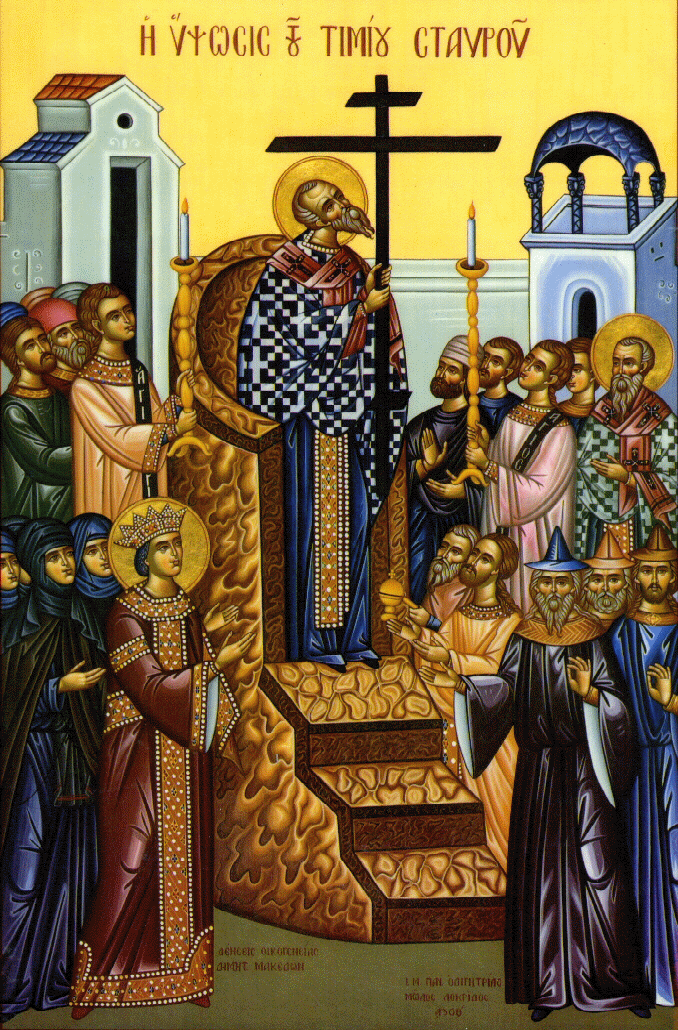
Today is the Feast of the "Invention," or "finding," of the Holy Cross by St. Helena, mother of Emperor Constantine. The second nocturn of Mattins today recounts how the saint used a sick person to discern which of several candidates was indeed the True Cross of our Lord, the person being healed instantly upon touch the real one. Despite the liturgical reforms of the 1950s and 1960s, the Latin rite Catholics in the Church of the Holy Sepulchre in Jerusalem still observe this feast, which mostly disappeared in 1960. Below is a video of last year's celebration, in which a relic of the True was carried in procession.