Sunday, April 7, 2013

Reasons for the Reform of the Roman Rite Part III: Devotionalism


We have now come to the third part in our series on the causes for the twentieth century reforms of the Roman rite liturgy. Today's cause, what I have termed "Devotionalism," is the first that can be attributed to the laity rather than the clergy or clerical culture. What is meant by "Devotionalism?" Two things:
  1. A tendency to over-emphasize private devotions at the cost of liturgical prayer.
  2. Private devotions entering into the liturgical calendar of the Roman Church, such that the calendar loses its rhythm.
Let us consider these issues in the order above.

The two most popular anatomical devotions: the Immaculate Heart of Mary
and the Sacred Heart of Jesus
First, private piety. Private piety underwent a considerable change during the baroque period. Through the Middle Ages and Renaissance, and in the Eastern rites to this day, the demarcation between liturgical prayer and extra-liturgical devotional prayer did not seem as sharp as it is in the modern Roman Church. This is not to say private prayers that follow some particular meditation or formula, such as the Rosary, were foreign. But the Rosary was clearly a private prayer. There was such a thing as public devotion, which had a very liturgical expression. One immediate example is the Office of the Blessed Virgin Mary, a mini-Divine Office following Marian themes that would often be sung on low ranked days. The Byzantine rite Akathist sung at Compline on the days leading up to the Annunciation resound as a modern day example of public devotion. Before Masses in medieval cathedrals the clergy and laity would visit the altars of the various saints, honoring them in hymns and asking for their prayers. Northern Europeans "raised" the Cross before Mattins and Lauds of Easter Sunday, a reflection of the "deposition" from the Cross on Good Friday—East and ancient West.

Devotion could clearly be a public act of worship or a personal prayer. During the years after Trent most of this changed. Local customs often remained, although liturgical centralization reduced them in their variety (more on that in a later post). While customary public devotion diminished, private devotions proliferated. St. Pius V popularized the Rosary beyond the Dominican Order, the Sacred Heart appeared on the scene in the seventeenth century, as did many other "anatomical" devotions, such as the Precious Blood. The Lady of Mount Carmel devotion also became popular, as did the associated "Brown Scapular"—which is actually just a symbol of a full scapular.

A private oratory named for Our Lady of Sorrows. A statute
of Our Lady of Sorrows in visible above the altar.
source: newliturgicalmovement.org
The Church has never deemed these devotions necessary, only requiring attendance at Mass for the laity and the Office of the clergy. Yet the "low Mass culture" examined two days ago cultivated a church setting where one would simply be listening to a priest talk in Latin for 45-60 minutes, a setting which required very little other than attendance of the laity. The low Mass culture is not conducive to sung Offices, much less any of the extra-liturgical functions mentioned above. Private prayer and private meditation filled the void for the laity during Mass. Indeed, as mentioned in the previous post, many methods of "hearing Mass" centered around these devotions.

The names of churches in the last four or five centuries tell the story. How many post-Trent churches are named Blessed Sacrament, Our Lady of Sorrows, Our Lady of Mercy, Immaculate Conception, Sacred Heart, Divine Mercy etc? How many received conventional names like St. Mary's or St. Peter's?

Here we reach the second point, wherein Devotionalism becomes not just a private liturgical substitute, but actually took root in the liturgical calendar.

Private devotions held by the laity or private devotions Rome wished to popularize found themselves in the calendar, often affixed to certain Sundays rather than days of a given month. Some examples are the Holy Name (second Sunday after Epiphany), St. Joseph (third Sunday after Easter), the feast of the Precious Blood (first Sunday of July), St. Joachim (Sunday after Assumption), Our Lady of Sorrows (third Sunday of September), the Rosary (first Sunday of October), and others like the Sacred Heart (falls on third Friday after Pentecost). Fr. John Hunwicke once called these devotional days "lollipop" feasts.

There were two consequences to this phenomenon. The first is that the Sunday Mass given for the time after Epiphany or Pentecost was said perhaps half the time, while these devotional feasts and other Double-rank feasts (see first post in series) impeded them. The second consequence was that the Masses for the time after Epiphany and Pentecost, which recount Christ's teaching and His miracles more than His actions, were rarely observed. This contrasts with many Eastern Sundays such as the "Sunday of the Prodigal Son," the "Sunday of the Pharisee and the Publican," and the "Sunday of the Rich Man and Lazarus" to name a few. Each of these "green" Masses was a self-contained lesson on the teaching life of Christ, yet feasts based upon private devotions often won the ranking competition. If Holy Week recounts Christ's Passion, if Eastertide recounts the time after His Resurrection, and if Advent and Christmastide recount His birth, then these "green" Sundays recount His preaching career. Double-ranked feasts and devotional feasts lessened the significance of these Sundays. The inevitable result was the replacement of public devotion and public liturgical life with folk religion.
Fr Antonio Rosmini

Naturally, many early members of the Liturgical Movement or those who favored drastic reforms of the Roman liturgy wished to force people out of their private devotions and into communal liturgical participation. One motive for the adaptation of vernacular and for "simplified" ceremonies during the last period of the Liturgical Movement, during the Second Vatican Council, was the wish to pop people out of their private prayer bubbles during Mass. Pius XII, anticipating certain excesses, attempted to moderate these views by issuing Mystici Corporis and Mediator Dei, as well as implementing certain demands of the Movement under Papal authority, but eventually these changes were of no avail and actually accelerated the reform process.

Reformers such as Rosimini constantly called for more "simple" ceremonies, as if the Roman liturgy was not already very sparse compared to Eastern and other Latin liturgies. Indeed, in his Five Wounds of the Holy Church Rosmini caterwauls over the separation of the people from the clergy, from the scriptures, and of the overgrown liturgy which caused this. Rosmini saw Europe secularizing and partially blamed the compartmentalized relationship between the priest and people at Mass for it. Of note: in the first chapter of his Five Wounds, Fr. Rosmini suggests that while Latin has become a barrier between priest and laity, the abolition of Latin was not the answer. He demands further effort in helping the laity understand the Latin Mass and also admires the Eastern Churches' retention of their own sacred languages. Rosmini wrote of the problematic separation of the laity from worship:
"This worship, to which God united the grace to render men and women capable of practising the moral precepts they had received, was not simply a spectacle for the people to behold. The people were not to be present simply to look at what was happening without genuinely participating in this drama of religious worship."
St. Pius X, for all the criticisms possible of his psalter and breviary rubrics, presents an elegant solution to the intrusion of Devotionalism into the calendar. He assigned each devotional feast a particular day of a month (ex. Precious Blood moved from first Sunday of July to July 1st) and gave the option for the Mass of the feast to be repeated on the next Sunday, provided the feast was not observed at the main Mass of the day.

John XXIII's adjustments to the calendar go far beyond Papa Sarto's changes, a true predecessor to "Ordinary Time," an endless monotony of "green" Sundays well beyond that which would have been experienced even under the sparse local calendars of ancient Rome and monastic settings during the Middle Ages. Pope John's calendar compressed the liturgical rankings of various days and gave preference to "green" Sundays to the point where feasts of the Apostles except Ss. Peter and Paul, would be excluded from even a commemoration on Sundays. Oddly, these simplified rubrics, when they do permit other feasts to overtake the "green" Mass, rarely commemorate the "green" Mass. Pope Roncalli's changes also diminished the number of lessons read at Mattins by about two thirds. "Ordinary time" in the Pauline liturgy completes this shift. The Roman general calendar swung like a pendulum from one extreme peak to another, briefly passing a nice position midway through the shift.

To conclude the thesis of this post in our series: public devotion evolved into private Devotionalism, which introverted a large number of laity and obscured important features of the calendar. Reformers began to demand simplified ceremonies to engage the laity and to alter the calendar in such an extreme fashion that all but a few feasts could ever take precedence over Sunday "green" Masses.

We should be very aware that while vernacular certainly shook the laity out of their private prayers during Mass, as I mentioned in my previous post on the "low Mass culture," very few of the changes to the calendar or to the form of the Mass took place during the Second Vatican Council. Indeed, the seeds of this problem began in the baroque period and calls for change started a century before Vatican II and the changes themselves started 50 years prior to Pope John's council. You can see that we soon will be reading about the Liturgical Movement!

I hope I do not appear to be blaming the laity for their private piety, that is not my intention. As someone who prays the Rosary and recommends you all do as well, I value devotion, but all things have their proper place. The second most recent position paper from Una Voce published by Dr. Joseph Shaw on use of the older Holy Week considers the times of the older rites pastorally preferable because, among other reasons, parishes would have time for Stations of the Cross after the Mass of the Pre-Sanctified. Is this Devotionalism or is it a semi-liturgical public devotion, like those of Northern Europe in times gone by? At the very least, a conversation has been started about more fundamental concepts of liturgy by papers and conferences such as Dr. Shaw's.

Our next post, likely shorter than these past three, will investigate the separation of liturgy and doctrine, in its precedents and its consequences. Stay tuned! Happy Low Sunday and a blessed Easter season to all!

Thursday, April 4, 2013

Reasons for the Reform of the Roman Rite Part II: Low Mass Culture (UPDATED)


Today I will treat the second of my six proposed causes of the reform of the Roman Rite in the 1950s and 1960s, the excessive usage of the low Mass at the cost of sung Masses or public celebration of the Divine Office.

Again, a little history goes a long way in understanding this phenomenon. Mass, and the Divine Office, is supposed to be sung using the chants given in the liturgical books of a given rite, be it Roman, Byzantine, Armenian, Milanese, or Japanese. High Mass is the presumed norm. Indeed, until, but not including, 1960 there was no formal distinction made in the liturgical texts of the Roman rite between sung Mass and low Mass, only between private and public Masses. Public Mass was presumed to be sung in a communal or conventual setting, such as the Mass sung by all the monks of a monastery in a given day or the main Mass on a Sunday or Holy Day in a parish church.
A monk of Clear Creek Abbey reads his private daily Mass

Private Mass developed in the late first or early second millennium. There were two motivations for its development: the first, and main, was so that priests who were monks and canons of collegiate churches could celebrate the Eucharist on days which they were not assigned roles at the main Mass; the second, so that numerous Masses for the Dead might be prayed. To put it succinctly, the purpose of the low Mass is so that a priest could live a full sacramental life under circumstances which would normally reduce him to spectator. This is a good reason on its own, but not one which makes low Mass suitable for public liturgy.

Originally the low Mass simply lacked a deacon, subdeacon, and incense. At first it was sung, although texts describing how are no longer extant. As late as the eighteenth century in France low Mass was sung in a monotone, except for the Canon, which was recited as it is at any type of Mass.

During the Middle Ages laity would frequently attend private low Masses, hoping to see as many elevations of the Blessed Sacrament as possible, asking for prayers to be said for their deceased loved ones. These are private devotional motives, and ones clearly supplemental to public worship. Private Masses did not stop rural parish churches from offering high Masses on Sundays and Holy Days, nor did they impede urban churches and monasteries from singing the Divine Office in choir. Indeed, private Masses were initially votive Masses and not part of the liturgy prescribed in the calendar. What happened?

In short, the model for sacramental life underwent a drastic change during the centuries that followed the Council of Trent, which did very little to change the presumed setting of the liturgy. First to note is the two major religious communities that the Counter-Reformation birthed: the Jesuits and the Oratorians. Ignatian spirituality is famously individualistic, focusing on private reflection and efficient meditation conducive to the life of a missionary priest. Although Jesuits operated in large communities their charism did not call for communal gatherings. Therefore Mass was often read in private and the Divine Office, the public prayer of the Roman Church, was recited in private.

"First Mass in Florida"
source: State Archives of Florida
This same analysis applies to the Oratorians, although I will readily concede that they do make an effort to have sung Masses and Vespers on Holy Days and Sundays. St Philip Neri said nearly every Mass in private and emphasized individual relationships with his parishioners. Neither of these things are bad. Indeed, the latter of these is a pastoral necessity. Still, given the size of Oratory communities, surely sung Offices were plausible?

The missionary needs of the Church also expanded the use of the low Mass and put it at the center of public liturgy. The discovery of the Americas by Christopher Columbus sent Spanish and Portuguese missionaries everywhere from Florida to south of modern-day Brazil. Priests often had better things to do than teach the locals how to sing in a language that used a different alphabet, such as build churches, create schools, and foster relationships. But when missionary communities expanded, high Masses did not follow.

A typical post-Tridentine country church
England and Ireland, although not part of the New World, were seen as missionary countries, as the faith was effectively suppressed on those islands for several centuries. Mass had to celebrated as privately and as quietly as possible. Low Mass was really the only option, if the priest wished to remain a free man.

As a result, outside of Western Europe, by the nineteenth century the faith was well-established in North and South America, growing in Africa and Asia, re-established in Ireland, and returning in England. Yet high Mass was very rare in these places and celebration of the Divine Office even rarer (although Vespers were popular in London until World War II). The revolutions of the nineteenth century and the two world wars of the twentieth century forced parish priests doing temporary duty as chaplains recite the Office in private and read Mass as quickly as possible. Sermons disappeared for practical reasons.

Yet I think I am blaming the nineteenth and twentieth centuries too much here. How do we explain this chapel, shown on the right?—a site so common throughout rural Europe? It is clearly built for low Mass and also for public viewing.

The Counter-Reformation defense of the priesthood, of the Real Presence, and of private devotion put an over-emphasis on all of these things, the "Spirit of Trent" if there ever was one. Various saints like Louis de Montfort, Francis de Sales, and Peter Julian Eymard devised methods by which the pious soul might hear Mass. These included, but were not limited to, meditating on the Passion, meditating on the Marian mysteries, and praying the Rosary. There is nothing wrong with any of these things, but none of them involve directly considering the Mass of the day. Easter Sunday and a votive Mass of St. Joseph vary minimally with this sort of devotion.

I will treat what I call "Devotionalism" in a separate post, but I think it suffices to say that regardless of what one thinks of these various spiritual devotions, they do not require one to engage the Mass of the day. The proper texts carry minimal importance.

This problem was compounded by the introduction of the layman's missal, first published in English by Bishop John England of South Carolina. Personally, I find the layman's missal very beneficial at high Mass, where I can glance at the Introit or Gradual, close the book, and spend some time in meditation whilst the choir circulates these words slowly through my mind. At low Mass this is not possible. One can only read the text and, as the priest too is reading, one feels compelled to keep pace with the priest. This means that, inevitably, one races through the missal throughout most of Mass, clinging on the priest's every word, trying to understand it. It seems one can either neglect the propers of the Mass in private devotion or cling to every word in a translation frenzy. There has to be a better way of praying than this. The hand missal has potential, but this potential is not tapped at private Mass.

Moreover, the focus on the propitiatory effect of the Sacrifice of the Mass gave people the impression that they only had to attend the Mass and not engage it. I shy of using the word "participating," as this word reminds most traditionalists of some layperson reading the book of Numbers from a lectern for five long minutes. Still, I maintain that a lay person can be very engaged in the old rite high Mass.

As someone who attended private old rite low Masses three or four times a week for a considerable period of time, I can say that I found little in life as rewarding or as spiritually uplifting as serving private Mass. Yet I find little disengaging as hearing a public low Mass. My Latin is decent and I know the liturgy. The close quarters allow these skills to take over my faculties and have an intimacy with the mysteries of the day. This is not possible for the average layperson listening to the priest's voice muddle through the walls of the church. One loses sight of Mass as an action.

This effectually divided the priest and the person in the pew (pews are a damned problem on their own) to the point that people viewed themselves as spectators. What the reformers got [very] wrong was the loss of a critical distinction: there is a difference between making the Mass accessible to a lay person and focusing the Mass on the laity. Sung liturgy makes the former possible while what happened was the latter.

Sung Vespers
source: newliturgicalmovement.org
Given this stark liturgical praxis, one could hardly expect public recitation of the Divine Office. It fell out of use in most churches. The reason hymns like Ave Maris Stella repeat so often in the Office and that most of the Sunday psalms were used on major feasts is because in ancient days parish churches in Rome determined their own Office and the clergy made an effort to use the most familiar material. In short, the old, pre-Pius X Office, was well-built for popular use owing to its repetition of hymns and utilization of psalms. This system became mundane by the end of the nineteenth century, as I said in my previous post, but an abuse ought not render the entire system dead.

Yet the prevalence of low Mass culture meant that liturgical texts were the jurisdiction of the priest, not the laity or even a collegiate community. Laszlo Dobszay in his The Bugnini Liturgy estimated that by the mid-twentieth century 95% of priests had no experience singing the Office in choir. I cannot verify this figure, but even 2% would be an appalling figure! What the hell were these people doing in their seminaries? A priest can hardly be blamed for not holding Terce before Mass or Vespers in the evening. These sung Offices were foreign nationals speaking an alien tongue to the clergy!

By the time Vatican II issued its liturgical constitution virtually all Sunday Masses were low Masses, with the rare sung Mass or low Mass with vernacular hymns for special occasions, like Confirmations or Christmas. People were used to Mass being their private, quiet time. Indeed, several years ago I took my father to a Latin Mass for the first time since 1965. He could not bear the 75 minute duration of the Mass. Afterward, I learned not only had he never attended a sung Mass in the old rite before, he was unaware such a thing existed! Vernacular, aside from being a change on its own, disturbed the person in the pew from his private prayers. The priest and lay person were talking to each other, although not necessarily praying. With sung prayer a long-gone concept, this vernacular exchange naturally became a conversation, not a liturgy.

What began as the priest's private devotion became the priest's sole function and the laity's private devotion. The reformers saw the problem, but not its cause or better solutions.

Am I blaming low Mass too much? Maybe. Or perhaps we are too accustomed to low Mass to see the problems its use as the norm creates.

UPDATE:

First I would like to thank Marko and Désiré for their input, which has given me some cause to update and clarify what I am trying to say here. I would maintain that the majority of Sunday Masses throughout the world were low Masses. In certain European cities—mainly London and Paris—one could easily find a Missa Cantata as the main Mass in most parishes and in other cities—particularly Rome and Cracow—solemn Mass. Still, in the Americas and elsewhere there was a proliferation in the number of Masses, but not necessarily high Masses. If a parish in 1820 had two Sunday Masses—one high and one low—it likely had three or four Masses in 1920—one high and the rest low.

Diaconal ordinations at the FSSP seminary in Denton, Nebraska
source: FSSP
Moreover, by "low Mass culture" I do not simply mean the number of low Masses, but the effect this new liturgical norm had on the liturgical praxis and formation of clergy. High Mass, outside of some European cities, had become so rare that seminarians routinely only spent a few days or weeks in the subdiaconate and diaconate. This contributed to a depleted understanding of the sacramental role of each level of Holy Orders, as well as a de facto ignorance of the qualitative difference between solemn and low Mass.

The restoration of the "permanent" diaconate is an amusing illustration of this problem. There was never a "permanent" diaconate, just deacons who did not have the vocation to become priests. Popes Innocent III, Leo X, and St. Gregory the Great were all deacons when elected and probably had no intention of becoming priests. The restoration of the "permanent" diaconate is an ill reaction to the loss of solemn Masses. The emphasis on the priesthood and also the "low Mass culture" meant most deacons only remained so for a short time until they became priests. The reformers assumed this "transitional" diaconate suppressed a phantom "permanent" one. The truth is that one simply accepted the call of the Church through the discretion of the local bishop, whenever that time came. My theory is that the "low Mass culture" contracted the number of deacons who did not immediately anticipate a priestly ordination and resulted in the short-lived diaconate of seminarians.

Lastly, I would like to say something about the dialogue Mass, an idea that came to me while gleaning Fr. Conrad's article. Although the reformers like Archbishop Bugnini wished to return to sung Mass, they still initiated many of their early attempted alterations on low Mass, such as the "dialogue" Mass. For those readers unfamiliar with this practice, the "dialogue" Mass was a set of rubrics for private Mass issued by Pius XI in 1922 that allows for the faithful to recite any number of things normally said by the server. Some parishes, under dubious legality, extended this participation to many other parts of the Ordinary of the Mass.

Yet the "dialogue" Mass, which I find can be done well, reveals the dynamic of "low Mass culture." In countries where sung Masses were still common, such as France or urban Italy, the "dialogue" Mass was successful and is still practiced to this day. Indeed the FSSPX church in Paris and FSSP church in Rome demonstrate a very impressive degree of participatio actuosa. Those who learned the responses and Ordinary by singing the Mass had no problem when the time came to recite the Mass. Yet in  many countries that I mentioned, mainly the Anglophonic world, missionary countries, and the Americas, the "dialogue" Mass never caught on. Indeed, many parishioners still find the idea awkward. Englishmen are distinctly allergic to the faithful saying anything. During the first time I attended Mass at the Oxford Oratory I began to say the Domine non sum dignus and promptly stopped, horrified that my voice and the priest's were the only noises audible in the entire church.

Lastly, I would like to share a brief anecdote. I once asked my priest, a Melkite Catholic formerly of the Roman Church, why the East had retained communal singing of the Office while Rome had not; we have two weekday Divine Liturgies, one weekday Vespers, and Compline during Great Lent. He ruminated and said "Where two or three are gathered in My Presence, someone has to say Mass."

Understand I actually do like low Mass as long as it used responsibly, yet I think the above quote speaks volumes.

I will read Fr. Sven Conrad's article and publish some sort of review either in my conclusion to this series or afterwards.

Tuesday, April 2, 2013

Reasons for the Reform of the Roman Rite Part I: Feasts

Since Benedict XVI's motu proprio Summorum Pontificum, which declared the liturgy of 1962 available for near-unrestricted use, interest has increased in the Roman rite as it existed before 1962, both to understand the nature of the 1962 liturgy and also the transition process to the liturgy of Pope Paul VI, who introduced his rite of Mass in 1969 and his Divine Office in 1975.

Many today believe the Roman liturgy was pristine before 1962, while the reformers then believed it totally corrupted. Conservatives tend to think that Archbishop Annibale Bugnini infiltrated the Vatican, possibly with Masonic motivations, and thrusted a new rite upon the Roman Church without precedent. This is folly. Bugnini and his Concilium did create the new Roman rite, but he and his commission were products of their time and of the problems in the Roman rite. I wish to draw attention to what those problems were. From there we can understand the evolution of the Roman liturgy in the twentieth century a bit better.

This series will examine the following problems in the Roman liturgy as it existed in the twentieth century, specifically the issues St. Pius X, Pius XII, and John XXIII attempted to address, namely:

  1. The inflation of Double-ranked feasts in the post-Tridentine Roman Church
  2. The "low Mass" culture which replaced sung Mass and public observation of the Divine Office in most churches
  3. Devotionalism
  4. The separation of liturgy and doctrine
  5. The left-turn of the Liturgical Movement
  6. Centralization
In this first post I will address the inflation of Double feasts. A little background information is necessary to see the problem. The Mass is the observation of Christ's order "Do this in memory of me," which He gave at the Last Supper according to St. Paul first epistle to the Corinthians and the three Synoptic Gospel accounts. Separate, but no less important, is the Divine Office, the praying of the psalms—mixed with scriptural and patristic readings and some hymns, which is the public prayer of the Roman Church. Indeed, it is no mistake that every Apostolic church has a Divine Office. The Divine Office and the Mass combine to form a regular schedule of prayer for the Roman rite called its liturgy. In the Roman rite the Mass was unique to Sundays, major feast days, and a few other feasts. Otherwise, the Mass was taken from either the previous Sunday or it was taken from a general formula called a Common. The Office, on the other hand, had different psalms every single day, unless a feast day occurred, on which certain prescribed psalms and hymns were sung. The way in which Mass and the Divine Office was observed was determined by rank of the day. In ancient days the ranks were three:
  • Ferial day: the psalms, hymns, and scriptural readings for the Divine Office are of those given for the day of the week and season of the year. Intercessory prayers in a versicle form are said at most hours of the Office. The Mass is that of the previous Sunday (except during Lent, during which every day had a unique Mass).
  • Simple day: the Divine Office is that of the Ferial day, but a local Roman saint is celebrated at Mass. Most local Roman saints' Masses were from a "Common" formula.
  • Double feasts: the psalms, hymns, and scripture are unique to the feast given. The intercessory verses are omitted. The Mass is of a major event in the life of Christ, His Mother, or of some other universally important saint. The psalms demanded for these days are mostly, but not entirely, those of Sunday. Moreover, the psalms at Mattins, the hour dedicated to readings, are organized into three groups of three psalms called "nocturns." On Simple and Ferial days, twelve psalms were sung straight through at Mattins. These Double feasts began with Vespers the night before and ended with Vespers that night.
During the Middle Ages a new type of feast called "semi-Double" developed, in which a universal, but not universally important, saint would be observed. These feasts would use the psalms and hymns of a Double, and have first Vespers, but also have the versicle prayers and votive prayers of a Simple or Ferial day. These were the most loathsome of days.
St Pius V

By the end of the Middle Ages certain patterns had developed in the observation of semi-Double and Double feasts. Vespers for most any Double feast would include psalm 109 and 112—with many male saints having 110, 111, and 116 and many females having 121, 125, and 147. These psalms would be said at first and second Vespers. Mattins had a similar pattern. Lauds, Ferial or feast, varied very little from day to day. The "little hours" (Prime, Terce, Sext, None, and Compline) were meant to be said any time of day, particularly on break from work, so their psalms never changed from day to day. Days within octaves, eight day celebrations of feasts, would basically use the feast day psalms every day.

St Aloysius Gonzaga
When St. Pius V promulgated his Roman Breviary in 1568 and his Missal in 1570, essentially a trimmed version of the 1474 liturgy used by the Papal court, there were 149 feasts that contained the word "Double" in the title, meaning the use of those certain psalms. By the papacy of St. Pius X in 1907 that number had nearly doubled to 280! Why? And why do we care?

There were two reasons why this, insane, inflation of Double feasts occurred. First, was a hyper-emphasis on Counter-Reformation era saints. Saints such as Aloysius Gonzaga were no sooner canonized than they were given Double feasts, liturgically the most important in the Church. St. Aloysius was a wonderful priest and chaplain, but he ought not have a feast on par with Mary Magdalen and Gregory the Great!

The second matter was the Double feasts were simply easier than Simple or Ferial days. They involved fewer psalms, had no versicle prayers, and could supersede the Sunday liturgy (which had a whopping 18 psalms at Mattins, rather than the Double-ranked nine). There was no one moment when Double feasts were printed en masse, like a central bank can do with money. Popes just kept adding these feasts out of popular devotion and to ease the prayer life of the clergy.

This was bad. As a result, outside of Lent, the weekly psalms were almost never said. By the time St. Pius X reformed the Divine Office in 1911, I doubt one could go three days without reciting psalms 109 and 112. The Office, slackened for the sake of convenience, had become monotonous. Sadly, the solution of Pope St Pius X was not an elegant one.
St Pius X, perhaps reading his new Divine Office?

Papa Sarto's solution to repetition in the Office was to toss the entire psalter out of the window and create a new schedule for the psalms which would somewhat preserve the old psalms on Sundays and the most important of Double feasts, but not for the rest of the week. Part of his re-distribution of the psalms involved cutting them into parts, i.e. splitting longer psalms into roughly equal 15 verse portions. Now one long psalm was two small ones. If a priest told you to say two prayers at penance in confession, would you cut the Hail Mary into halves and say that it counted as your penance? Except for the highest ranking Doubles, the psalms in a given day would be of the new psalter and the hymns and variable prayers would be of the saint of the day. This made for a strange, strange division in the Office. Also, the ancient system whereby the "little hours" would remain constant from day to day, for the sake of familiarity, was axed, as they too were made variable.

This had a poor effect on prayer, splitting single prayers into parts. Moreover, if meant that, if pastoral reason permitted the right authority to do so, the most ancient prayer systems could be changed at a whim. St Pius X certainly had no evil intentions in doing what he did. Like later reformers, he was something of a product of his age, but was his decision prudent? I am inclined to say it was not. He could have saved the old psalter, and himself a lot of work, just by lowering the feast rank of those Counter-Reformation era saints to Simple. But he did not do this. Instead we got a new Office, and more importantly, a new precedent. The Pope did not guard the liturgy. He guarded it, but could also create it.

What do you think? Did the Pian Office fix the problem? Was it a cause or a symptom of the problems in the Roman liturgy? Are we ready to blame someone else other than the members of Concilium group 10?

Sunday, March 31, 2013

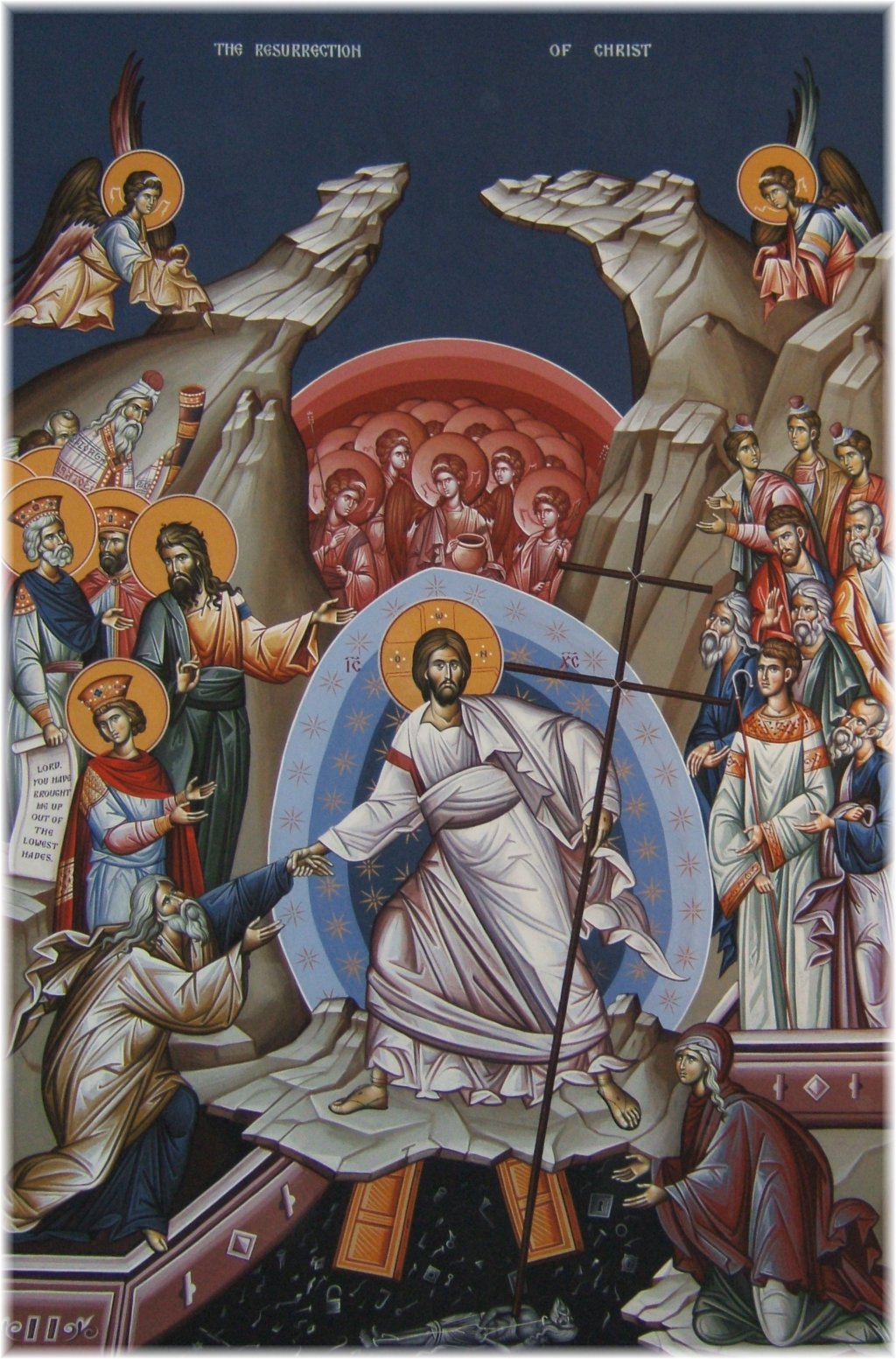
Christ is Risen! Hades is Embittered!

Christ raises Adam and Eve from their tombs in Hades, trampling on the fallen gates of the house of Death

 If any be pious and a lover of God, let him rejoice in this fair and radiant festival. If any be a faithful servant let him enter into the joy of his Lord. If any be weary with fasting,
let him now enjoy his payment. If anyone has labored from the first hour, let him receive today his just reward. If anyone has come after the third hour, let him now be thankful that the feast is at hand. If anyone has waited until after the sixth hour, let him not be anxious, no loss shall be his own.
If anyone has tarried until the ninth hour, let him draw near also, shedding all his doubts.If anyone has come only at the eleventh hour, let him not be fearful because of his delay.For the Master is bountiful and receives the last even as the first. He gives repose to him who came at the eleventh hour just as to one who labored from the first. The tardy are shown mercy and the timely are made whole.
To the one he gives, on the other he bestows. He honors the deed and praises the intention. Let all therefore enter into the joy of our Lord, (let both the first and those who came later receive their wages) let rich and poor dance with one another. You sober and you heedless celebrate the day.
You who have fasted and you who have not rejoice in this occasion. The table is full-laden let all enjoy the feast. The calf is fatted, let no one go forth hungry. Let all partake of the banquet of faith, let all partake of the riches of goodness. Let none mourn his poverty, for the kingdom stands before us.
Let none lament his failings, forgiveness has risen from the tomb.
Let none fear death, for the death of the Savior has set us free. He quenched death when it had tasted his flesh. He despoiled Hades when he descended thereto foreseeing this, Isaiah cried:
'Hades was embittered when it met you face to face.’
It was embittered for it was made void,It was embittered for it was mocked,It was embittered for it was slain,It was embittered for it was despoiled. It was embittered for it was led off in chains.It received a body and encountered God,It received earth and came face to face with heaven.It received what it saw and fell where it could not see.
Death where is thy sting,Hades where is thy victory?
Christ is risen and you are cast down,Christ is risen and the demons are fallen,Christ is risen and the angels rejoice,Christ is risen and life is made free.Christ is risen and there is none dead in the tomb.For Christ is risen from the dead as the first fruits of those that fell asleep.To him be glory and power forever and ever. Amen.
Easter Sermon of St. John Chrysostom

Christos Anesti! Alithos Anesti!

Saturday, March 30, 2013

Surrexit Christus Hodie!


Dearly beloved brethren, ye have heard the deed of the holy women which had followed the Lord; how that they brought sweet spices to His sepulchre, and, now that He was dead, having loved Him while He was yet alive, they followed Him with careful tenderness still. But the deed of these holy women doth point to somewhat which must needs be done in the holy Church. And it behoveth us well to give ear to what they did, that we may afterward consider with ourselves what we must do likewise after their ensample. We also, who believe in Him That was dead, do come to His sepulchre bearing sweet spices, when we seek the Lord with the savour of good living, and the fragrant report of good works. Those women, when they brought their spices, saw a vision of Angels, and, in sooth, those souls whose godly desires do move them to seek the Lord with the savour of good lives, do see the countrymen of our Fatherland which is above.
It behoveth us to mark what this meaneth, that they saw the Angel sitting on the right side. For what signifieth the left, but this life which now is? or the right, but life everlasting? Whence also it is written in the Song of Songs : His left hand is under my head, and His right hand doth embrace me. Since, therefore, our Redeemer had passed from the corruption of this life which now is, the Angel which told that His undying life was come, sat, as became him, on the right side. They saw him clothed in a white garment, for he was herald of the joy of this our great solemnity, and the glistering whiteness of his raiment told of the brightness of this holy Festival of ours. Of ours, said I? or of his? But if we will speak the truth, we must acknowledge that it is both his and ours. The Again-rising of our Redeemer is a Festival of gladness for us, for us it biddeth know that we shall not die for ever; and for Angels also it is a festival of gladness, for it biddeth them know that we are called to fulfill their number in heaven.
See this glad Festival then, which is both his and ours, the Angel appeared in white raiment. For as the Lord, rising again from the dead, leadeth us unto the mansions above, He. repaireth the breaches of the heavenly Fatherland. But what meaneth this, that the Angel said unto the women which came to the sepulchre : Fear not? Is it not as though he had said openly : Let them fear which love not the coming of the heavenly countrymen; let them be afraid who are so laden by fleshly lusts, that they have lost all hope ever to be joined to their company. But as for you, why fear ye, who, when ye see us, see but your fellow - countrymen? Hence also Matthew, writing of the guise of the Angel, saith : His countenance was like lightning, and His raiment white as snow. The lightning speaketh of fear and great dread, the snow of the soft brilliancy of rejoicing.
From Sermon 21 of Pope St. Gregory the Great

Happy Pascha!

Friday, March 29, 2013

Holy Saturday: Anticipation


First, let me say that contrary to many contemporary opinions the old Holy Saturday liturgy was not at the wrong time. It was at a distorted time, morning, rather than when it once would have been, around 3:00 pm or 4:00 pm, but it was never a night time liturgy. Also, it is not Easter's Mass done the day before, nor is it a midnight Mass, as at Christmas. It is a Mass and liturgy meant to help us anticipate the Resurrection. Let us see what the Church has given us.

The liturgy begins after None, the last "little hour" of the afternoon. The deacon and subdeacon still wear the folded chasubles, their penitential vestments. The clergy and laity gather outside the church, where, hopefully, someone has lit a fire. The priest, vested in violet, sings three luminously themed prayers: the first referring to the "brightness of Your Son," the second calling God the "Creator of all lights," and the third an actual blessing. This is very reminiscent of the Eastern blessing at the end of Divine Liturgy, which quotes St. James in calling God the "Father of Lights," of all that is perfect, luminous, and good.

A server ignites coals and the priest imposes and blesses incense. He sparges the Holy Fire with blessed water and then incenses it. He also blesses five grains of incense which he be inserted into the Pascal Candle, representing the light of Christ throughout Easter season, inside the church.


The deacon then changes his penitential folded chasuble for a white dalmatic and maniple. He takes a large, triple-branched candle and, lighting a new wick from the Holy Fire, enters the church exclaiming Lumen Christi—"The Light of Christ." This happens twice more until we are in the church proper.


A deacon with the triple-candle preparing to enter the church.


The deacon then petitions the priest for a blessing, approaches the Paschal Candle, which is off to the Gospel side of the altar, and sings the Exsultet, a long blessing. The Exsultet is rich with imagery of light in the night and the deliverance from Egypt. This day is the deliverance from our spiritual Egypt: Sin and Death. Part way through, the deacon inserts the five grains of incense, calling them an "evening sacrifice," and lights the Paschal Candle. The video to the left is a singing of the Exsultet at St. Peter's Basilica two years ago. I find the continued use of the prayer in the newer rites odd, given that none of the actions mentioned in the text are performed, nor is the intention any longer to bless! The prayer concludes with a petition for the Pope and the, no longer extant, Holy Roman Emperor. The lights of the church go on at the words Vere beata nox—"Oh, truly blessed night!" In the middle ages, when this ceremony took place in day light, the windows of the church would be covered in dark cloth, which would be removed at those words, washing the church in God's light after a spiritual slumber.


The deacon returns to his penitential folded-chasuble and, along with the priest and subdeacon, read twelve prophecies, which are chanted by lectors in the middle of the choir. The prophecies together form the story of salvation, both in anticipation and in prediction of Christ:
  1. Genesis 1:1-31, 2:1-2: The creation of the world by God, the ruler of all things. He sees that it is good.
  2. Genesis chapters 5-8: The Great Flood and God's commissioning of Noah to build an ark. The ark is a foreshadowing of the Church, which God gives us to protect us from the Flood of Sin.
  3. Genesis 22:1-9: Abram is about to offer his son, Isaac, but an angel intervenes. For his love of God, the Lord makes a covenant with him and renames the man Abraham.
  4. Exodus 14:24-15:1: God lets the Israelites pass through Egypt unto freedom through the Red Sea, which drowns the pursuing forces of the Pharoah. Baptism will be our watery means of passing unto freedom.
  5. Isaiah 54:17, 55:1-11: God has heard the cry of His people and will honor the promises to David.
  6. Baruch 3:9-38: God has absolute knowledge and dominion over His creation.
  7. Ezekiel 37:1-14: The bones of the fallen will rise again under the spirit of the Lord.
  8. Isaiah 4:1-6: The Lord will wash away the "filth of Jerusalem" and build a covenant.
  9. Exodus 12:1-11: God prescribes the Passover sacrifice of a lamb to the Jews, which will deliver them from God's plague over the first-borns of Egypt. They will be free. Christ is the perfect, spotless Lamb, the perfect sacrifice. He will intercede for us before the Father.
  10. Jonah 3:1-10: The prophet Jonah convinces the city of Nineveh to repent of their sins and do penance, averting their impending destruction. Penance is necessary to pay the debt of sin, not just to be forgiven.
  11. Deuteronomy 31:22-30: Moses provides for his death and the continuation of the Israelites into the promised land. This succession of leaders will continue until Christ.
  12. Daniel 3:1-24: King Nabuchodonosor attempts to kill three Jewish children for not worshiping his idols. They are thrown into a fire, but angels guard them.
In between these readings are sung various prayers and sung psalms. A procession forms and heads to the baptismal font. The priest blesses the empty font and the water in it by plunging the Paschal Candle three times. He sprinkles water towards the four points of the compass and then the faithful with Holy Water from the font, and then infuses Holy Oils into it. He proceeds to baptize and confirm any converts present in the normal manner. The procession then returns to the altar as the choir sings the Litany of Saints, doubling the invocations and answers (ex: choir: Pater de caelis, Deus, Miserere nobis people: Pater de caelis, Deus, Miserere nobis). If there is no font, everything until the Litany is excluded.


Everyone kneels for the duration of the Litany, which takes the place of the Introit of the Mass. The intention of the Litany is mainly to pray for converts, but also for the Church as a whole, as She enters the Paschal mystery. The priest, deacon, and subdeacon remove their outer vestments and prostrate themselves.


Towards the end of the Litany the priest and his ministers rise and head to the sacristy to vest in white vestments for Mass. Servers prepare the altar with the missal and put on the best, most festive frontal.


The altar candles are lit from the Paschal Candle. The ministers of Mass return and sing a normal solemn high Mass. The Gloria is the lovely Lux et Origo setting. The Epistle is from St. Paul's letter to the Colassians, in which the Apostles tells us that if we are dead with Christ, Christ will rise and us with Him.

The priest sings Alleluia for the first time in two months. Absorbed in joy, he sings it three times, each higher and each repeated by the choir. The Gospel, taken from St. Matthew's account of the myrrh-bearing women finding the empty tomb, is accented by the fact that candles are not carried in the procession, emphasizing that the Resurrection has not yet happened for us, but that we are anticipating it. 


The celebrant reads the Gospel before the deacon sings it.


As this is a vigil, the Creed is not sung. There is no verse or chant prescribed for the offertory, so the organ  is played or Latin hymns are sung.


The preface is of Easter. During the Canon of the Mass, the Communicantes prayer is unique: "Communicating, and keeping this most holy night of the Resurrection of our Lord Jesus Christ according to the flesh; and also reverencing the memory...." The Pax is not given and the Agnus Dei is omitted. This may be for two reasons: (1) the Lamb is not yet risen and with us or (2) this liturgy is so old that it pre-dates the eighth century introduction of the Agnus Dei


After communion and the cleansing of the vessels, a short Holy Saturday Vespers is sung rather than a communion chant. It is psalm 116, surrounded by a triple Alleluia. The priest begins the antiphon on the Mangificat: Vespere autem sabati....  During the Magnificat everyone is incensed as usual. The priest sings the post-communion prayer, which I have given below:
Pour forth, O Lord, we beseech thee, the Spirit of thy love into our hearts, and by thy mercy make all them to be of one mind to whom Thou hast given to eat of thy mystic Passover. Through our Lord, Jesus Christ, your Son, Who liveth and reigneth with Thee in the unity of the Holy Ghost, God for ever and ever. Amen.

The dismissal is Ite, missa est, alleluia! Alleluia. The Deo gratias response is also given a double alleluia. The priest says the Placeat, gives the blessing, and recites the Last Gospel as normal. It is traditional to end the liturgy with the Regina Coeli.
Queen of Heaven, rejoice! Alleluia!
For He Who you did merit to bear, Alleluia!
Has risen as He said, Alleluia!
Pray for us to God, Alleluia! 
These rites would end about four hours after they started. The main point of celebrating this liturgy early was so that Paschal Mattins and Lauds could start at a reasonable time. The twentieth century de-emphasis of the Divine Office saddens me. Paschal Mattins and Lauds are the most important liturgical event of the entire week, more so than any Mass or office. In these offices we formally begin the celebration of the Resurrection. In Eastern Churches the people wander the church looking for Christ, but not finding Him! He is risen! They then sing Mattins and Lauds at midnight, followed by Divine Liturgy. The Divine Liturgy is of Easter Sunday, it is not a vigil nor is it a midnight Mass, as we have on Christmas. The reformers lost this critical difference and canned the most important office of the year in the process.

In the West there would be a Resurrection ceremony, which would find the sepulcher created on Good Friday empty, the crucifix would be adored again as on Good Friday, and Mattins and Lauds would be sung. Mattins has one nocturn, with lesson from a sermon of Pope St. Gregory the Great, in which the saintly pontiff says we, the Church, must come to Christ's tomb bearing gifts like the women if we are to be surprised and rejoice. The Te Deum is sung de tempore for the first time in two months. At Lauds, the first antiphon declares that an angel descended from heaven to roll back the stone. The antiphons for this Lauds are among the most beautiful of the year. There is no hymn at Mattins or Lauds. The dismissal has a double Alleluia, as at Mass. The office ends with the Regina Coeli again. Easter has begun at this point.

Good Friday: Mass of the Pre-Sanctified

I will endeavor to give a very brief explanation of the old, pre-1956, Good Friday "Mass of the Pre-Sanctified." The name is such because the structure, vestments, music, and prayers of this services, particularly towards the end, follow the structure of a Mass, although using a Host consecrated at yesterday's Mandy Thursday Mass.


The priest and his two deacons, who wear folded chasubles rather than dalmatics, prostrate themselves before the altar for enough time to pray psalm 50, the Miserere, in silence, while servers spread a cloth on the altar. Like at Mass, the crucifix and candles remain on the altar, though unlit.


A lector sings a prophecy of the prophet Osee (or Hosea, in the Hebrew spelling), which foretells the suffering, burial, and third day rising of Christ. Then the subdeacon sings chapter 12 of the book of Exodus, which recounts the manner in which the finest lambs were killed during the first Passover in Egypt. This sacrifice liberated the Israelites from the bondage of the Pharoah. The sacrifice of the perfect victim, Christ, liberated the world from the bondage of death. God does not want a sacrifice because He wants things to be destroyed. A true sacrifice is the gift of what is precious to one's self unto another. This was the intent of the Israelites in Egypt, and more so on the Cross. A tract, psalm 139, is sung: Eripe me Domine ab homine malo—"Deliver me, Oh Lord, from the wicked man!"


Three deacons then sing the Passion of our Lord Jesus Christ according to St. John, beginning with His arrest in the Garden and ending just after His death on the Cross. The deacon of the "Mass" removes his folded chasuble, as at Mass, and sings the burial of Christ as the Gospel, suggesting that this, not the general narrative, is the most important text of the day.


Priest and subdeacon listen to the Passion.


Then deacon, now wearing the "broad stole," returns to the other ministers. Returning to the epistle corner, the priest sings the Solemn Collects, some of the oldest continuously used prayers in the Church. Moreover, these prayers give us some indication as to what the structure of the Mass was like in the mid-first millennium and for what those Christians prayed. There is a preface to announce the prayer intention, followed by Oremus—"let us pray," Flectamus genua—"Let us kneel," and Levate—"Let us stand" before the actual prayer itself.


The prayer intentions were:
  • For the welfare of the Church universal
  • For the Pope
  • For the clergy, people in religious life, virgins, and widows
  • For the enlightenment of the catechumens and the remission of their sins
  • For the cleansing of the world of errors
  • For the rescue of heretics and schismatics
  • For the conversion of the Jews
  • For the end of idolatry and conversion of the pagans
No genuflection was made during the prayer for the Jews. A genuflection was added by Pope John XXIII in the revised rite of Holy Week in 1959, although John XXIII seems to have continued to celebrate the old Good Friday in the Sistine Chapel!


The ministers, probably for mobility in ancient times, remove their outer-most vestments and the deacon retrieves the veiled crucifix from the altar and gives it to the priest. The priest, beginning at the bottom of the epistle side, steps higher and towards the center of the altar, unveiling part of the crucifix and singing Ecce lignum crucis—"Behold the wood of the cross"—as he rises. The people respond In quo salus mundi pependit. Venite, adoremus!—"On which hung the salvation of the world. Come, let us adore!"

This happens three times, after which the entire crucifix is visible. It is then laid upon a pillow or cloth and adored by the people. First the priest, then the ministers of the service, then any other present clergy, and the servers. They all adore barefoot. Then the congregation adores, making three prostrations before their kiss of the cross.


Although the Mass of the Pre-Sanctified supposedly died in 1956 under Pope Pius XII, John XXIII continued to use it in the Sistine Chapel, as seen in this 1959 celebration.


Ecce lingum crucis, in quo salus mundi pependit.


Venite, adoremus!


Whilst the laity make their adoration, the altar is prepared for the Mass of the Pre-Sanctified and the choir sings the Reproaches, which includes the Trisagion.

The crucifix is then placed upon the altar, where it would normally go, and is reverenced with a genuflection for the rest of the day.


The clergy, and laity if they wish, process to the altar of repose, where the Blessed Sacrament has been over night.


The Sacrament is then incensed by the priest, who assumes the hummeral veil and takes the Sacrament back to the main altar.


This is a full Blessed Sacrament procession, with incense and the processional cross carried before the priest and the Sacrament. The great hymn Vexilla Regis is sung.


The procession returns to the main altar.


The deacon arranges the chalice and its veil, containing the Sacrament, as it would be at Mass.


The Blessed Sacrament is then incensed by the celebrant.


The subdeacon prepares the chalice with wine and water, as he would at Mass and the "Gifts" are incensed in the same way they would have been at a regular Mass. The priest turns to the people and says the Orate, fratres... ("Pray, brethren, that my sacrifice and yours....) as at Mass.

One English friend of mine always insisted that the Mass of the Pre-Sanctified is indeed an actual Mass. He had something of a point. Its prayers are those of a Mass. It is not a simple communion service. Although there is no consecration of the Host, the actions imitate those of a Mass in order to emphasize the relation between the Mass and Calvary, that they are one and the same sacrifice of Christ.


The celebrant then sings the Pater Noster, "Our Father," and elevates the Host for public adoration as he would after consecration at Mass. He then fractures the Host as at Mass and mingles a fragment of the Blessed Sacrament with wine. Liturgical reformers particularly disliked the pious medieval belief that the fragment consecrated the wine into the blood of Christ (which Eastern Catholics and Eastern Orthodox still believe).


The priest then says the communion prayers of Mass and consumes the Host as normal. He consumes the chalice's contents saying nothing, leaving some mystery as to whether consecration occurred or not!

The priest purifies his fingers and the subdeacon cleans the chalice as normal at Mass.

Vespers, the same as yesterday except for the addition of mortem autem crucis ("even unto death on a cross") to versicle, are chanted in a monotone immediately.

The clergy then leave in silence.

This marvelous rite was replaced with a general communion services. The revised rites, from 1956 until 1969, involved a maddening three changes of vestments. Prayers and readings, in both the 1956 rite and the Pauline rite, take place at the chair, the altar, at a podium, and any where else you can find. Odd.

A blessed Good Friday to you all.